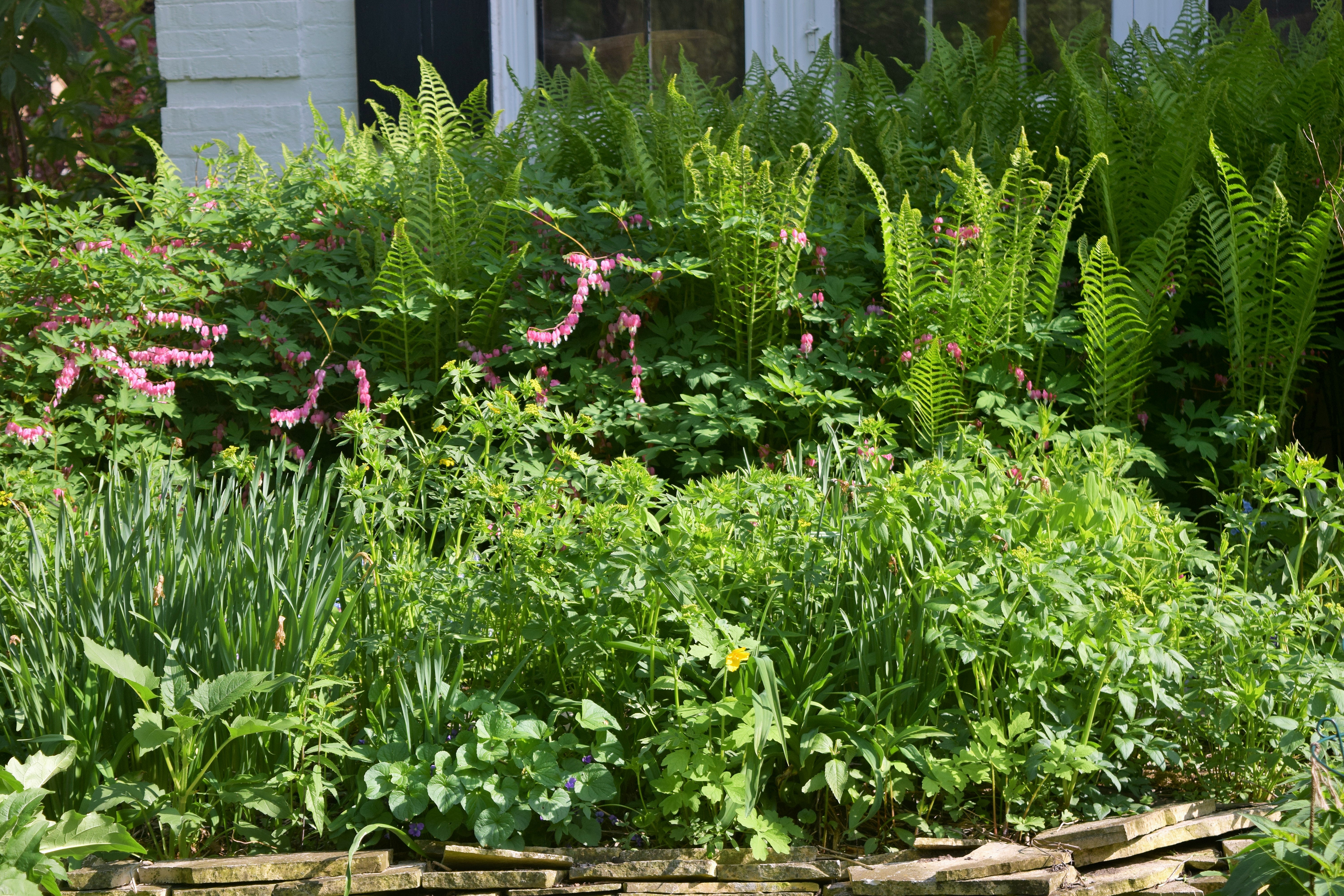
A few years ago I removed the foundation planting of yews that were in front of my house and replaced them with Ostrich Ferns (Matteuccia struthiopteris). Overall, I have been happy with the switch, though it leaves the front of the house bare for several months of the year.
A foundation planting of Ostrich Ferns.
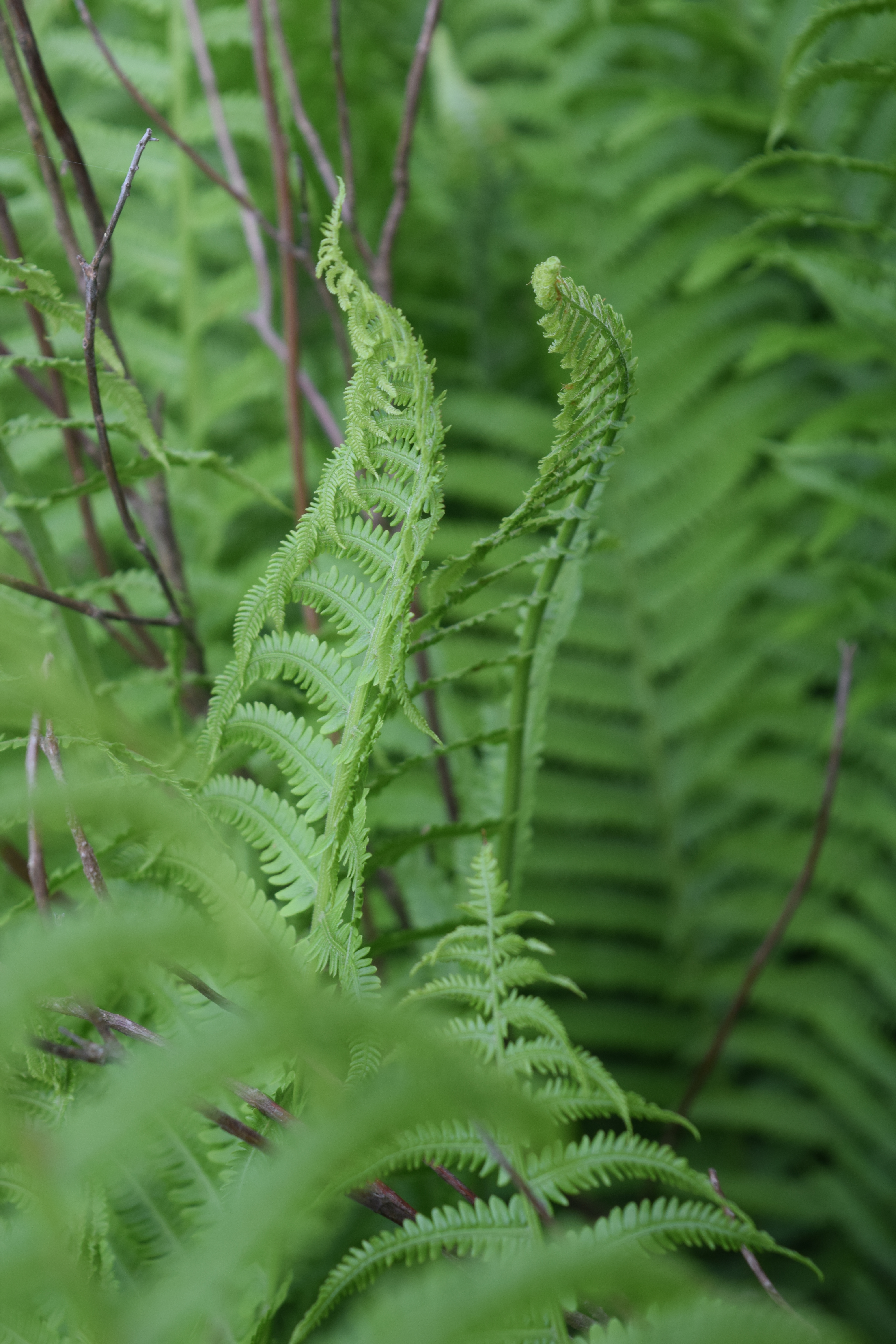
Right about now the Ostrich Ferns have completed unfurling. They stand nearly 4 feet tall, and they will keep stretching upward for a while yet.
Ostrich ferns: strrrreetch!
They are majestic plants, but I always wondered why they were named after ostriches, because honestly I don’t see the resemblance. Well, it turns out that the species name struthiopteris comes from the Greek struthio for ostrich and pterion for wing. So, “ostrich wing”. Although, frankly, I still don’t see it.
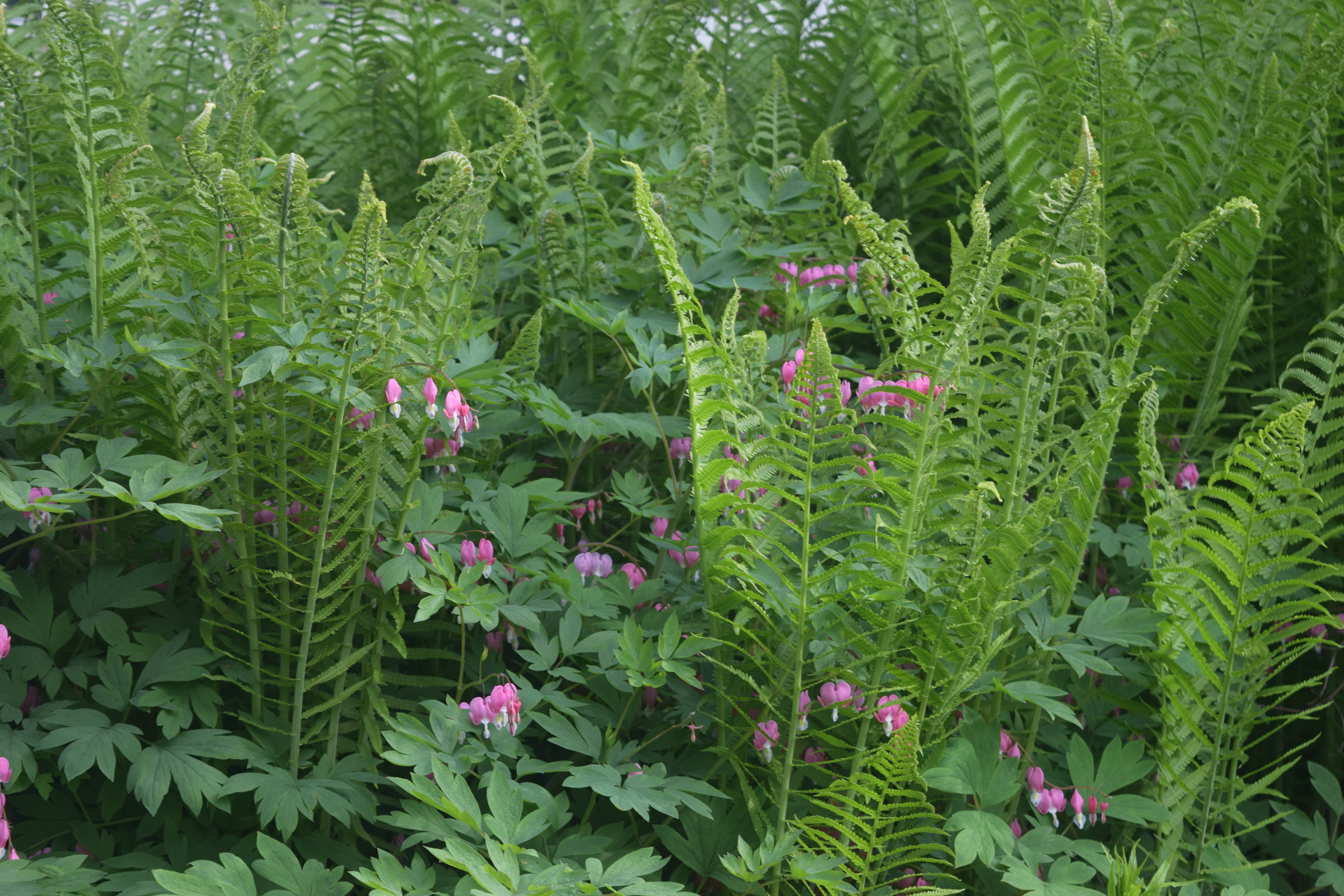
Ostrich Fern and Bleeding Heart
Our Ostrich Ferns are quite happy growing up against the north side of the house, where it’s moist and shady. They make a pretty good background plant for the Bleeding Heart (Lamprocapnos spectabilis) and others growing further out from the wall.
If Ostrich Ferns had elbows I would say they were elbowing their way to the front of the Bleeding Hearts.
I say “pretty good” because Ostrich fern definitely has expansionist tendencies, and is a bit disgruntled with its role as a background plant. It’s sending rhizomes out to establish beachheads among and in front of the Bleeding Hearts. After the Bleeding Hearts are done blooming I will have to get my shovel and carry out a containment operation.
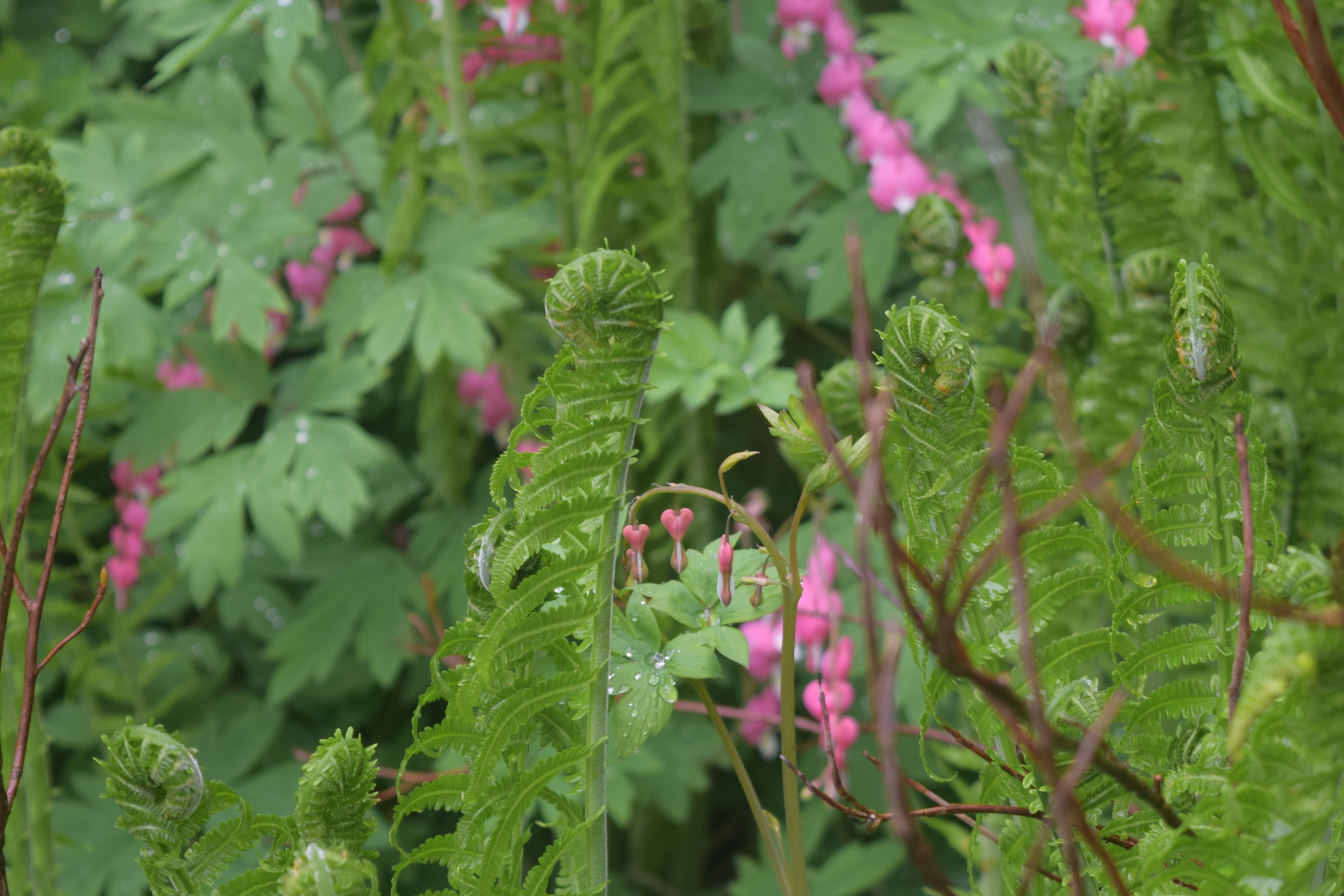
Cinnamon Ferns with Virginia Bluebell on a rainy Sunday.
We have other ferns in the garden: Lady Ferns (Athyrium filix-femina) and (I think) Cinnamon Ferns (Osmunda cinnamomea). In fact, I will close with the above photo of Cinnamon Ferns with Virginia Bluebells (Mertensia virginica) that Judy took this past Sunday.
I’m linking this post to Foliage Follow-Up, hosted by Pam at Digging. Check out the foliage featured by other garden bloggers.
Happy Garden Bloggers’ Bloom Day! For those of you who don’t know, GBBD occurs on the 15th of every month, giving garden bloggers everywhere an opportunity to show off their best blooms of the moment. It is hosted by Carol of May Dreams Gardens.
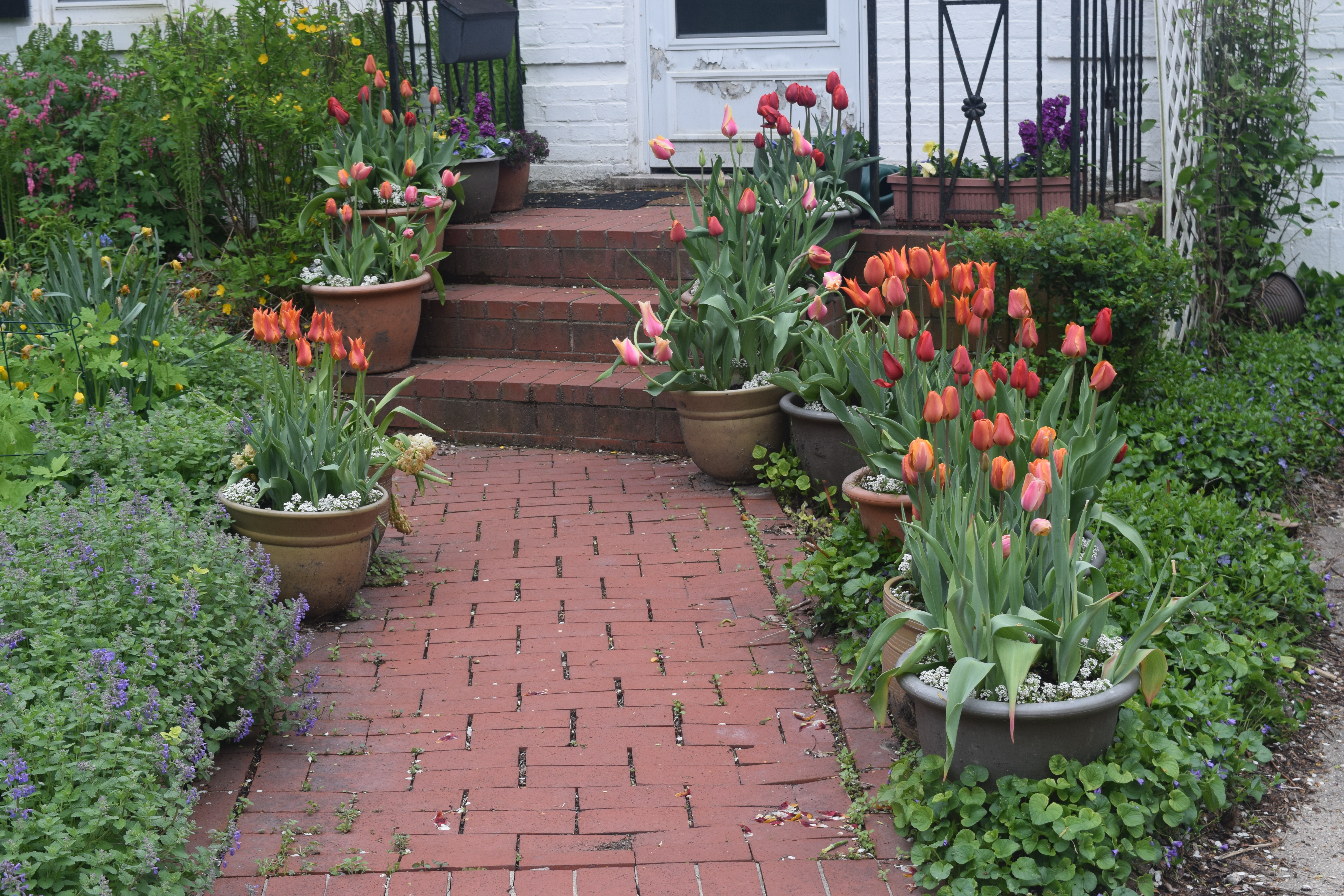
Happy container tulips greet visitors at the front walk.
The timing of May’s GBBD is very fortuitous as it occurs at the peak of the tulip season.
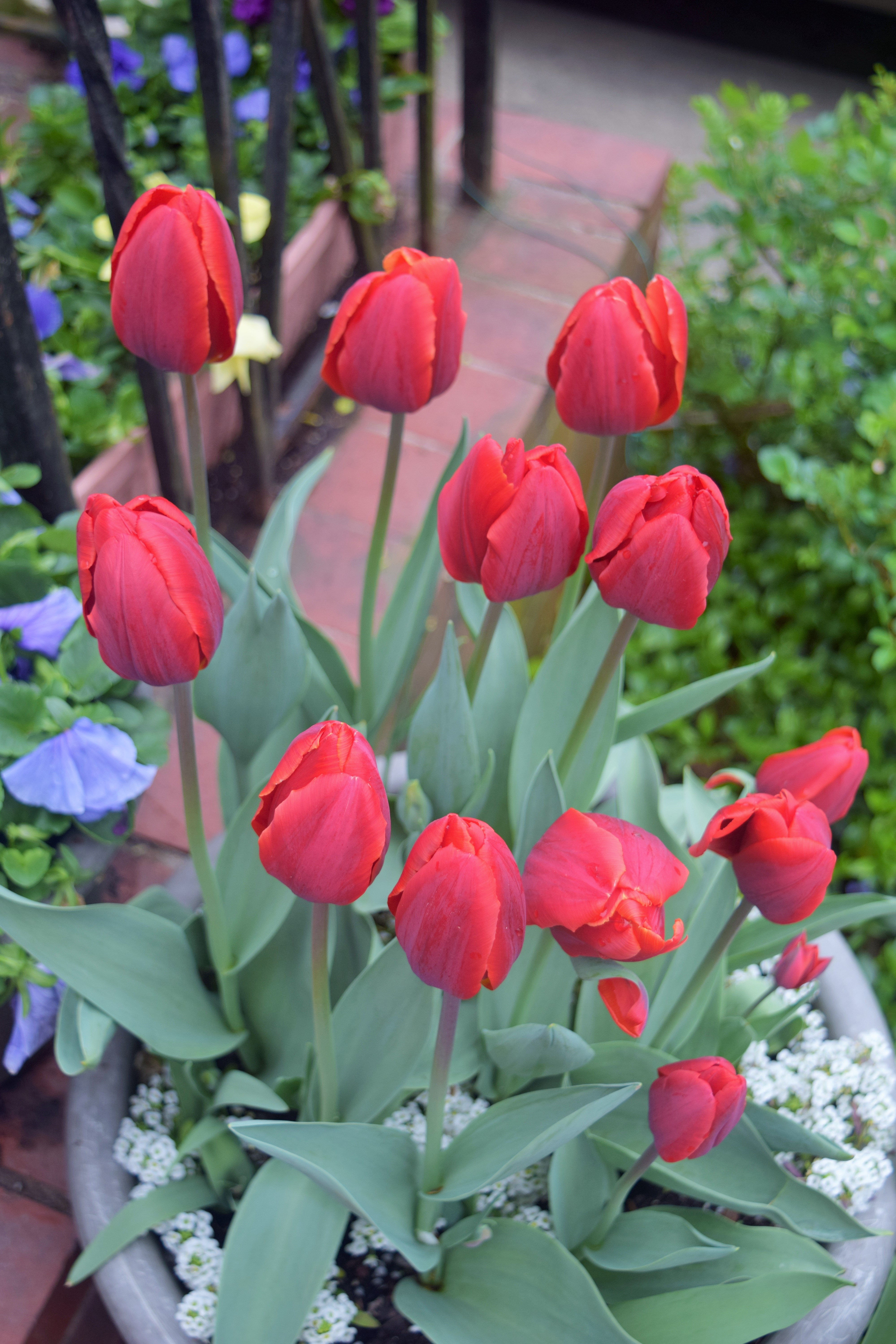
A closer look at the container tulips.
This seems to have been an excellent year for tulips and spring bulbs generally, due in part to the cool weather and generous rainfall.
‘Princess Irene’ is still going strong.
Mid-season tulips are lasting later into the late season, and late season bulbs seem especially luscious.
Tulip ‘Couleur Cardinal’
‘Couleur Cardinal’ has been looking great for weeks.
‘Ballerina’
The same is true for ‘Ballerina’.
‘Annie Schilder’ with ‘Princess Irene’
And ‘Annie Schilder’.
‘Kingsblood’
‘Kingsblood’ is a later-season tulip that has more recently joined the party.
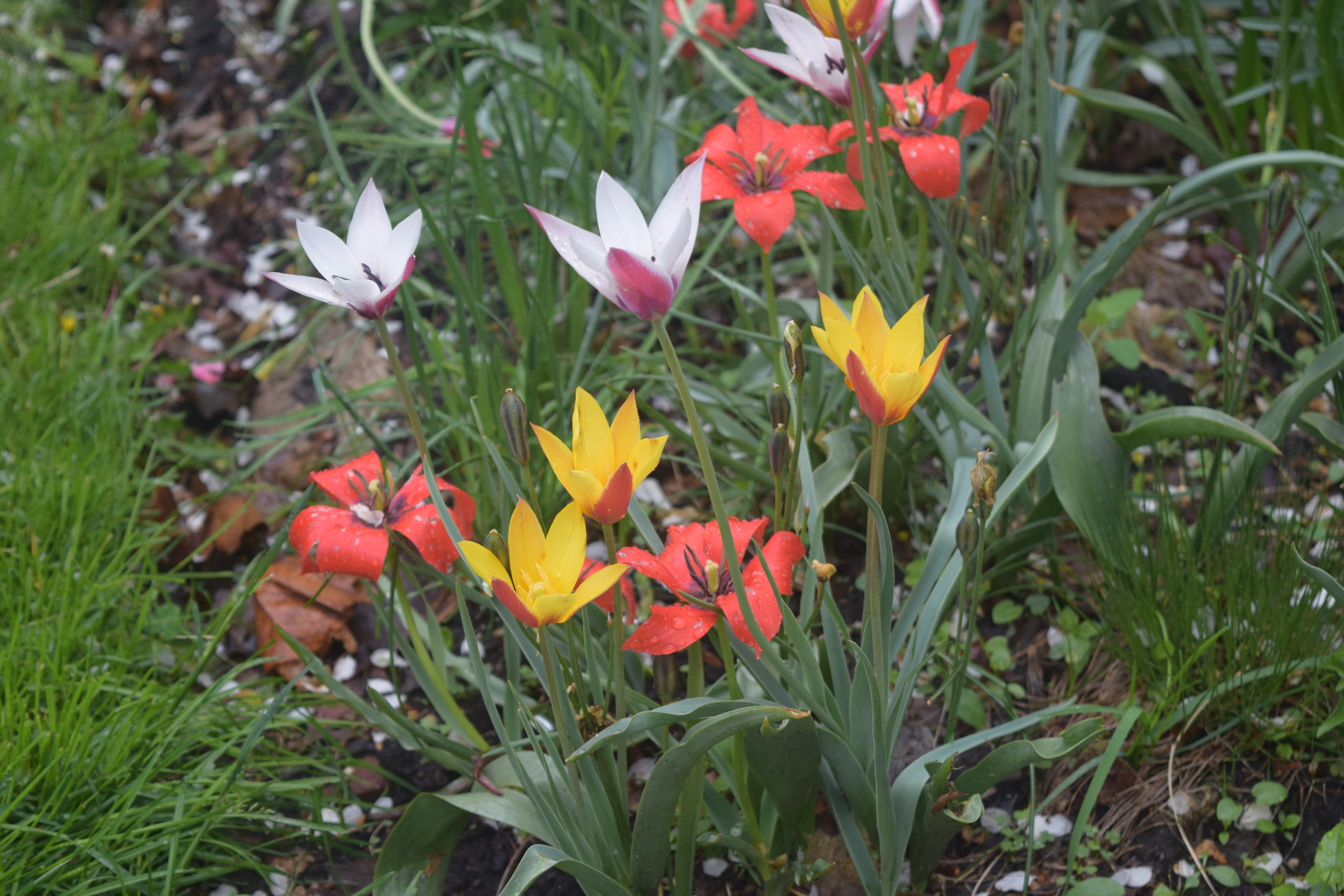
Tulipa ‘Chrysantha’ (yellow), ‘Lady Jane’ (white), and ‘Red Gem’.
As for late season species tulips, I have discovered that my friends at John Scheeper’s have made an unusual (for them) shipping error. But I’m not complaining!
You may recall I ordered T. clusiana ‘Chrysantha’ and ‘Tubergen’s Gem’. However, it seems that instead of the latter, I received T. clusiana ‘Lady Jane’ instead.
Tulips ‘Lady Jane’ and ‘Chrysantha’
It turns out, though, that ‘Chrysantha’ and ‘Lady Jane’ are excellent partners. ‘Lady Jane’ has a candy cane color scheme, with a creamy white interior that goes well with the rose and golden yellow of ‘Chrysantha’. ‘Lady Jane’ is also a bit taller and starts blooming a little later. Also taking part, though a bit faded, is T. batalinii ‘Red Gem’.
There are three Tulip varieties I wouldn’t try again: ‘Elegant Lady’, ‘Blushing Lady’, and ‘Salmon Pearl’ – all have colors that are too soft to mix with the powerful reds, oranges, and yellows that predominate among my tulip plantings. Also, ‘Elegant Lady’ has very long stems that seem to require staking.
Bleeding HeartWhite Bleeding Heart
If the tulips have a co-star, it is the Bleeding Heart (Lamprocapnos spectabilis), pink and white.
But let’s tear ourselves away from the tulips and check out the other blooms at our place.
Peony ‘America’
‘America’, our earliest Peony, has just started to bloom in the back garden.
Red Trllium with a dash of Virginia Bluebell
Also in the back garden, the Red Trillium (Trillium recurvatum) has begun to flower as the Virginia Bluebells (Mertensia virginica) begin to fade.
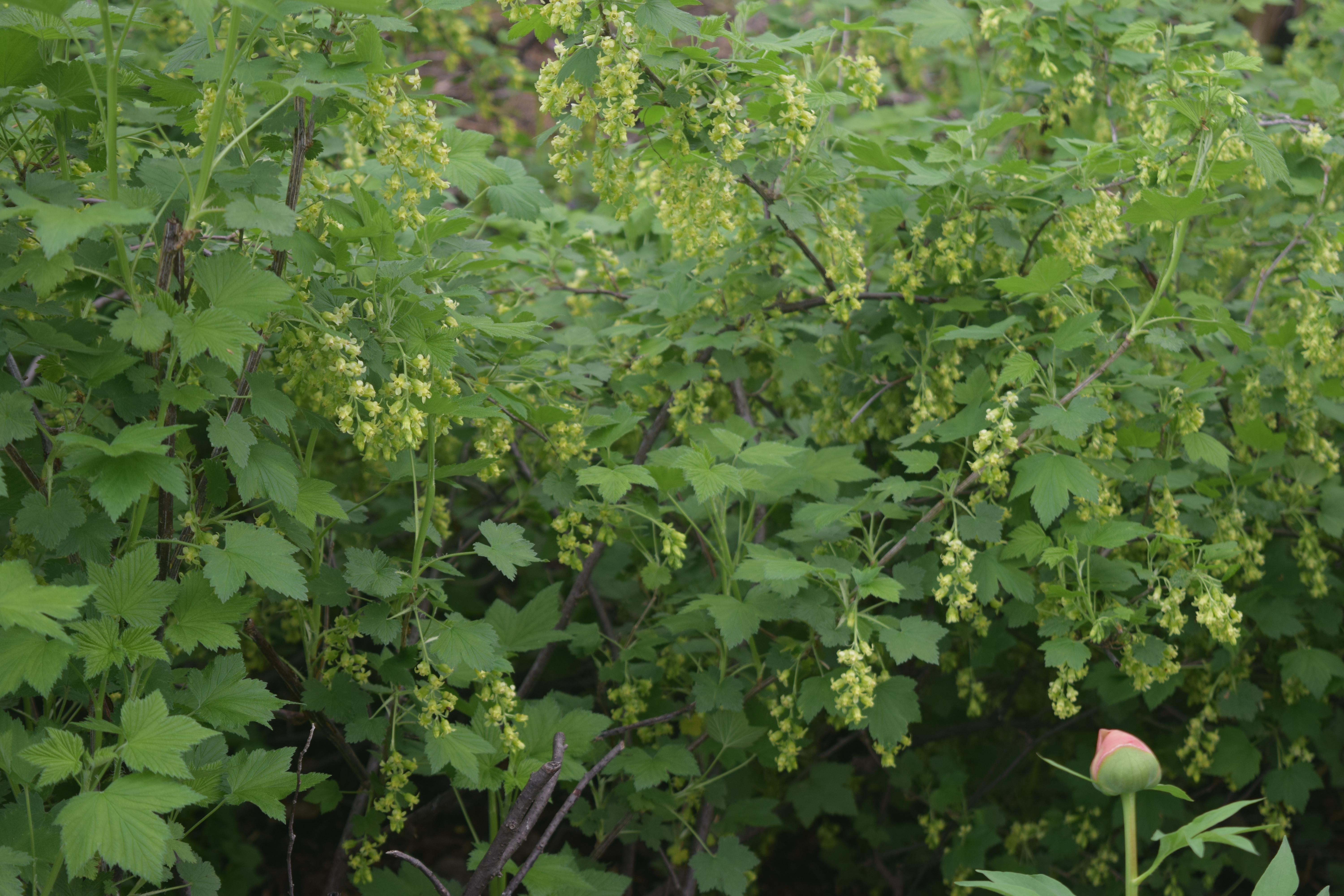
Wild Currant
The dangling chartreuse flowers of Wild Currant (Ribes americanum) have made their appearance.
Flowering containers on the back patio.
If they’re not full of tulips, the containers are full of pansies (Viola tricolor or V. x wittrockiana), Sweet Alyssum (Lobularia maritima), and Stock (Matthiola incana).
Prairie Smoke
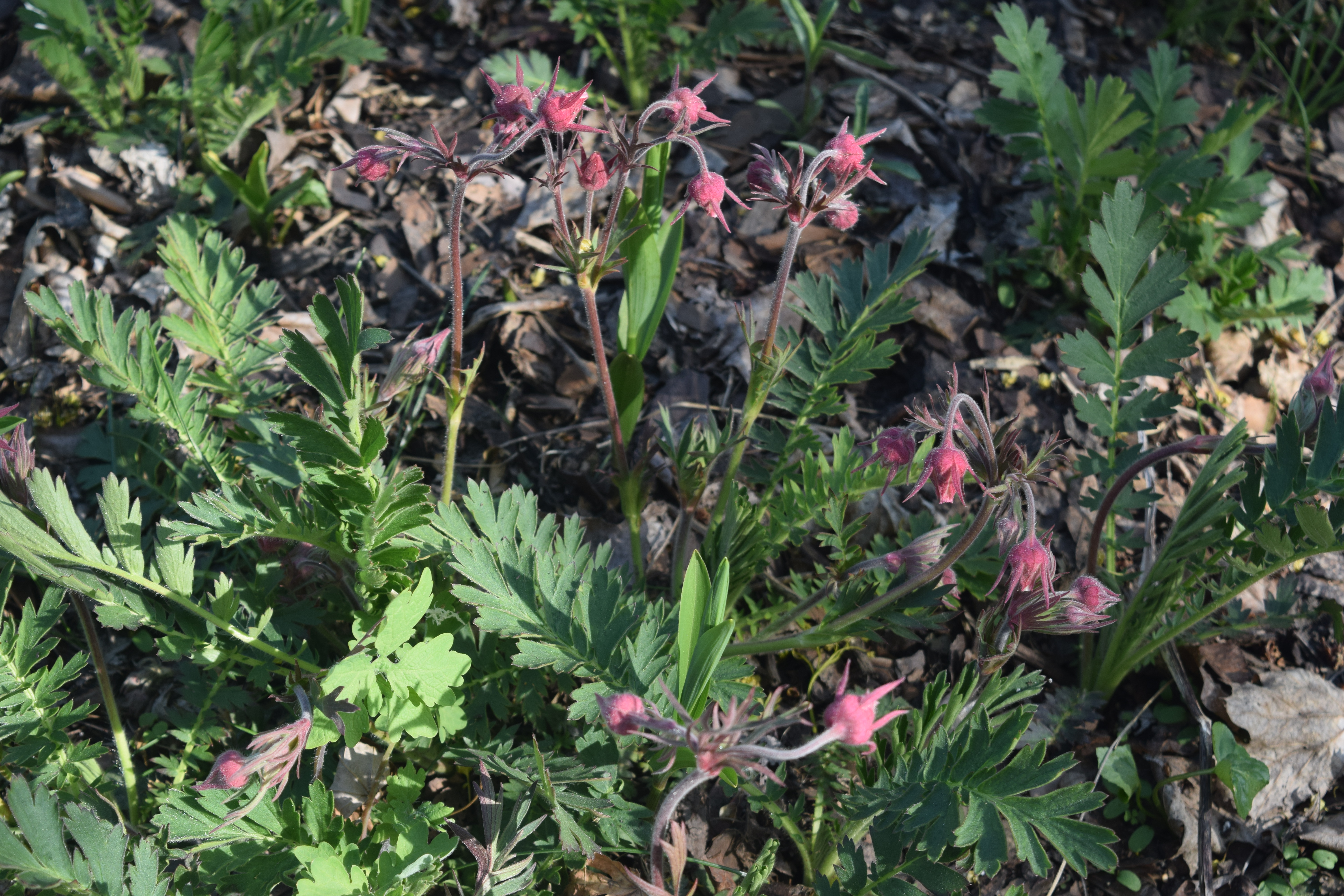
In the front garden, the Prairie Smoke (Geum triflorum) continue blooming. The flowers are nice, but it’s the seedheads that are really special and give this plant its common name.
‘Donald Wyman’ crabapple blossoms.
Sadly, we never got a picture of our ‘Donald Wyman’ crab at its peak this year, but there are still a few blossoms that have not been knocked off by the rain.
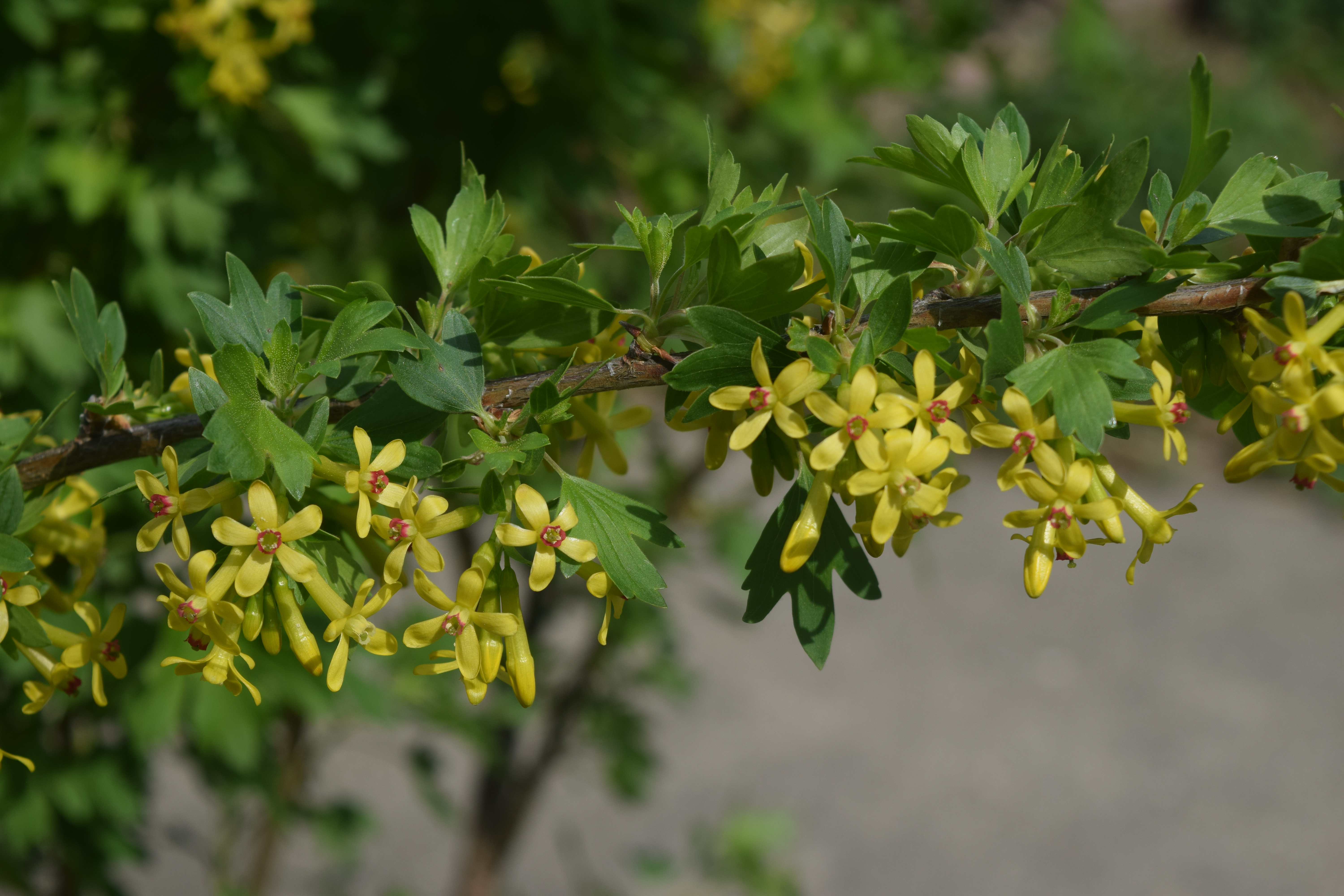
Clove Currant
Finally, this has been a great year for blooms on the Clove Currant (Ribes odoratum), which I have placed right next to the sidewalk so anyone can enjoy its spicy-sweet scent.
What are your favorite blooms in the garden right now?
According to All About Birds, the website of the Cornell Lab of Ornithology, Indigo Buntings are common. That has not been our experience, however.
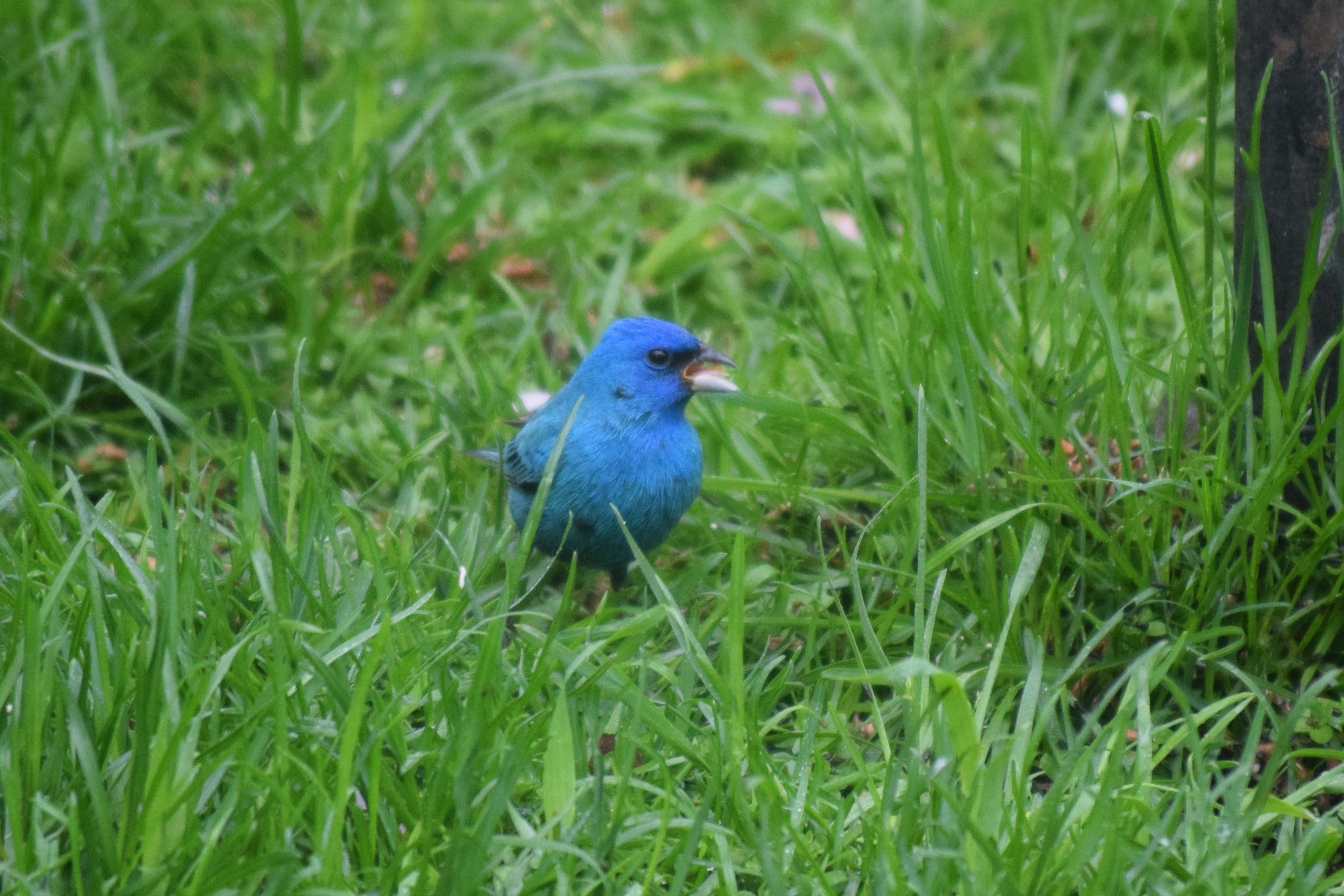
Indigo Bunting in the back garden last Sunday.
Maybe three years ago Judy and I saw an indigo bunting foraging for seeds in the back garden. These are small birds, about the size of a sparrow or goldfinch, but what they lack in size they make up for with the most amazing electric blue color.
Three years ago: Indigo Bunting, or tiny blue Sasquatch.
Judy grabbed her camera and got a single shot that was so fuzzy the bunting could have been a tiny blue Sasquatch. It was a tantalizingly brief visit, and ever since then we have been yearning for the Indigo Bunting to return.
To attract Indigo Buntings, let your flowers sow their seeds all around the lawn. Hedges and brushy or weedy areas are a plus, but neat weedless lawns are a turnoff. I’ve been spreading white millet on the ground, and you can also tempt them with thistle and nyjer seed (not surprising, since they are just small finches with a terrific sense of fashion).
If you have other birds ground feeding in your garden you are more likely to attract Indigo Buntings, who will want to get in on the grub.
Indigo Bunting
Anyhow, on Mother’s Day an Indigo Bunting appeared in the back garden. He made himself at home and stayed for the whole day, allowing Judy to get a decent number of pictures. Their color is so outlandish and unusual I can’t help but think they are completely out of place in a Midwestern suburban garden.
Indigo Bunting
I hope this one Indigo Bunting brings his friends and that they all stay a good while. But if we never see him again, he did make an outstanding Mother’s Day present.
Right around May 1 they return from winters spent in southern Mexico, Central America, and the Caribbean. (If only I could spend my winters there.)
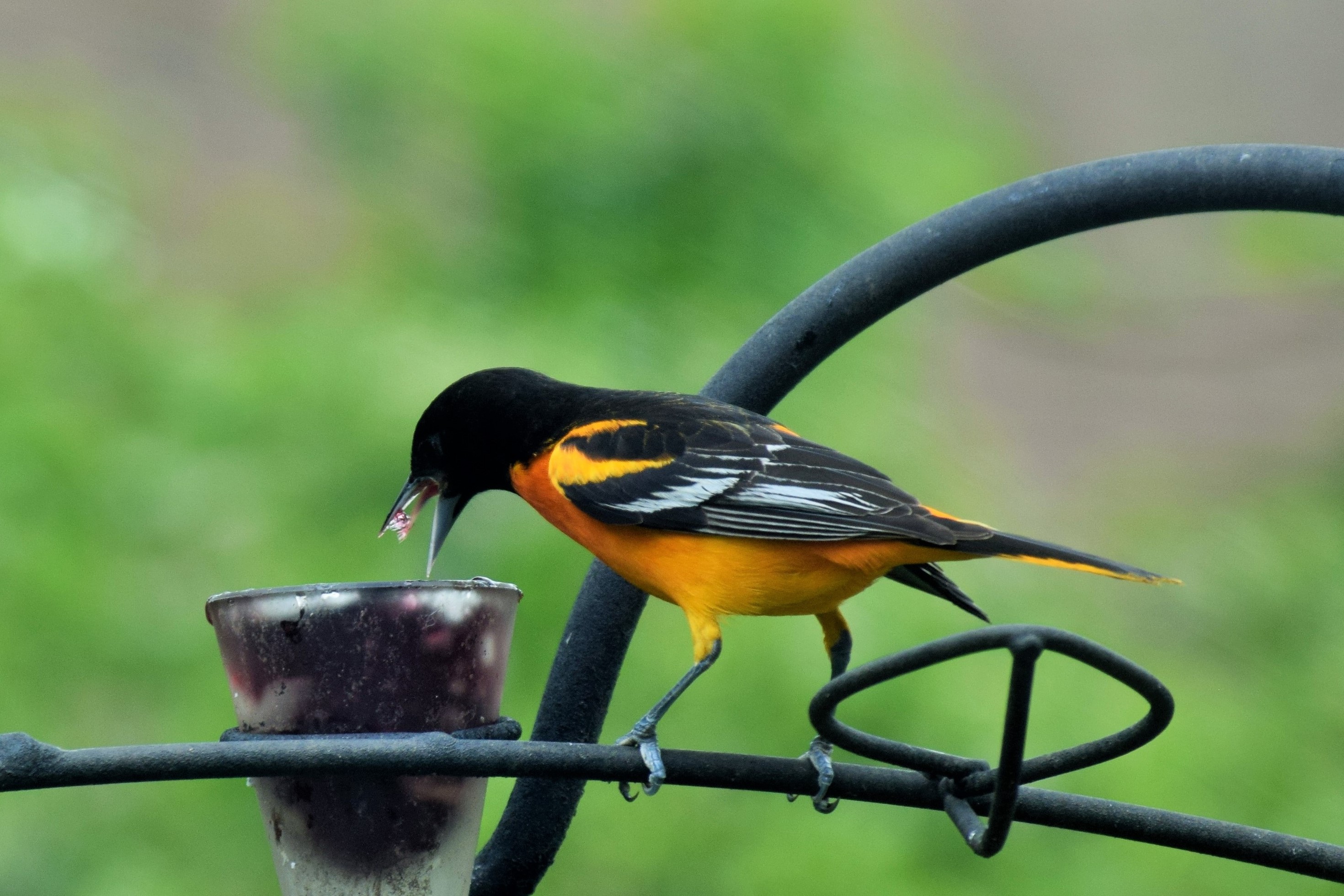
Male Baltimore Oriole
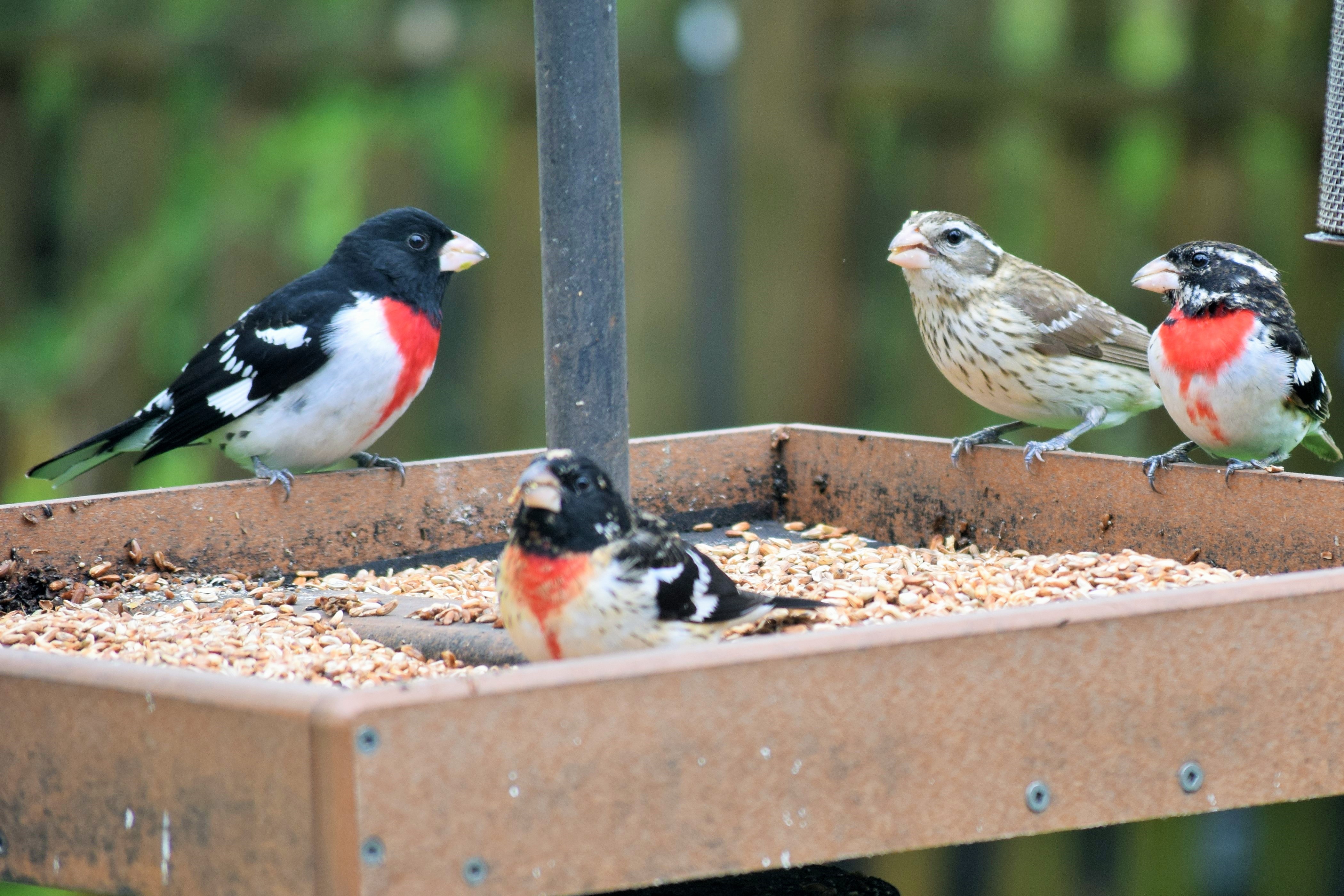
Of all the migrating birds that return from the tropics, my favorites are probably the Baltimore Orioles and Rose Breasted Grosbeaks.
Rose Breasted Grosbeaks: 2 males, one female.
In late April I start putting out grape jelly and oranges for the Orioles, safflower seeds for the Grosbeaks.
I maintained an anxious watch on the feeders, but by May 4th there had been no appearances. Then I had to go out of town. The morning after I returned, however, there they were: the Orioles with their striking plumage of black and bright orange, the Grosbeaks wearing red chevrons on their chests (suitable, I always thought, for superheroes).
Female Baltimore Oriole, with a beak full of jelly
Once they arrive, the Baltimore Orioles will visit the feeders all summer. Their normal diet consists of fruit and insects, and they prefer to spend most of their times up in the treetops.
Male Baltimore Oriole ready to snarf down some jelly.
Jelly and colorful ripe fruit (oranges, but also cherries and grapes) will tempt them into making appearances at lower elevations, however.
The song of Baltimore Orioles has a certain fullness to it, but they chatter sometimes as well. Here’s a link to what they sound like.
Rose Breasted Grosbeaks
Rose Breasted Grosbeaks visit feeders for only a few weeks in May. They like sunflower, safflower, and peanuts – though I notice at our feeder that they have also developed a taste for jelly.
The males look like they are wearing dark suits and starched white shirts with a bright red tie.
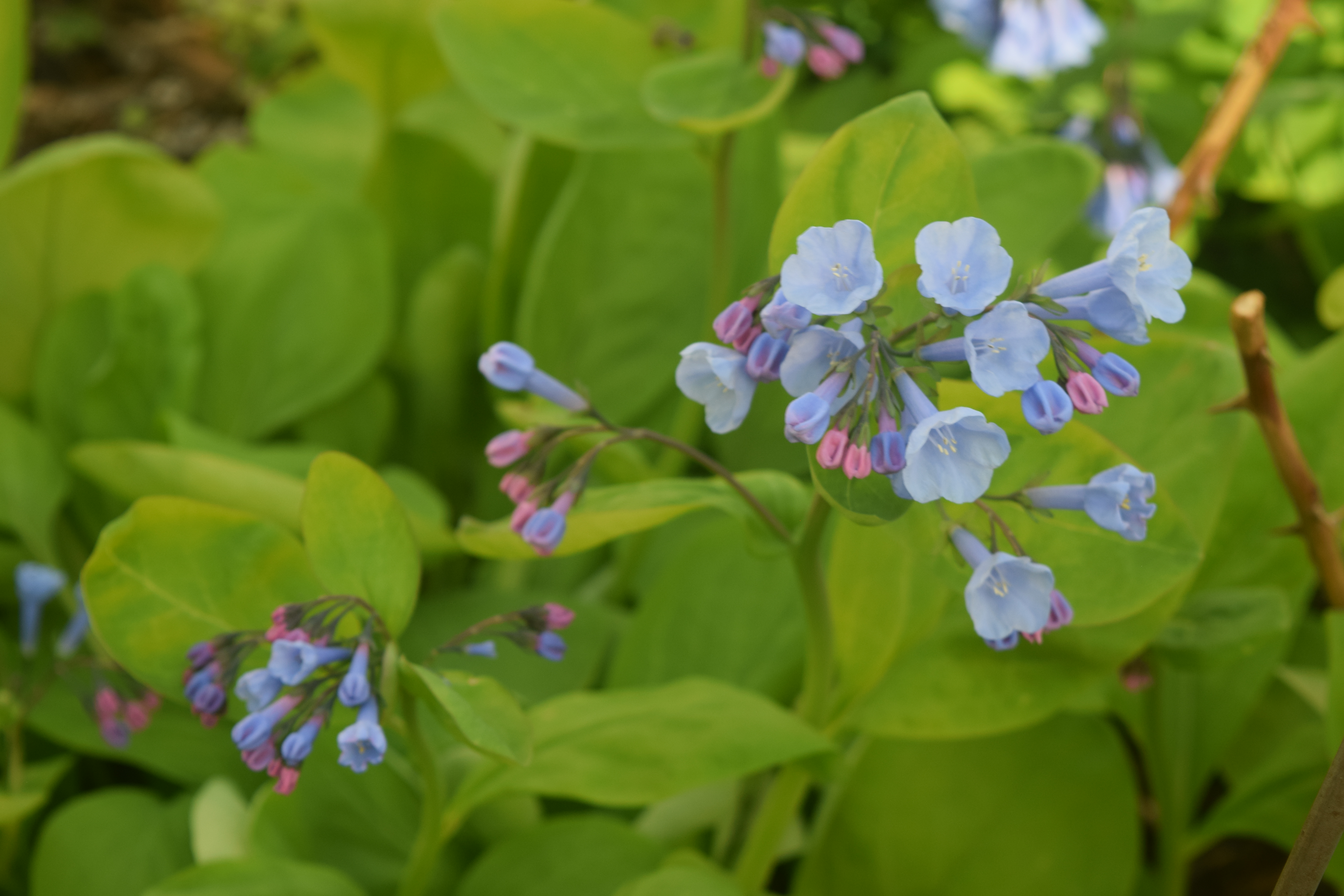
Virginia Bluebells (Mertensia virginica) are a widely loved wildflower.
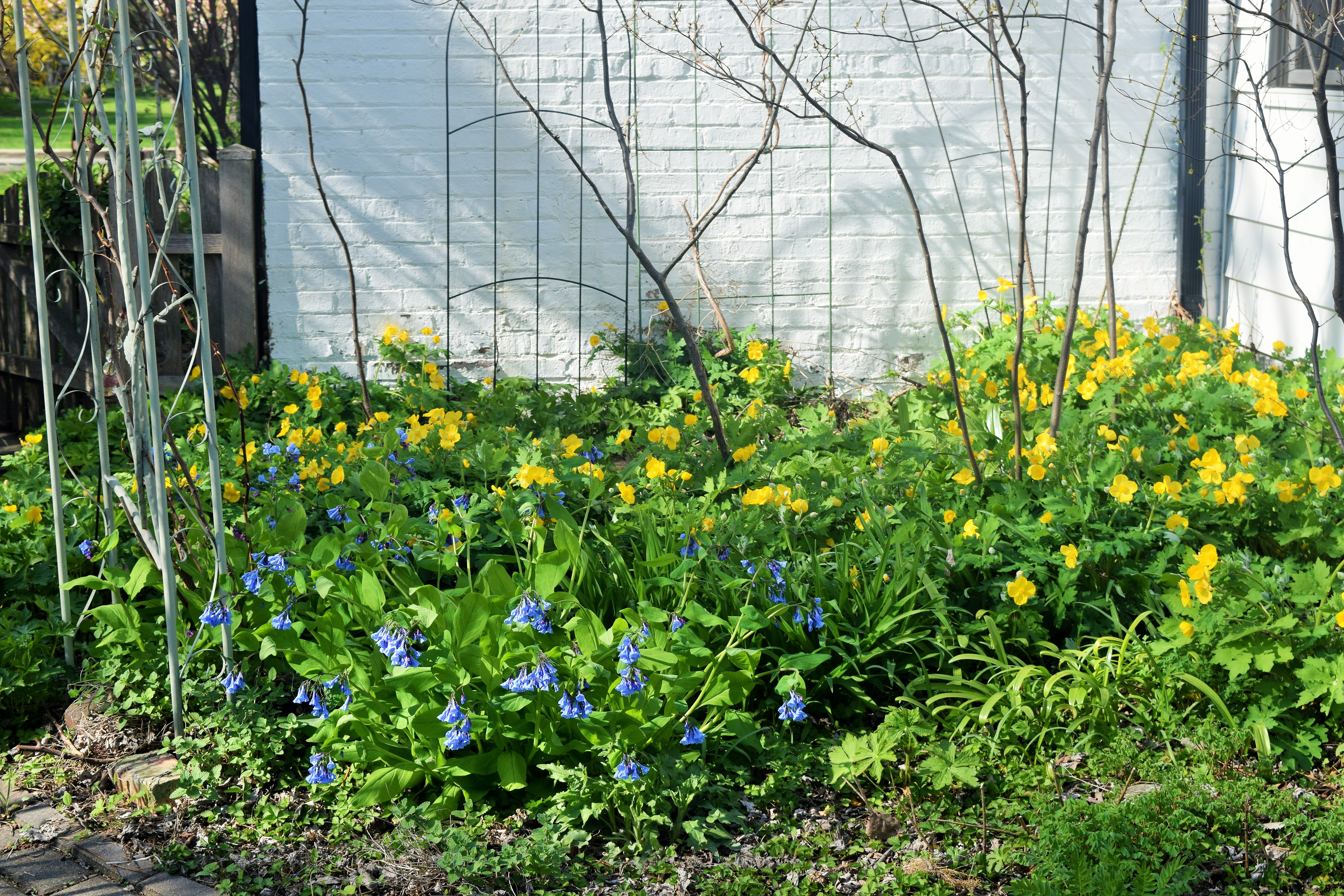
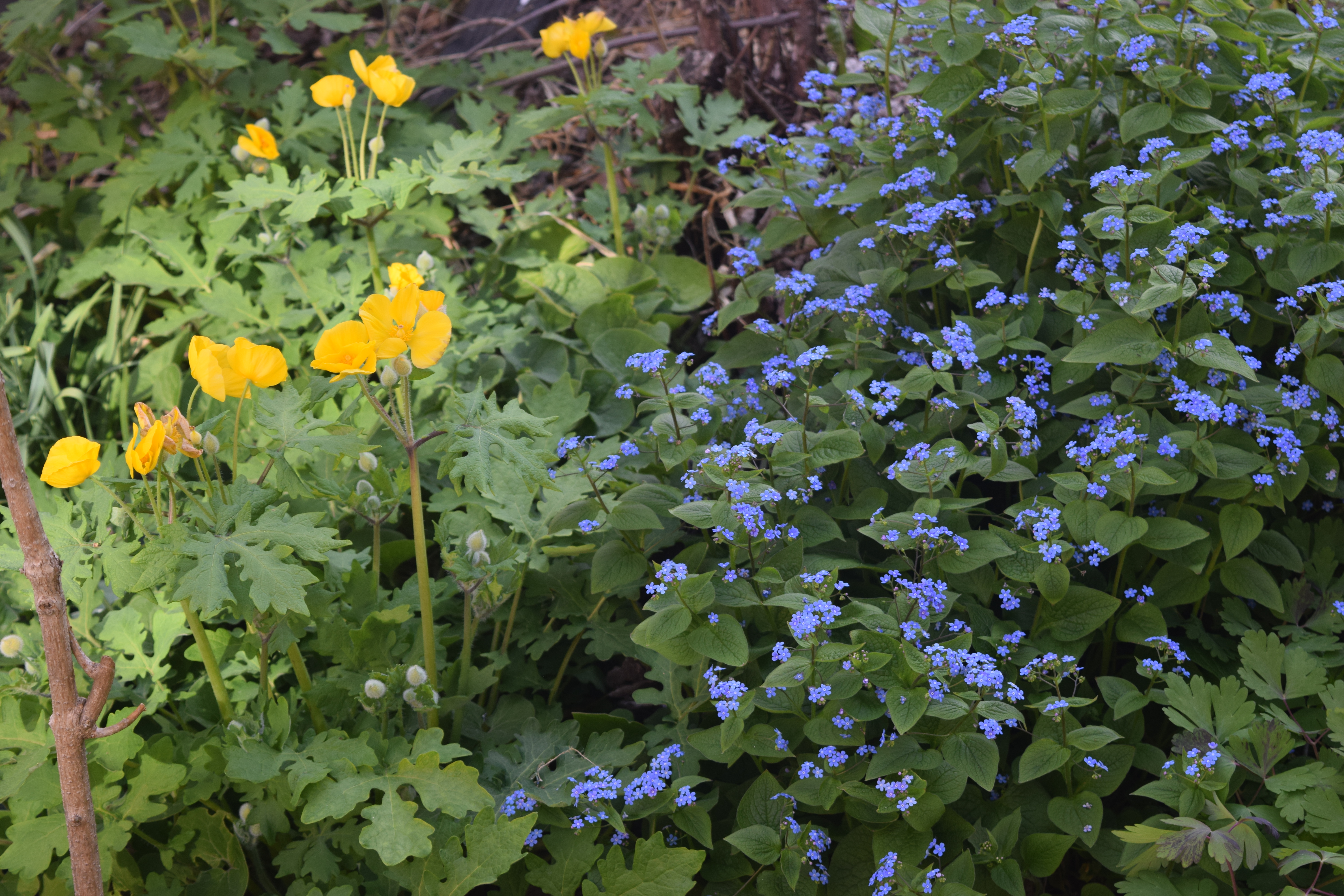
A mass of Celandine Poppies provide a backdrop for Virginia Bluebells.
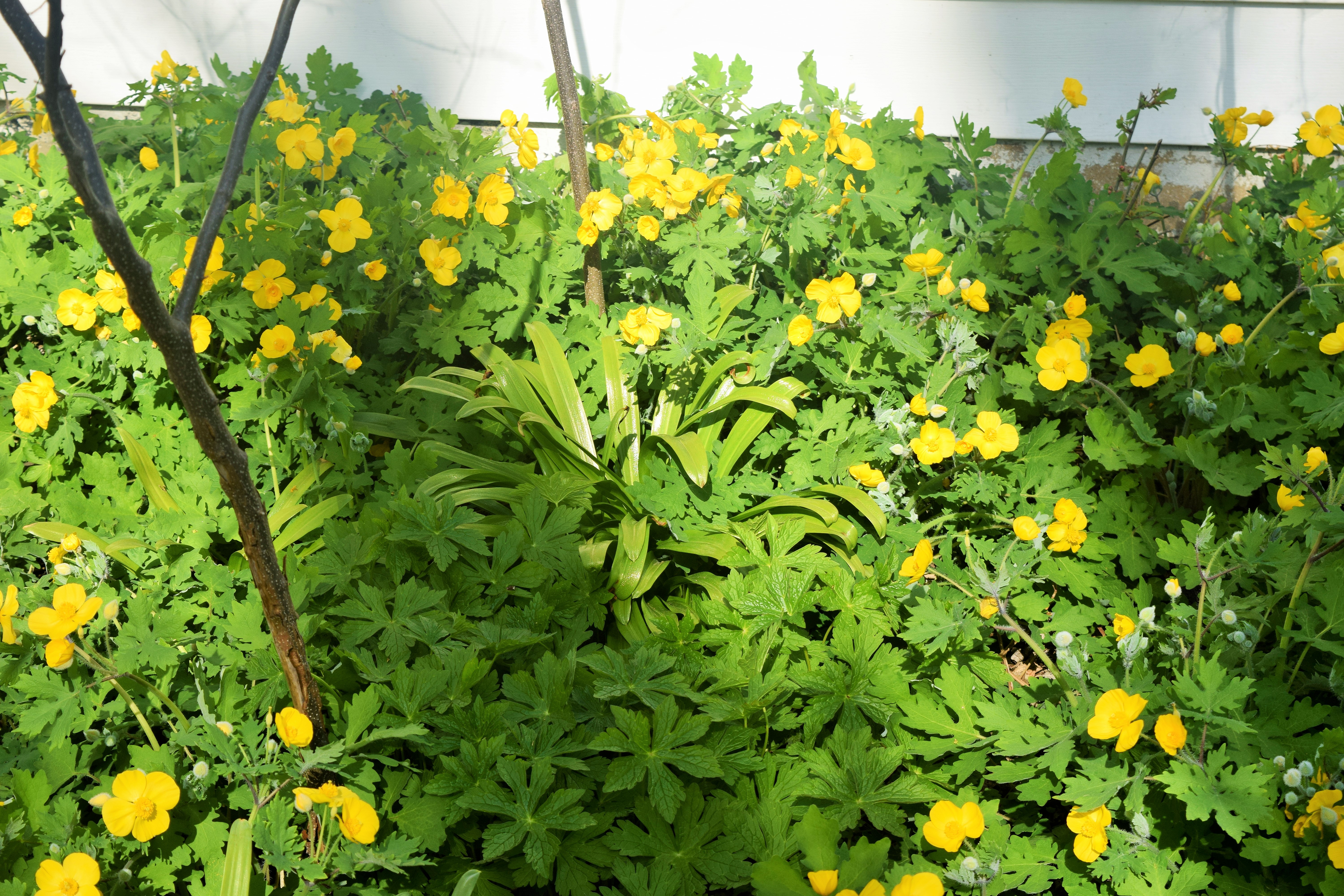
One of its best companions, however, is not so widely loved. I speak of Celandine Poppy (Stylophorum diphyllum), which is peaking in my garden along with the Bluebells even as I write this.
Celandine Poppies
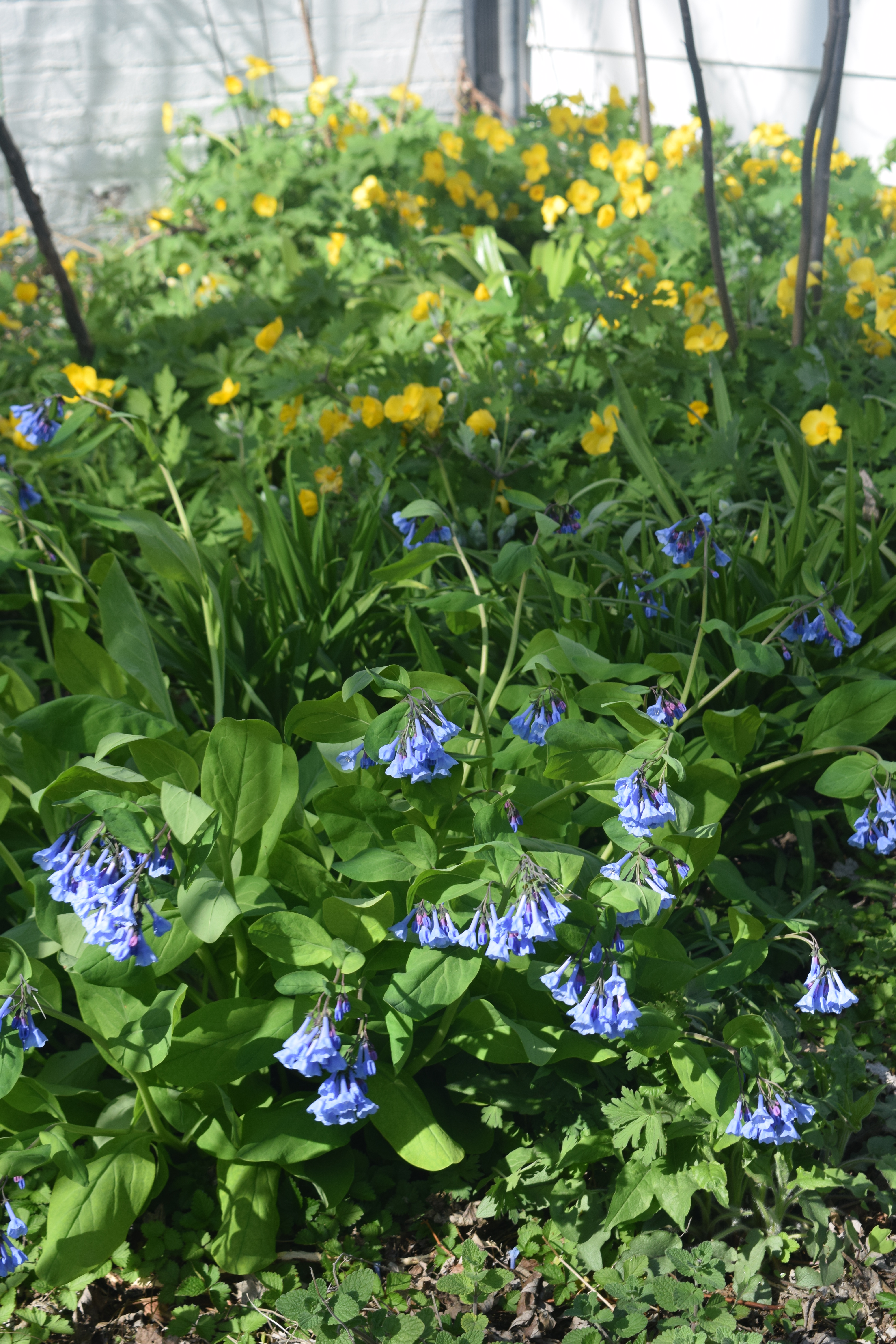
These plants perfect for each other. There are the simultaneously blooming flowers – blue for the Mertensia, golden yellow for the Stylophorum. I always like to mix blue and yellow blooms.
Virginia Bluebells
Then there is the contrast of foliage shape: lobed and oak-like for Celandine Poppies and rounded leaves for the Bluebells, though the leaves of each have a similar bluish green hue. Also, these two plants prefer the same woodsy, part shade conditions.
Celandine Poppies with Great Forget-Me-Not
Some people consider Celandine Poppies to be weedy, and they do tend to seed themselves about with more enthusiasm than is strictly necessary. However the seedlings are not difficult to remove – and a mass of blooming Celandine Poppies are an energizing sight.
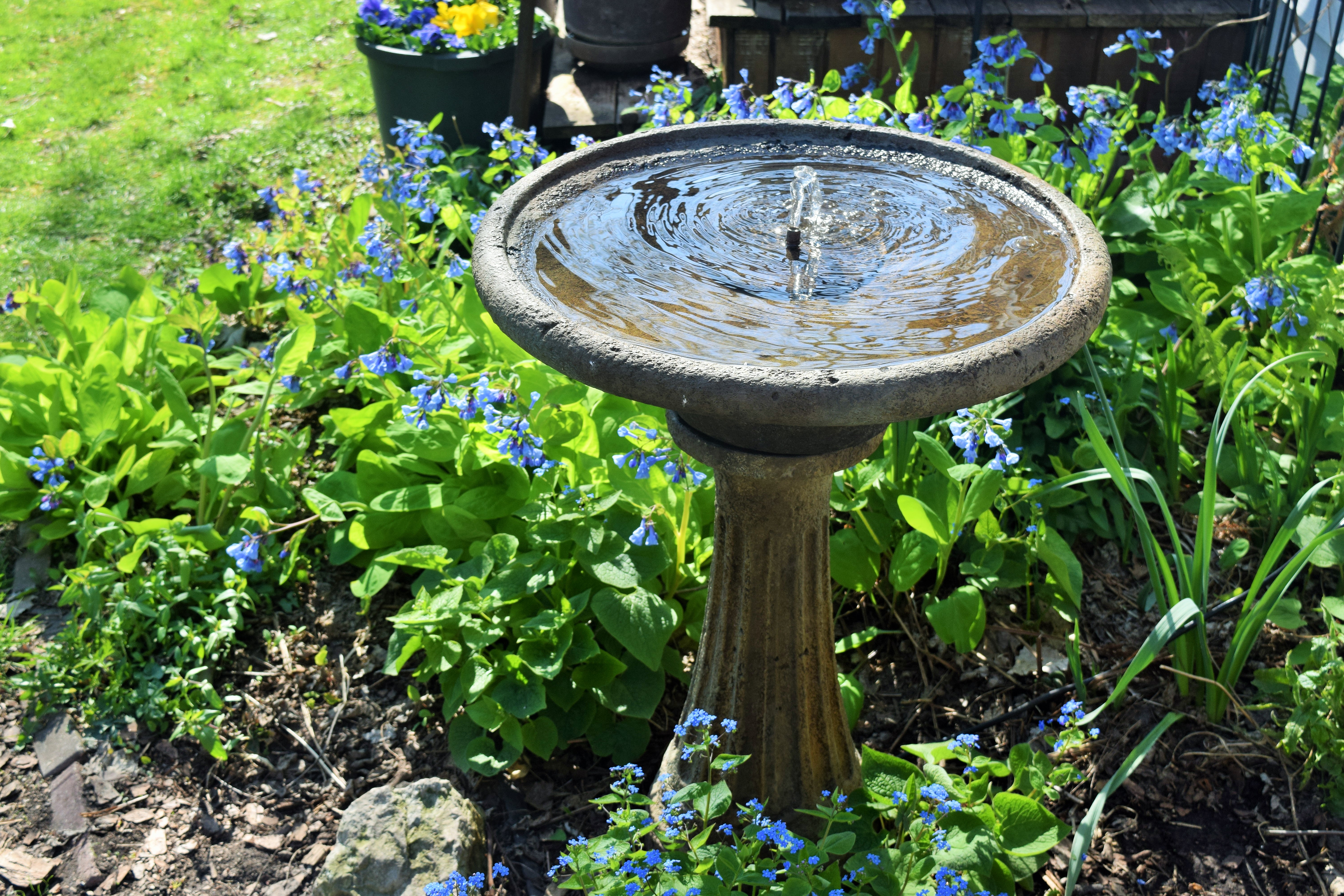
A little off topic, but here’s our new fountain surrounded by Virginia Bluebells. Nice, don’t you think?
Celandine Poppies are not ephemerals like Virginia Bluebells. Their foliage does get ratty during a hot summer, but fresh leaves (and sometimes flowers) will sprout when the weather cools.
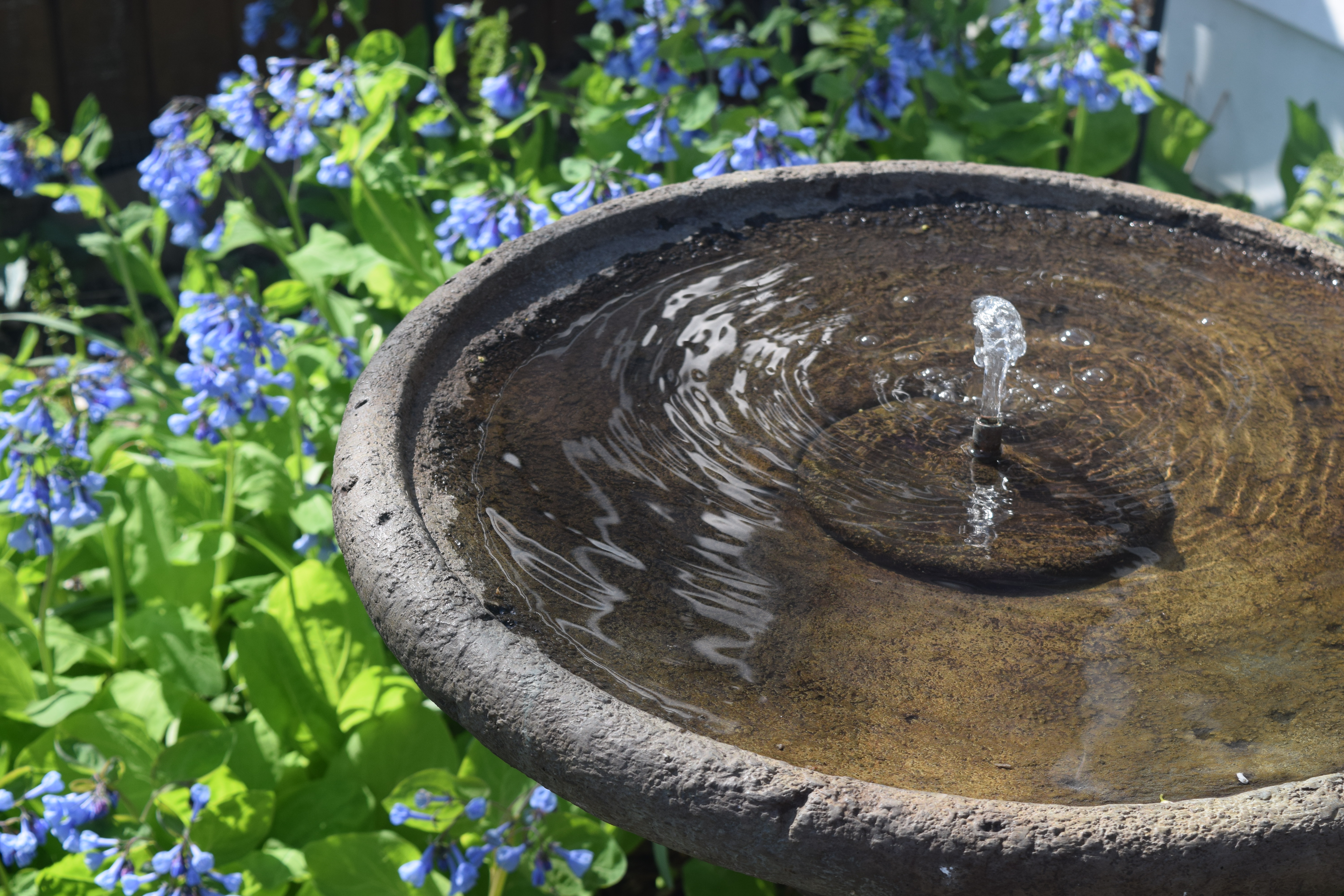
Another look at the fountain and the Virginia Bluebells.
Celandine Poppies are probably not a good fit for a formal garden, but they can add a great deal of pleasure to an an informal cottage or wildflower garden. The same is true, I think, of Virginia Bluebells.
Virginia Bluebells and Celandine Poppies, another look.
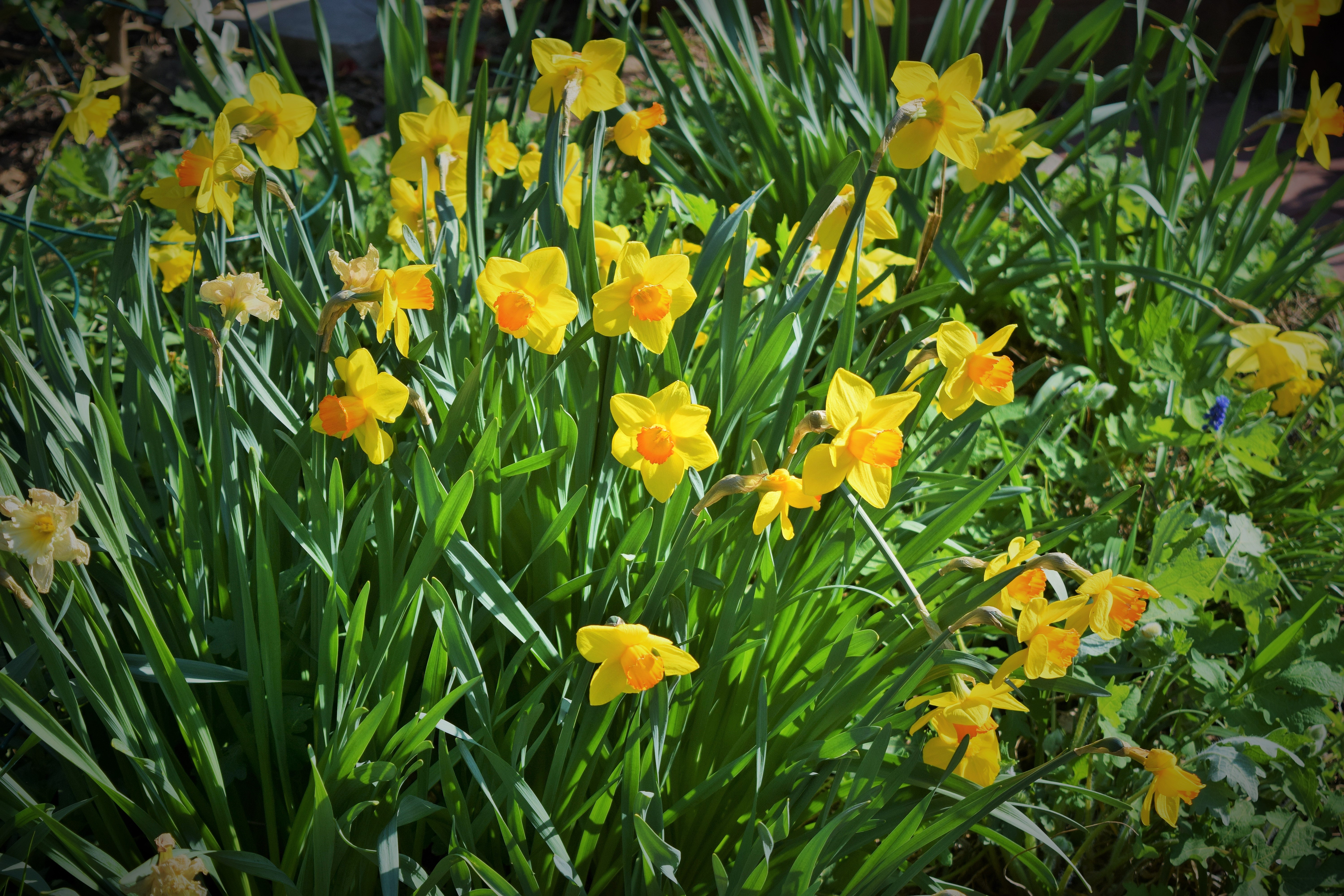
In an earlier post I established that Tulips are better than Narcissus. However, as a socially responsible garden blog, I endeavor to present multiple points of view and also to comply with the Equal Time Rule (Communications Act of 1934, 47 USC Sec. 315). Although there are limits to everything, so please don’t ask me to write about Fritillaria.
Narcissus ‘Delibes’ glow in the late afternoon sun.
Therefore, I present to you some of our later-season Daffodils. Judy has stated several times that this has been an exceptional year for Daffodils in our garden, and I wouldn’t disagree with her as far as that goes.
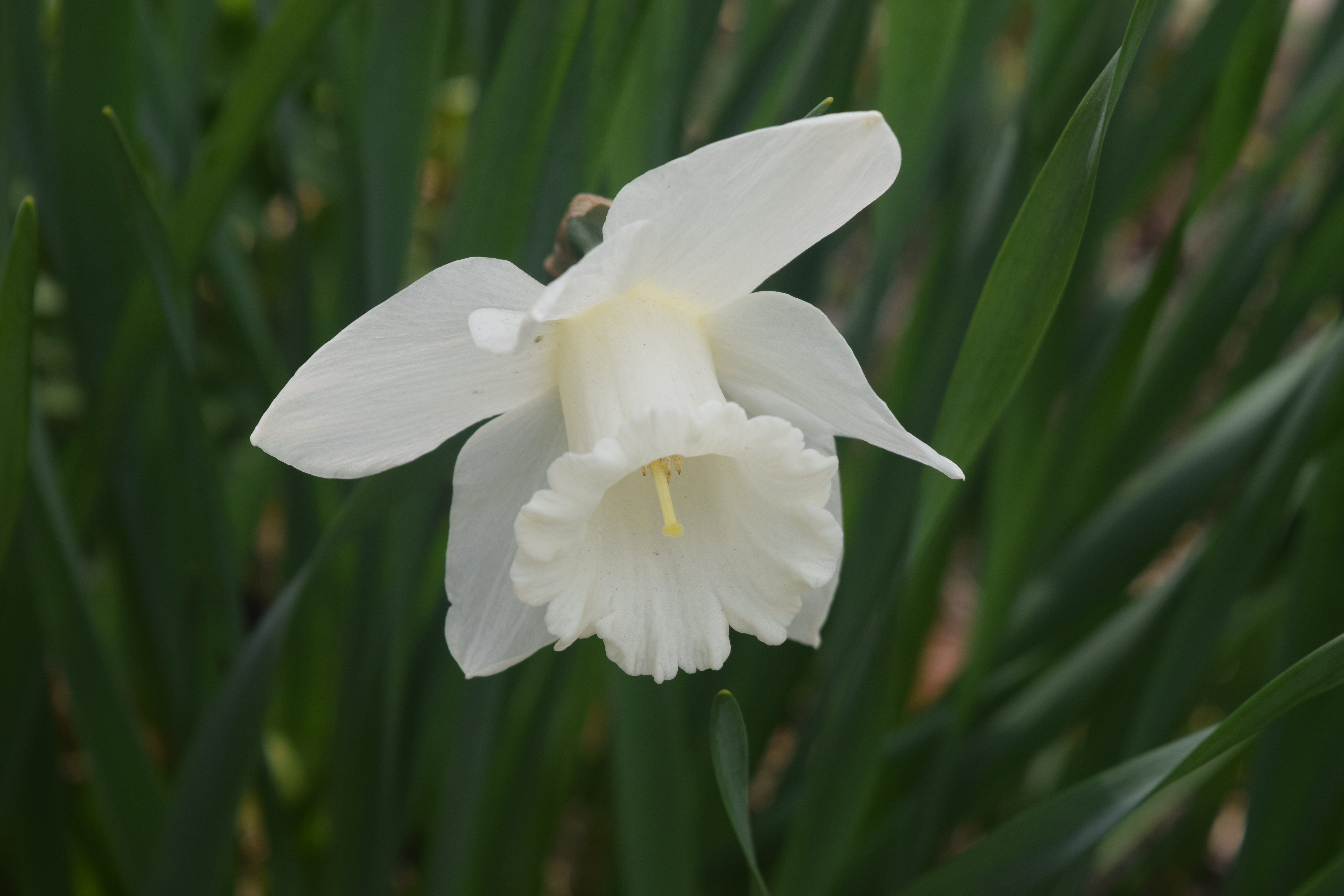
‘Mount Hood’
‘Mount Hood’ is a gleaming white Trumpet Daffodil.
‘Flower Record’
I think this is ‘Flower Record’. I like the combination of the red edging with the white petals.
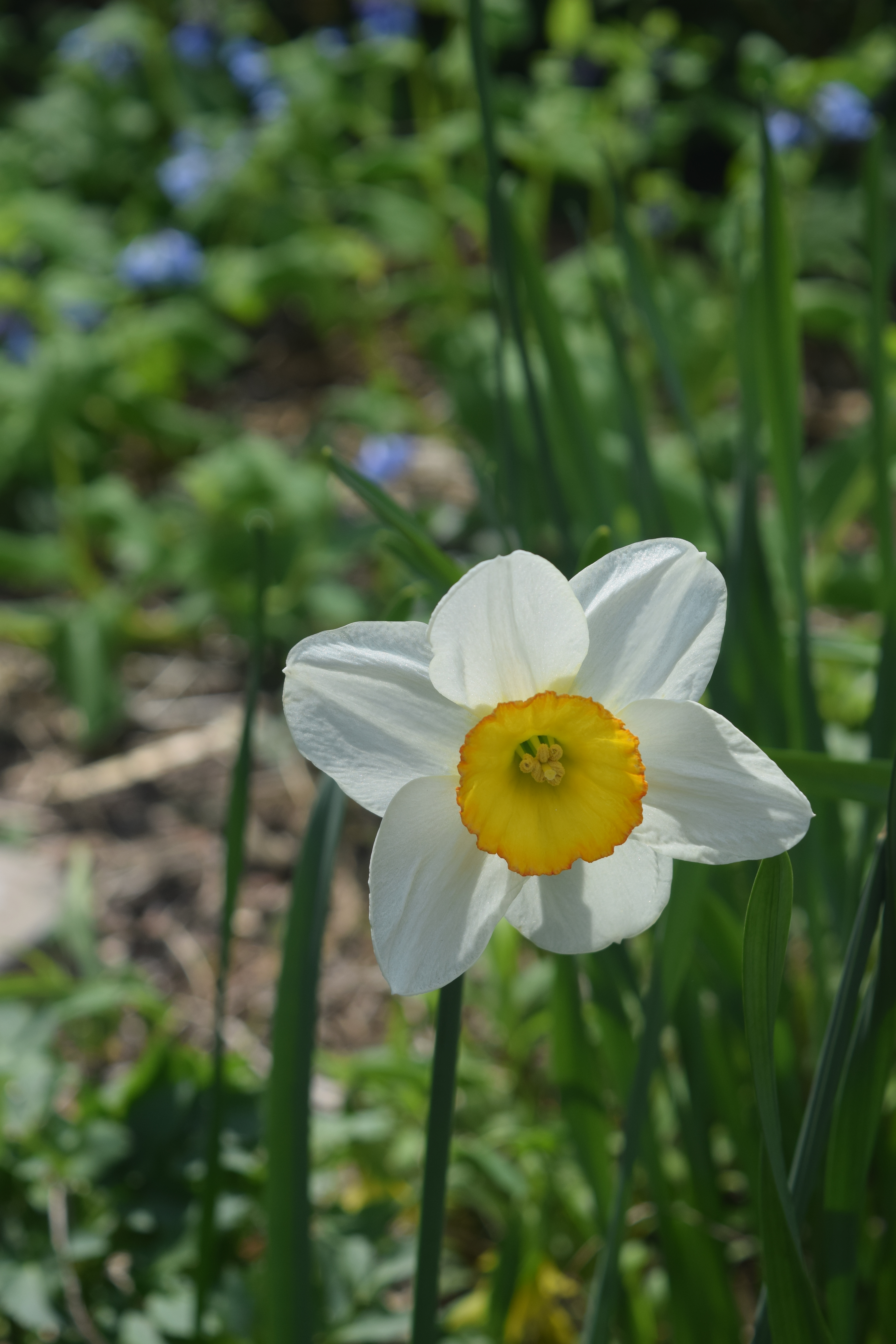
‘Sentinel’ (I think)
I think this is probably ‘Sentinel’, which is a Large Cupped variety. From the last three you can tell I am partial to white Narcissi.
‘King Alfred’
And here’s a classic old Trumpet Daffodil, ‘King Alfred’.
Well, that’s enough Narcissi for now. More Tulips coming soon!
We are now right in the middle of tulip season. So many varieties to show you! Where to begin?
Tulipa clusiana, showing the outer pentals. Such thin, delicate stems.
Perhaps with the shy but charming Tulipa clusiana, also called Lady Tulip. I have two varieties of Lady Tulip, ‘Tubergen’s Gem’ and ‘Chrysantha’, and damned if I can tell them apart. They’re both really nice, though!
Tulipa clusiana, opening wide.
One thing about these varieties of T. clusiana is that their outer petals are a soft red, but inside they are bright yellow. They close up in colder weather or as the sun sets, and open wide in the warm sunshine.
‘Golden Parade’ tulips with Celandine Poppy.
Generally I plant hybrid tulips in containers and species tulips in beds and borders. However, years ago I planted some Darwin Hybrid tulips into mixed borders. Darwins are relatively long-lived, and they still show off big blooms around the end of April. For instance, here are some ‘Golden Parade’ blooming with Celandine Poppies (Stylophorum diphyllum).
‘Holland’s Glory’ and Banja Luka’ with Tulipa dasystemon
And here are some ‘Holland’s Glory’ (red-orange) and ‘Banja Luka’ Darwins looming over the Tulipa dasystemon in a raised parkway bed.
‘Red Impression’ with even more Tulipa dasystemon.
This one, I think, is ‘Red Impression’.
Tulip ‘Ballerina’
‘Balerina’ is an orange lily-flowering tulip. Planted in containers last fall, it’s not supposed to bloom until May, but it decided to have an early start.
Tulip ‘Princess Irene’
You don’t see people mixing purple and orange very much but ‘Princess Irene’ carries it off.
A look inside ‘Princess Irene’.
Irene also has startling purple anthers.
Tulip ‘Annie Schilder’
This year we kind of went in for orange tulips in a big way. This is ‘Annie Schilder’.
Tulip ‘Couleur Cardinal’
‘Couleur Cardinal’ is one of my absolute favorites, we have to plant some every year.
Tulip ‘Elegant Lady’
On the other hand, I don’t think I would order ‘Elegant Lady’ again.
The Tulip parade, with ‘Keizerskroon’ bringing up the front.
We are by no means done with the Tulip parade!
Another view of the Tulip parade.
Some of the Tulips will keep marching for a couple of weeks yet, others have yet to begin. It is an exciting and joyous spectacle while it lasts.
All my beds and borders have names, though most are rather pedestrian. There’s the Sidewalk Border, the Driveway Border, the Patio Border, etc. The most evocative name I’ve come up with is the Left Bank Border, for the area north of the ‘Donald Wyman’ crabapple on the far side of the driveway.
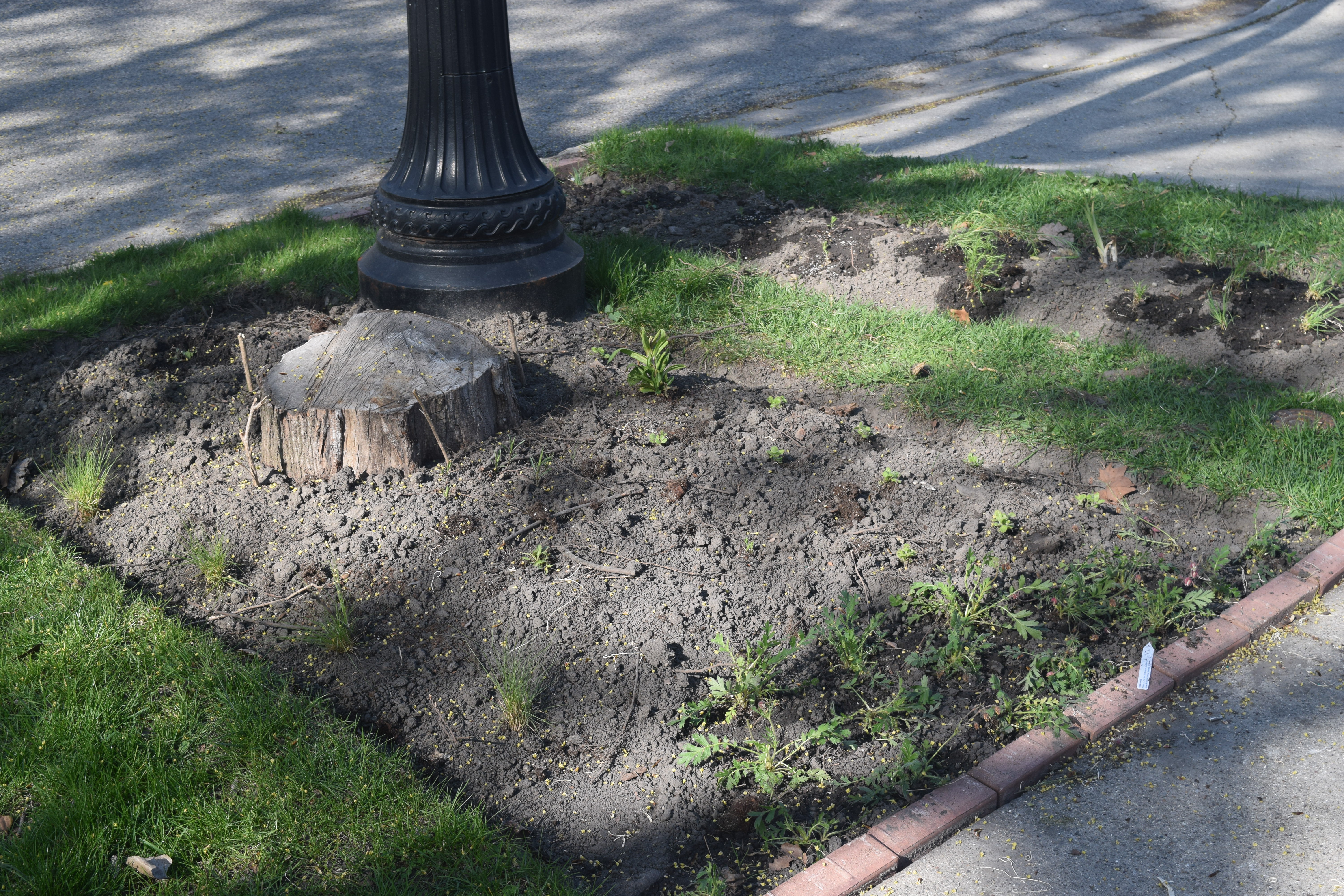
The new parkway border, all planted. The city has told me they won’t remove the stump, so I’m thinking of putting a container on it.
Now I have dug a new border (or would you call it a bed?) on the parkway across the sidewalk along the Left Bank. What to call it? I’ve considered calling it the Maginot Line, thus maintaining a Gallic theme, but that sounds too martial.
So I am turning to my readers to come up with a name via a contest. The judges (specifically Judy and I) will pick from among the suggestions offered in the comments. The winner gets the thanks of a grateful nation.
Another view of the new parkway border.
I finished the planting today. The bulk of the plants were from Prairie Nursery, and arrived a couple of days ago. I’m afraid I crammed too many plants into the available space, which is my normal practice. As my grandmother Tessie would say when people were coming for dinner, “Better too much than too little!”
So here’s the plant list:
Prairie Smoke
Prairie Smoke (Geum triflorum). I’m using this to edge both sides of the sidewalk.
Prairie Onion (Allium stellatum).
Wild Petunia with Wild Strawberry
Wild Petunia (Ruellia humilis).
Whorled Milkweed (Asclepias verticillata).
Butterflyweed
Butterflyweed (Asclepias tuberosa).
Aromatic Aster (Aster oblongifolius). Just one of these, to provide a splash of blue in autumn.
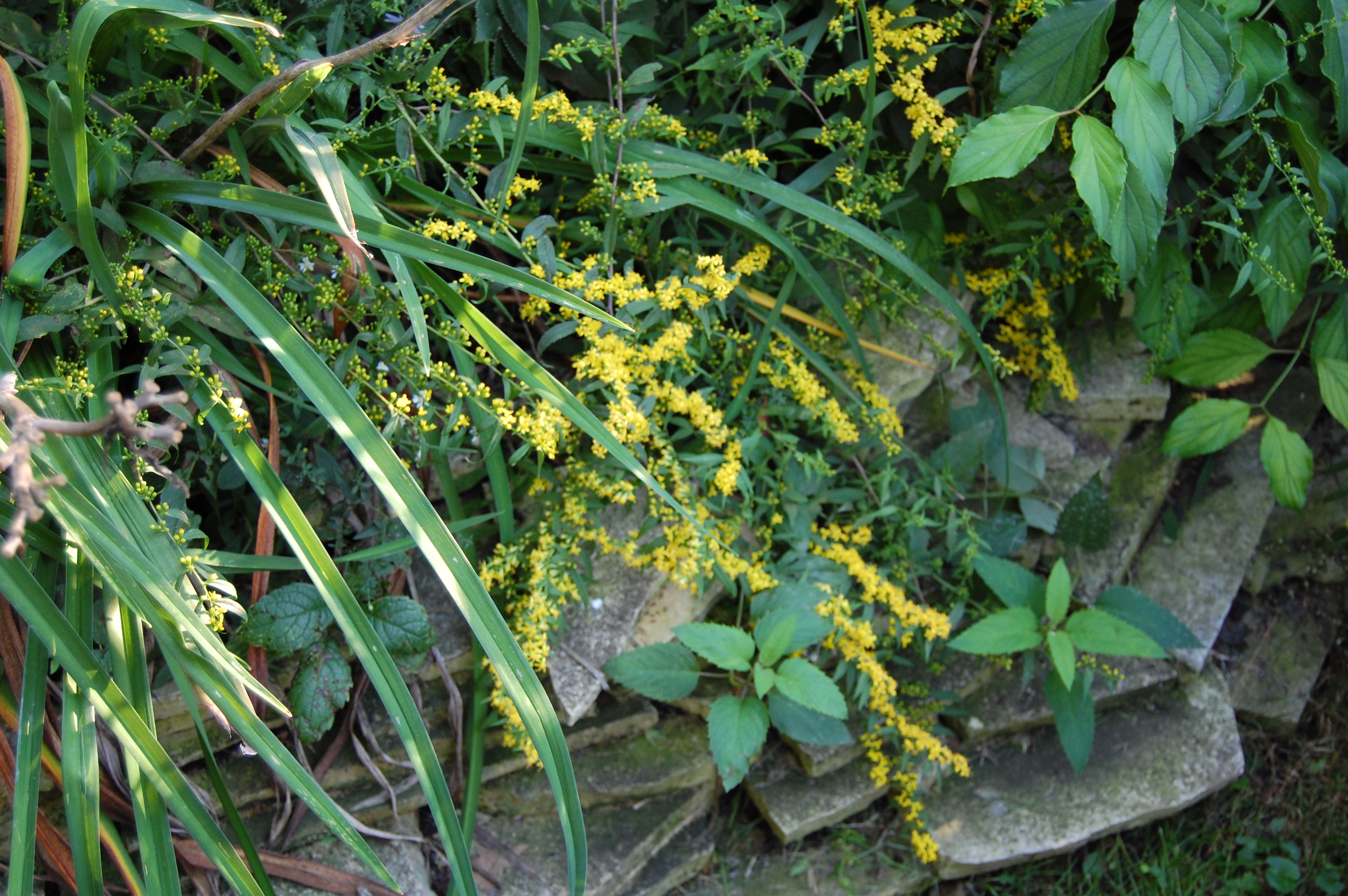
Blue Stem Goldenrod (Solidago caesia)
Bluestem Goldenrod (Solidago caesia).
Praire Dropseed (Sporobulus heterolepis).
Prairie Baby’s Breath (Euphorbia corollata). These are hard to find. They arrived bare root from Prairie Moon about two weeks ago. I planted them right away but I’m still waiting for them to show themselves. I was really impressed when I saw them growing in Pat Hill‘s garden.
Most of these plants are repeated on both sides of the sidewalk. In addition, there are two plants I received as an unexpected gift from the kind people as Klehm’s Song Sparrow Farm, one each of ‘Priceless Gold Strike’ Daylily, and Helenium autumnale ‘Short’n’Sassy’.
So taking this plant list or anything else you like as inspiration, what do you think I should name my new border?
In Chicago and other Northern lands, people tend to think of tulips as flowers of May.
‘Keizerskroon’ Tulip
However, there are quite a few tulips that bloom in April. In my garden, the three earliest tulips are ‘Early Harvest’, T. praestans, and T. turkestanica. Of these, only T. turkestanica is still in flower. However two new tulips have emerged to make up for any floral attrition.
‘Keizerskroon’ close up.
‘Keizerskroon’ is a Single Early Tulip that dates back to 1750. It’s a dramatic tulip, with blood red flames on a yellow background.
‘Keizerskroon’ is Dutch for ‘Emperor’s Crown’. The upwardly pointing triangular flames do seem to be joined at the base in order to form a crown.
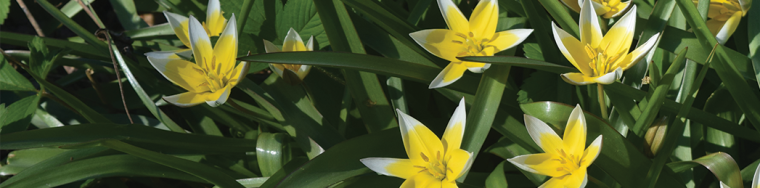
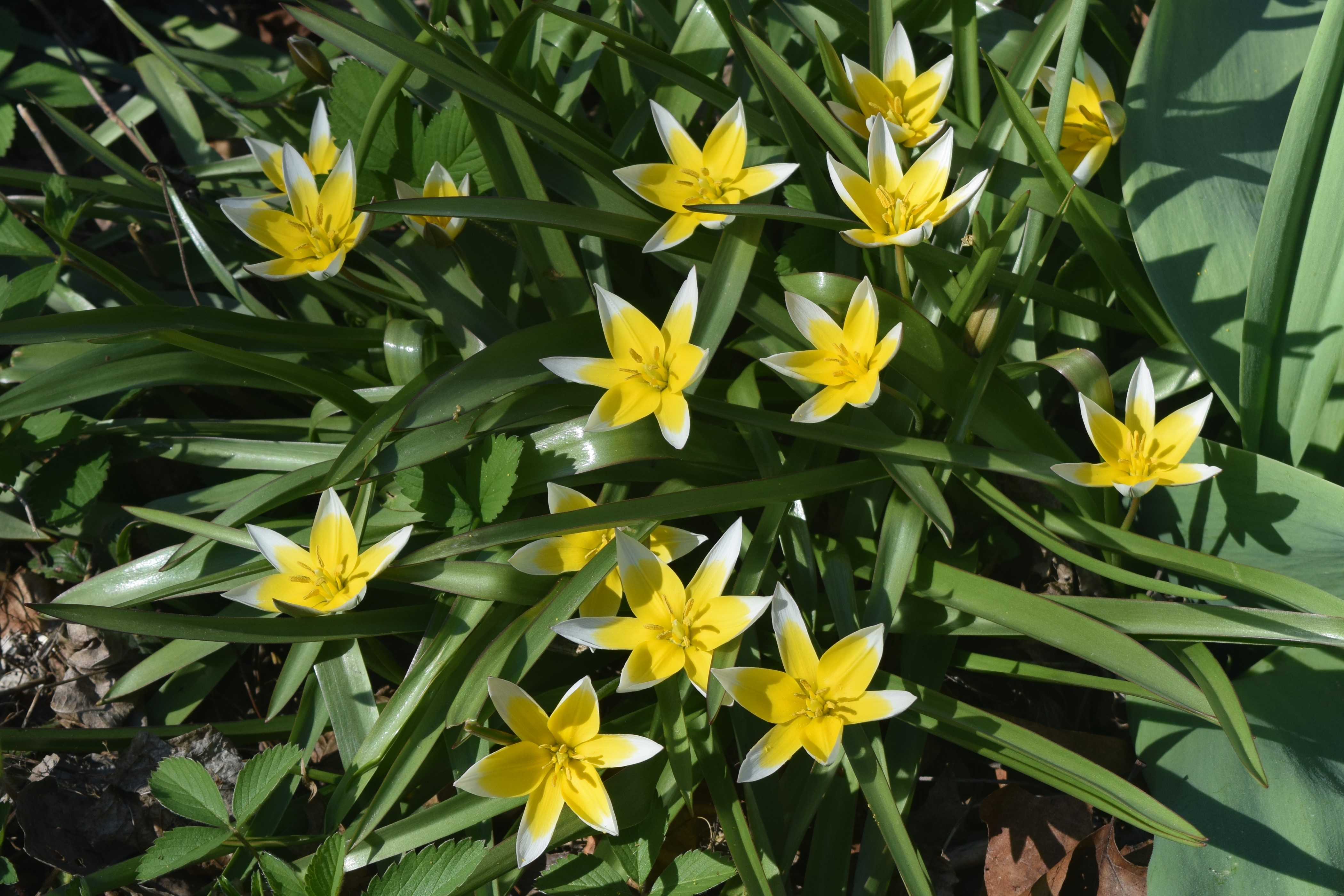
My friend Julia described Tulipa dasystemon as looking like someone took a cookie cutter to an egg cooked sunny side up. This is a description I cannot improve upon.
Tulipa dasystemon
T. dasystemon is just six or so inches tall and forms nice clumps. It seems to be looking skyward with optimism and eagerness. The leaves are long, straight, and pointy. This is a species tulip from the mountains of western China.
Watch this space for many more tulips coming soon!
Fine, it’s actually Thursday at this point, but don’t get hung up on technicalities. On to the vignette.
West side of our house. There is a ‘Darlow’s Enigma’ rose on that arbor, but it has not yet leafed out.
The west side of our house is a little bit challenging.The relatively narrow side yard between our house and the neighbors’ is mostly shady. There is also a rain shadow from the roof that keeps the area right along the brick wall fairly dry. Here you will find the path that leads to the back garden.
In late April you can see the Wild Ginger (Asarum canadense) leafing out along the stone path. Many people prefer the shiny European Wild Ginger (Asarum europaeum). Both are good groundcovers for shade, but I prefer the downy, olive green leaves of the North American species. This is not the same as culinary ginger, though the roots are edible and have a similar smell.
At the near end Great Merrybells (Uvularia grandiflora) are blooming. It’s hard to see, but among the Wild Ginger Lady Ferns (Athyrium filix-femina) are unfurling. Closer to the wall, ‘Annabelle’ Hydrangeas (Hydrangea arborescens) are just starting to leaf out. ‘Annabelle’ is a rugged shrub, quite happy in dry shade. Later in summer its big, white puffball flowers will make their appearance.
From this vantage point you can’t see the moist north end of the border. There you will find White Bleeding Heart (Lamprocapnos spectabilis var. alba) and Jacob’s Ladder (Polemonium reptans), among other plants.
Wednesday Vignette is hosted by Anna at Flutter and Hum, follow the link to see more intriguing garden scenes.


























 gardeninacity