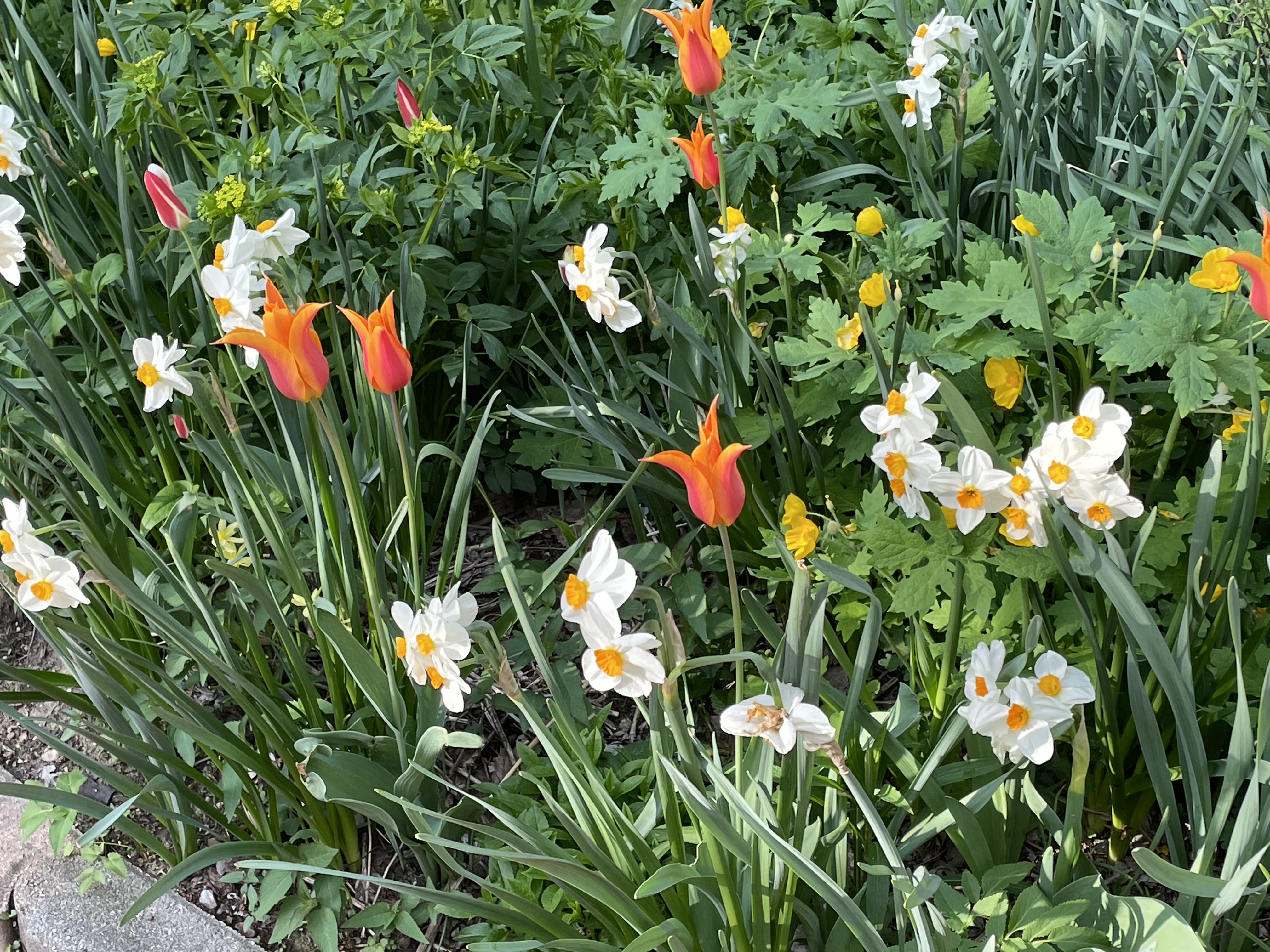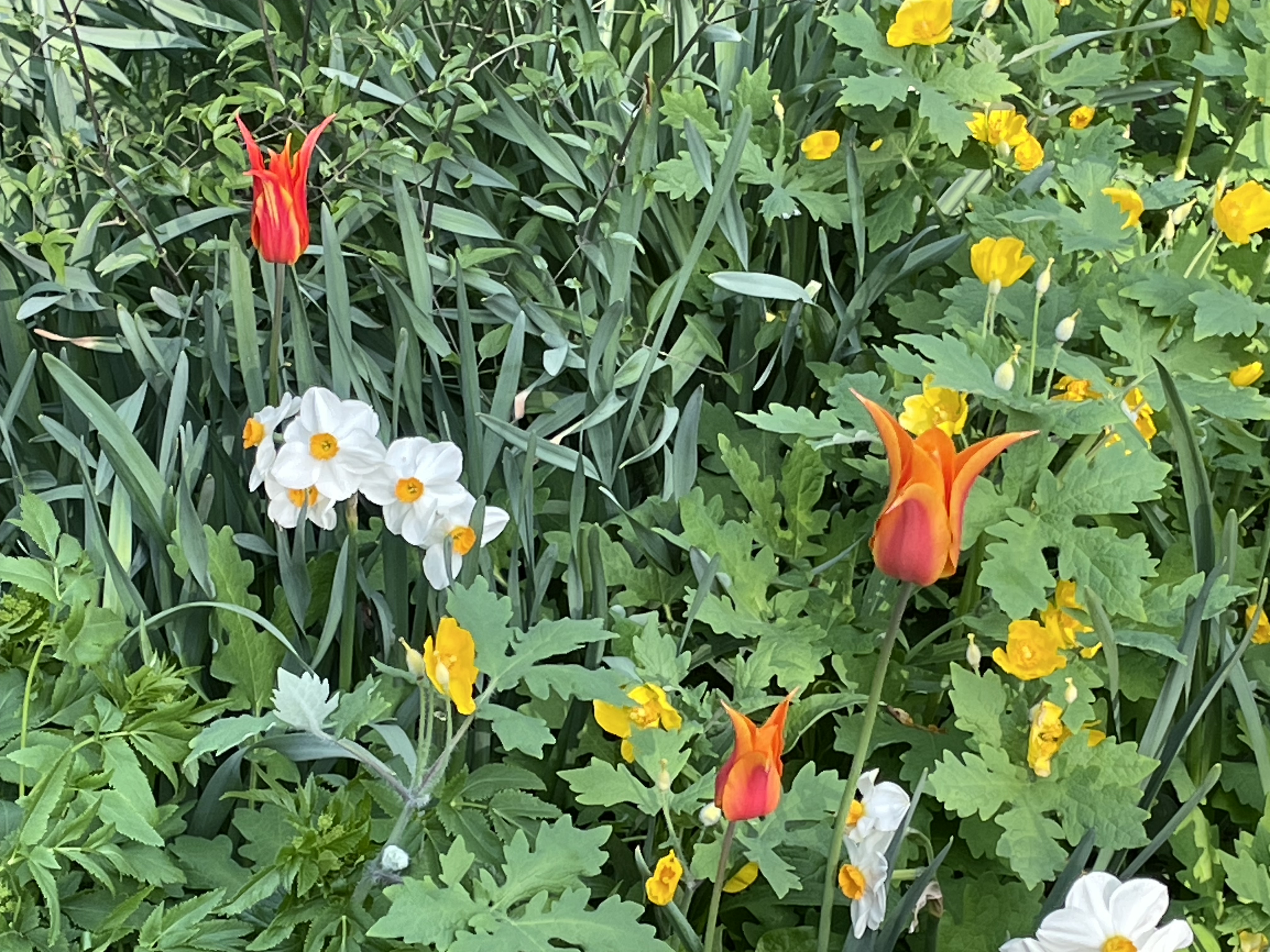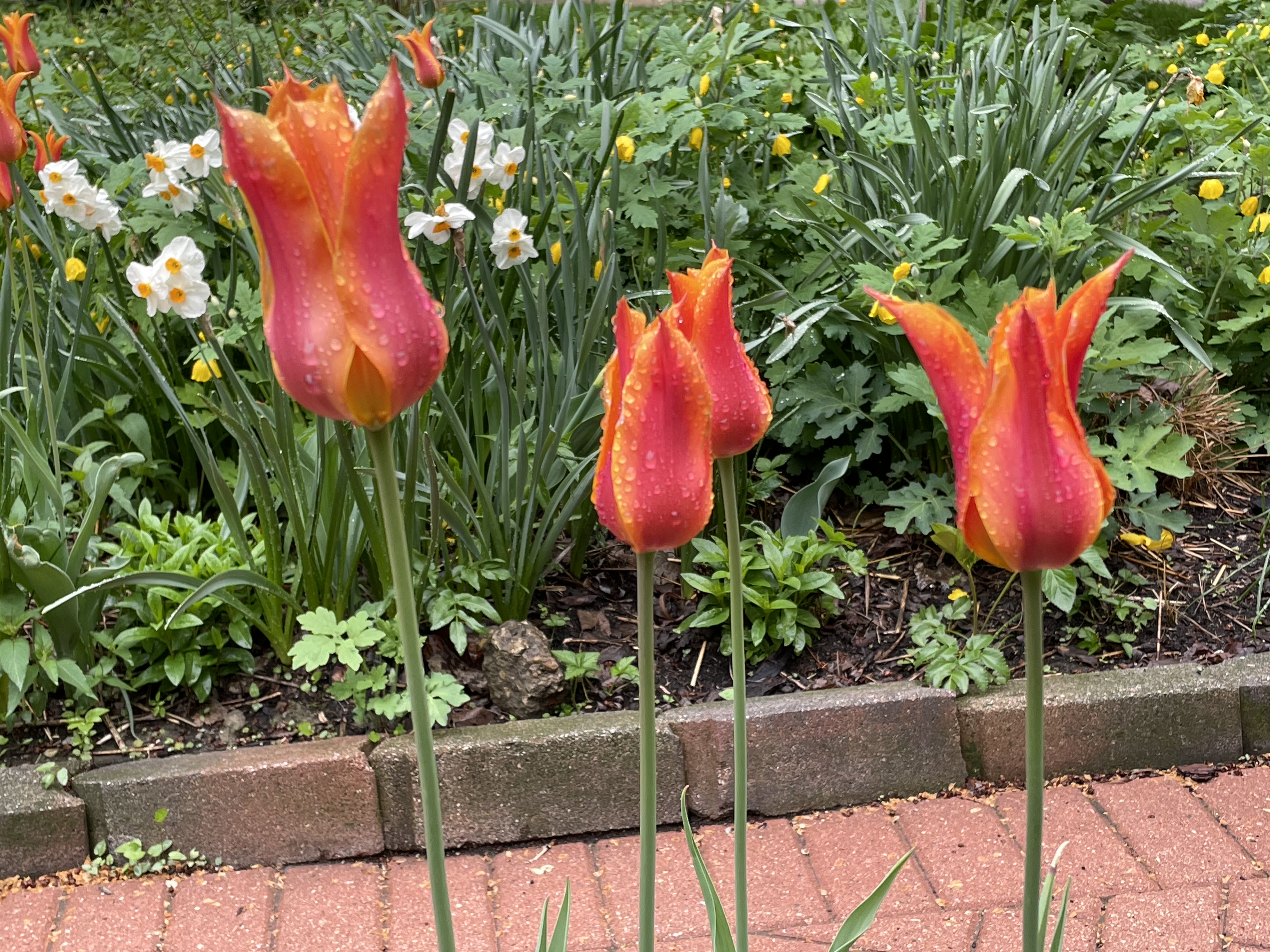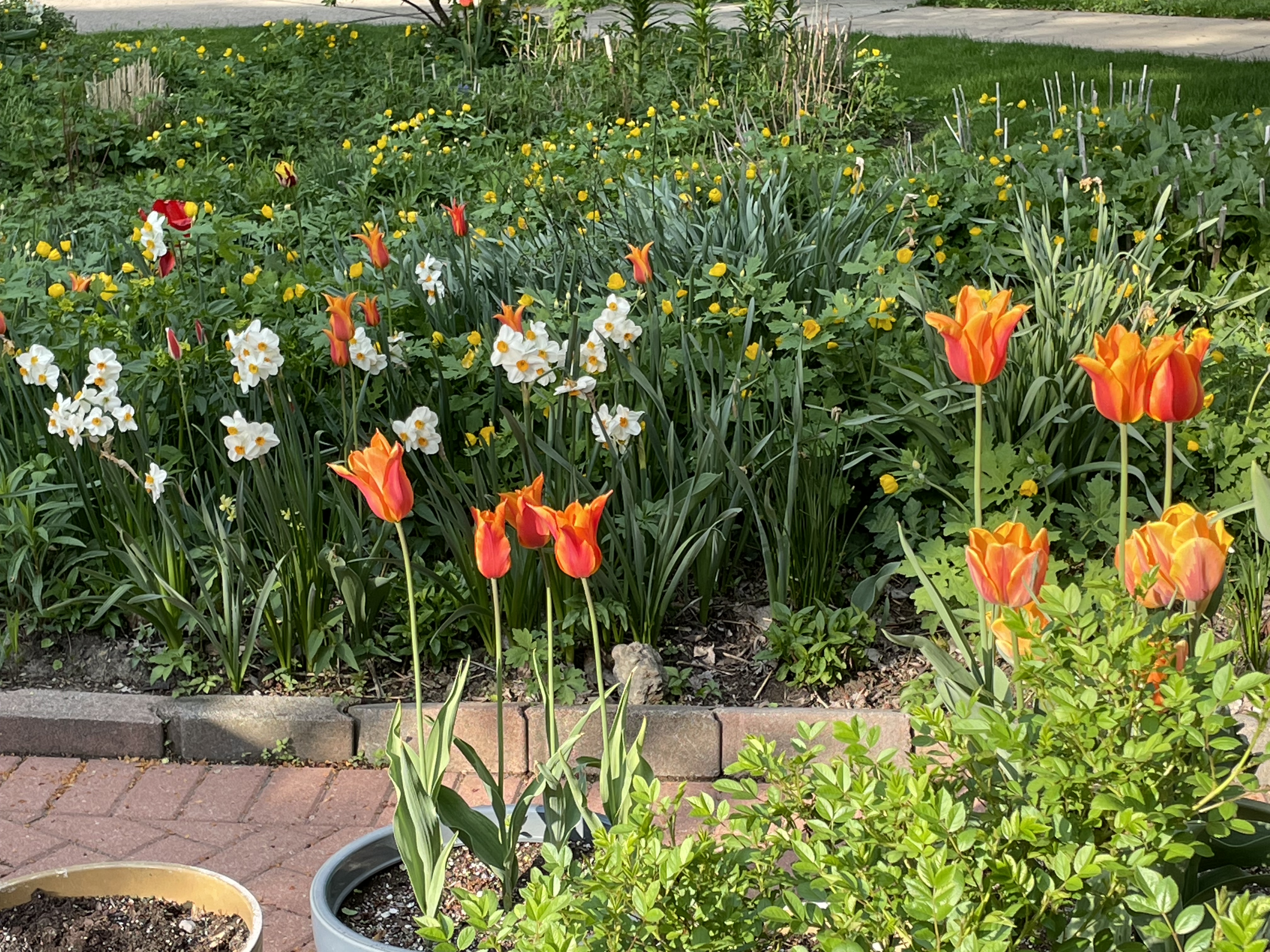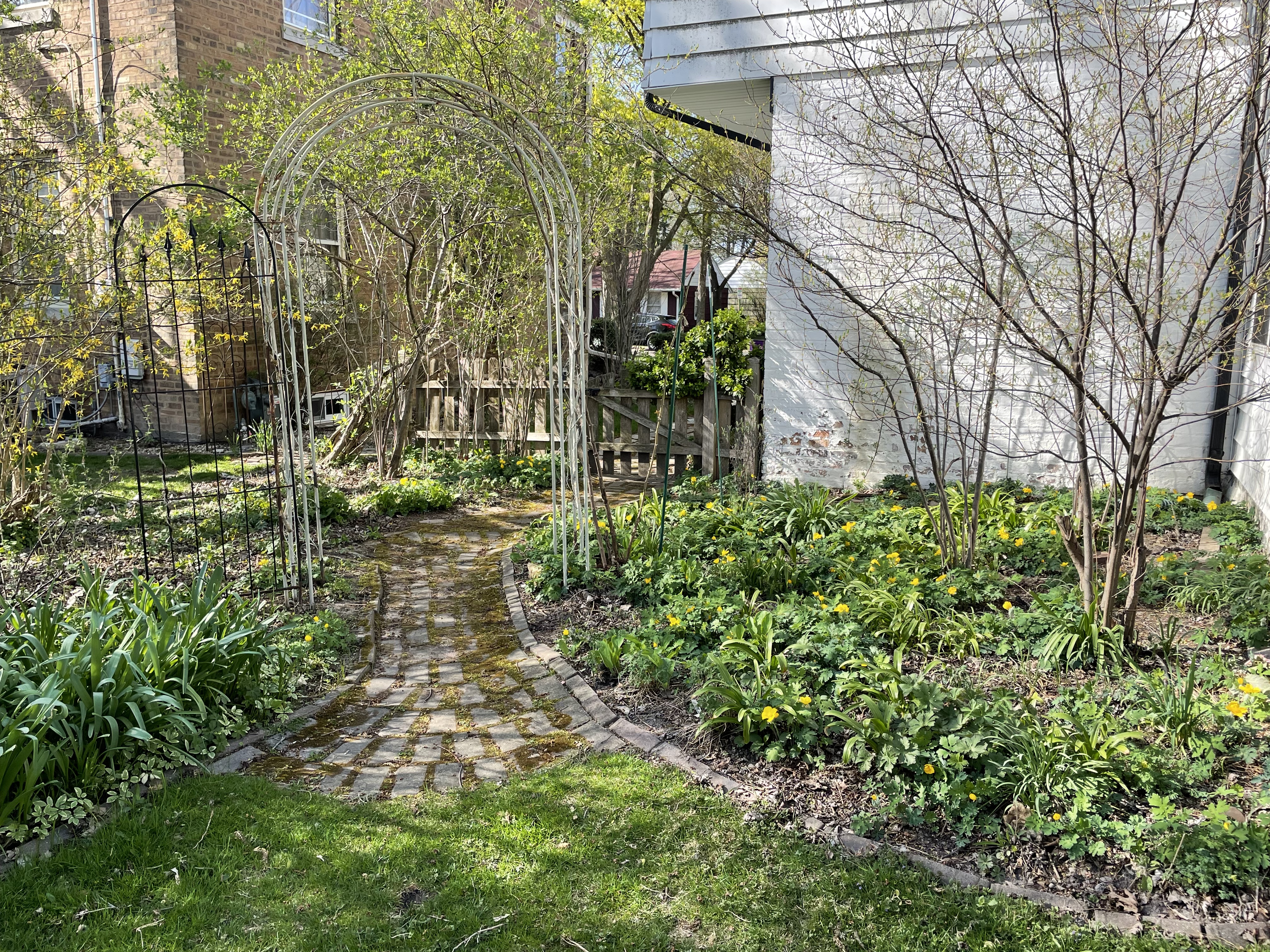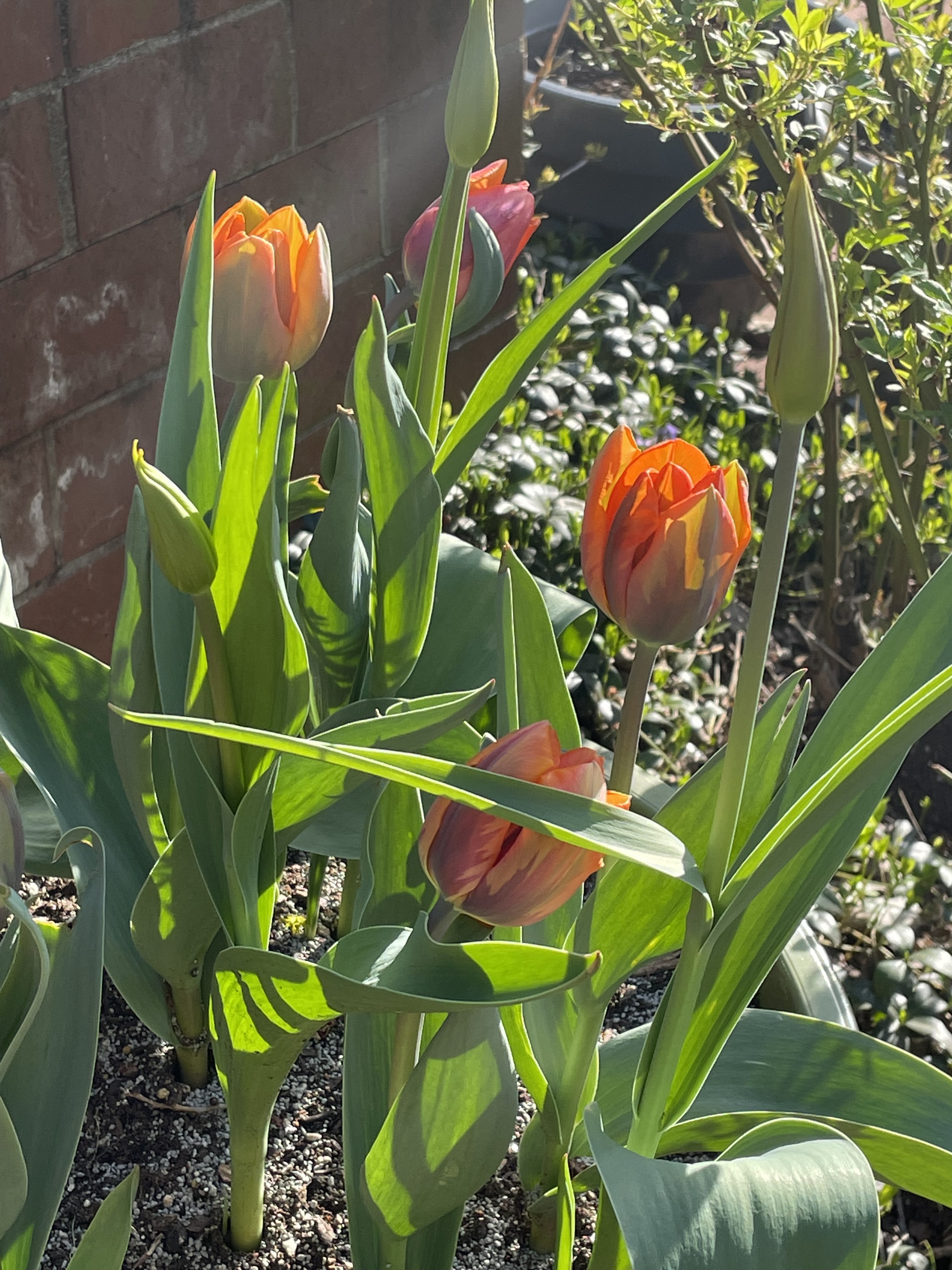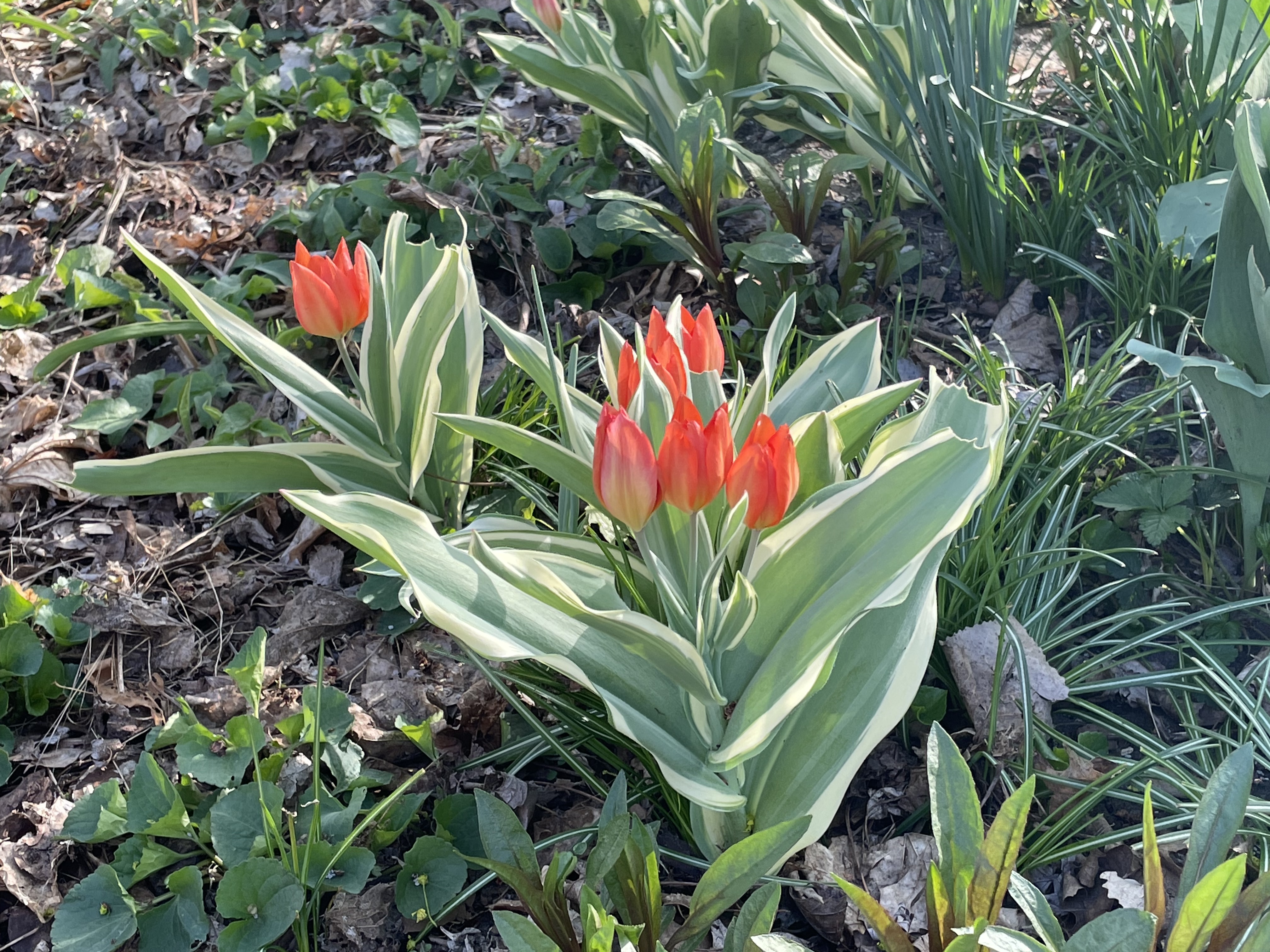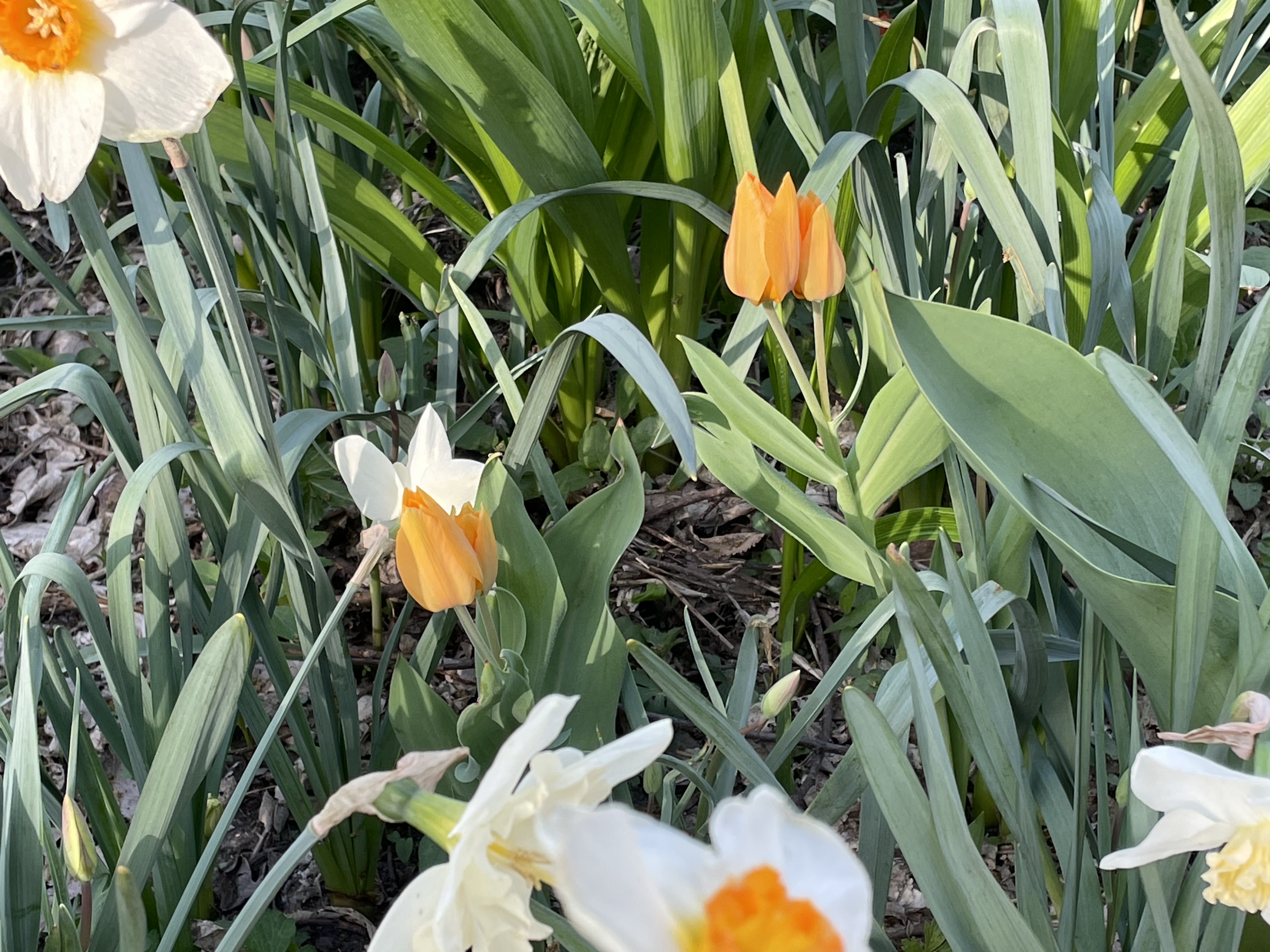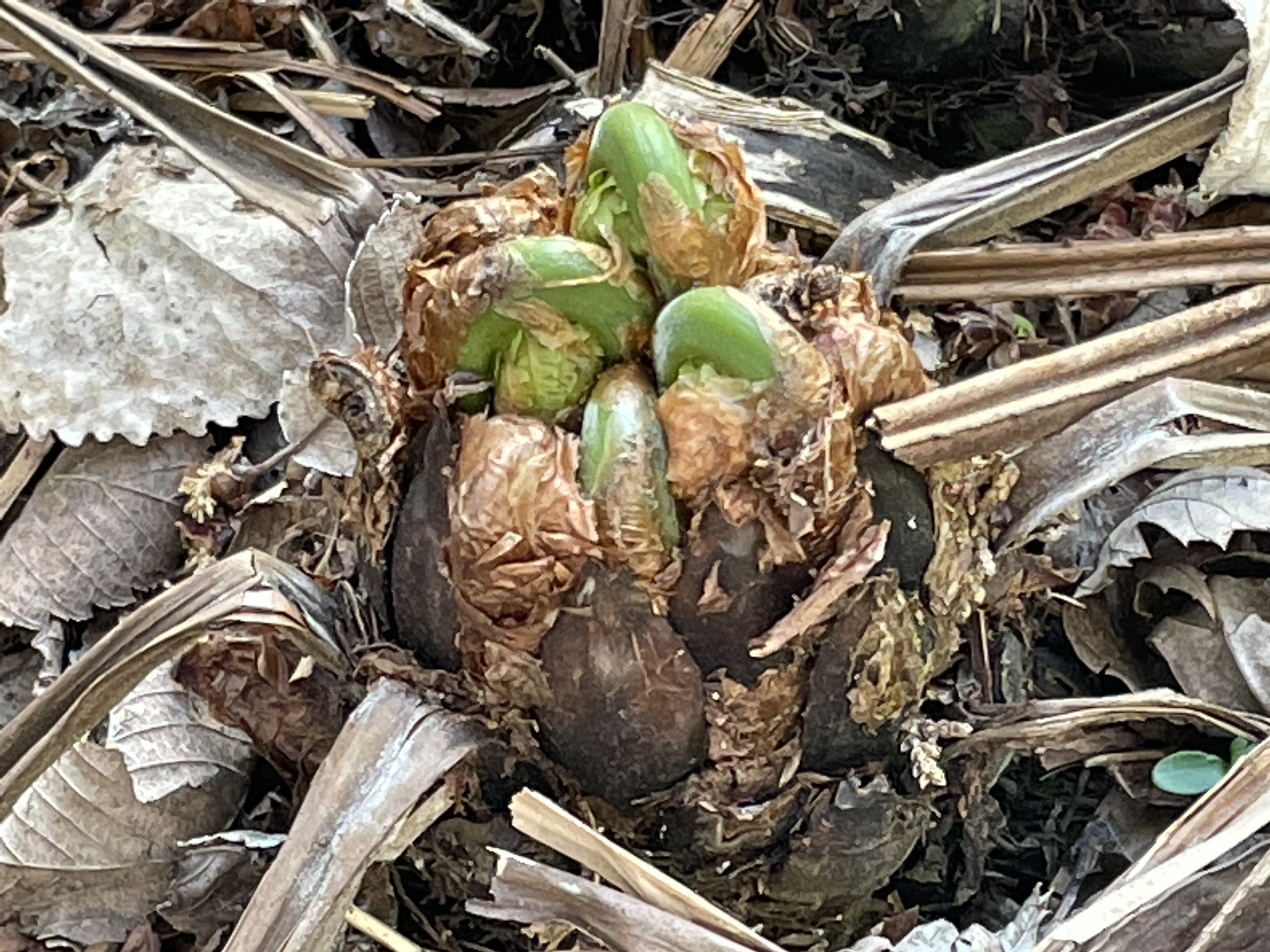
I’ve been feeling a little bit guilty that I posted that winter interest blog just as we were all craving spring. I don’t know what came over me — a last blast of nostalgia for the long, cold, dark winter? In any case, I have two quick posts here to make up for it. This first post will highlight the awakening of spring in my backyard, and the second will follow with the front garden.

The two gardens are quite different. The back is private, quiet and restful. In the summer, it is primarily dappled shade. If only I were able to keep to a theme, it would be a white garden, layered with shades of green. Since I have the common gardener’s inability to resist a beautiful flower, and so did Jason, there are other colors scattered throughout (as accents, I tell myself).

The front garden is much more public. Although I don’t live on a busy street, people stop as they walk by and pull up in their cars as they drive by, to comment on the garden. It is big and loud and tall — when I give directions, I say, come to the house with the ten-foot plants in front (or “with all the brown stalks” if I am giving directions in the winter).

The backyard kicks off the spring season with snowdrops galore, often beginning in February. Why are there none in the front? Who knows.

Several spicebushes add a touch of early color. When Jason planted them, he assured me they would be better than forsythia. It took me a few years, but I now fully agree.

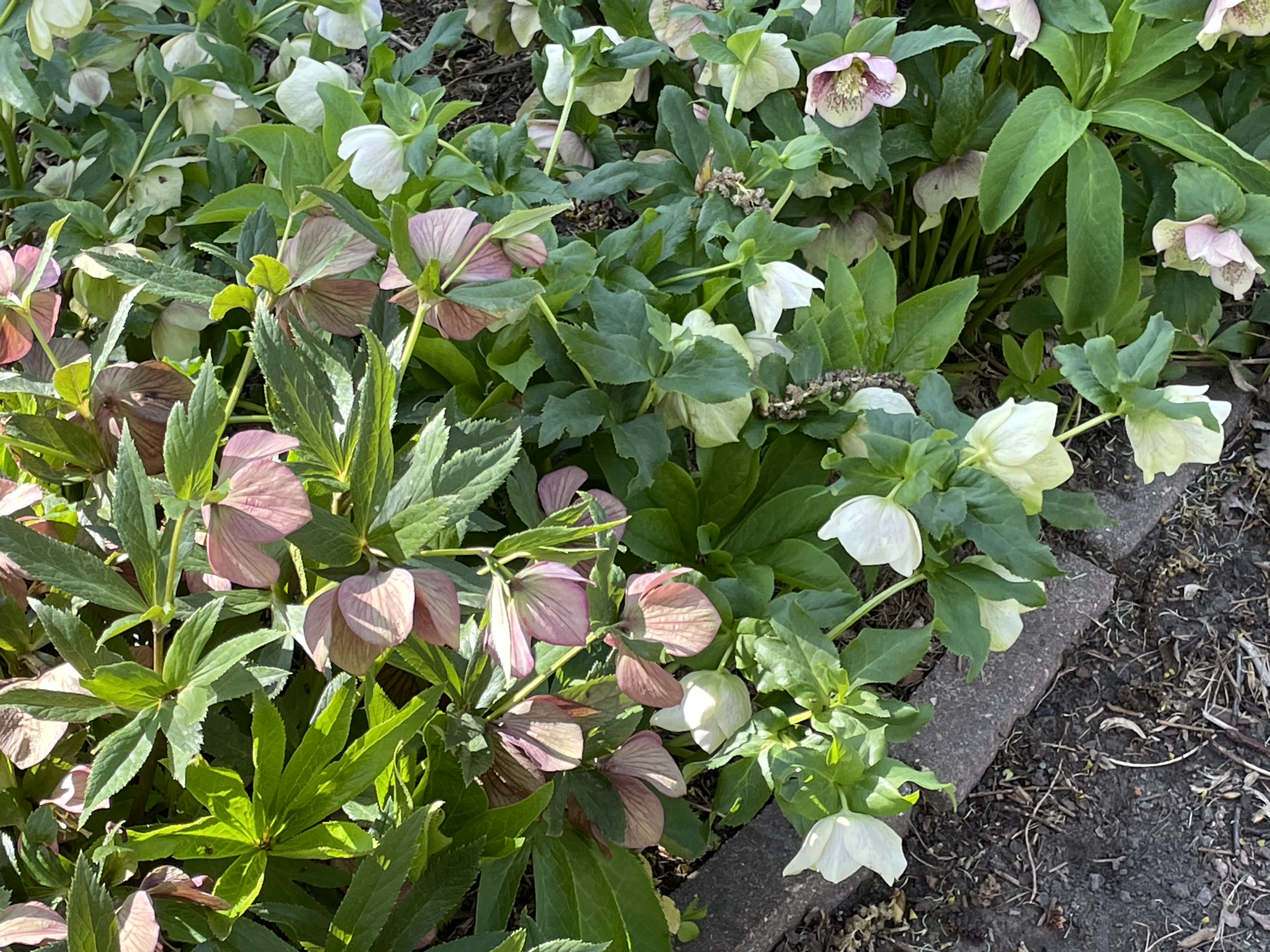
Neighbors down the street many years ago had hellebores, and I wanted some. Jason reluctantly planted them, and then fell in love with them. They bloom so early and provide a burst of color when you most need it. They couldn’t be hardier, and they spread in a slow, polite way.

Last fall, the gardeners and I added muscari — grape hyacinths. What was I saying about accent colors?

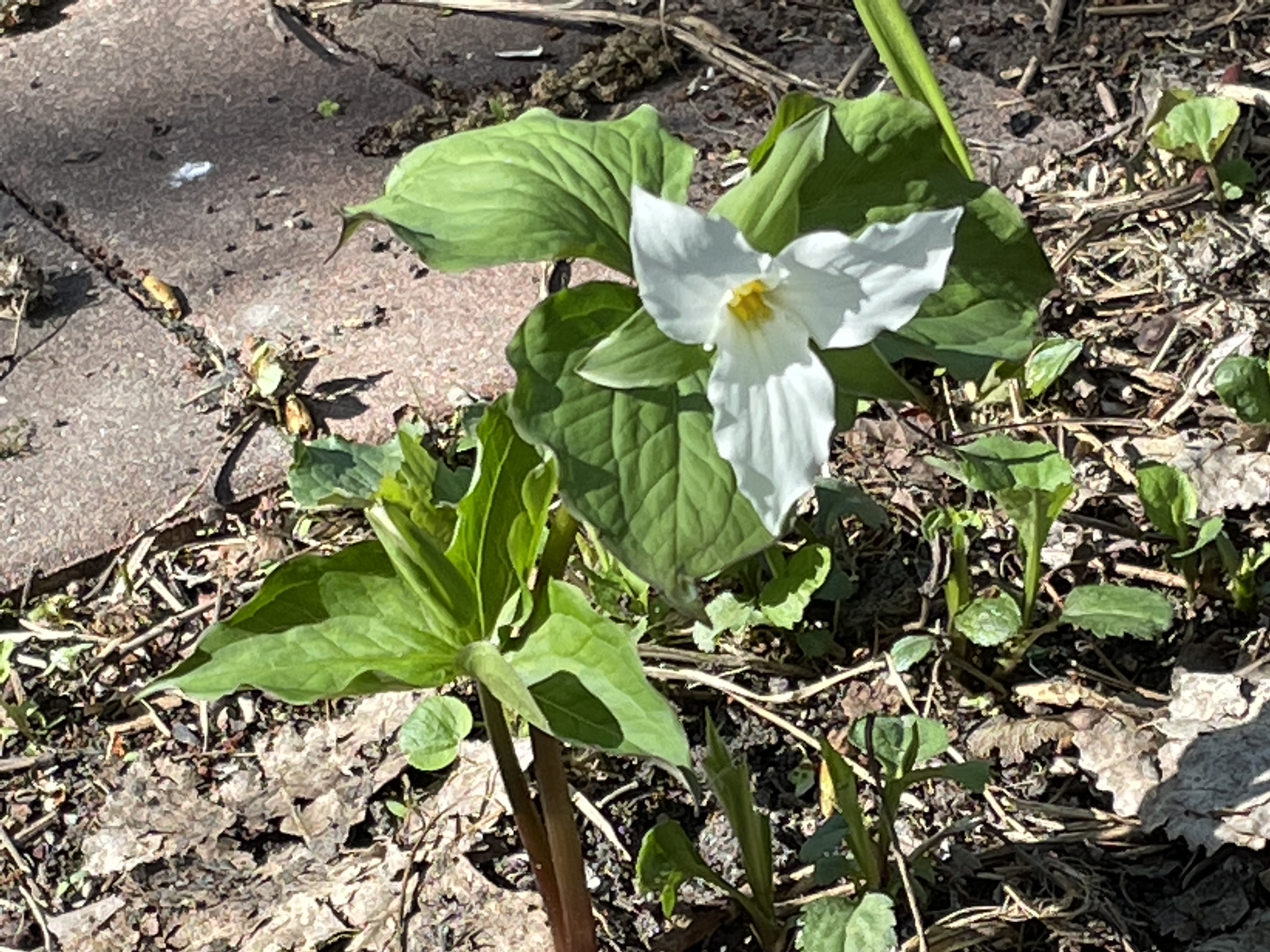
When we moved in 20 years ago, there were several native spring perennials at the edges of the backyard. These prairie trillium do their thing every year, huddled against one of the side fences. They neither spread nor diminish.

We planted the great white trillium, and as is its habit, it is taking years to fully establish.

I have a particular place in my heart for these native emphemerals. We lived for two years in Madison, Wisconsin, before we moved here, and our house was on a lot that backed into a small woodlot. Six-foot deep borders on two sides of the backyard had been allowed to go wild, and we discovered many flowers that were new to us. Among those were uvularia. When we moved, I demanded that our new garden contain uvularia, which at that time were difficult to source.

Several of the original native perennials have vanished, either on vacation or moved out without giving notice. There is a small cluster of bloodroot; some years I see it bloom, and some I don’t; nothing this year. We used to have a couple of Jack-in-the-Pulpits, in two locations, but I haven’t seen them in a few years. Dutchman’s Breeches (if you have more than one, is it Dutchmen’s Breeches? or do the breeches all belong to one guy?) only bloomed a couple of times after we arrived. There were also a couple of small patches of lungwort. I have no idea if the previous owners, who were here for many years, planted or encouraged any of this.

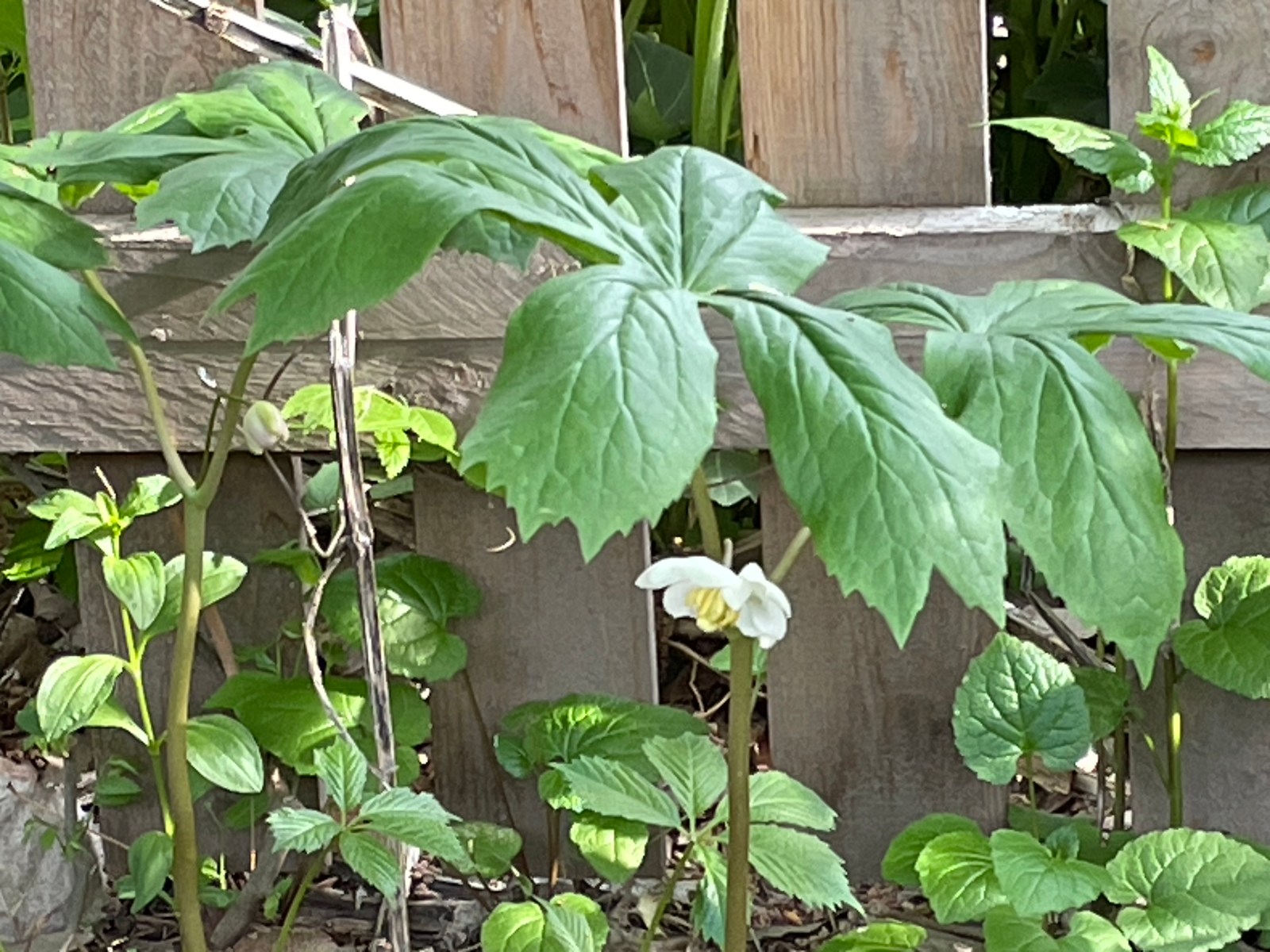
A spring ephemeral that remains is Mayapples, very slowly spreading by the back fence.

Jason planted two Chokecherry trees about ten years ago, one in the backyard and one on the east side of the house, because they do better in pairs. I was very confused last year by its May blooms and green leaves — turns out the leaves turn deep purple during the summer. As one does, I googled to try to clarify the situation — and up came Jason’s post, telling me exactly what I needed to know.

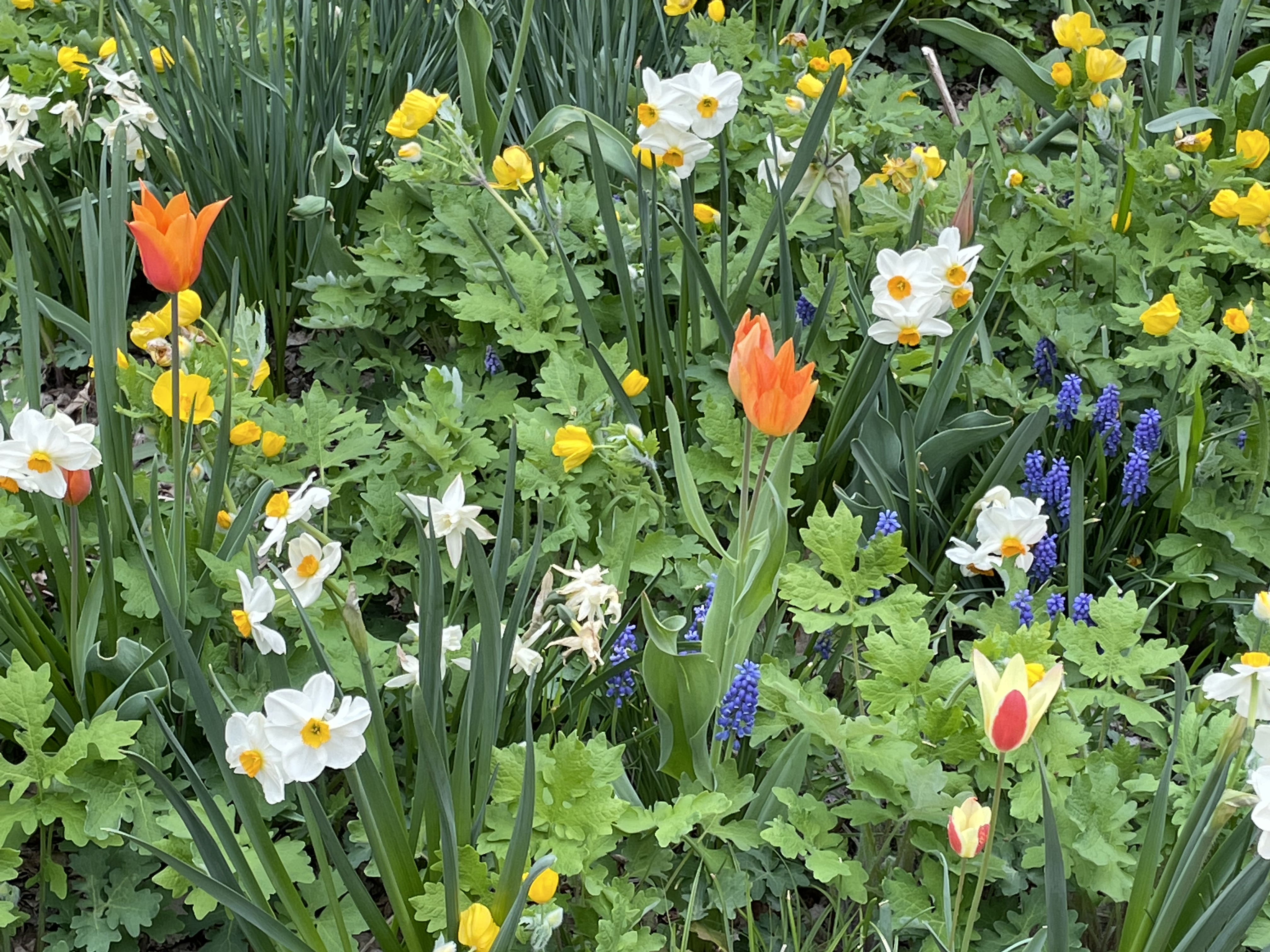
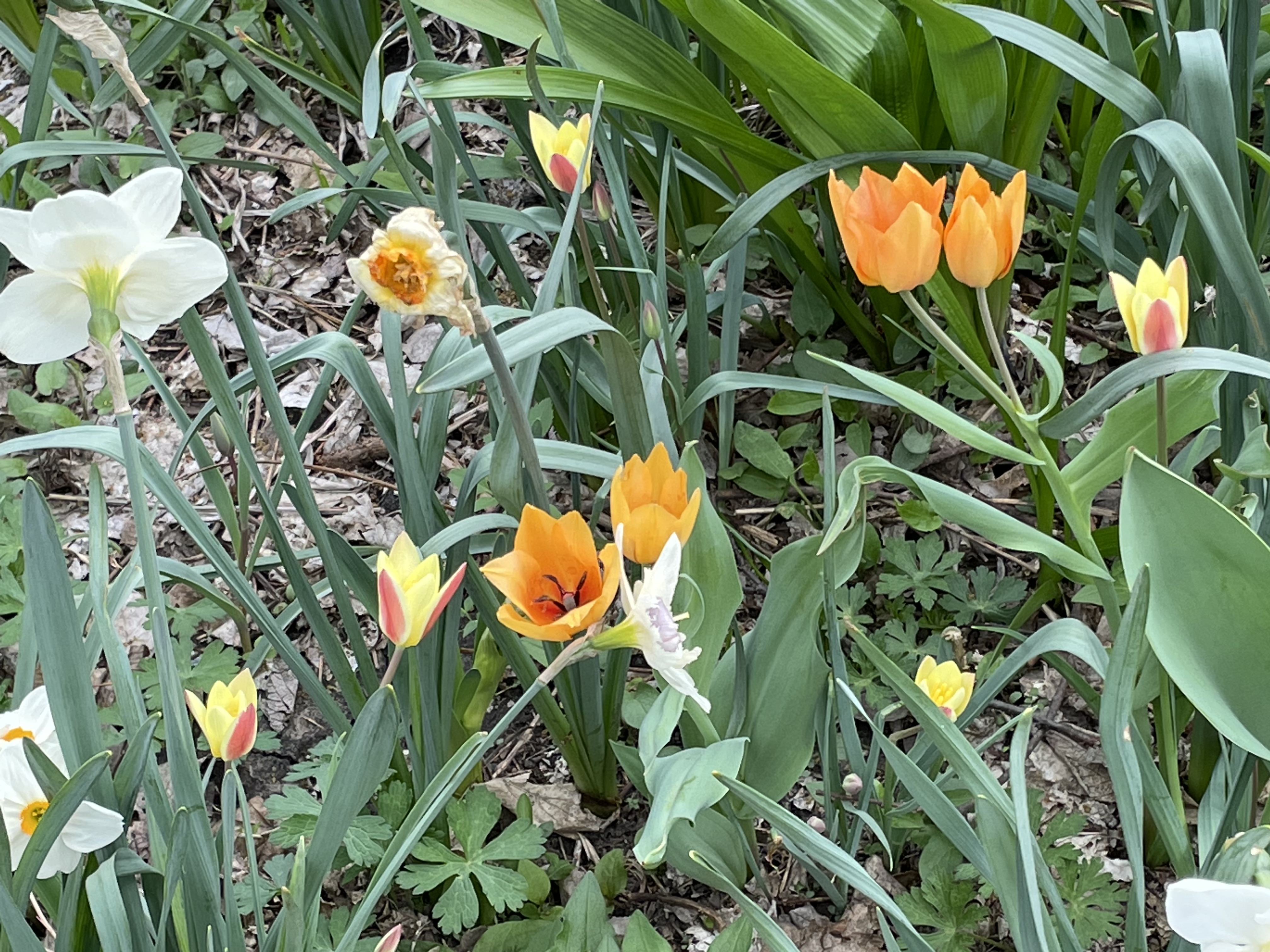
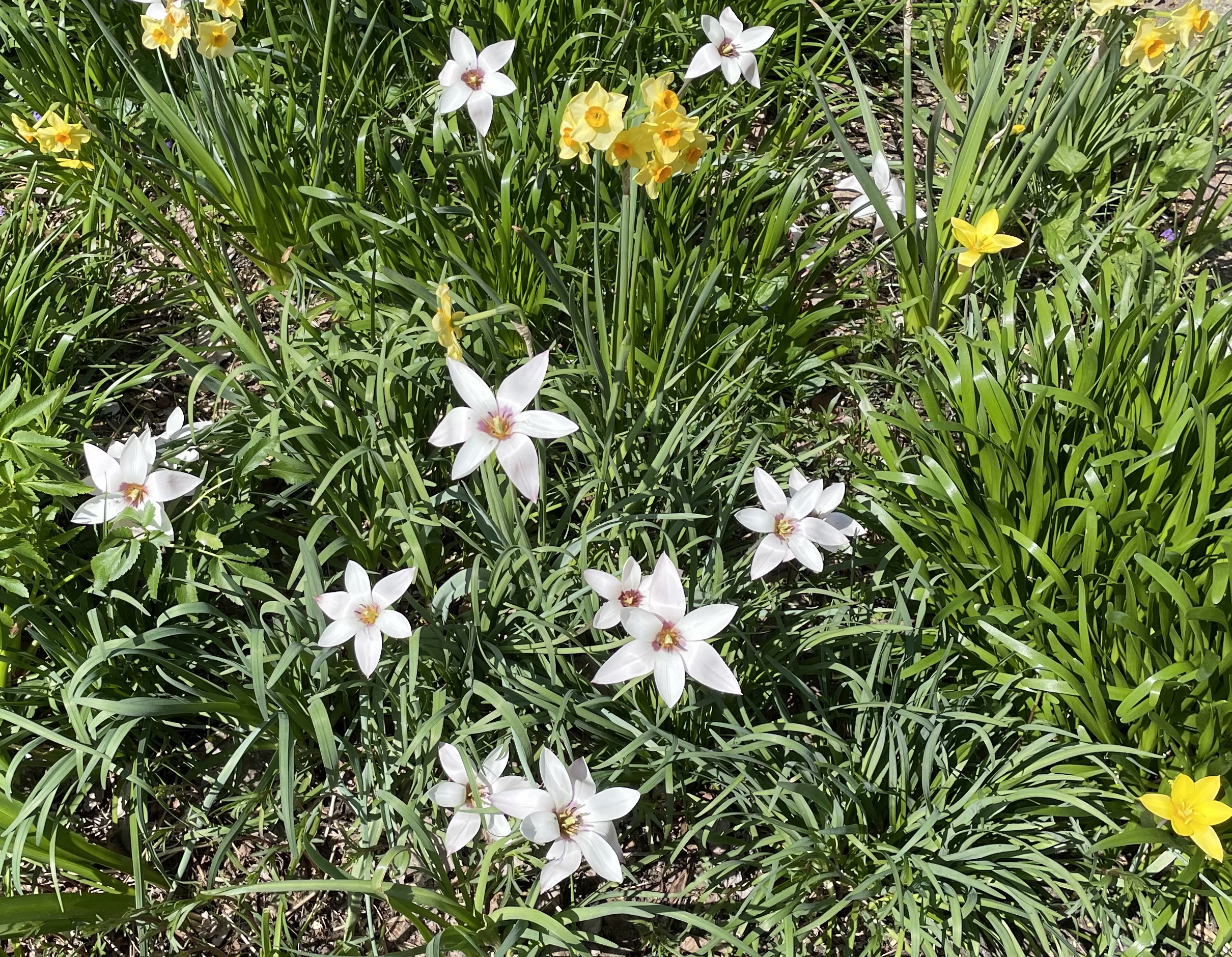
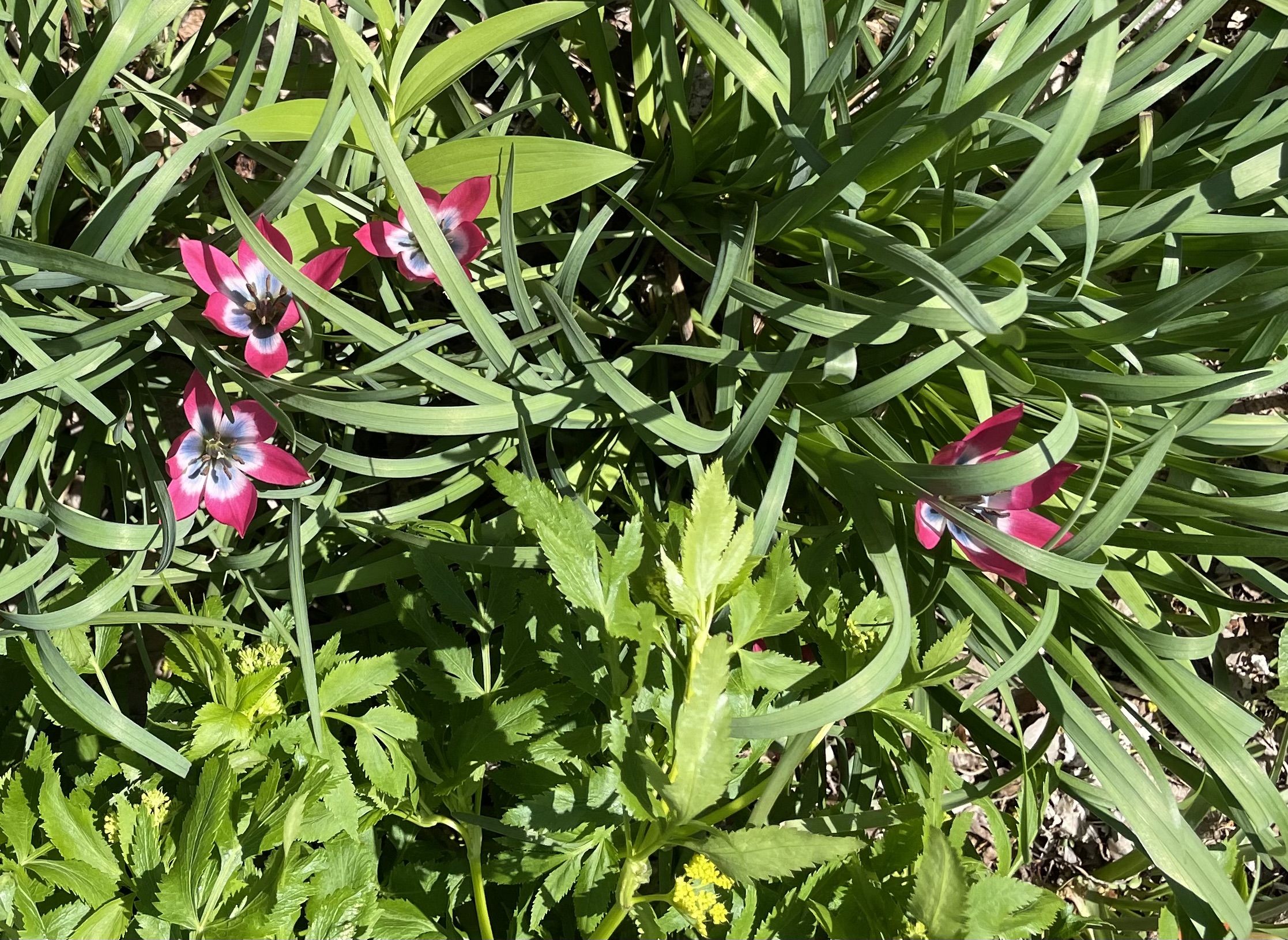
Now here we are at peak spring in the backyard — bulbs galore.

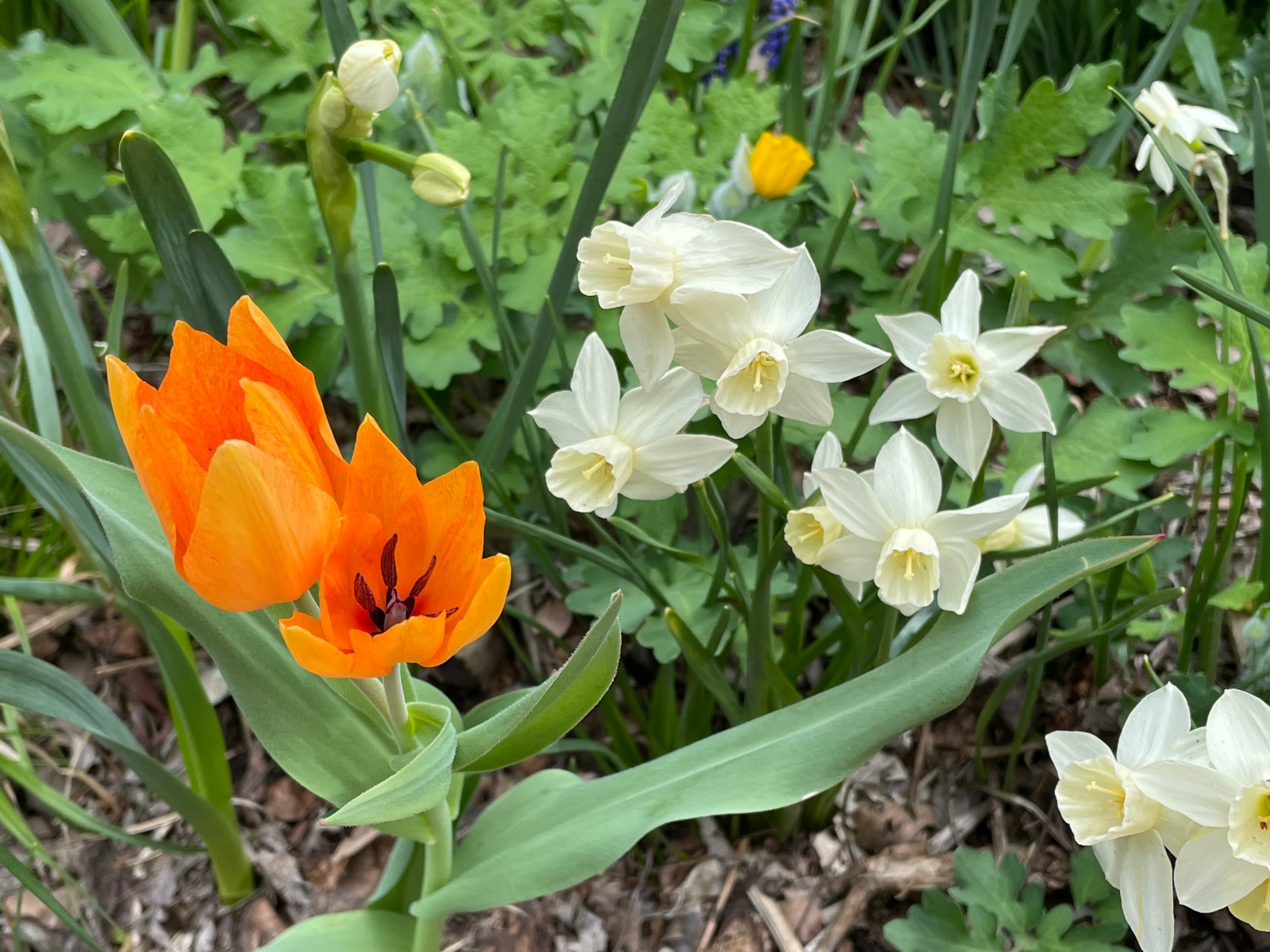
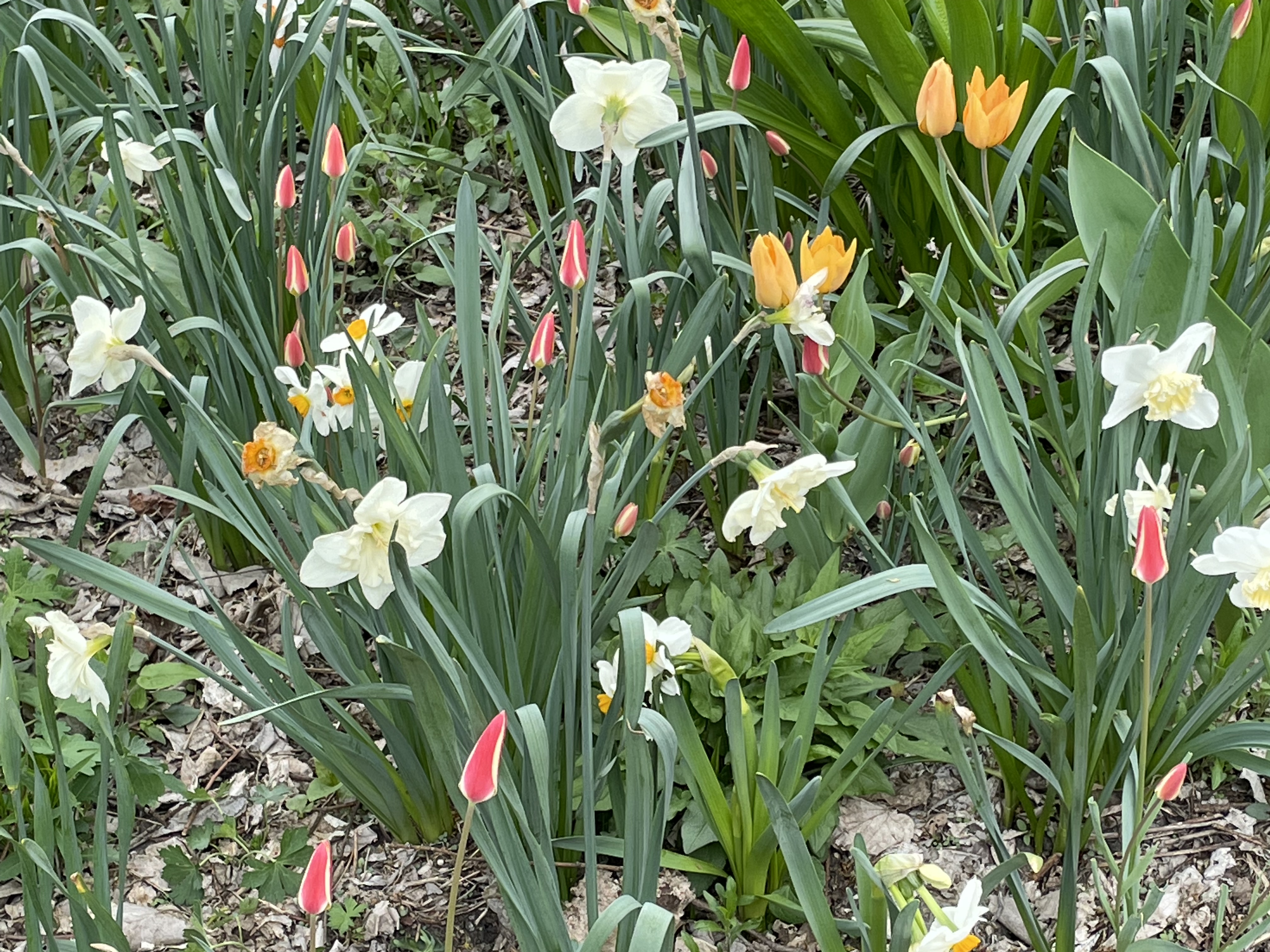
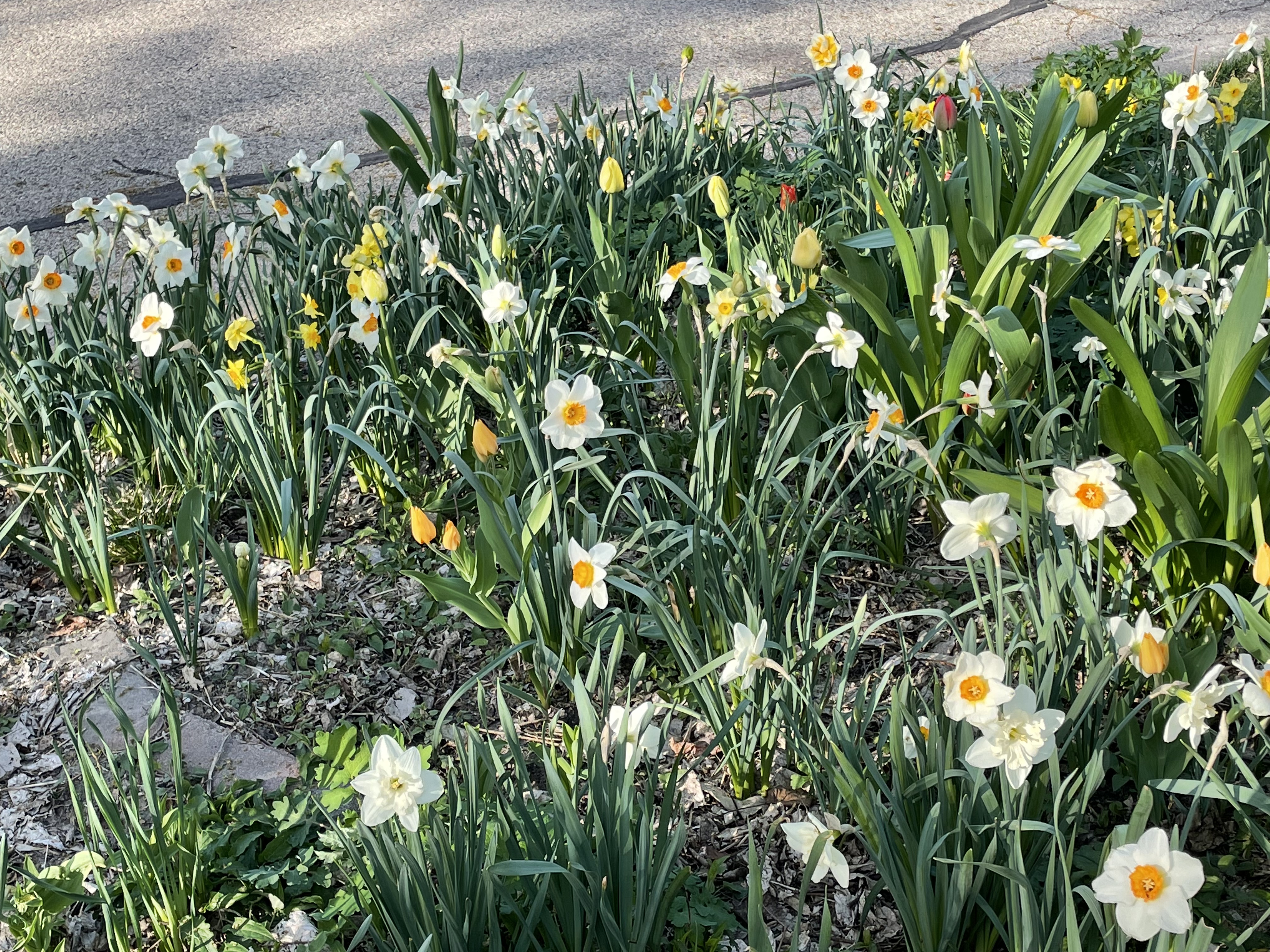
The daffodils below are Cornish Dawn, and I highly recommend them. They put on a great show, and are fragrant as well.

I had an idea about black and white tulips, inspired by a visit to Brandywine Cottage, the home garden of David Culp. I didn’t see the tulips — we were there in September — but he talked about them, and I came home and planted some. Alas, in two years I have been unable to find Queen of the Night tulips which are anywhere near black or even dark purple! I was apparently too disgusted this year to even take a photo, but here are the white ones.

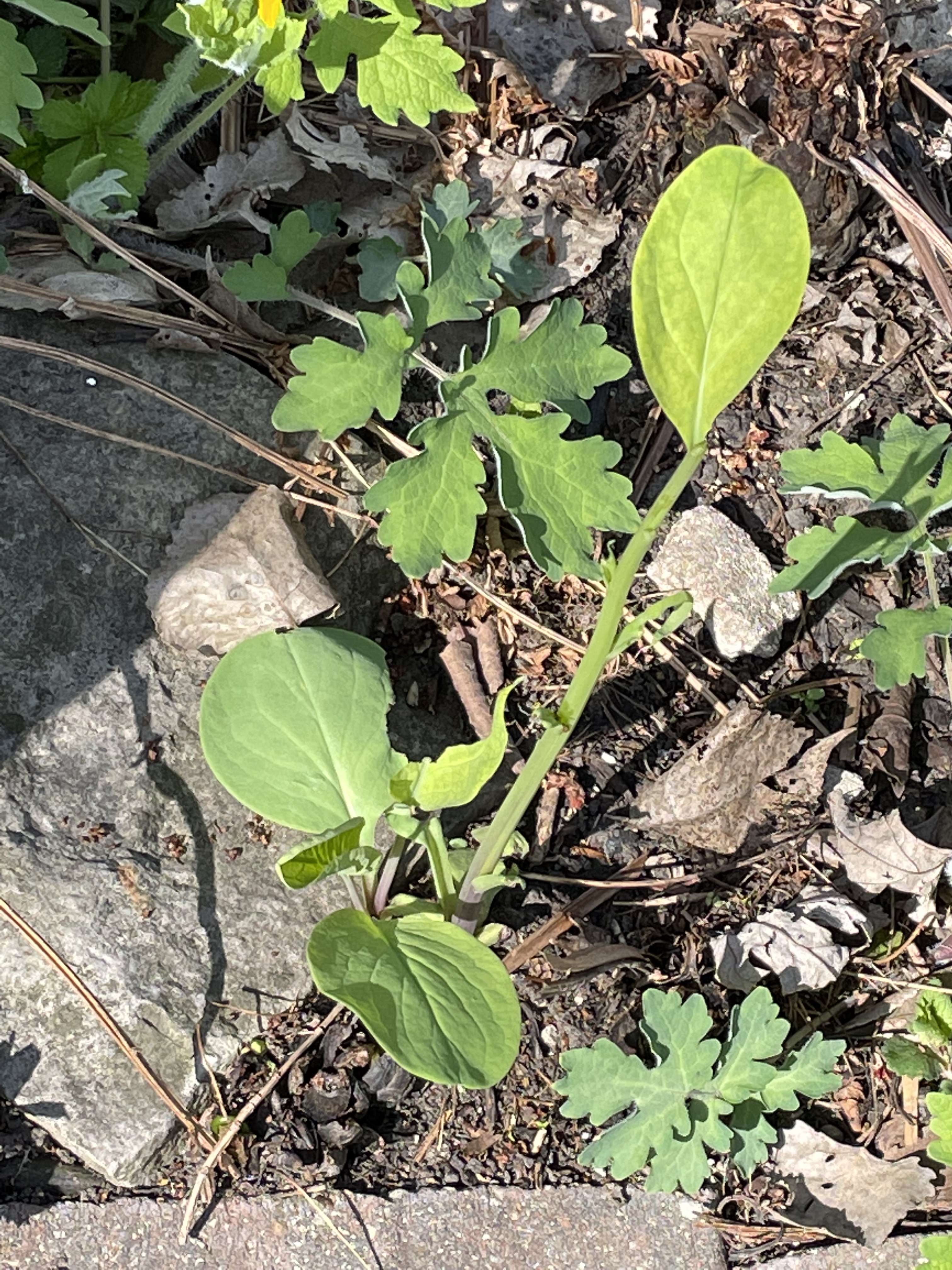
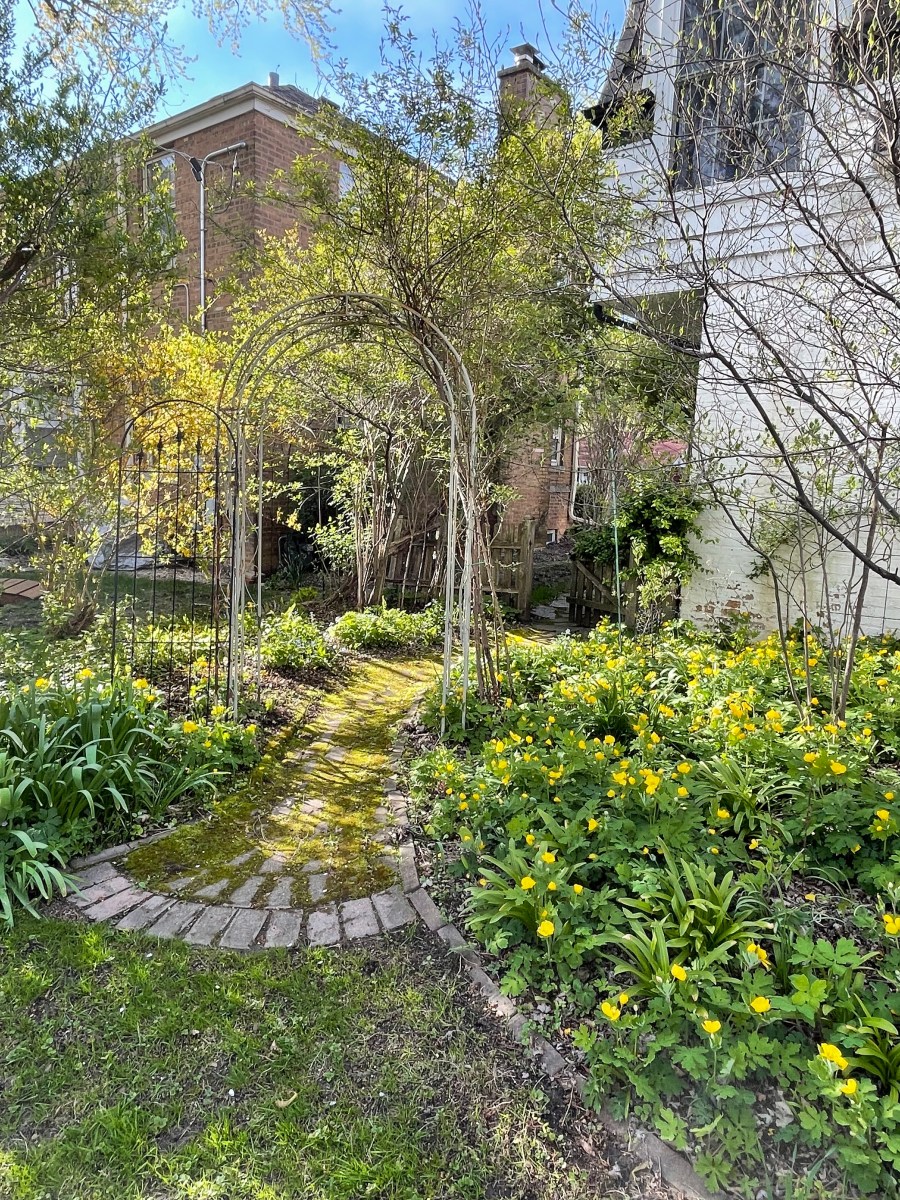
Spring at Garden in a City would be nothing without Celandine poppies — even if I spend May pulling them out so they don’t crowd out the next round of plants coming after. These are greater Celandine, Stylophorum diphyllum, a bit of a menace with how they spread, but as the Wisconsin Horticulture people say, easy enough to pull up by the roots.

That’s it — I’m going to give you a tour of the front in my next post, and then we will move on to summer. Can I blame being behind on the plants? Gardening is supposed to be a peaceful hobby! Do you ever feel like your plants are rushing you along?

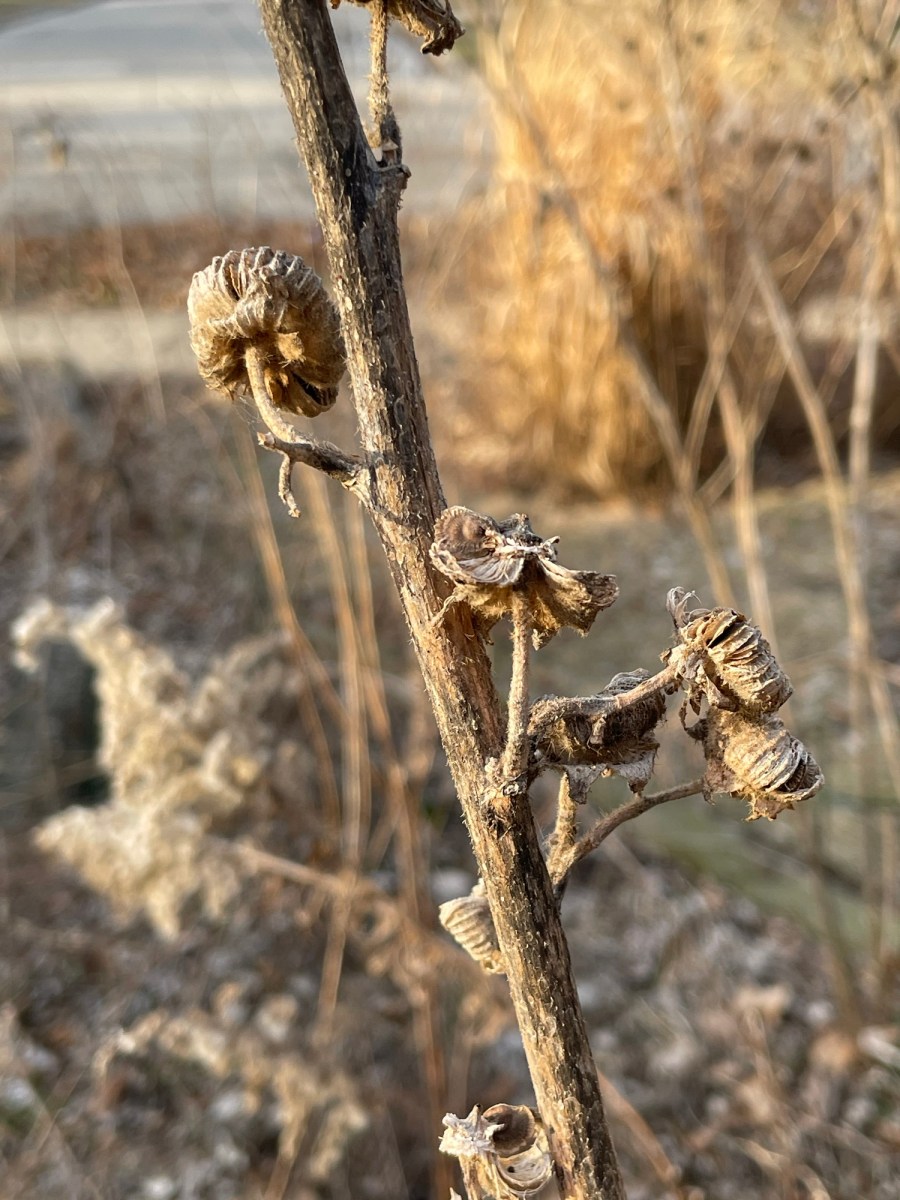
Monday was a beautiful spring day (not that it won’t turn cold and rainy again and maybe even snow), and I went out for a walk around the premises, looking for new life. But paradoxically, I fell in love with the winter garden all over again, and decided to take you on one last tour. It’s all being cut down tomorrow.

I came to the front flower beds just as the glorious rays of the sun were slanting their golden evening light over everything.

This hollyhock came back years after Jason pulled all the plants out because they had become diseased. Surprise! I had to wait a couple months to see what color it would be (white). I’m not sure hollyhocks go with the current garden plan, but I do like a surprise, and I’m hoping it will bring a few friends along this year.

These yellow coneflowers are maybe not as tall as they appear in this shot, but I love how they are shooting for the sky, even after a long winter. Myself, I was desperate for Daylight Saving Time to begin.

This is Baptisia, False Indigo. Alas, I could not make my cell phone focus on the seed pods, no matter how I tried. I’ve been wondering if I should switch entirely to a cell phone camera, and this may be the answer. I did go in to get my tiny Panasonic Lumix, but both batteries had died in the six months since I last touched it. More about camera issues in another post!

This reminds me of wandering through Lurie Garden in the winter. So many textures, so many shades of brown and gray. I’m not downtown much these days, and I miss it.

Milkweed has so many good qualities to recommend it. Friend to monarchs in the summer, provider of a spectacular show through the winter. I think I’ll save this seed pod and let Addie float it into the wind when she’s here next.

I do love grasses. I added a couple to the garden in the fall (including some prairie dropseed!) and am hoping to add a few more this year. But I may need to make flash cards to help me remember their names.

This is what remains of Northern Sea Oats after a long winter. They have to be cut back or they will drop a million seeds and take over everywhere. But aren’t they irresistible!

I believe this is the empty seed head of a monarda. We were a little overzealous in trying to restrain them this past summer. They have never been my favorites (I’m just not fond of their colors, for one thing; personal taste, not their fault). But I missed their quirky presence when they were diminished, and so did the bees.

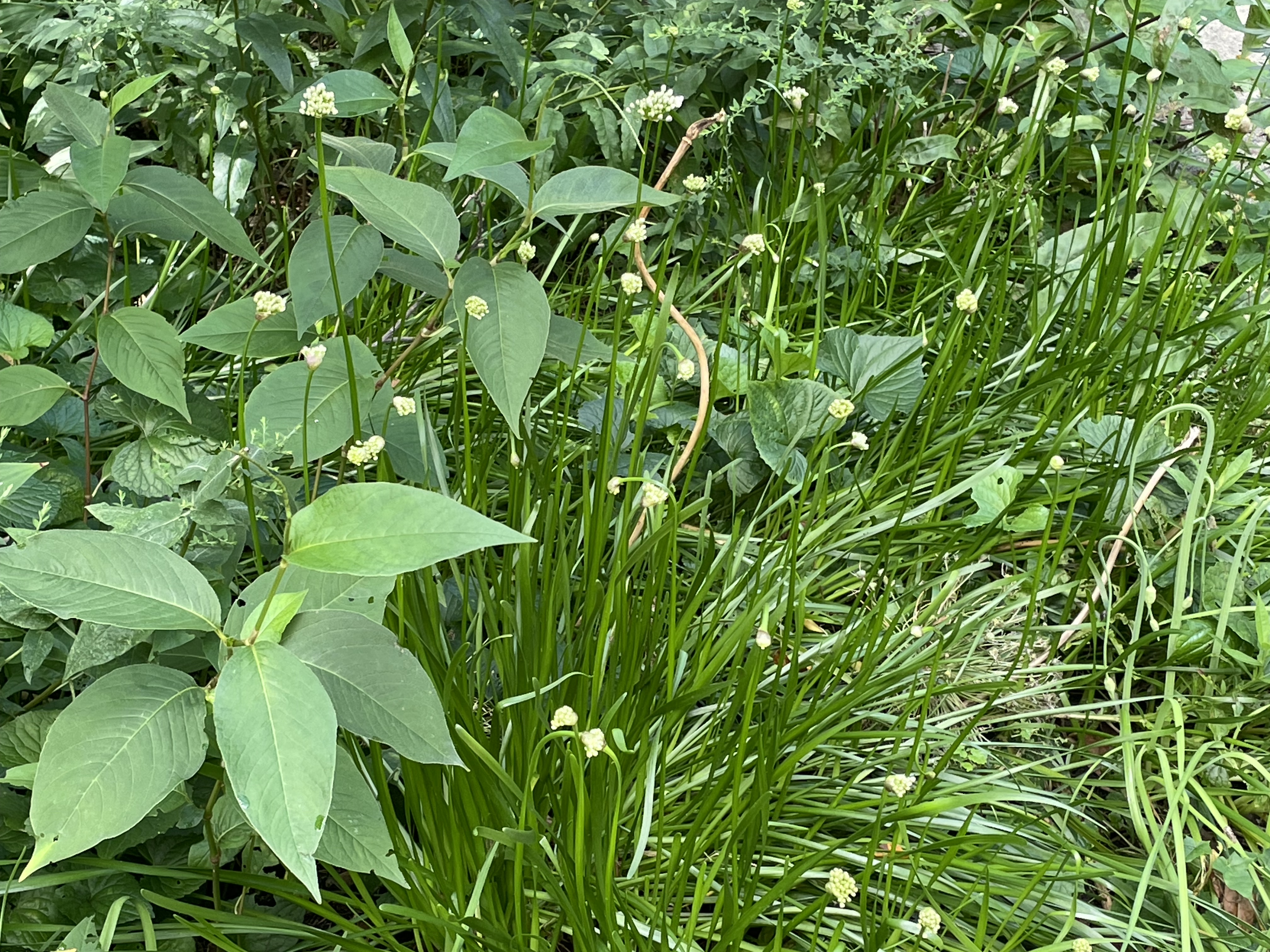
Alliums! Stars of the garden in May and June, and then all winter. And I always cut some in the late fall to have inside in a vase. My earliest awareness of them was as those silly pom-poms that look like they belong in a Dr. Seuss book, but over the past two decades or so, they have taken more natural shapes and proliferated energetically in gardens everywhere. Last summer, they transplanted themselves into several garden beds where we had not planted them. My first thoughts were, what thugs! Et tu, Allium! But then I noticed that they had put themselves in all the right places, filling a number of gaps, and I happily left them. There are only a handful of beds they haven’t hopped into (yet).

There are so many shapes and shades in the winter garden.

And then, while this post was in progress, yep, it snowed. This view was captured by my son, Daniel, as he and Addie arrived to spend the day with me on Thursday.

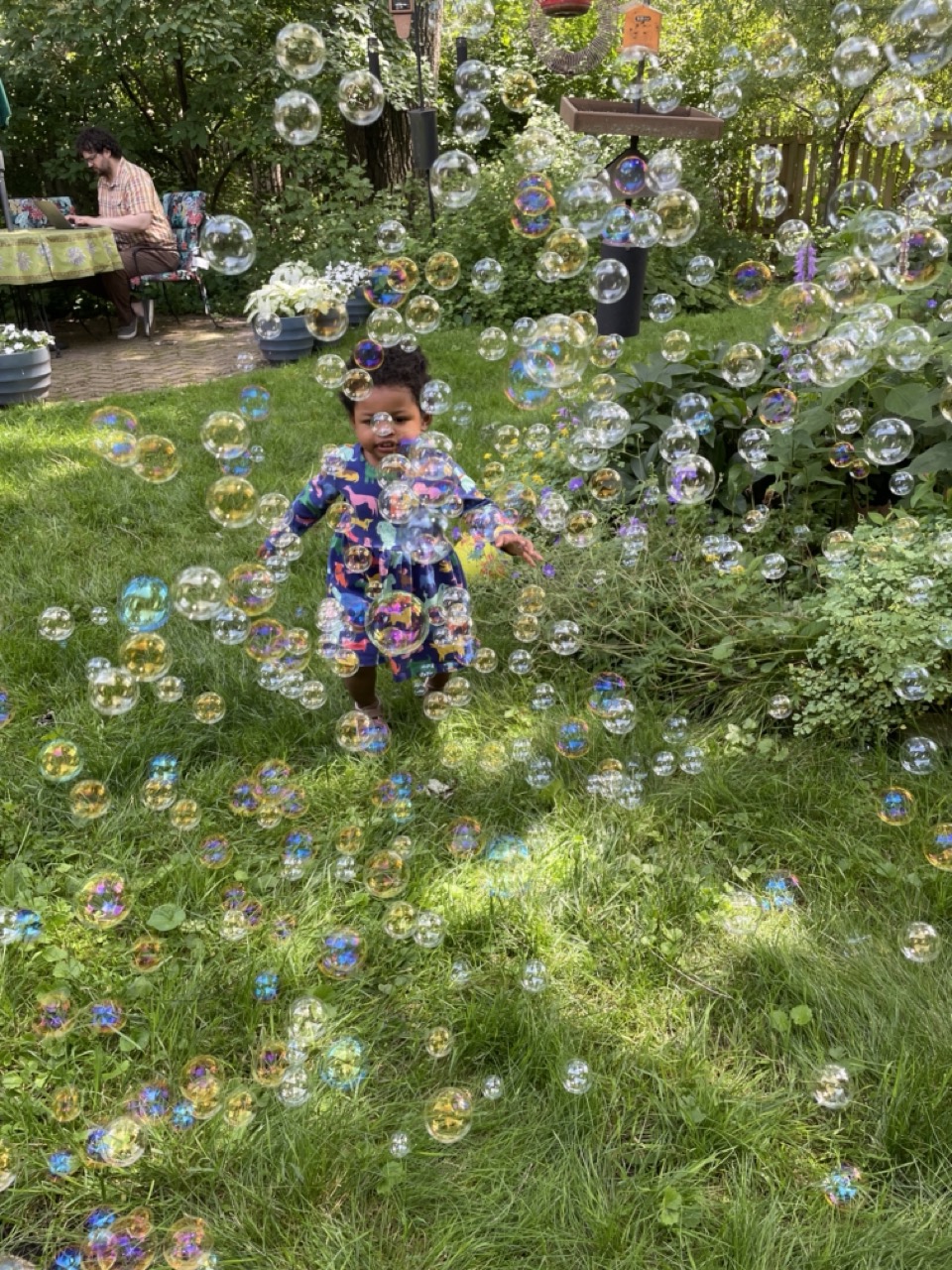
By the afternoon, we were able to take Addie outside for a bubble fest.

How is spring progressing where you are? I have snowdrops, a couple of the earliest daffodils, a few crocuses, and hellebores beginning to fill out, and I’m checking impatiently every day hoping for more.

And now we come to the Garden in a City stumpery. When I started writing the first post about stumps, this was only a gleam in my eye, as they say. I’ve been fretting for several years about the two large trees in the back garden. They provide a wonderful dappled sunlight throughout the day, around which the character of the back garden has been built.

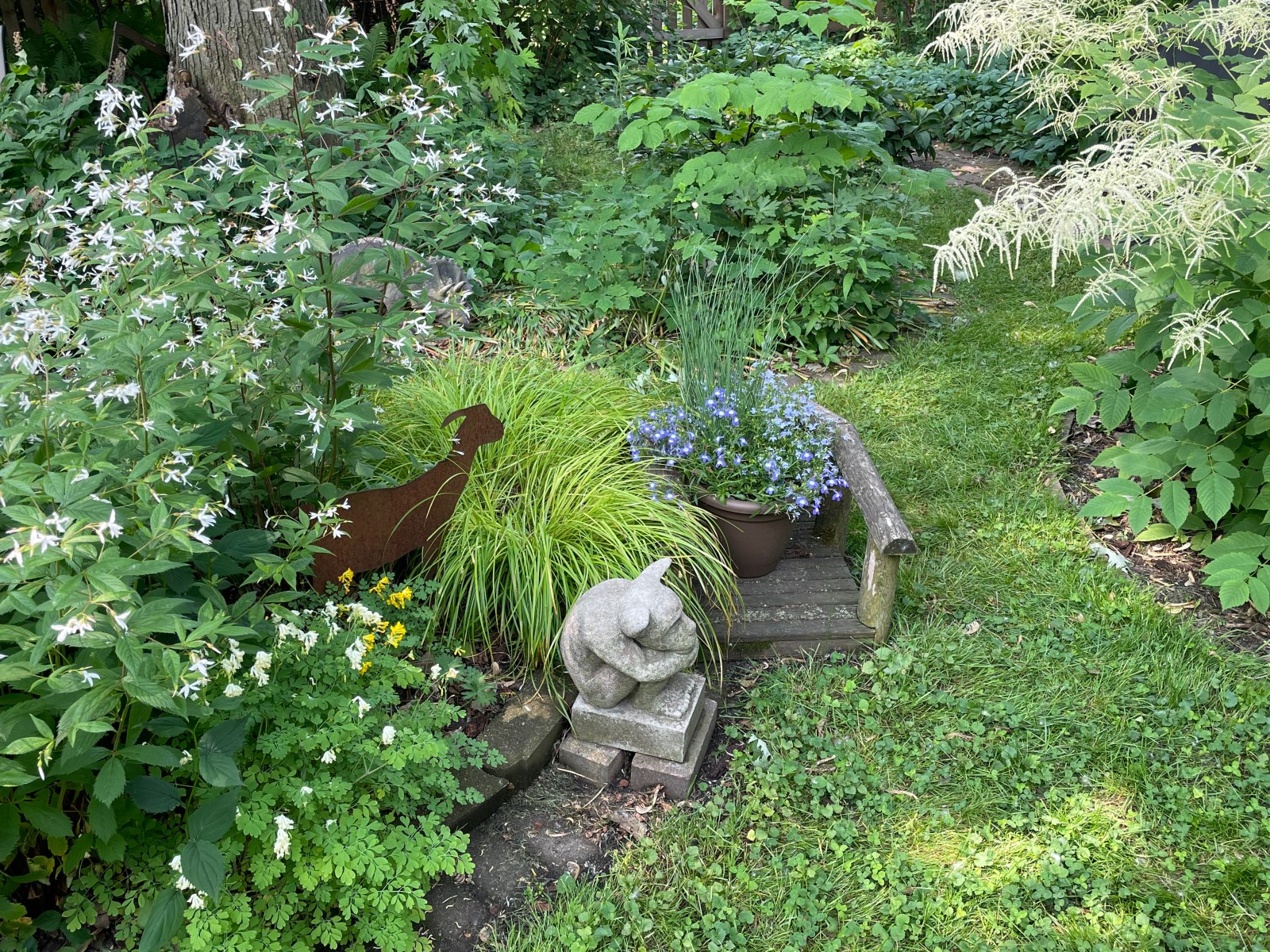
The overall theme is meant to be green and white, but who could resist a few wild geraniums, and I don’t know when that yellow corydalis was added, but it is very happy. So green, white, lavender and yellow.

Both were planted when the house was built, in 1940, and are exactly the kind of fast-growing but short-lived (for a tree) trees favored by contractors. Anchoring a small bed to the back right of the yard is a silver maple, which has long since lost to its shape due to trimming of dead branches.

I love that Bowman’s root! You can’t see it here, but in the photo above there is a large goatsbeard. There’s another dwarf variety behind this Bowman’s root. Two goats and Jason decided we needed a third one, a bridge and a troll.

In the far left corner of the yard is a Siberian elm, still with some graceful limbs, but gradually losing them. Jason used this corner as a wildlife refuge, and left piles of sticks and branches and leaves there. I suppose that is where the possums live, and maybe a few of the many rabbits that inhabit our yard.

Here Addie and I are enjoying a gentle summer day, and there’s my son Daniel, having a work-from-home day on my patio. That’s the pagoda dogwood just beside him, and a bit further to the right, the Siberian elm. The back corner is maybe 16′ square.

Not necessarily the best photo of the back corner, but a fine photo of the uses of a garden full of dappled sunlight.

A few years ago, I was standing by the back gate when a huge branch, six or seven inches in diameter, fell out of the silver maple with no warning. So while I am in no hurry to get rid of these trees, I have a clear understanding of why they shouldn’t be kept too long. Of course, when they go, that will be the end of the dappled light. One corner of my brain has been worried about falling branches (two have fallen from the neighbor’s trees in the past few years) and another corner has been fretting about the future of dappled sunlight, shady-loving plants, and our wonderful backyard haven.

After Jason was gone, there was no one to share the worry and the planning, and even more reason, it seemed, to fear change in the garden. The problem-solving part of my brain knew that I needed a new vision for the backyard, something that I could be excited about and look forward to, in order to counterbalance the worry.

Also beautiful in the fall light! This is from 2020, a few lost branches ago. You can see several stumps where branches were removed.

But I did not have that vision until I saw the two stumperies this past summer. Of course, I am in no rush to cut down the trees, and the arborist who did the trimming this year thinks they have a few good years left. For awhile, I thought my vision was mainly for daydreams.

Before the arborists came out this fall to perform the latest amputation, I mentioned my new idea to Kasey, the head of Vivant Gardens. She was quite enthusiastic about the idea of a stumpery.

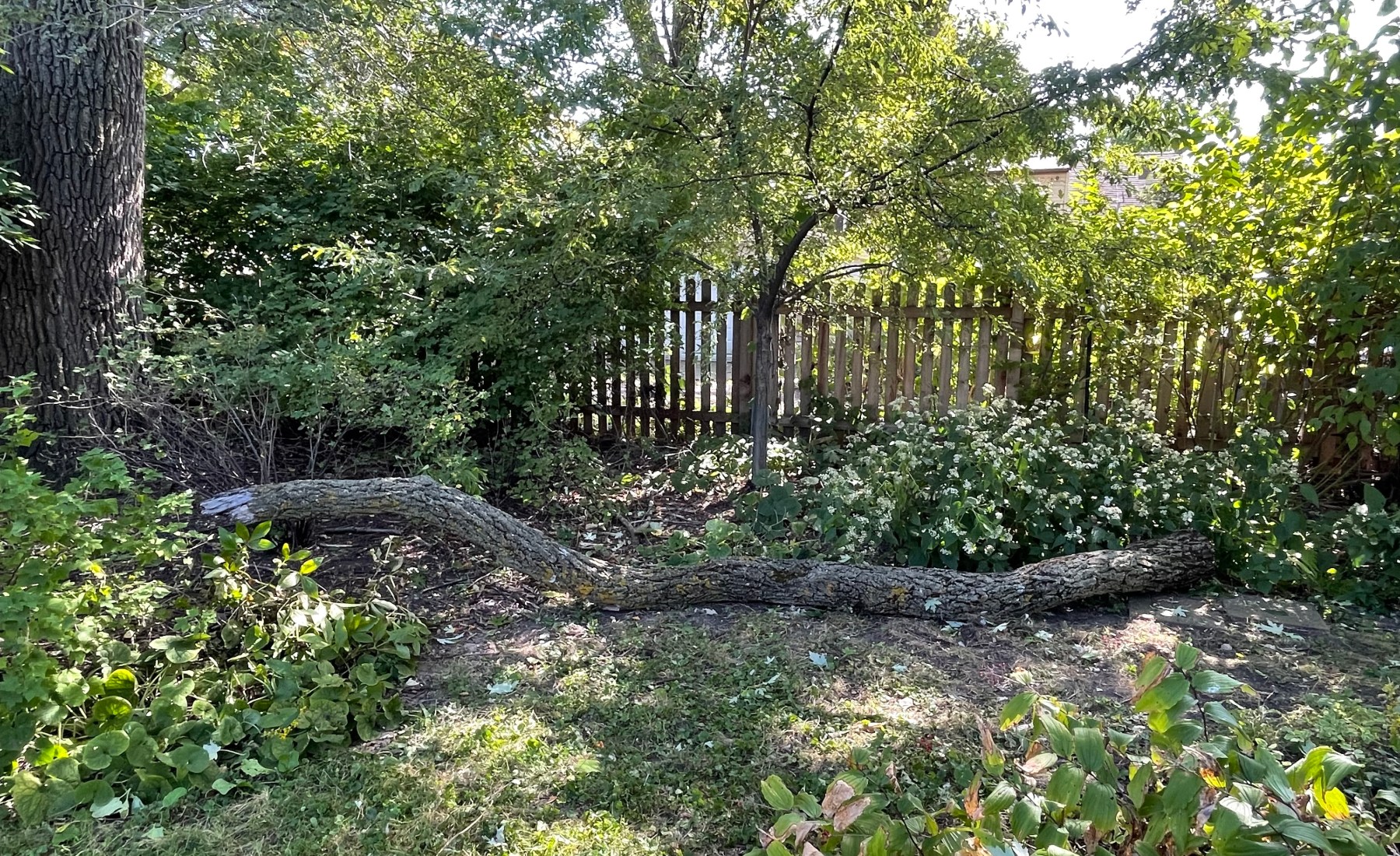
The tree limb in question was long and sinuous, and I pictured it lying out of sight along the back fence, awaiting further developments. Ha! I had no ability to comprehend the size of a tree limb thirty feet above my head. It was too big to come down in one piece, and the sinuous part was too long to be safely moved into the back corner.

The sinuous part of the branch is 16′ long; the rest of the branch is stacked by the tree trunk in the next photo.
Yep, those logs were part of this branch, too. Yikes!

Before it was cut, it hung over my neighbors’ yard, and they called it the dragon. You can see why it felt menacing!

Sooner than I anticipated, this looks like the beginnings of a stumpery! The arborists and I made sure the long log was well-positioned so that it would not shift and possibly hurt Addie (or anyone else).

It looks pretty good in the winter, too, and you can see that plenty of small animals are finding passage into the back corner. Now I just need to ask the arborists to keep an eye out for an actual stump for me, a nice big octopus. I’m pondering ferns and mosses in the meanwhile.

I’ll keep you posted as the situation develops. What do you think?

Here at long last is the next post on stumperies. The second stumpery I saw this past summer is known as the Renaissance Garden, and is part of Heronswood Garden on the Kitsap Peninsula of Washington State. I saw it the day after the stumpery in my last post, as a part of the 2024 Garden Fling (formerly Garden Bloggers Fling) in July.

I still can’t entirely explain why these stumps, logs, mosses and ferns make my heart go pitapat, but they do.

The Kitsap peninsula was extensively logged during most of the past century, and this stumpery is called the Renaissance Garden because it represents the reclaiming of the forest and the land. My friend Pat Webster, of Glen Villa Art Garden in the Eastern Townships of Quebec, suggests that, “To be truly memorable, a garden needs to grow out of an idea. It needs to mean something.” This garden certainly fulfills that mission.

Let me back up and tell you about Heronswood, to put it into some context.

Heronswood was launched when Dan Hinkley and Robert Jones took possession of the property in 1987 and began to develop Heronswood Nursery and Garden. They lived on the property, so it became both personal garden and showcase. In addition to many more common garden plants, the gardens highlighted the exotic species that Hinkley gathered in regular voyages across the world to collect rare and unusual plants, trees and shrubs. The gardens and nursery became well-known in horticultural circles.

In 2000, the nursery and property were sold to Burpee Company. Unfortunately, this did not work out well, and in 2006, the gardens and nursery were closed. A period of nearly complete neglect followed. Happily, in 2012, the Port Gamble S’Klallam Tribe was able to buy the property at auction and begin a lengthy process of rejuvenation.

A small part of the more formal garden near the house

Some parts of the original garden remained if not intact, then capable of restoration, and significant parts of the original gardens can been seen. The decision was made, however, not just to restore, but to imagine the future.

In addition to the Renaissance Garden, there is a rock garden, a formal garden and borders around the house, a woodland garden, a garden which showcases the plants which the S’Klallam Tribe uses, and a Traveler’s garden, which highlights the plants brought in from around the world.

In the woodland garden

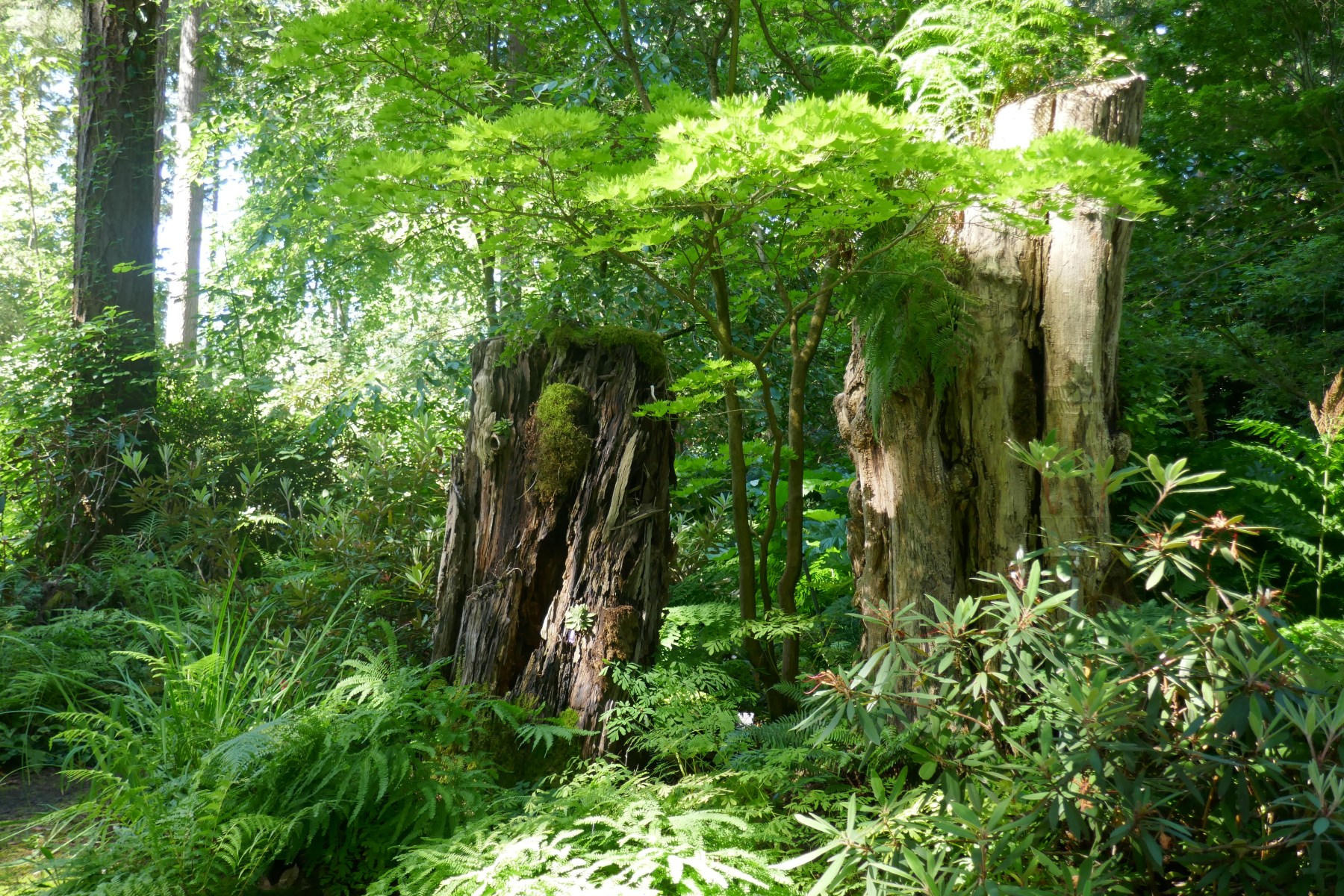
Many members of the S’Klallam Tribe had found work in logging camps over the past century, on what had once been their tribal lands. Now they had an opportunity to restore a part of the land. At the Renaissance Garden, in particular, there is the triumph of reclaiming land that had been exploited, beginning the process of making it whole again.

The stumpery includes some of the equipment of a typical logging camp, now rusting away.

So much life is springing up from the ruins of the old forest, nature moving in and taking over, with some judicious assistance and enhancement. All the shades of green are present, and dappled light filters through the trees. I find these decaying logs, the surrounding ferns and mosses, and the canopy of towering trees totally enchanting.

We were given a tour by the Garden Director, who talked about the ongoing process of putting it together and pointed out some of the unusual plants. At first I was surprised that they had not primarily used native plants in the restoration, but I imagine the exotic plants are part of the overall character of Heronswood.

As I have been reading over this post and contemplating these photographs, it occurs to me that this stumpery evokes for me some of the same feelings we had in the gardens Jason and I visited in Japan. There is a sense of how ancient the land is, the many uses to which our forebears have put it, and the meaning it has had to them. In these gardens, I feel surrounded by history and a powerful sense of place, and aware of the people who have been here before me.

At Ginkaku-ji, in Kyoto, there are no stumps, but there is a serious appreciation of tree trunks, ferns and mosses, as well as dappled light and a sense of reverence for place and history.

I’m not sure how I can put a photo of one of my first stumpery logs right below these gorgeous pictures of Heronswood and Ginkaku-ji, but here it is, as a teaser for my next post, all about the beginnings of a stumpery at Garden in a City. And here’s the best part: I’ve already written the post, and it is queued up to publish about 48 hours after this one.

Are you ready to rush off to a stumpery right now? Are you looking at your local trees with new eyes? Or are you wondering if winter isolation has driven me batty? As always, please let me know in the comments.

In late July, I took a six-day trip to the Pacific Northwest, to the 2024 Garden Fling (it used to be the Garden Bloggers Fling, but some of us are using Instagram and even TikTok, and so we have a new name).

And then I got Covid (for the first time!) and was totally out of it for awhile — nothing alarming, just sick and then very tired.

All of which explains my very slow responses to comments on the last post! Sorry!

Now that I am finally recovering, I really want to tell you all about Stumperies.

I’ll come back later in the fall and winter and tell you more methodically about the various marvelous gardens we saw in three days of wide ranging tours based out of Tacoma. But my heart was stolen by a bunch of tree stumps, and it’s really all I want to think about right now, and share with you.

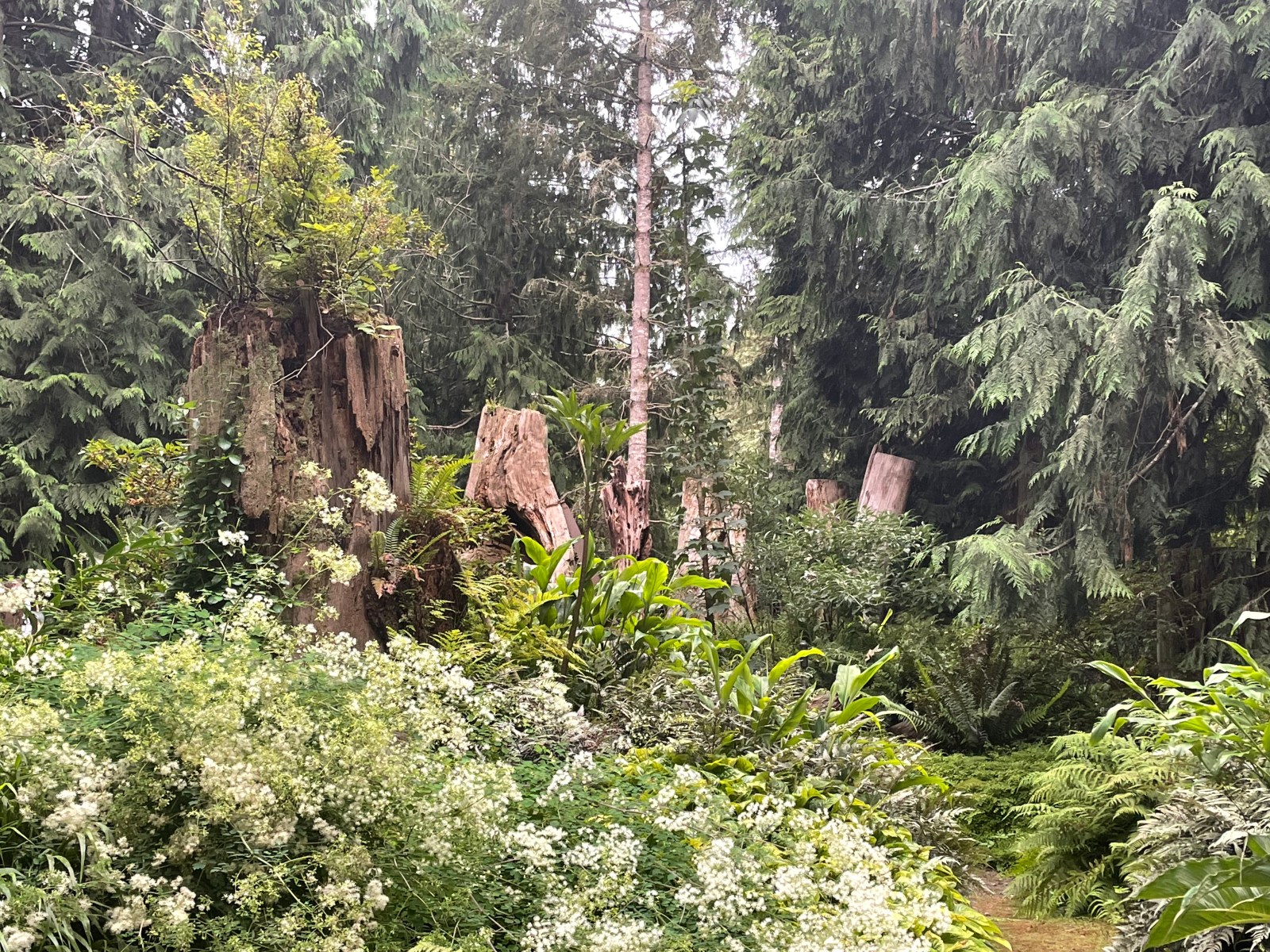
I’m smitten, so I will get straight to the point: look how magnificent these old stumps are in the Rhododendron Species Botanical Garden!

It may be that in order to fully appreciate this stumpery you have to be standing in the woods with trees towering over you. (Have you been to the Pacific Northwest? The trees SOAR!) Not to mention the scent of the woods and moss and forest floor compost in your nose. Our eyes are truly wondrous because we can adjust and pick out the details in both shadow and light in ways that photography struggles to duplicate. And stumperies are all about shadow and light and atmosphere.

Let me back up and tell you a bit about stumperies. First of all, they are obscure enough that WordPress is quite annoyed with me and keeps trying to autocorrect to Stumper or Stumped, for my own good, I am sure. The Missouri Botanical Garden says that “A stumpery is a garden that re-purposes logs, driftwood and the root wads of dead trees to create a unique garden display.” Roots wads?? If they say so. “These wood elements also provide a structural counterpoint to ferns, mosses and other woodland plants which are planted on, in and around the stumps and logs to ‘soften’ them.”

A little dry and technical, if you ask me, but okay as far as it goes.

I was slightly horrified to learn that stumperies first arose in Victorian England (not the time or place that much of Garden in a City is patterned around). But I can’t honestly say I’m surprised. The first one, apparently, was established in the 1850s. I am just relieved that they are not, apparently, related to the vogue earlier in that century for cemetery gardens.

One of the most famous stumperies was created by then Prince Charles at Highgate in England. The website calls it “tranquil” and “other-worldly” and notes that Victorians liked to grow ferns in tree stumps. Not everyone agreed with the Prince’s taste, apparently, because the Gardens Trust blog notes that Prince Charles’ father, upon seeing the stumpery at Highgate for the first time, asked his son, “When are you going to set fire to this lot?” I do like the idea that perhaps Prince Charles installed the whole thing to annoy his father; much more interesting than a Victorian restoration project. (Yes, I know he’s the King now, but he was the Prince when all this happened.)

The stumpery where I took these photos, a part of the Rhododendron Species Botanical Garden, is the largest public stumpery in the world, according to their website. The stumpery is one small part of a much larger Pacific Northwest woods. We were, of course, there at entirely the wrong time to see any rhododendrons blooming (there might have been a few), but it was quite a fine woods, particularly for a Midwesterner unaccustomed to trees of such height.

Also on the same grounds is the Pacific Bonsai Garden, which I only got a chance to look at briefly. I’m not quite sure how these areas came together. But flingers who did manage to look at the bonsais were very impressed.

I’m going to make this into a two-part post on Stumperies, because amazingly enough, there was another stumpery the next day! Splitting the post will give me space to show you more photos — and the second stumpery was quite different. It is called the Renaissance Garden, and is a stumpery with a story and a purpose.

Also, as an added incentive to read the next post: I’ve been daydreaming about adding a stumpery to Garden in a City, and I’ll tell you all about that, too. You can help me decide if it is just post-Covid fever dreams.

So: Have you been to a stumpery? Are you with me in admiring them, or with Prince Philip, ready to burn it all down?

This is a post I wrote a year ago but didn’t publish. I’ve made a few edits and additions and I am posting it now — I feel a little less at sea this year, but I’m sure the plants are still giggling behind my back.

I saw a social media post recently about Creeping Bellflower (Campanula rapunculoides) and ran outside in a panic to see whether the lovely purple spikes I had welcomed into the garden, knowing that they were sneaking in from the alley rather than invited guests, were INVASIVE!

Update: My gardeners wanted to pull them; maybe they are the invasive. Who knows. I’ll keep a good eye on them and see how they behave.

Thank goodness, no! This gentleman from the University of Wisconsin went over Creeping Bellflower leaf-by-leaf to teach us how to identify it, and my plants are innocent! Well, mostly innocent, not a total thug! (“Never been indicted!” as a certain Chicago alderman used to brag. I believe he is now headed to prison.) It has spread in from the alley, into a couple of places in the backyard, and I do recall that Jason didn’t like them as much as I do, and would pull them out when he wanted to plant something else. But there are a lot of good plants in Chicago alleys — that’s a post for another time — and I’m keeping this one for now.

Let me tell you, however, how much some plants have taken advantage of Jason’s absence to sneak into all sorts of spots in the garden beds! Uvularia waltzed around a corner, jumped across the driveway, and over a border into the bed with the ostrich ferns. Mr. Golden Alexander is setting himself up anywhere he thinks he can get a foot in the door (or a root in the ground). About a third of the plants in the garden are taking advantage of the regular gardener’s absence to tiptoe around and visit each other, leap into each other’s beds, and have a good time.

Yes, they look great, but those yellow Celandine poppies are thugs!

The worst offender, by far, is Celadine Poppy (Stylophorum diphyllum), looking so innocent and decorative above. This is partly my fault, as I am a soft touch when it comes to discipling wayward flowers. Jason noted a few years ago that Celandine Poppies can be quite a bully to smaller plants, but that taller and hardier plants (like wild geranium) can fight it off. I think I need to contain it to only certain beds, or it will take over everything. It even set itself up in a flower bed at the neighbor’s house this year — fortunately, they welcomed it. I did warn them about its promiscuity.

In addition to the Celandine poppies everywhere, look closely and you will see a bit of the uvularia which is hiding behind and just to the right of the daffodil leaves, in the very center of the photo. It’s taking advantage of the fact that it is yellow, but you can see the inverted V-shapes of its flowers. Well camouflaged, indeed!

Another group of plants have vanished altogether. Well, some have just vanished and I regret to say, some were probably hollering at me to be saved from rabbits and thuggish plants, and I heard their cries too late. The flower bed above, with the ferns and poppies, for example, used to be full of bleeding hearts. Did they gradually just decline, or were they throttled by the Celandine Poppies? I’m not sure.

A few years ago, Jason planted Golden Groundsel in a blank spot at the back of the garden, with a direct sightline from where I sit on the sunporch. It bloomed gloriously and I loved it!! It vanished in 2022, but we didn’t have what it took to investigate. In 2023, I was watching for it, closely, I thought. This shot above is from May 11, 2021, so I knew when to be looking. I didn’t see it, and I asked Kasey, from Vivant, to take a look. She didn’t see it, and we made a plan to replant it for next year. Maybe it accidentally got pulled because it looks too much like certain weeds, or maybe it just failed to thrive.

Well. I went back later, and here’s what I found. Left photo, first day: leaves and buds right where they should be; next day, on the right, stumps!!!

Dang blasted rabbits!!! And probably the Groundsel was hollering for my attention the whole time, and I just didn’t know what to look for and got out the anti-rabbit powder too late. I got a bit of bloom out of it in 2024, but not like before.

Next up, we have the mystery of the Allium Caeruleum. Here they are in 2022, blooming along with the Allium Christophii. I remember planting the bulbs not long ago. Sigh, not a one in 2023. Did they die out? Did they get pulled as weeds because I didn’t know to tell someone they were there? Hard to imagine either of those possibilities completely wiping them out, but there you are. A garden mystery, one of many. We replanted for 2024, but they were not as glorious as they had been.

I think these blue Allium caeruleum are just gorgeous. I’ve replanted them, but they have never looked this good again.

Meanwhile, the asters seem to have planted themselves all over the place, by ones and twos, poking up where they are not meant to be. On the other hand, I’m worried about where the goldenrod is — but maybe it’s there, and I just don’t see it.

I feel a bit like a substitute teacher. I now repent about how wicked we were to substitutes! Our favorite game was to make up new names. The whole class would solemnly swear that the kid in the front of the middle row was and always had been Tex. I can hear the flowers giggling behind my back: You jump over here, she won’t notice, and look, let’s all crowd into this bed and see what happens!

Wait, I don’t recall Monarda in this flower bed? And the Borage has moved to a new location, crossing the driveway. Jason was not a strict disciplinarian, and he knew that flowers needed to be grown in spots where they were happy, but he also knew how to keep them from completely running amok. He would not have fallen for the Tex gambit.

Even the pots on the patio, drat them, are getting into the act. Look at how these Impatiens are overwhelming the Caladium. The Caladium started out with plenty of space, and should have been just fine. But no, I turned my back, and one day I could hardly see where they were, under the Impatiens. I know we’ve always planted them together in the past; it was one of the tasks I generally did.

Let’s end with two slightly more upbeat happenings, from 2024. In the photo below, a number of alliums have decided to try out a new bed, without waiting to ask my permission. But they have chosen well, crossing both the driveway and the driveway border, and ending up in the central island bed in the front yard. Excellent placement, I should have thought of it myself!

And last but not least, a visit from a scarlet tanager, who stayed and posed very nicely while I fetched the camera. And who didn’t seem too horrified by the state of the water in the birdbath (I am getting better at keeping it refreshed, I promise!).

Does your garden sometimes pull tricks when you’re not watching? Do you feel like a substitute teacher in your own yard?

Well you might ask what is happening, since I haven’t posted in nearly a year! I have composed the beginnings of a hundred posts in my head, and I am often in dialogue with you in my mind. But I’ve had a mental block about sitting down with the computer and writing and hitting the publish button. I’m sure part of it is because this was always Jason’s space, as much as I shared it by taking most of the photos. And of course, I miss him desperately.

The garden misses him too. Many weeks, the goings-on in the garden have left me mystified. I wrote a draft post last year just about this time (but didn’t publish) about how badly the plants are misbehaving in Jason’s absence. It’s still mostly true, and I’ll publish it early next week, after I give this post a few days in the limelight.

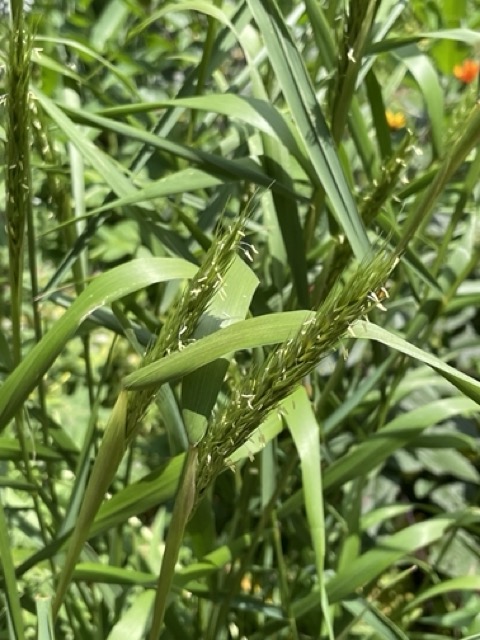
This plant below is one of the poster children for the garden-run-amok. It’s in the middle-front of the driveway bed, four feet tall, growing in the kind of small but healthy clump you might expect from a first-year plant. I have struggled to learn the identities of many of the plants in the driveway border (in particular) as they have emerged in June and grown into July — more on that in a later post. I have also become aware that I was mentally only half here last summer; I listened to the gardeners and expressed opinions and thought I had at least some idea what was going on, but I was in a bit of a fog.

It’s hard to get a great photo since it is green on green.

So for the last several weeks, I have said to myself, Huh, I know I wanted some more grasses, that must be one that I asked the gardeners to plant last fall and I just forgot about it.

Well. This week, as this fine plant is coming into bloom, the gardeners and I looked at it and they told me that it was an interloper. It saw an opening and took it. It just planted itself in my nice, comfy flowerbed, with everything a plant needs except a feather comforter and a bedtime story.

My iPhone says it is probably some type of wild rye. I think it looks good. And there is just a little comfort in the fact that Mr. Wild Rye fooled the gardeners for this long, too. (I think perhaps it’s also a comment on gardening by committee.)

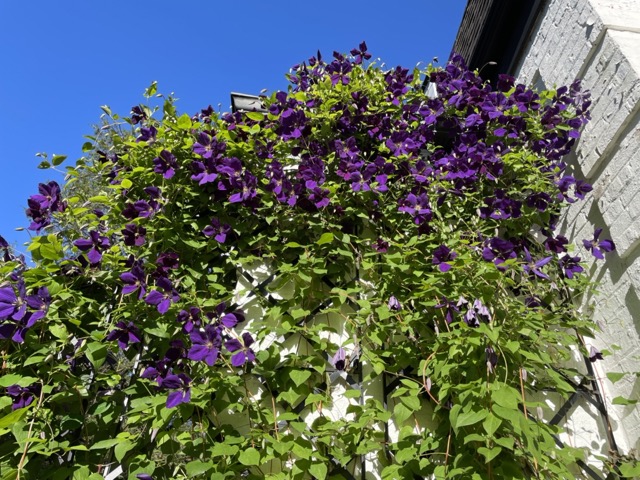
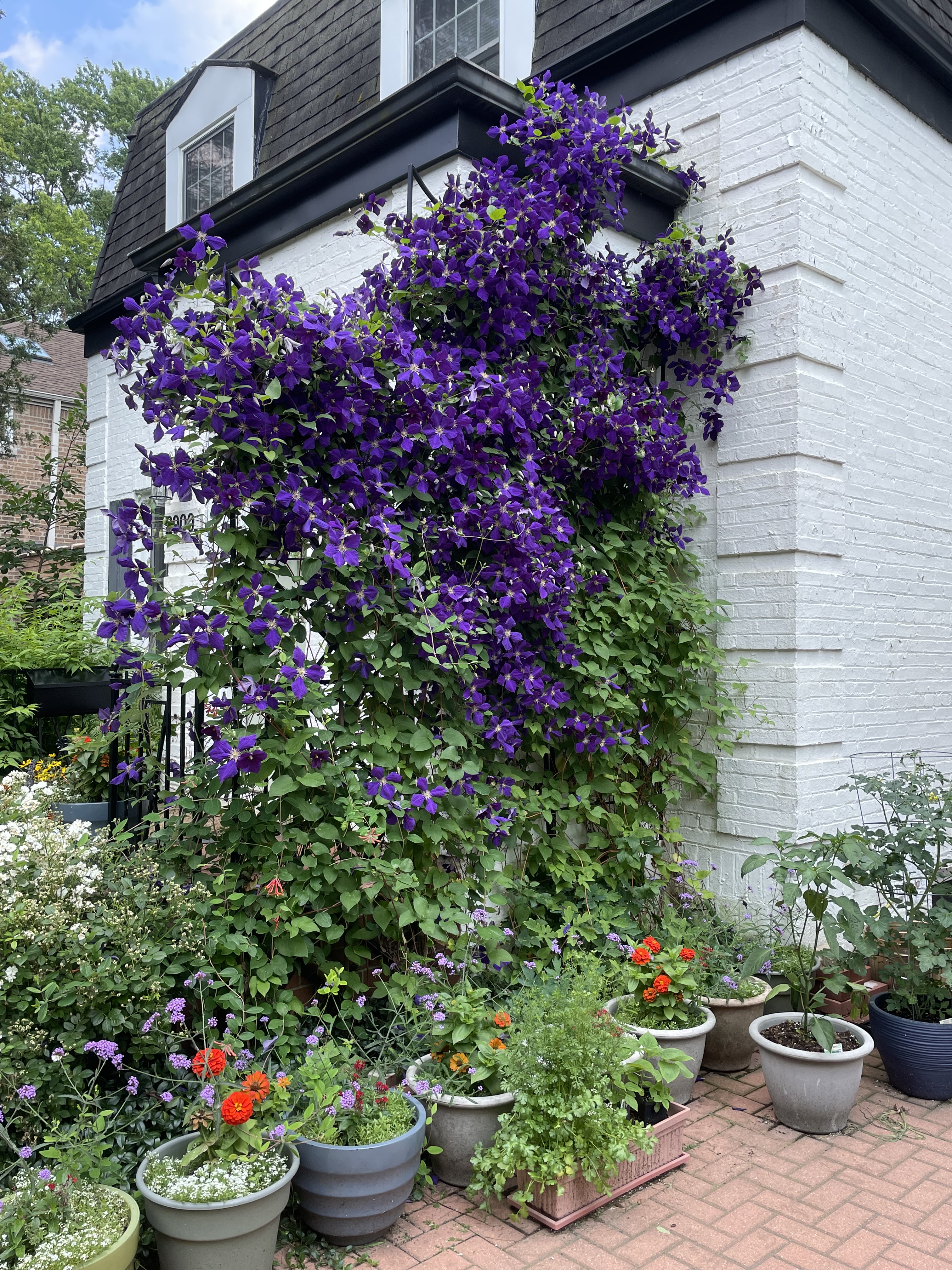
Meanwhile, a lot has also been going well in the garden. You can see at the top of this post that the Giant Wall of Purple (Clematis Jackmanii) is still going strong. The spring ephemerals were spectacular as ever, and the bulbs only get better and better as I indulge my desire for an eye-popping display that announces SPRING! to the whole neighborhood.

I have spent much of the past twelve months in a major learning curve, trying to cram the names of plants into my head and reading books and studying gardens here and there in person, online, in books, and yes, I’ve become a devotee of the BBC’s Gardeners’ World. I thought I knew a lot, but of course it is one thing to observe a garden someone else is managing, and quite another to manage it myself. But I’ll get there.

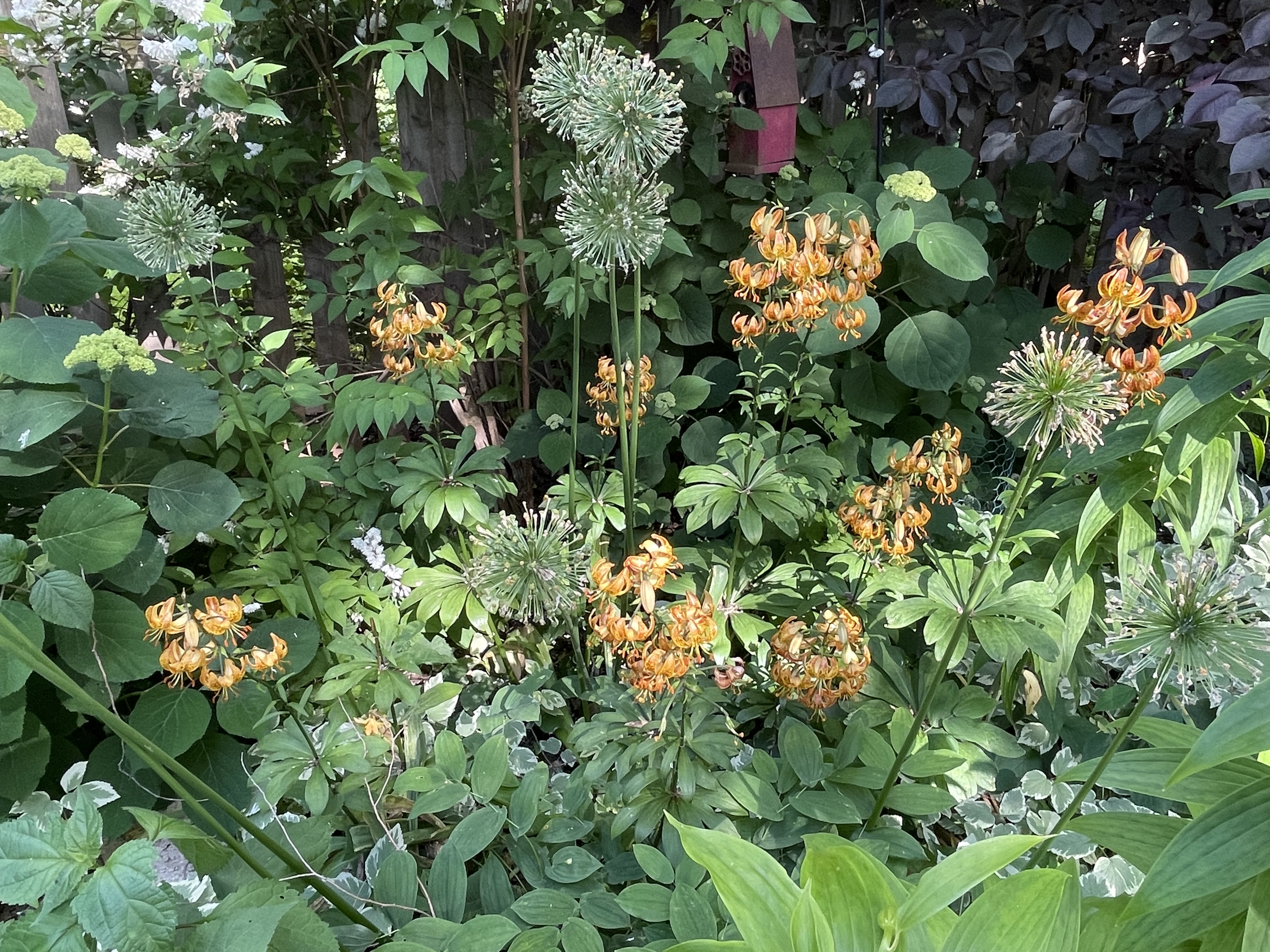
This is a lovely vignette, and I just wish I knew who those leaves on the left are. I probably knew last week, and hopefully I’ll figure it out again next week. The white pom-poms are allium about to bloom. There’s a bit of aster in the back, and some Solomon’s Seal. And I’m afraid there’s a bit of garlic?? You can see it’s not a simple garden. Layers, as they say in the books I’m reading.

And now that I am back to writing the blog, I will take you along for the journey in my upcoming posts. It’s quite a process. But one feature of perennial gardens is that there will be another crack at it next year; not everything needs to be learned at once.

I’ll just ask one small favor. If you can take a minute to make a comment, it will definitely cheer me on as I get back to blogging.

What have you been learning from your garden, and do your plants behave themselves any better than mine do?

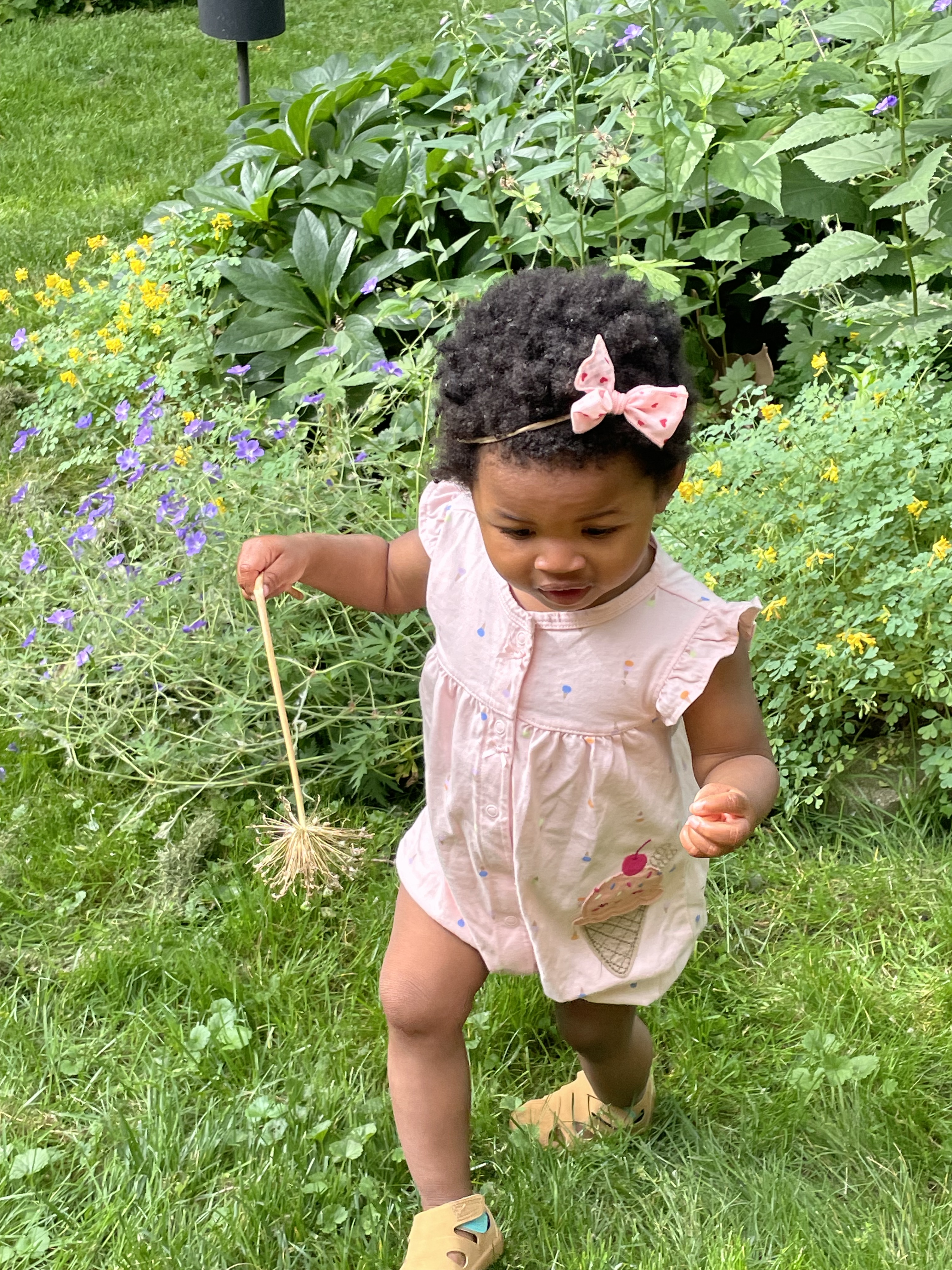
Let me end this post with an update on my granddaughter. That’s my son hard at work in the back garden on a work-from-home day, while Addie and I play.

I have a special place in my heart for spring ephemerals. They are early harbingers of spring. Perhaps what I love is the surprise: You weren’t expecting us, but here we are! Volunteers are always welcome (though maybe not Dandelions and Creeping Charlie…). Perhaps I identify with their shy nature, since many of them have to be sought out in the back of flower beds, beneath otherwise innocuous-looking green leaves. And they certainly don’t overstay their welcome!

Some of them do just show up, with no fanfare, perhaps a remnant of the time long ago when our block was open prairie. Others are purchased over and over, restarted with hopes that this will be the lucky time when the plants choose to stay. And a few of them are invited in (I’m thinking of you, Celandine poppy), feel right at home, and, after a short honeymoon, try to take over.

Here’s bloodroot, from 2022, because it didn’t show up this year. I’m hoping I just missed it, or maybe it is skipping a year.

I had seen ephemerals occasionally before we had them in the garden, when I managed to hike in the Midwestern woods at just the right time. But my first real consciousness of them came during the two years we lived in Madison, Wisconsin. We bought a house with a very neglected garden which abutted a woodlot. A number of ephemerals had crept in to take advantage of the neglected flowerbeds: Uvularia, Large-Flowered Trillium (possibly planted by the previous owners), Jack-in-the-Pulpit, and Dutchman’s Breeches, along with so much Jewelweed that we pulled it out by the bucketful. I fell in love.

One of two stands of uvularia planted in our garden. As of this year, a third stand has planted itself in the bed under the living room window, cowering behind some daffodils and hoping not to be noticed until it has sunk in serious roots.

I wasn’t sad to leave Madison and return to Chicago, but I knew I would miss the garden. Jason searched for, and found (harder then than now) Uvularia to plant in our new flowerbeds. He tried Large-Flowered Trillium more than once before it took — and it’s still a bit marginal. Though it has bloomed for several years in a row, I don’t take it for granted.

There are three plants, of which this is the most hardy.

There was a small, inconspicuous stand of Prairie Trillium next to a fence, near some bushes, when we moved in. It’s still there, same size, blooming for about a week or ten days each year. This photo is from 2019, because I didn’t get a good picture this year.

And we were delighted to find Jack-in-the-Pulpit volunteering in two flowerbeds — though not every year, and so well hidden that you have to be looking for it specifically to notice its presence.

There are at least two Jacks in this photo, but you can see how hard they are to find.

As I thought about spring ephemerals for this post, I realized I didn’t know for sure exactly which flowers were included. So I did a bit of research. (I am learning so much as I write this blog!) Here is a list of Illinois ephemerals. Perhaps you can find a good list for your location. Here, for example, is a completely different list from the Mountain West. If you find a great list for your area, post a link in the comments so we can all enjoy it!

The definition doesn’t seem to be cut-and-dry: the Illinois Extension Service refers to tulips and narcissus as “non-native perennials,” a category which surely includes snowdrops as well. As always, anyone with more knowledge of the matter is encouraged to share in the comments.

Ephemerals show up in the early spring before the leaves are fully out on the trees. They bloom and then disappear — although for some of them, their leaves remain. They provide early sustenance for pollinators coming out of hibernation. Some of their seeds have sweet or fat elements to encourage ants to spread them.

I’m not sure this Columbine was planted here; it may have moved itself from another bed.

Columbine does not appear on the Illinois Extension Service list, but it clearly seems to belong. I think it is time to plant more in the garden. This Columbine in the Front Island Bed is one of about five or six plants remaining of a larger group, each now isolated and looking a bit lonely.

So delicate and pretty. I just love these.

I believe the May apples along the back fence introduced themselves into the garden a few years ago. They really tickle my fancy. But you have to keep an eye on them, or else they bloom so inconspicuously that it is over and you’ve missed it.

I don’t seem to have gotten a good group photo this year, but you can see from this vignette that Virginia bluebells and Celandine poppies go well together.

Virginia Bluebells and Celandine Poppies grow with such abandon in our garden that I find it hard to think of them as spring ephemerals, but the Illinois Extension Service says they are. Although here it is July, and I’m still gnashing my teeth at all the half-dead Celandine poppy plants taking up space in the garden. Ephemeral, indeed! I’m going to call the Extension Service and report them!

The poppies look perfectly innocent here, until you realize that they have elbowed out a bunch of Virginia bluebells and are pushing the Bleeding Hearts to the side as well. I also have photos of the driveway bed with poppies forming a lovely background to the tulips and daffodils — but meanwhile, they are quietly smothering some of the flowers that should come along next. I’ll know next year to take a firmer hand with them.

Still, this color combination is lovely, and makes me think of Easter bonnets. Those are false forget-me-nots in the background — and behind the photographer are ostrich ferns.

Okay, I thought ephemerals would make for a short post, but it’s too late for that! I’m going to end with a couple of pictures from our visit to Mount Cuba Center, a botanic garden in Delaware with natives from the MidAtlantic region. We had the amazing good fortune to arrive at peak ephemeral season, and it took Jason three posts to cover it all — trilliums and trout lilies, various ephemerals, and a broader view. I highly recommend a visit!

Did you have ephemerals in your garden this spring?

I may not post as often as I wish I did, but I can’t tell you how many posts I have composed in my head — I have a regular dialogue with you all, whether you hear it or not. It is lovely to think of so many people spread so far who have appreciated this garden, and it’s about time I shared some updates!

Clematis jackmanii, the Great Wall of Purple, is thriving this year. It is so large, I feel that I should refer to it with plural pronouns, they, them, theirs.

For this post, I am going to focus on bringing you up-to-date on what’s been blooming. Let’s walk through the garden together and appreciate everything that is going well.

I’ve started out-of-chronological-order, because the Jackmanii is just dominating everything right now (but in a polite, well-mannered way). When I was in high school, the mother of one of my friends would say to us, when we were upset about something, “People driving by in cars won’t notice.” In this case, they do, and sometimes they pull over and comment, and it’s all good.

We have several other clematises, but they are of a much more normal size. The other clematises include Multi-Blue in the Crabapple Bed, Betty Corning who is now moved to the bed along the front sidewalk, and Ice Blue on the arbor leading into the backyard. Multi-Blue is looking hale and hearty, but not outsized; Betty is still adjusting after being moved; and Ice Blue is pouting because he would like a little more sunshine.

Isn’t this what a spring garden should look like?

I shared some spring photos in the last post, but this may have been the best ever year for bulbs, due to a long cool April and May, so I will share some more.

Look at these two-headed orange tulips. I swore I’d never seen them before, but they were everywhere this year. Aha! I looked at the well-organized garden notes that Kasey from Vivant sent, and saw that 100 Shogun tulip bulbs were planted in the fall (we don’t do things by half-measures here at GardeninaCity).

Apparently, they are generally called multiheaded or multi-flowering or bouquet tulips. Between the two of us, Jason and I called flowers that unexpectedly (to us) had more than one flower “multiple-warhead.” This probably reflects trauma left from the Reagan years.

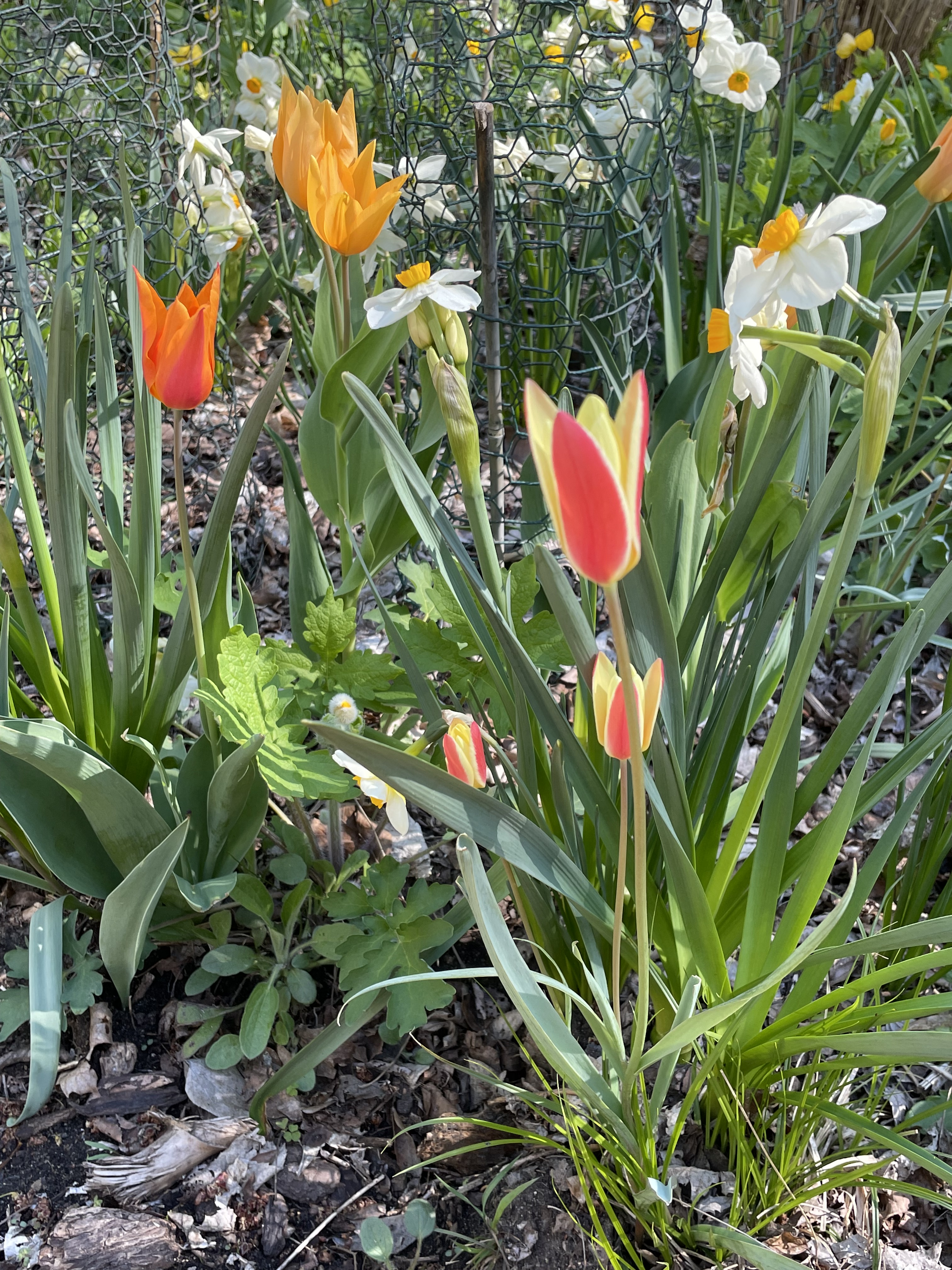
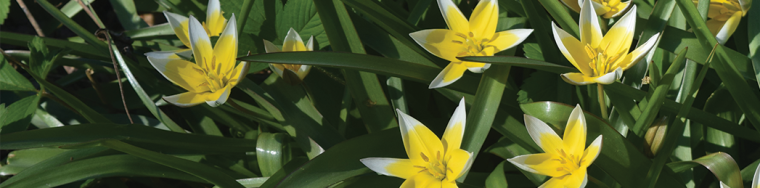
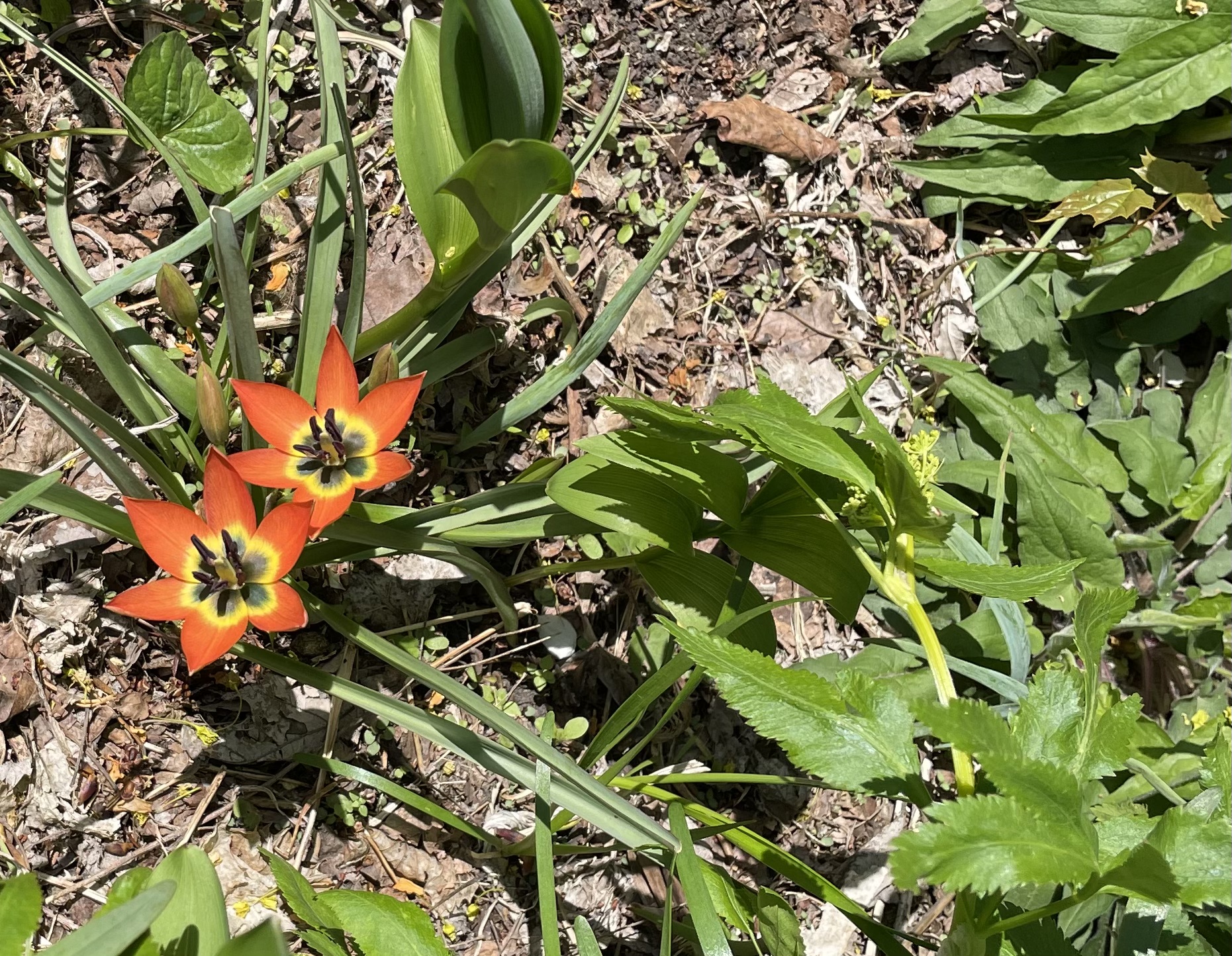
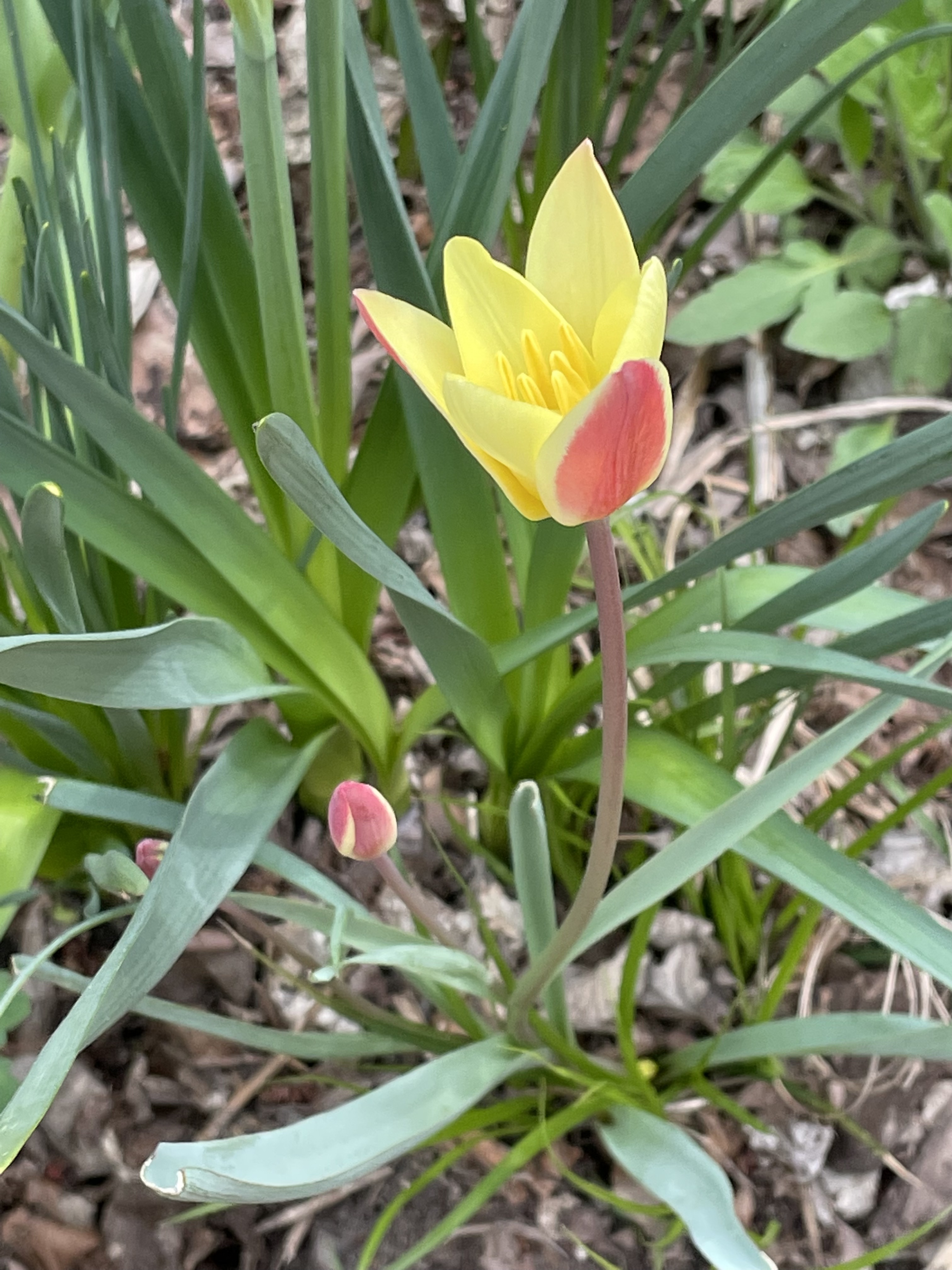
Here’s a medley of species tulips. They open and close each day in the most charming way, depending on the sunlight. I love them all, but the yellow and red one in the lower middle is my favorite. (The tulips are all sleeping now, so I can say that.) Apparently last fall we also planted 100 Clusiana Tubergen’s Gem bulbs. They were everywhere this spring, and I swooned over them.

By the way, that’s the Royal We who did the planting: Vivant and our friends Anne and Jo ana did all the work, while Jason and I cheered them on. Many, many thanks to them. These flowers warmed my heart this spring.

Species tulips are the original plants native to Turkey and areas to the east of Turkey, in contrast to the giant, hybrid tulips that are more common. They are supposed to be more reliably perennial than hybrids (mostly true here) and to spread (some do, some don’t). I’m very happy with a mix, in which the hybrid tulips are bold accents in a sea of species tulips.

(Let me know in the comments how you like the addition of photo galleries to the blog; I suspect that if you are looking at this primarily on your cell phone, these photos will be too small.)

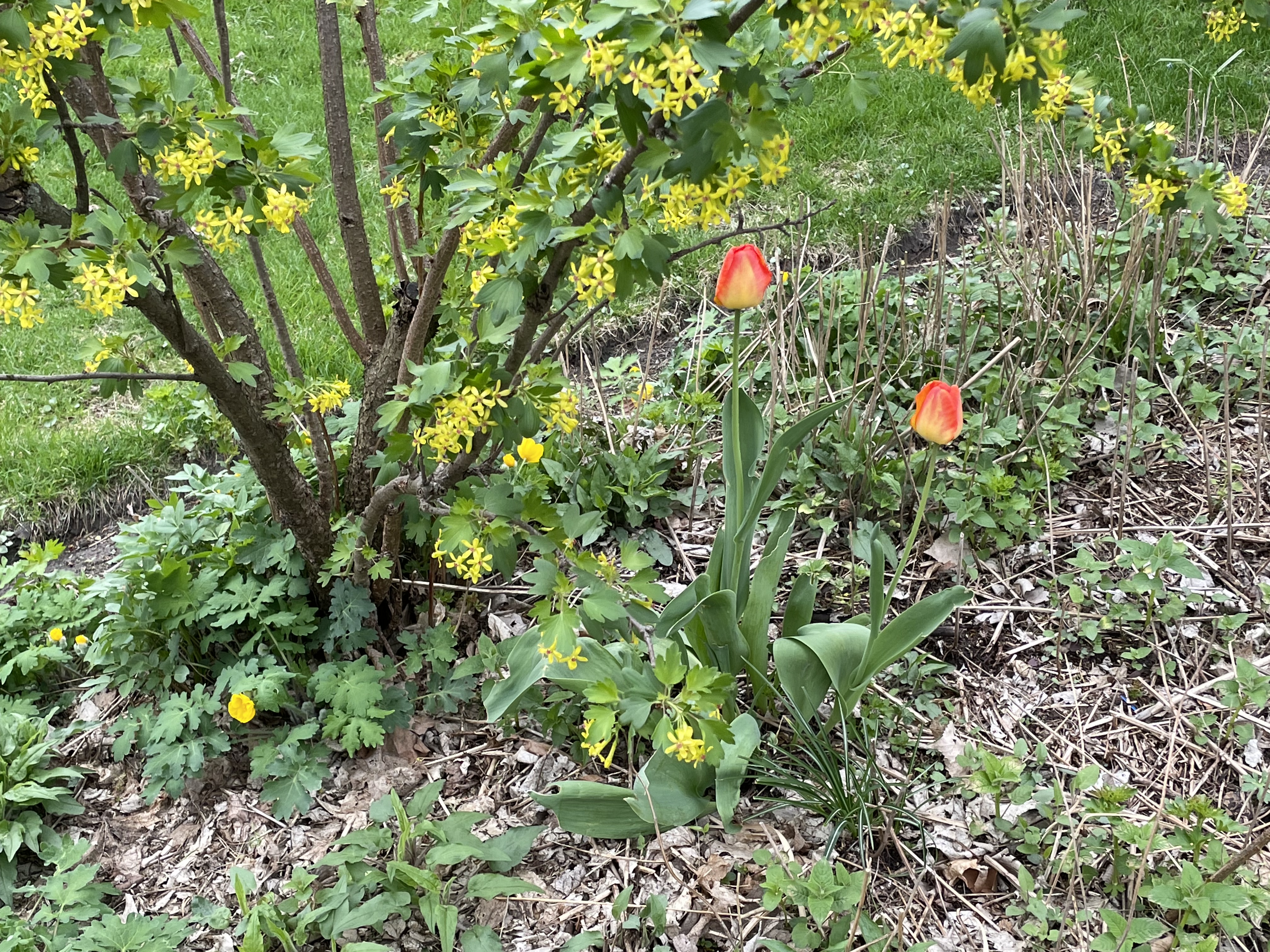
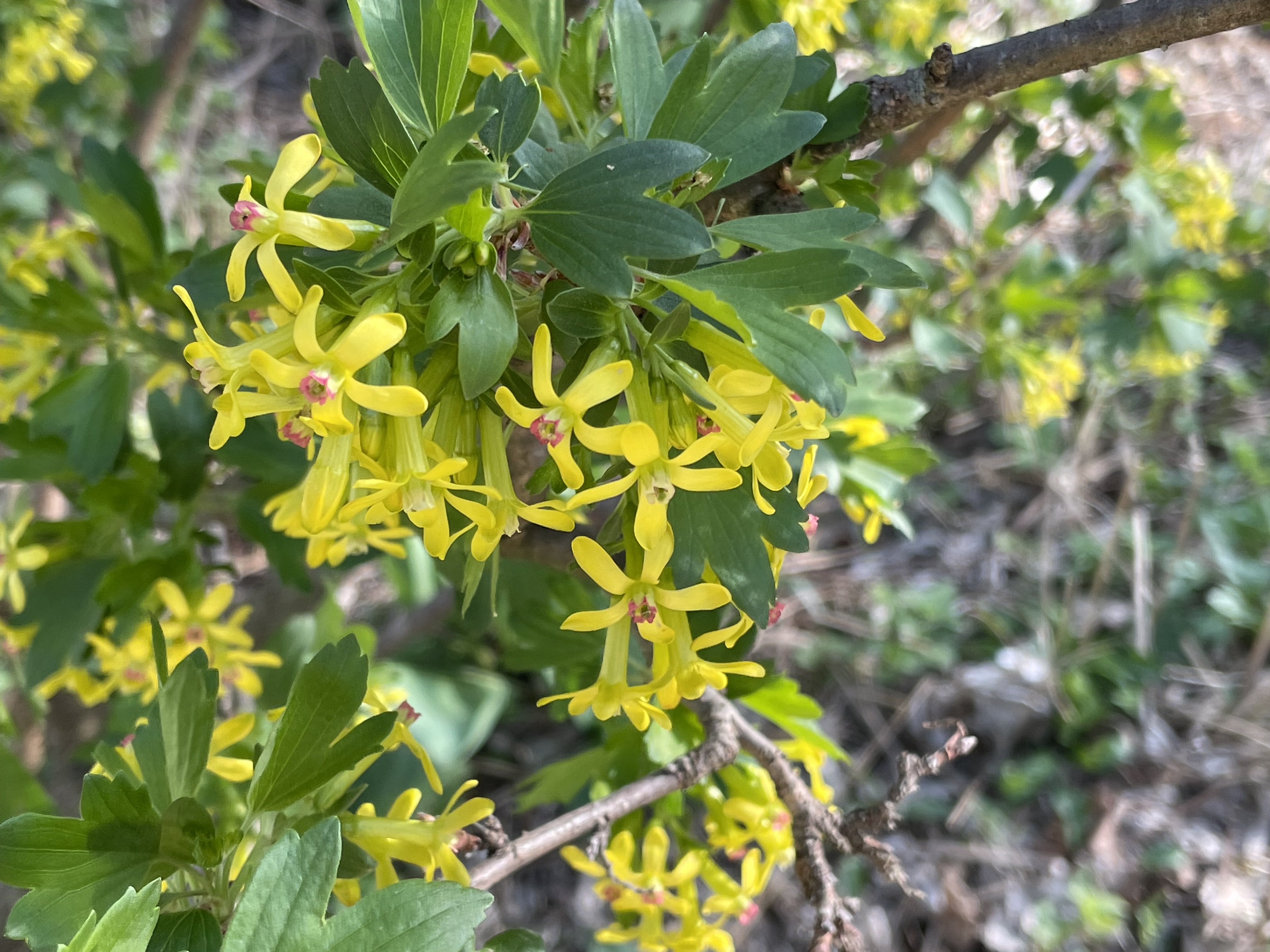
The clove currant was wonderful and perfumed the whole block, seducing many admirers. It turns out to root easily from a cutting, so if you are in the neighborhood, I’ll give you one, and we can spread the spicy aroma around.

It’s a graceful vase-shaped bush, due to good pruning, but I needed you to see these tulips.

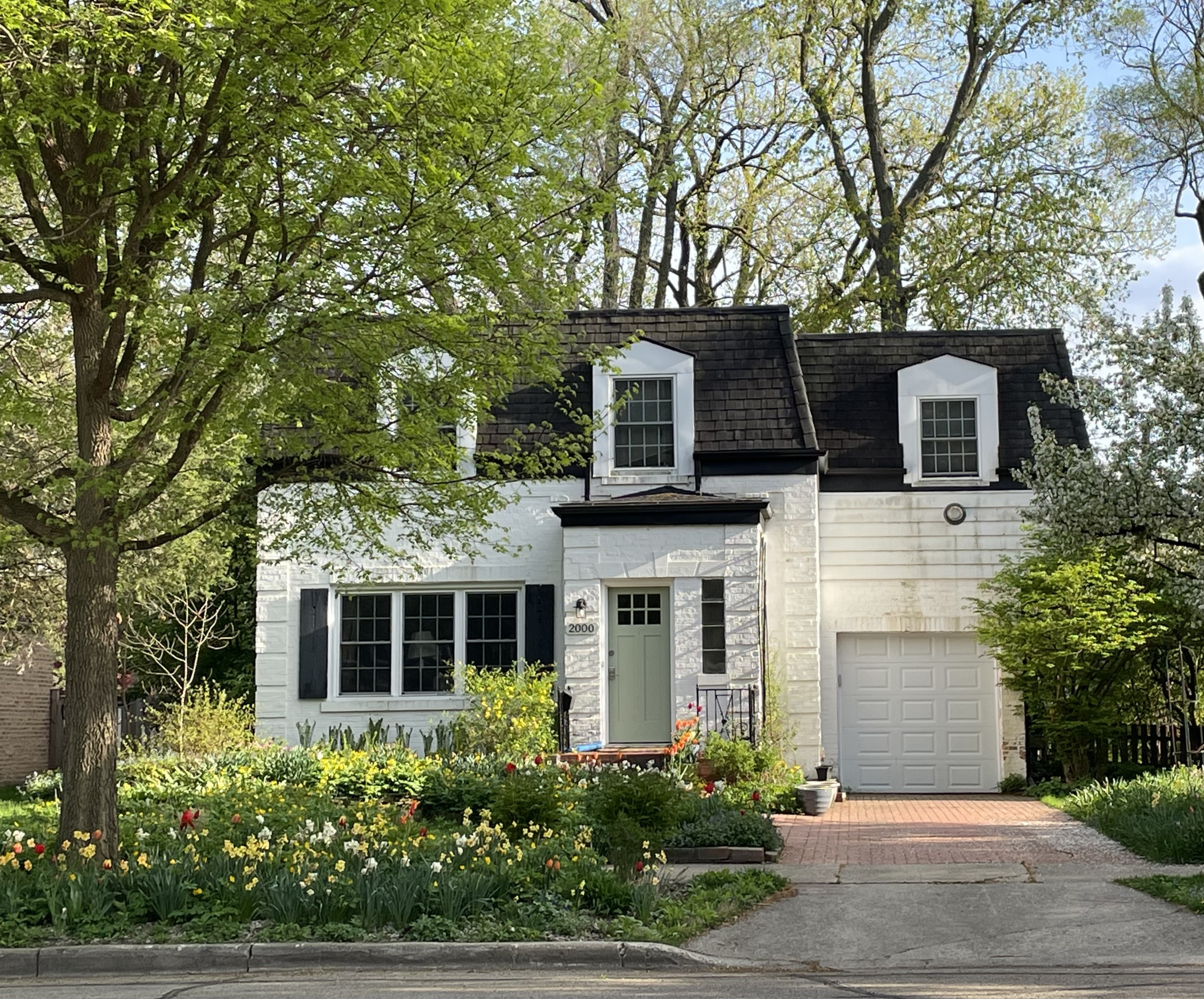
Here we have an early spring overview, with the bulbs up front. You can see the ostrich ferns coming up under the living room window, and the tulips in pots on the right side of the steps. Note how flat the garden is at this stage; no ten-foot cup plants or other tall perennials that will take over later. The new leaves on the trees are one of my favorite moments of spring.

I’m not sure who these lovely guys are, below, but they are having a good time together.

What was I thinking, trying to catch you up on an entire spring’s worth of flowers in one post? I have a particularly bad sense of time these days, between Covid and Jason’s illness. My days seem to exist on a different plane, in which everything is both very immediate and very distant. I guess it’s been over two months since the last post, even though it seems like much less (or some days, much more).

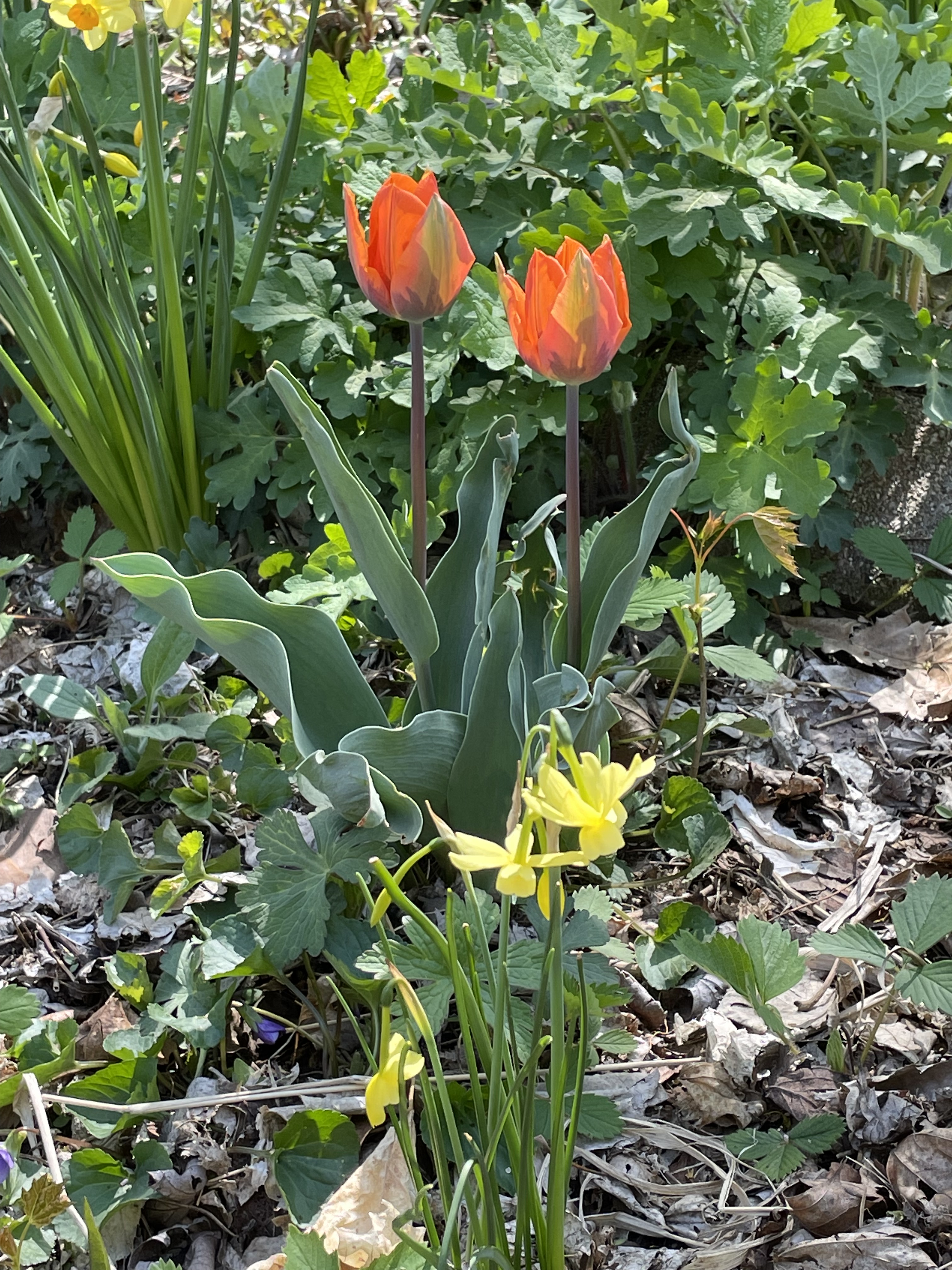
I’ll end with tulips in pots — reasonably successful this year, not spectacular — and Princess Irene tulips with some tiny multiple warhead daffodils.

We’re well into May with the photos here, and I’ll save the end of May and June for another post. I have a couple of short topics in mind, too, so let’s see if I can’t make the next update sooner rather than later. I’ll include an explanation of that “mostly” in the second paragraph — I want to tell you about some of the things that have gone wrong, too.

One housekeeping note: I am still figuring out the part about approving comments. So if your comments haven’t shown up, bear with me, and don’t give up! I will get the hang of it.

I know the weather has been crazy across the world this spring. I feel like we were on the lucky end of things here in the Chicago area, with a long cool April and May that prolonged some of the most beautiful days of the season. How have things been where you are? Are you sweltering? or drenched? I hope you and your garden are well.
Thank you for all your lovely comments on the last post – later this week or next week I will try to respond to as many as I can.

Meanwhile, I want to share some photos of spring in the garden with you. The garden is blooming its heart out, which is both a great comfort and a reminder that Jason is not here. Because we both traveled so much for work, we texted a lot, and I keep finding myself wanting to take a photo of something spectacular in the garden that he needs to see.

Let me give you a little tour.

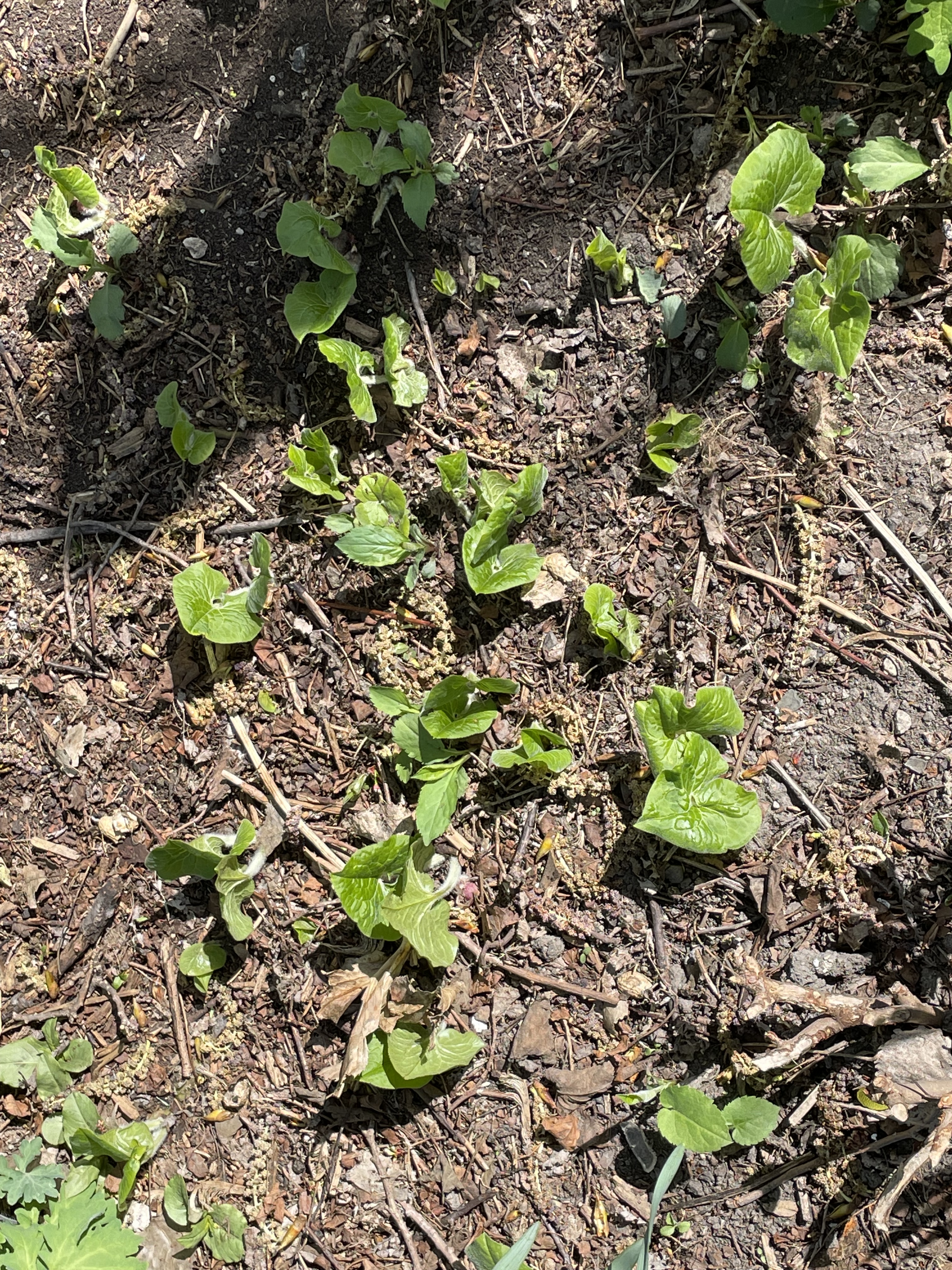
First, the bloodroot, which I am trying to watch closely — it has a way of blooming one day and being gone the next, and I don’t want to miss it! (It’s also possible that this is just wild ginger, and that the bloodroot has died out — I hope not!! Feel free to offer opinions in the comments.)

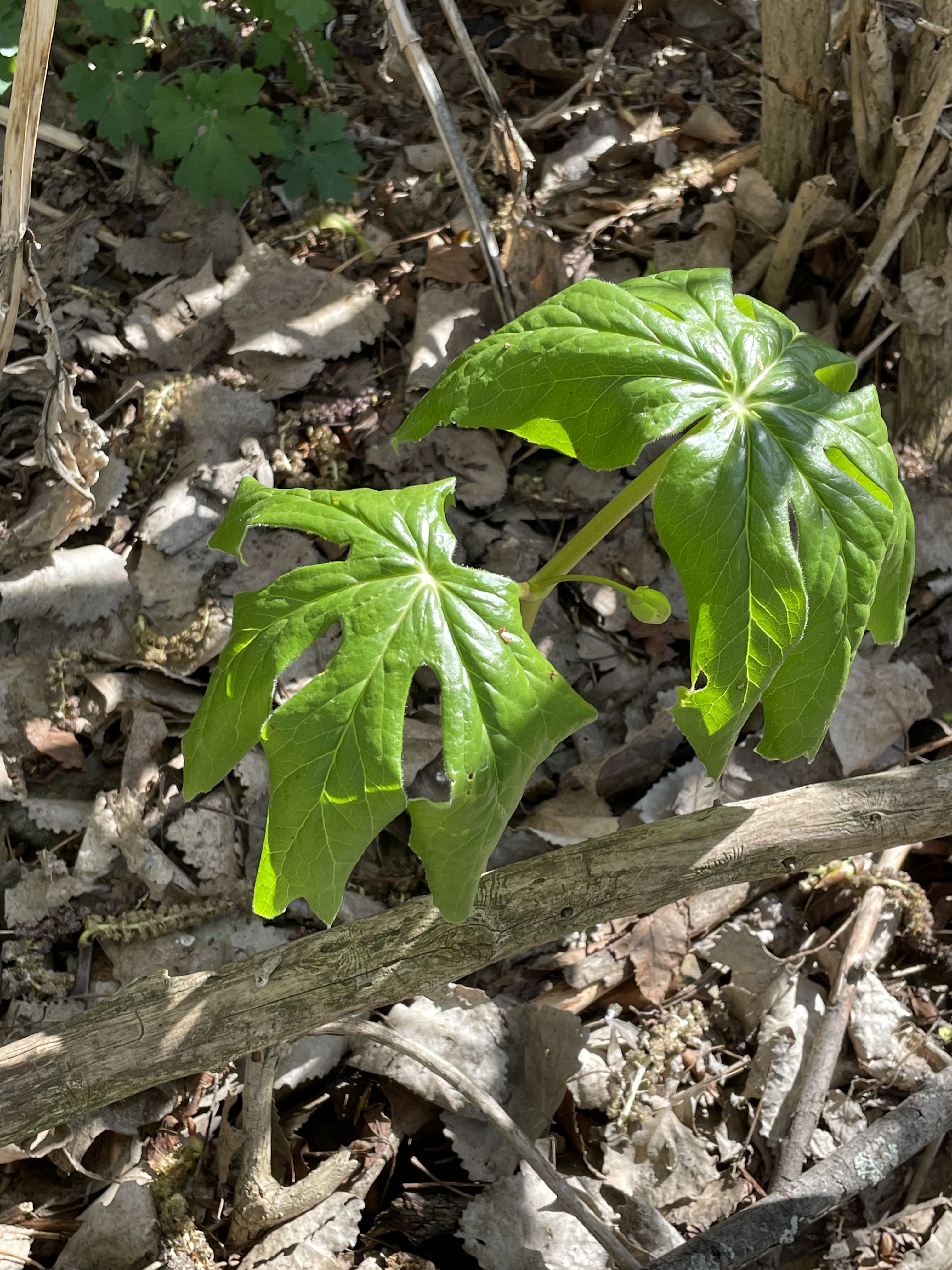
Here is one of the May Apples. I love the spring ephemerals, but you really have to watch them, or they’re gone before you know it. You can see the bud; it’s hiding below the leaves to make it even easier to miss.

A couple of years ago, Jason planted Golden Ragwort. It was spectacular in 2020 and 2021, but failed to appear last spring. It seems possible that it was accidentally pulled by the gardeners because it closely resembled a noxious weed as it came up. These things happen. I’m hopeful that this is it, coming back strong. Its bright yellow flowers are so intense and cheerful.

The hellebores are covered with flowers, and have been for weeks. I’ve picked five bouquets to fill bowls, for myself and for friends, and still there are so many more flowers. One thing I have learned: I put about 15 flowers in a Tupperware with some water to send home (to St. Paul) with David for his wonderful partner Meridith. Alas, when the flowers get their faces wet, they don’t want to float any more. I further proved this by taking some flowers to friends who invited me to dinner; they (the hellebores, not the friends) only had 20 minutes in water, not the seven hour drive to Minnesota, but they too refused to float properly.

Here’s the trillium that Jason planted a few years ago. There are two or three plants (one too small to be sure that’s what it is). I thought they had grown bigger and more established, but I could be wrong. At least they are still here and blooming. They have a history of being difficult.

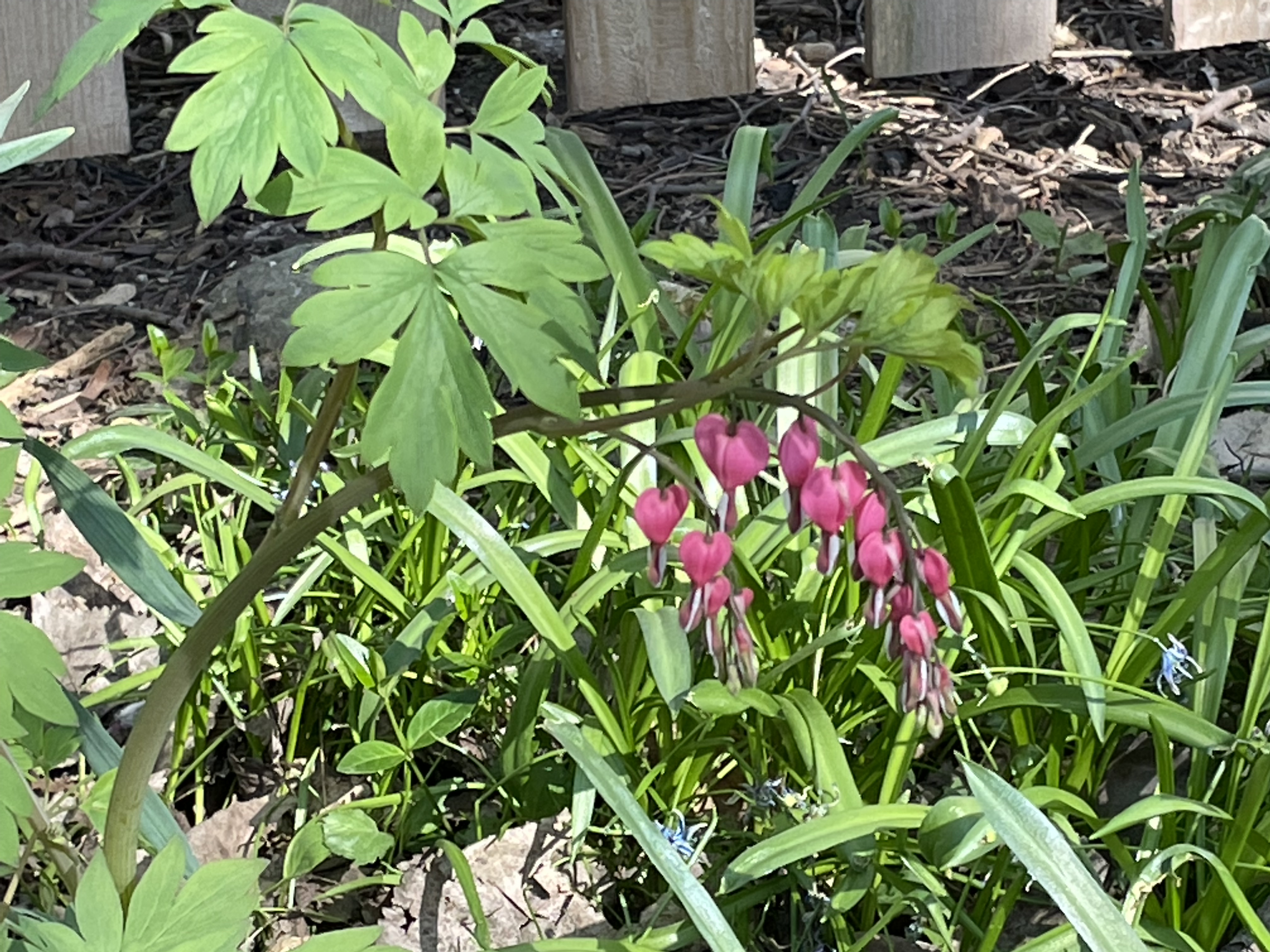
We used to have a lot more Bleeding Heart. It’s one of those flowers I didn’t think I was going to like (too pink!) and then fell completely in love with. I have made a note that we need to plant more. It’s especially lovely combined with Virginia bluebells and ferns (although the Ostrich ferns in the front window bed are just barely starting to come up, see photo below in the collage).

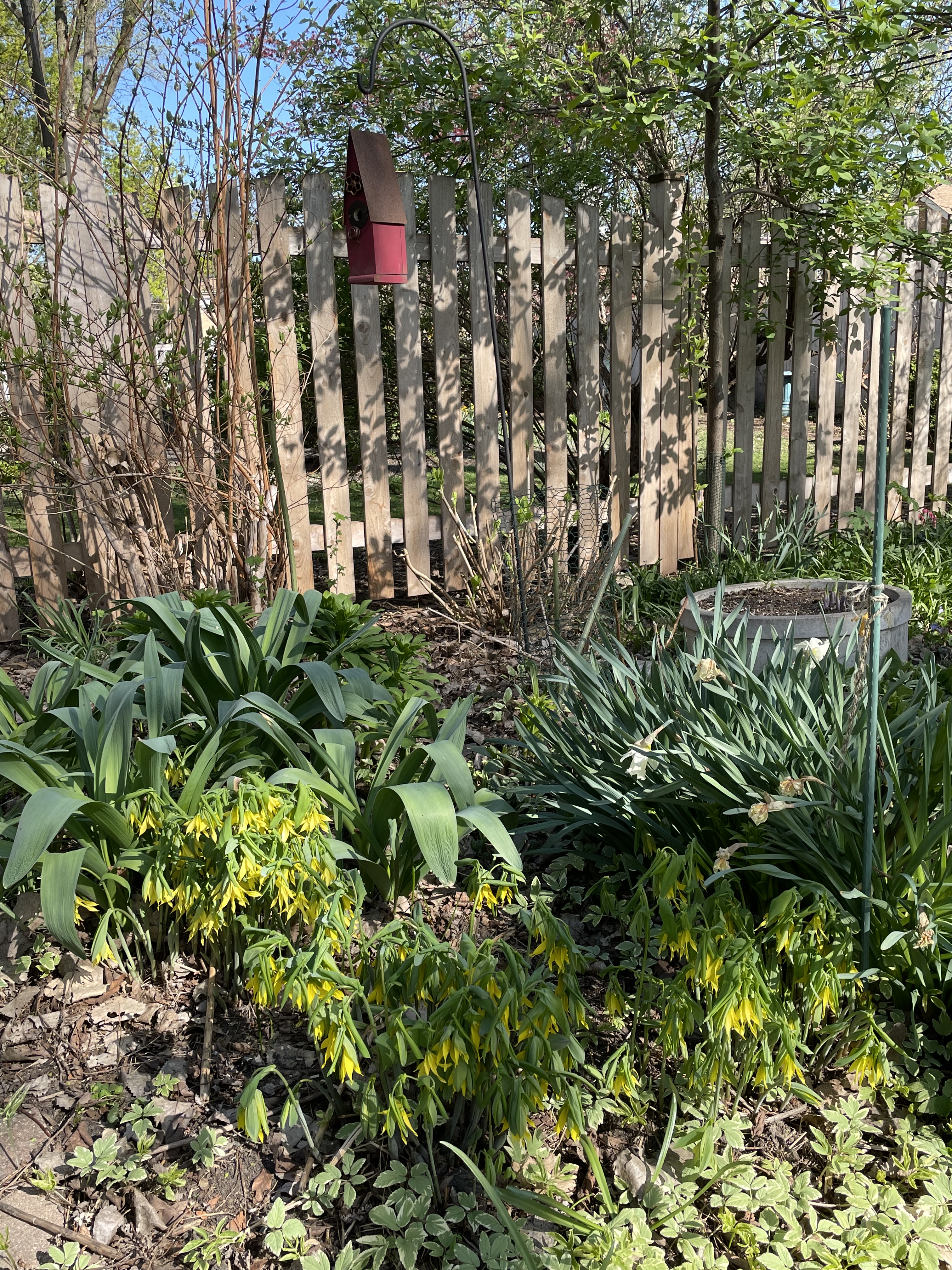
The yellow flowers below are uvularia. We discovered them when we briefly lived in Madison, Wisconsin, in a house whose border garden had been allowed to go wild, next to a woodlot with lots of natives. When we moved to our current house, 20 years ago, uvularia was not common in plant catalogues, but Jason found some. The main planting is on the west side of the house, where it gets less sun, and is still just opening. (Don’t you love the red birdhouse, it turns any plants nearby into a lovely vignette.)

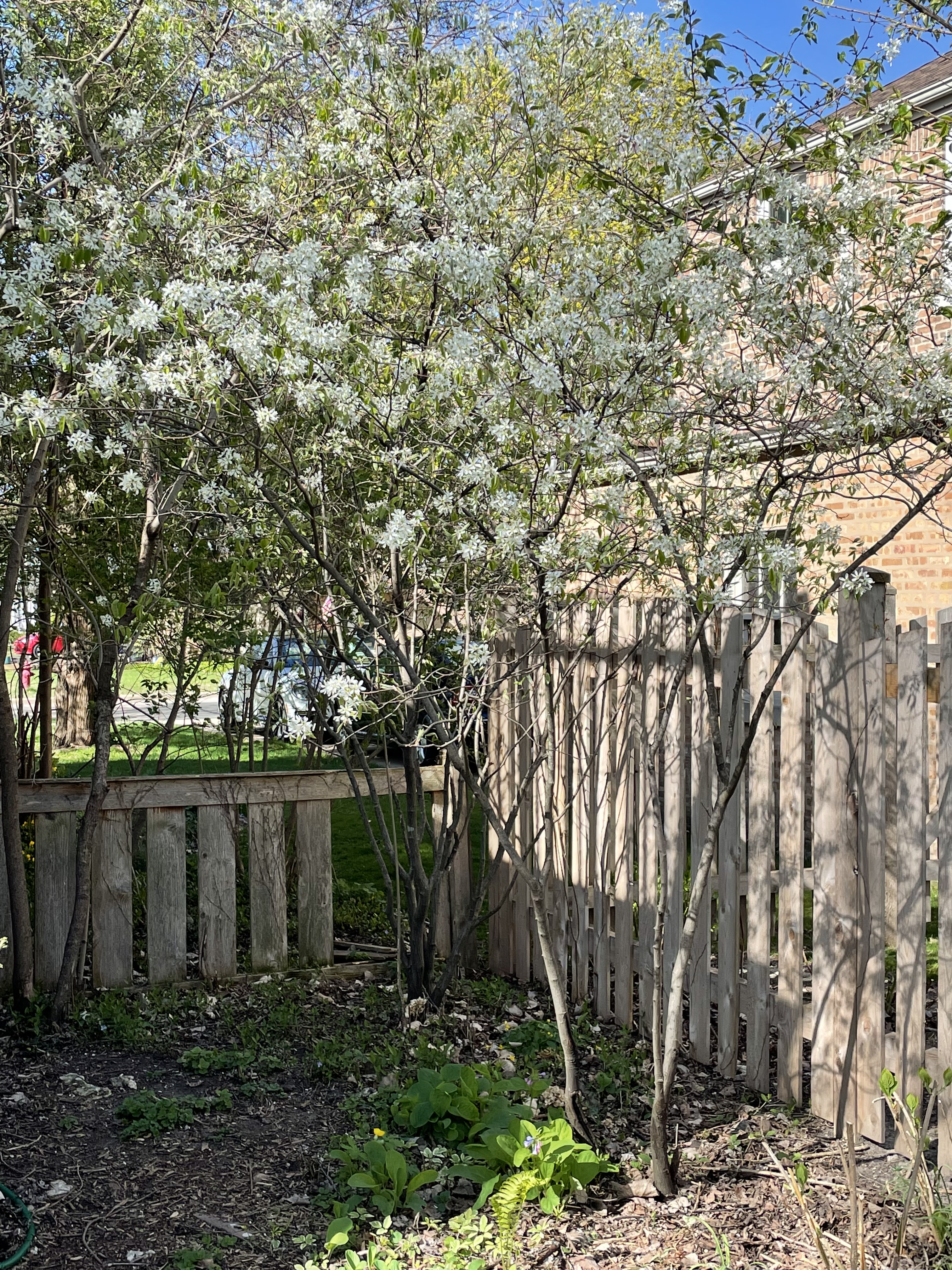
Serviceberry. What can I say. One of Jason’s favorites. A shrub that I didn’t appreciate at first, but have come to really like.

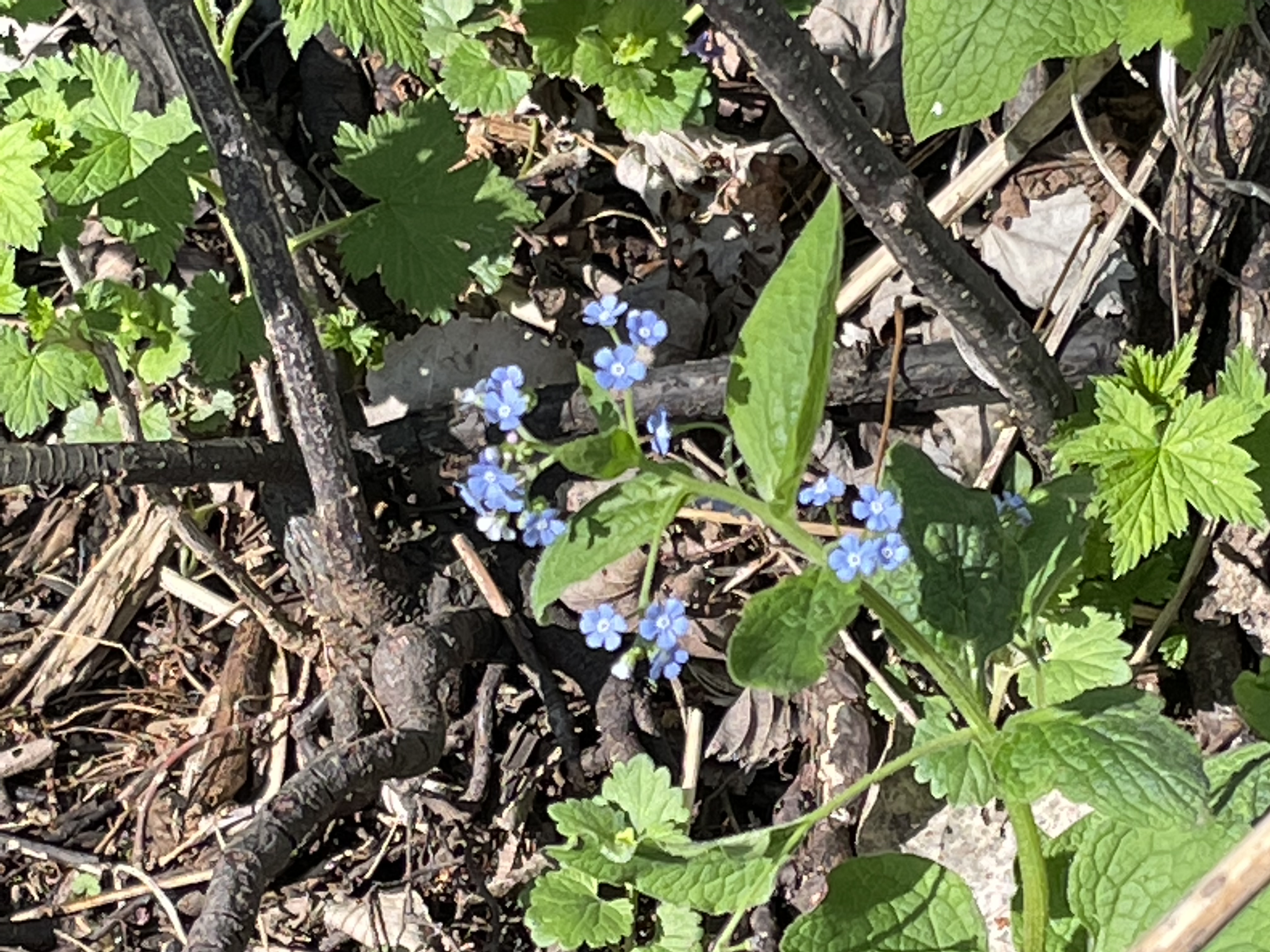
Is it even possible not to like False-forget-me-nots? Their cheery blue is just the thing most corners of the garden need in early spring. I’m sure most of you would not confuse these Brunnera with Myosotis aplestris, or (real) Forget-me-nots. Brunnera have heart-shaped leaves and are perennial.

X%?#@ Rabbits!!! They are hopping about eating things in the garden, though mostly less destructively than here with this poor denuded Virginia bluebell stem. I’m watching the Martagon lilies like a hawk, and will fence them in at the first sign of munching. Tulips in the front yard have also been nibbled.

Virginia bluebells and Celandine poppies, a classic combination here. The poppies are coming on just as the daffodils are passing their peak, an excellent bit of timing and some consolation for the loss of the earlier blooms. (The poppies have really started to spread everywhere; I asked the gardeners not to pull too many of the ones that had traveled to new sites because I love them; I hope I don’t regret it. I am much less ruthless than Jason.)

This corner, which a month ago was filled with snowdrops, continues to make me smile. Celandine poppies, witch hazel, moss. Leaves at lower left will burst with allium in May.

I realize I can’t show you everything, and it all moves so fast — especially since we had weather in the upper 70s last week. So here is a collage of blooms from the front yard. I’m so happy that the Princess Irene tulips made it through the winter (in a pot, in the garage). There’s the Ostrich ferns, just poking their heads up. Lower left, the clove currant is wafting its scent across the sidewalk.

One more bit of spring growth to show you — our delightful granddaughter Addie, who is now eight months, and has just started to crawl. She is absolutely full of smiles and giggles.

Coming up next, I’ll try to respond to some comments on the post about Jason, and I’ll pull together some photos from our trips to the Montrose Point Bird Sanctuary.

Many heartfelt thanks to those of you who have sent cards and donations (see the previous post).