This week I placed my order for bulbs, something I do every September. For me, placing this order is a kind of early fall ritual. It is also an opportunity to experience the sweet agony of choosing from among the offerings in the John Scheeper’s bulb catalog (so many bulbs that I want but cannothave).
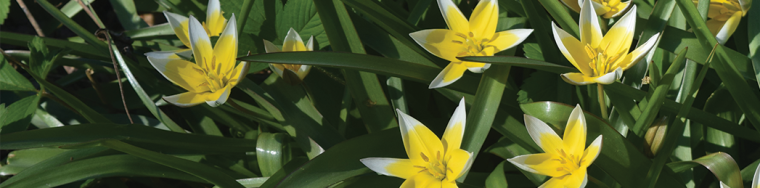
‘Early Harvest’ are very early and very short.
Tulips are always the main course of the September bulb order. This year I am ordering seven varieties and 160 bulbs, all of them going into containers. All seven varieties were also in last year’s order, but I eliminated three varieties from last year that I found unsatisfactory.
These are the tulips I ordered:
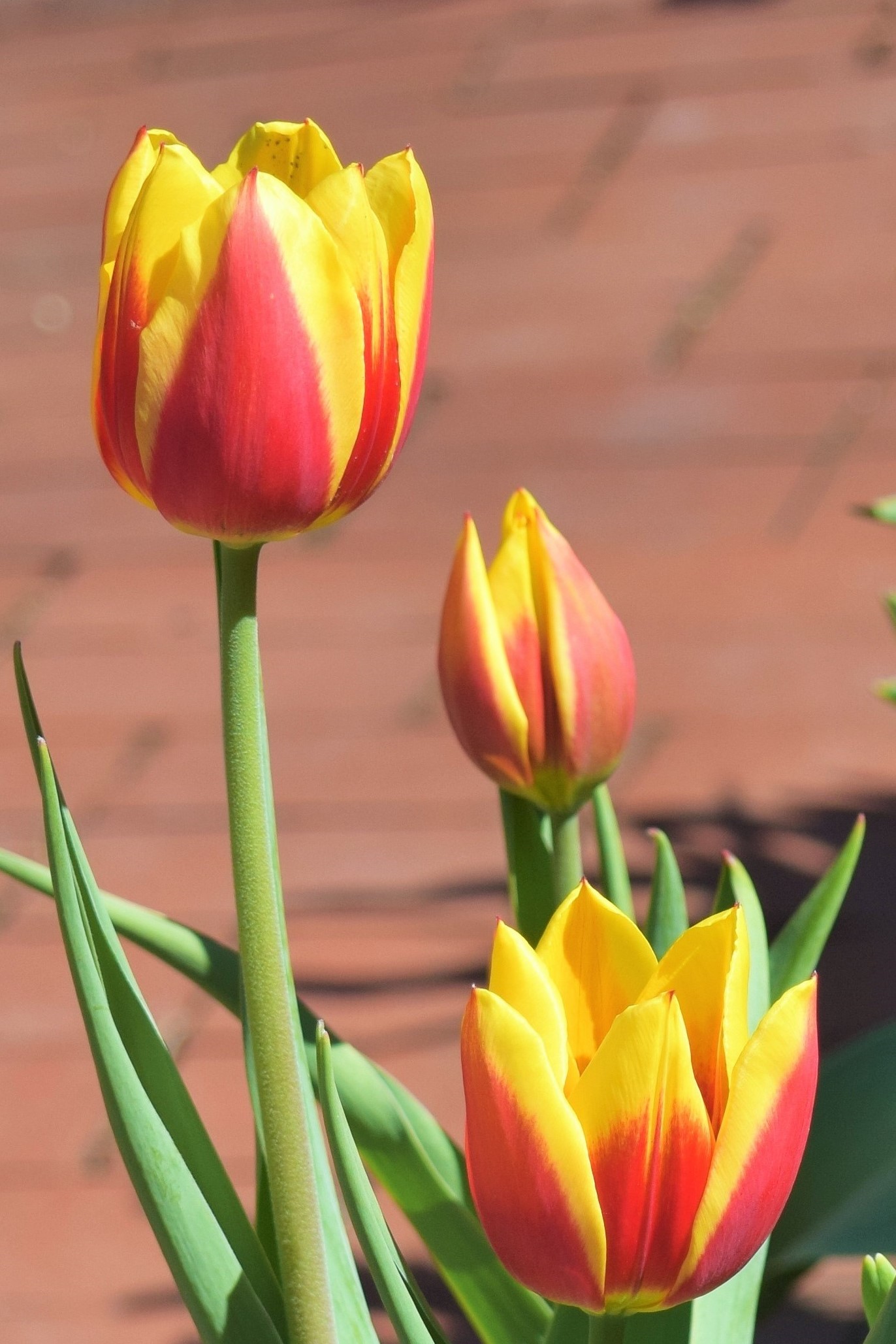
‘Keizerskroon’ is an old Dutch heirloom variety.
Annie Schilder. A mid-season light orange Triumph Tulip.
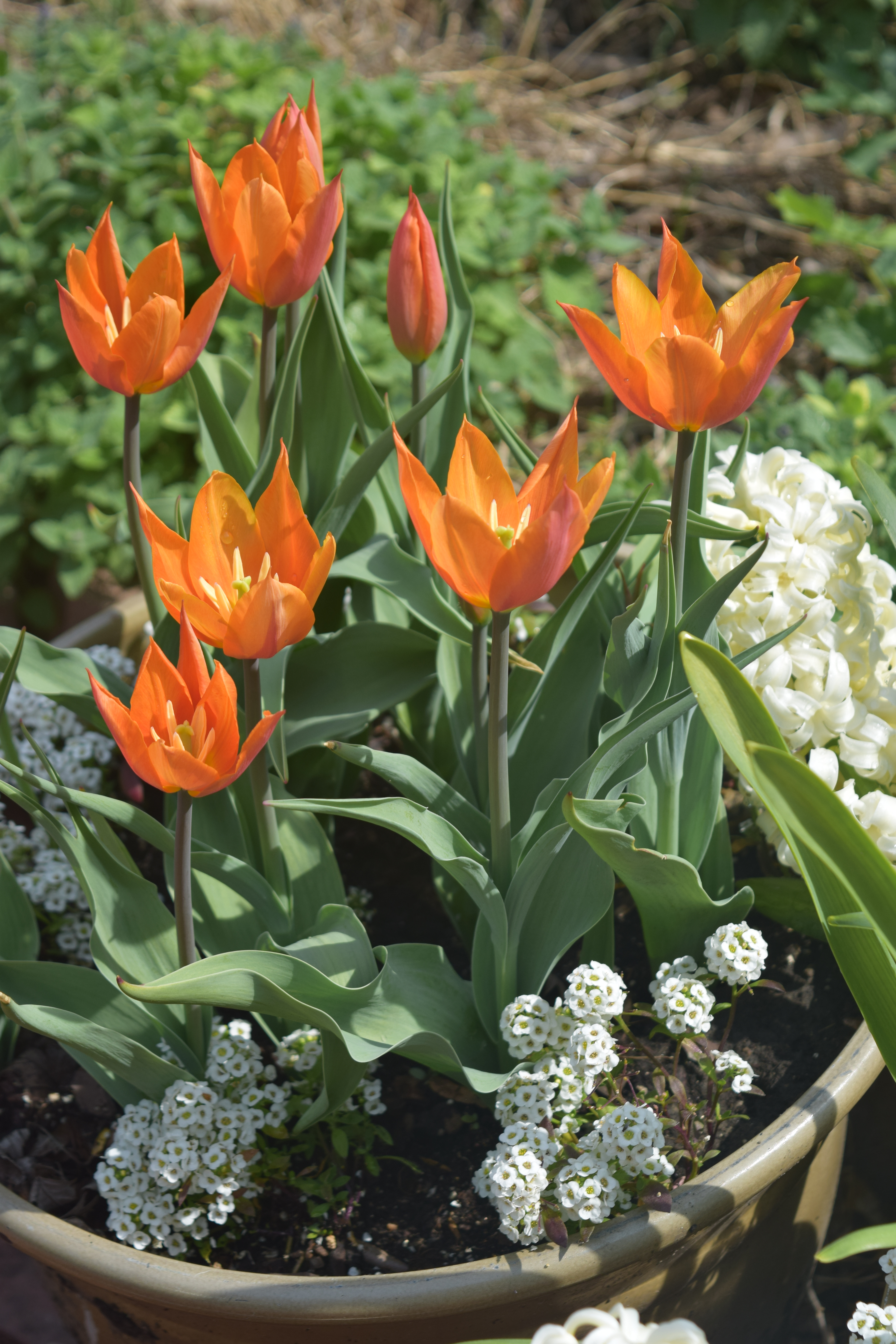
Ballerina. A late-blooming orange Lily Tulip.
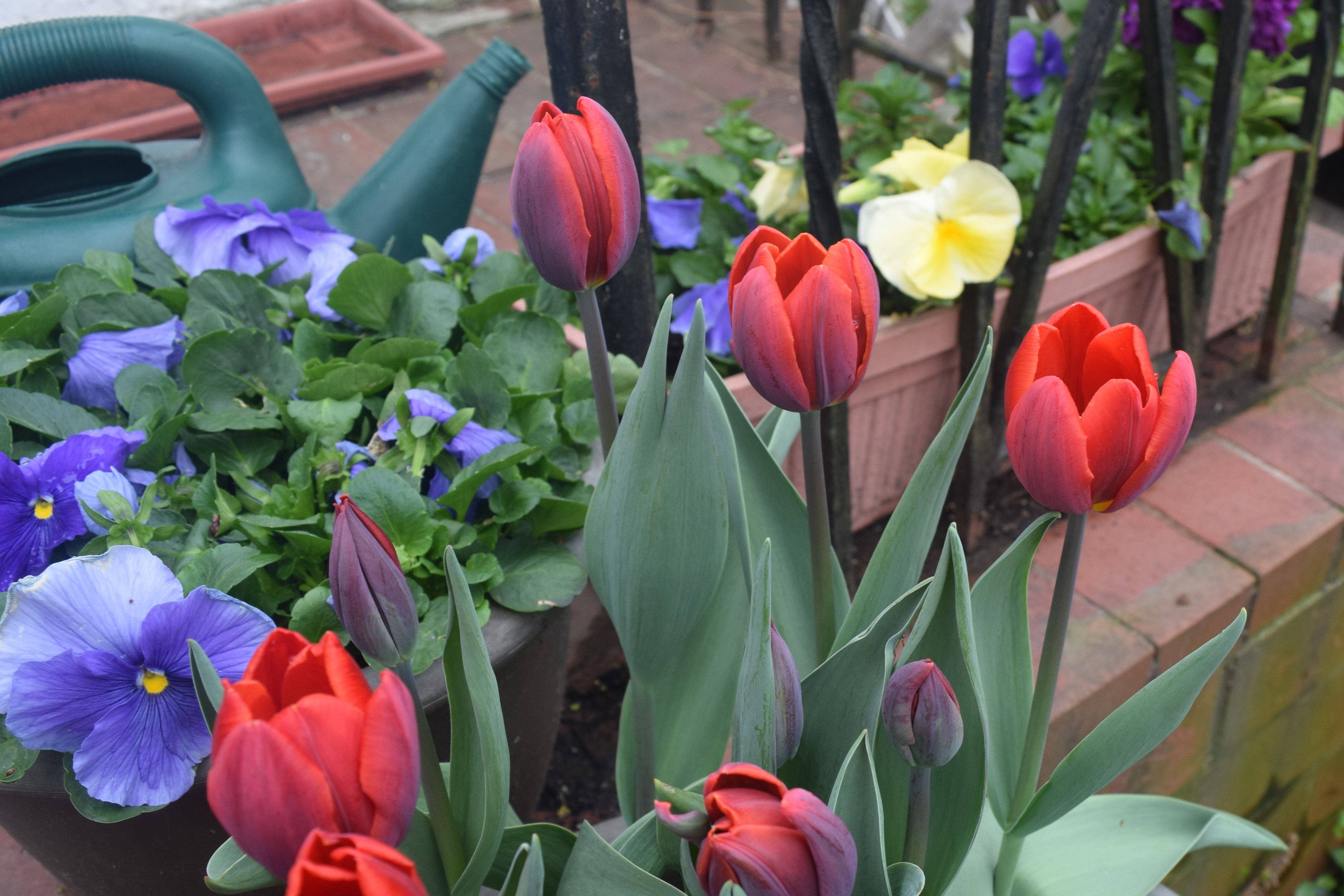
Couleur Cardinal. A scarlet-purple Single Early Tulip.
‘Ballerina’
Early Harvest. A bright orange Kaufmanniana variety that blooms very early.
Keizerskroon. An red and yellow Single Early Tulip.
‘Princess Irene’
Kingsblood. A deep red Single Late Tulip.
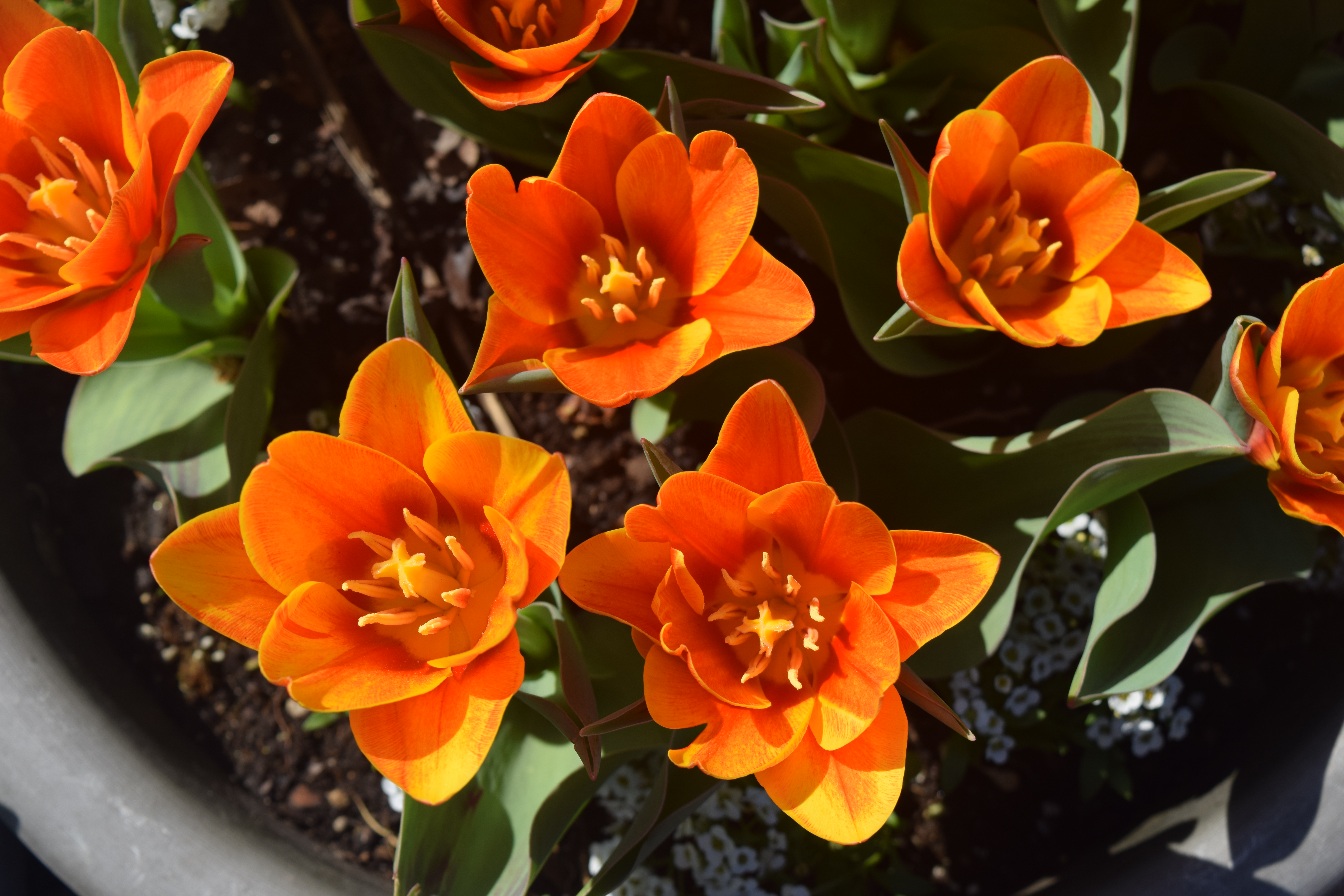
King’s Orange. A deep red-orange mid-season Triumph Tulip.
‘Couleur Cardinal’
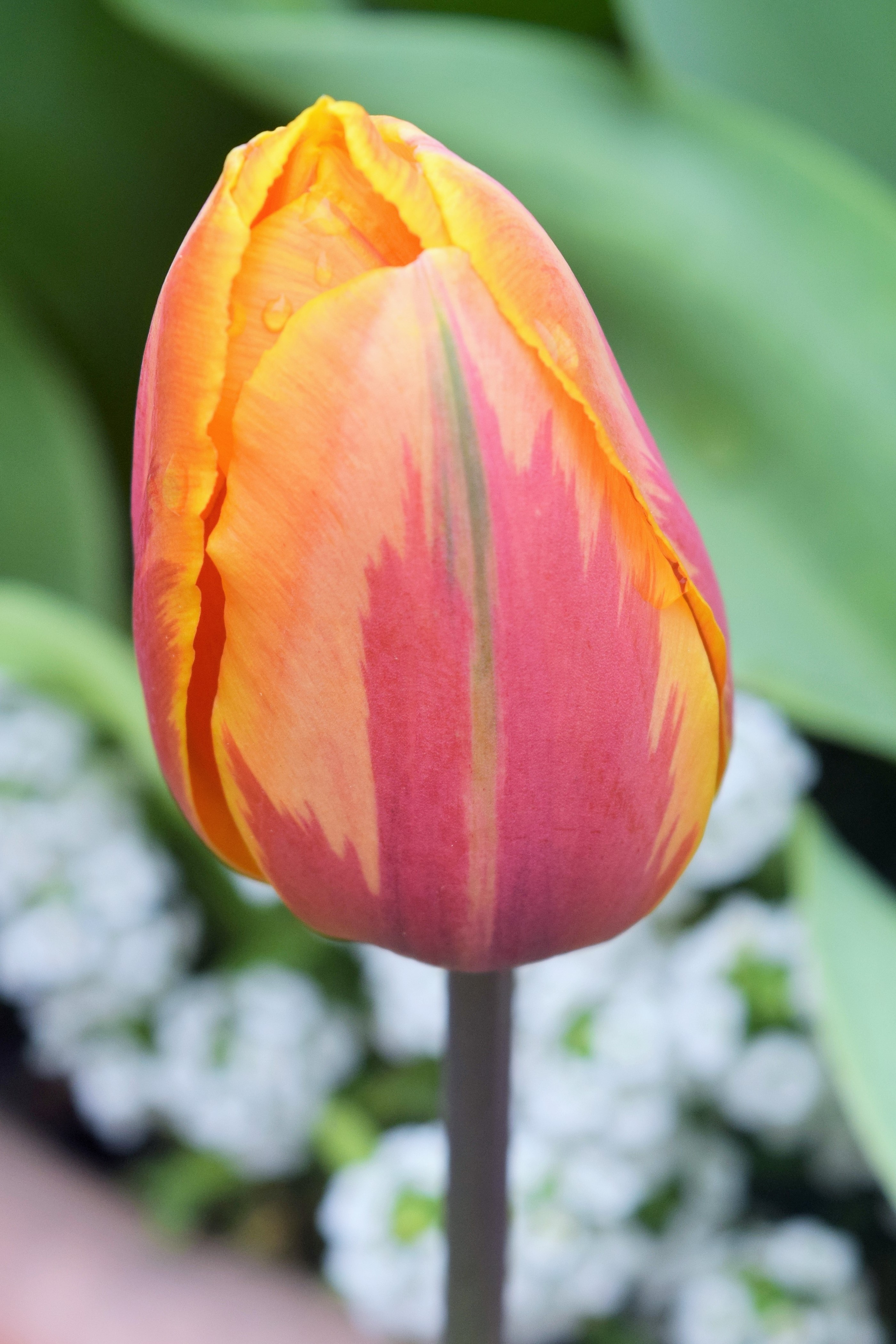
Princess Irene. An orange-purple Single Early Tulip
As you can see, I’m into orange tulips in a big way. Basically I have one very early variety, three early, two mid-season, and two late-season.
Celandine poppy with grape hyacinth.
In addition to tulips, I’ve ordered 75 Grape Hyacinths (Muscari). That’s not a lot, I know, but they will spread. Of these, 50 are the straight Muscari armeniacum, and 25 are Muscari ‘Valerie Finnis’. While M. armeniacum is deep blue, ‘Valerie Finnis’ is a very light blue, so I think they will combine nicely.
The Grape Hyacinths will all go into the new Lamppost Bed, to contrast with all the red, orange, and yellow tulips elsewhere in the front garden.
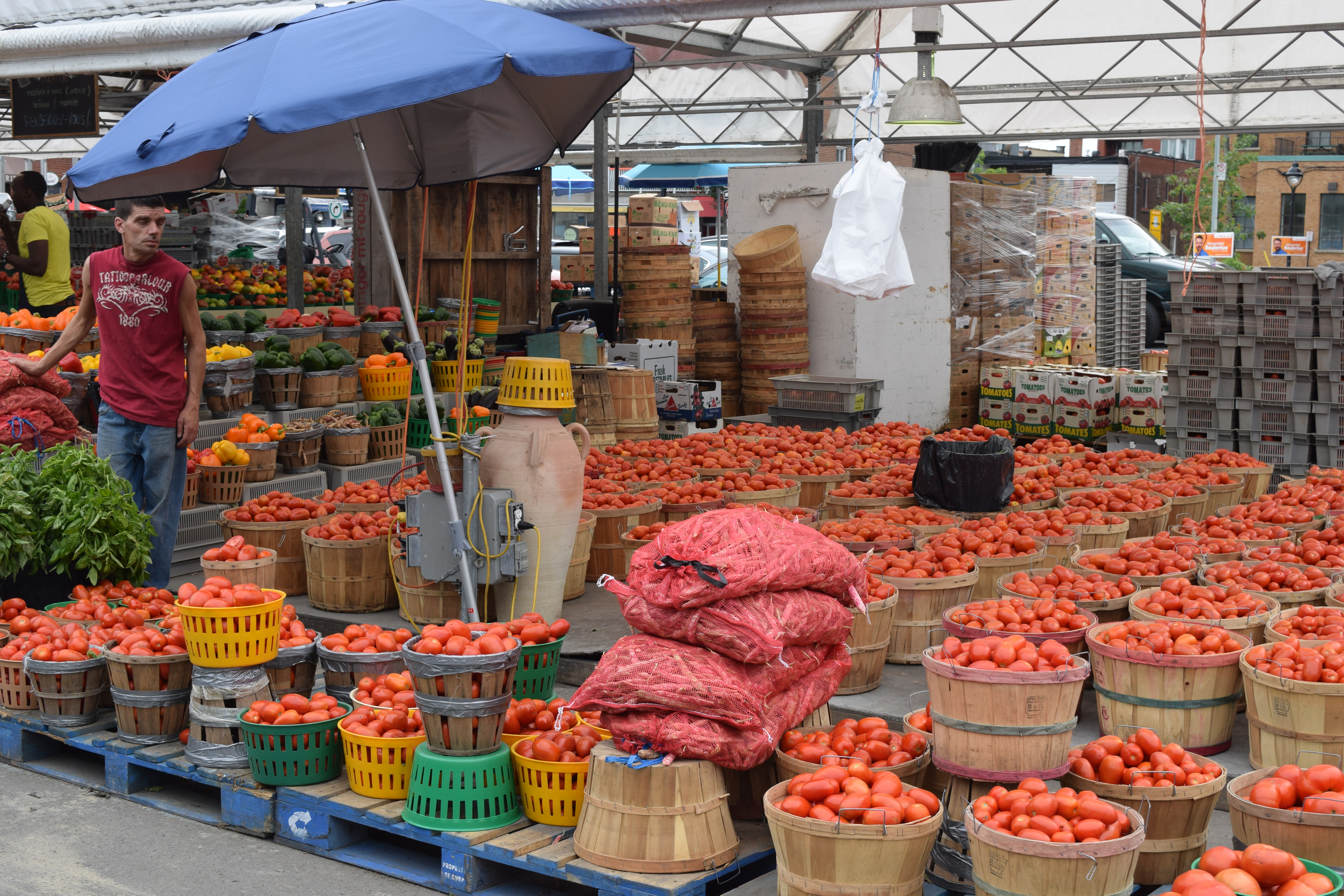
Why are public markets so much more fun than a supermarket? The produce is at least a step closer to the farm, I suppose. But more than that, there is a color and bustle, a liveliness, that is infectious.
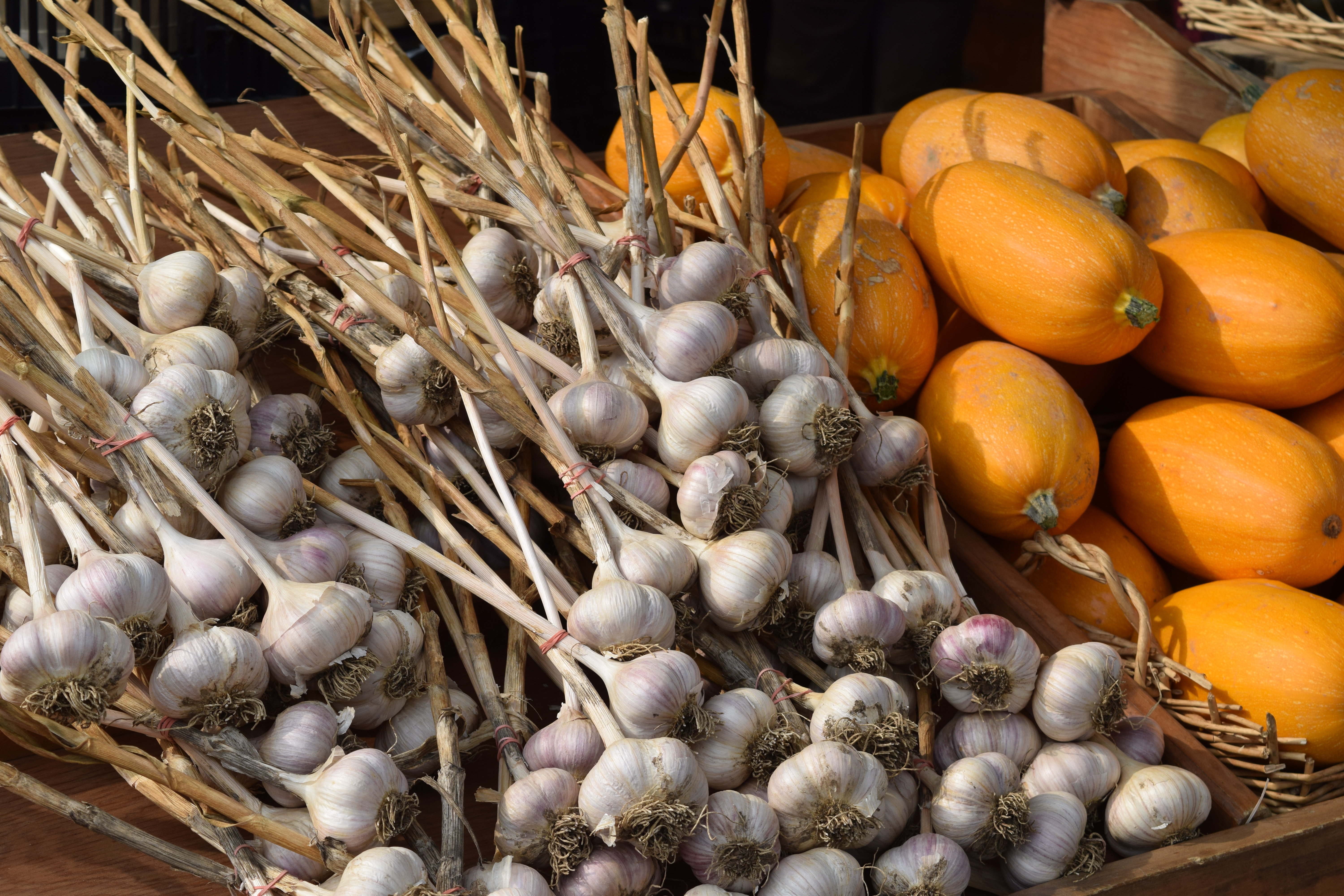
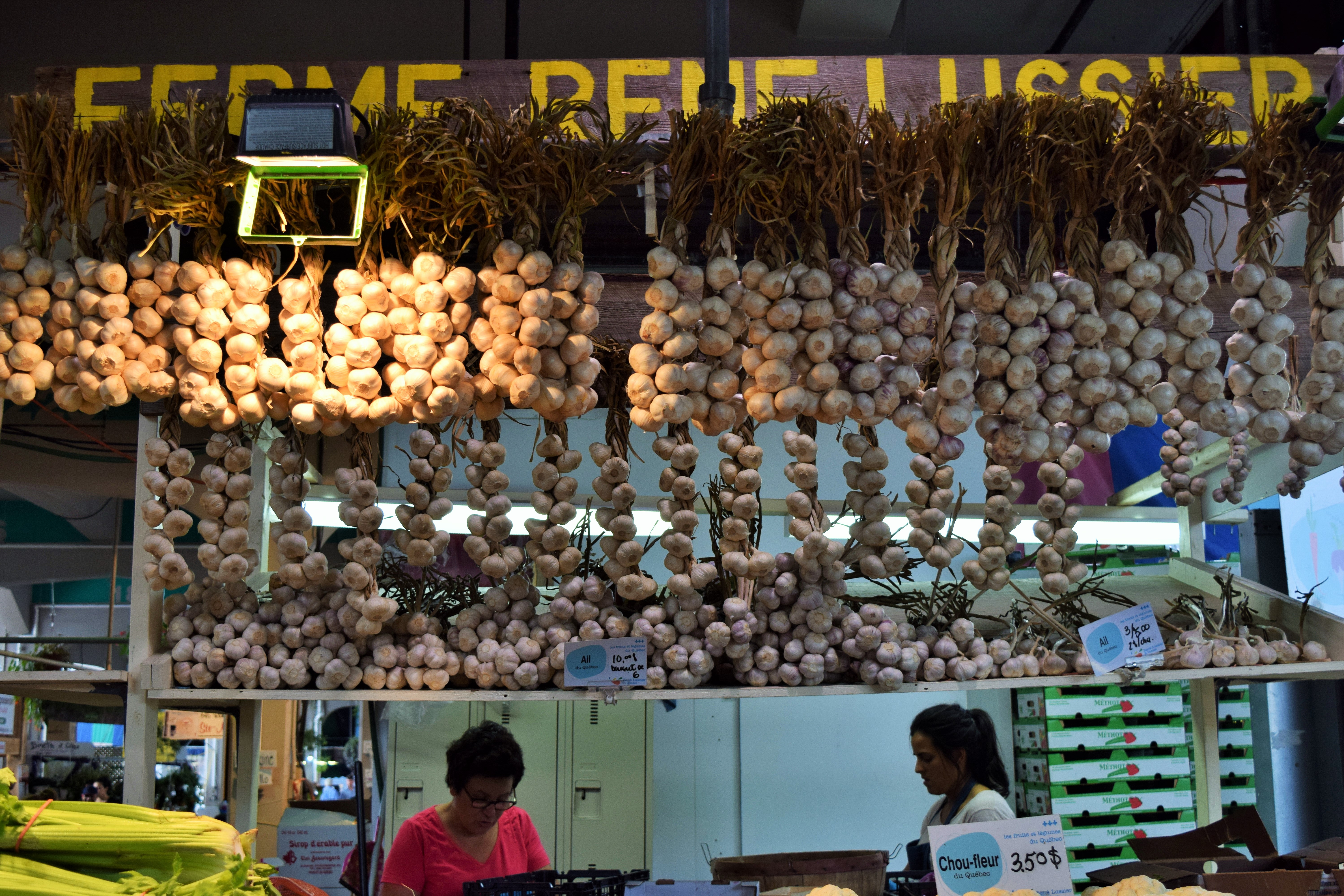
In Montreal, we love to visit the Jean-Talon Market, in the Little Italy section on the north side of the city.
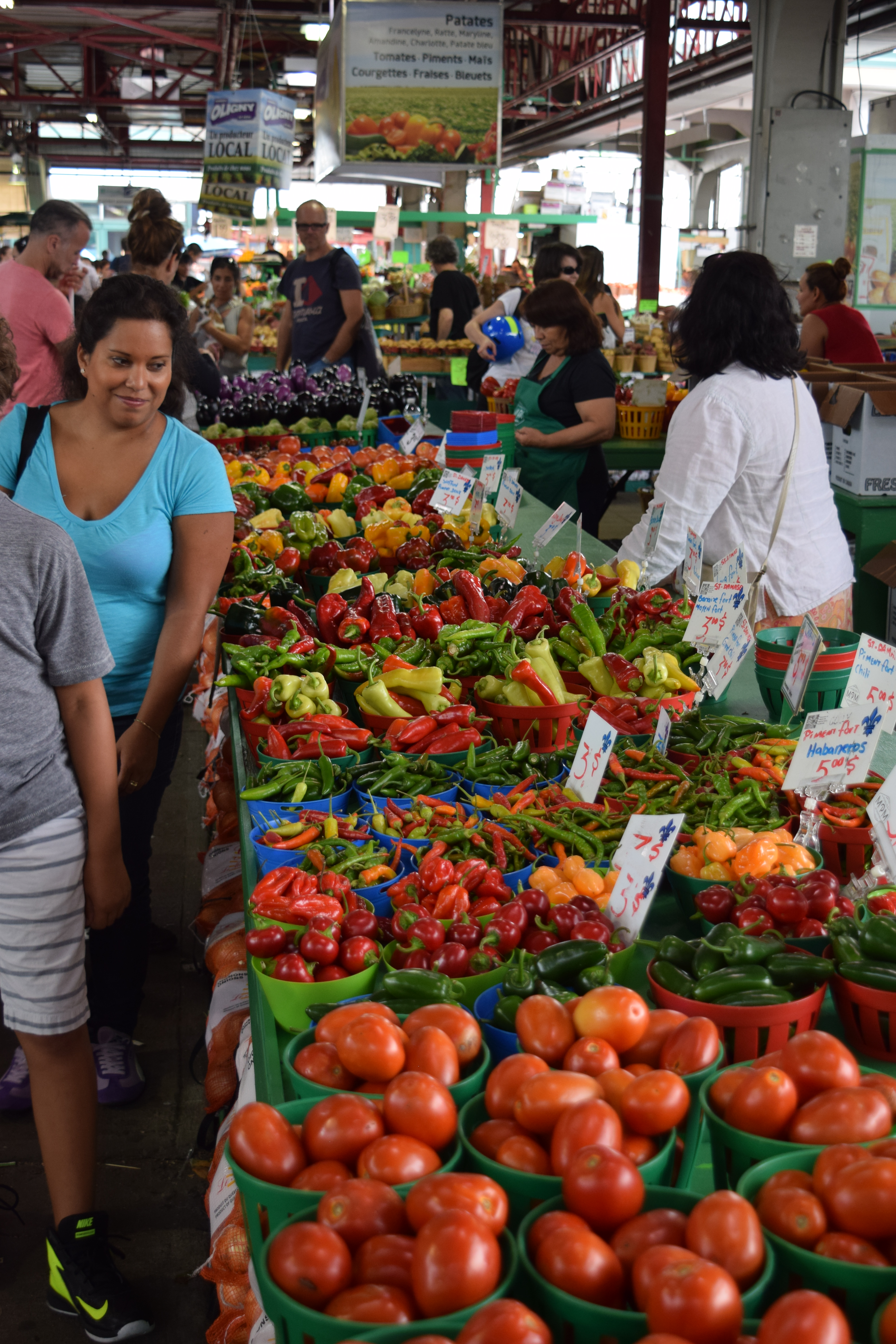
Never mind eating, the colorful produce is a visual feast. How could you look at all those peppers and tomatoes without smiling?
Jean-Talon is one of Montreal’s oldest public markets, going back to 1933. Generations have grown up buying and selling there.
Try to find mushrooms like these at a supermarket.
This little girl looks like she is wondering if these vegetables might taste as good as her popsicle. They do look like as if they could be candy.
We bought some fresh Quebec strawberries to eat in the car. They were delicious.
There is music to hear as well as sights to see. These two were playing Andean music. The guy on the right was playing the guitar, pipes, and a drum simultaneously. Quite a virtuoso performance.
The peches de L’Ontario were also juicy and good.
Plenty of enticing ready-to-eat food can be found at Jean-Talon. Judy and I bought hot sausages (Croatian, if I remember right) on rolls from this stand. They were spicy and yummy.
The mix of people is as interesting as the mix of produce.
Happy Bloom Day! On the 15th of every month Carol from May Dreams Gardens hosts Garden Bloggers’ Bloom Day, enabling gardeners to share and compare what’s in flower in their little patch of earth.
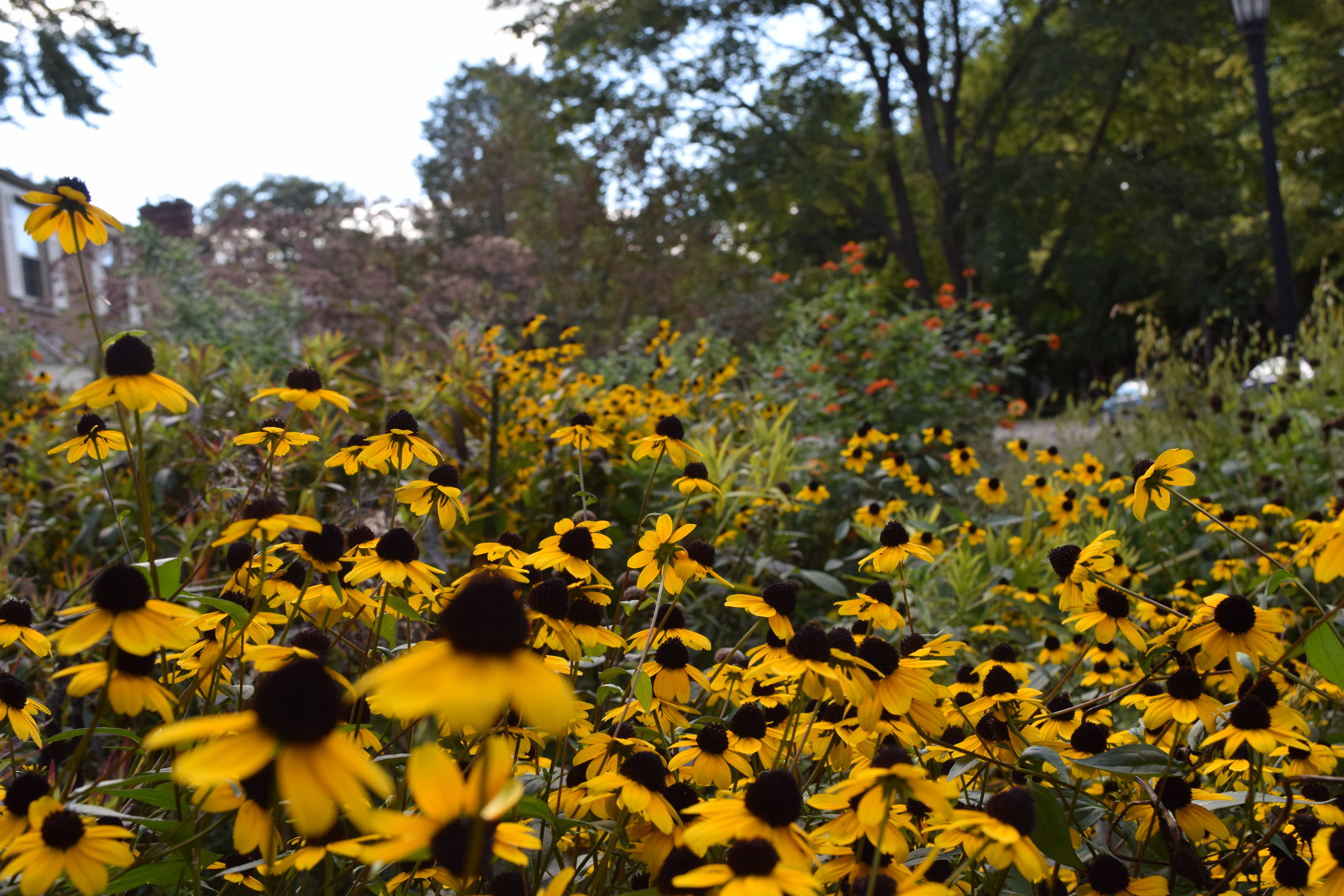
Brown Eyed Susan
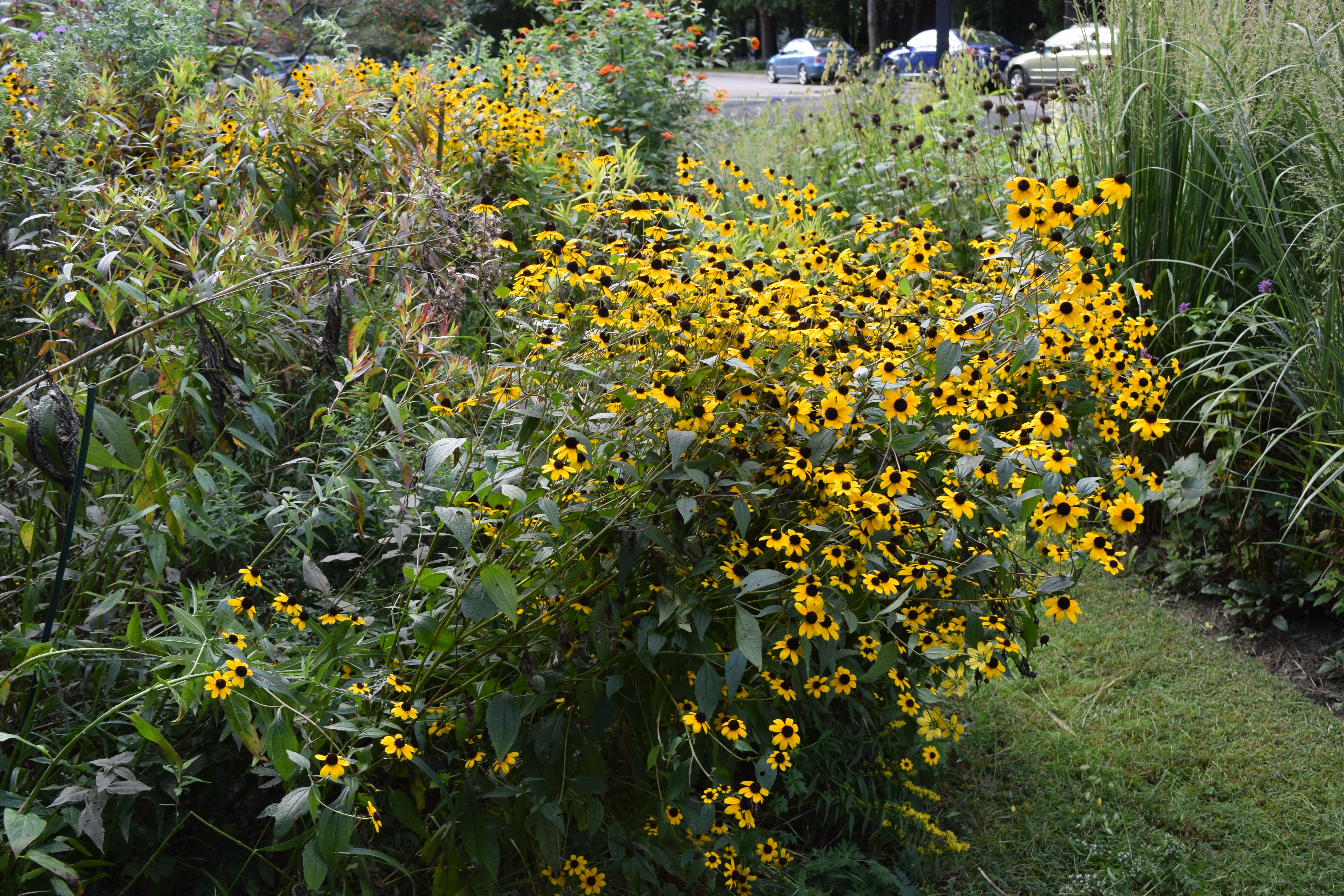
In our garden the most bountiful blooms at the moment are provided by Brown-Eyed Susan (Rudbeckia triloba). This Rudbeckia makes me happy with its clouds of little golden yellow flowers with cute little cones in the center. They call them “eyes” but they look to me more like noses. This Susan self-sows freely, as they say, but I consider that a virtue.
Though I’ve got to confess that keeping this Susan upright has been an ongoing battle, especially after she’s had plenty to drink (not that kind of drink – I’m talking about rain).
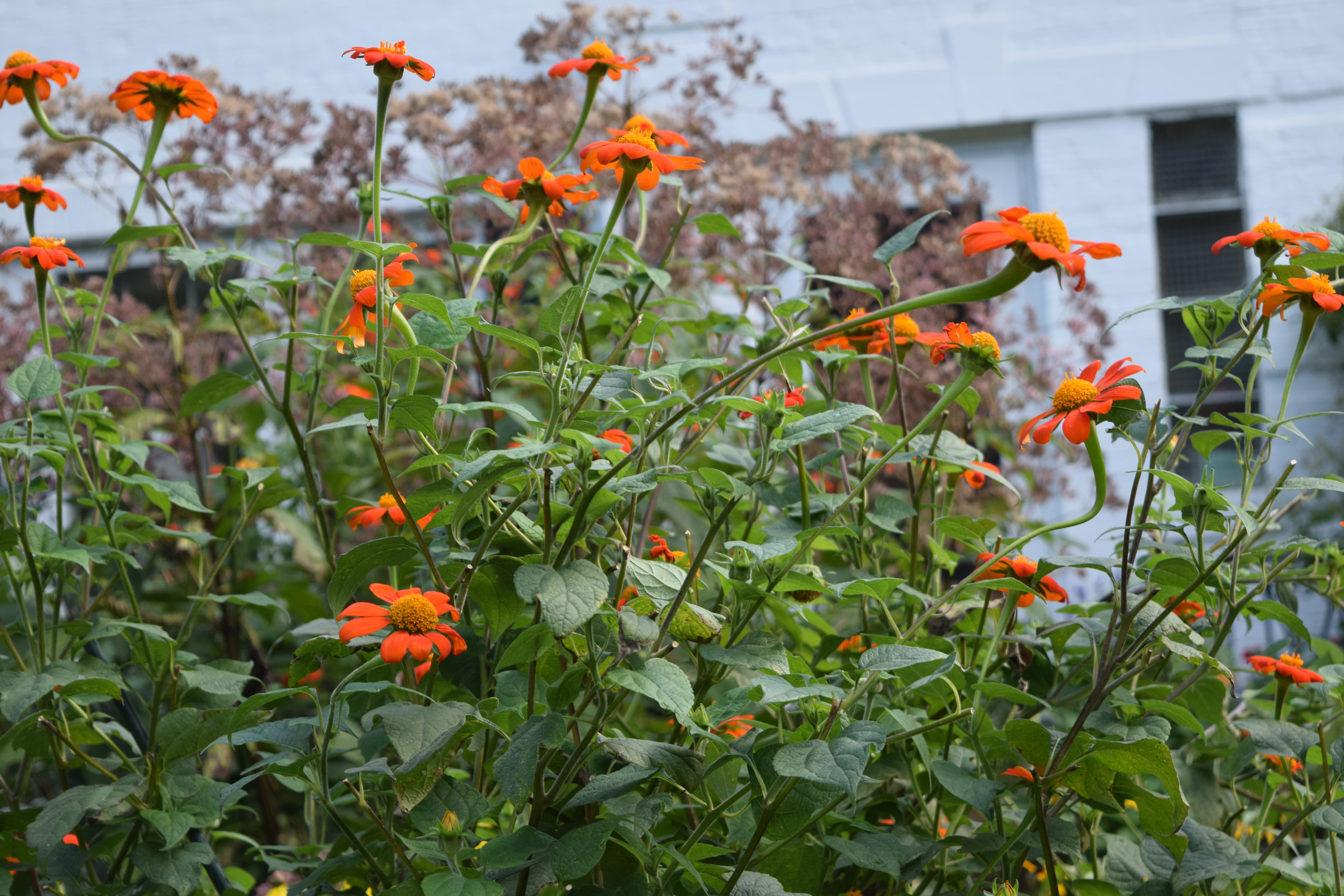
The Mexican Sunflowers (Tithonia rotundifolia) keep pumping out flowers like champs, though in a couple of weeks they will literally start to fall apart as stems start to break.
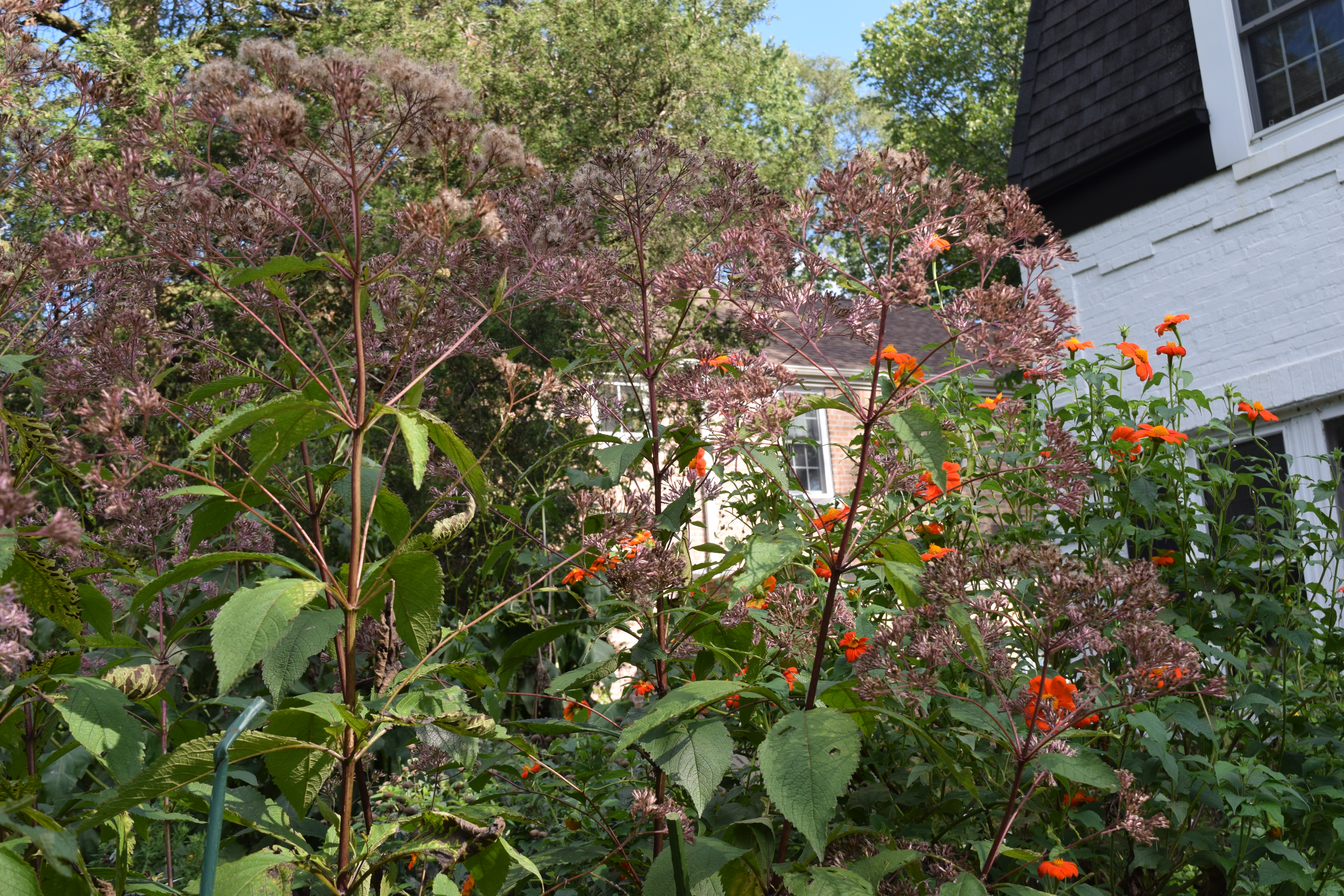
A big clump of ‘Gateway’ Joe Pye Weed (Eutrochium maculatum) stands between two Mexican Sunflowers. E. maculatum flowers last much longer into the season than Sweet Joe Pye Weed (E. purpureum). They also have nice purple stems.
The birds are eating up the cones of Yellow Coneflower (Ratibida pinnata), but there are still some in bloom.
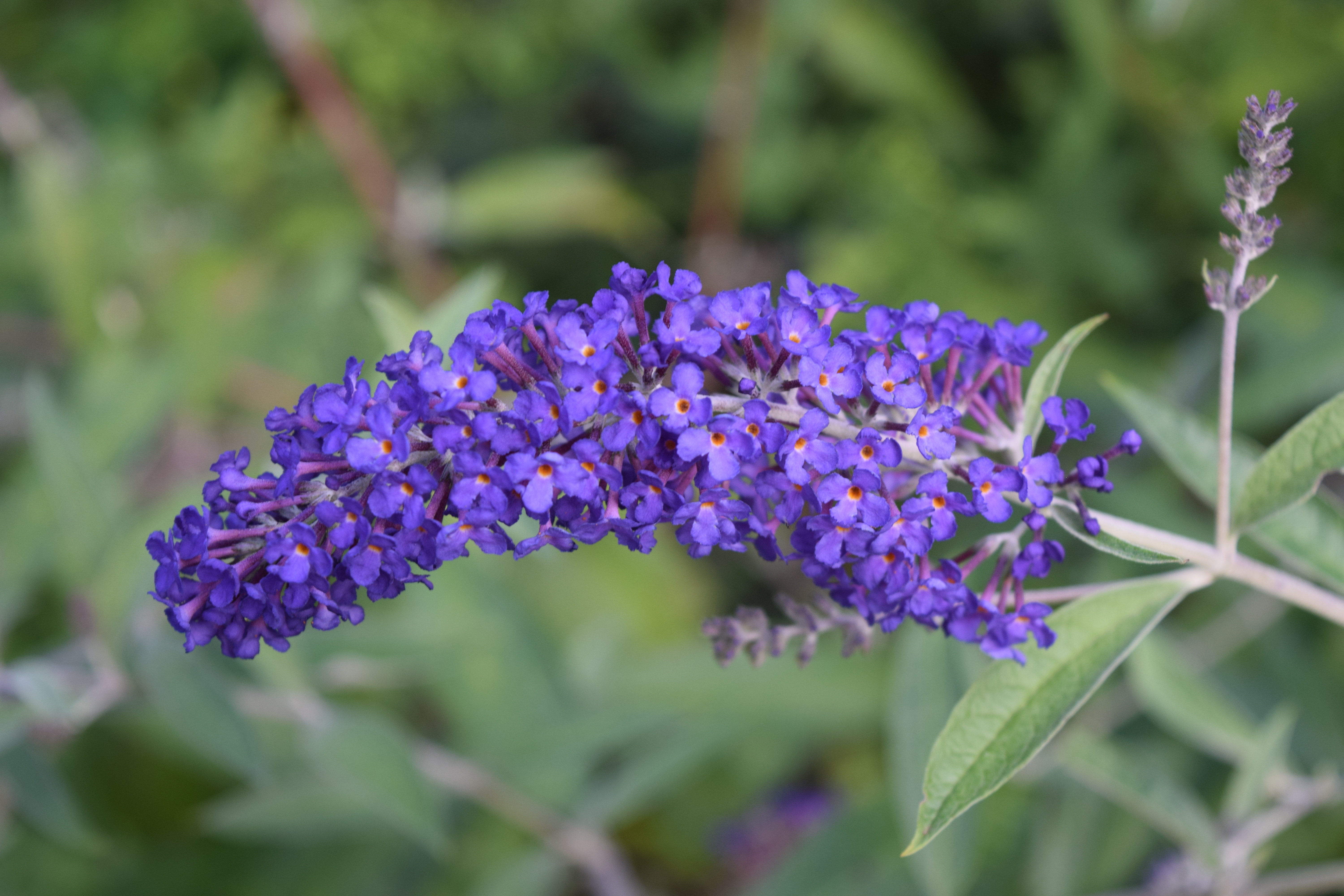
At the sidewalk end of the Driveway Border, the compact ‘Blue Adonis’ Butterfly Bush (Buddleia davidii) is still perfuming the air with racemes of blue flowers. I placed it here so people could smell the honey scent as they walk by. I’m very pleased with this plant so far, it blooms pretty well, is very fragrant, and doesn’t overwhelm the border with its size (only about 3′ this year).
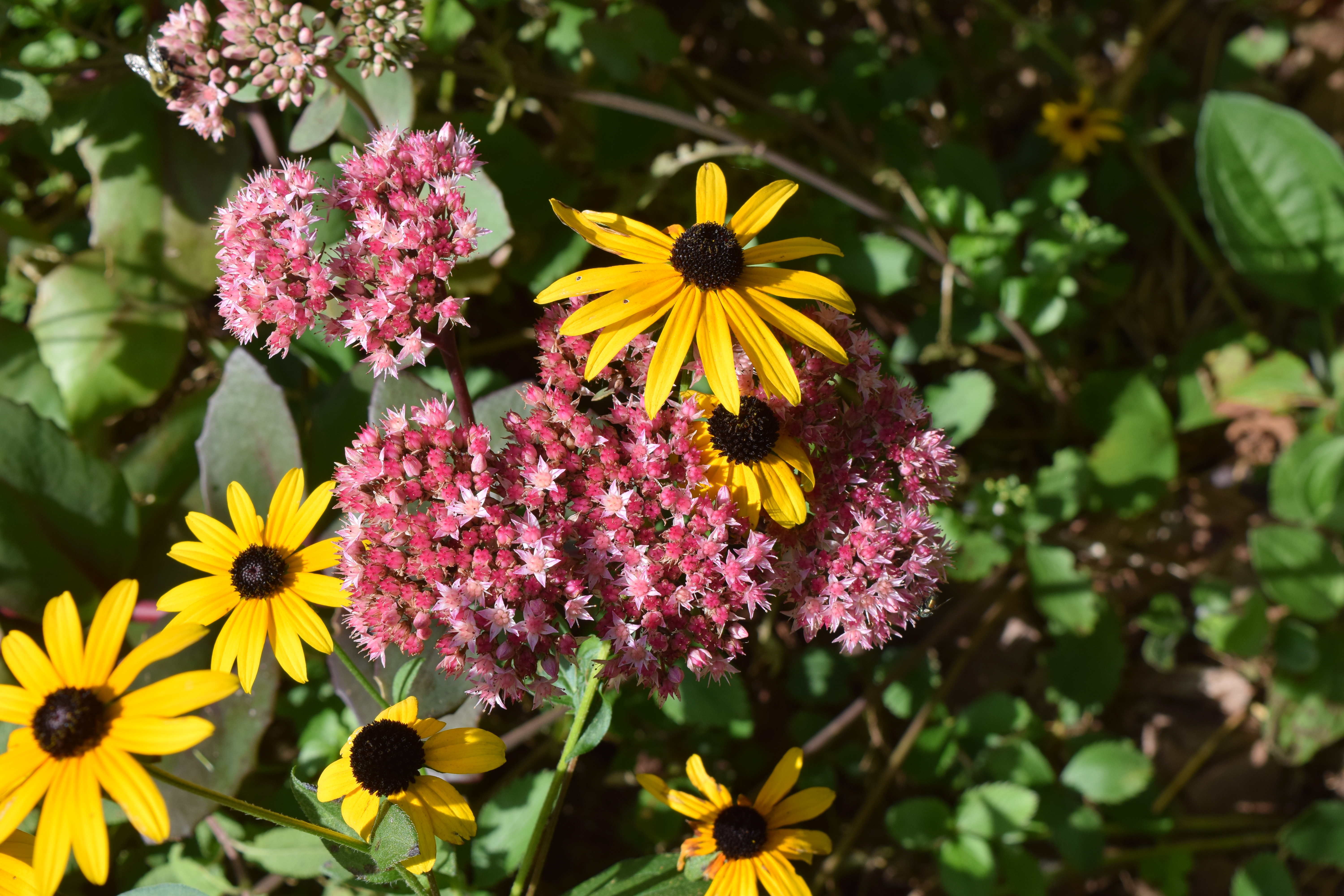
Orange Coneflower (Rudbeckia fulgida) and ‘Matrona’ Sedum spectabilis are blooming nicely together in the East Parkway Bed.
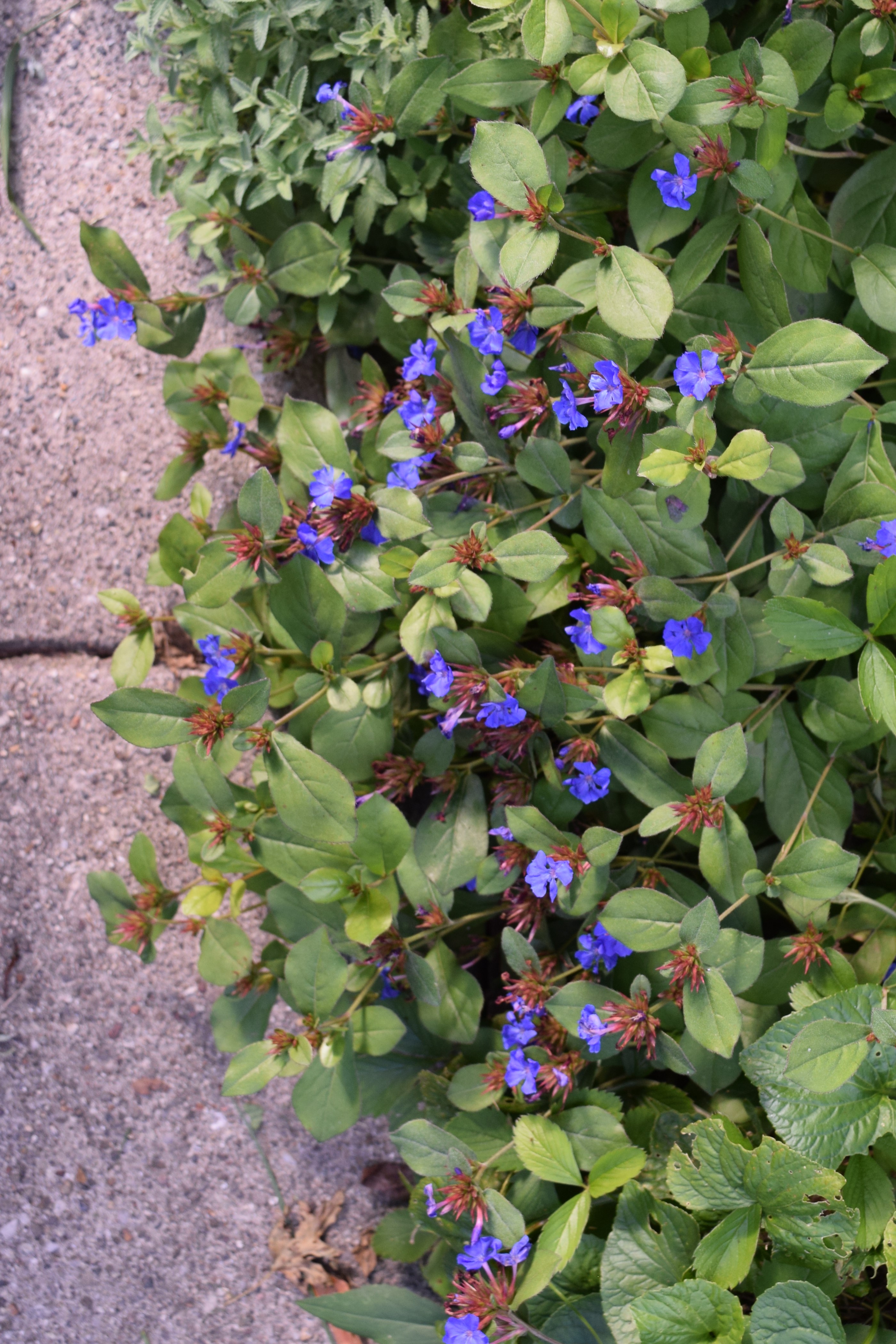
In the same bed there’s a sizable and growing patch of Plumbago (Ceratostigma plumbaginoides). This picture really doesn’t do justice to the deep blue flowers. This is a really nice late-blooming groundcover for sunny areas.
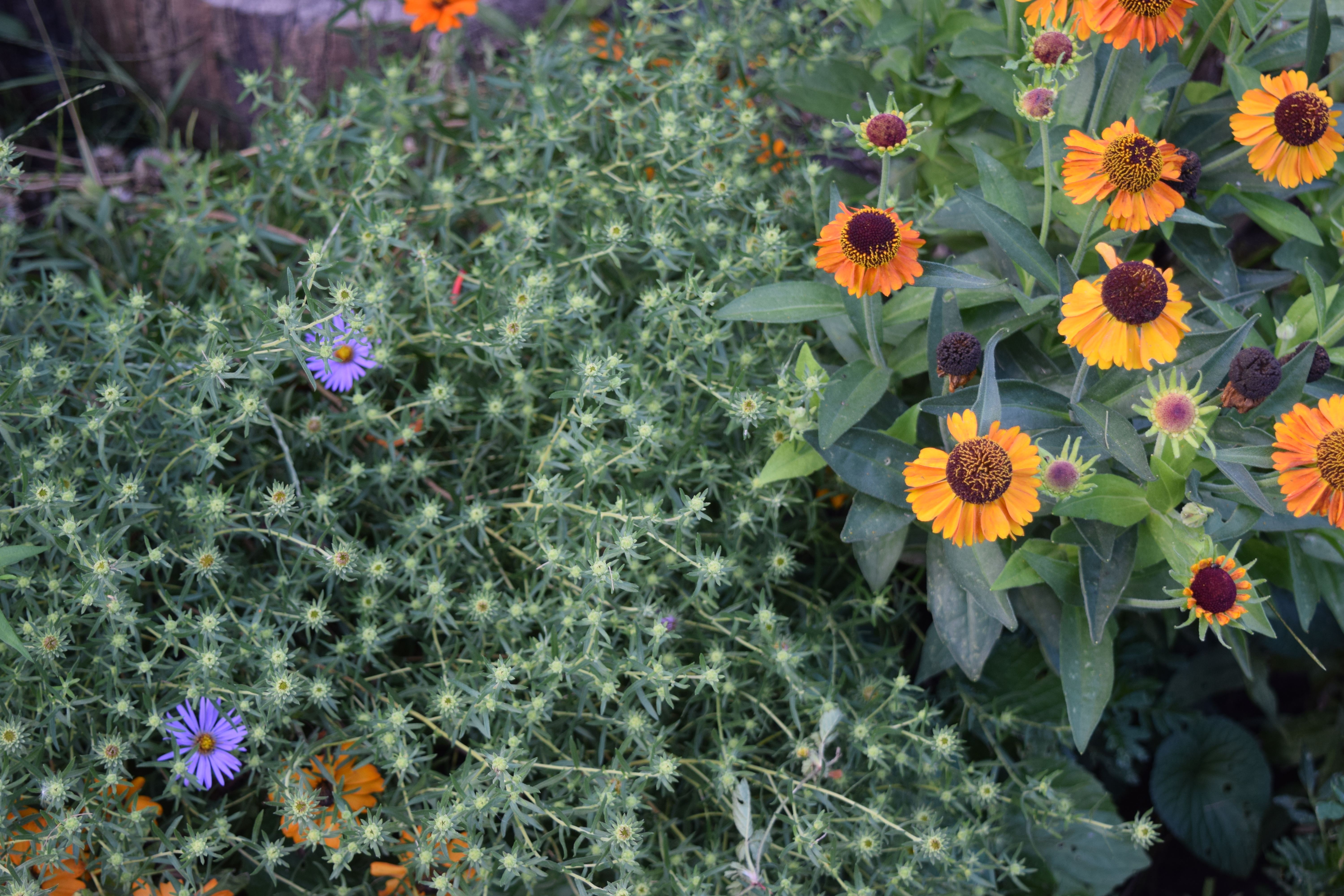
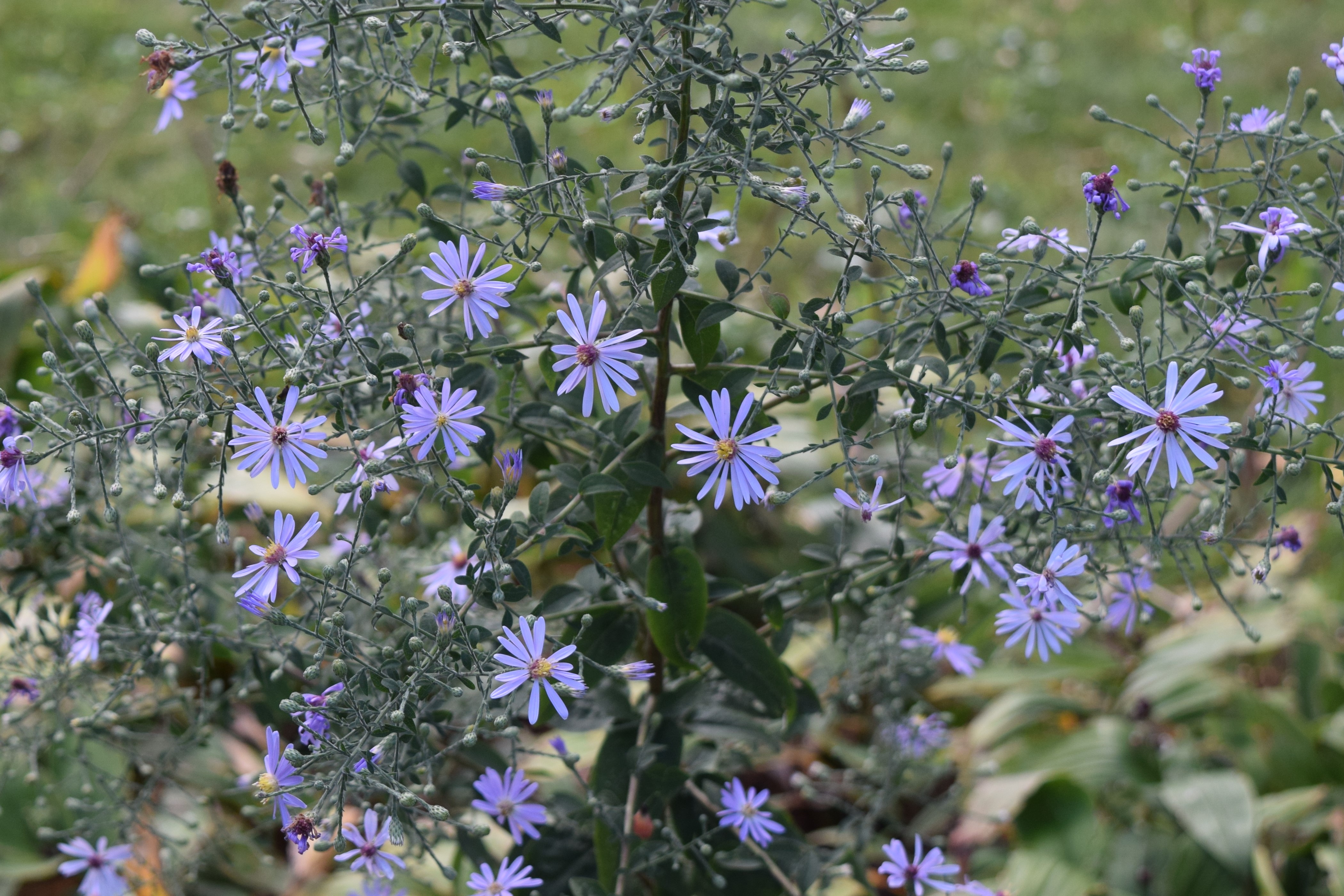
On the other side of the driveway, in the Lamppost Bed, Helenium autumnale ‘Short’n’Sassy’ has been blooming since June. I’m beginning to worry it’s going to be so exhausted soon it won’t survive the winter. Aromatic Aster (Symphyotrichum oblongifolium) is cozying up to the Helenium, but just a handful of buds have actually opened. Soon, though, it will be covered in flowers.
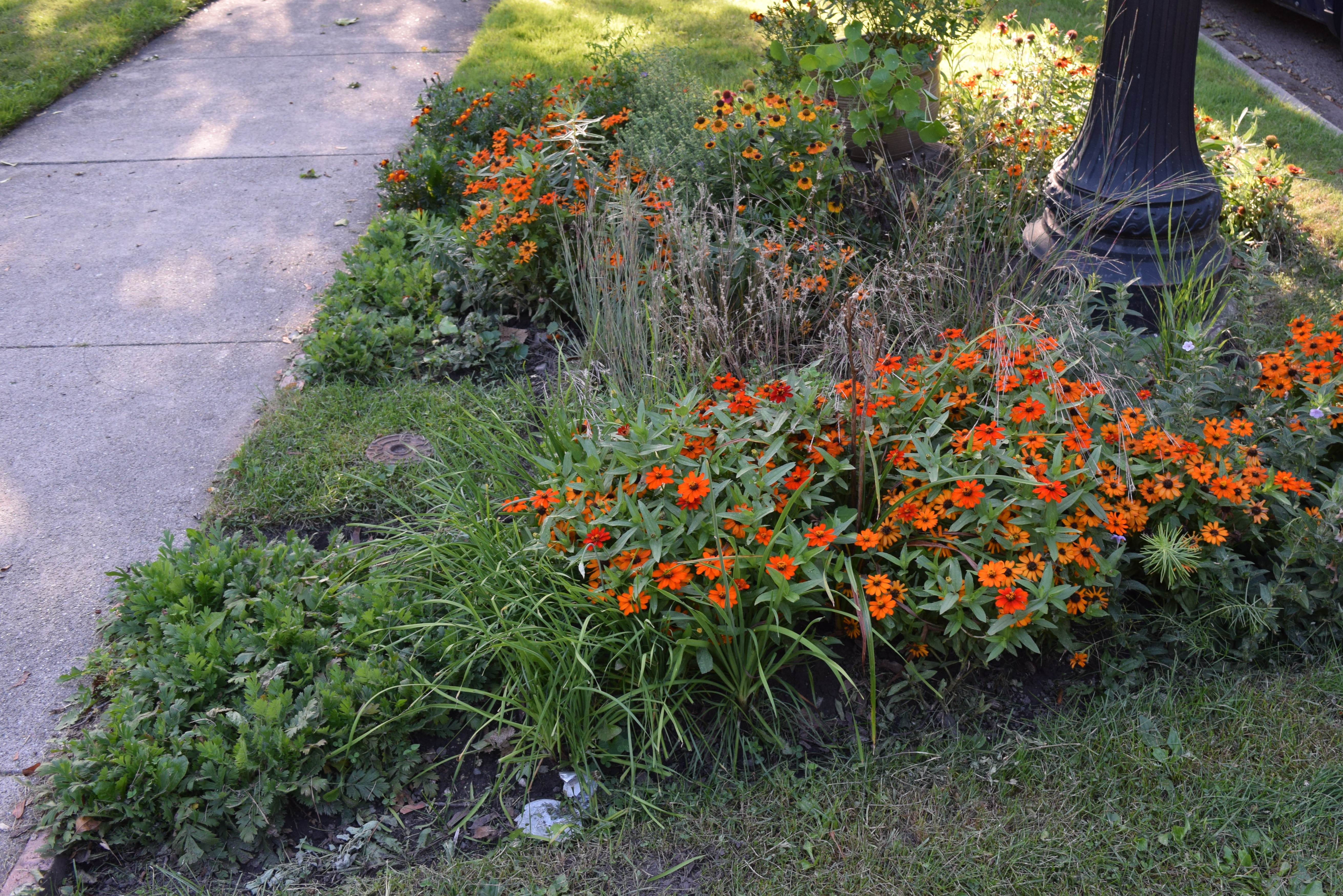
Most plants in this new bed were planted just this spring, however ‘Orange Profusion’ Zinnias (Zinnia elegans) have done an admirable job of filling in empty spaces and providing lots of zippy color.
Short’s Aster
In September, of course, a gardener’s fancy turns to Asters and Goldenrods. While Aromatic Aster is just dipping its toe in the seasonal waters, Short’s Aster (S. shortii) has gotten about knee deep.
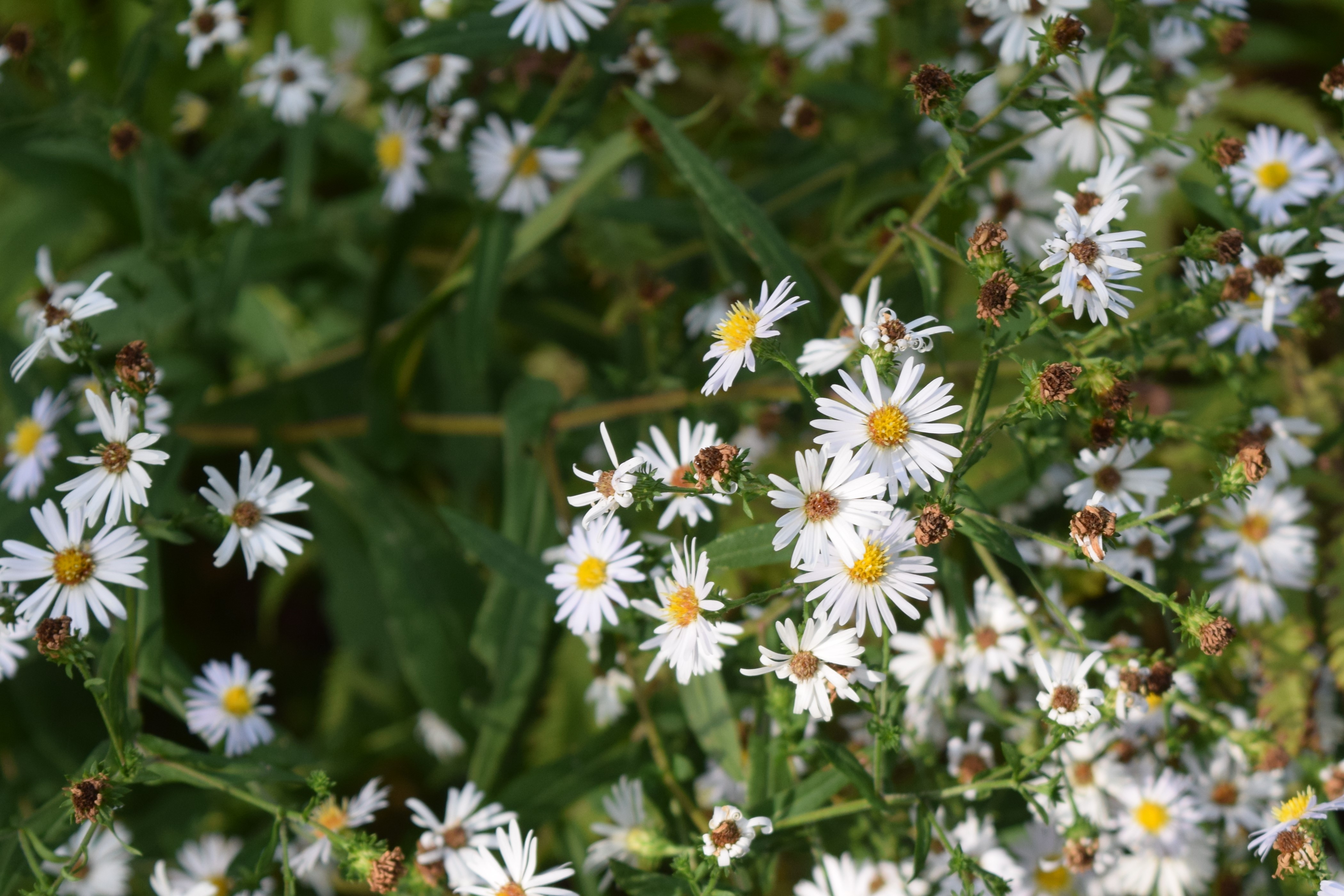
On the other hand, in the back garden the Crooked Stem Asters (S. prenanthoides) have already peaked. Or to continue the metaphor, they’re done swimming laps and are starting to think it might be time to get out of the water. The flowers of this aster open light blue and fade to almost white.
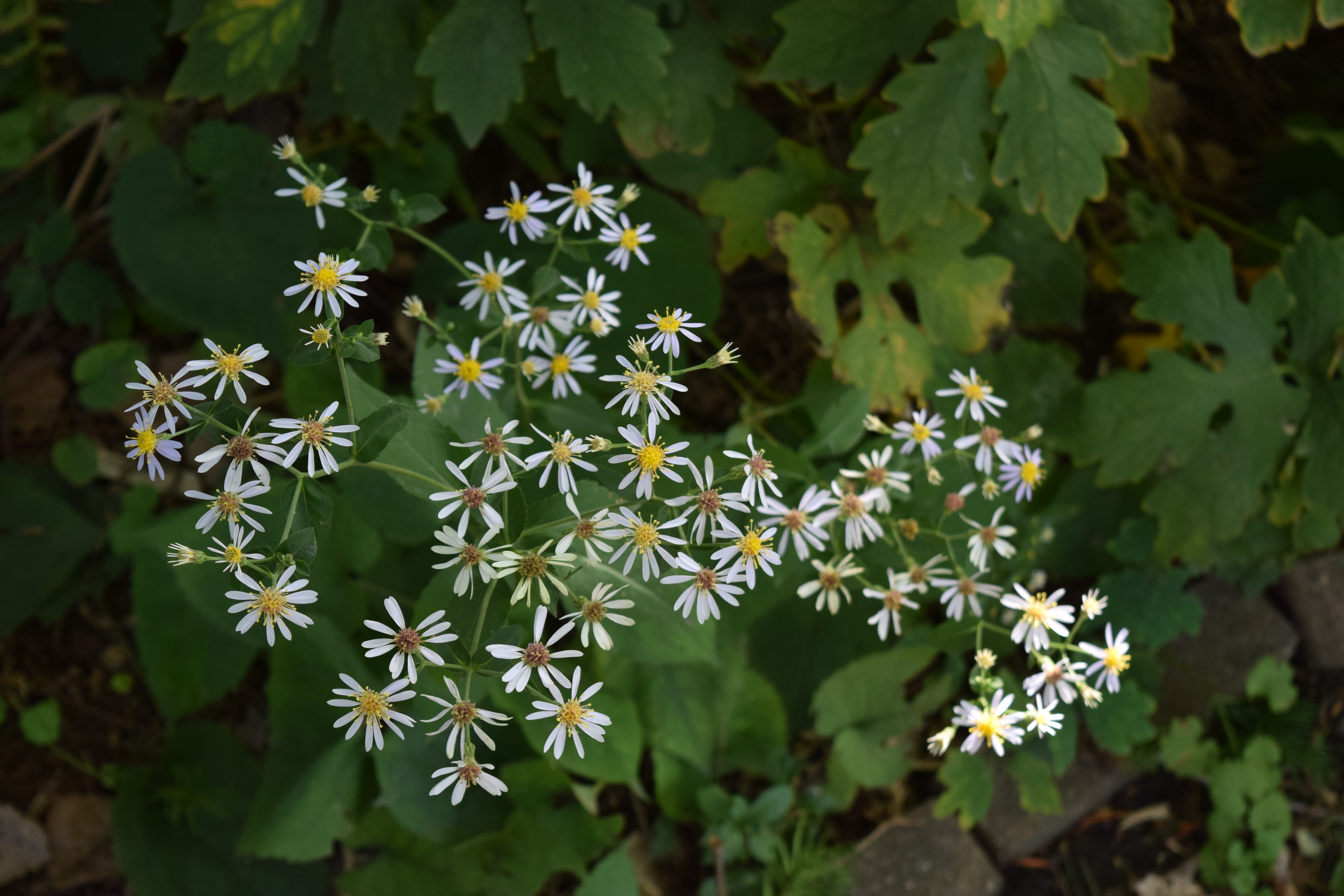
The Big Leaf Asters (S. macrophyllum) have also peaked. Their flowers have a kind of gap-toothed look, but they make up for this by growing contentedly in dry shade and also by being a pretty decent groundcover.
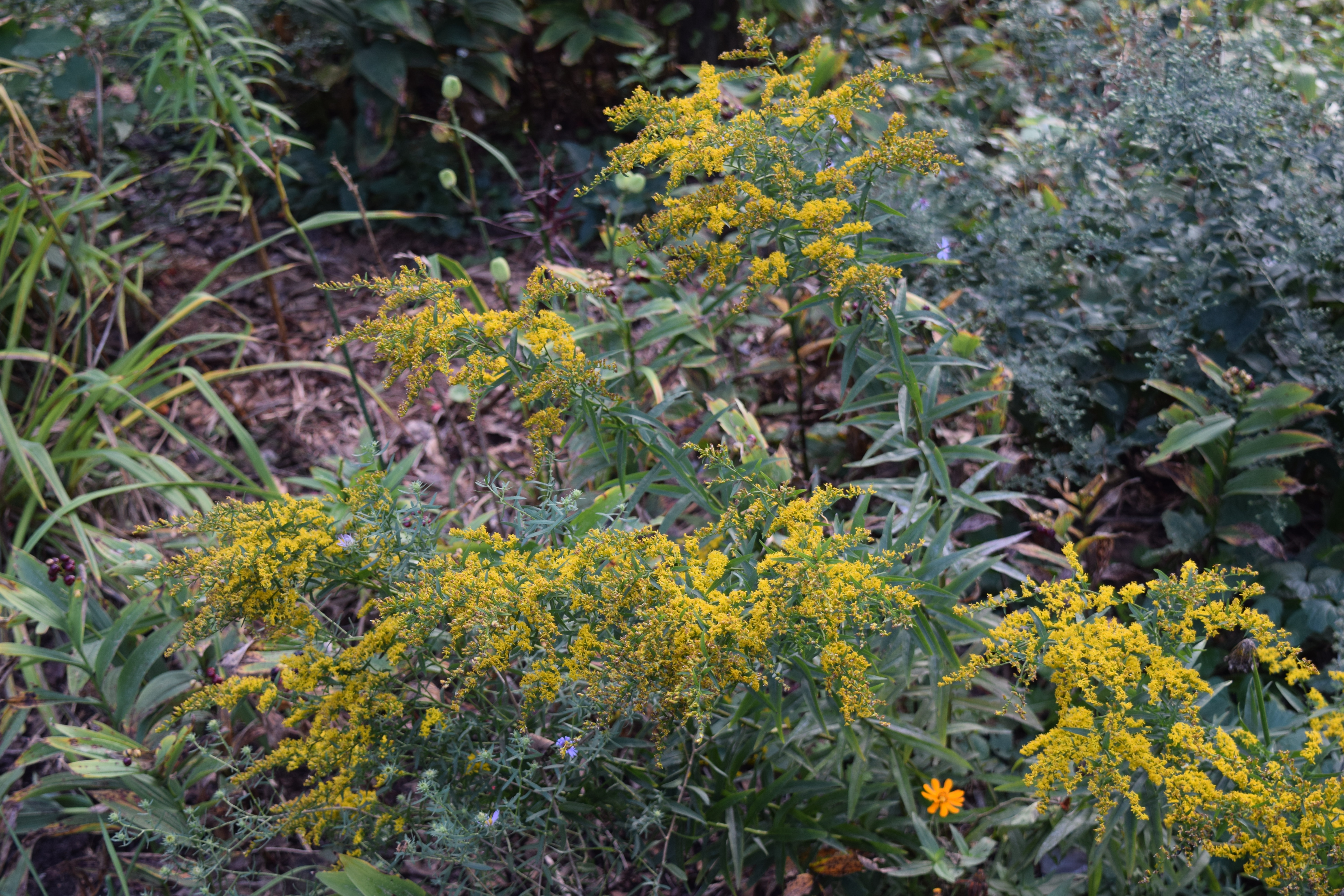
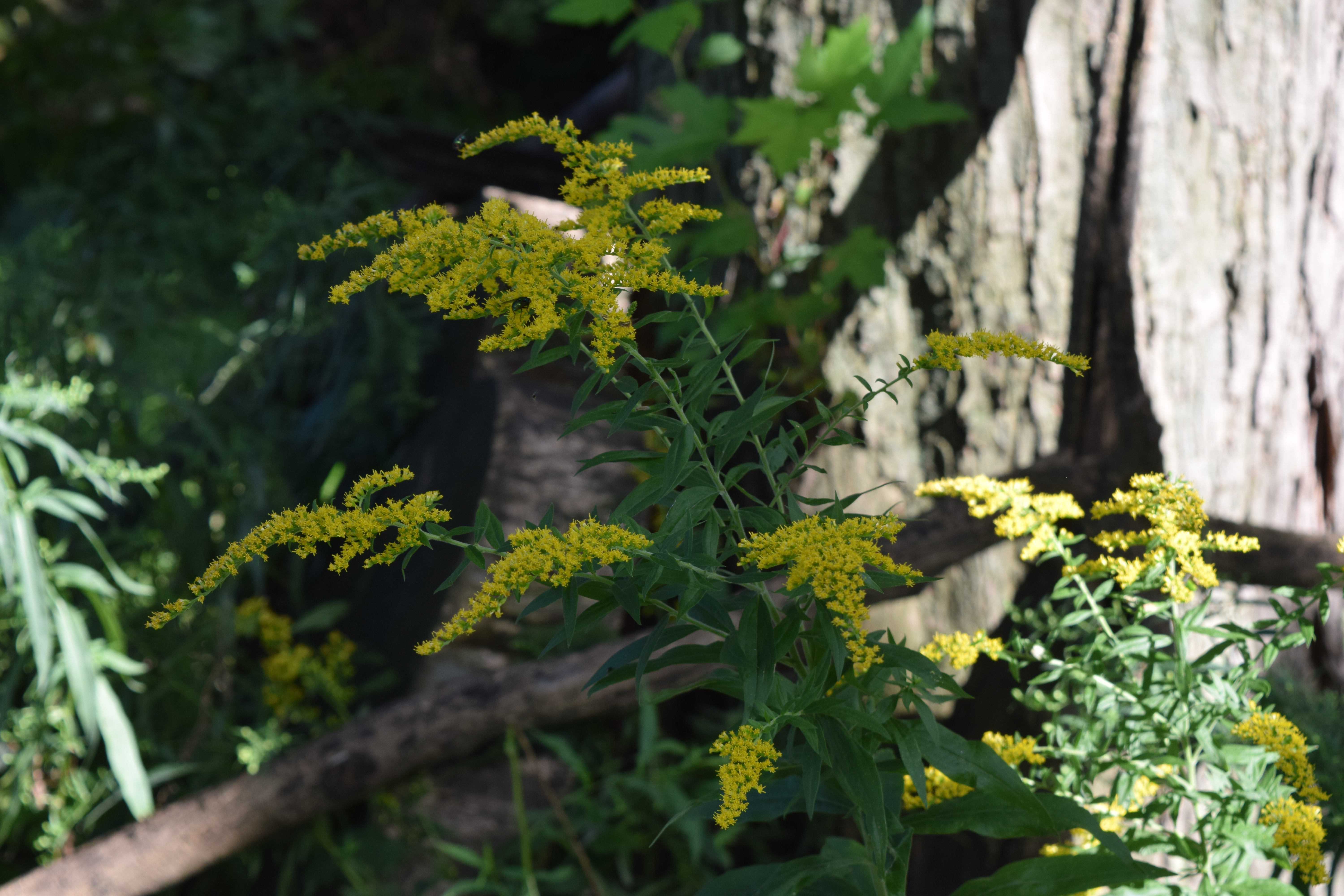
Anise Scented Goldenrod
Anise Scented Goldenrod (Solidago odora), which grows in the Left Bank Bed, has peaked. This is a nice little Goldenrod that tops out at 2-3′ and takes some shade. Some people make tea from the leaves.
NOID Goldenrod
There’s also a NOID wild Goldenrod growing in the back garden. On the other hand, Blue Stemmed and Zigzag Goldenrod (S. caesia and flexicaulis) only have a few sporadic blooms as of yet.
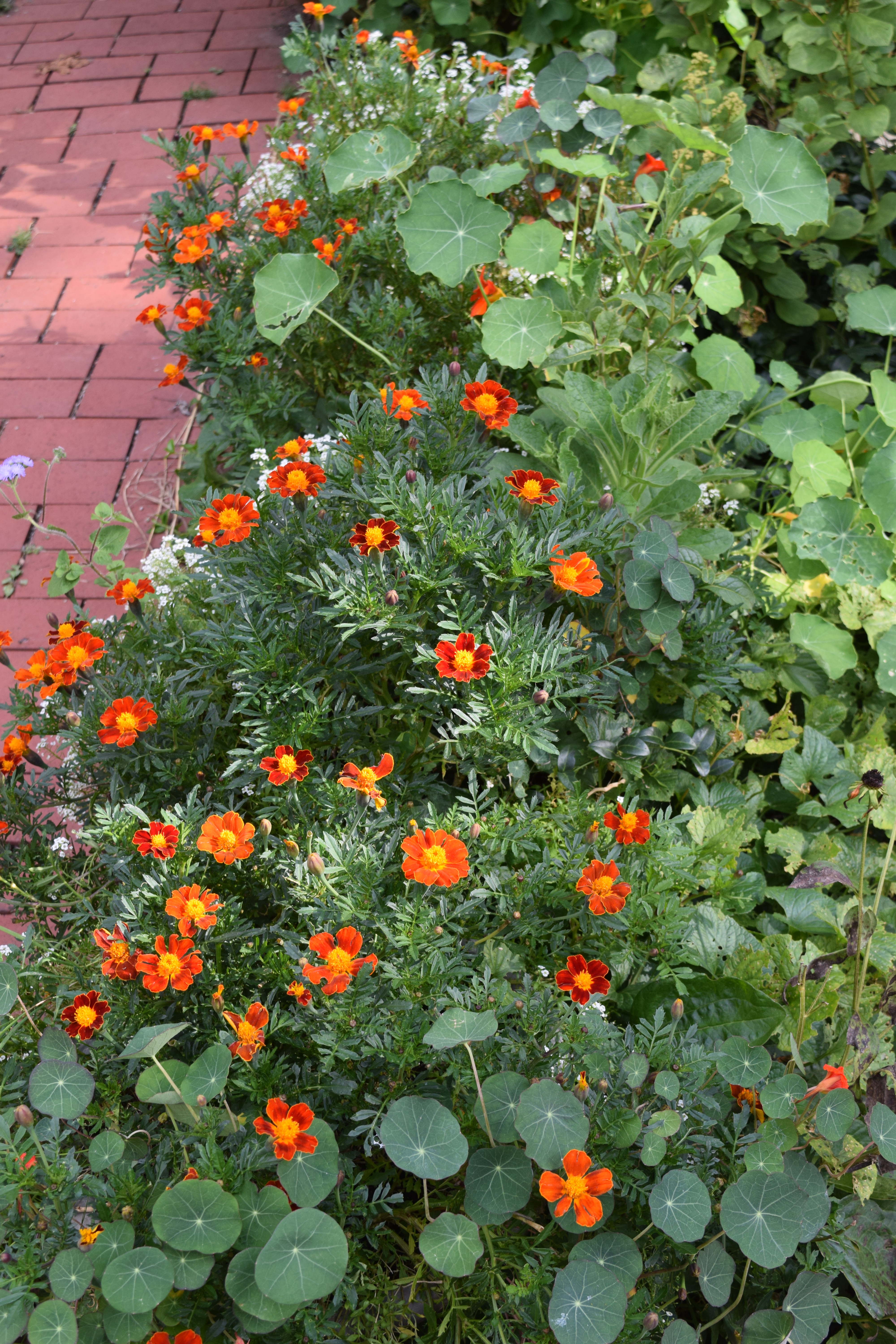
‘Disco Red’ Marigolds
In terms of container plants, the Nicotiana and Nasturtiums have pretty much thrown in the towel blooming-wise. On the other hand, other container plants have found renewed vigor in September. The ‘Disco Red’ Marigolds (Tagetes patula), for example.
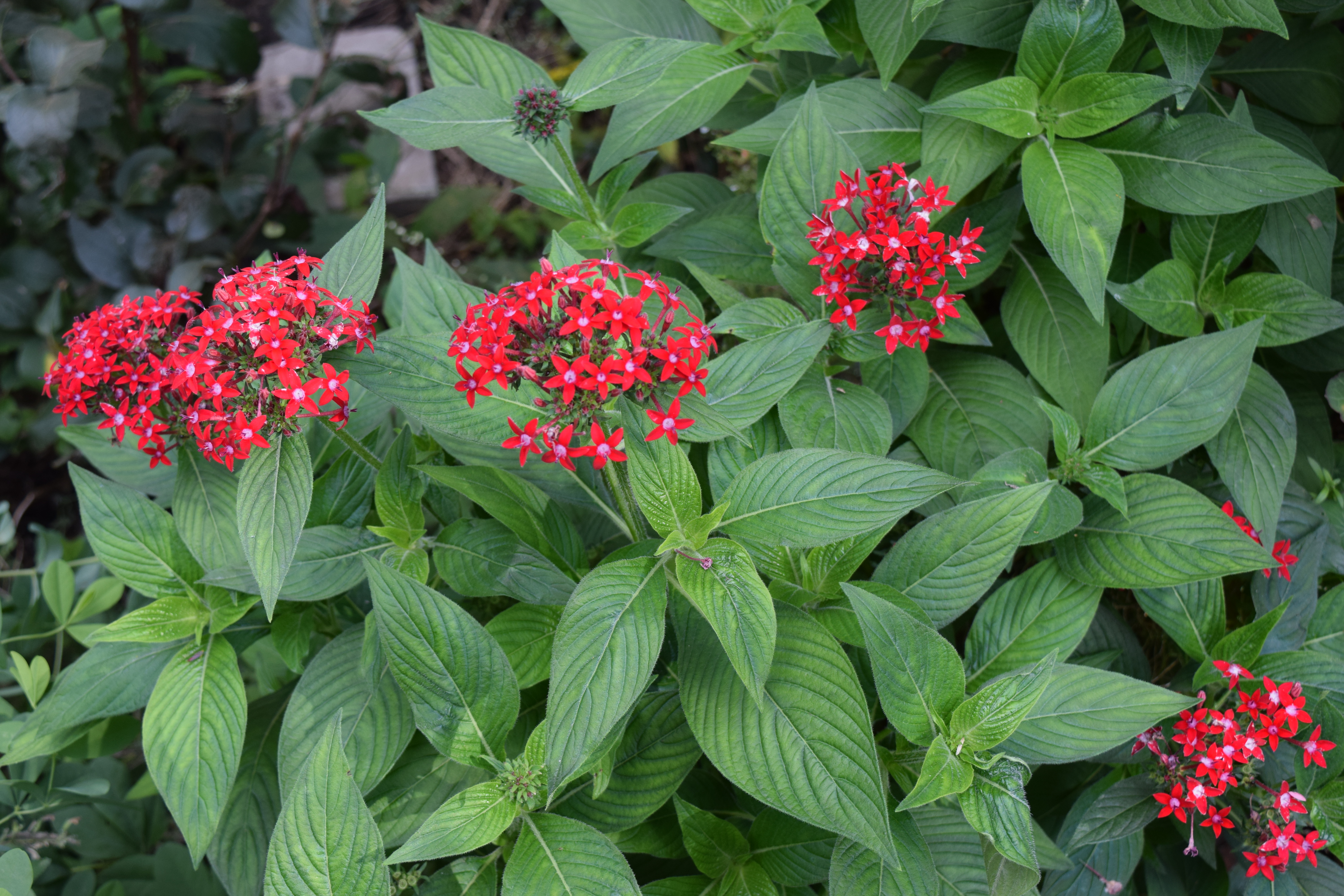
Pentas
Also the Pentas (Pentas lanceolata). Great hummingbird plants, by the way.
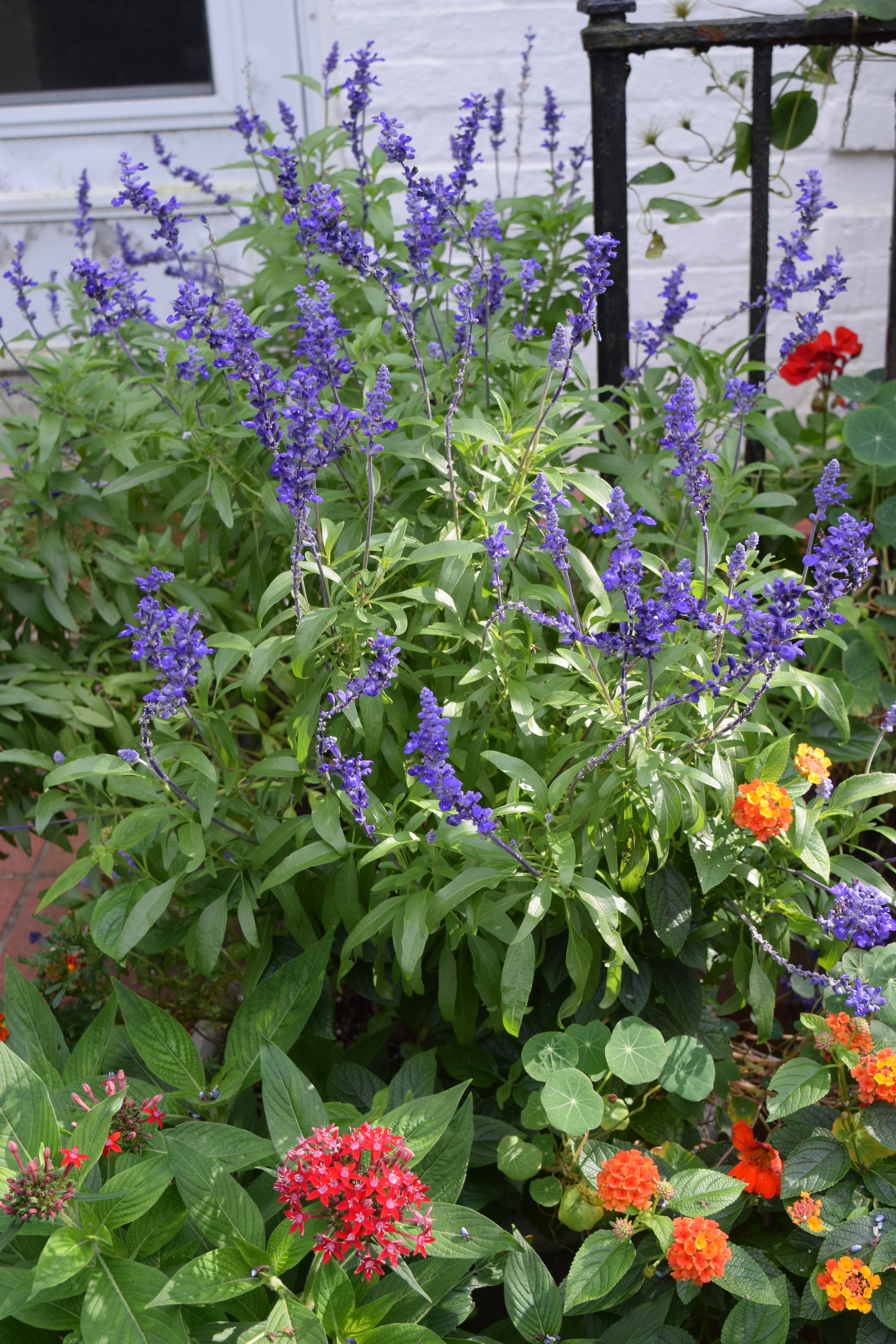
And the annual Salvias (Salvia farinacea ‘Evolution Violet’ and S. ‘Mystic Spires Blue’).
The Sidewalk Border viewed from behind.
So that’s about it for September Bloom Day. Which blooms are making you happy right now?
After experiencing the Chinese Garden, Judy and I ambled through a large area known as the Flowery Brook and Lilacs.
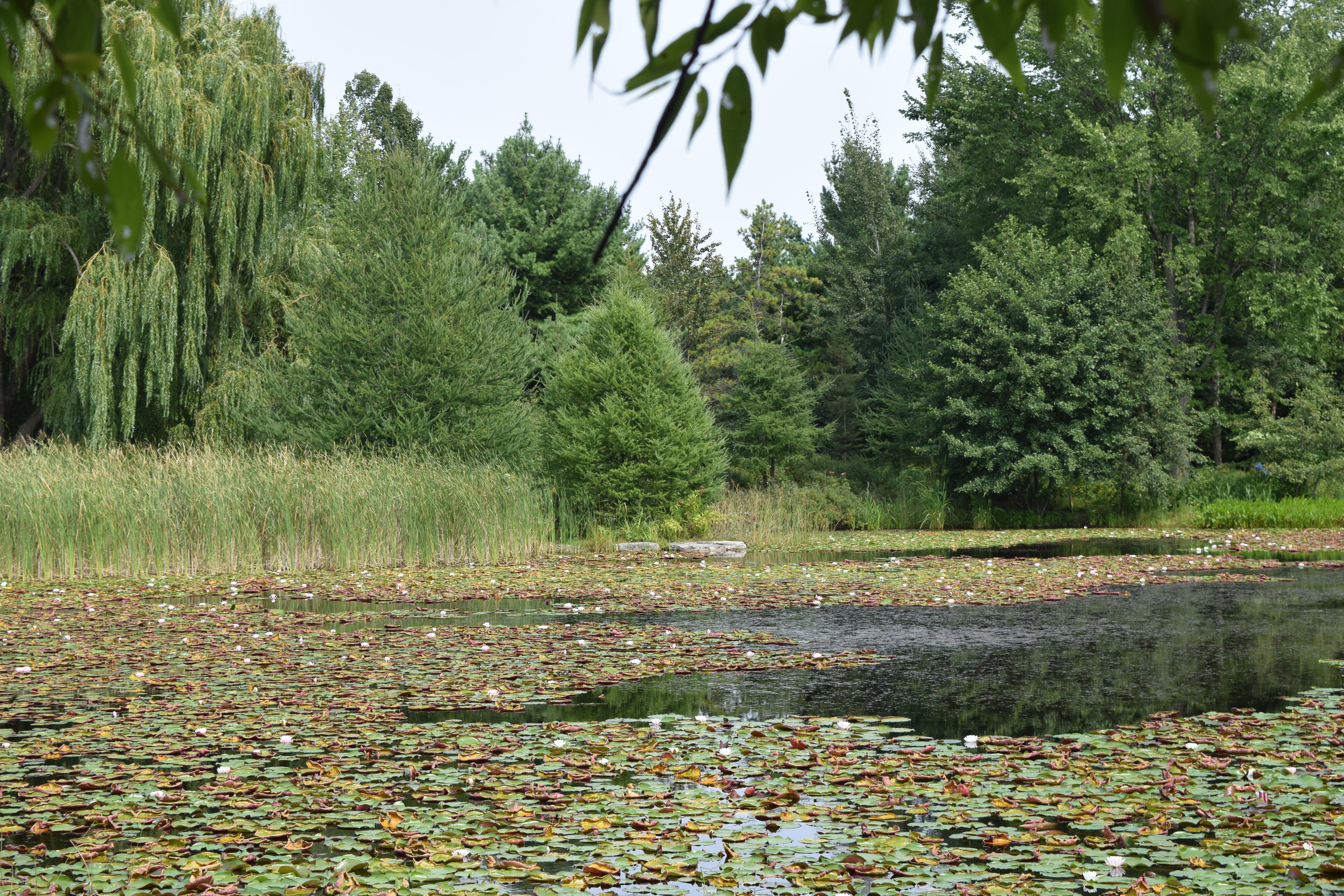
This has not only a brook, but also two large ponds almost covered with lily pads at the very end of August, when we were there.
There were a number of birdhouses set up around the ponds, and Adirondack chairs thoughtfully left for those who wanted to rest or just contemplate the scene.
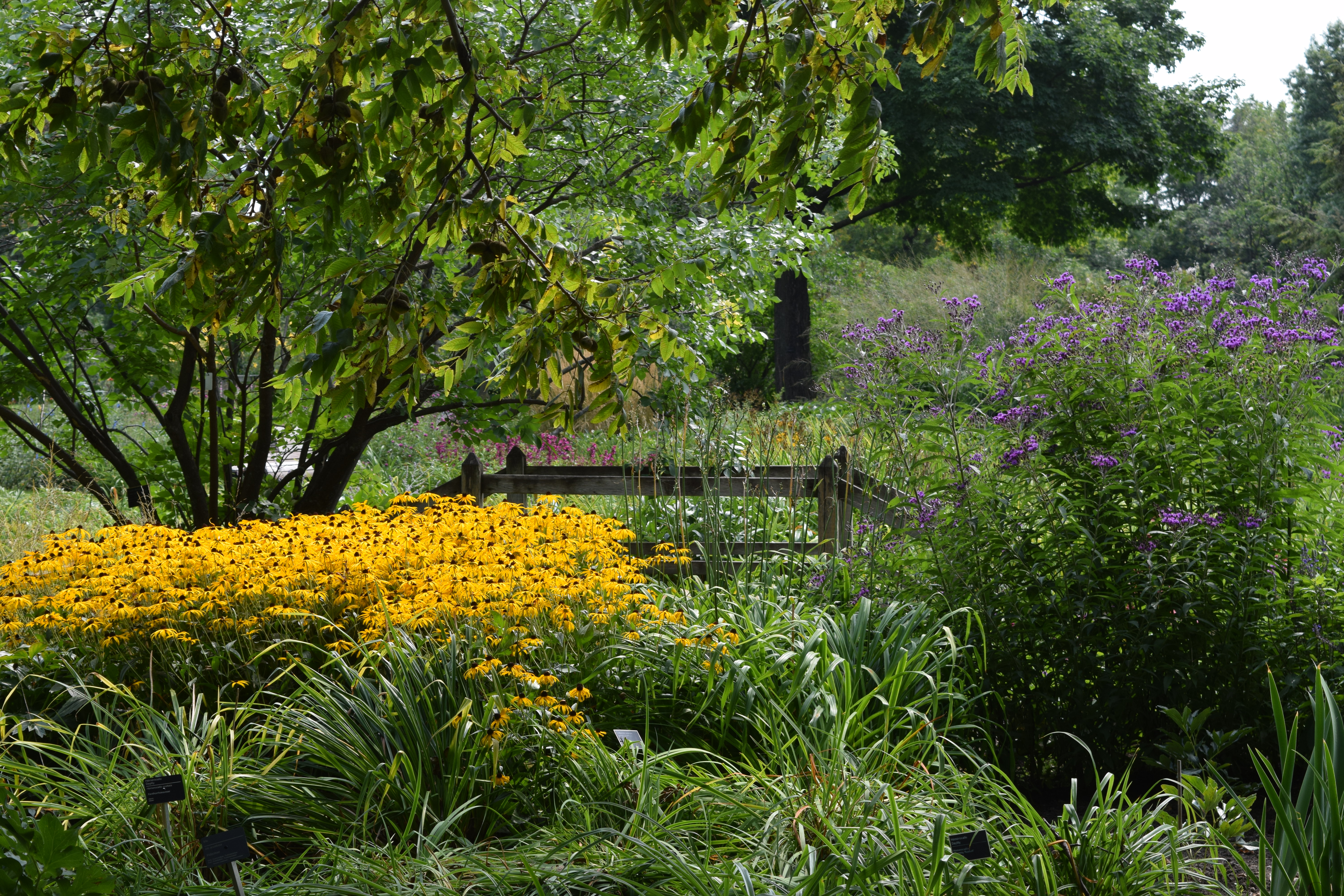
This area is at its best in June and July, when the lilacs, peonies, and daylilies are in bloom. However, there was still plenty of color when we were there.
Occasional bridges crossed the brook that flowed through this part of the garden.
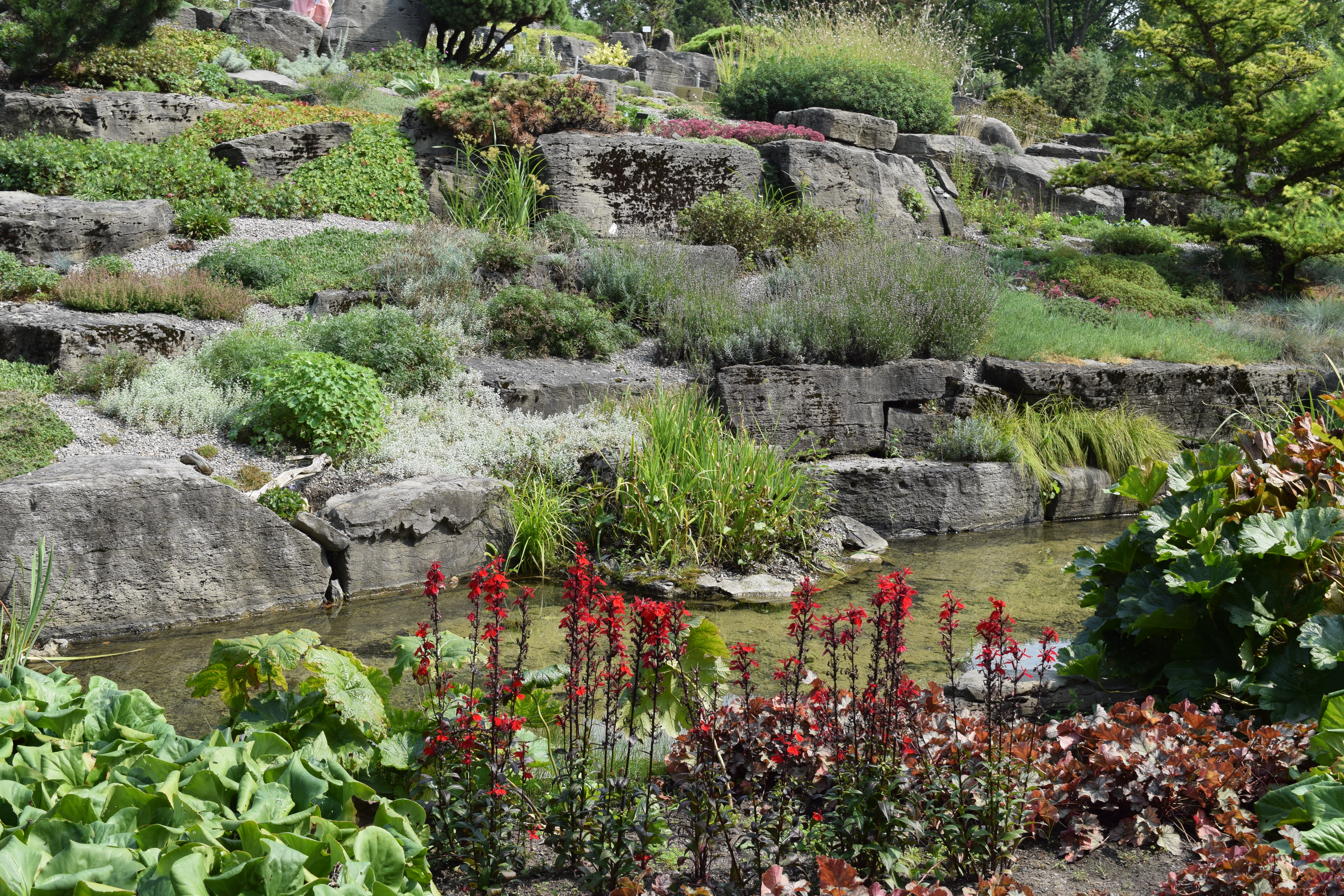
We then had a quick walk through the Alpine Garden, a kind of garden I generally don’t get too excited about. Some Cardinal Flowers (Lobelia cardinalis) did catch my eye, though.
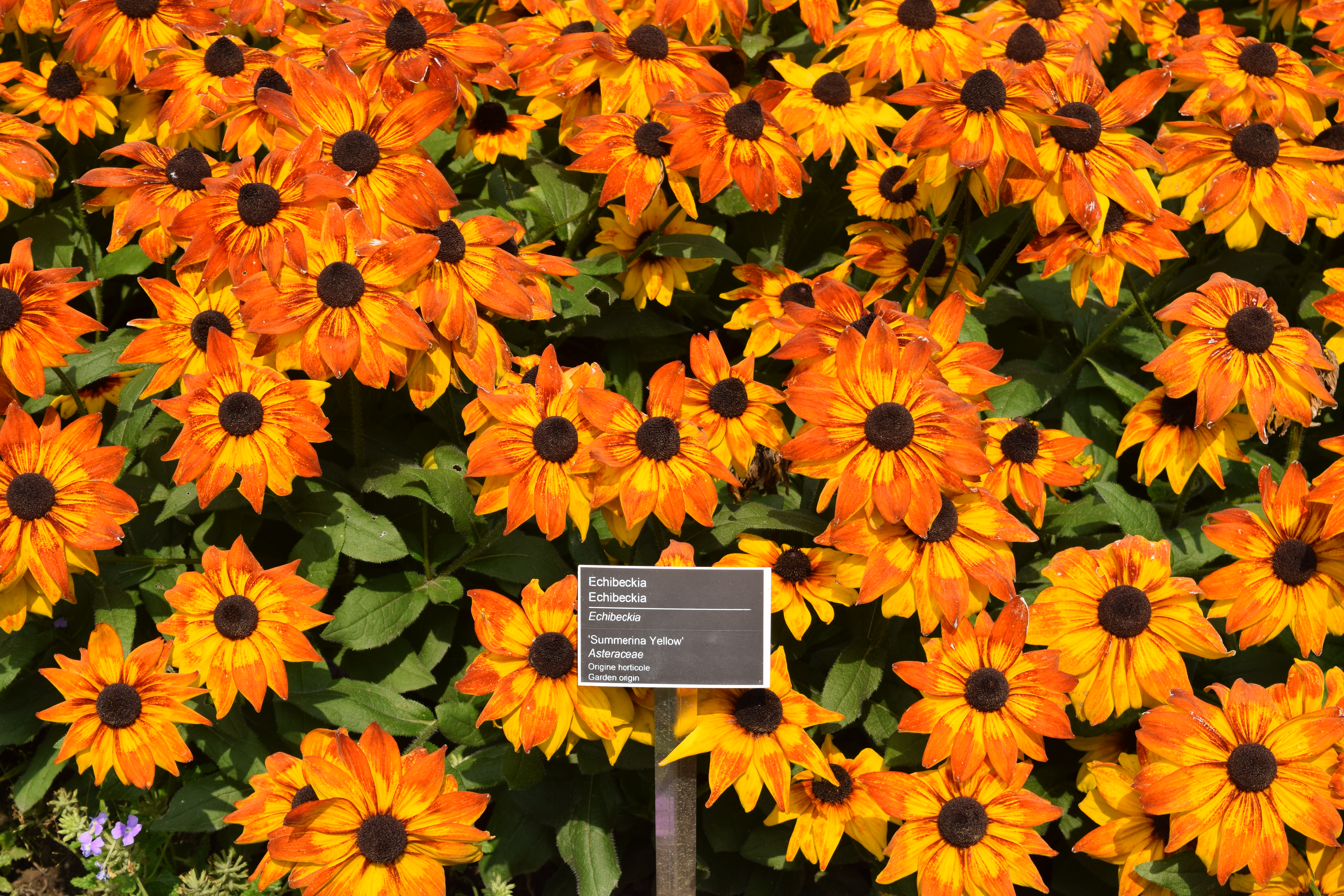
We then strolled over to the Garden of Innovations, which highlights new species and varieties of garden plants. This is where you go if you need waking up after all that tranquil green. Personally, I loved all the bright color.
Although: “Echibeckia”? Really?
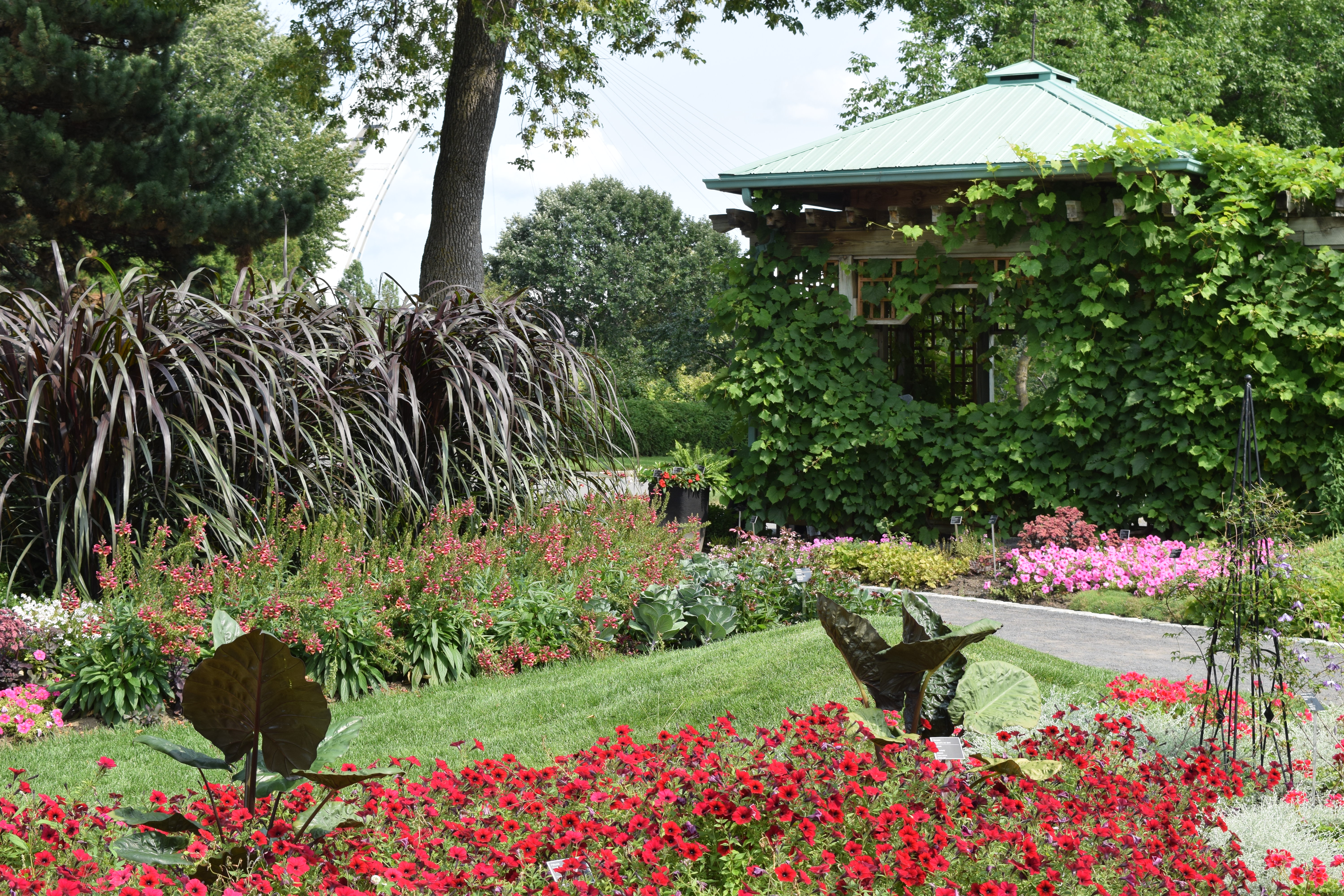
Nice grass for people who like dark foliage. I confess that I was not taking notes on names.
The Useful Plant Garden is next to the Garden of Innovations. These are mostly food plants.
It’s always a pleasure to see Sunflowers in bloom.
I’ve never seen this type of Allium before. It’s called Allium grande, which seems apt. Not sure in what ways it is useful, though it looks you could give someone a pretty good whack with it.
This garden has about 200 genera.
I’m sorry I didn’t make a note of the grass they used with this Verbena to make this stream leading to a fountain. At this point we had to move on, as we wanted to visit the Jean Talon Market before leaving the city. But there was so much at the Botanic Garden we didn’t get to see: the Arboretum, Japanese Garden, First Nations Garden, etc. I would also really like to see the Biodome and Insectarium.
We’re definitely going to have to plan another trip to Montreal.
We got to spend some time in the Montreal Botanical Garden’s Chinese Garden during our visit. This part of the botanical garden was created through a collaboration with the Parks Department of Montreal’s sister city, Shanghai.
The entrance garden.
A prominent Shanghai landscape architect produced the design, 50 Chinese craftsmen worked on its creation, and tons of materials were brought over from China in order to produce something genuinely expressive of the Chinese garden tradition..
The garden is built around a large lake, which was full of sacred lotus (Nelumba nucifera). The lotus had passed their peak of bloom when we were there, but there were still many flowers among the seed heads.
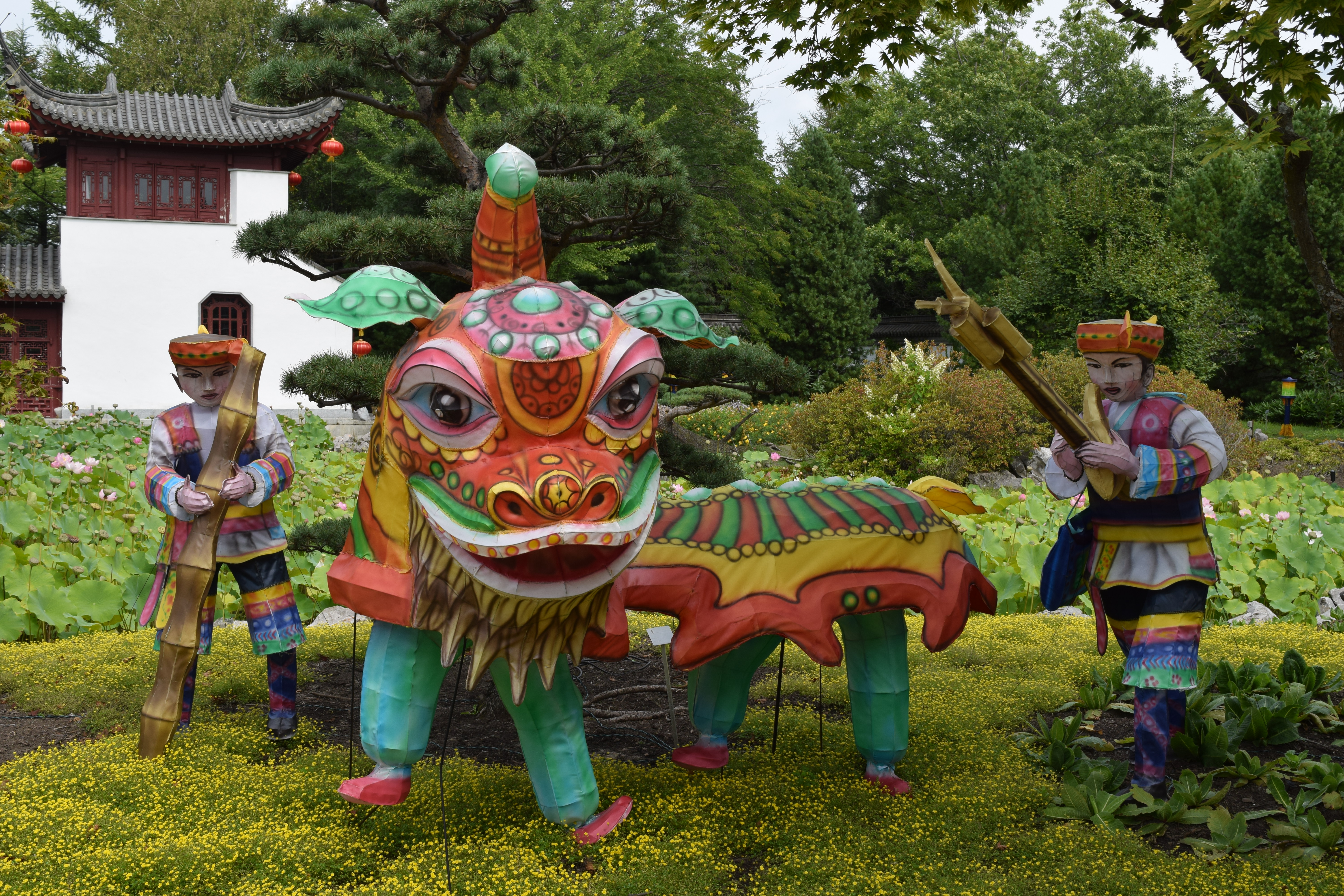
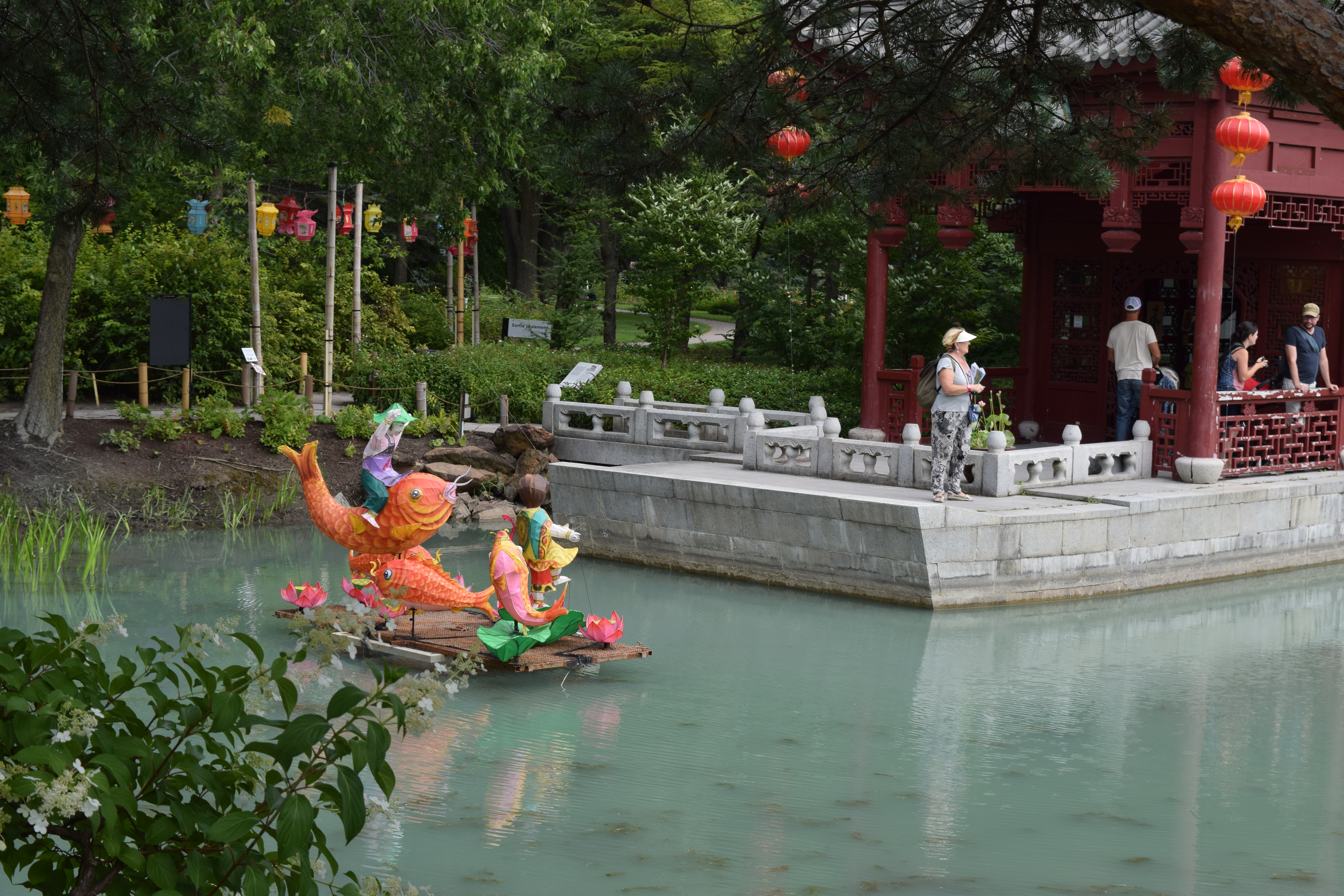
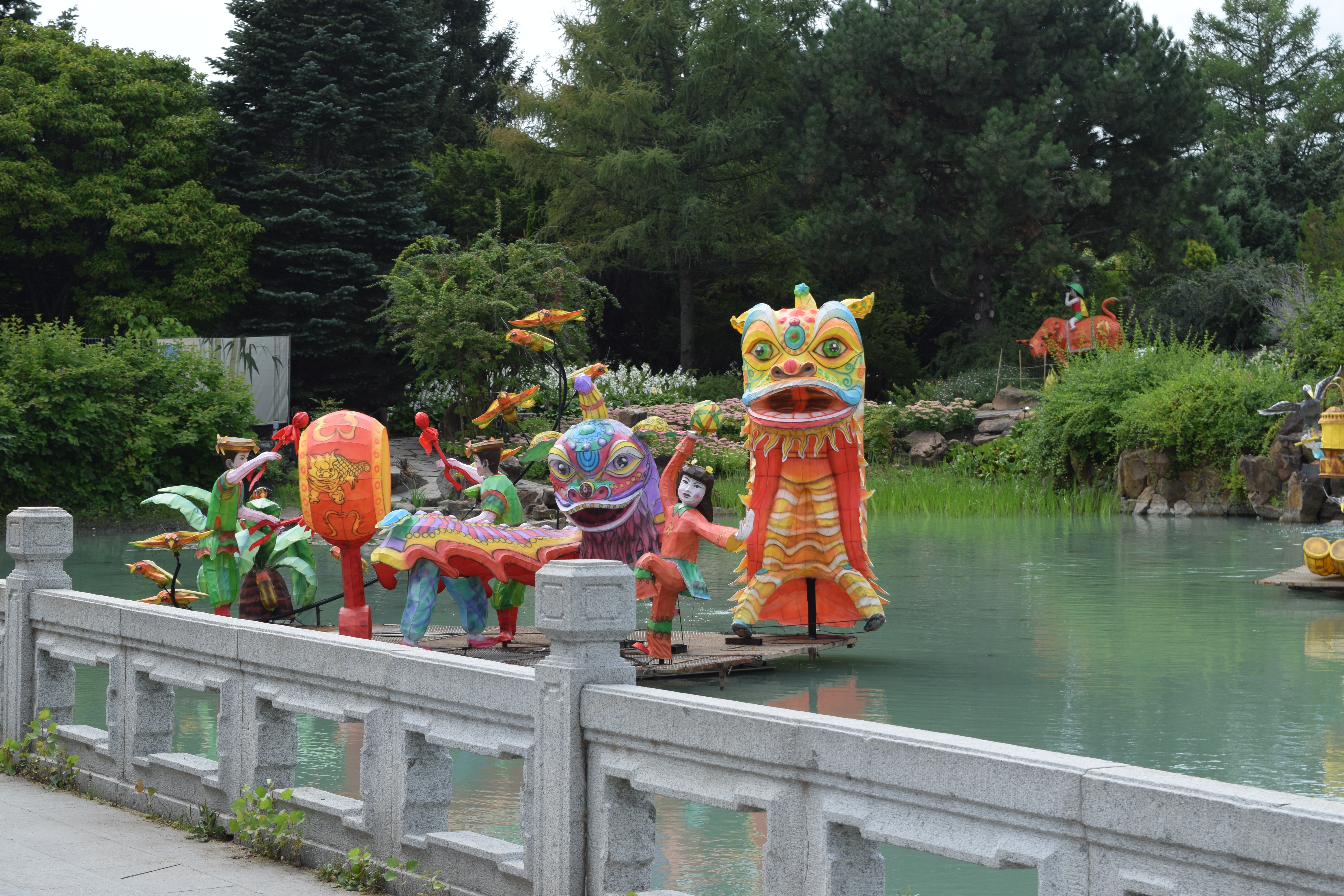
At this time of year the Chinese Garden is full of brilliantly colored lanterns in the shape of dragons, people, horses, birds, etc. In September the lanterns are lit in the evening. Even without being lit, they add a festival atmosphere to the garden. We were very disappointed, though, not to be able to see the lanterns at night.
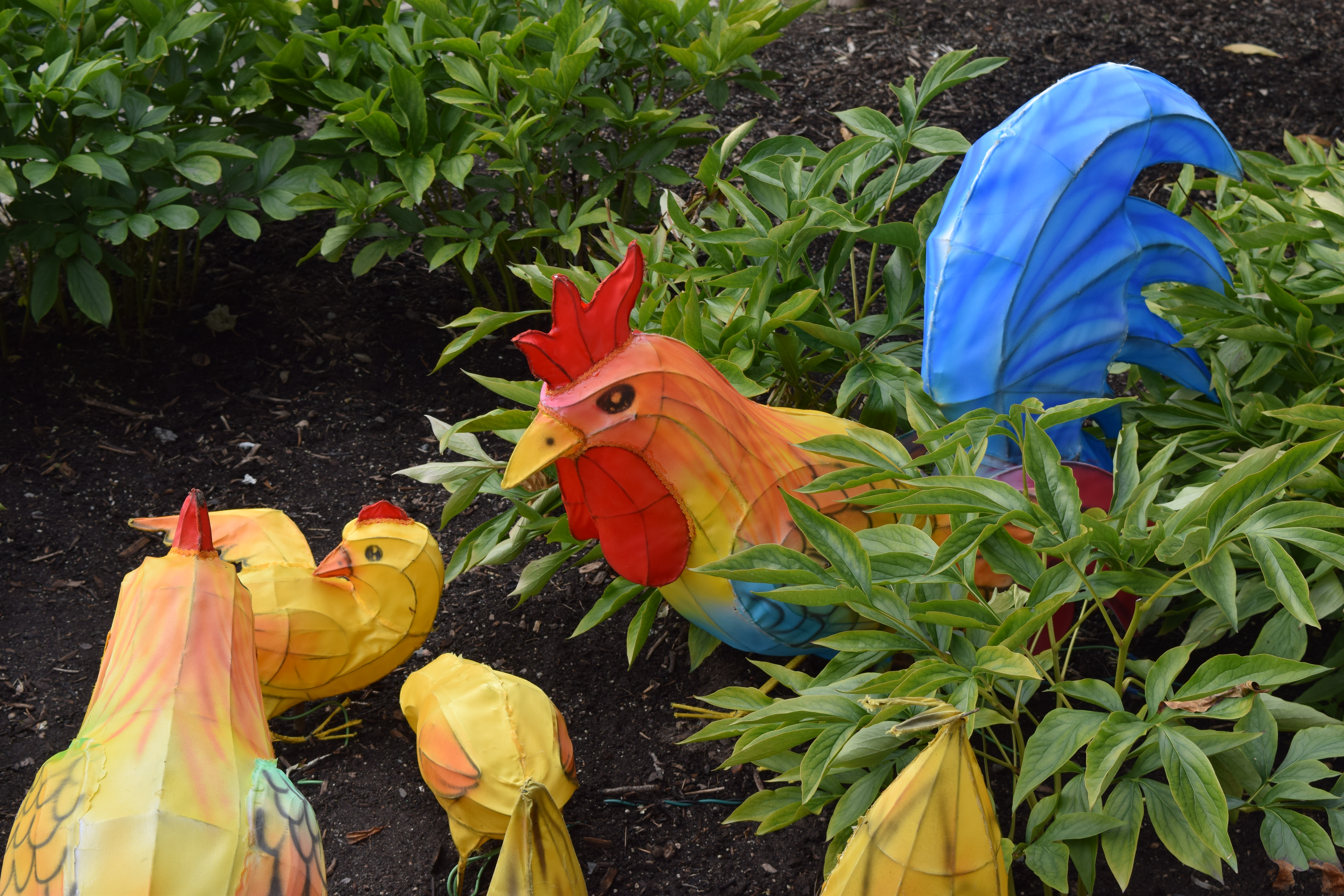
I loved these little chick lanterns with their mother hen.
The stone boat is a traditional feature of Chinese gardens. I’m sorry, but it reminds me of the pontoon boats people use to hold barbecues on lakes in Wisconsin.
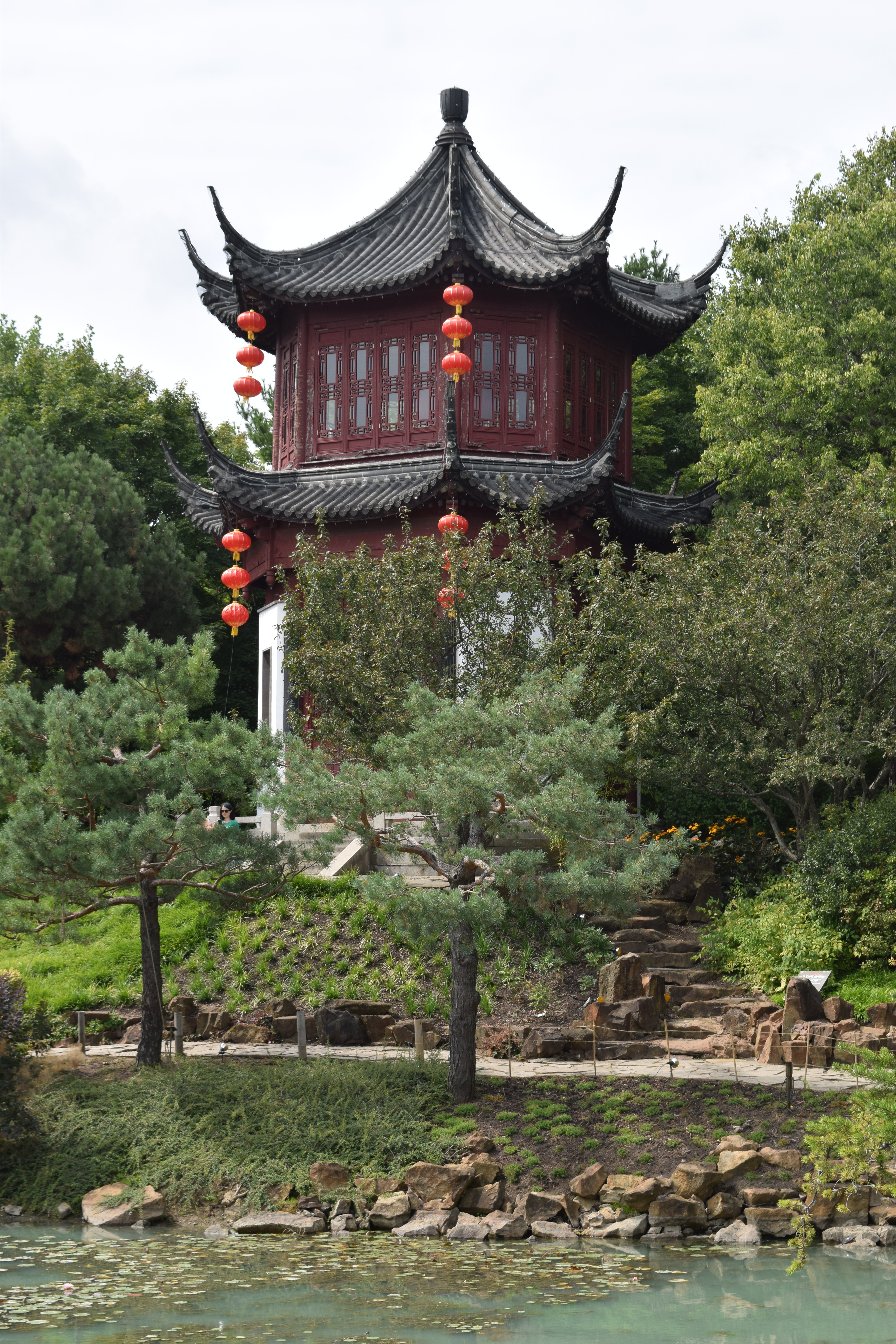
This tower is modeled after a Chinese pagoda. I like how those conifers near the base of the tower seem to echo its pagoda shape, at least to my eyes.
There is also a 30′ tall artificial mountain, complete with waterfall. This is another garden tradition, a very old one that goes back to the first Chinese imperial dynasty. It was originally based on the belief that immortal spirits, who had the power to grant wishes, lived on mountains.
This particular mountain required 3,000 tons of stone, so don’t attempt to build any mountains in your own garden unless your car has really good shock absorbers.
I must confess that I feel no desire to imitate any of the elements in this garden. I am a plant-driven gardener, and in this garden plants are one element, but hardly a dominant one.
And yet this is a place that draws you into its own world, creating a powerful sense of separation from the outside. It is by turns festive and tranquil, solemn and humorous. I would challenge anyone to walk through it and find their emotions entirely unaffected.
More on the Montreal Botanical Garden still to come.
Because of time constraints, Judy and I only got to see a modest portion of what is on offer at the Montreal Botanical Garden. Its 185 acres of indoor and outdoor spaces provide rich opportunities for exploration. For this post, I want to focus on the Aquatic Garden.
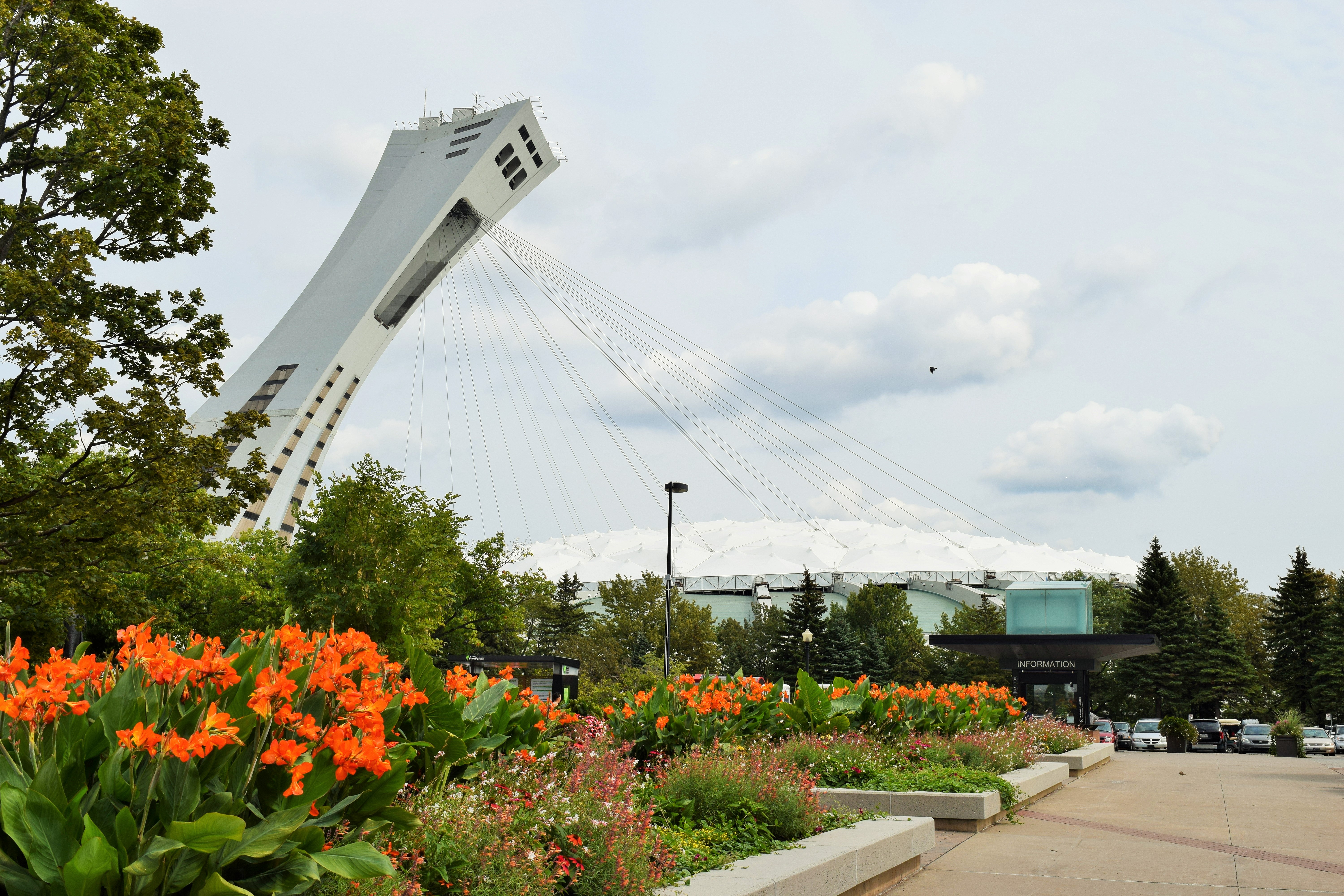
Entrance area of the Montreal Botanic Garden, with the Olympic Stadium looming in the background.
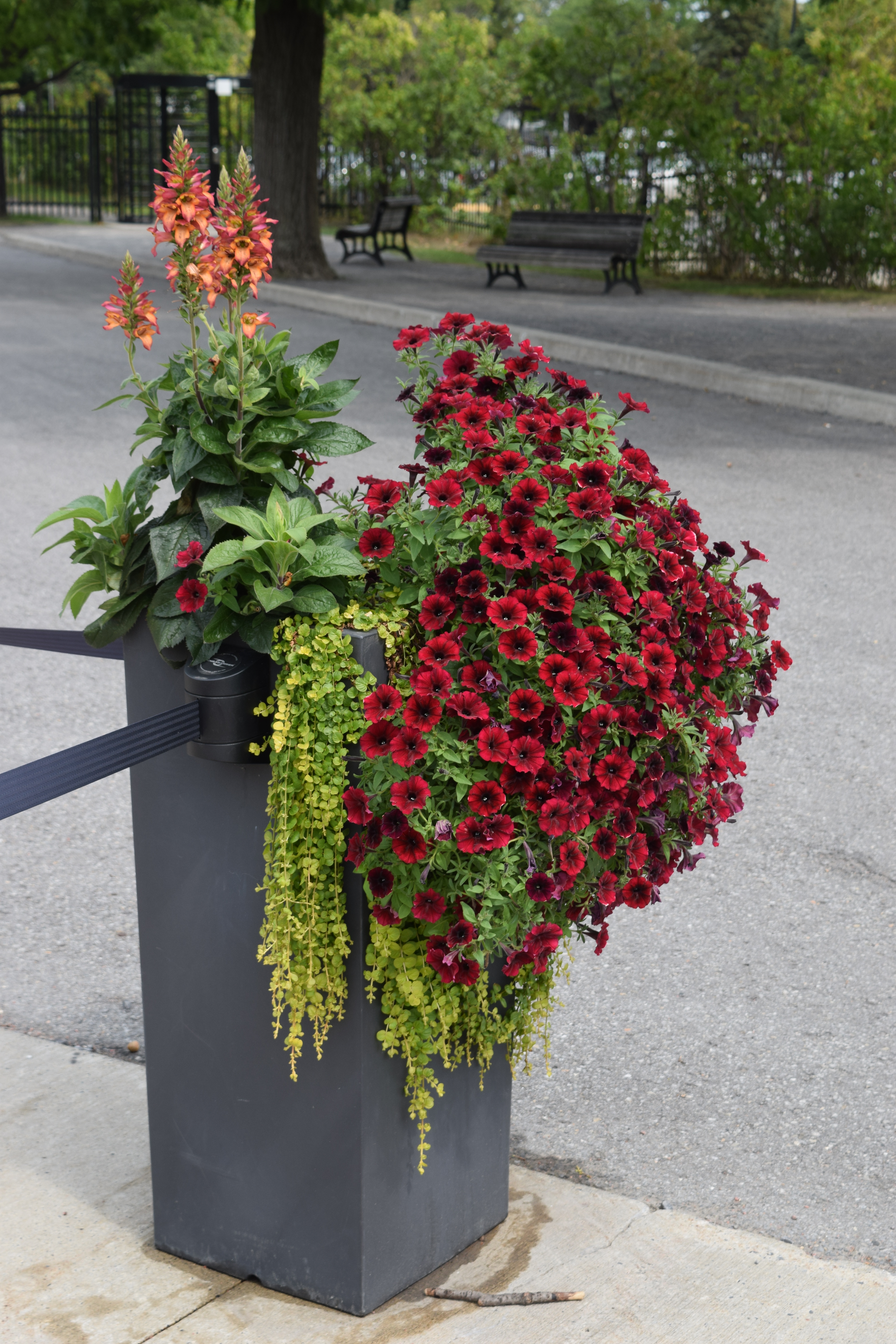
The entrance area is full of planters overflowing with bright flowers and foliage.
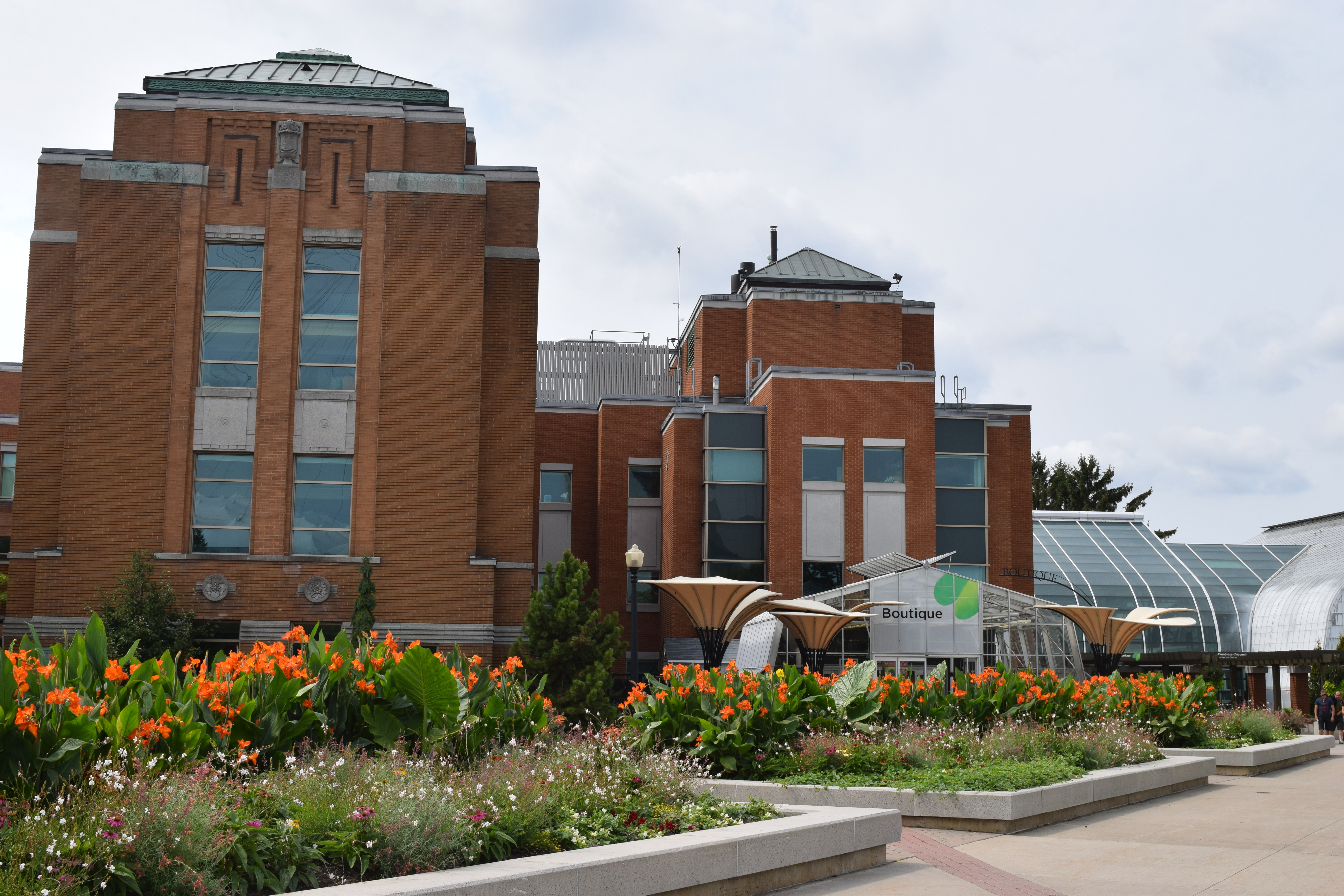
Another view, this one showing, I think, the Insectarium.
The orange Cannas were particularly attention-grabbing.
I like the contrast of the flamboyant plants and plain metal containers, though as Judy pointed out they do look sort of like they were originally used for trash disposal.
Soon after we entered the grounds we came to the Aquatic Garden.
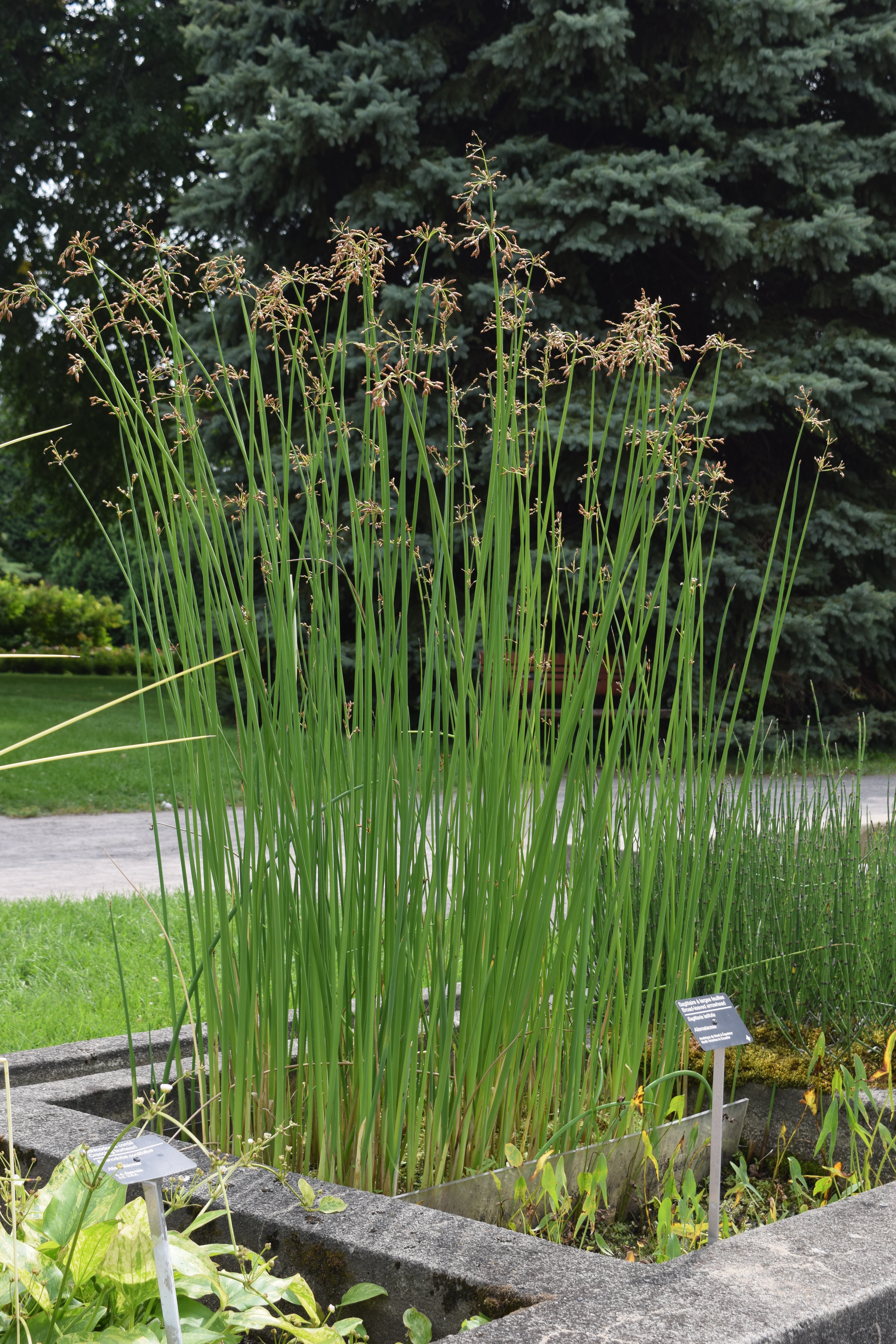
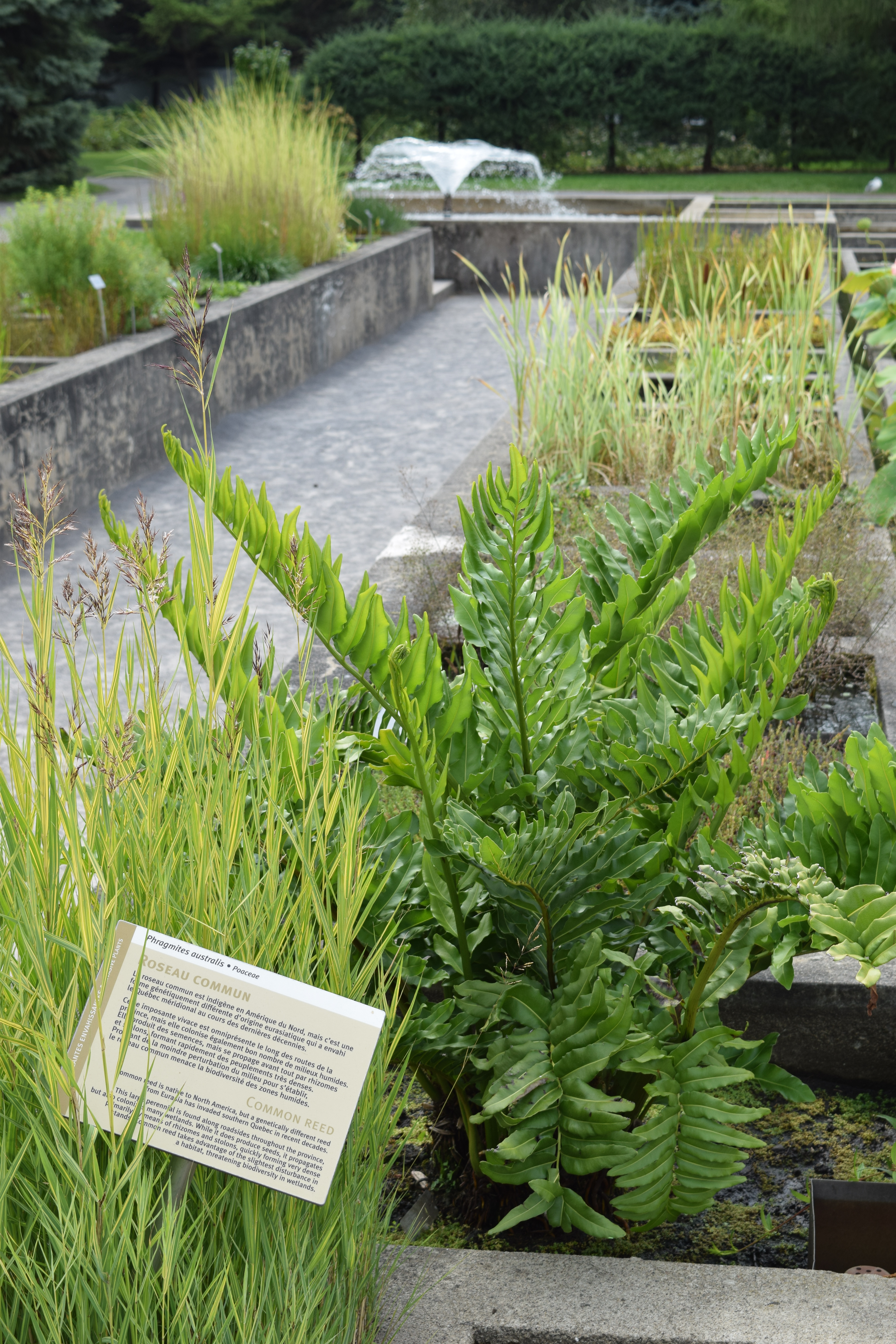
The design here was really clever. Sunken paths traveled between rows of concrete raised “beds”, each containing a different aquatic environment and a different plant. This gave us a close look at the various species in the collection.
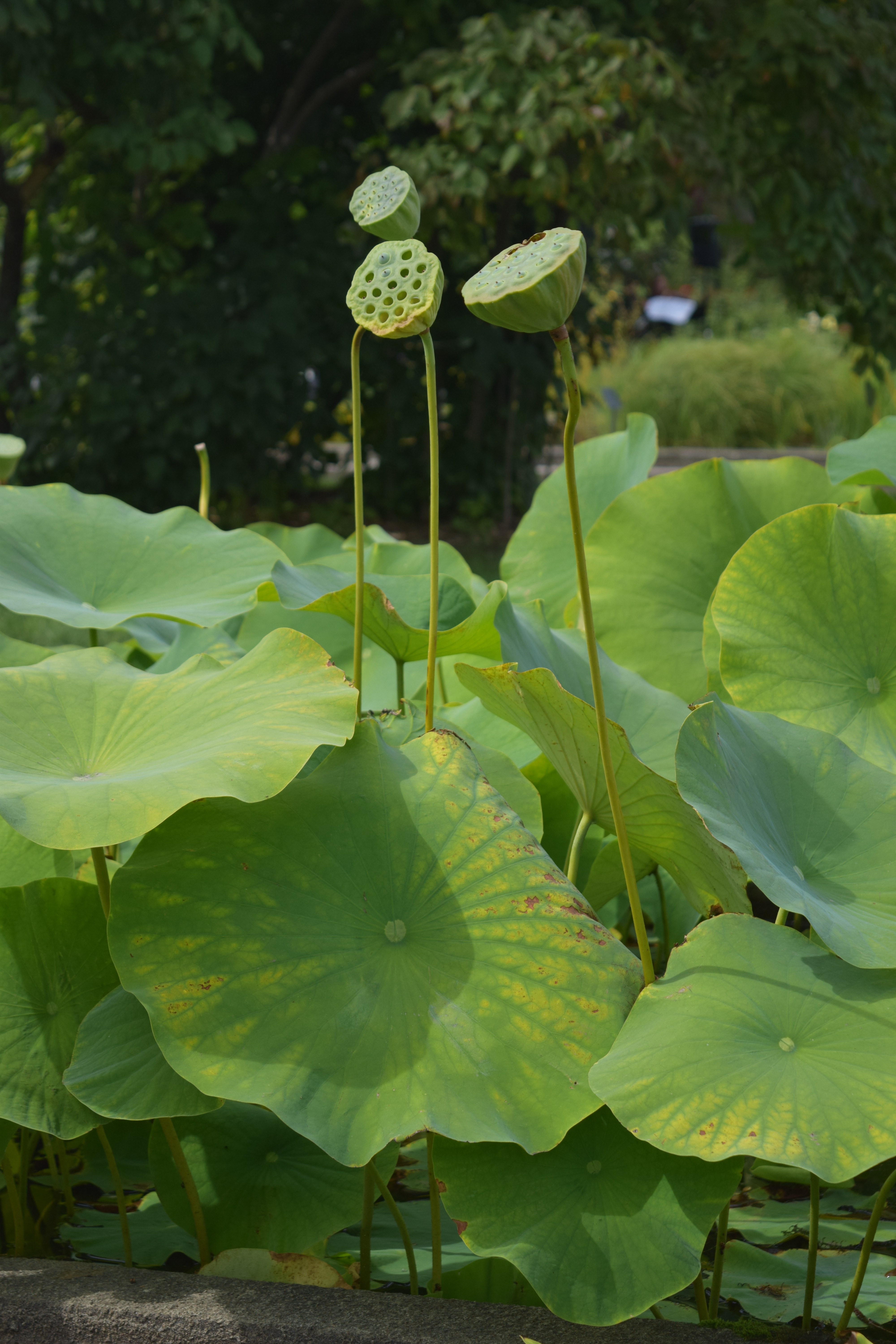
Unfortunately, the water lilies were pretty much done. However, they had some interesting seed pods.
Water Hyacinths
We had never seen water hyacinths (Eichornia crassipes) before; I was impressed by their beauty.
This garden has over 200 aquatic species.
There was a diverse mix of exotics and plants native to Quebec.
So we are back from our trip, and I find that Summer in our garden is coming to an end.
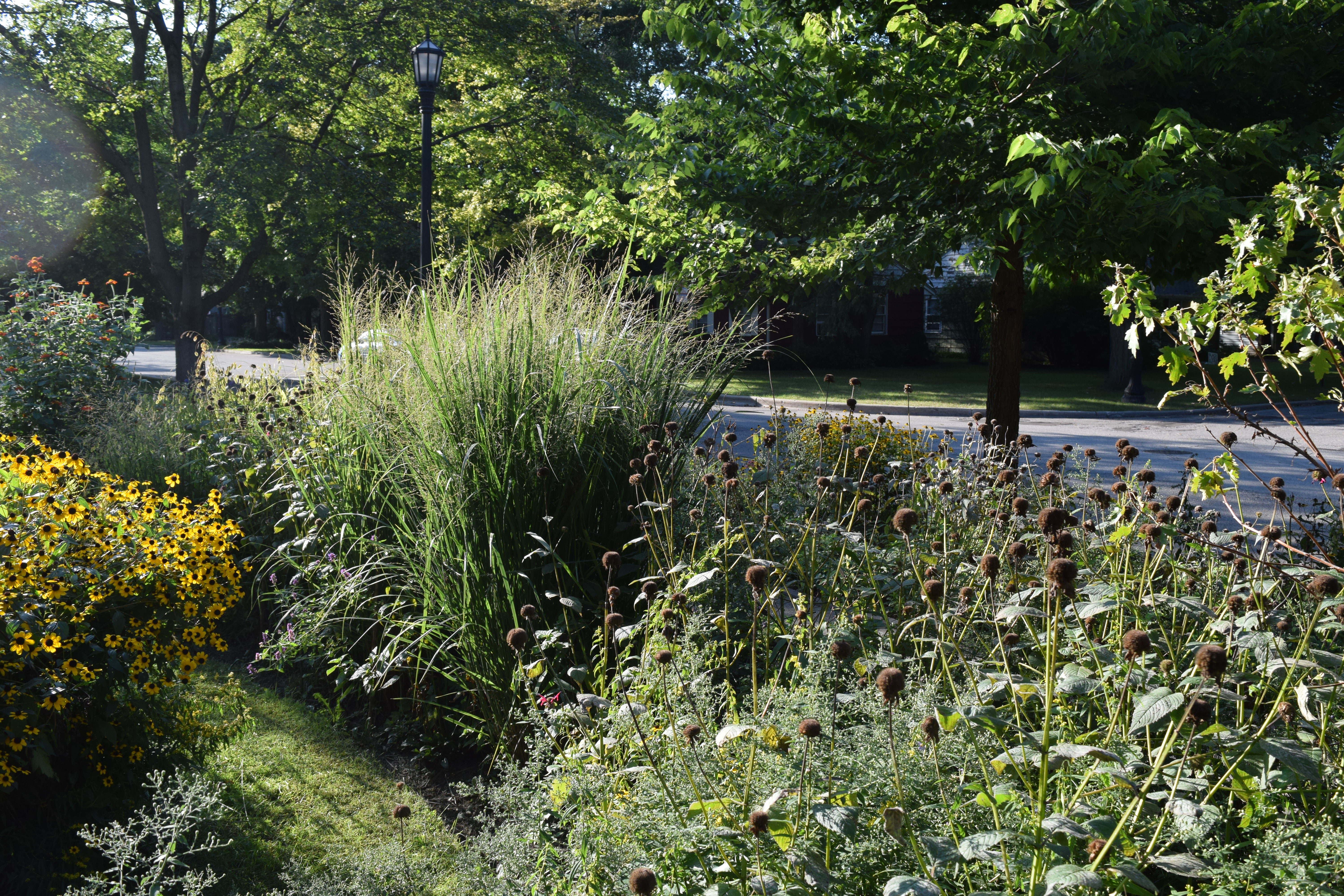
My front garden, mixing natives and exotics in mid-summer.
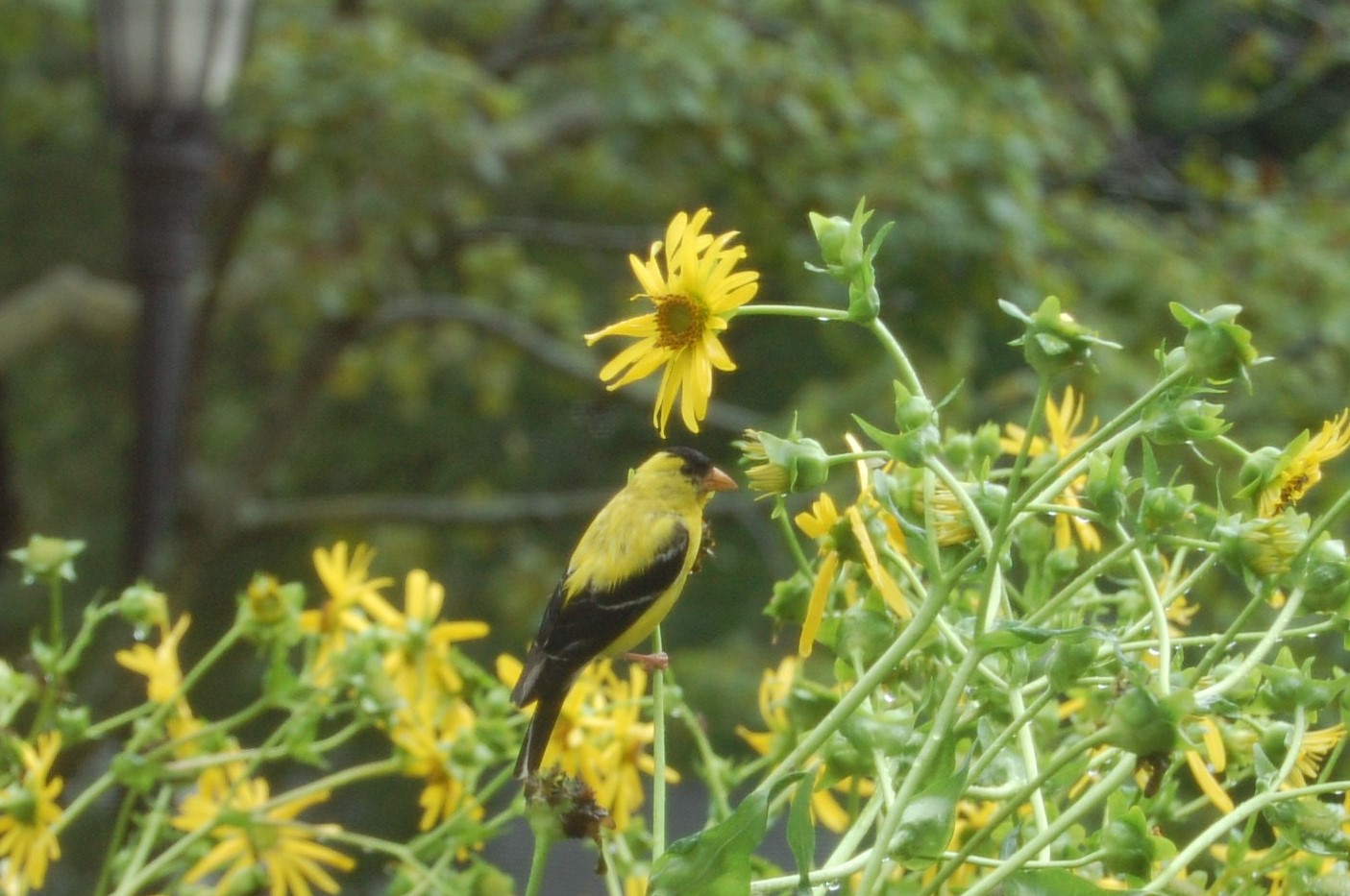
Some of the summer flowers are in slow decline. Others, like the Monardas and Silphiums, are done for the year. Now the birds come to feast on their seeds, a sight that inspires great pleasure for me.
On the other hand, many of the annuals are putting on an extra-energetic burst of bloom, as if they are making the most of the time that remains before the first hard frost.
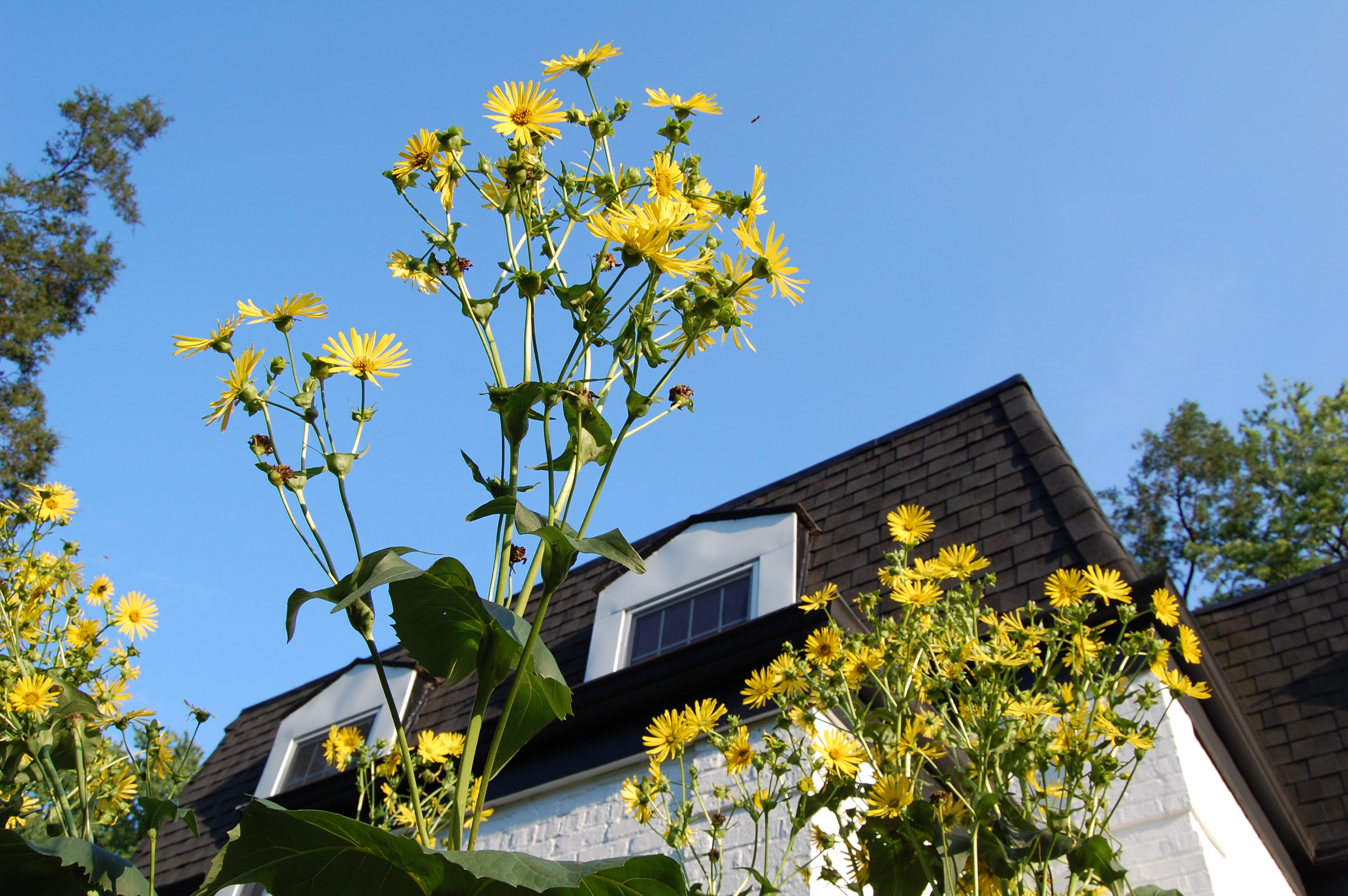
Cup Plant. Hello up there!
Of course, autumn has its own beauties, and we can talk about those in the next few weeks. But for now it must be said that in our garden, at least, summer is the climactic season, a time of brilliant color and towering stems. And so autumn, though a season of fruitfulness, is also a time of drowsiness, preparatory to the sleep of winter.
Goldfinch feeding on Cup Plant
But we should not mourn the summer garden. It was not more or less beautiful because it was temporary. If we were smart we took advantage of summer to experience as many moments of garden joy as we possibly could.
So is this one of those essays about just living in the moment? Certainly not. Summer in the garden is temporary, but it does not exist in isolation. The glory of each summer is built on plant growth and gardeners’ work from summers, springs, and autumns past. So let your autumn and winter be filled with dreams and plans for a brilliant summer to come.
We’re actually in Quebec right now, but we’ll be back soon.
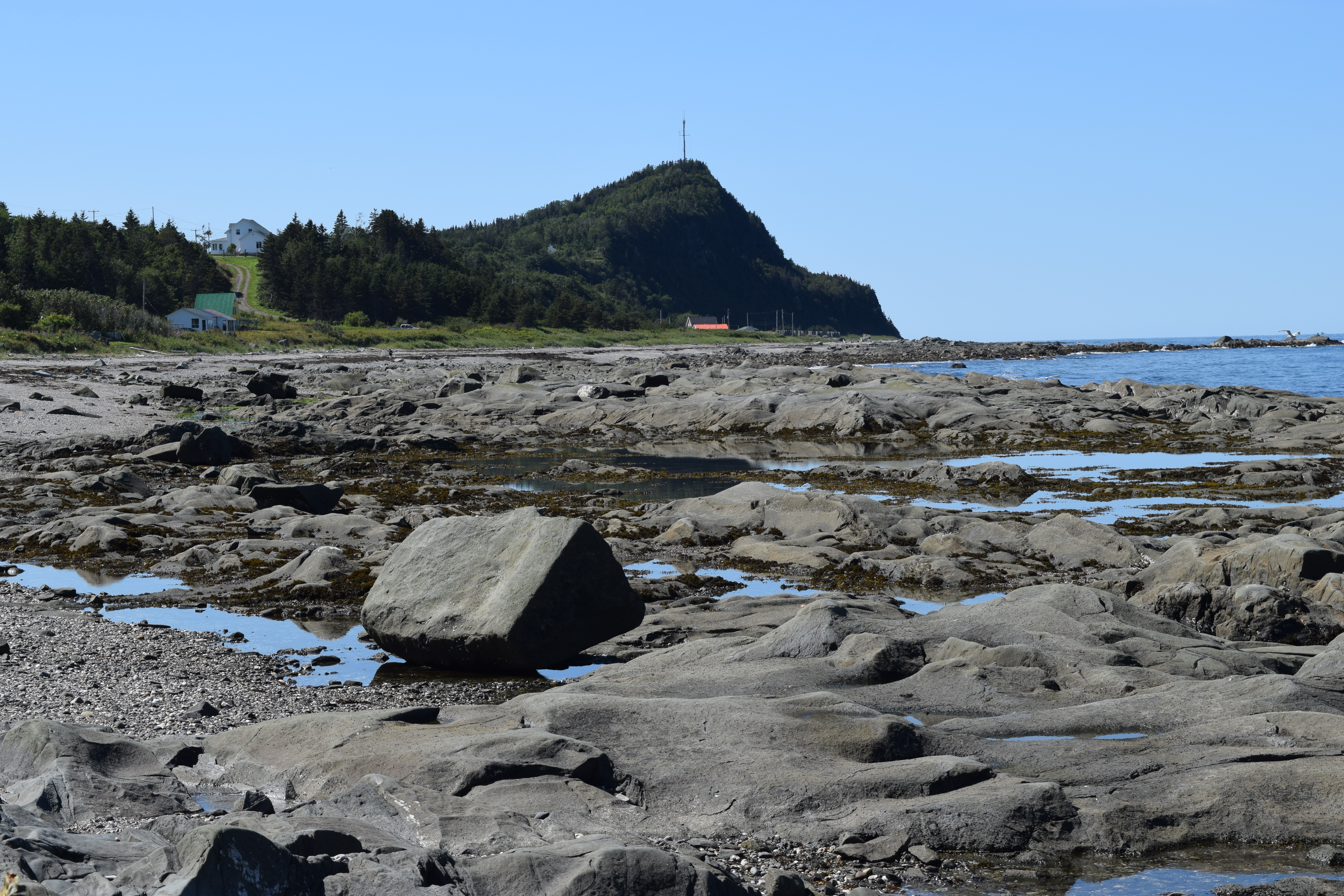
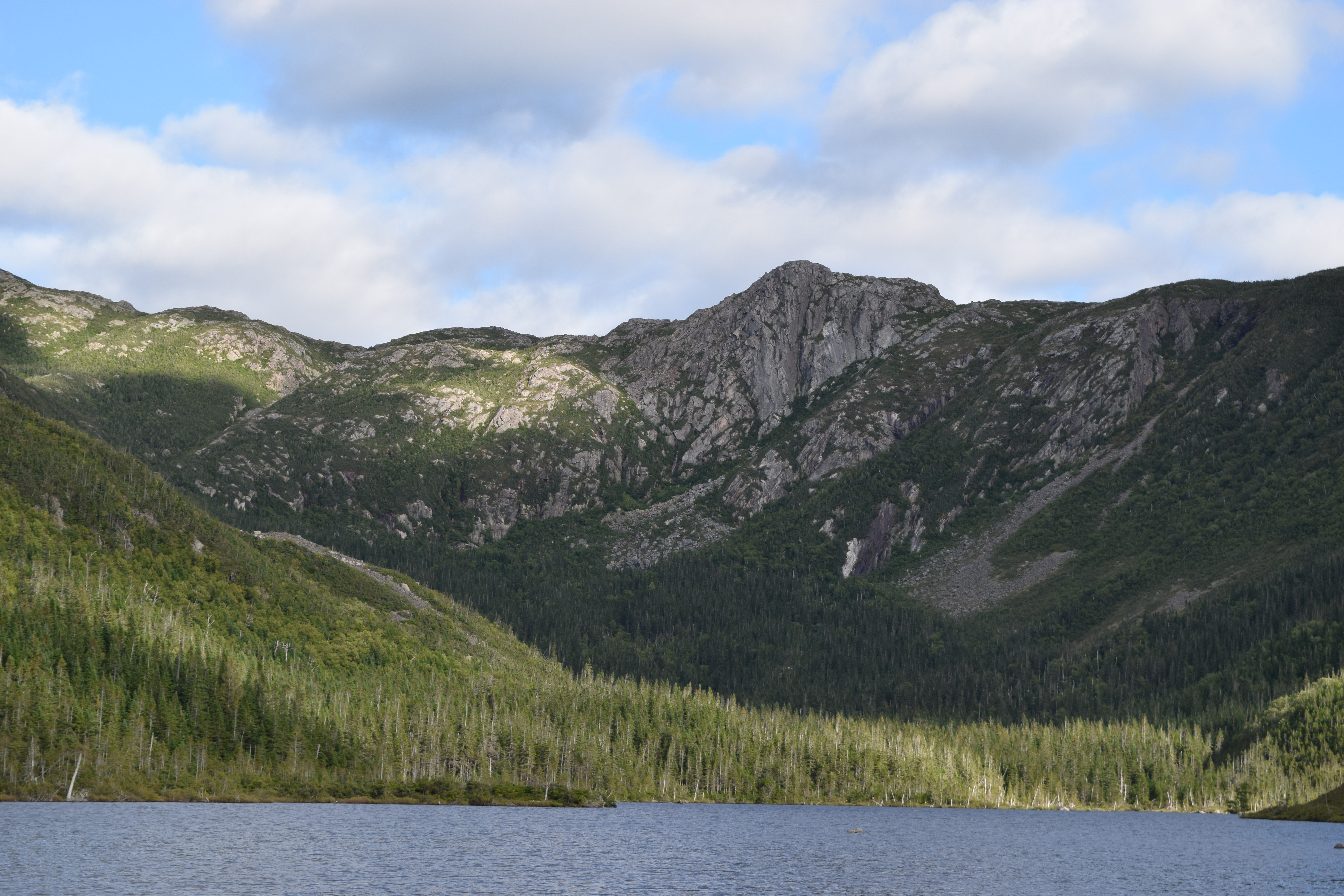
This picture was taken at the garden of Pat and Norman Webster, who live about 90 minutes southeast of Montreal (Pat writes the blog Site and Insight). I’ll have lots more about their truly amazing garden after we return to Chicago. Not to mention the Montreal Botanic Garden, the Jean-Talon Market, and the Gaspe Peninsula.
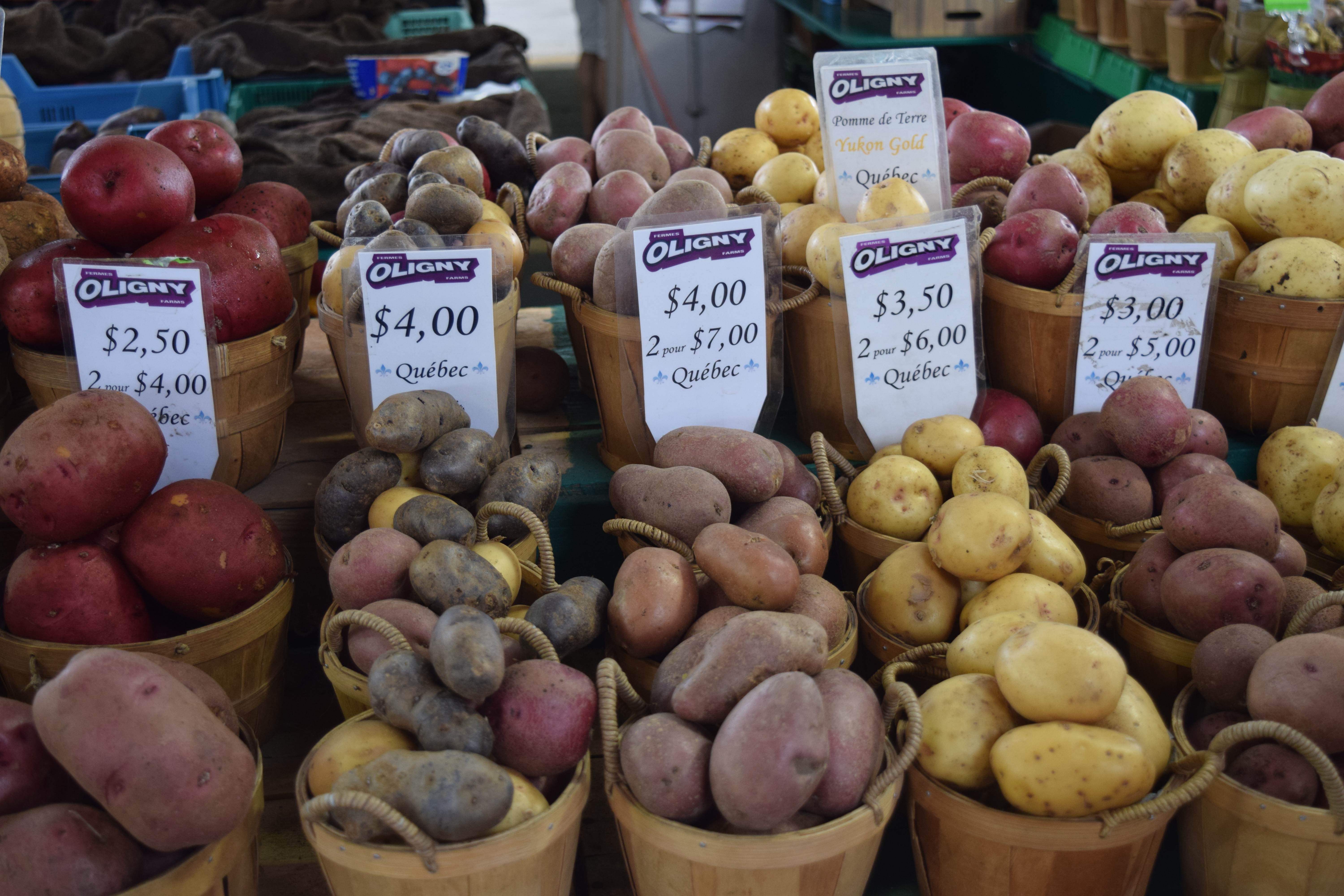
At the Jean-Talon Market in Montreal.
So far Judy has taken about 700 photographs. I may post one or two while we are away, but I won’t be writing any full posts until we get home.
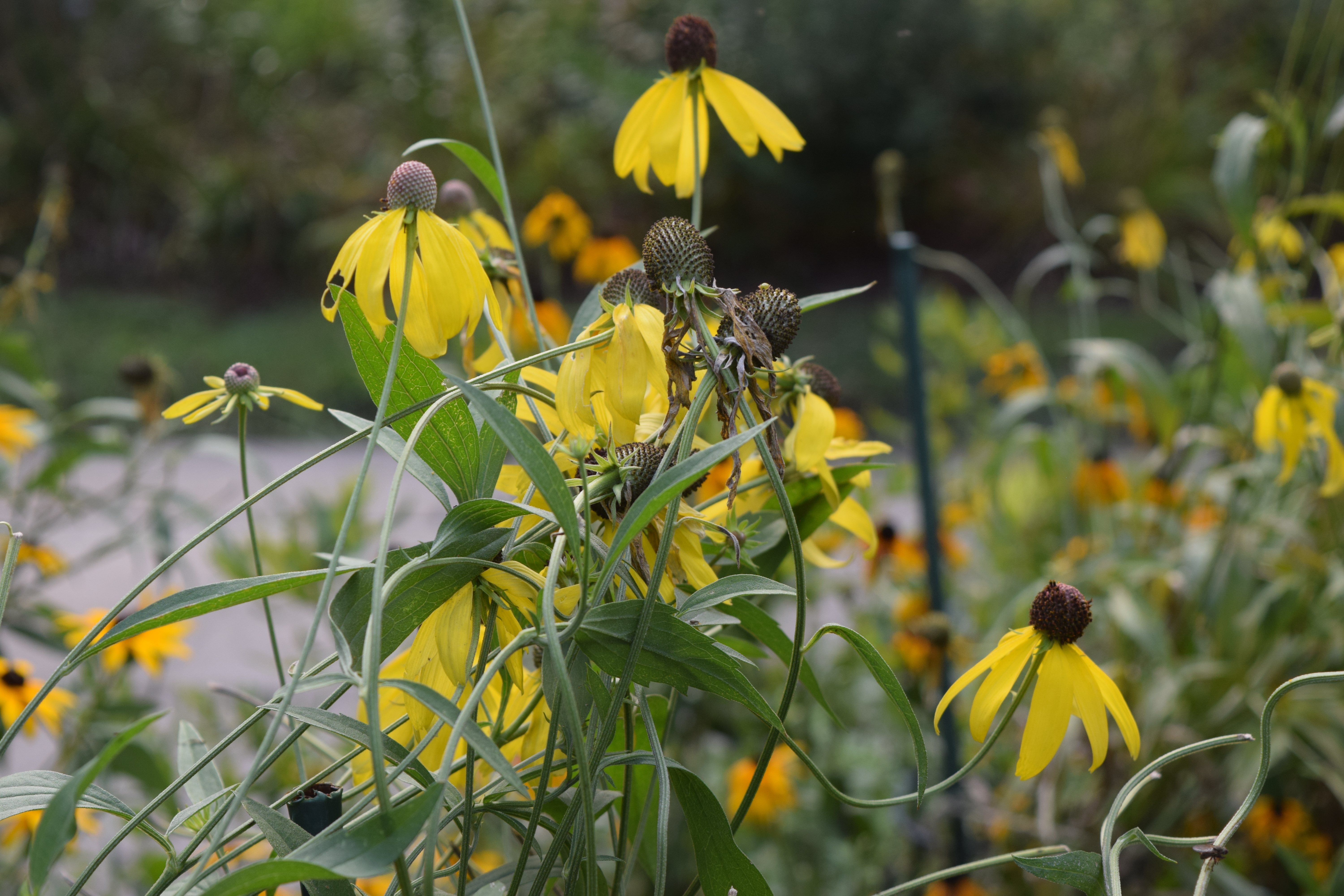
For starters, why can’t the Yellow Coneflowers (Ratibida pinnata) stand up STRAIGHT! I could put up with some nonchalant leaning, but these guys want to just flop over like, I don’t know, like something that is very floppy.
Yellow Coneflowers
For the past six weeks I have been in a quiet struggle with my Yellow Coneflowers, trying to get them to be just the tiniest bit vertical. At first I would allow them to lean (I hoped) gracefully and naturally against lengths of twine tied inconspicuously between discretely placed stakes.
Eventually, though, they would always end up looking like they needed someone to call them a cab after a night of way too much fun at the neighborhood tavern. Finally, I gave up on subtlety and started trussing each one to its own personal post.
All this after I cut them back by about half back in June.
I don’t know why my Yellow Coneflowers are so excessively flexible. They get full sun. Perhaps the soil is too rich?
Even with all the angst over staking, I still love this plant. The petals are a clear, cheerful yellow and their droopiness reminds me of a basset hound’s ears. The cones make me think of clown noses. Needless to say, they are great plants for birds and pollinators.
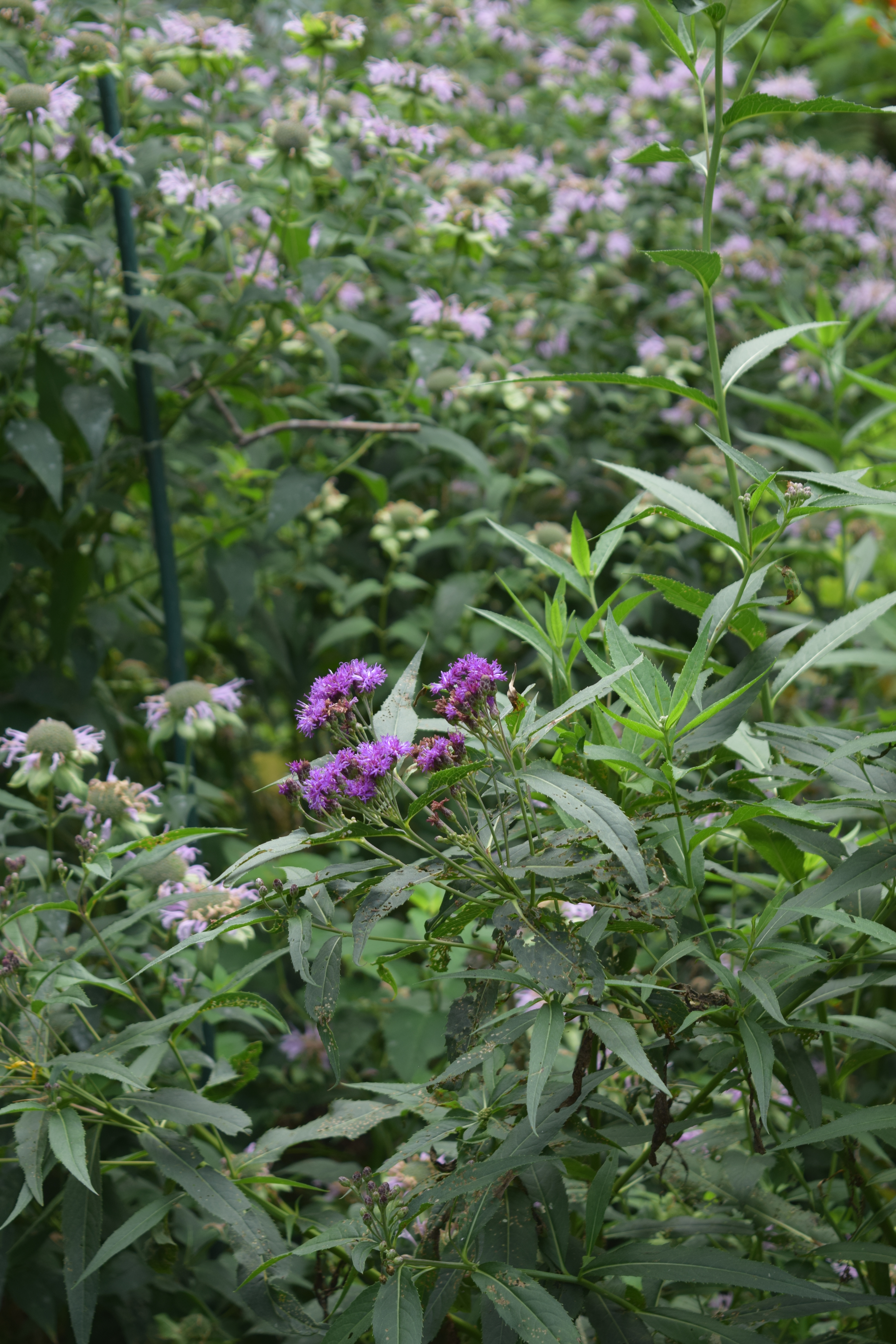
Ironweed
Another wildflower I feel like complaining about is my Ironweed (Vernonia fasciculata). So far it just doesn’t seem to be a plant with much visual impact. Maybe I just need to give it more time (this is its third summer in the Driveway Bed). It was seriously damaged by the four lined plant bugs this spring, so perhaps I am being too harsh.
Or perhaps I shouldn’t have planted it in the raised Driveway Bed, which could be a bit too well-drained. Maybe the Ironweed should be transplanted to another spot with more moisture? I’ll probably give it one more year before making a decision. I’m reluctant to just get rid of this plant. For starters, it is a host plant for American Painted Lady butterflies.
To read about more wildflowers, check out the Wildflower Wednesday post at Clay and Limestone.






























 gardeninacity