In late July, I took a six-day trip to the Pacific Northwest, to the 2024 Garden Fling (it used to be the Garden Bloggers Fling, but some of us are using Instagram and even TikTok, and so we have a new name).
And then I got Covid (for the first time!) and was totally out of it for awhile — nothing alarming, just sick and then very tired.
All of which explains my very slow responses to comments on the last post! Sorry!
Now that I am finally recovering, I really want to tell you all about Stumperies.

I’ll come back later in the fall and winter and tell you more methodically about the various marvelous gardens we saw in three days of wide ranging tours based out of Tacoma. But my heart was stolen by a bunch of tree stumps, and it’s really all I want to think about right now, and share with you.

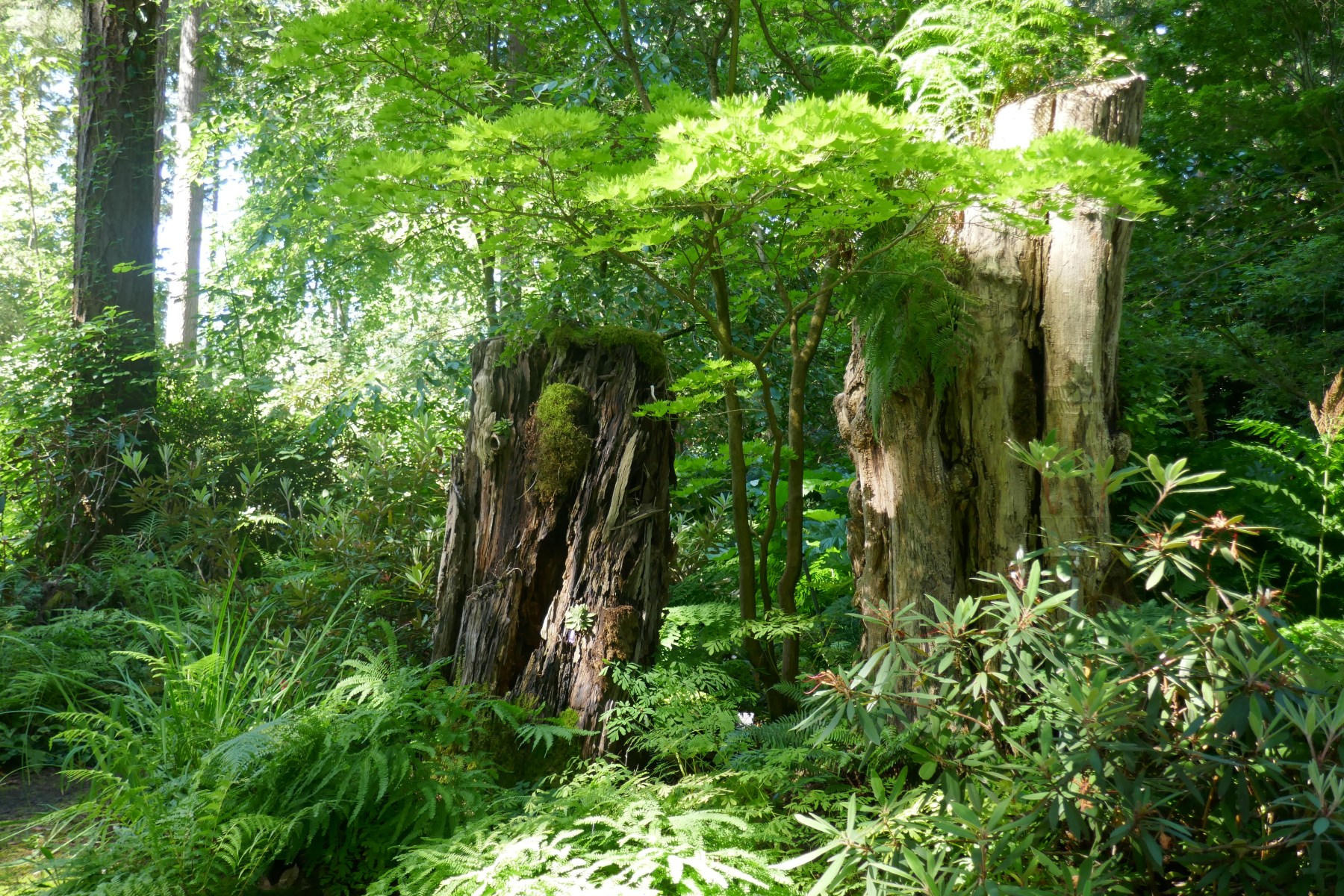
I’m smitten, so I will get straight to the point: look how magnificent these old stumps are in the Rhododendron Species Botanical Garden!

It may be that in order to fully appreciate this stumpery you have to be standing in the woods with trees towering over you. (Have you been to the Pacific Northwest? The trees SOAR!) Not to mention the scent of the woods and moss and forest floor compost in your nose. Our eyes are truly wondrous because we can adjust and pick out the details in both shadow and light in ways that photography struggles to duplicate. And stumperies are all about shadow and light and atmosphere.

Let me back up and tell you a bit about stumperies. First of all, they are obscure enough that WordPress is quite annoyed with me and keeps trying to autocorrect to Stumper or Stumped, for my own good, I am sure. The Missouri Botanical Garden says that “A stumpery is a garden that re-purposes logs, driftwood and the root wads of dead trees to create a unique garden display.” Roots wads?? If they say so. “These wood elements also provide a structural counterpoint to ferns, mosses and other woodland plants which are planted on, in and around the stumps and logs to ‘soften’ them.”
A little dry and technical, if you ask me, but okay as far as it goes.

I was slightly horrified to learn that stumperies first arose in Victorian England (not the time or place that much of Garden in a City is patterned around). But I can’t honestly say I’m surprised. The first one, apparently, was established in the 1850s. I am just relieved that they are not, apparently, related to the vogue earlier in that century for cemetery gardens.

One of the most famous stumperies was created by then Prince Charles at Highgate in England. The website calls it “tranquil” and “other-worldly” and notes that Victorians liked to grow ferns in tree stumps. Not everyone agreed with the Prince’s taste, apparently, because the Gardens Trust blog notes that Prince Charles’ father, upon seeing the stumpery at Highgate for the first time, asked his son, “When are you going to set fire to this lot?” I do like the idea that perhaps Prince Charles installed the whole thing to annoy his father; much more interesting than a Victorian restoration project. (Yes, I know he’s the King now, but he was the Prince when all this happened.)

The stumpery where I took these photos, a part of the Rhododendron Species Botanical Garden, is the largest public stumpery in the world, according to their website. The stumpery is one small part of a much larger Pacific Northwest woods. We were, of course, there at entirely the wrong time to see any rhododendrons blooming (there might have been a few), but it was quite a fine woods, particularly for a Midwesterner unaccustomed to trees of such height.
Also on the same grounds is the Pacific Bonsai Garden, which I only got a chance to look at briefly. I’m not quite sure how these areas came together. But flingers who did manage to look at the bonsais were very impressed.

I’m going to make this into a two-part post on Stumperies, because amazingly enough, there was another stumpery the next day! Splitting the post will give me space to show you more photos — and the second stumpery was quite different. It is called the Renaissance Garden, and is a stumpery with a story and a purpose.
Also, as an added incentive to read the next post: I’ve been daydreaming about adding a stumpery to Garden in a City, and I’ll tell you all about that, too. You can help me decide if it is just post-Covid fever dreams.
So: Have you been to a stumpery? Are you with me in admiring them, or with Prince Philip, ready to burn it all down?



 gardeninacity
Hi Judy, sorry to hear you caught Covid on your trip to the North West. There seems to be a rise in cases this summer. I took a trip to England in 2017 and has the good fortune to tour Highgrove and see the stumpery installed by the then Prince of Wales. It was rather enchanting! Highgrove is well worth a visit. And, while there in the Cotswolds, there are Hidcote, Kiftsgate Court Gardens, Bourton House Garden, Sezincourt Garden, Snowshill Manor and Garden and more! Although only Highgrove has a stumpery.
I’m glad you had a good trip and recovered from your Covid bout. Regarding stumps, a local public garden, Bedrock Gardens, has a small stumpery interplanted with ferns. It’s very interesting. I will admit to liking the ferns more than the stumps, but I’ve never met a fern I didn’t like. Stumps are always unique, and I’ve picked up several from our local recycling center. I currently have two with vintage iron cultivator wheels mounted on them in the garden and enjoy them a lot. They do deteriorate where they sit on the soil. One thing about gardening, if you can lift the item, you can put it in, and if you don’t like it, you can take it back out. Happy gardening, Judy. 🙂
I enjoy seeing them but am not as smitten as you are, Judy. Like you, I find the PNW forests to be very different from what I’m used to seeing here in Texas. They are magnificent! I visited Olympic National Park before the Fling, and it’s an entirely natural stumpery everywhere you turn. You’d have loved it!
I have never seen an intentional stumpery. But old, big hemlock trees, when they fall over, create much of the same effect, and in similar environments (shady, damp). I will try to see if I can find a picture. I have seen them in the Finger Lakes region of New York, and also in the Upper Peninsula of Michigan. They happen when the big hemlocks blow over in high winds, bringing their roots with them, or when they are growning on too steep a slope and just fall over. Very magical.
So sorry you caught Covid and glad it wasn’t too bad.
But, I absolutely loved this post. Wonderful pictures! I am totally smitten by stumperies and can’t wait for your next post.
Also, will be waiting anxiously to read about your very own stumped.
I LOVE stumperies! And I live very near to this first one you are sharing with us today. I probably need to revisit it, as it’s been a little while. I can’t wait to see which one you feature tomorrow. I have visited one on Vashon Island, and it was also spectacular. I hope you got to see it!
Happy that your COVID wasn’t too bad. I live about an hour from New York’s Finger Lakes region. I’ve never seen intentional stumperies, not knowingly, anyway. I have seen forests with stumps, especially now that we have the ash borer tragedy in our area. Garden fashions do come and go. You seem quite smitten with stumperies. Should you create one intentionally on your property? I would vote for “go with your heart”. I wouldn’t have the room on mine. Alana ramblinwitham
Hi, Judy, Great post. I had never heard of stumperies before! Jim (PS: I couldn’t post it on the site, so I am sending it to you.)
>
somehow, on my way to this stumpery, I got waylaid by a dragonfly. So I never actually got to see it, more’s the pity. But I did see a Victorian stumpery at Biddulph Grange in Staffordshire. It was extremely stumpy, but fascinating nonetheless. Looking forward to your next installments!
Glad you’re recovered from your Covid experience, Judy, and equally glad I didn’t give it to you!
Stumperies are ‘circle of life’ gardens to me. The old and rotting providing sustenance to the new growth. They seem a perfect balance. And as a backdrop to such gorgeous ferns… bellissima!
The Stumpery was my favorite part of the Rhododendron Species Botanical Garden but I didn’t get as many fabulous photos as you did. (I published my own account of that part of the Fling on Wednesday.) I love the idea of a stumpery and while I’ve planted the middle of stumps here and there, a PNW-like version of a stumpery is probably unsustainable in my coastal Southern California climate. Ferns in general hate our dry conditions.
I’m sorry to hear you got COVID. I also tested positive 2 days after my return. Other than a persistent cough (which could be related to allergies), I’ve put it behind me. At least we now have some antibodies that may protect us from further incursions on the part of the FLiRT variant!
https://krispgarden.blogspot.com/
No, I have not been to a stumpery. However, I work with major stumps of redwoods that were harvested more than a century ago. They do not rot because they are redwood. They burned since then, so rot even less. Epiphytes dislike them, especially after they are charred. Perhaps I will post pictures of what I have done with some later. One is big enough to build a guest room inside of. One became an outhouse. One became a shower stall.
Haha! Prince Philip had a great sense of humour (and not at all confined by political correctness too!).I am personally not keen on some stumperies I have seen in photos, but your images are lovely – all that lush greenery above and below you is definitely calming and refreshing. Look forward to seeing the next one..
I know I’ve seen stumperies, but I’m trying to remember where…Hawaii, Florida, elsewhere? Would have loved to have seen this one. It looks so lush and relaxing. Your photos are great (as always), but I know what you mean about not quite capturing the beauty/essence of the actual scene. Anyway, sorry I missed the Fling this year and seeing you again…hopefully both of us will attend in Memphis next year. 🙂
Beth at PlantPostings
I’ve never been to an official stumpery, but I do love the character stumps can bring to a garden. Even live trees can nurture the Forests of Lilliput out here in the Pacific Northwest.
I am familiar with Stumperies. I have tried to make one in our garden. I didn’t have good luck with it. I think our garden is too dry plus we seem to be in a dry cycle after just coming out of a drought. Of course I blame all my failures on the weather. 😉
I will be looking forward to all of you new posts here.
Good to hear you have recovered from your trip and the dreaded Covid.
I visit the Rhododendron Species Botanical Garden a few times a year: the stumpery is my favorite area in the entire garden and I always draw inspiration from it.
I’ve seen tall cedar trees that topple after a windstorm. The root ball looks like massive flat plate, caked with mud, standing on end: ‘roots wads’ indeed, perfectly suited for tucking baby ferns in. I’m really glad you enjoyed that natural cathedral. I find it magnificent.
Oh I love stumps. And created my own Stumpery without knowing it. In my old garden, I cut down several trees that were damaged and kept the stumps. We loved watching them naturally decompose and become part of the natural world. I can’t wait to see what you come up with in your garden.