So let’s travel back in time to early June and the Garden Bloggers Fling in Toronto. I’ve done a few posts already about the Fling (this one and this one about the Toronto Islands and then this one about Swansea), but I’ve been holding most of Judy’s photographs in reserve for when our own garden was slowing down.
Marion Jarvie (center) points out some choice plants to the garden bloggers.
For this post I want to talk about Marion Jarvies’ garden. Marion gardens on a suburban half acre north of Toronto. She is an enthusiastic plantswoman, a noted educator and speaker on topics horticultural.
What would autumn be without goldenrods? In my garden, certainly, it would be a lot less colorful.
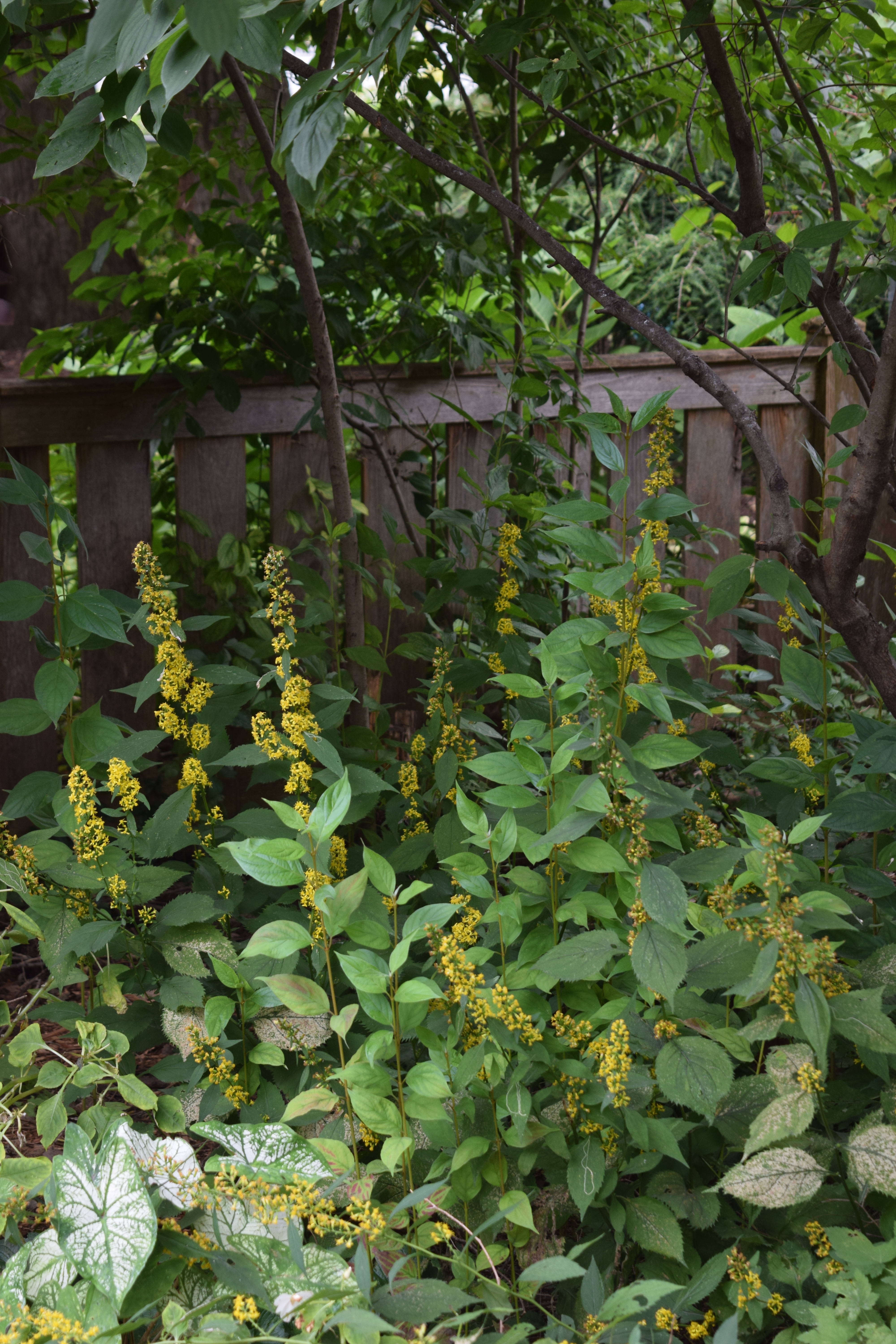
Even in a shady corner, Zigzag Goldenrod (Solidago flexicaulis) adds luminosity to the scene. A good plant for spots that are difficult or on the wild side – aggressive but useful in the right place and beautiful in its season.
This is our second post about Glen Villa, which Judy and I visited at the very end of August. Glen Villa is the garden of Pat Webster, located in Quebec about 90 minutes southeast of Montreal. Pat writes the blog Site and Insight, which recently received a Silver Award from the Garden Writers Association.
The last post focused on how water was integrated into the landscape at Glen Villa. With this post we want to concentrate on how garden art and hardscape is used to tell the story of both the land and of Pat’s family. This is just a partial overview, for greater depth you should check out Pat’s blog.
Book Review: Bees, Wasps, and Ants, by Eric Grissell
I picked this book up because I wanted to know more about insects. Eric Grissell, a research entomologist, is a good source for such knowledge.
This particular book focuses on the order Hymenoptera, which consists (as the title suggests) of bees, wasps, and ants. Also sawflies. (If you want to know why bees and wasps are in the same order with ants and not, say, butterflies, read the book.)
Black wasp on swamp milkweed.
Grissell is a little miffed that so much attention goes to bees and butterflies, while wasps, ants and sawflies suffer neglect (or receive only negative attention). Despite their low profile, these other creatures are an enormous and mostly beneficial presence in the garden ecology (for example, there are 106,000 species of predatory or parasitic wasps, but only 19,000 species of bees).
Aster means “star”, and certainly Asters are stars of the autumn garden. But stars need supporting actors, or the show can be pretty boring. For example, those one person shows where the star spends two hours impersonating, say, Teddy Roosevelt. Be honest, would you pay good money to see that? I didn’t think so.
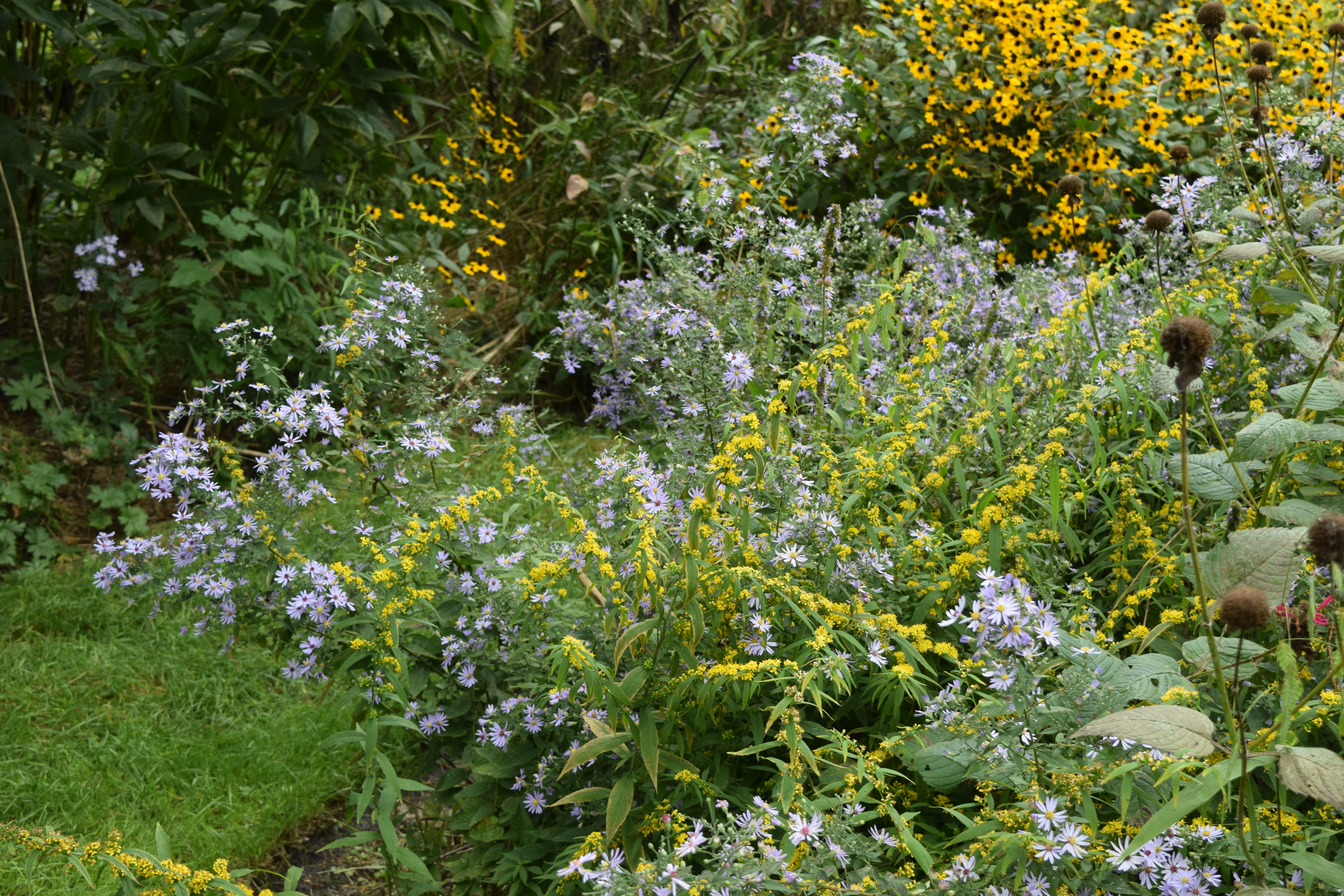
Which goes to show that asters need the right companion plants to make for a really beautiful autumn garden. Incidentally, all of the perennials in this post are native to central North America.
Bluestem Goldenrod with Short’s Aster.
Bluestem Goldenrod (Solidago caesia) is a really good companion for mid-size to shorter Asters. this is particularly true of blue-purple Asters, which all of mine are.
So just yesterday I posted that I was seeing only one Monarch per day in mid-September. As if in response to a customer complaint, Monarch Central seems to have dispatched four Monarchs to ensure that I don’t feel neglected. These were displaying themselves in the front garden when I first opened the door.
According to the website Monarch Watch, the peak for Monarch Butterfly abundance in Chicago should be roughly during the first half of September.
monarch
However, in our garden the Monarchs seem to be on an expedited timetable. This year in July and August we would often see multiple Monarchs, as many as five at once. In September, though, there’s only been one at a time.
This September has been rather warm, with now and then more than a hint of summer. Leaves are still green on plants both woody and herbaceous. However, my attention is often seized by seedheads on the grasses.
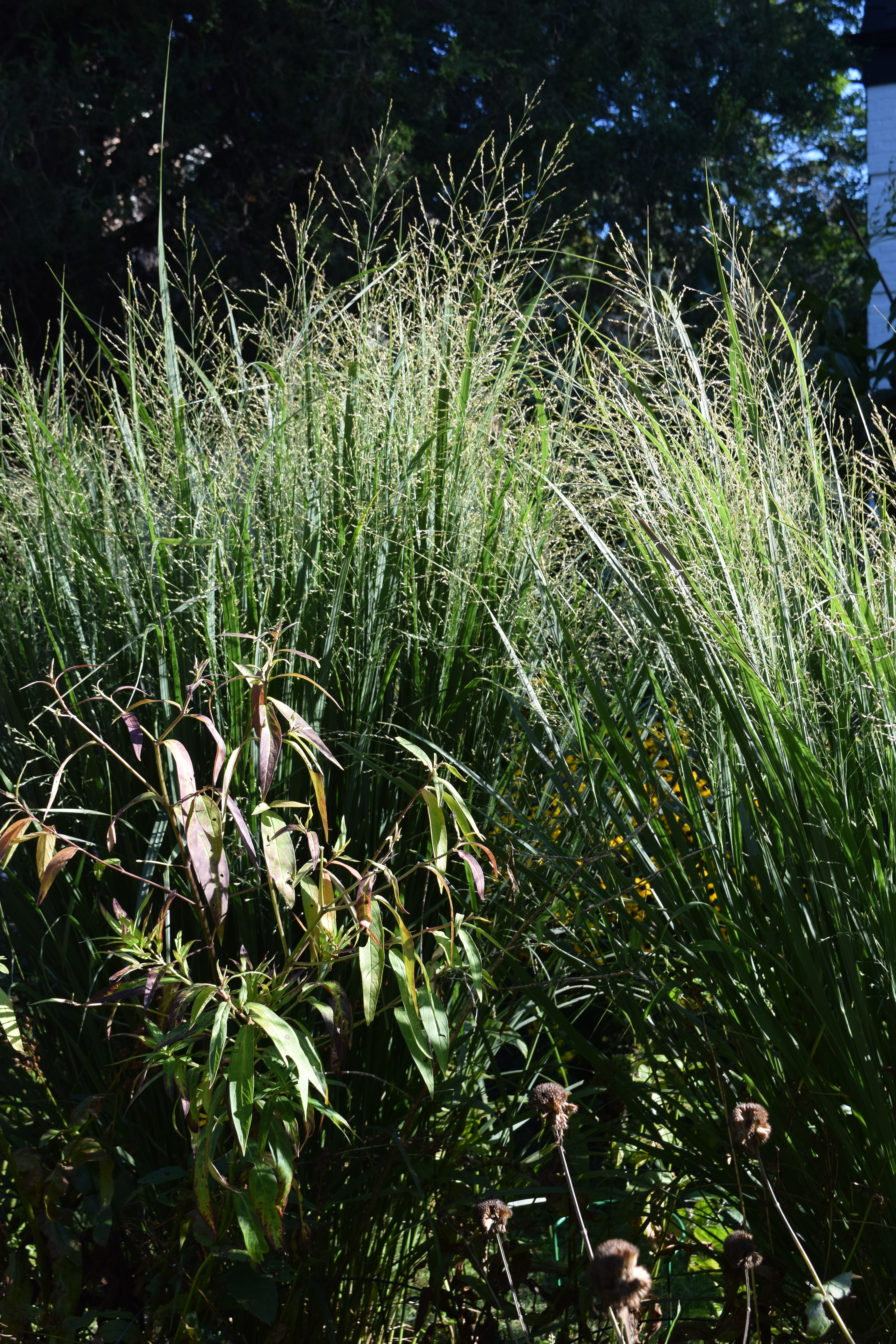
Of all the grasses of September, I think Switchgrass (Panicum virgatum) is the most glorious. Judy took these pictures of ‘Northwind’ Switchgrass in the late afternoon.
The clumps of tall grass stalks and the mass of tiny seeds make me think of clouds on a forested mountain.
The Red Cedar (Juniperus virginiana) standing in shadow provides a nice background. In front, the leaves of the Swamp Milkweed (Asclepias incarnata) are beginning to show just a little color.
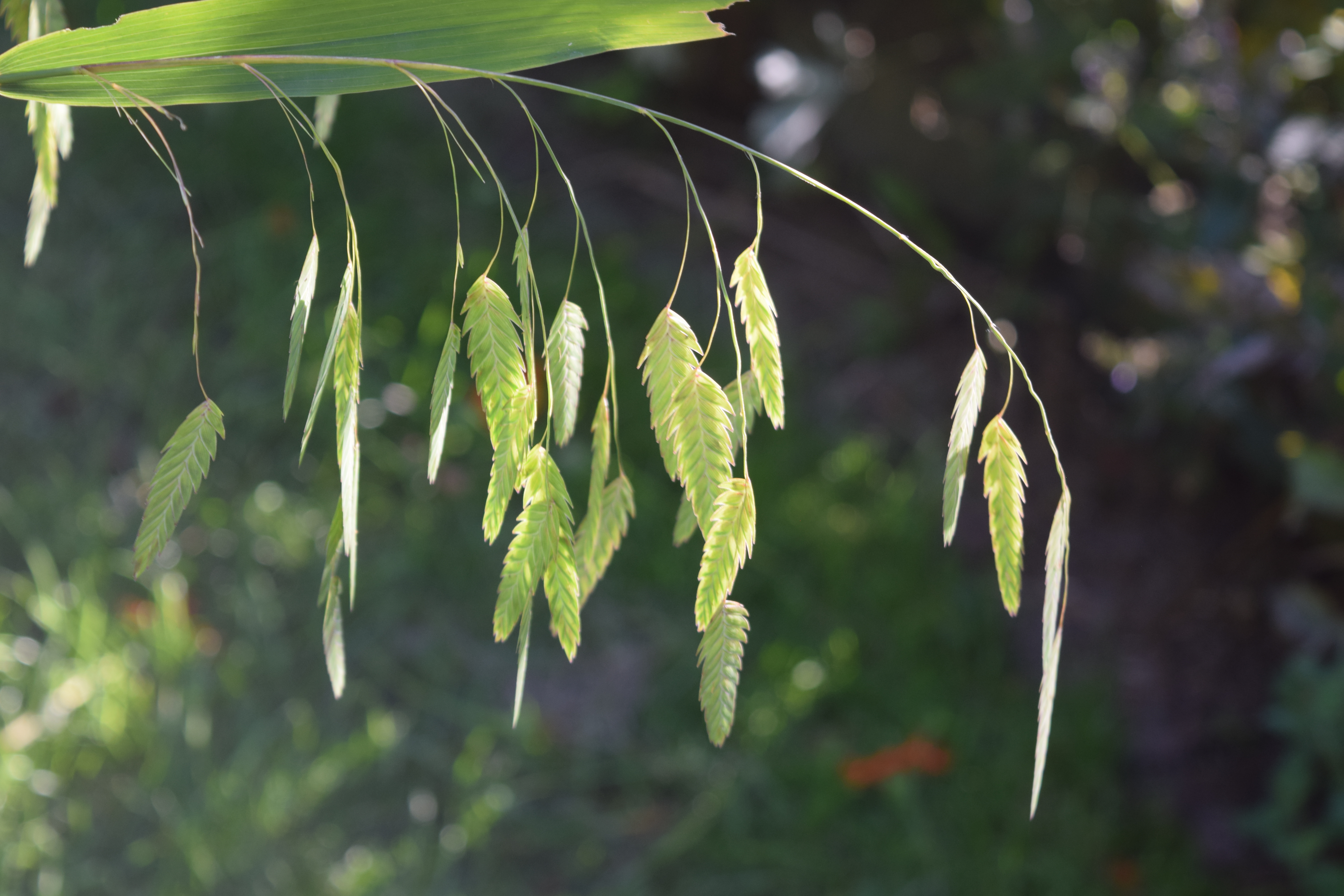
The seeds of Northern Sea Oats (Chasmanthium latifolium) are just barely beginning to turn from green to tan. I’ve been cutting back some of the seeds to prevent too much self-sowing. Soon I may take a clump or two inside for a dried arrangement.
as
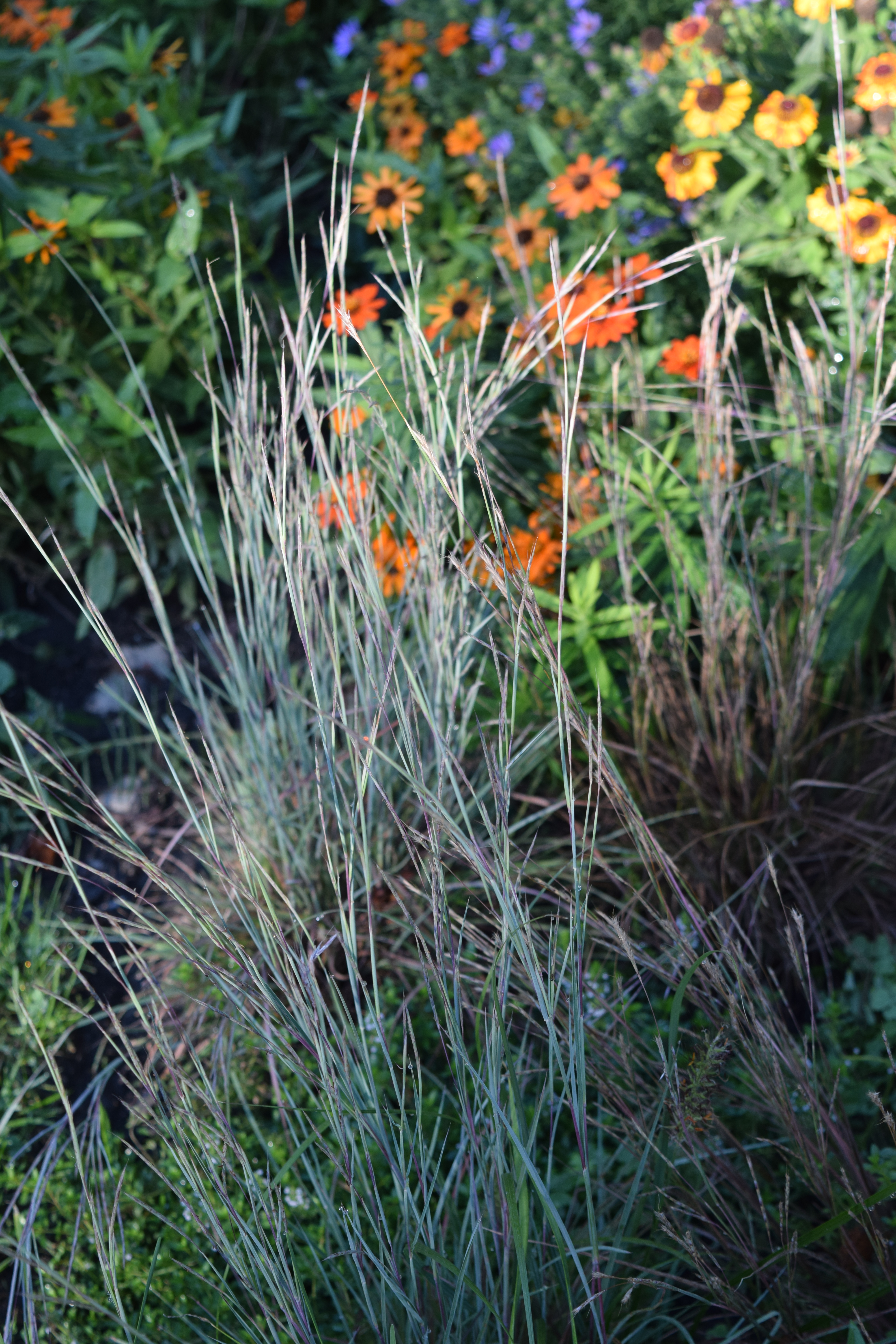
In the Lampost Bed I planted a clump of Little Bluestem (Schizachyrium scoparium) this year, a mix of straight species and the varieties ‘Jazz’ and ‘Carousel’. So far, I like ‘Jazz’ the best of all. It is compact and upright, with blue-green color. It’s supposed to turn more purple later in autumn, but I’m waiting to see.
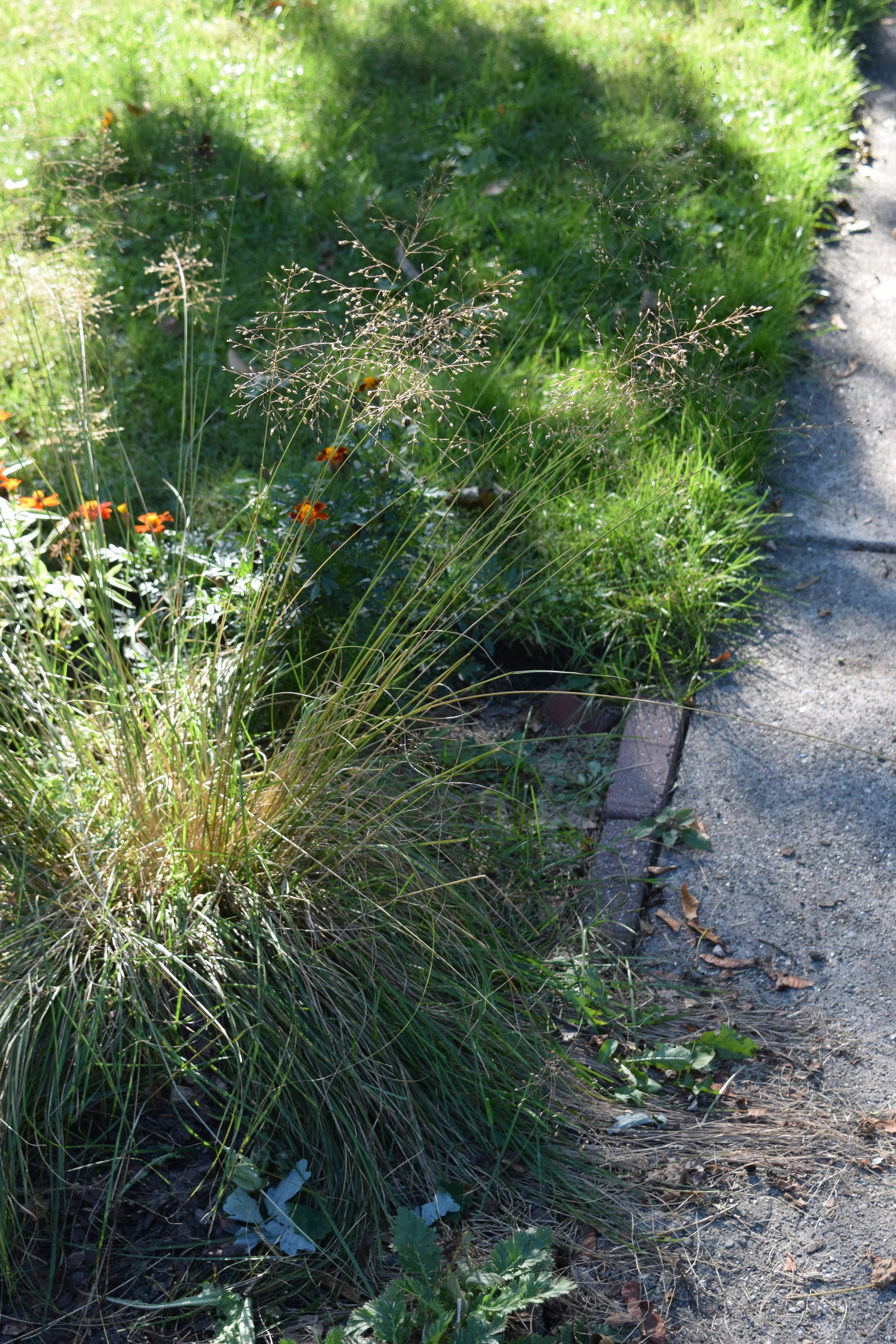
There’s also some Prairie Dropseed’ that’s been slow to bulk up and grow together.
To see more September foliage, check out Christina’s post at My Hesperides Garden.
During our trip to Quebec we were delighted to be invited to visit Glen Villa, the home of Pat and Norman Webster. Theirs is a big property of 750 acres near the small village of North Hatley, about 90 minutes southeast of Montreal. Pat writes the blog Site and Insight, covering topics related to art, gardens, and landscapes.
Glen Villa is so rich in its offerings and Judy took so many hundreds of pictures that I cannot cover it all in a single post. For now I want to just talk about how Pat captures the magic of water at Glen Villa.
Water in the garden is magical because it is simultaneously tranquil and restless, comforting and yet fundamentally wild. All these aspects are apparent here.
Judy: From the photographer’s perspective, water is also magical because of how it interacts with the light. It was overcast during our stay at Glen Villa, which provides one kind of light; at every step of the way, I was wondering what kinds of photos I could get on a sunny day, or at dawn or dusk. Then Jason would have had many more photos to sort through! (This is Judy in italics; I don’t usually write, but the water at Glen Villa is moving me to add a few thoughts, because it was so interesting to photograph.)
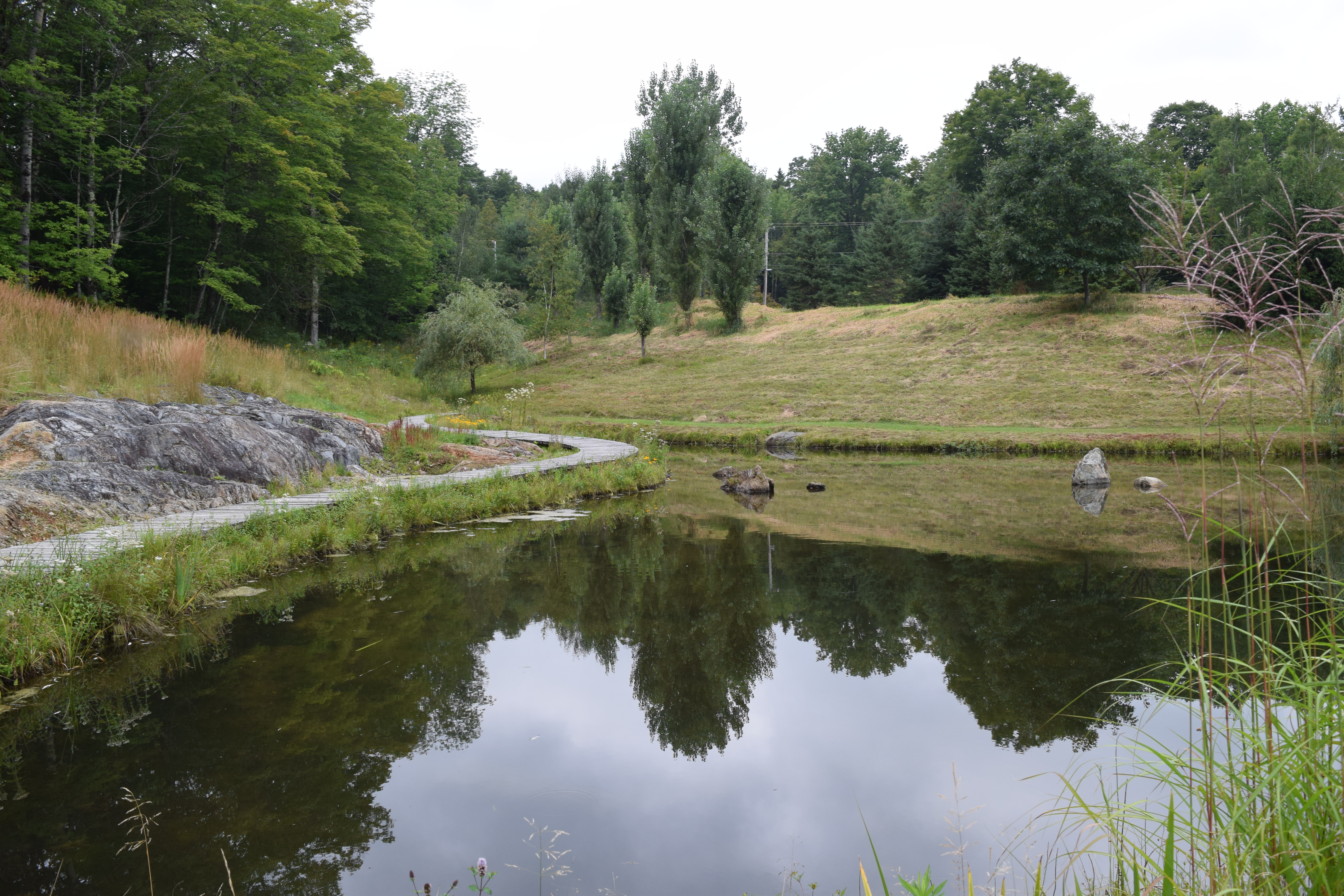
The Skating Pond is a good place to start. In the course of building a berm along a road bordering their property, Pat and Norman discovered water, clay, and stone beneath the surface. The Skating Pond is the result. (No one actually skates on the Skating Pond, but that is another story). In the picture above you can see the berm.
It was an overcast day when we visited the pond, and yet the water was still full of lovely reflections in its deceptive stillness. I think these tall grasses are Miscanthus, but I’m not positive. Pat mixed plants of her choosing with the naturally occurring vegetation.
Judy: While Jason and Pat were talking about the plants, I was admiring the reflections — look how puffy and deep those clouds are. And the reflected grass is just as interesting as the real grass.
Other additions include the Calamagrostis x acutiflora ‘Karl Foerster’ and Japanese Blood Grass (Imperata cylindrica) seen above. Pat has written that she thinks there is too much ‘Karl Foerster’ here, but I don’t agree. This is a great grass for massing and why not take advantage of the space available?
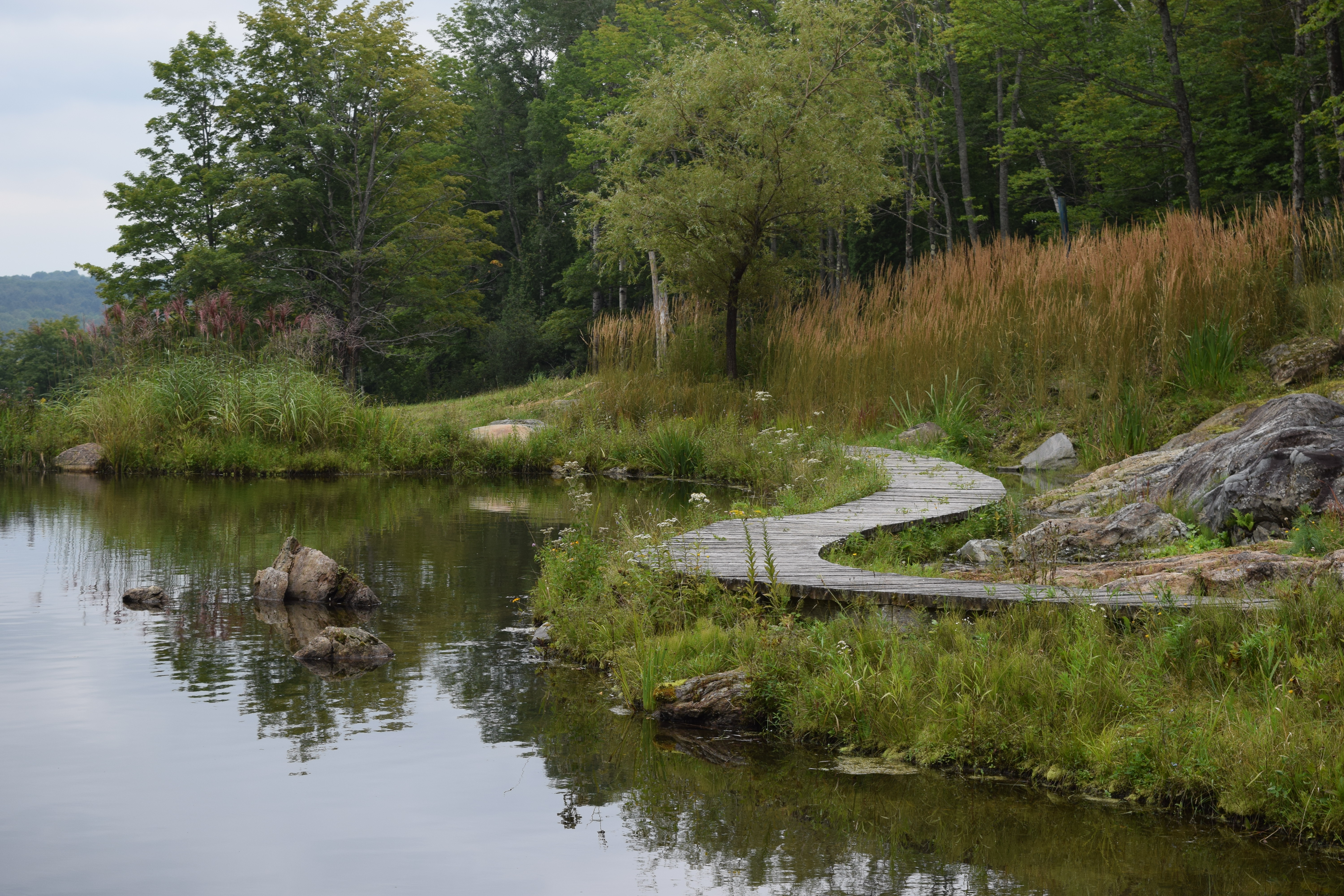
I love the flowing quality of the stone here, which had been bedrock before creation of the berm.
Judy: The contrasting textures in this scene above are very pleasing to me. As is the vista. I could have spent all day taking photos of the boardwalk, which curves along the edge of the pond in just the right way.
Late summer wildflowers, like these Rudbeckia, were also plentiful. I like that stone emerging from the center of the pond.
Judy:From this angle, it appears that the pond is on a plane all of its own, high above the upper field. Although you see the edge of the pond, it makes me think of an infinity pool, perhaps because of the reflection of the sky.
Here’s another view of the ‘Karl Foerster’ and the curving wooden boardwalk.
Judy: At first glance, it looks like such a simple little pond. But all the shapes are just so, and interesting from so many different angles. I’m a total sucker for a curving path, and when you add water and plants and rocks and reflections…
Here the brook is crossed by a Japanese-style crooked bridge.
While the Skating Pond seems still, the water in fact runs downhill through the meadows of Glen Villa to nearby Lake Massawippi. In late summer this meadow brook was flowing rather low and slow.
The water then passes through a holding pond and little waterfall called the Cascade. Personally I think the Cascade would be an excellent site for a grotto.
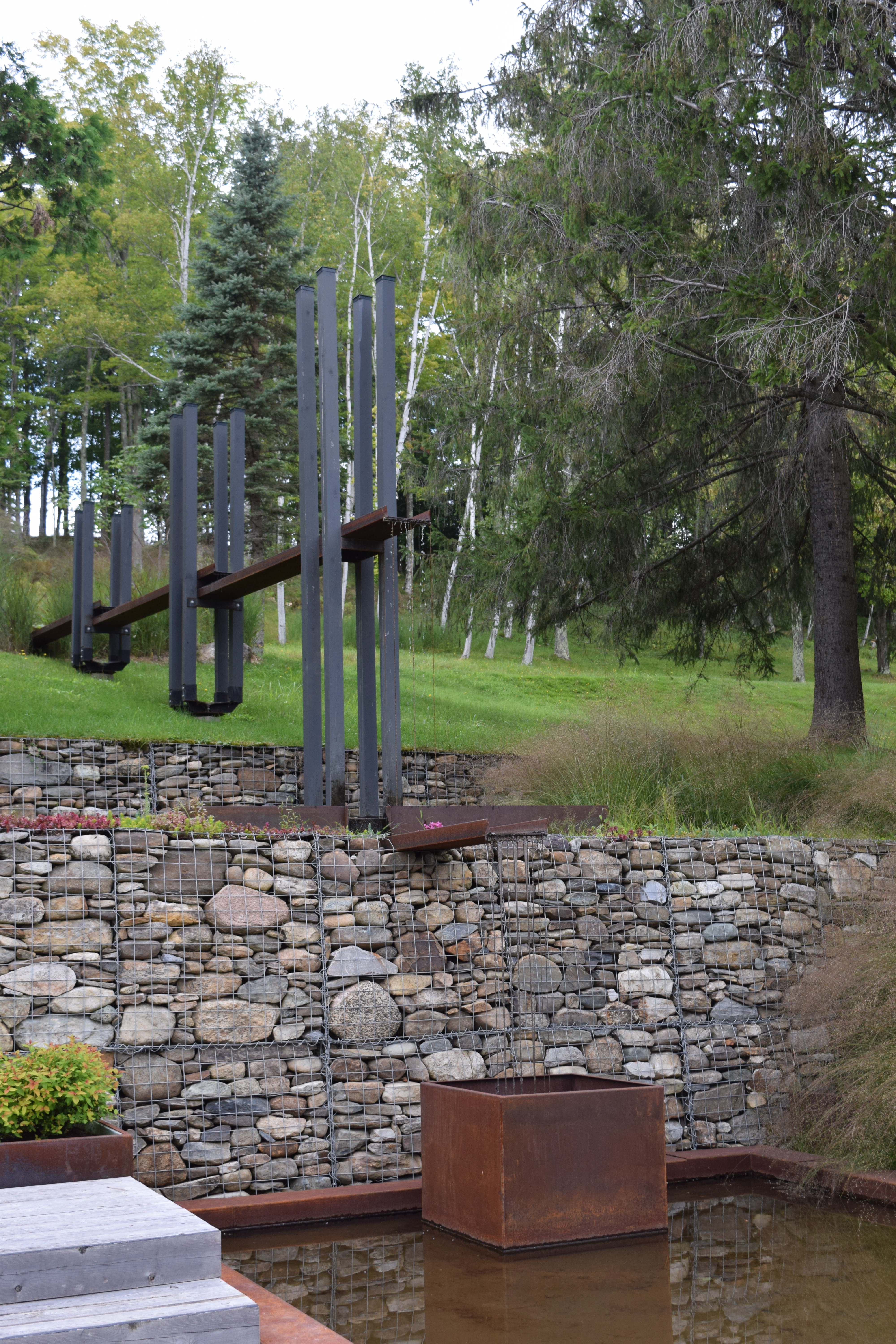
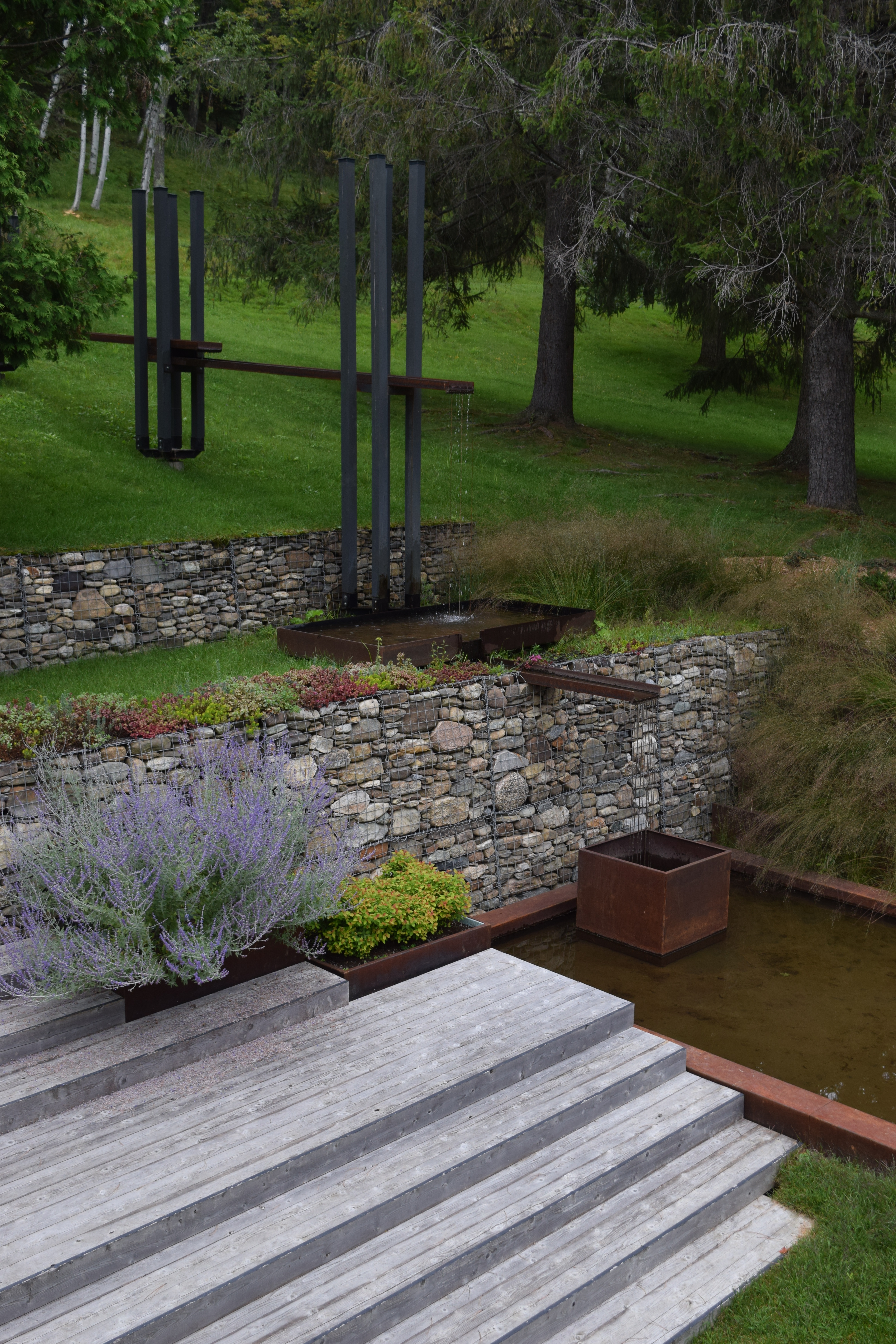
Finally the water flows into a rust-colored steel construction called the Aqueduct.
Judy: I had seen the Aqueduct on Pat’s blog, but not fully appreciated it until I saw it in person, and realized how it is part of the flow of water from the Upper Field. You really have to walk around the land to appreciate all of the elements Pat has created in it, and how they fit together to make something greater.
There are thriving plantings of succulents and Prairie Dropseed (Sporobulus heterolepis) where the Aqueduct makes its own waterfall.
Here’s another view from the house. I love the contrast here of metal, wood, dry stacked stone walls and that patch of blue provided by Russian Sage (Perovskia atroplicifolia).
From here the water flows into another steel channel, this time set into the ground, and into another pond.
Here’s a view from further back.
A final small pond is located just above a small boathouse by the lake.
Judy:The water from the angular steel Aqueduct and channel flows into this lovely round pond, surrounded by ferns and other plants. The light cooperated with the water to create these pleasing ripples.
Plants include Lady Fern (Athyrium filix-femina) near the steel channel and Japanese Forest Grass (Hakonechloa macra ‘Aureola’) on the farside of the pond. Siberian Iris (Iris sibirica) and Fingerleaf Rodgersia (Rodgersia aescufolia) is on the near side.
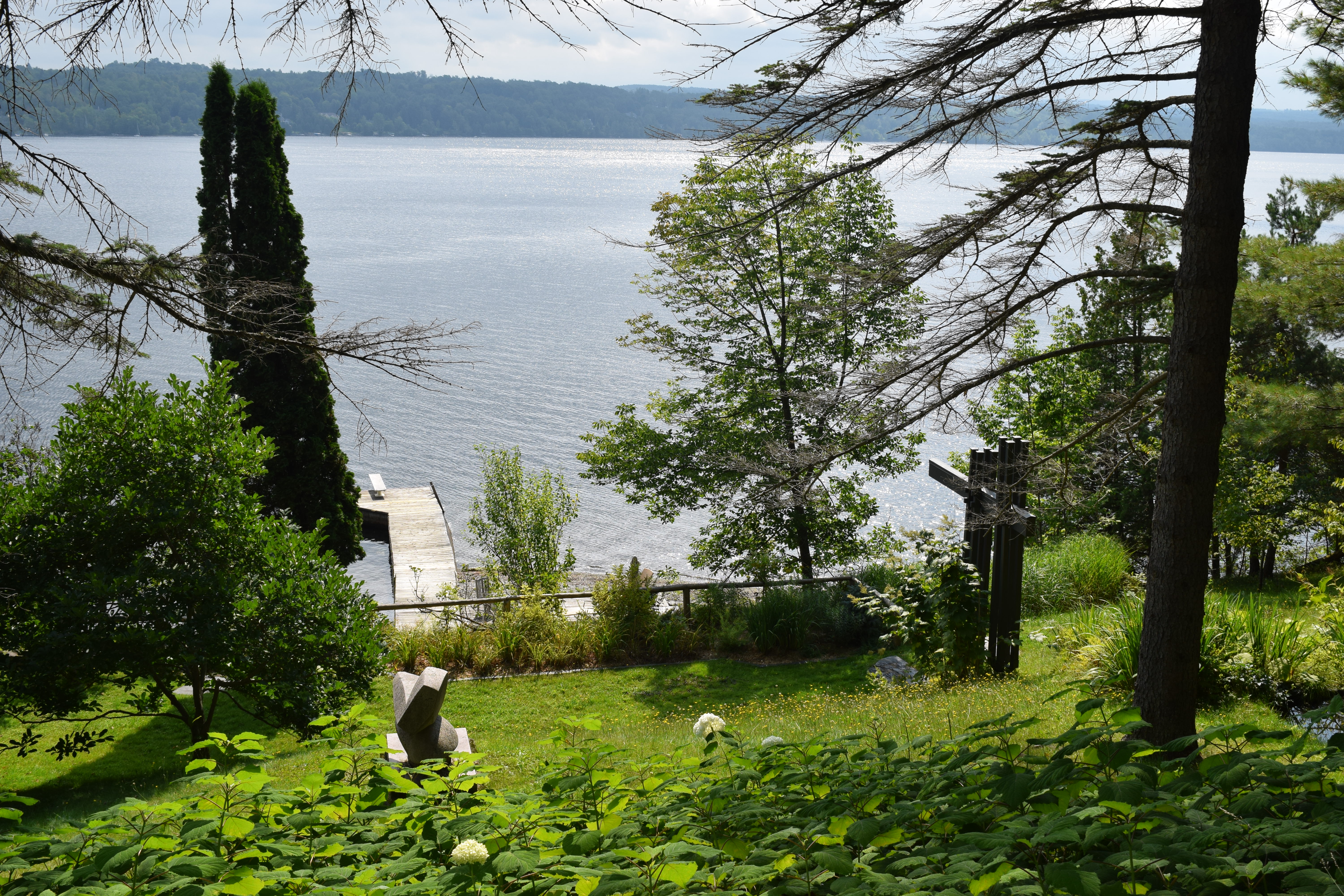
From ponds and channels the water finally arrives at the lake. The house at Glen Villa takes full advantage of its position above the lake shore.
Judy: The light didn’t cooperate for a great photo of the lake, but at least you see where all this water is ending up, and how it is integrated in to the overall landscape.
The water’s journey, of course, is never done. From here it continues to drain to the St. Lawrence and beyond.
The quality of water at Glen Villa is found in a wide lake, in tranquil ponds, and rushing waterfalls; and in partnerships with stone and steel, flowers and ferns. It evokes comfort, tranquility, and mystery.


















 gardeninacity