Mother Nature is a tease. Since early February here in Chicago, we have several times been granted a couple of lovely mild days. The snow would melt. Us gardeners would tentatively venture out to sniff the air and perhaps prune a shrub or two. We would start to think – this is it, we’re having an early spring. Then – WHAM! Wind, cold, snow, hail, and the slaying of the first born. Oh wait, that’s Passover.
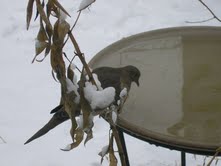
January 2012 – Mourning Dove at the heated bird bath
Thaw. Freeze. Thaw. Freeze. The cruel cycle goes on, raising hopes only to dash them. And of course, these days it’s pretty hard to know what to expect from the weather. What we would consider an early spring is gradually becoming the norm. It was not always thus. When I first moved to Chicago in 1983, you would typically begin March with a thick layer of ice and compacted snow on the ground, a layer which may not be inclined to melt before April.
Last year, however, February was like a mild March, and March was like May. This year is more like the old days. There is snow and ice on the ground, and there was more snowfall today.
All this can lead to considerable frustration for the gardener. However, in an effort to help all of us maintain a positive attitude, I am offering five reasons to be glad that we are NOT having an early Spring.
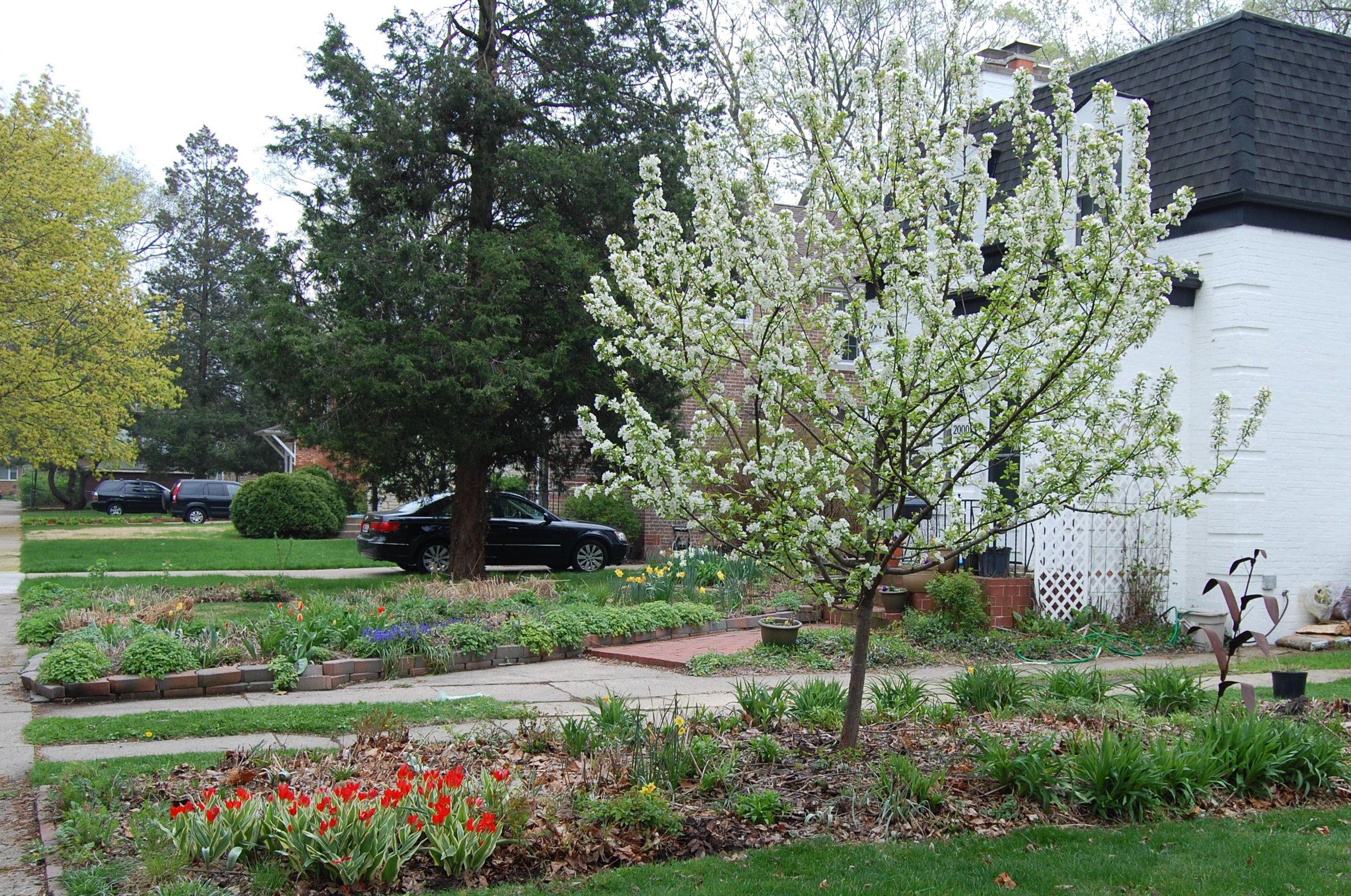
Flowering fruit trees are better off if they don’t come out of dormancy too early. This is the ‘Donald Wyman’ crabapple in front of our house.
Early Flowering Trees and Shrubs are Safer! Last year March was like May, sure, but then April was like February. The result was a lot of traumatized woody plants. These plants had gotten all cozy and vulnerable, only to have their leaves and flower buds flash frozen. Orchards in Illinois and all over the upper Midwest were devastated.
Freezing and Thawing Reduces Soil Compaction! Sure all that restless soil may heave your new perennials out of the ground to whither in the frozen wind, but there is also a bright side. Compacted soil is a widespread problem, especially in the city and suburbs. The cycle of freezing and thawing tends to reduce compaction, at least in the upper layer of soil.
Fewer Pests! Longer, colder winters means fewer unhelpful insects and disease-causing organisms around for the following spring, especially those that are creeping North with climate change.
Justifies My Investment In The Heated Bird Bath. If it turns out we’re not going to have long, cold winters, what am I doing with a heated bird bath?
We’ll Appreciate Spring That Much More! That is, if we make it that long.
Recently I have read a number of articles and posts about the devastation caused among Impatiens (Impatiens walleriana and related) by downy mildew. While usually just an unsightly nuisance among perennials, this strain is deadly for Impatiens. It can be treated but only if caught early and if you are willing to resort to the chemical arsenal.
I used Impatiens to fill in between new perennials in this bed. Eventually the space will be taken over by ferns, Columbine, Solomon Seal, and Wall Iris.
This raises two questions. First, is it worth planting Impatiens in 2013? And second, what would you replace them with? My tentative answer to the first question is no. Regarding the second question, I’m not sure, though I have some ideas.
I realize that some people really don’t care. They disdain Impatiens as common, boring, etc. For myself, I do not believe that because a plant is common it is therefore of no value in the garden. I use Impatiens extensively in my shady back garden, mostly in containers but also in beds, as a filler. I also used it last year to fill in between the new perennials in the shady bed on the east side of the house.
We’ve been using this old wheelbarrow as a planter for several years. Last year there was a mix of Impatiens and petunias. Petunias were an experiment that did not work.
Impatiens has several notable virtues, or at least it did until the Impatiens plague came along. First, it blooms its little head off from early summer right through frost. Second, it is not at all bothered by dense shade or by Chicago’s hot and humid summers. Third, it needs almost no attention, the main thing is to keep it from getting too dry. Fourth, it spreads nicely, creating a mounded flowery carpet. Also, it will obligingly spill over the sides of containers, and it attracts hummingbirds. Oh yeah, one other thing: they’re really cheap.
Almost all the Impatiens I plant are white, I like to have lots of white flowers in shady parts of the garden.
Despite all this, I don’t think I will plant any Impatiens this year. Just seems too risky, because once you have infected plants the disease will be in the soil, lying in wait, for Lord knows how long. The best way to be able to plant this species again is to wait out the infestations, or until the breeders come up with resistant varieties.
So what should I plant instead of Impatiens? I will probably use a mix of plants, but they all should be shade tolerant, low-growing, have white flowers, fill in nicely, and not require a lot of attention. Ideally, they will also be good for wildlife. Oh, and not too expensive. A few possibilities include:
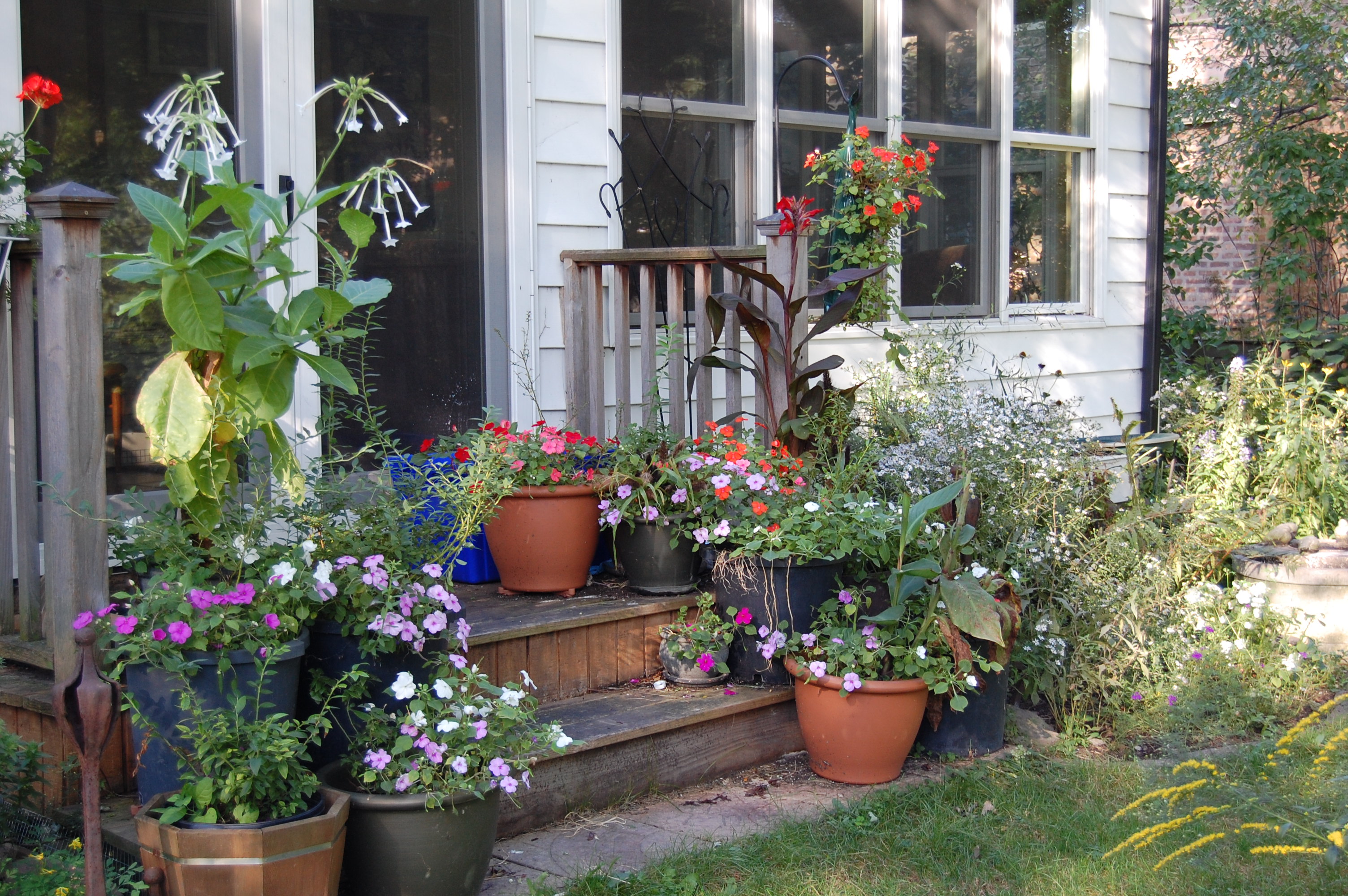
Flowering containers on our back porch landing.
Floss Flower (Ageratum houstonianum). Usually blue, but has white varieties. Meets all my criteria, except that in my experience this plant will not spill over the side of containers.
Saphire Flower (Browallia). There’s a variety called ‘Endless Flirtation’ with white flowers. This plant is supposed to be a good spiller. Not nearly as cheap as Floss Flower, though.
Foliage Plants. There are varieties of Coleus and Calladium with green and white or near-white leaves. Calladiums are much more expensive, though I usually plant a few anyway.
I also considered but rejected a few possibilities, including annual Lobelia (Lobelia erinus) and various types of Begonias. I like annual Lobelia, but it usually shrivels in the heat of summer. On the other hand, Judy and I just don’t like Begonias. Hard to explain, but there you are.
What about you – will you be planting impatiens this year? And if not, what will you use as a replacement?
Looking at photos from a summer outing to the Chicago Botanic Garden, I was particularly struck by three of the plant combinations Judy took pictures of. (UPDATE: As Alison and Alberto point out in comments, the blue flower below is a tall variety of Nepeta, not Bluebeard. Sorry for the error!) First, Bluebeard (Caryopteris) and Poppies (Papaver). (Sorry, I don’t know the exact variety of any of the plants in this post.) I love mixing blue with hot colors like red or yellow.
Nepeta with Red Poppy
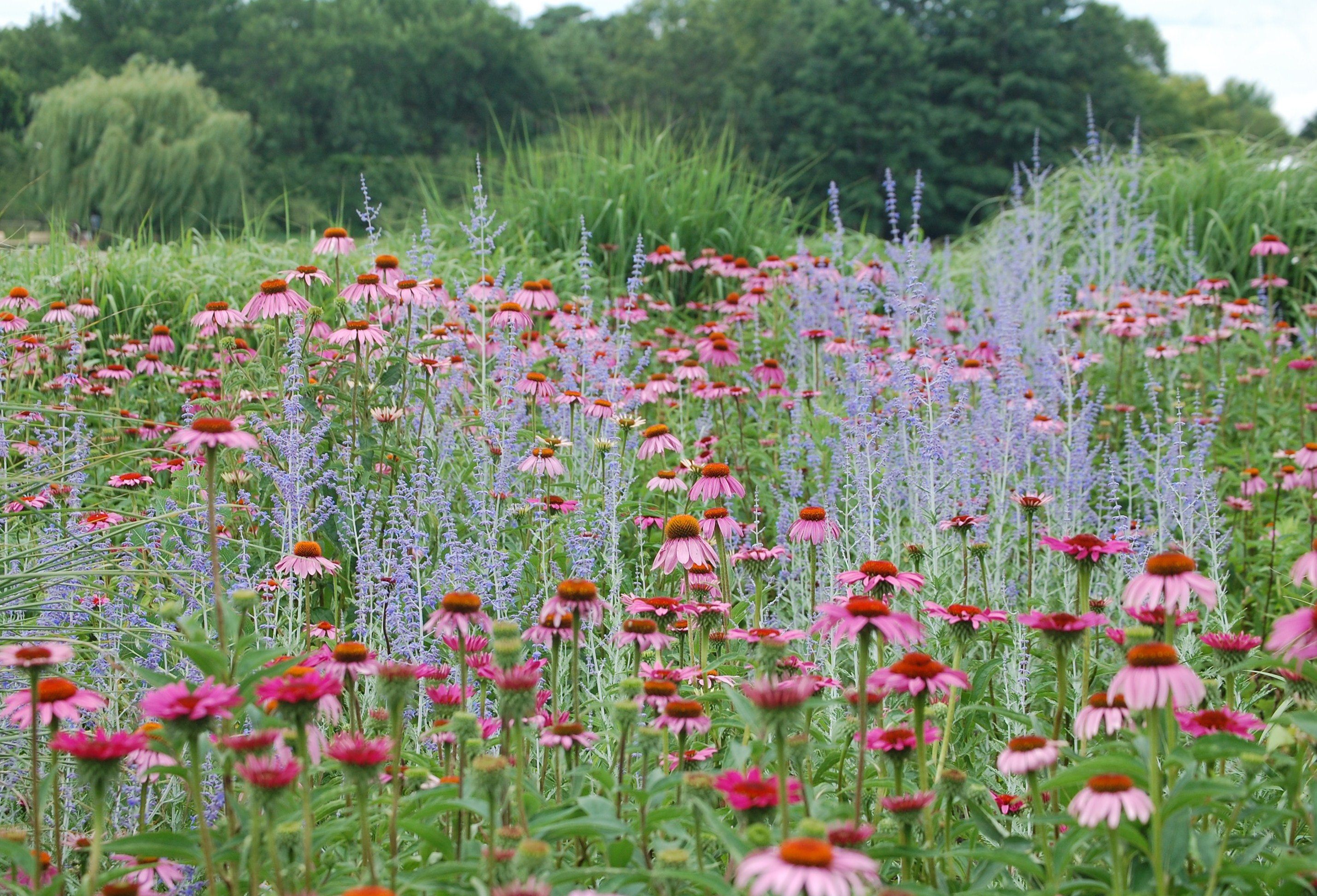
Second, Russian Sage (Perovskia atriplicifolia) and Purple Coneflower (Echinacea purpurea).
Russian Sage and Purple Coneflower
And finally, Allium (looks like ‘Purple Sensation’) and White False Indigo (Baptisia alba L.) What I really like here is the contrast in shape between the Allium lollipops and the softly serrated spikes of the Baptisia.
Allium and White False Indigo
Have you been thinking about trying any new plant combinations this year?
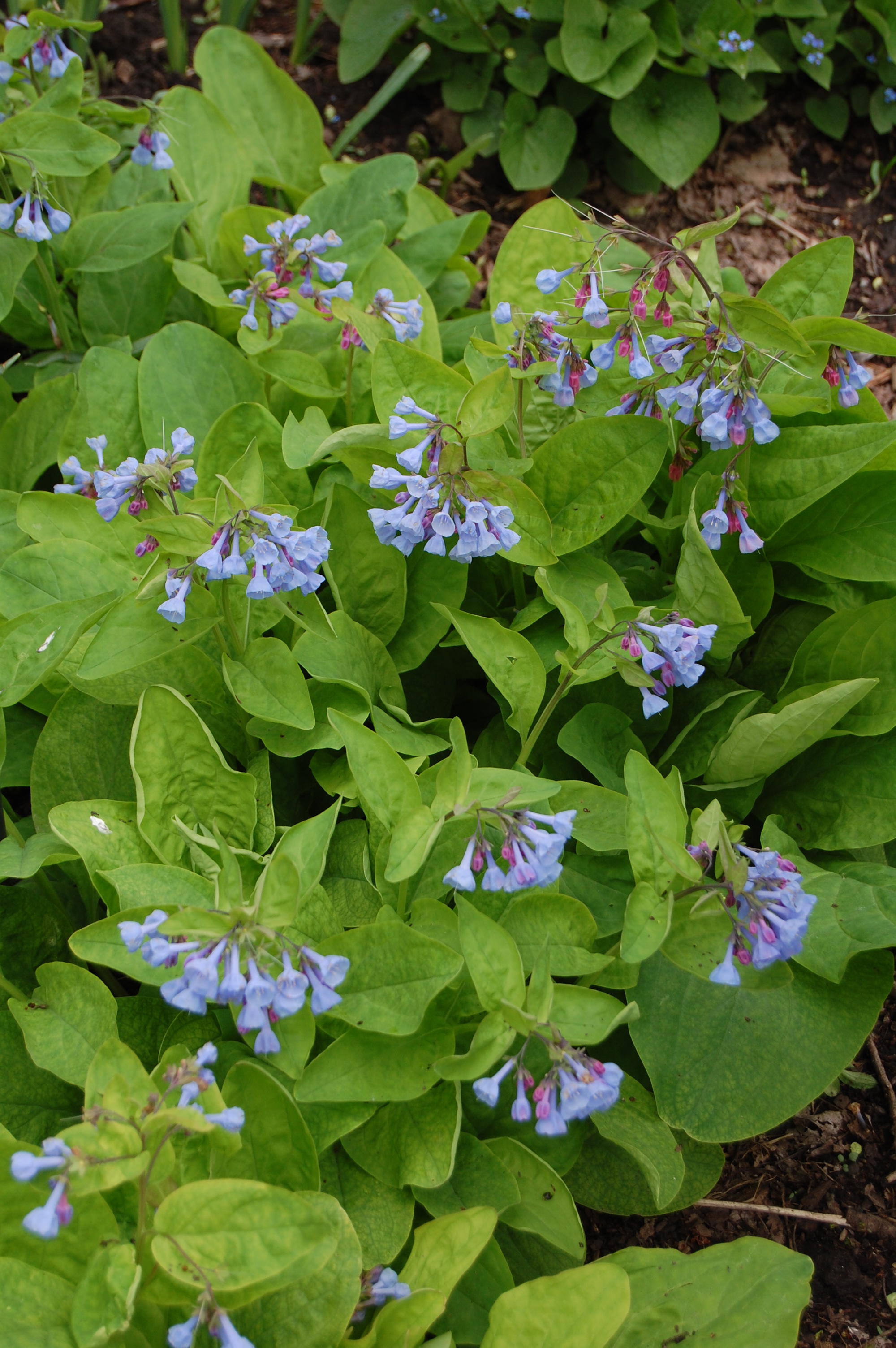
As we all have spring on our minds, I’d like to write about a lovely spring wildflower, Virginia Bluebells (Mertensia virginica). The flower buds of Virginia Bluebells tend to start out pink, and the flowers are tinged with pink before they turn blue.
Virginia Bluebells
Virginia Bluebells are native throughout much of eastern and midwestern North America. It likes fertile, moist soil in deciduous woodlands. In the right spot, they are an easy care perennial. It is hardy from zone 8 all the way up to zone 3.
This spring ephemeral blooms usually in April here in Chicago. The foliage is oval, smooth, and blue-green, but becomes unsightly as it dies back. Virginia Bluebells are best planted with ferns or other companions that can obscure the dying foliage. Bleeding Heart (Lamprocapnos spectabilis) (that’s right, Lamprocapnos, not Dicentra, the taxonomists strike again) is another classic companion for Virginia Bluebells.
Virginia Bluebells will expand to form substantial clumps, but will also self-sow energetically, so that you will always have little seedlings to give away or move. I tend to let it grow where it sprouts if at all possible.
Thanks to Gail at Clay and Limestone for hosting Wildflower Wednesday on the fourth Wednesday of every month.
The Front Island Bed lies between the Sidewalk Border and the low retaining wall of the expanded Foundation Bed. It is filled mostly with taller plants that enjoy lots of moisture, since the soil is a moist clay loam. It gets almost full sun, even though it is on the north side of the house. It’s also more of a peninsula than an island, I guess, since I expanded it to go right up to the retaining wall for a couple of feet.
The Front Island Bed, July 2012
The Front Island Bed is separated from the Sidewalk Border and the Driveway Border by grass paths, roughly 3′ wide. The key plants in this bed, from front to back, are as follows:
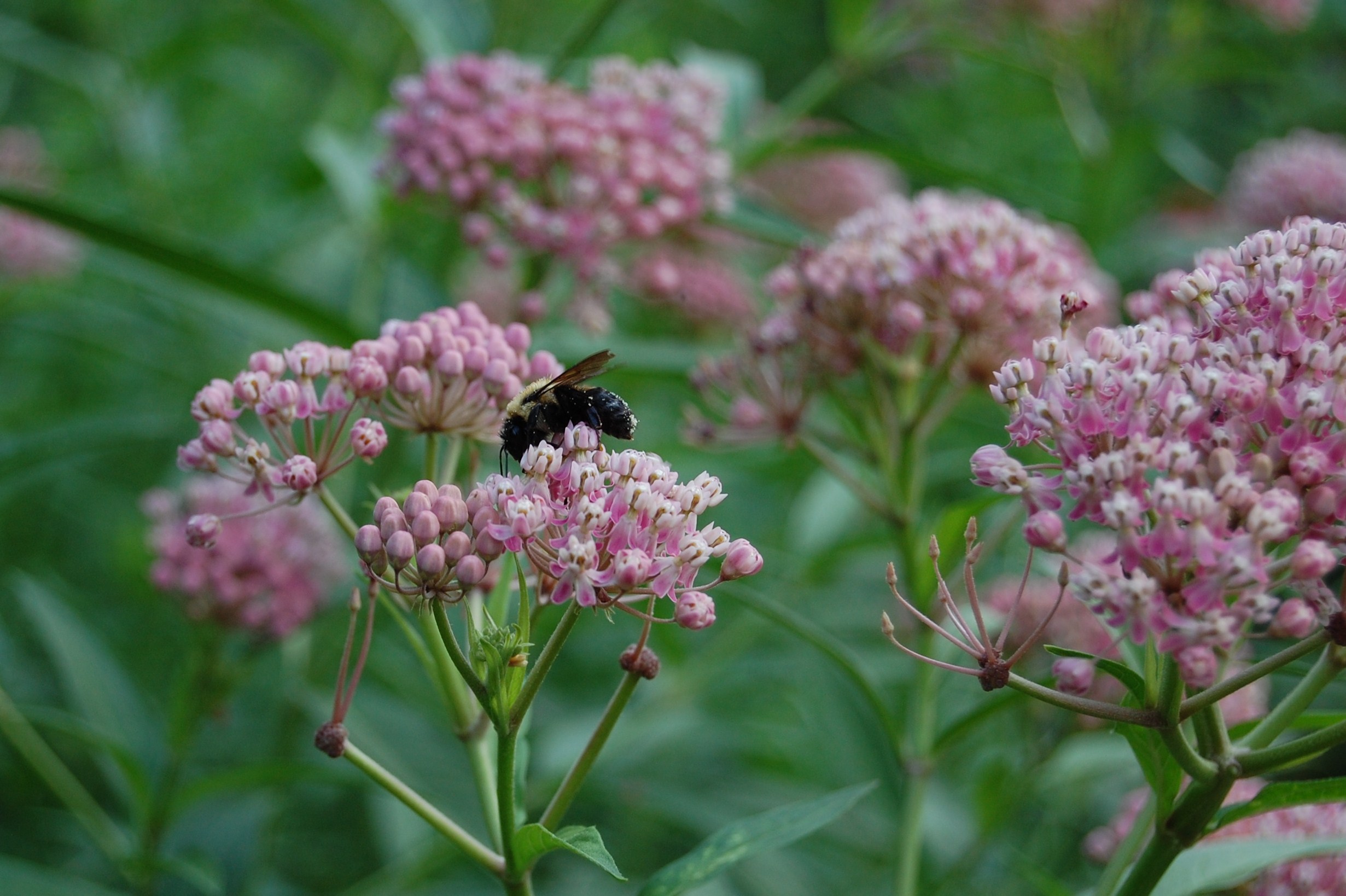
Swamp Milkweed (Asclepias incarnata). I have both the straight species and the cultivar ‘Ice Ballet’. The species is taller (4-5′) with pink flowers, ‘Ice Ballet’ is shorter (3-4′) with white flowers. Both have a delicious vanilla scent, and both have long bloom periods, starting by late June and lasting into August.
Swamp Milkweed, straight species
The seed pods can be beautiful in fall. Under the right conditions (sun, moist soil) this plant is easy to grow. Like other Milkweeds, Swamp Milkweed is a host plant for Monarch butterflies, and are superlative nectar plants for pollinators. I think the Perennial Plant Association doesn’t want us to use the common name “Swamp Milkweed”, so you may find it listed in catalogs and elsewhere as “Red Milkweed”. Swamp Milkweed will self-sow and form expanding clumps, but it is not an overly aggressive plant.
Swamp Milkweed ‘Ice Ballet’ (white)
Swamp Milkweed seed pods
New England Aster (Symphyotrichum novae-angliae). The New England Aster stands more or less behind the Swamp Milkweed. This aster has spun off innumerable cultivars, but I have the straight species. This guy is a tall aster (5-6′) with variable flowers – mostly blue but sometimes pink or purple. He will spread by seed and by rhizome, but I don’t have to work too hard to keep him in bounds. Blooms August to October. I highly recommend cutting back hard at least once during the season, in order to get a bushier plant of more manageable height. A good nectar plant for butterflies, and birds will eat the seeds.
New England Aster
Cup Plant (Silphium perfoliatum). I’ve written about this plant, which is a particular favorite of mine, in a number of posts. Cup Plant stands behind the New England Aster on the right side of the Island Bed. To avoid being overly repetitive, I will just summarize: VERY tall (8-10′), yellow daisy flowers from July to September, bold foliage that forms “cups” that hold rainwater around the stem, seeds are loved by goldfinches.
Cup Plant
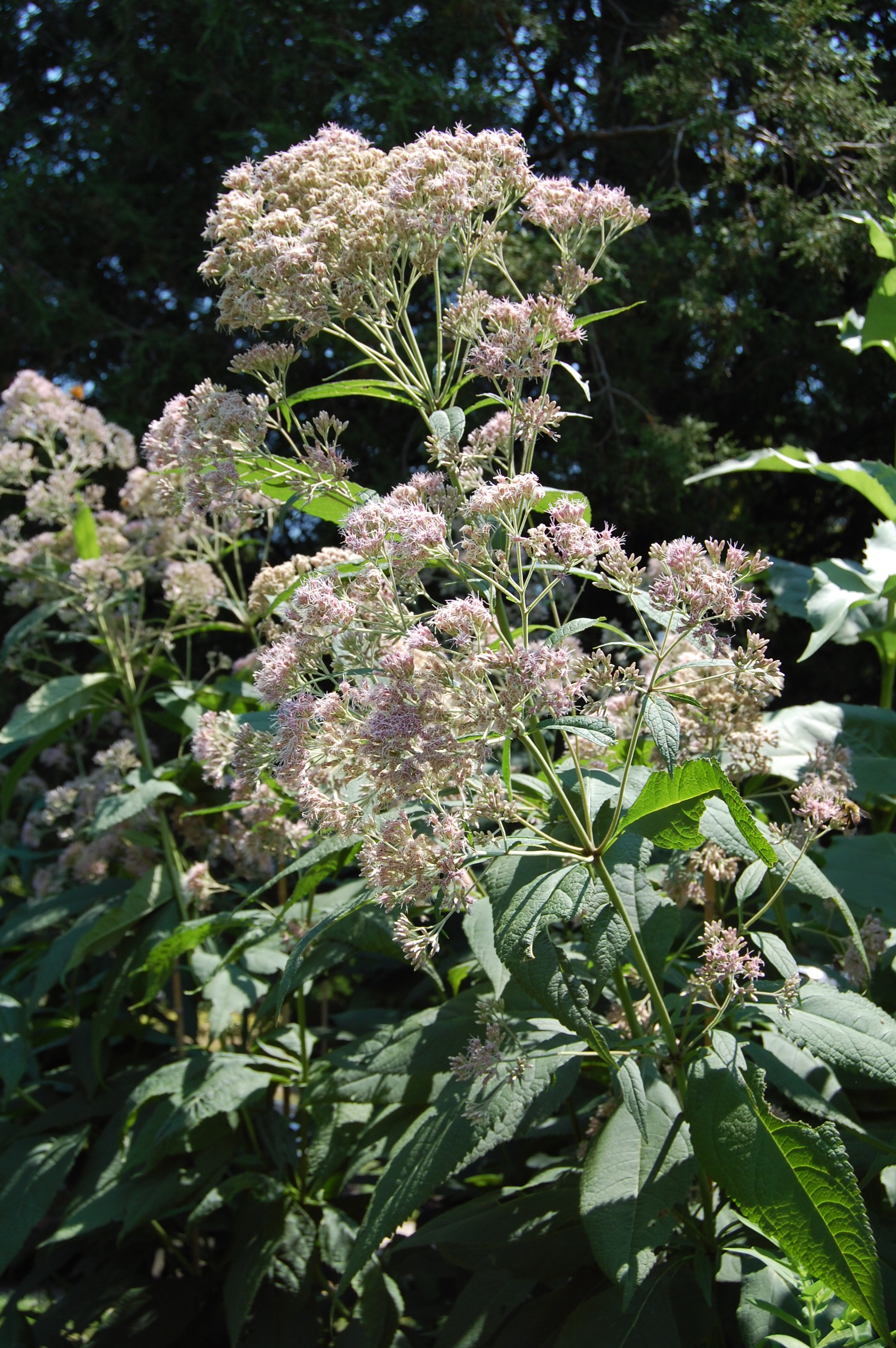
Sweet Joe Pye Weed (Eutrochium purpureum). Gaah! I just discovered that Joe Pye Weeds are now Eutrochiums, not Eupatoriums. That’s very annoying! But back to the topic at hand. Sweet Joe Pye Weed is like the more common variety ‘Gateway’ except that it is taller (7-8′), flowers earlier (July-August), and the flowers are more of a dusty pink. Supposedly the leaves are fragrant, but I haven’t noticed any fragrance myself. This plant sits behind the New England Aster and along side the Cup Plant. The flowers are attractive to butterflies.
Sweet Joe Pye Weed in the front island bed.
This is a taller bed because it is generally viewed over the tops of other beds. Most of the plants require some serious staking. I use 10′ rebar for the Cup Plant and the Sweet Joe Pye Weed. It does have some shorter plants in the front:Blue Stem Goldenrod (Solidago caesia), Geranium ‘Johnson’s Blue” and Northern Sea Oats (Chasmanthium latifolium). I removed most of the Chasmanthium I originally planted and replaced them with the Geranium, because I found this grass to be too tall and floppy to have very much of it at the front of the border.
Blue Stem Goldenrod
There are also a couple of volunteer Brown Eyed Susan (Rudbeckia triloba) that I allowed to grow that provide nice contrasts of color and form.
All of the plants in this bed, other than the ‘Johnson’s Blue’ are native to this part of North America. At the moment this is one of the beds where I am not scheming to add new plants or move things around.
The other night Judy made this tomato and goat cheese galette for dinner, and it was delicious. It would be even more delicious with home-grown or farmer’s market tomatoes instead of supermarket tomatoes, but it’s February, so there you are. She got the recipe here. The recipe called for thyme and she didn’t have any, so she used zaatar (a spice mix that includes thyme), then threw in some sumac powder for good measure.
Tomato and Goat Cheese Galette. Looks good, doesn’t it?
Judy says the key to making this successfully is slicing the tomatoes thinly, otherwise they will stay too juicy.
A quick postscript. Am I the only person who feels an urge to snicker when hearing the words “goat cheese”? I mean, goat cheese is delicious, but if someone had mentioned it to me when I was 15 (I was born in 1958), I would have snickered. And even today, it just sounds weird to my unsophisticated inner self. Of course, I also think boiled tongue and creamed herring are perfectly normal, so what do I know? But what about you, are there foods you enjoy today that you would have laughed at while growing up?
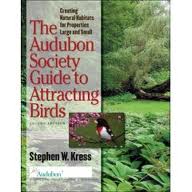
This book has impeccable birder credentials, sponsored by both the Audubon Society and the Cornell Lab or Ornithology. If I could have only one book on having a bird-friendly garden in the USA or Canada, this would be the one. It covers the basics – food, nesting, water, cover – in a more comprehensive manner than any of the other books I have seen on the topic.
The land management chapters deal with both backyard habitats and larger landholdings of forest, grassland, and shrubland.
My favorite chapters deal with plant selections. These are especially valuable because plants are listed regionally, with separate lists for the Northeast, Southeast, Prairies and Plains, Mountains and Deserts, and the Pacific Coast. Plant charts provide information on specific birds attracted by various plants, as well as plant descriptions and cultural information.
The section on nests includes information on both nest boxes and plantings that provide safe and attractive nesting sites. Challenges such as parasites, predators, and competition from invasive species are addressed. Water features, both simple and elaborate, are discussed, as well as aquatic plants. Finally, there is a thorough review of the dos and don’ts of supplemental feeding.
This book’s only serious shortcoming is the complete lack of photographs or any colored illustrations. This is a book for information, but not for sighing over the beauty of various plants and birds (I have a lot of those). The line drawings used for illustrations are adequate, but not inspiring.
Stephen Kress, The Audubon Society Guide to Attracting Birds (Second Edition), Cornell University Press, 2006.
Neil Diboll is President of Prairie Nursery, one of the Midwest’s best known growers of native plants. He is an internationally recognized expert on topics related to native plants and sustainable garden and landscape design. Neil was nice enough to answer some questions I sent him, thus making possible Gardeninacity’s first interview.
Neil Diboll of Prairie Nursery
Question: Do you find that the interest in native plants continues to grow? Are natives in danger of being passed by as a gardening trend?
Answer: When I started in business 31 years ago, lots of people said that native plants were just a passing fad. Instead, there has been a steady, gradual acceptance of the use of native plants in landscapes as an excellent alternative to non-natives. There will always be gardening trends, some of which will be fads, but the use of native plants simply makes too much ecological and economic sense not to be adopted as a long-term viable alternative to high-maintenance, large carbon footprint, and chemically dependent traditional landscapes.
Q: Do you think additional species of North American native plants (beyond the ones already grown) will become common in the garden? If so, can you give some examples?
A: We have only begun to use the various native trees, shrubs, vines, flowers, grasses, sedges, ferns, and mosses in our landscapes. There is, of course, a finite number of species native to a given region, but there is an excellent palette of native plants from which to select in almost every region of North America.
Palm Sedge, a native of the Midwestern USA Photo: Missouri Botanic Garden
I think that most of the showier, widely adaptable species are now in the trade, but we have only recently begun to use sedges in our landscapes. This is a new frontier in native plants, because many members of this group of plants are so diverse, adaptable, and easy to grow. Many sedges also grow in problematic habitats, such as wet soils, dry shade, etc.
There are also many readily available prairie flowers that are under-utilized in our gardens. I expect to see more people including these fabulous plants in the future, especially after the drought of 2012, during which so many prairie flowers absolutely excelled!
Q. Some people argue that there is no advantage to native plants as such, that gardeners should focus on the characteristics of plants (such as drought resistant, etc.), and not their origins. What’s your response?
A. The recent research by Douglas Tallamy proves beyond a shadow of doubt that plants that are native to a region have a significantly higher value to the native fauna with which they have co-evolved over thousands of years. Most native plants have sufficient natural enemies that they do not present an invasive threat to diverse ecosystems, unlike certain invasive non-native plants that have caused huge ecological and economic damage.
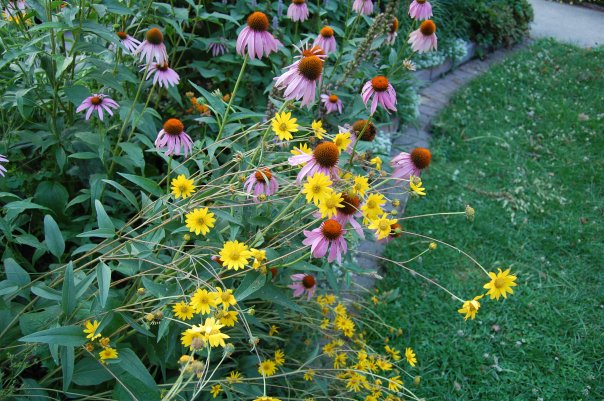
Western Sunflower with Purple Coneflower
Q. Global warming is changing the local climates to which native plants are adapted. Do you think this affects the rationale for planting natives?
A. There are many rationales for planting native plants. One is that they are adapted to their local climatic conditions. If the planet continues to warm rapidly, this is one rationale that will not continue to hold true for all species. However, there are other native plants that could well be perfectly adapted to the new conditions. While a warmer climate will not be favorable for sugar maples and white cedars, it will be ideal for many heat-loving prairie flowers and grasses.
In fact, plant geographers (phytogeographers) have determined that prairie species dominated the Midwest during the Xerotherimc Period, which occurred around 1,500 BC. This was apparently a period of elevated temperatures and possibly drier growing conditions that led to the demise of mesic forests and the rise of prairies and oak savannas. As the climate cooled and became more moist in more recent times, forests have invaded areas that were previously vegetated in prairie. Remnant prairies as far east as Long Island, NY point to the possibility that prairie communities were common all the way to the east coast in recent geologic time, only some 3,500 years ago. There is no reason to believe that this phenomenon would not occur again during a period of warmer temperatures in the future.
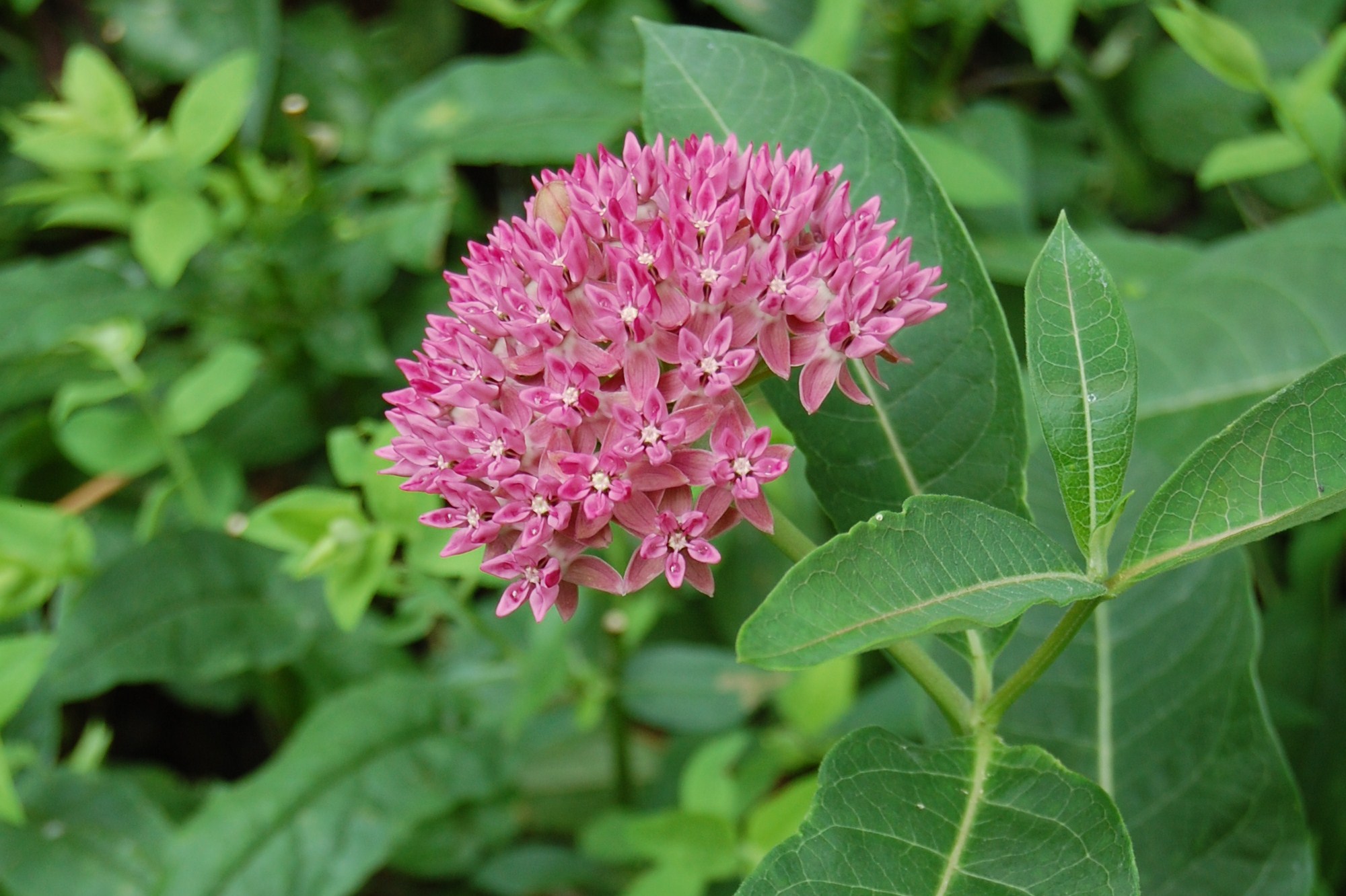
Purple Milkweed
There will be both winners and losers among native plants under the new climatic regime. Plants have migrated and ebbed and flowed throughout history. It will be no different this time around, although the changes may occur at a more rapid pace than in past periods of climatic perturbation.
Q. How do you feel about people mixing natives and exotics in the garden?
A. I am not a native plant purist. I mix native woodland plants with hostas in my gardens at home. I am careful as to which non-natives I plant, so as to prevent the spread of invasive non-native plants. I also grow apple trees, originally from Kazakhstan, pears from Europe, potatoes from the Andes, onions from Persia, garlic from Kyrgyzstan, and so on. I also have planted our No Mow Lawn Mixture extensively on my property. This turf mix blend contains six different varieties of fescue, none of which are native to Wisconsin [where Prairie Nursery is located]. And I love cheery golden daffodils, reviled by deer, rabbits, groundhogs, and squirrels alike!
My front garden, mixing natives and exotics in mid-summer.
Q. Is the economic climate becoming more challenging for independent nurseries like yours?
A. The economic climate of the past ten years has been extremely challenging for those of us in the ornamental nursery business. Sales of perennials have been in decline since 2004, and the lack of housing starts from 2008 until recently has devastated the industry. Add the uncertainty in the economy since the Great Recession, and you have a very tough business climate for those of us selling something that is not generally considered to be a necessity. Many of my friends have closed their nurseries or sold them for a fraction of what they might have been worth ten years ago.
That said, we enjoyed good sales in 2012, and our booked orders for 2013 to date are well ahead of last year for the comparable period. I believe that native plant business has been less affected by the recent downturn, as the market share for natives seems to be growing. However, that does not make us immune to the economic realities of the marketplace.
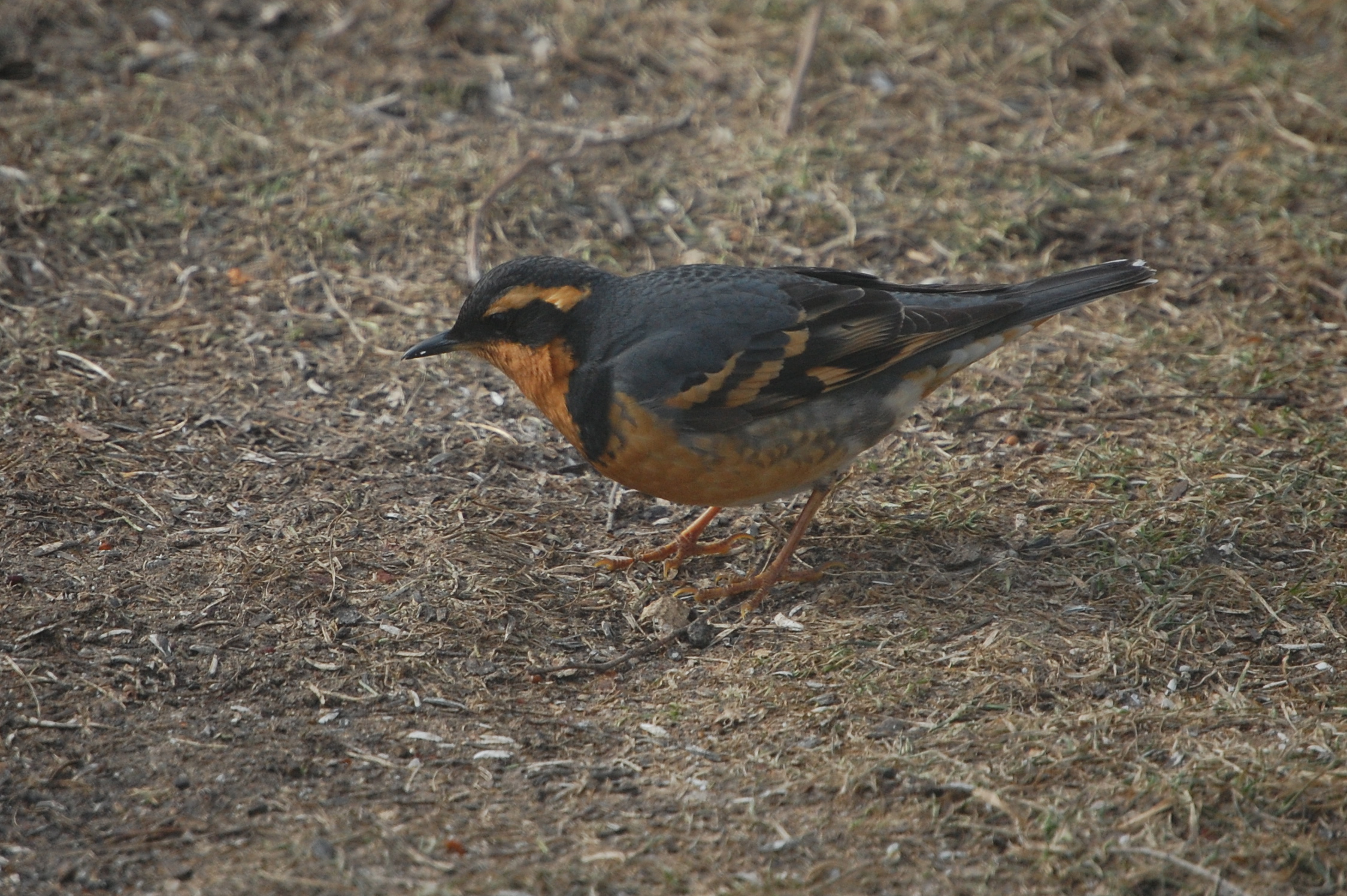
A little more than two weeks ago, I wrote about an avian phenomenon in my back yard that had generated major excitement in the Chicago birding world. Specifically, a bird called the Varied Thrush had adopted the area around our yard as his temporary home. Varied Thrushes are a very big deal in Chicago because they are spotted here only once or twice in any given year (they are fairly common in their normal range in the Pacific Northwest).
Varied Thrush in our back yard.
So for the past two weeks, dedicated birders (are there any other kind?) have been braving the cold, standing in the alley behind our fence. They are carrying binoculars and cameras with massive zoom lenses, hoping for a glimpse of the fabulous Varied Thrush.
I’ve wondered just how long this phenomenon would last. Would the Varied Thrush tire of the Paparazzi and find himself a new home? Would we run out of Varied Thrush enthusiasts, resulting in an empty alley?
Birders standing in the alley behind my house around noon today.
Well, fear not. Fame has not yet soured for our friend the Varied Thrush. And Thrush-o-Mania remains strong, although perhaps a little reduced in intensity. There were at least a dozen bird watchers who showed up in the alley today. I think they all got what they were looking for.
Birder with a serious camera.
I’m thinking about monetizing this Varied Thrush happening. Can I persuade the Varied Thrush to stay longer term? And if so, how about a line of Varied Thrush merchandise – sweatshirts, caps, mugs, Varied Thrush Action Figures … The kids of a friend of mine are suggesting selling hot coffee and those Styrofoam Also, I really need to think long term. If the Varied Thrush becomes a permanent resident, eventually the excitement for local birders will have to fade. So can I engineer the arrival of other rare birds? Must work on that.
Has your house or garden ever gotten unexpected attention?
You can have year-round valentine gifts in the garden, you know. Take Judy and I. We’ve been married for almost 28 years. If you walk around the garden, you’ll see many valentines from me to her.
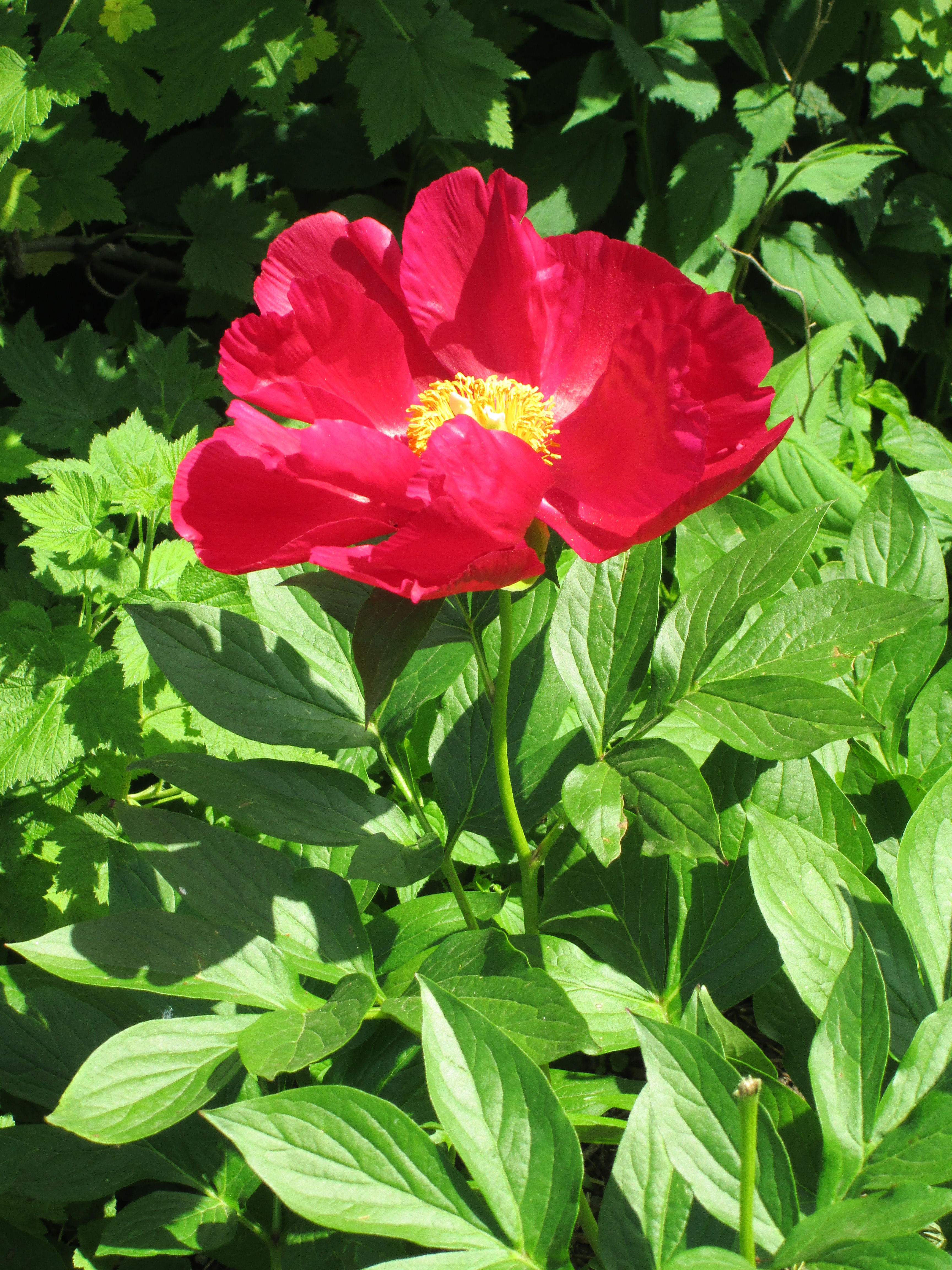
Peony ‘America’.
For example, there’s the Lilac on the east side of the house. There are many shrubs I prefer over a Lilac. She loves Lilacs, though, so I planted one, right by the window so she can smell it in bloom. If this doesn’t count as a valentine, then I don’t know what does.
Then there are the Peonies. I really don’t like Peonies. However, Judy yearned for Peonies, so I ordered five from Klehm Song Sparrow Farm. Now they take up scarce space in the back that could be filled by some really worthwhile perennials. But you cannot have love without sacrifice.
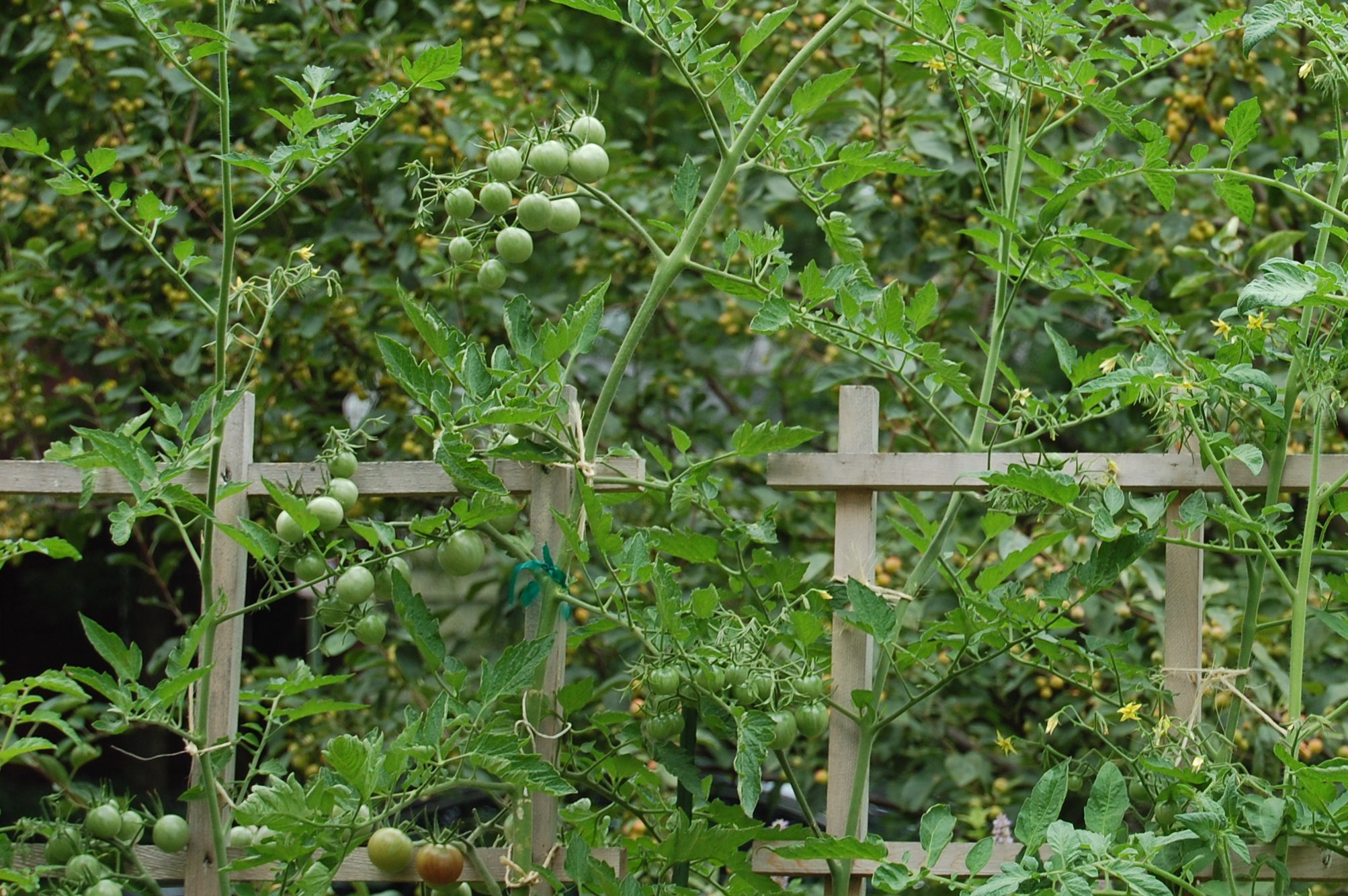
Heirloom cherry tomato ‘Black Cherry’.
Oh, and don’t forget the cucumbers and heirloom tomatoes. I’m not really interested in vegetable gardening when there are several perfectly good Farmers’ Markets within a few miles of our house. But she really wanted some home-grown edibles, so I put in a small vegetable garden.
There’s also the Prairie Smoke (Geum triflorum). For a long time, Judy would ask wistfully, “Why don’t we have any Prairie Smoke?” So I got some.
Prairie Smoke
Now, you could point out that I chose the vast majority of our garden plants based on my own interests. This is true. Fortunately, Judy likes almost all of those plants as well, so that’s all right.
There are garden valentines from her to me, as well. For starters, she tolerates the enormous amounts of time I dedicate to the garden. Then there’s all the photographs I badger her to take, even when she has something better to do. Then there are the walks we take around the yard together, examining the progress of the various garden beds.
Not that we don’t have conflict. She has her irrational prejudice against shrubs. This forces me sometimes to sneak shrubs into the garden and plant them in secret. When she sees the new shrub and asks where it came from, I say: “Oh that? That’s been there for years.”
It bothers me that she doesn’t believe me, even for a moment. After all, a strong marriage is built on trust.





















 gardeninacity