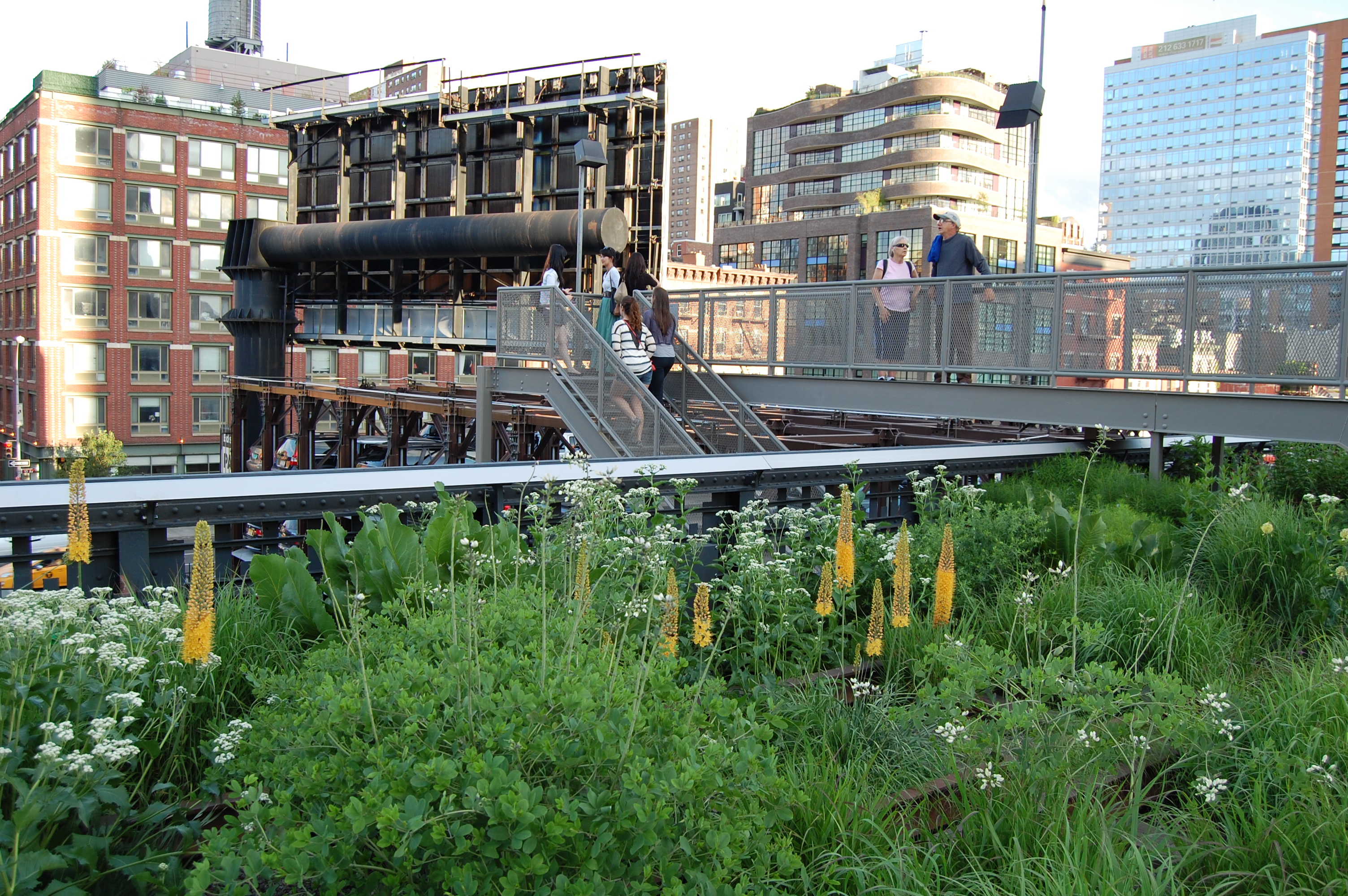
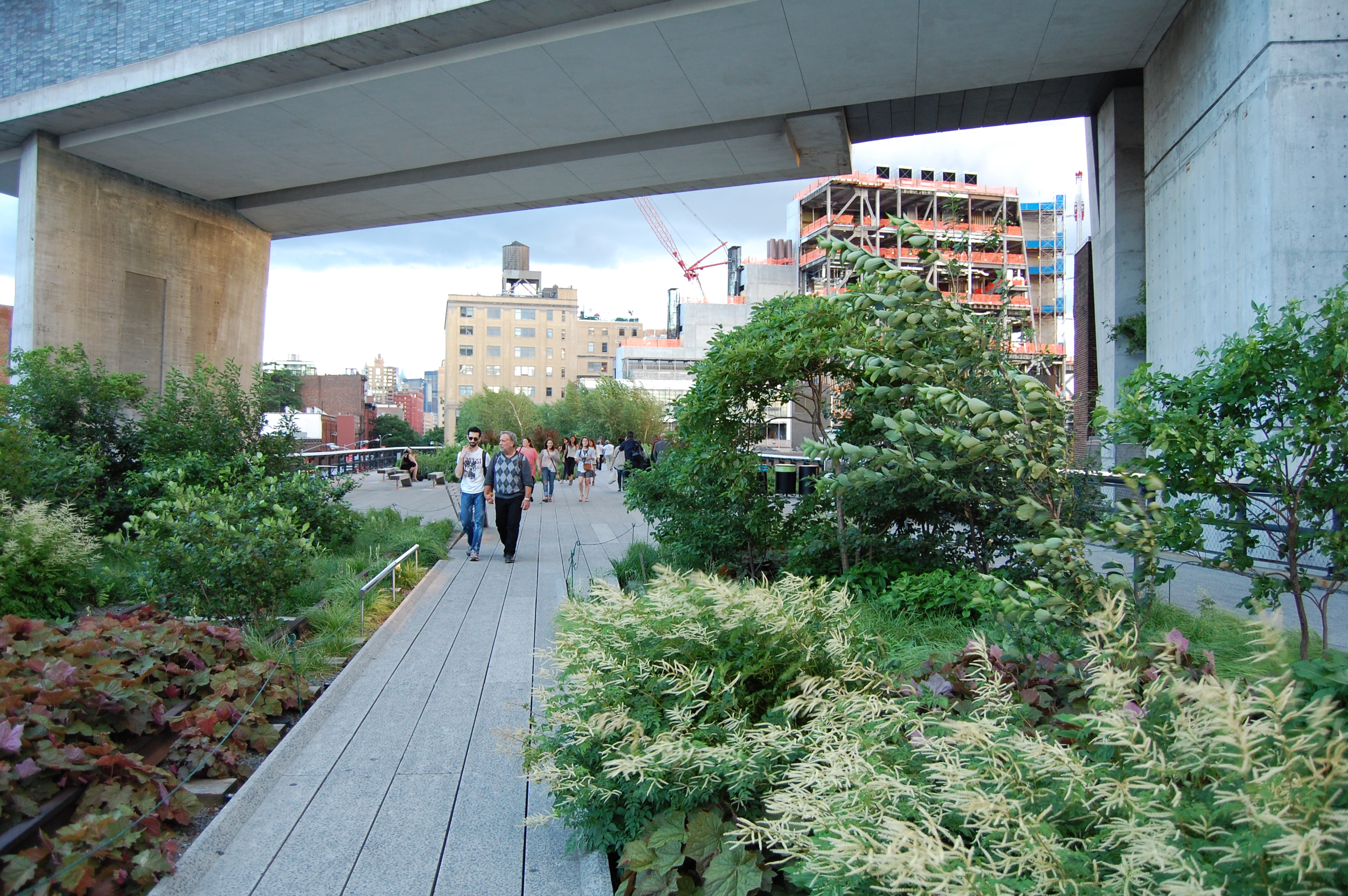
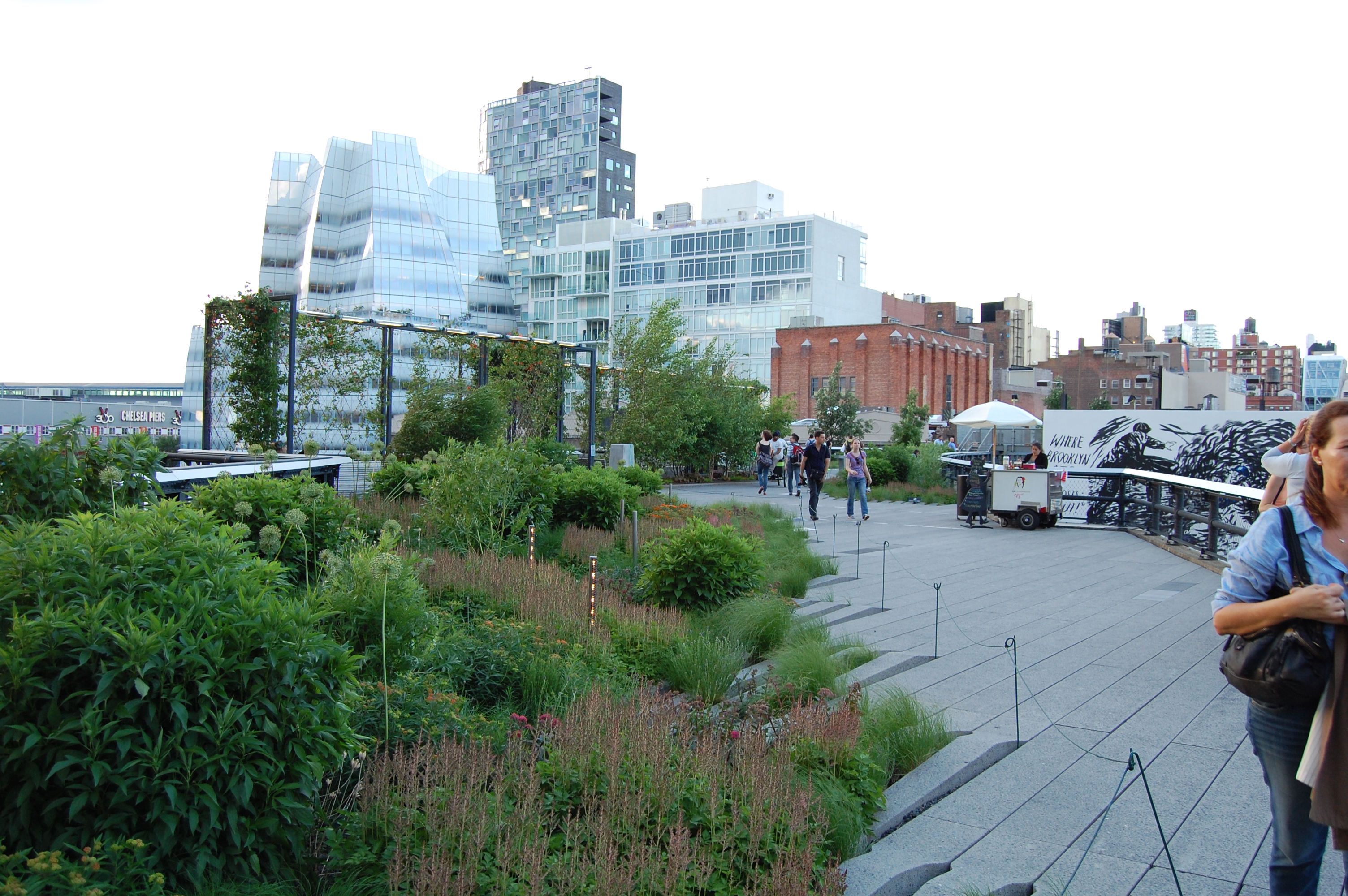
Judy was in New York a couple of weeks ago for work, and being an excellent and supportive spouse she took the opportunity to visit the High Line and take lots of photographs. The High Line is a public park that uses abandoned elevated train tracks as a platform.
New York’s High Line park.
The design was done by the landscape achitecture firms of James Corner Field Operations and Diller Scorfidio and Renfro.
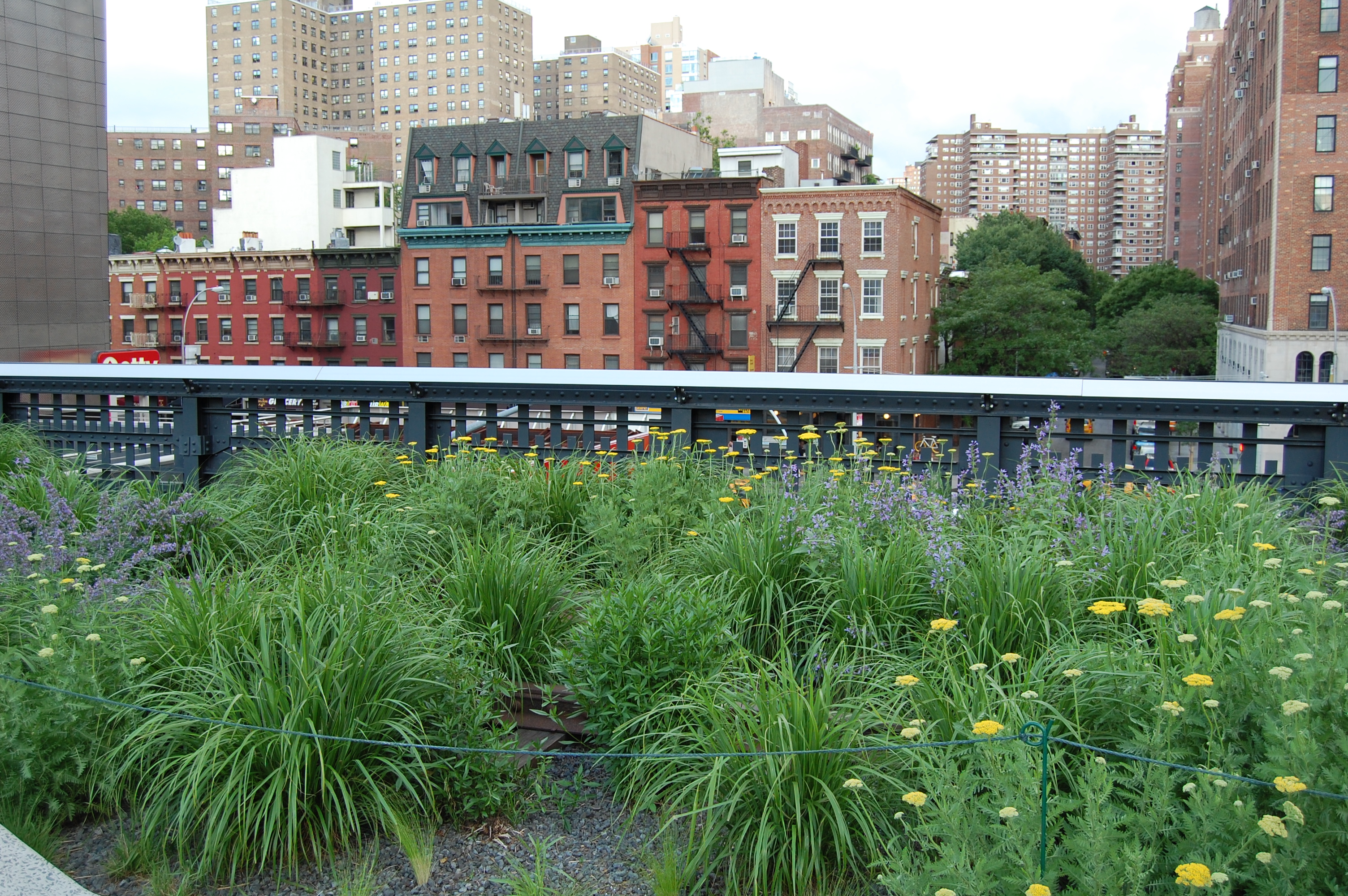
An elevated meadow in the city.
By the way, today is Judy’s birthday. Happy birthday, Judy! Sadly, we are not together as she is now in California for work. She does an ungodly amount of travel. However, we will be meeting out there next week and attending the Garden Blogger’s Fling together.
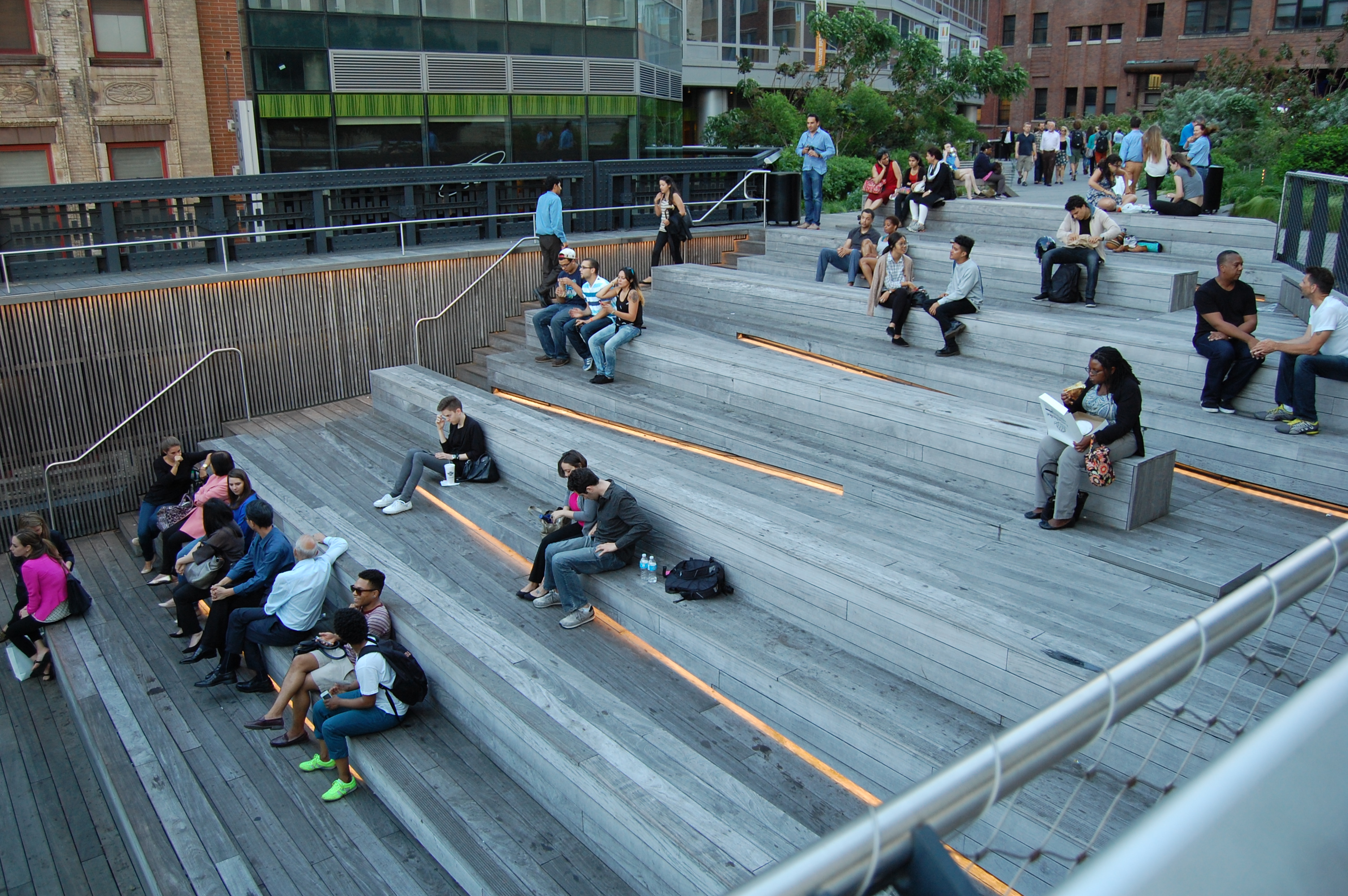
The High Line is a public space providing all kinds of opportunities for public use. There is space for just sitting, and maybe have lunch outside.
Lots of space for strolling, of course. Judy said the width of the park seemed to be about 10′ to 30′.
Couples can get to know each other better.
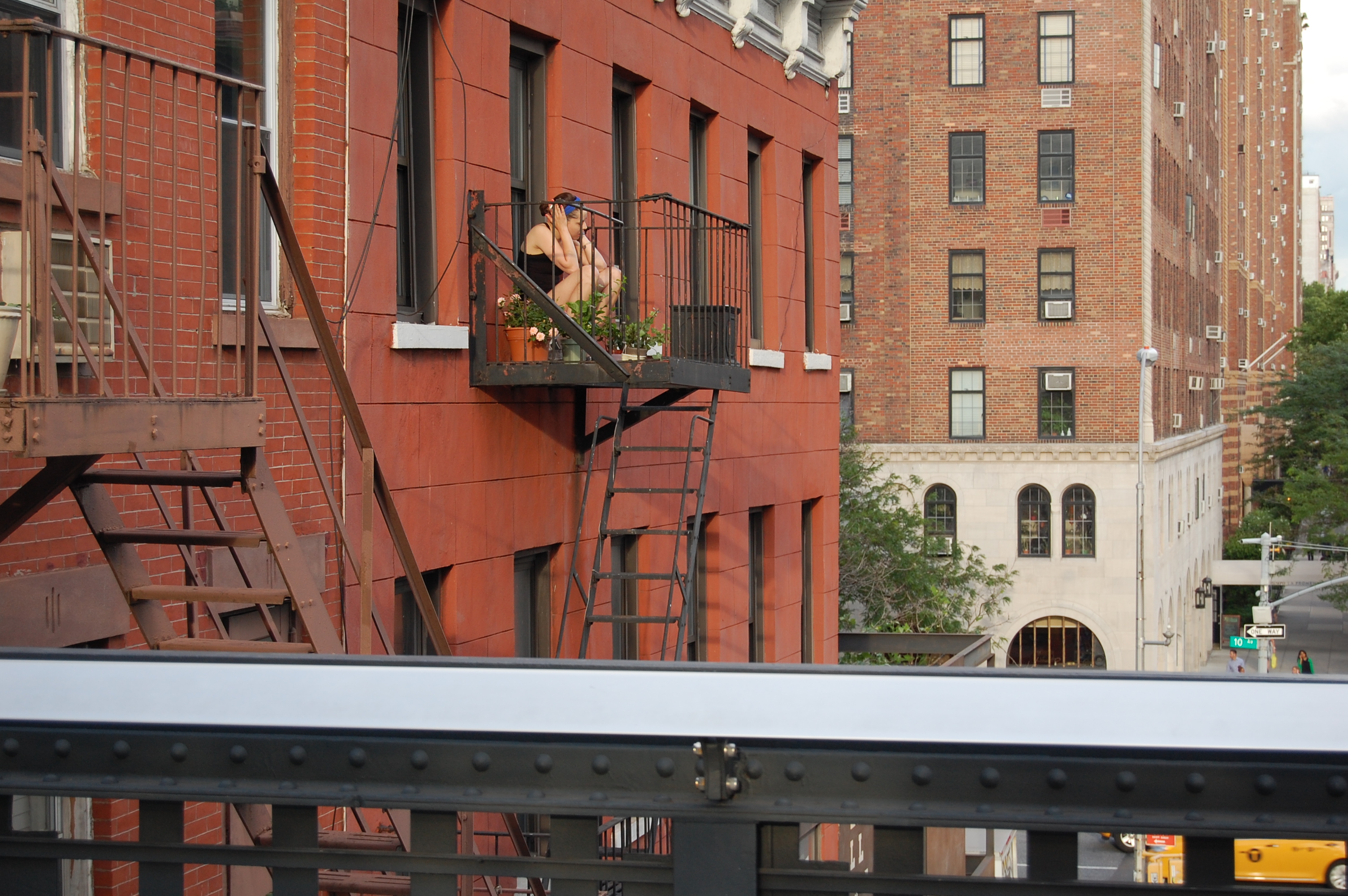
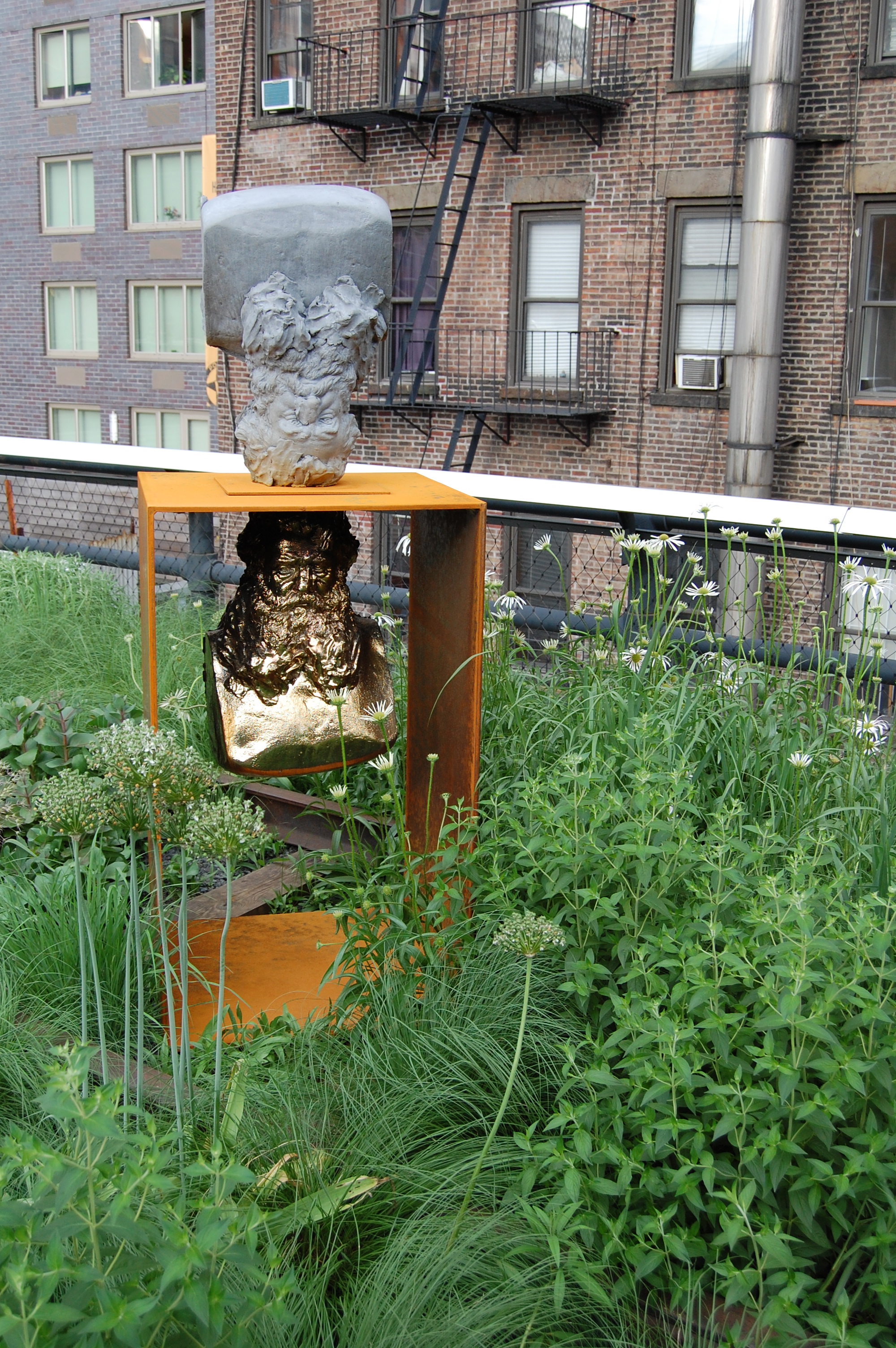
The High Line is similar to Chicago’s Lurie garden in that the views take in the strikingly urban and a kind of idealized natural beauty. The High Line is different, though, in that the city and the garden are on much more intimate terms. This girl on a balcony is just a few feet from the High Line.
When I first heard about the High Line I thought it would be a sort of massive green roof, but that is not really the case. Yes, there are low-growing drought tolerant plants, but there are also deep-rooted prairie plants, shrubs, and trees.
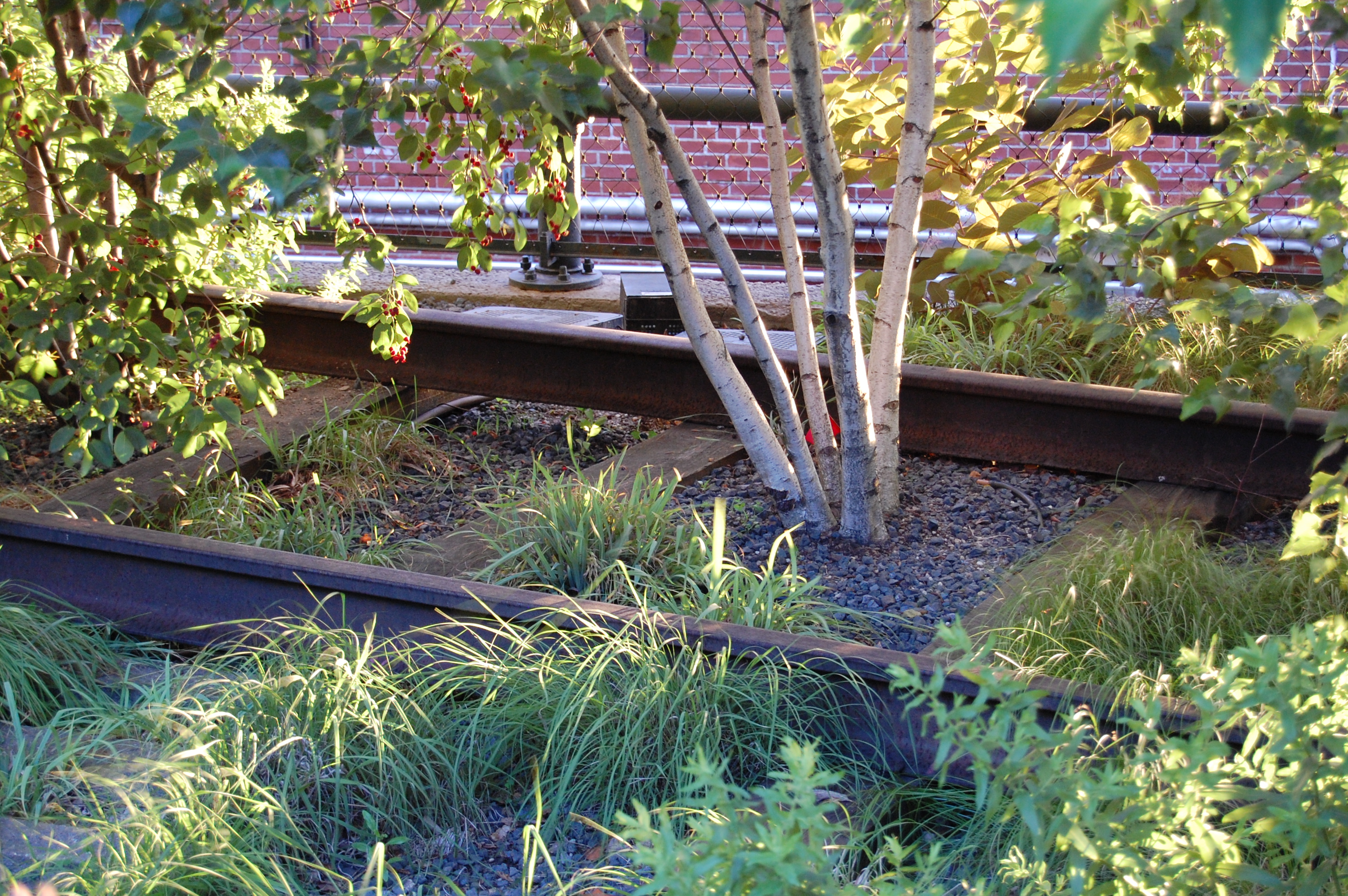
Looks like a Himalayan Birch, maybe? Notice it is growing up out of the train tracks.
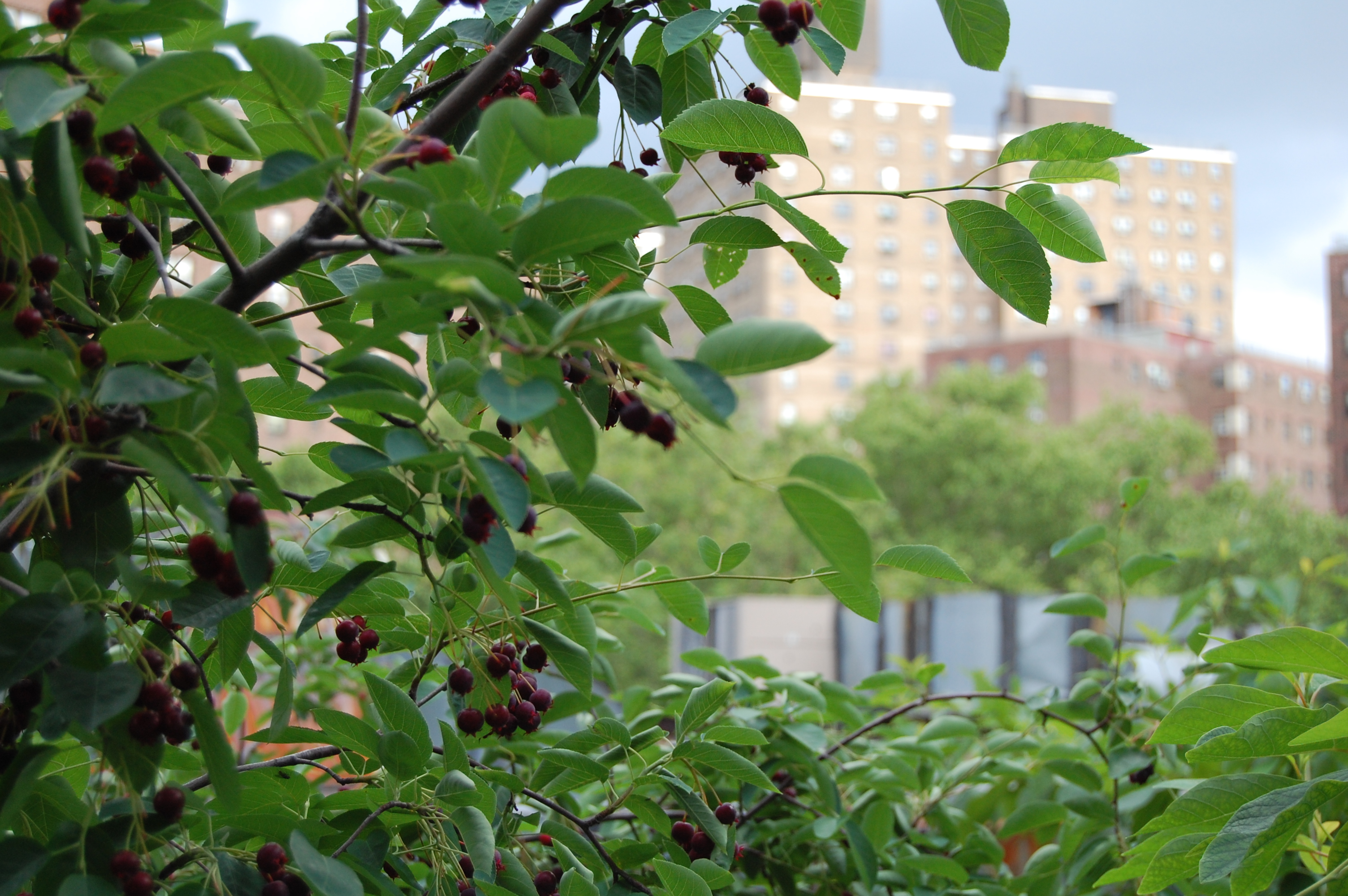
Serviceberries ripening in the city air.
Yarrow and Salvia growing among the grasses.
White False Indigo and Prairie Dock that hasn’t sent up any stalks yet. Not sure what that orange flower is.
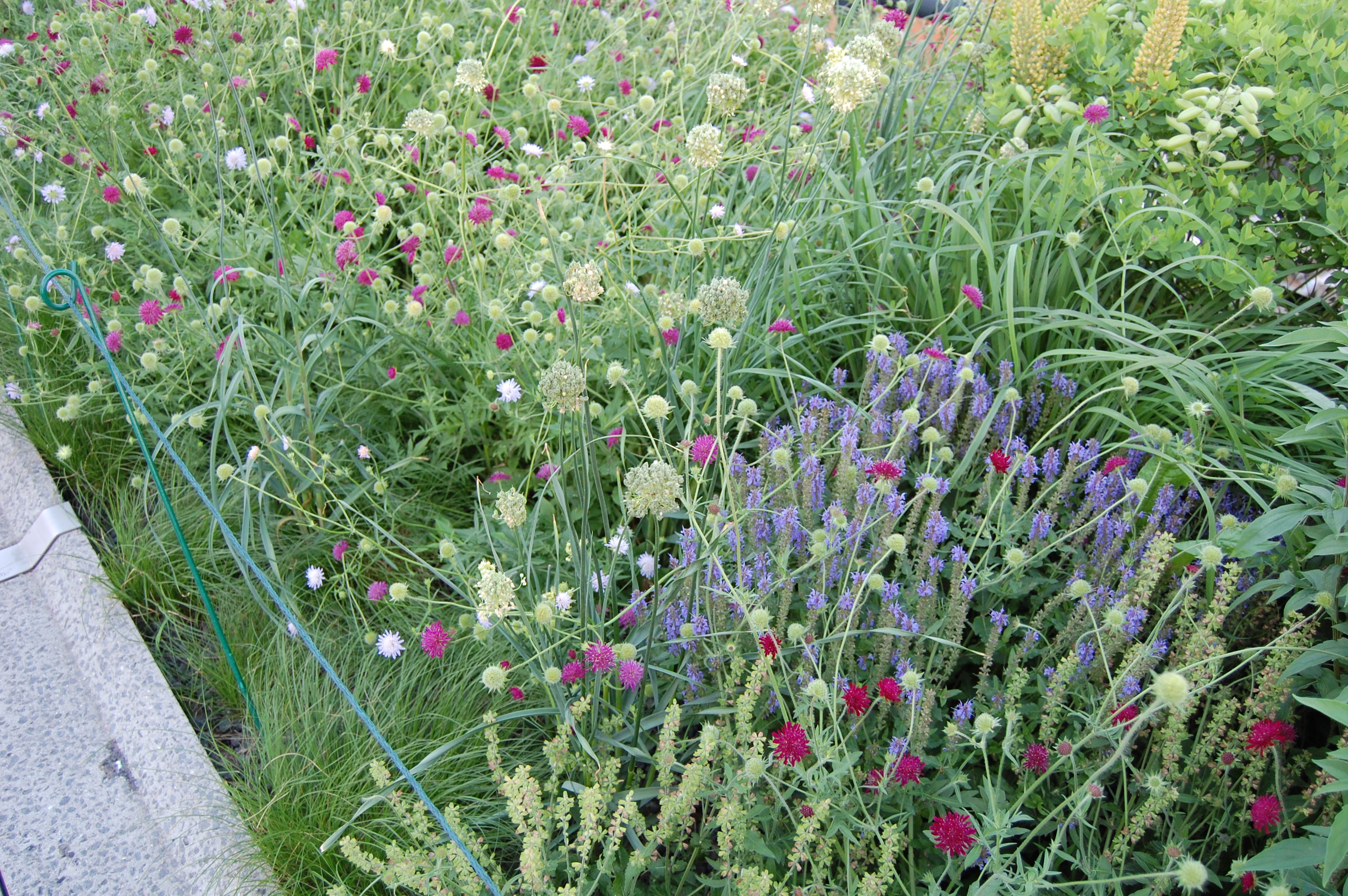
Knautia, Salvia, and grasses.
Purple Coneflowers.
Heuchera on one side, and Goatsbeard on the other.
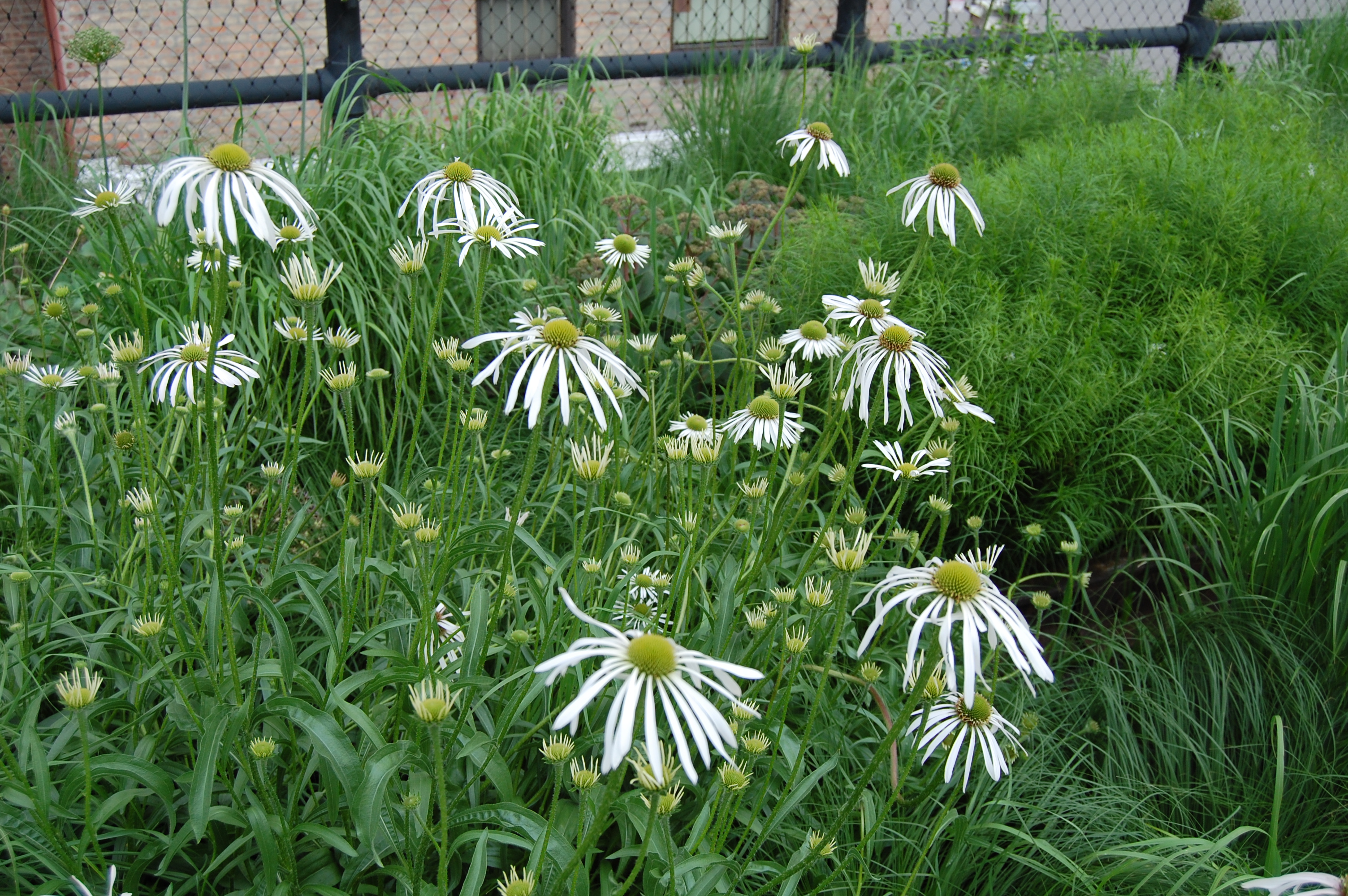
What looks like a white cultivar of Pale Purple Coneflower.
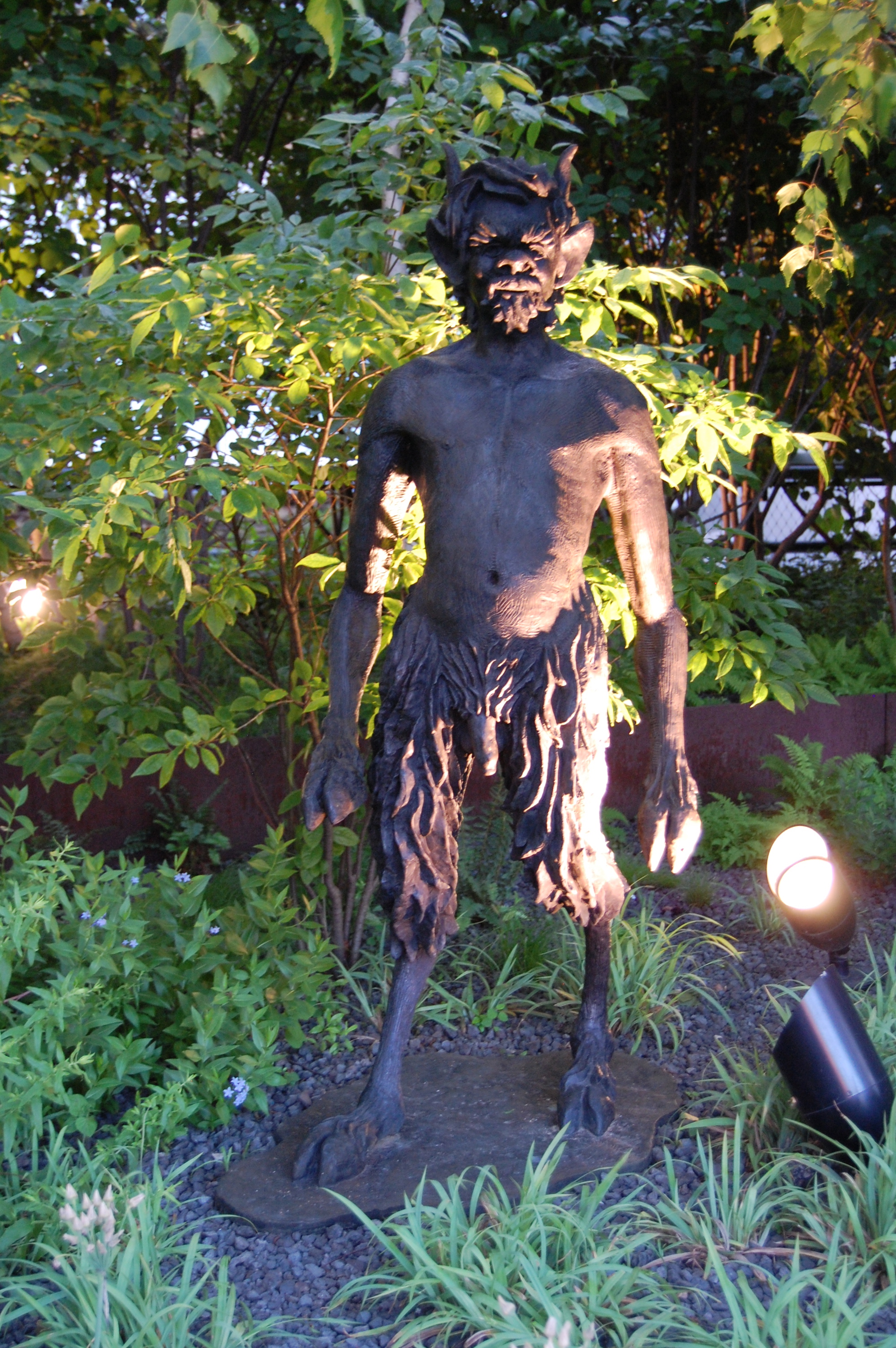
Oh, I can’t forget the garden art.
Now, you would never find this statue in a Chicago park. Jeez, put some pants on.
Oh, and it wouldn’t be New York without a hot dog cart.
Would you like to see this kind of public garden in your town?
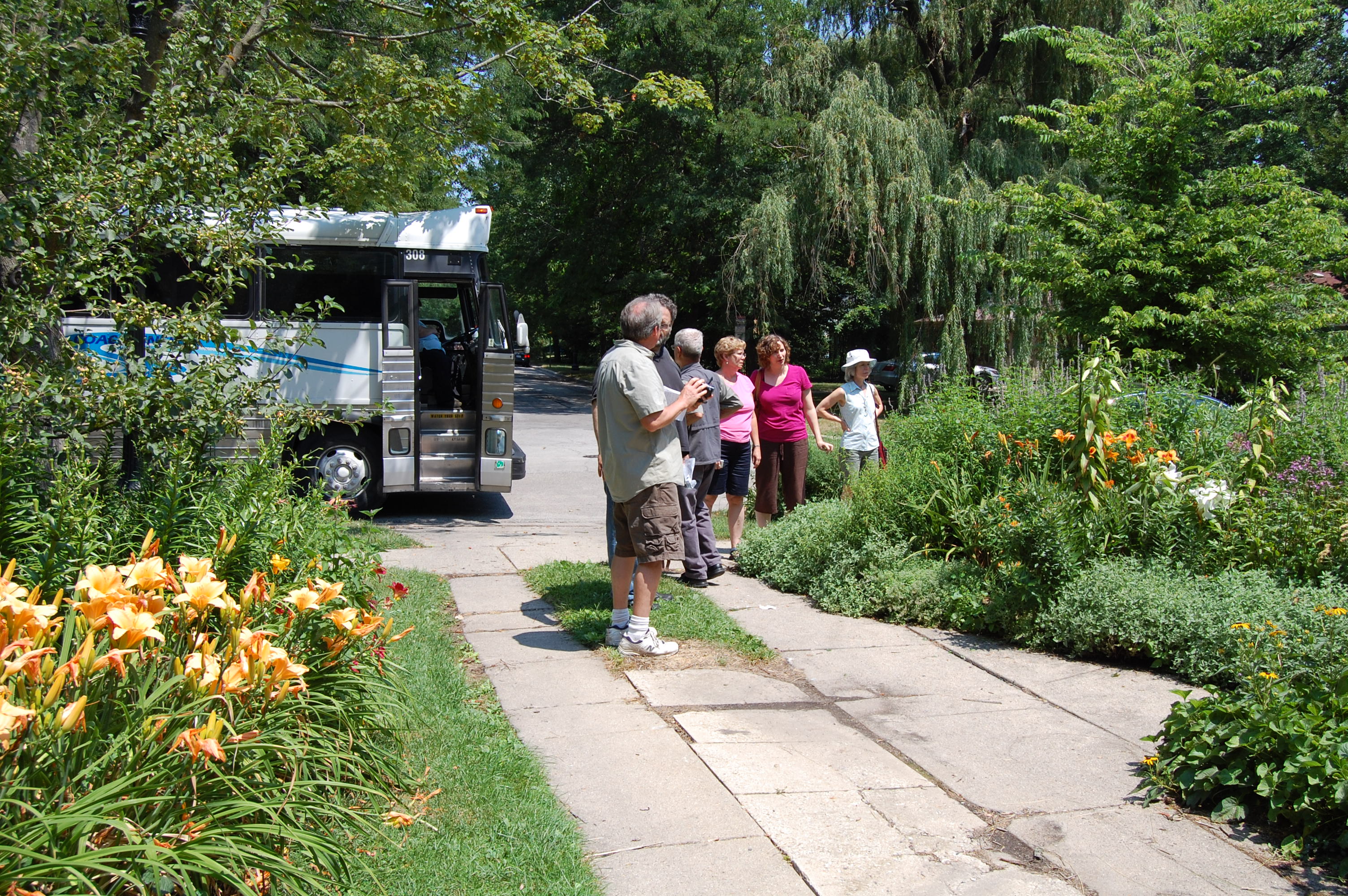
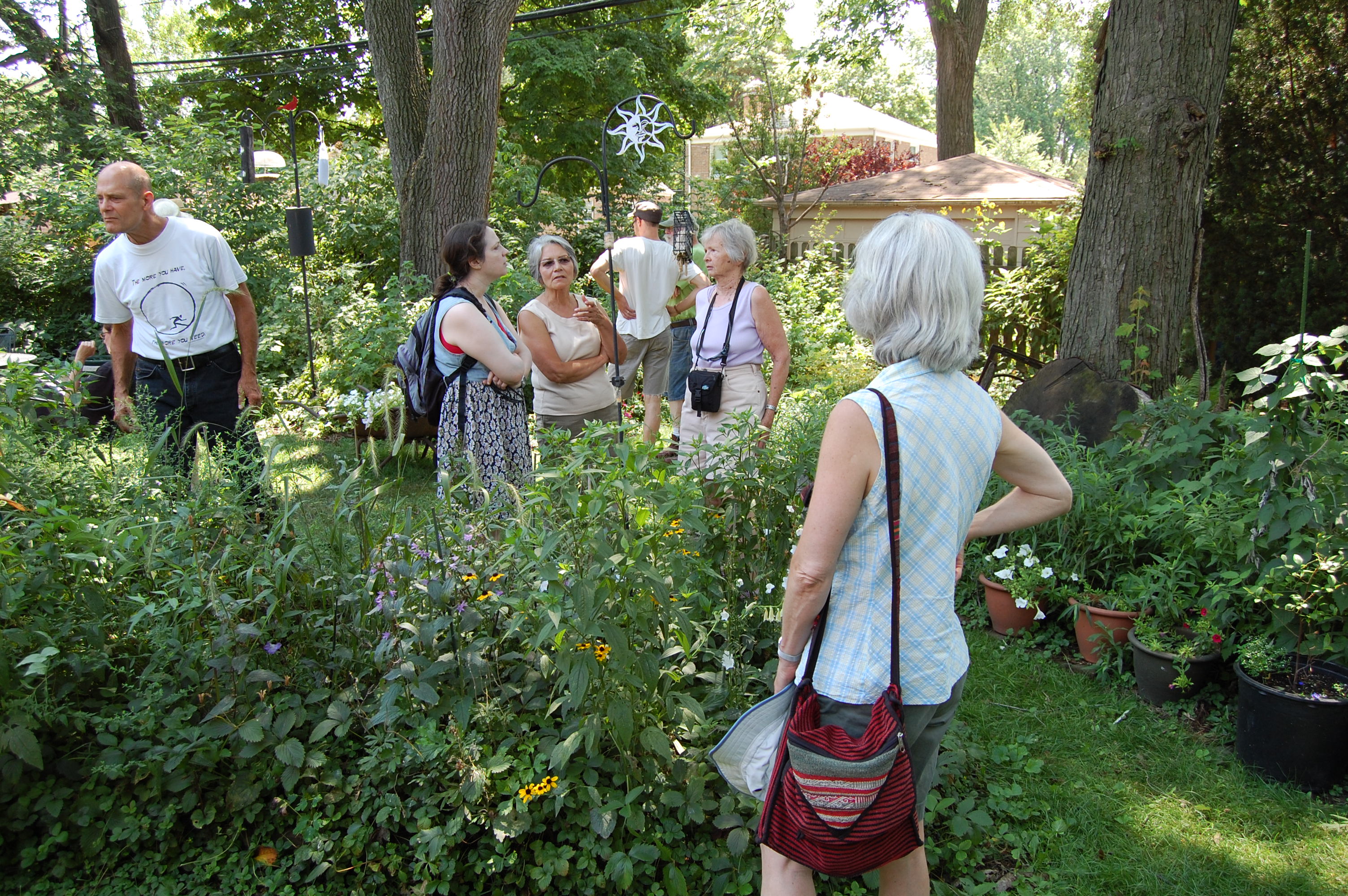
Our garden was on a garden tour in 2012 and a couple of years before that. The tour was sponsored by a local chapter of a group called, without irony, The Wild Ones, promoters of native plants in home landscapes. Unfortunately, it looks like that tour isn’t happening this year.
The Wild Ones garden tour arrives at the Garden In A City, July 14, 2012
That’s too bad, because it was fun. Also, I’ll admit, it provided a certain amount of ego gratification. I’ve made inquiries about being included in the Evanston Garden Walk, but never heard back. That’s just as well, since I don’t think my garden is quite what they are looking for.
2012 Wild Ones garden tour in our garden.
My little bits of lawn, for example, are a mess. They are an amalgam of white clover, violets, creeping charlie, plantain, and bits of actual grass here and there. (Actually, I don’t mind the clover or violets.) It’s not that I wouldn’t like a nicer lawn, it’s just that lawn is a very low priority. I have my hands full with the beds and borders.
And there are corners here and there that are kind of rough.
Even so, there are a lot of people who have expressed an interest in our garden, what we have planted, and how we keep it more or less under control. I thought it would be fun to have a day when the garden would be thrown open to neighbors, readers of this blog, or anybody else who feels like coming over and poking around.
I’ll have a handout available with a plant list, and maybe some related information. There’ll be iced tea and lemonade.
The details:
The date is Sunday, July 28. Time will be Noon am to 5 pm. The location is 2000 Cleveland Street, Evanston. And, of course, the event is free.
Have you ever taken part in a garden walk or garden day? Have any suggestions or words of wisdom for me, things I may not have thought of? I ask this because as far as I can tell, what I’m planning seems pretty simple. Any time something seems simple, that usually means there is something pretty major that has not been thought of.
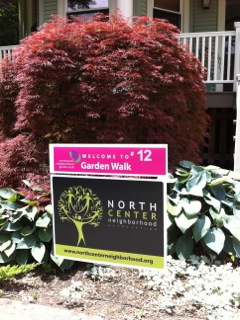
And speaking of garden walks, I am told that the North Center Neighborhood Garden Walk will be this Sunday, June 23rd. It’s a self-guided tour of 50+ home gardens in this community west of Wrigley Field. The tour starts at Bell School, 3730 N. Oakley, where you can pick up your map. Suggested donation is $5, seniors are free.
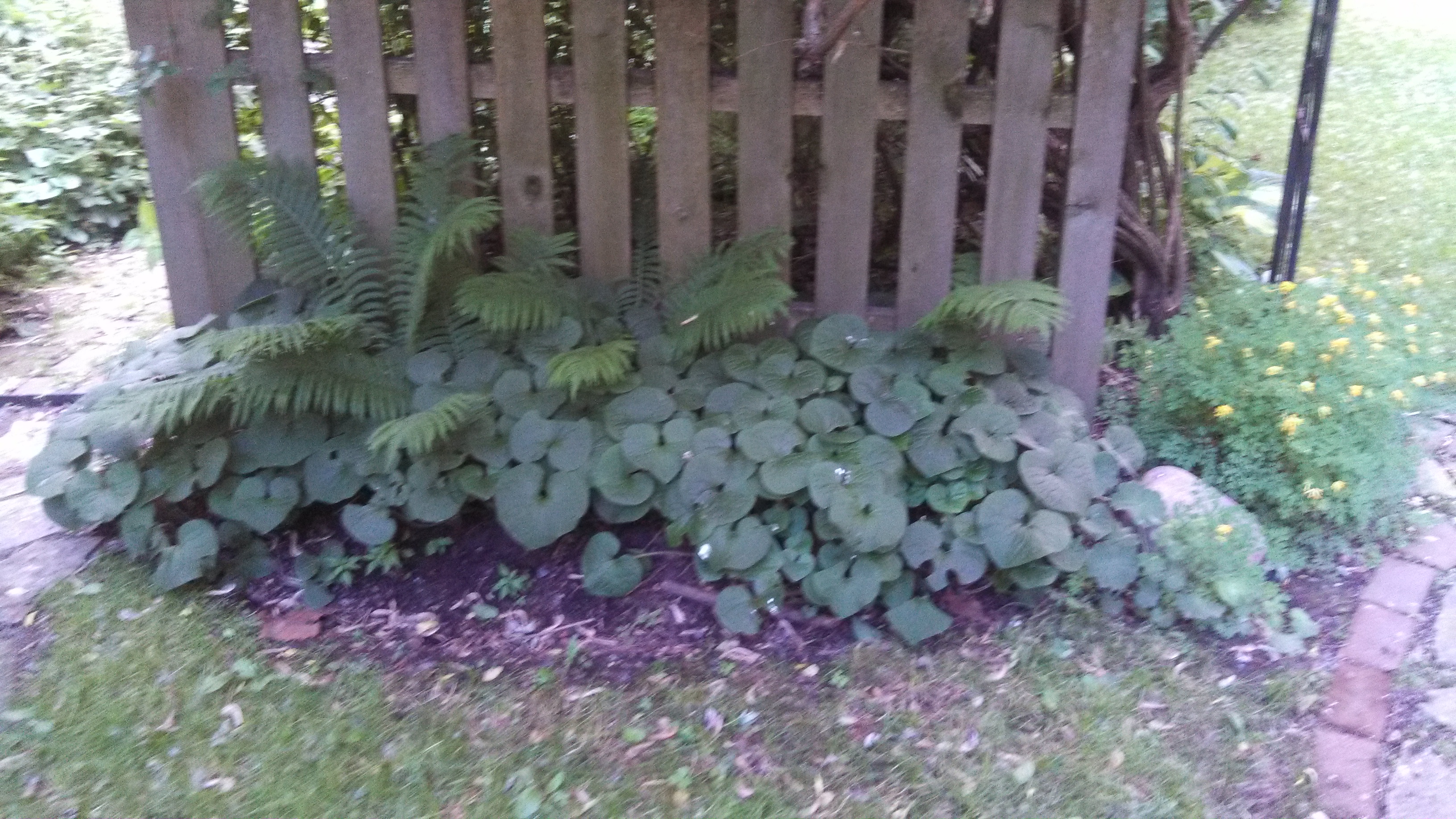
This has been a good year for ferns and other foliage plants, cool with lots of moisture. Along the shady west side of the house, Lady Ferns (Athyrium felix-femina) and Wild Ginger (Asarum canadensis) are looking happy.
Lady Ferns with Wild Ginger.
Here’s some more Wild Ginger with an unknown fern.
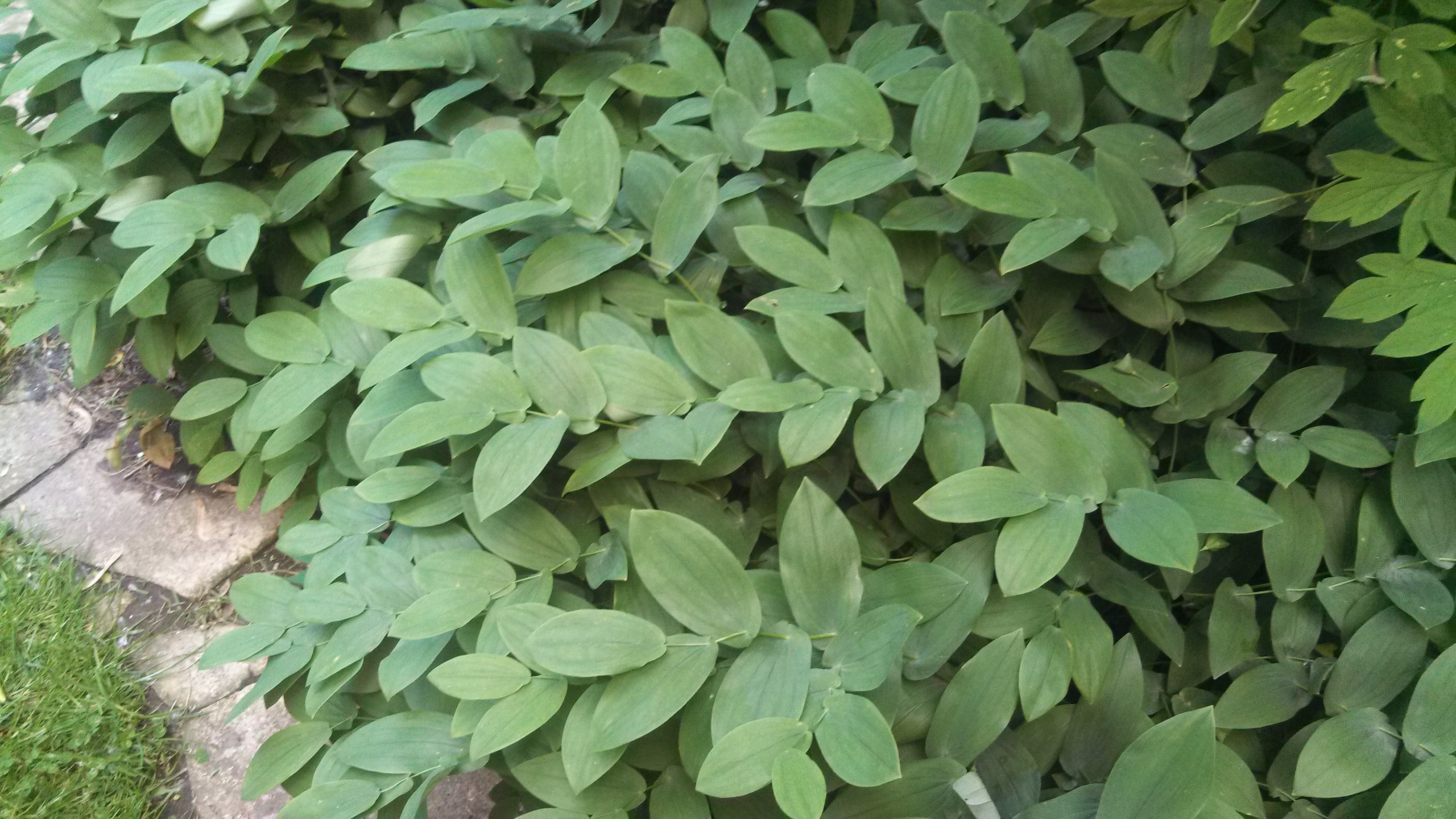
Merrybells (Uvularia grandiflora) makes a nice groundcover after blooming if it is in a moist, shady spot.
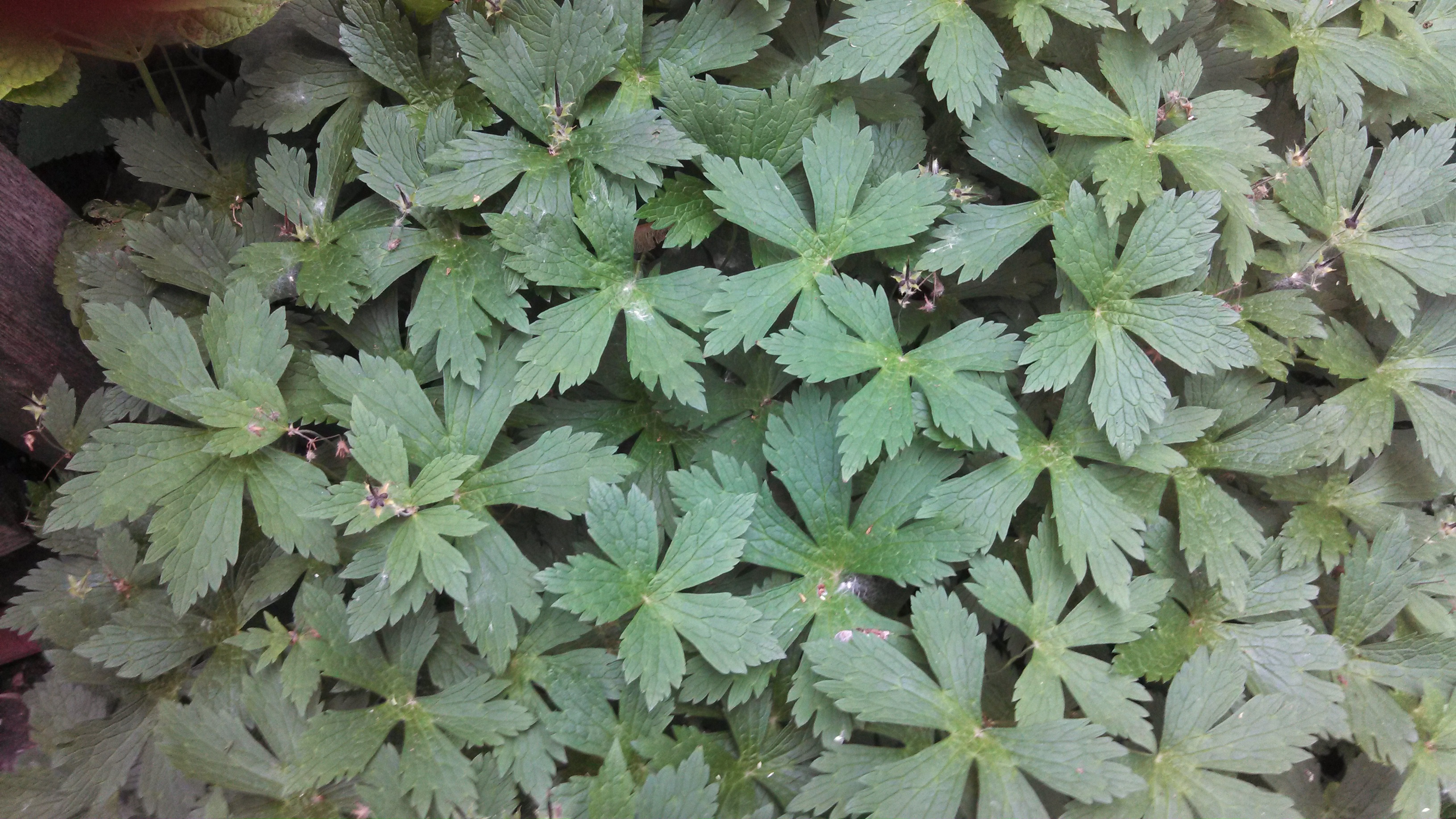
And Wild Geranium (Geranium maculatum) is the first of the Geraniums to stop blooming, but I like the foliage.
Palm Sedge (Carex muskingumensis) grows quite vigorously in my garden. I like the texture. The seed heads are not yet ripe here.
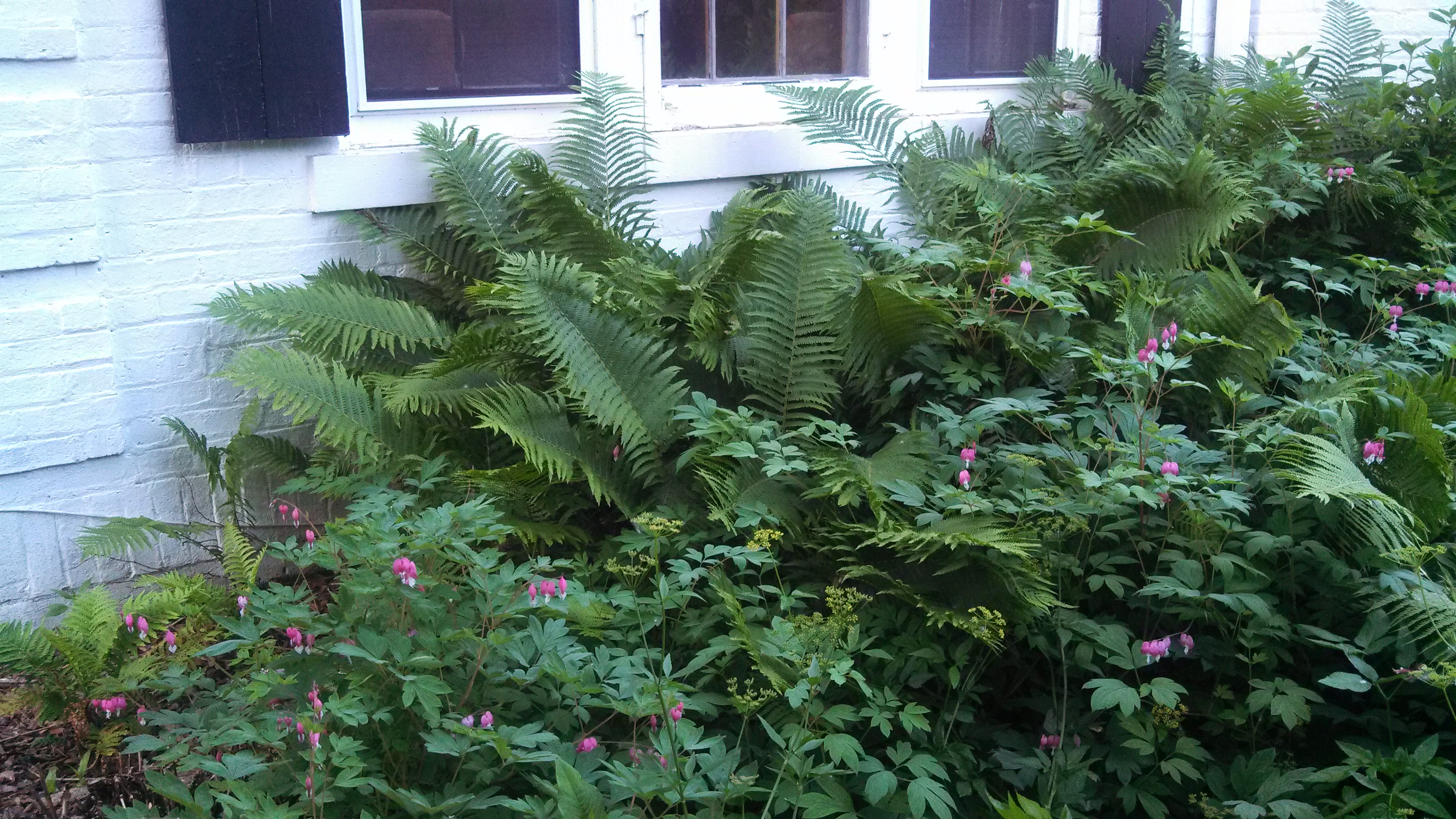
And the Ostrich Ferns (Matteuccia struthiopteris), of course, in the front foundation planting. The foliage of the Bleeding Heart is still looking nice, and still displays a flower here and there.
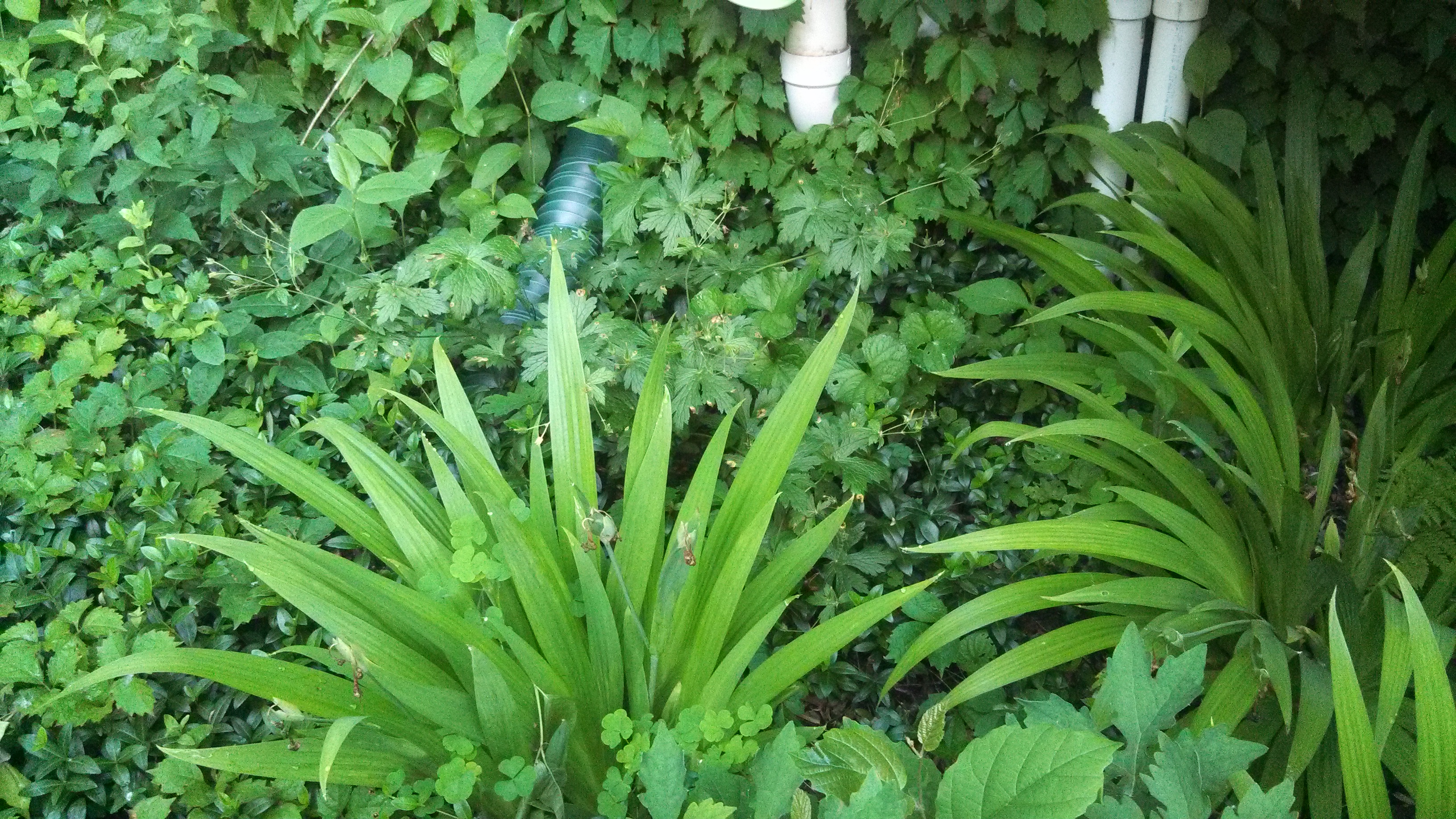
The Roof Iris (Iris tectorum) are done blooming, but the sword-like foliage is nice, and I think will be nicer as it fills in.
Oh, I should say that these are all pictures taken with my cell phone. Foliage Follow-Up is hosted by Pam at Digging. Thanks Pam!
I’m late with this post for some very legitimate reasons. It rained most of the day yesterday so photography was not an option. When it finally cleared, we were due to leave for Judy’s brother’s house for what turned out to be a wonderful dinner. Judy did take a few rushed shots but we didn’t get home until late. Plus the dog ate my homework.
Penstemon ‘Husker’s Red’
The temperatures are finally getting to the point where there is a hint of summer in the air. Plants are growing lushly with all the rain, but blooms are coming late, especially compared to last year. On the other hand, they are lasting longer as well.
The roses have begun to bloom, though they are nowhere near their peak. First, my favorite, ‘Sally Holmes’.
Rosa ‘Sally Holmes’
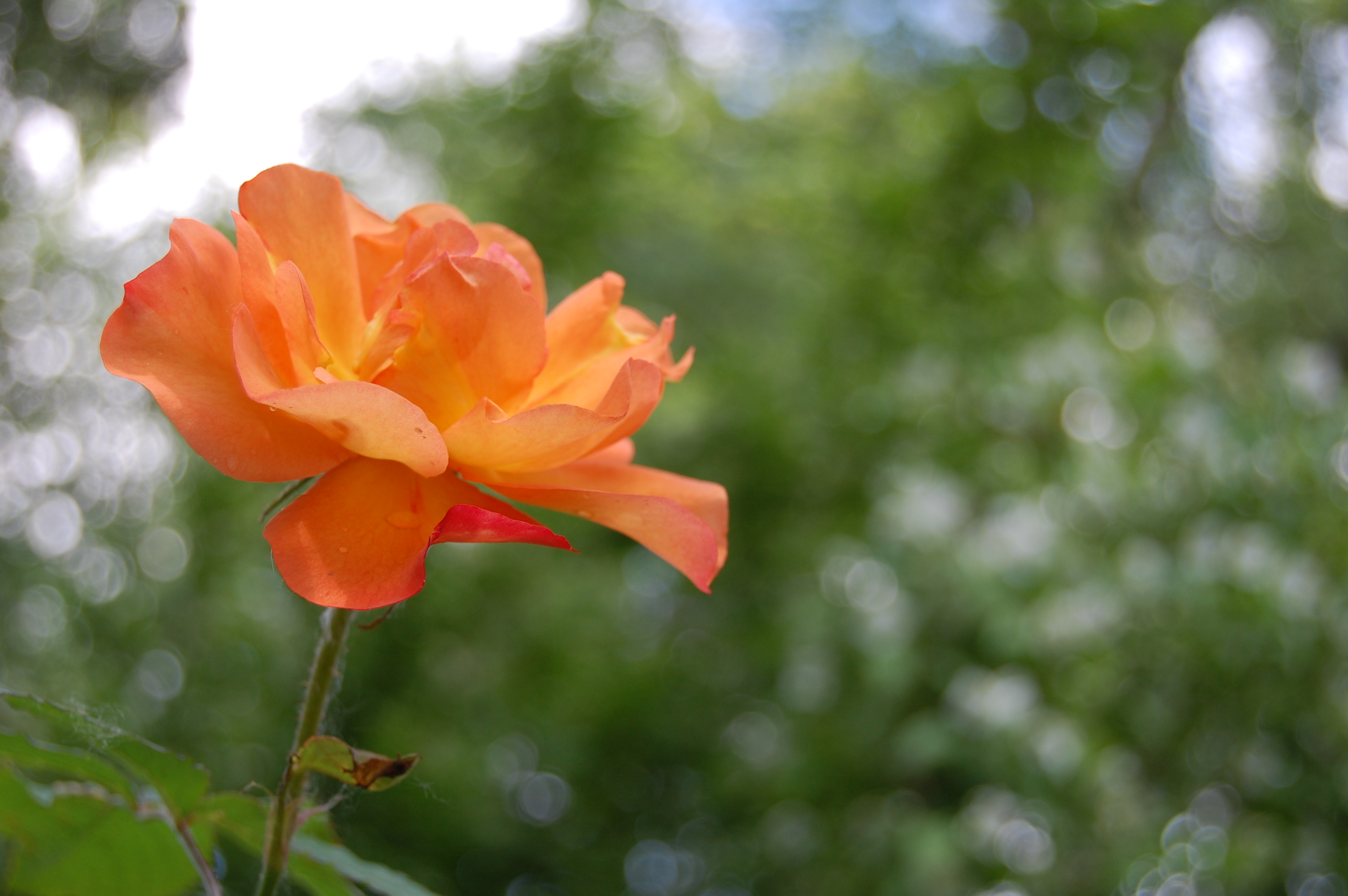
Also, ‘Westerland’ had its first blossom, though its looking a bit sickly I think. (Not in the photograph, but some of the foliage doesn’t look right.)
Rosa ‘Westerland’
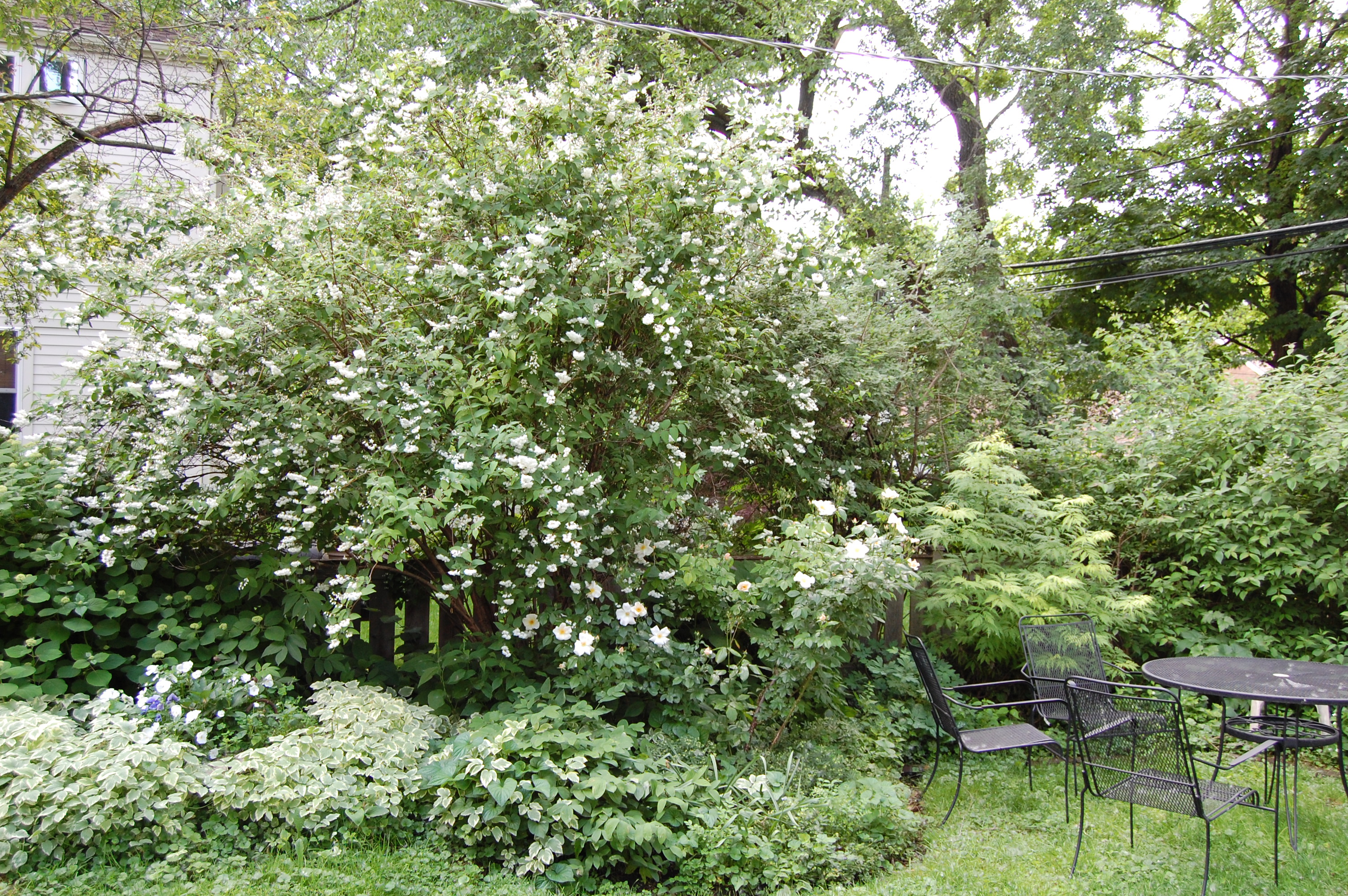
A big old Deutzia is blooming. This shrub was here when we moved in, variety unknown.
My big old Deutzia
There’s also a Weigela we inherited from the former owners, again variety unknown.
The Pansies and Johnny Jump Ups in containers are liking this cool spring. They are only now just barely showing signs of withering under the heat. I may replace them next weekend with summer shade annuals.
Pansies in the old wheelbarrow planter
The Trumpet Honeysuckle (Lonicera sempervirens) has been blooming like mad for weeks. I love this vine, not to be confused with the beautiful but evil invasive Japanese Honeysuckle (Lonicera japonica). I’ve planted another Trumpet Honeysuckle on a trillis by the back porch windows, by next year it should be drawing hummingbirds for easy viewing.
Trumpet Honeysuckle
I have lots of Grey Dogwood (Cornus racemosa), a shrub dogwood great for wildlife. The earlier cultivars have begun blooming.
Grey Dogwood
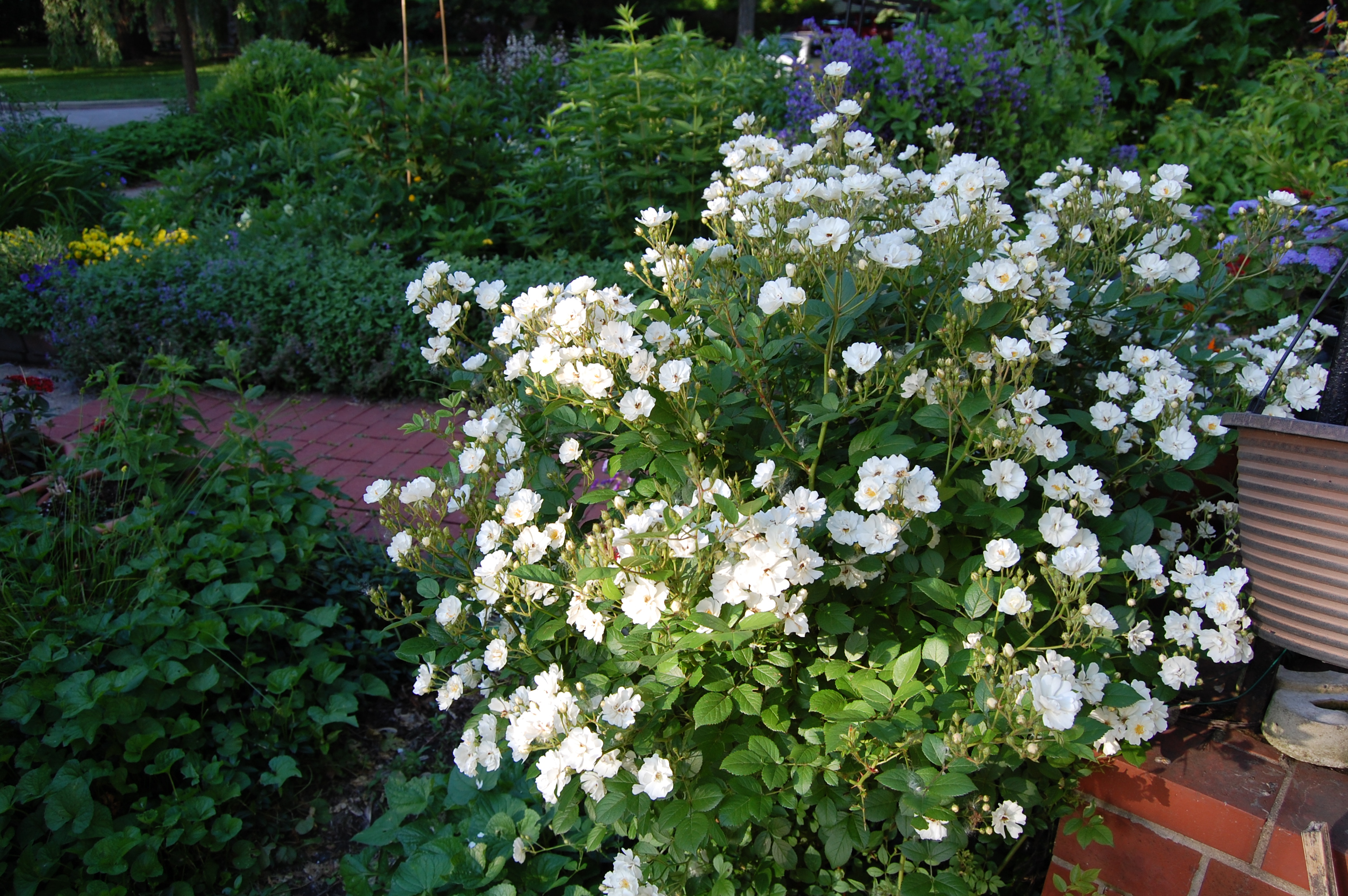
Sweet, sweet ‘Cassie’ is blooming her heart out with those adorable little white flowers. Only thing that bothers me is: why did I plant a white rose in front of a house painted white? Too late now, though, I like ‘Cassie’ too much to risk moving her.
Rosa ‘Cassie’
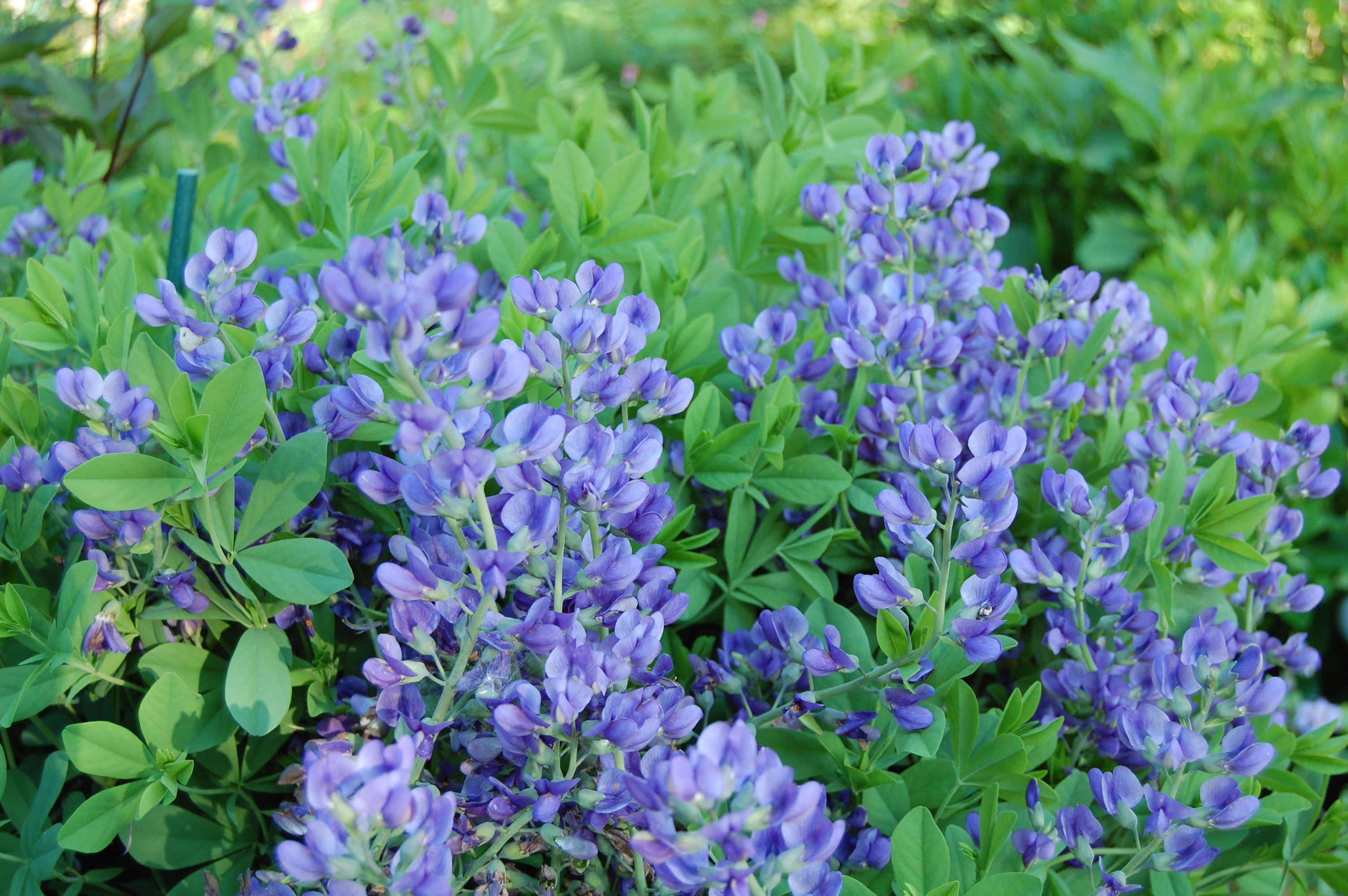
The Blue False Indigo (Baptisia australis) is just past its prime. This is a wonderful plant, with flowers reminiscent of sweet peas, though sadly not fragrant.
Blue False Indigo
Geranium ‘Johnson’s Blue’ still going strong.
Geranium ‘Johnson’s Blue’
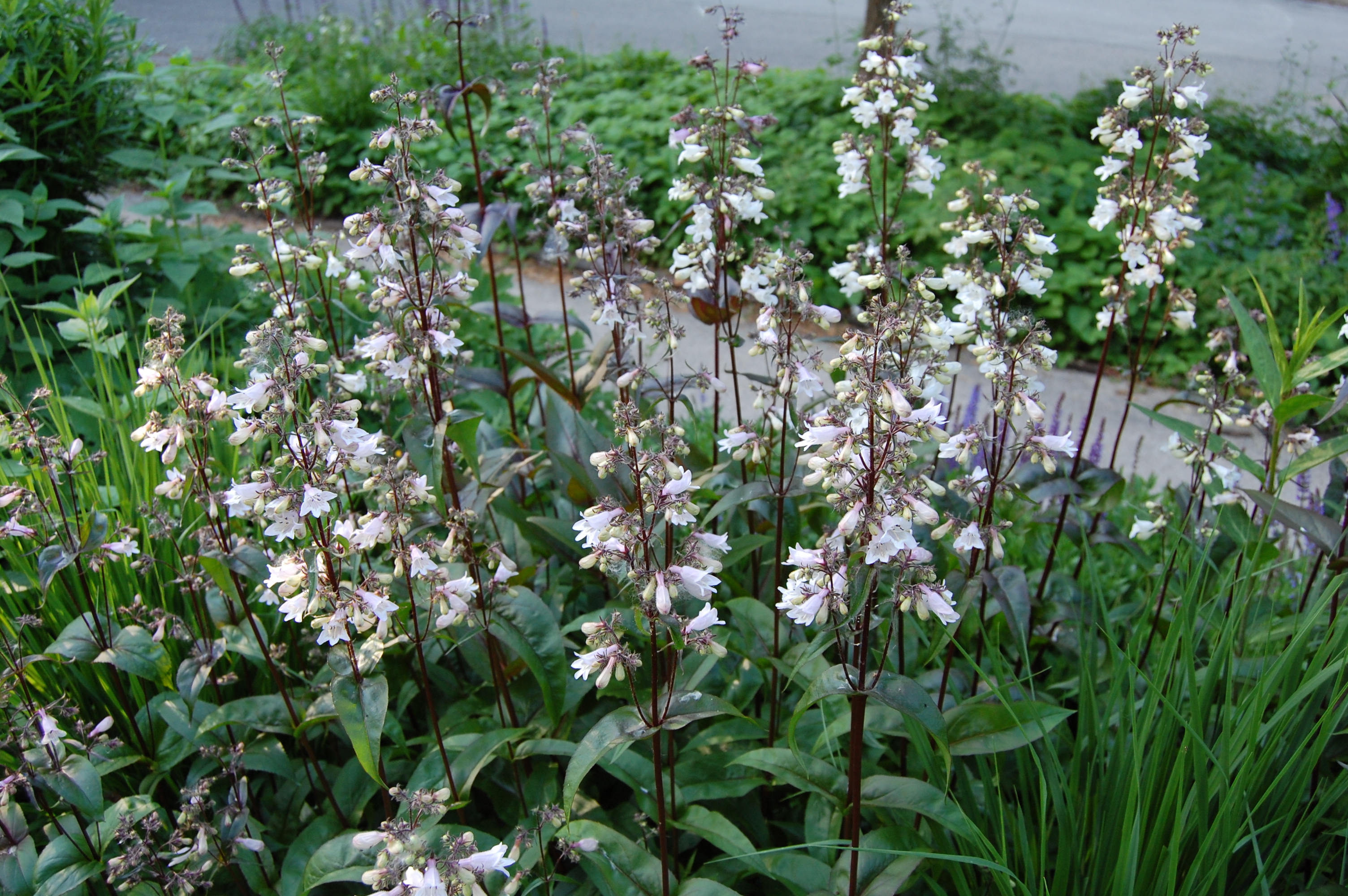
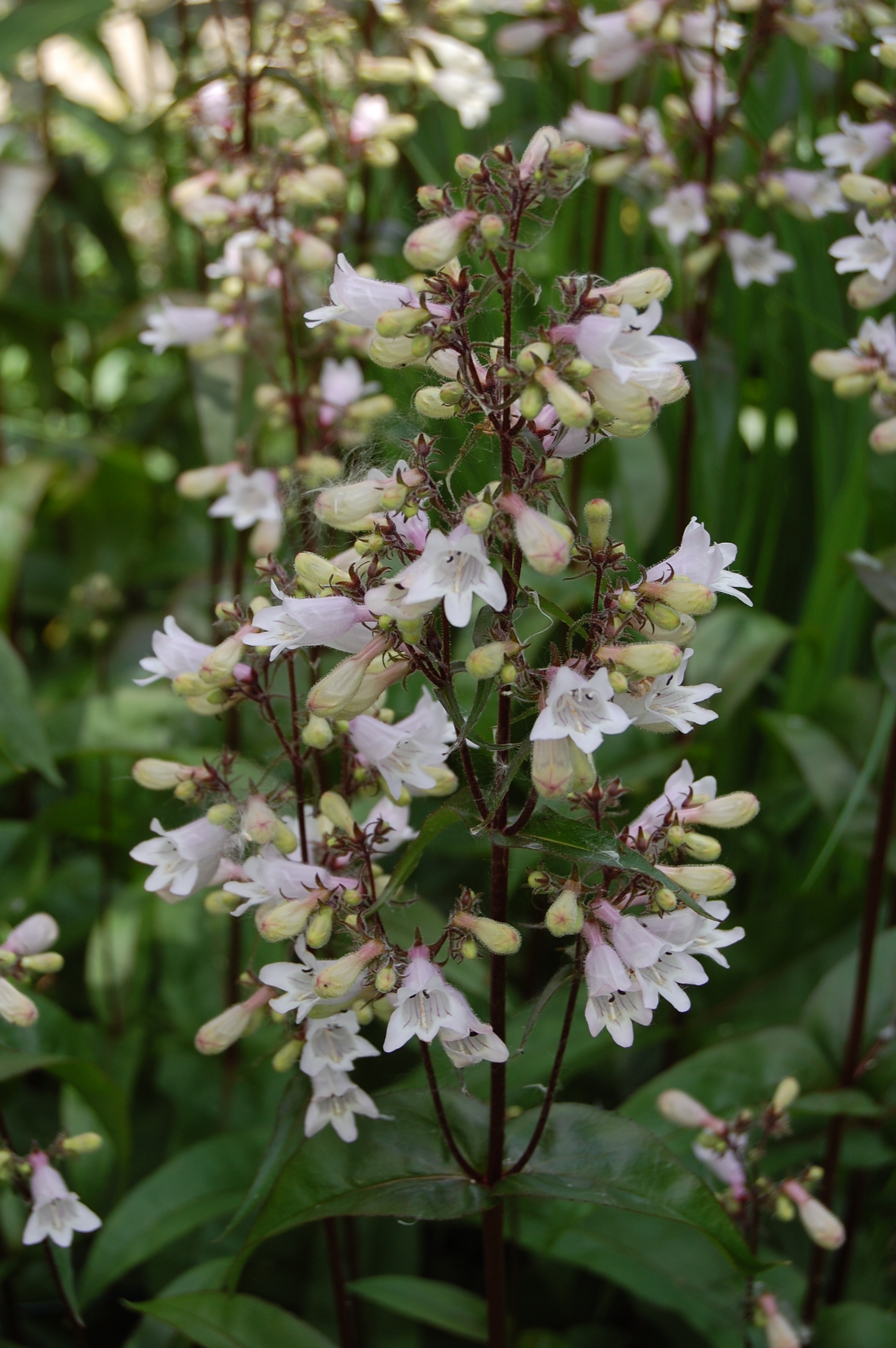
Smooth Penstemon (Penstemon digitalis) is looking really good this year. I have the straight species and the cultivar ‘Husker’s Red’.
Penstemon ‘Husker’s Red’
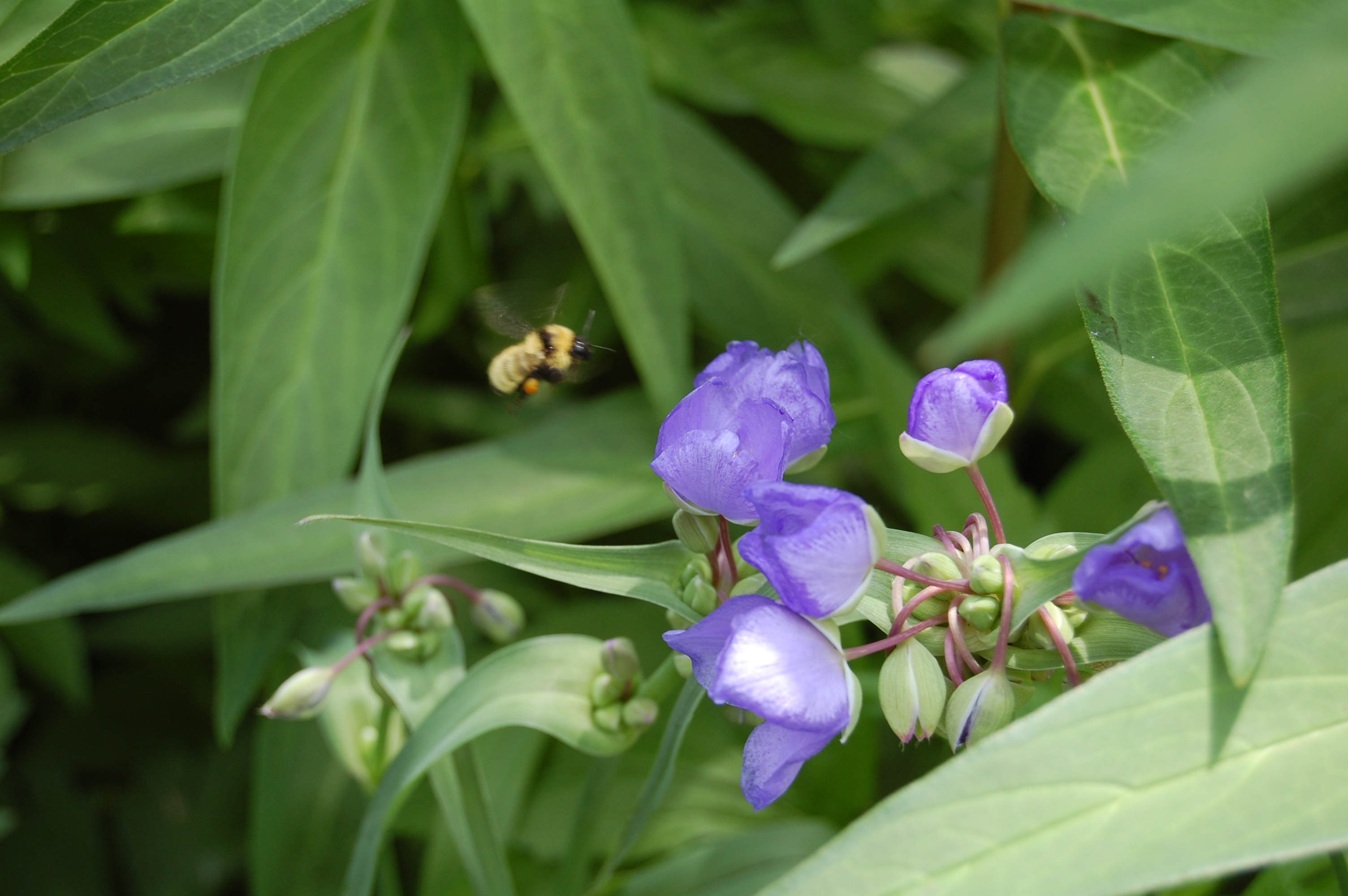
The Ohio Spiderwort is just starting to bloom. They’re looking very vigorous this year, not weedy at all, thank you very much. Too bad the flowers close up in the afternoon.
Ohio Spiderwort
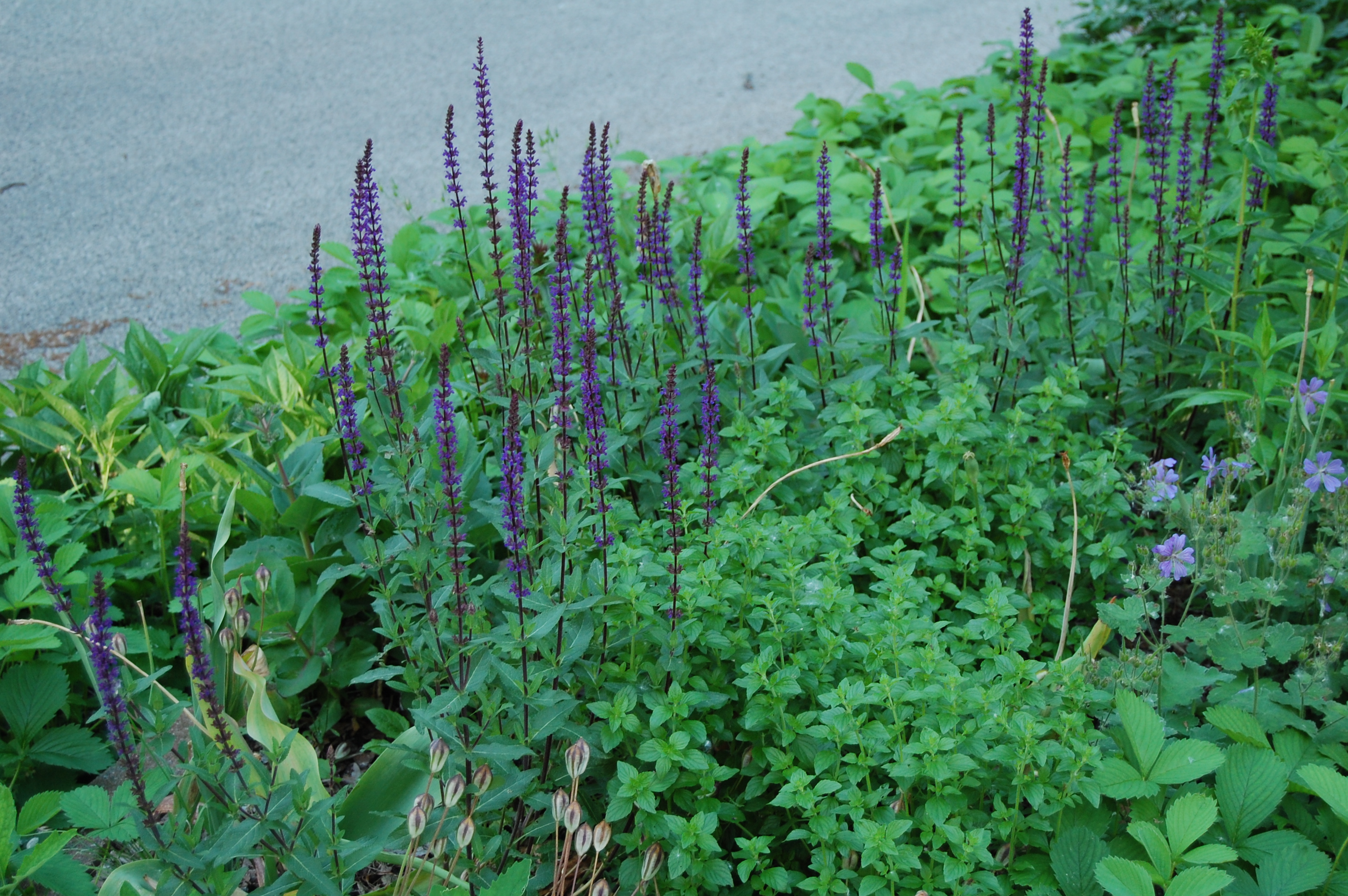
And the Salvia is coming into its own. Some are blooming later because I cut them back in May. I really like my new ‘Caradonna’, and it will only look better as it fills in. ‘May Night’ and ‘Blue Hill’ are just starting to show a little color.
Salvia ‘Caradonna’
Garden Blogger Bloom Day is sponsored by Carol at May Dreams Gardens. Pay a visit and see what’s blooming in other gardens.
There are many people who love peonies, and I respect their point of view. I am not one of them, however. Judy is, though, and that’s why we have peonies in the garden.
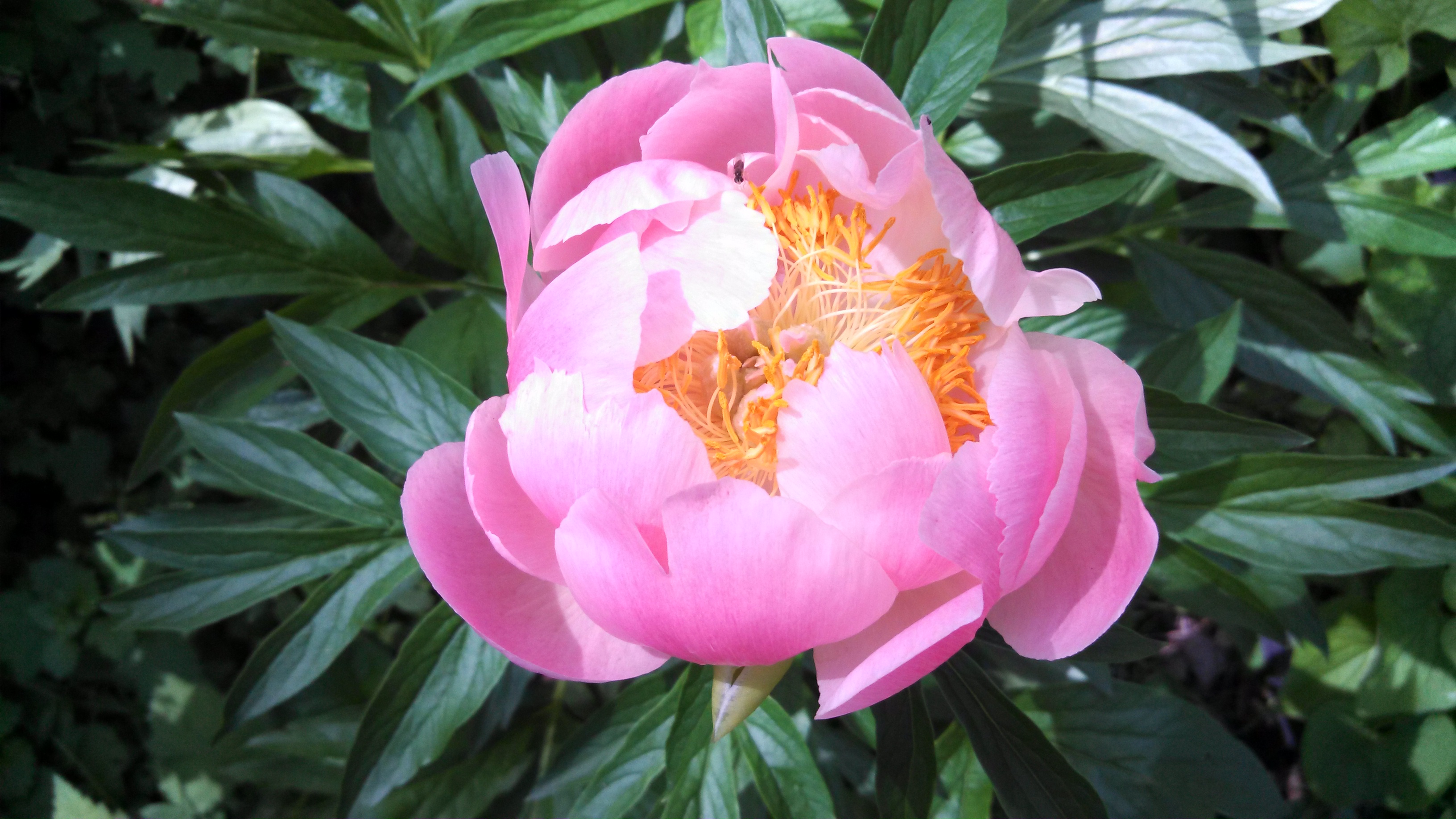
Peony ‘Abalone Pearl’
As it is, we have four, all from Klehm’s Song Sparrow Farm in Illinois. There are three hybrids: ‘America’, ‘Abalone Pearl’, and a third whose name I can’t remember. There is also the species Paeonia anomala.
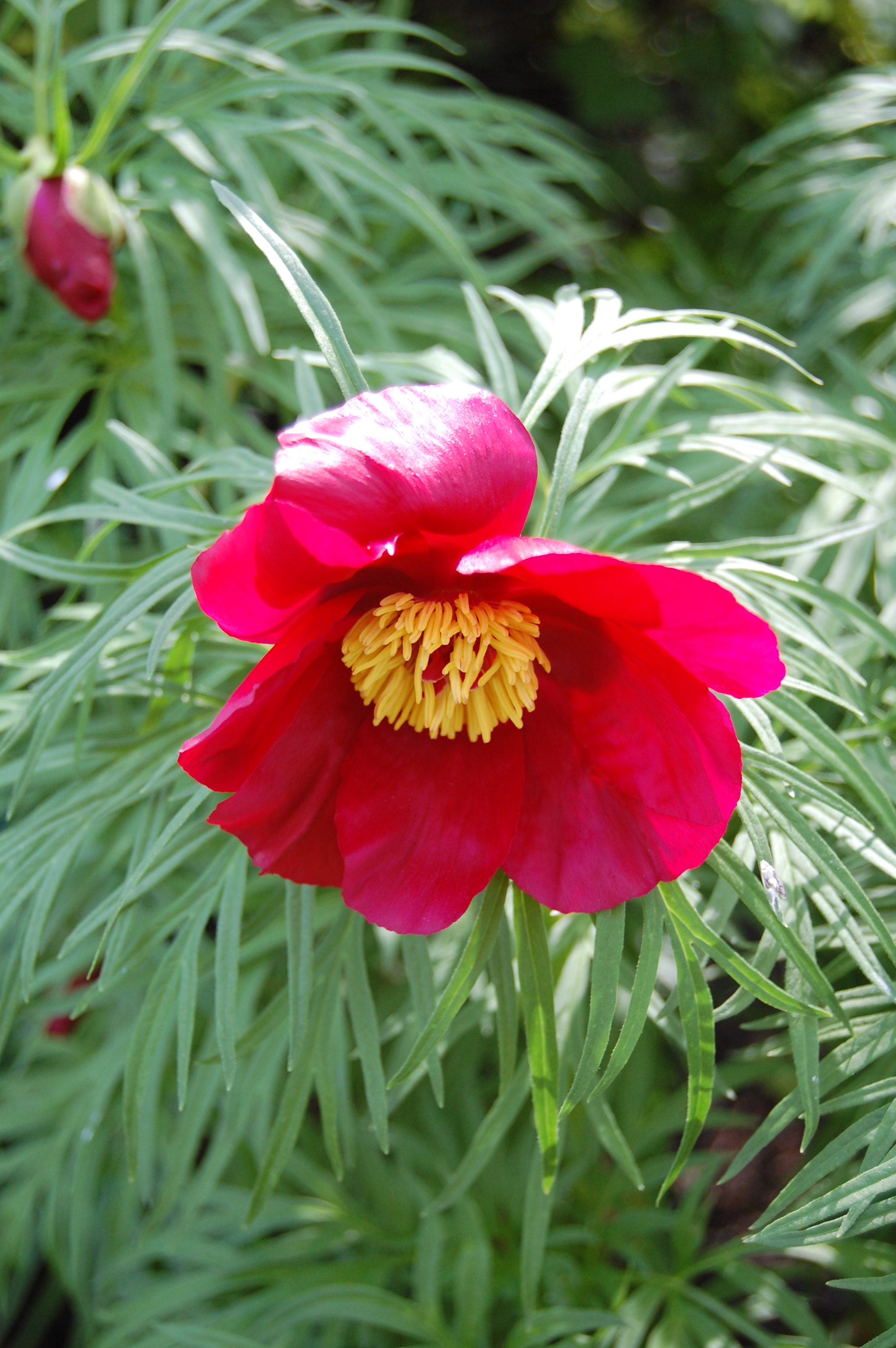
P. anomala
I don’t dislike peonies. I’m just not, well, all that impressed. Sure they can be beautiful for a brief period. But what about the other 51 weeks of the year?
Peony ‘America’
And don’t tell me that I can combine peonies that bloom at different times to have several weeks of color. My point is, each individual plant is earning its keep for just a few days a year, maybe less if there’s a badly timed rainstorm. Otherwise they’re lying on the couch, playing video games, and eating potato chips.
Paeonia anomala
Peonies with single blooms are what I like best, and all of the ones I planted are singles. The doubles do not appeal to me. Too fussy.
And peony foliage can be nice for a while, sure. P. anomala in particular has interesting ferny foliage. However, for me the foliage gets a bad case of downy mildew by the middle of the summer.
Peony ‘America’
Also, these plants offer very little of value to birds, butterflies, or other critters.
I will say that I am surprised my peonies are doing as well as they are. The spot I put them in gets only part sun. And the mildew they had last season was so bad I wondered how strong they would be this spring. Despite this, they came back this year clean and green, with more stalks and flower buds. Despite appearances, they are tough plants.
So am I crazy? Or are there other people out there who don’t swoon over peonies?
You may have read my earlier post where I wrote about how I wanted to grow morning glories (Ipomoea tricolor) on my new tuteur.
New tuteur, without morning glories.
Judy and I have a history with morning glories. We grew it in our first garden, if you can call it a garden. We had just moved in together, into an apartment on the third floor of an old three flat.
There was a rectangular yard behind the building, surrounded by a chain link fence, with an alley on one side and a row of four story apartment buildings on the other. The flora consisted of scruffy grass and weeds. There was also a dead evergreen tree, about three feet tall, that the landlord had planted in the center of the yard in a vain attempt at beautification.
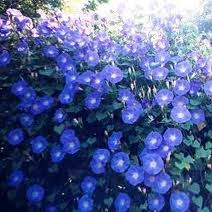
Yet Judy and I were undaunted. We could make our first garden! With the landlord’s permission, we planted the seeds of morning glory ‘Heavenly Blue’ on the fence along the alley. The morning glories grew fast and completely obscured the chain link. In the morning they displayed large sky blue blooms that closed after lunchtime. Judy and I were thrilled every time we saw the fence covered in flowers, transformed into something beautiful.
Morning Glory ‘Heavenly Blue’. Photo from Underwoodgardens.com.
We’ve grown morning glories in other gardens since then, always from seed and always ‘Heavenly Blue’, but not in the last few years.
Anyhow, enough history. Shortly after the middle of May I went to Anton’s garden center to find some seeds for ‘Heavenly Blue’. But before I bought the seeds, I saw that they were selling morning glory plants in little baskets. Oh, I thought, maybe these plants will bring me a week or two closer to having my tuteur covered with blue blooms. So I plunked down $6, several times the cost of a seed packet, and off I went.
Dumb. First of all, the roots did not fill the container, so when I removed the plant, the medium fell apart. The morning glories lost a bunch of roots as a result.
And once planted, they sulked and went into decline. The cool spring weather didn’t help, as these are plants who like it warm.
So a week later I went back to Anton’s to buy morning glory seeds. Before I got the seeds, though, I saw that they had more morning glory plants, these from a different grower. The vines looked so sturdy, the leaves so glossy, just a few inches tall, but still. I thought – why not? This time I plunked down $7.
You know how this ends, right? Some of the sturdy vines snapped during planting. Afterwards, these plants also sulked towards oblivion.
So another week goes by. It is now early June. Finally, I go to buy seeds, and actually buy seeds. I soaked them overnight, and planted them the next day. I await their emergence.
So what have we learned here? Something I kind of already knew, but forgot as a result of the mind control rays secretly emitted by most garden centers. Namely, it’s not worth paying for some plants as plants, seeds are cheaper and better. Morning glories are one of those.
This post is written as part of the Lessons Learned meme hosted by Beth at Plant Postings.
I can’t deny it any further: my ‘Casa Blanca’ Oriental Lilies did not make it through the winter.
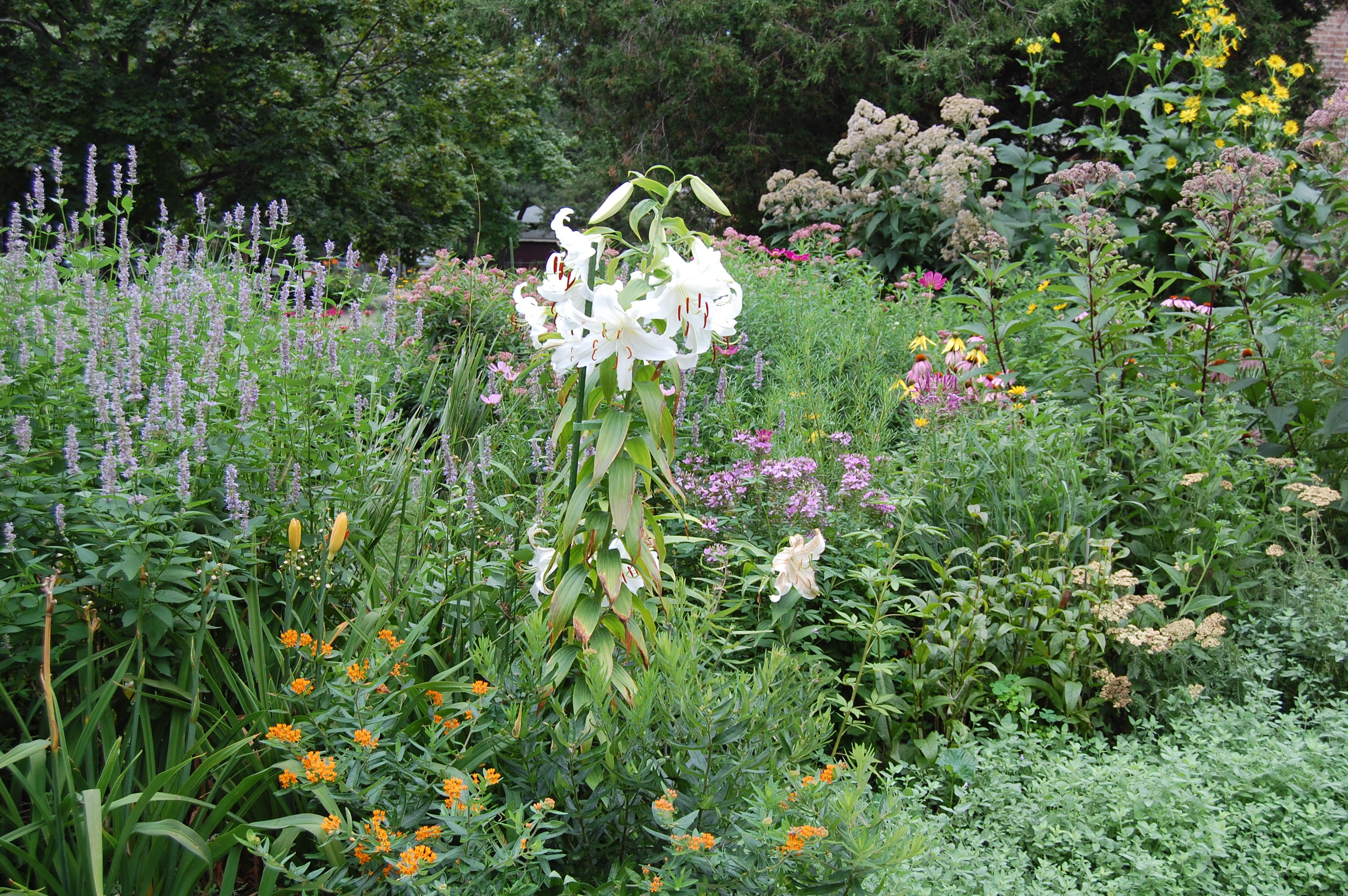
‘Casa Blanca’ Oriental Lily in happier times, summer 2012
This is a bitter loss, indeed. I loved my ‘Casa Blanca’. The pure, ivory white blooms. But above all, that fragrance, a fragrance that made me want to lie down on the ground and wriggle with happiness.
I don’t understand what went wrong. They seemed to be happy. The stalks were coming up thick and healthy looking. OK, a couple had borers, but I pulled those out, bulbs and all.
They were given pride of place in the driveway border.
The location, I thought, was good. A nice spot in the raised driveway border. Sun, good drainage. I provided them with a happy home, and yet they are gone.
Can anyone explain to me what happened to my ‘Casa Blanca’ lilies? Maybe if I understood, the pain would be a little more bearable. Perhaps, also, it will give me the courage to try again.
The interview below was posted in June, 2013. I was surprised and honored to see it referenced in Mr. Lacy’s New York Times obituary, but I think it may have been one of the last interviews given by the author.
I became acquainted with Mr. Lacy online after he wrote me a friendly note in response to a book review I had written. After this interview, we exchanged a few more emails and then lost touch.
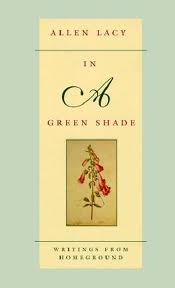
Allen Lacy is without doubt one of my favorite garden writers. For roughly forty years he has written about plants and gardens with passion, knowledge, and gentle (often self-mocking) humor. He is the author or editor of 10 books, including Home Ground, In a Green Shade, The Garden in Autumn, Farther Afield, and The Gardener’s Eye. For a dozen years he wrote a newspaper column on gardening, first at The Wall Street Journal and then the New York Times.
Allen Lacey
In addition to his garden writing, Lacy was a professor of philosophy at Stockton College, and currently holds the title of Professor Emeritus. In addition to his own garden in Linwood, New Jersey, Lacey also helped create and volunteers at the Linwood Arboretum.
A couple of weeks ago, I unexpectedly found myself exchanging emails with Allen Lacy. I asked him if he would be willing to do an interview, and he was gracious enough to agree.
You started gardening while growing up in Texas. How did gardening become a lifelong obsession for you?
Since I am now, at 78, what I prefer calling “advanced middle age,” questions about the remote past are usually hard to answer. This one is easy because the memories are still vivid. In the third grade, in Irving, Texas, I was something of a disciplinary problem. I managed to get myself expelled toward the end of the spring term. I was in what amounted to a parole, supervised by a wonderful fourth grade teacher, Ruth Harkey, who ran a small nursery and was a breeder of bearded iris. I worked for her after school and on Saturdays. Mrs. Harkey taught me the elements of hybridization, and I was hooked at the idea of interfering with nature to bring something new into being. My first plant acquisition (25 cents, my entire weekly allowance) was a yellow iris called ‘Happy Days.’
The next stage, after moving to Dallas, took place at age 12 when I started working at Nicholson’s Seed Store which required me to memorize its catalog.
When did you start writing about gardening, and how did that come about?
Writing came first, then writing about gardening. In my senior year in college I was privileged to be enrolled in the legendary year-long writing seminar of Professor William Blackburn, previously taken by writers like William Styron, Mac Hyman, and Reynolds Price. At that time, Duke’s Hoof ‘n’ Horn annually put on student-written musical plays, and I was the author of something called “Top Secret,” which dealt with the confusion that erupted when the US Navy wanted to test atomic weapons on Femina, a Pacific atoll inhabited by feminist colonists. I also had a one-act play about Mexican bandits that was produced by the Carolina Playmakers at UNC. Later, after grad school, my dissertation on the Spanish philosopher Miguel de Unamuno was published, and I was co-translator of two volumes for Princeton University Press. In the late 1970s I began reviewing books on general topics for The Chronicle of Higher Education.
Meanwhile, I harbored the itch to be a novelist, but without success. My wife suggested that I write something about gardening, and I sent off an over-the-transom piece to Horticulture magazine which the science editor, Roger Swain, accepted. Manuela Hoelterhoff, then arts editor of The Wall Street Journal saw the piece, asked me to write for her, and lo, I became a garden columnist.
You’ve written about how at various times you’ve developed a mania for certain plants (hostas, daffodils). Are you suffering from any plant manias at the moment?
Yes. For the Linwood Arboretum, where I am founding curator, I just acquired a large collection of over 100 native pitcher plants, 30 different species or hybrids.
You’ve visited gardens all over the world. Which garden did you think was the most remarkable?
This is an impossible question to answer, for although this garden or that may be striking or impressive, what I most admire is the human urge to take an empty or an ugly site and transform it into a human artifact. Right now the garden I would most urge others to visit is actually the largely mail-order nursery Plant Delights, which co-exists with the Juniper Level Botanical Garden, both brought into being by plantsman Tony Avent.
You’ve been in the same garden for about 40 years, right? From the perspective of all that time, what would you say were your worst and best home garden decisions?
The best decision was getting rid of the lawn planted by the previous owner of our house, also some of the little spruces he had dotted in perfect symmetry everywhere. The worst decisions were (1) not getting rid of al those spruces–and (2) planting yellow groove bamboo. But it took time for both plants to become serious space hogs. In the meantime, I had a huge cottage garden in which to experiment with a host of herbaceous perennials.
Please tell us about a couple of people who have inspired you as a gardener or writer.
Easy question. First, two of my editors were also fine writers, namely Roger Swain and Manuela Hoelterhof. Roger’s red suspenders were memorable for all watchers of the Victory Garden on PBS, and his columns of science essays from Horticulture were exemplary in more ways than I can outline. Manuela still writes for Bloomberg, and her columns on opera are astute, delightfully opinionated, and often very funny.
As a gardener–no, really a master plantsman, the late J. C. Raulston, founder of the arboretum at the North Carolina State University now named in his memory, was hugely influential on me and many others.
You taught philosophy at Stockton College for many years. Did your gardening at all influence how you approached philosophy?
I don’t think so. For me, these two categories were strongly different. Philosophy had great, often unanswerable, questions. In horticulture, the basic questions had answers. (Which end of the bulb points down?)
You were instrumental in the creation of the Linwood Arboretum. Describe how this park came to be.
Again, an easy answer. Just down the street from the garden my wife Hella and I have been making for over 40 years, there was a real estate eyesore. It was first an electrical substation and then a cleared acre lot that was proposed as a site for a soccer practice field. I thought it an ideal spot for an arboretum, based on what Raulston had done in North Carolina. Linwood’s city council agreed as did our county freeholders, who came up with a grant for construction and plant acquisition. Many others lent their minds and their hands to building a small arboretum packed with unusual and I think superior shrubs and small trees.
Some of my favorite perennial flowers are Geraniums. When I say Geranium, I mean members of the genus Geranium that also go by the common names Cranesbill or Hardy Geranium.
Geranium ‘Johnson’s Blue’ spills nicely over the edge of a raised bed.
I don’t mean the red flowering annuals that grow in pots. Those are really members of the genus Pelargonium, but are commonly called Zonal Geraniums, Scented Geraniums, or Ivy Geraniums (actually, these names apply to three different species of Pelargonium). But you probably knew that already.
Those red flowers are Pelargoniums, but we call them Geraniums. Why, you ask? Who knows?
There are many, many different species, hybrids, and cultivars of Geranium. However, they tend to have certain traits in common. They have a low, mounded habit. They have five petaled flowers that bloom in blue, pink, or white. They have hand-shaped leaves, often deeply lobed. And they tend to be easy care plants.
I have four different Geraniums in my garden.
Geranium ‘Johnson’s Blue’
Geranium himalayense ‘Johnson’s Blue’. For me, this is the Old Faithful of Geraniums. Forms a loose mound about 12-18″ tall with profuse blue flowers in May and June. Can get rather sprawling, but that is part of its charm. Flowers are sterile. Will grow in sun or shade. People talk about the new hybrid ‘Rozanne’ as superior to ‘Johnson’s Blue’, but I have not found that to be the case.
Wild Geranium
Geranium maculatum, Wild Geranium. This is the North American native Geranium. Flowers are usually lavender, or white if you get the variety ‘alba’. Definitely not sterile, it will start popping up around your garden, but new plants are easy to remove or transplant. Leaves may whither during a hot summer, but just cut it back and fresh foliage will emerge. A good native spring flower for shady gardens.
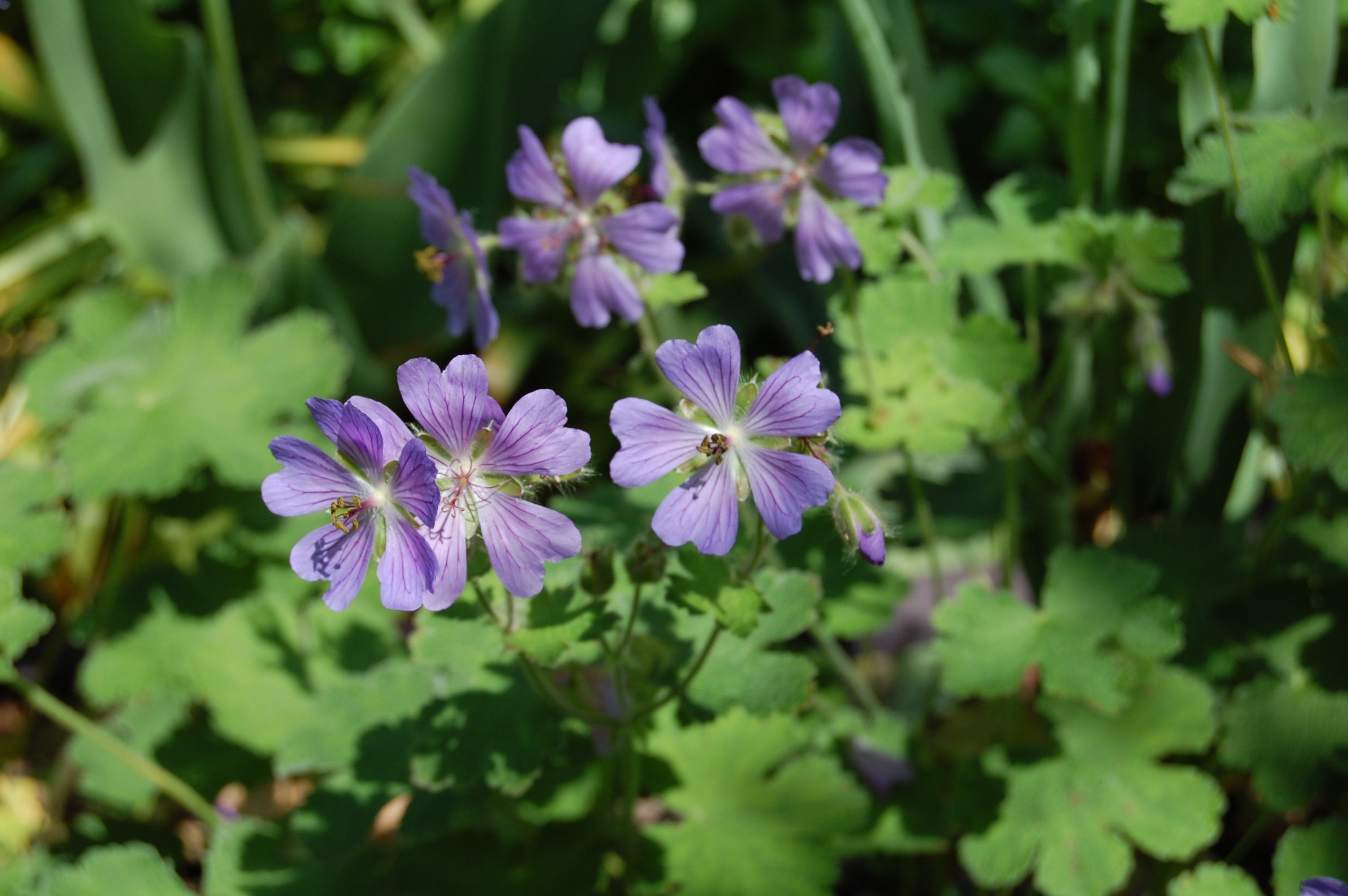
Geranium ‘Tschelda”
Geranium renardii ‘Tschelda’. This Geranium is well adapted to sunny, drier spots. The flowers are blue with darker veining, and the leaves have a felt-like texture. Shorter at about 1′. I planted these for the first time last fall, so far they are doing well this year.
Geranium Biokovo. I took this with my phone.
Geranium ‘Biokovo’. White flowers with pink centers. About 12″ tall and 18″ wide. Very adaptable – sun or shade, dry or moist soil (but not too moist). Foliage turns red in the fall.
I use these Geraniums mainly for edging and as ground covers, and they generally perform well.
After the Chicago Botanic Garden, the Lurie Garden should be the next must-see item on the agenda of any avid gardener visiting Chicago.
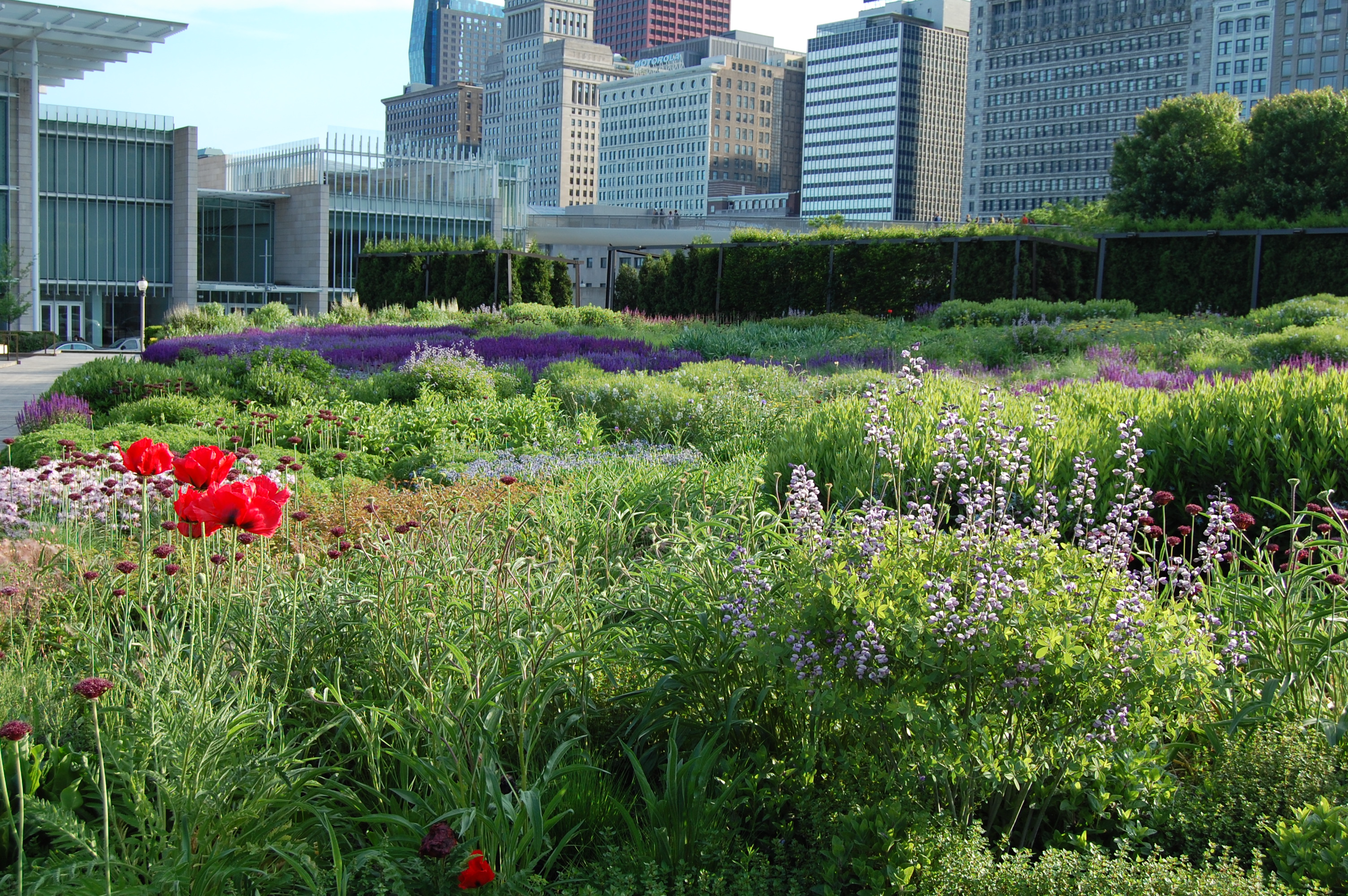
Part of the Chicago skyline as seen from the Lurie Garden.
It is a five acre garden in the heart of downtown, designed by Piet Oudolf and Robert Israel. Truly a garden in a city.
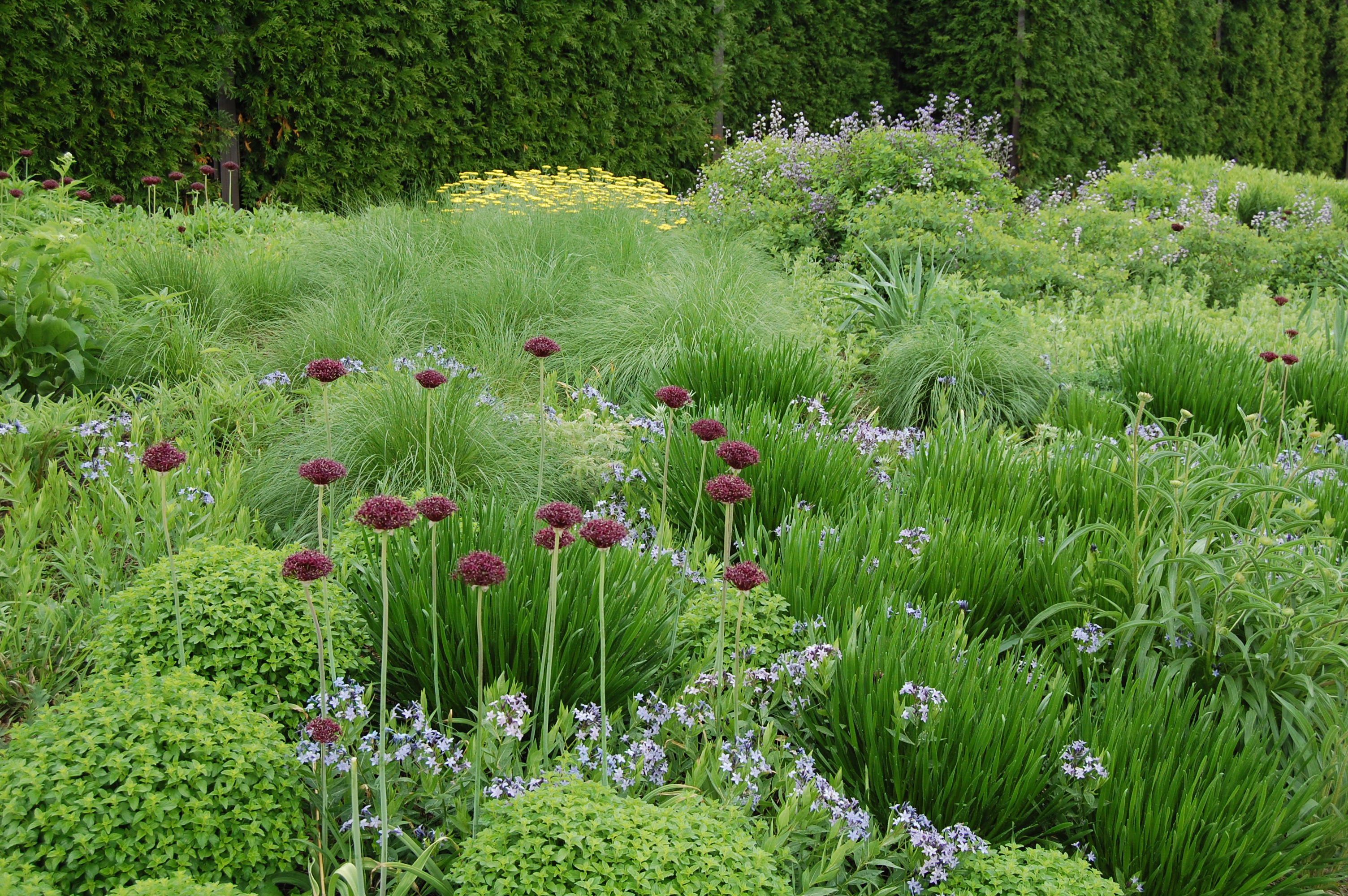
Love this combination: Monarda bradburiana, Allium atropurpureum, and Amsonia tabernaemontana. I like the low habit of the M. bradburiana but prefer M. fistulosa’s lavender color.
The Lurie Garden has a prairie-style design, but it is not a prairie. It is a mix of native and exotic – bulbs, perennials, and grasses, with a few shrubs and small trees.
Red poppies are a new element I haven’t seen before.
This is a garden that is beautiful throughout the growing seas0n. In my opinion, though, it is at its most glorious right now, when the salvia are in bloom.
There is a massive sweep of salvia (mostly ‘May Night’ and ‘Blue Hill’) that curves from one end of the garden to the other, know as the River of Salvia.
Judy came out and took some of these pictures during her lunch hour, when it was quite overcast. She came back after work as well, when the clouds had cleared and the sun was starting to set.
The garden is bordered to the west and north by an evergreen hedge. To the south is the Chicago Art Institute.
On most days the garden is full of awe-struck visitors, tourists and native Chicagoans, taking pictures with cell phones and fancy cameras.
A wonderful mix of colors and textures.
Prairie Smoke.
Anybody who works in the Loop has no excuse for not visiting the Lurie Garden. And no serious gardener should leave the city without spending some time here.


































 gardeninacity