With high summer comes a new cast of players in the front garden’s Driveway Border. There are many stars in the border, and it is gratifying to see them strut their stuff.
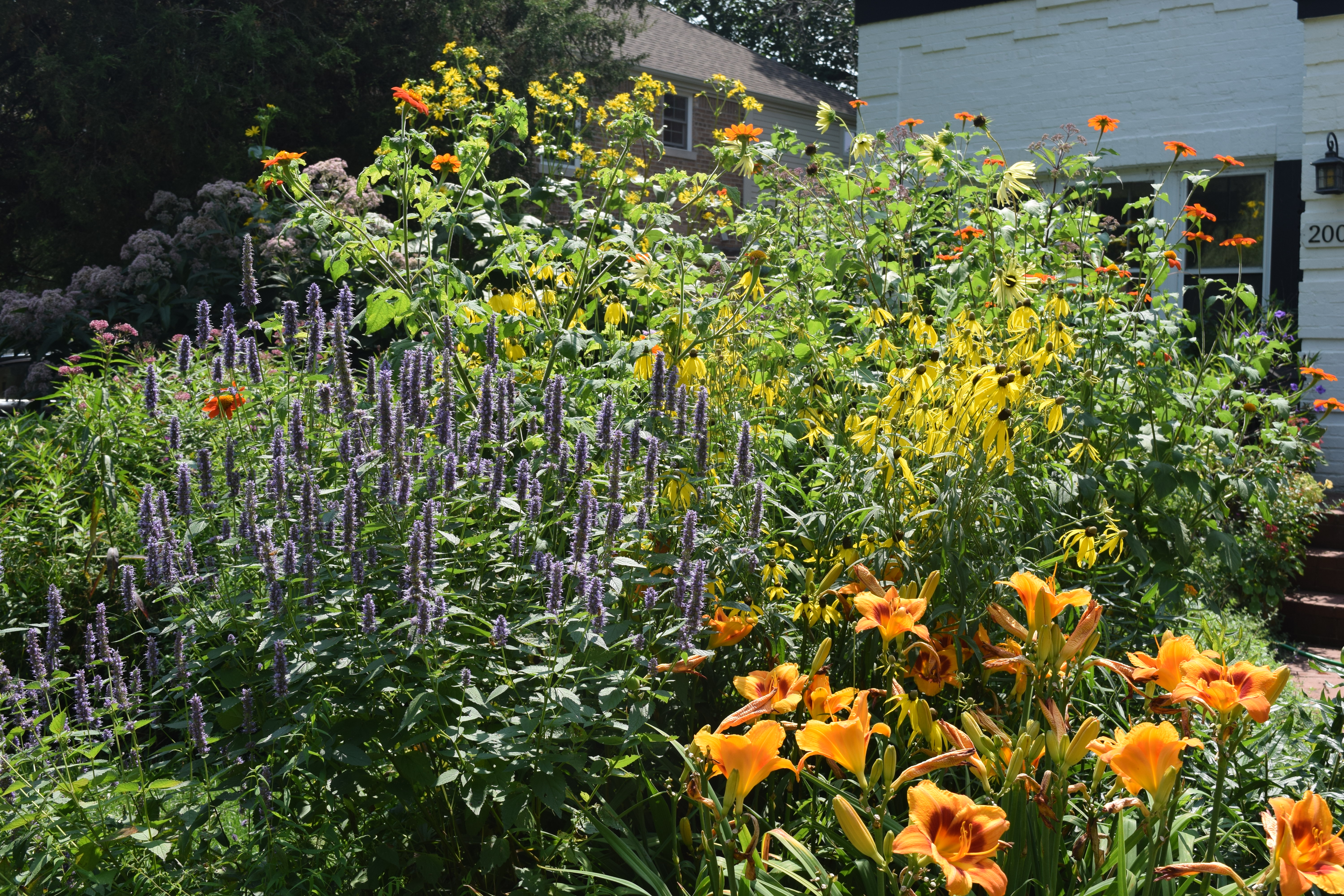
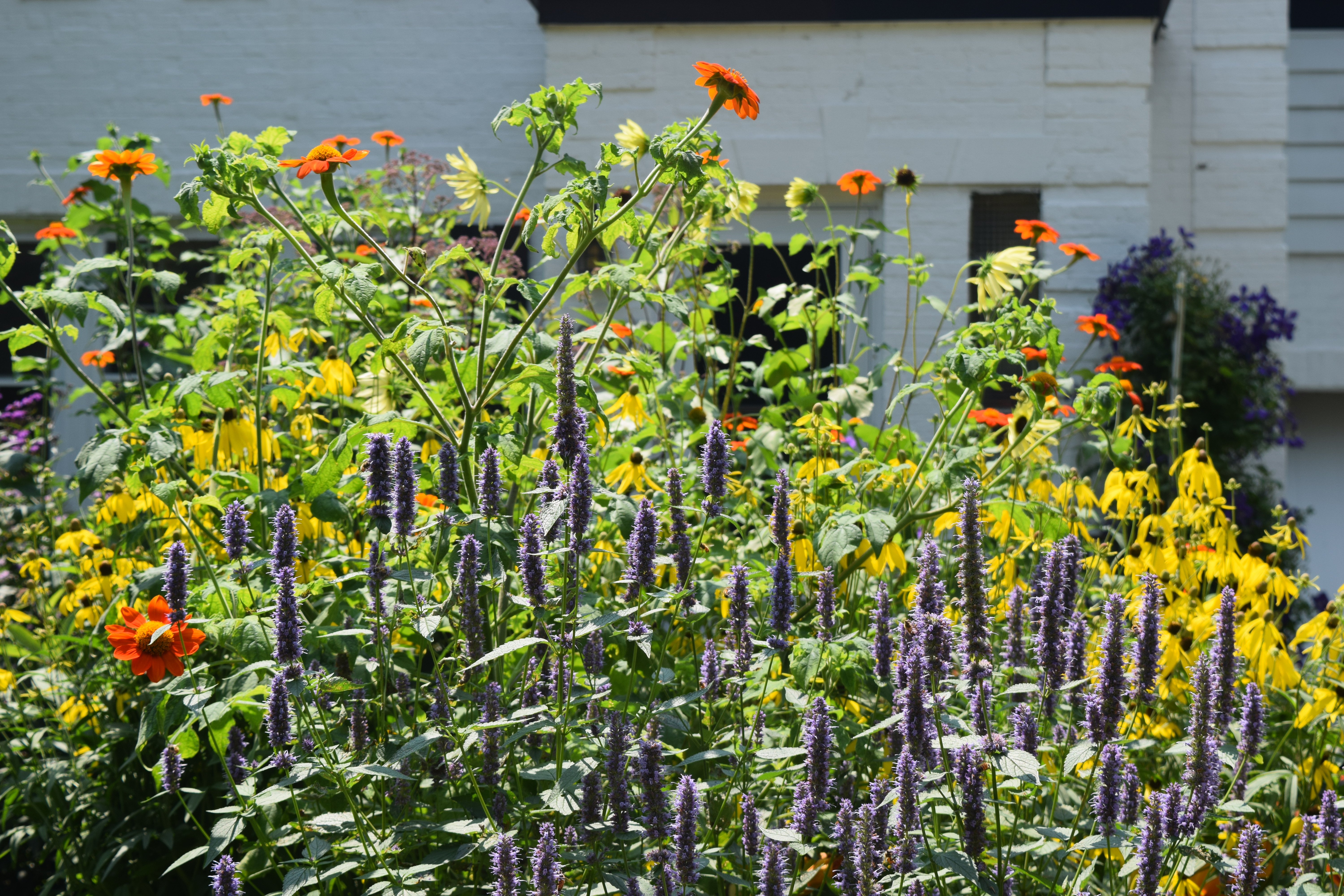
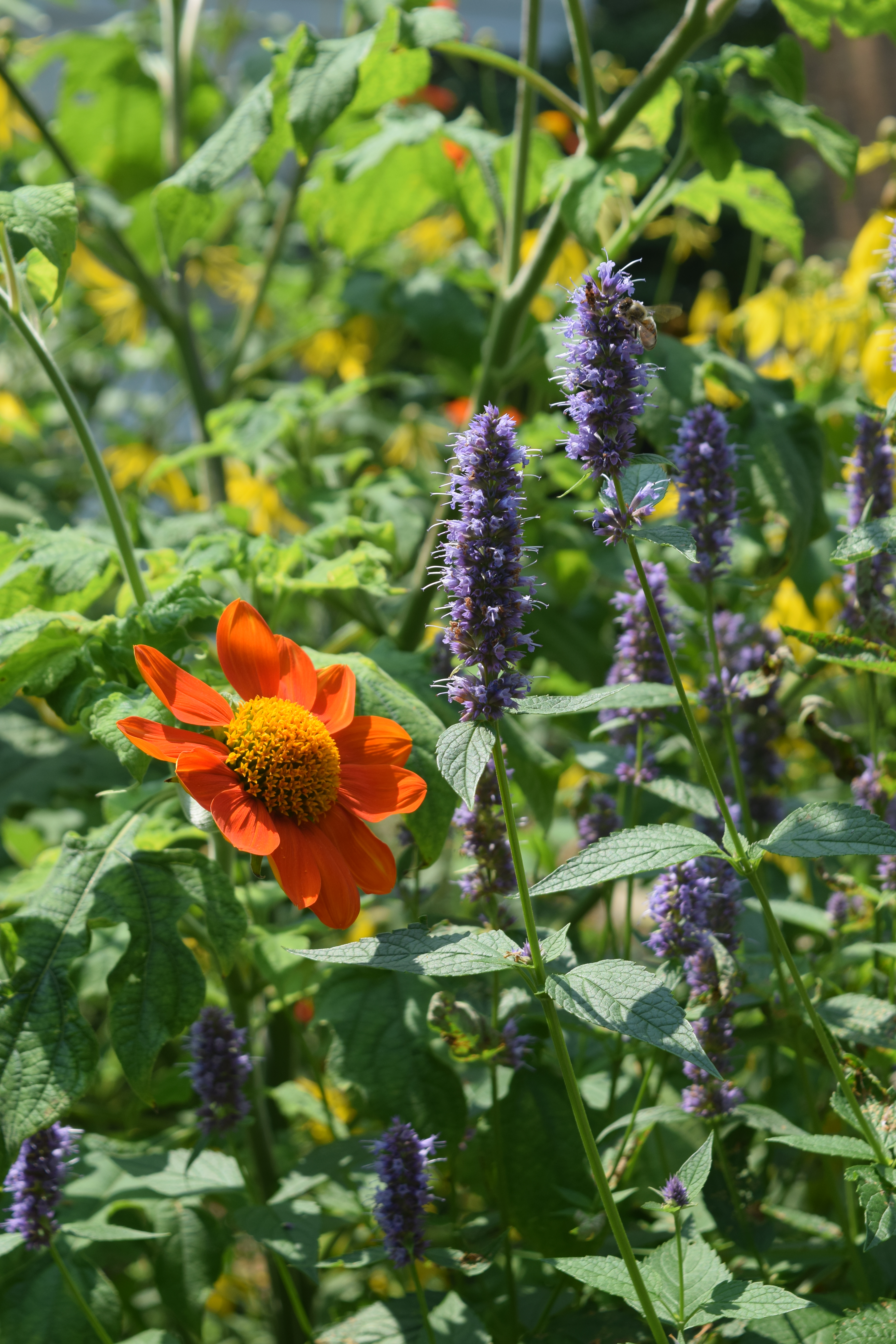
Blue spikes of anise hyssop, along with yellow coneflowers, orange Tithonia and annual sunflowers. The ‘Eye-yi-yi’ daylily blooms from mid to late summer.
At the far end, anise hyssop (Agastache foeniculum) comes to center stage.
I’ve already written about the virtues of this plant, but let me add now that it’s blue-lavender flower spikes beautifully complement the yellow and orange daisies of summer.
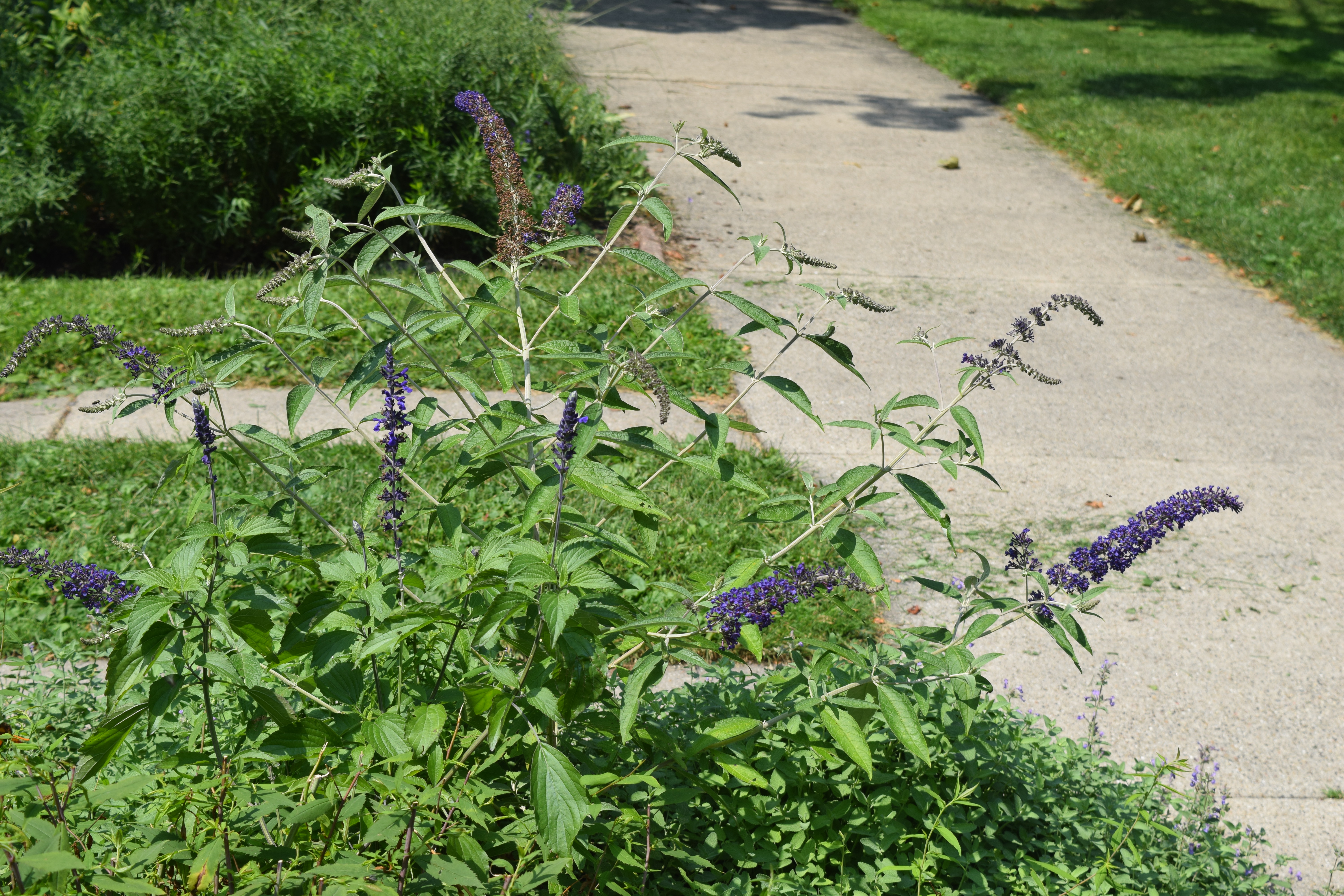
‘Adonis Blue’ butterfly bush.
My new ‘Adonis Blue’ butterflybush (Buddleia) is more of a supporting player now, though it provides a sweet scent that for passersby on the sidewalk. This is its second summer and it is flowering nicely. ‘Adonis Blue’ is a compact variety that is supposed to grow to no more than 4-5′, though I think it is less than 3′ in my garden this year. In this region it dies to the ground every winter, which is fine with me. I just wish they had picked a cultivar name that wasn’t so suggestive.
Yellow coneflower with ‘Gateway’ joe pye weed in the background.
That’s yellow coneflower (Ratibida pinnata) right next to the anise hyssop. I like the bright clear yellow of the flowers. The endearingly droopy petals remind me of floppy dog’s ears.
Yellow coneflower, a closer look.
Though flowering abundantly, the Ratibida stems are way too floppy this year. This is not so endearing, and it has been a struggle to keep them minimally upright without creating the “perennials wearing a corset” look. I may try cutting them back next year and see what happens.
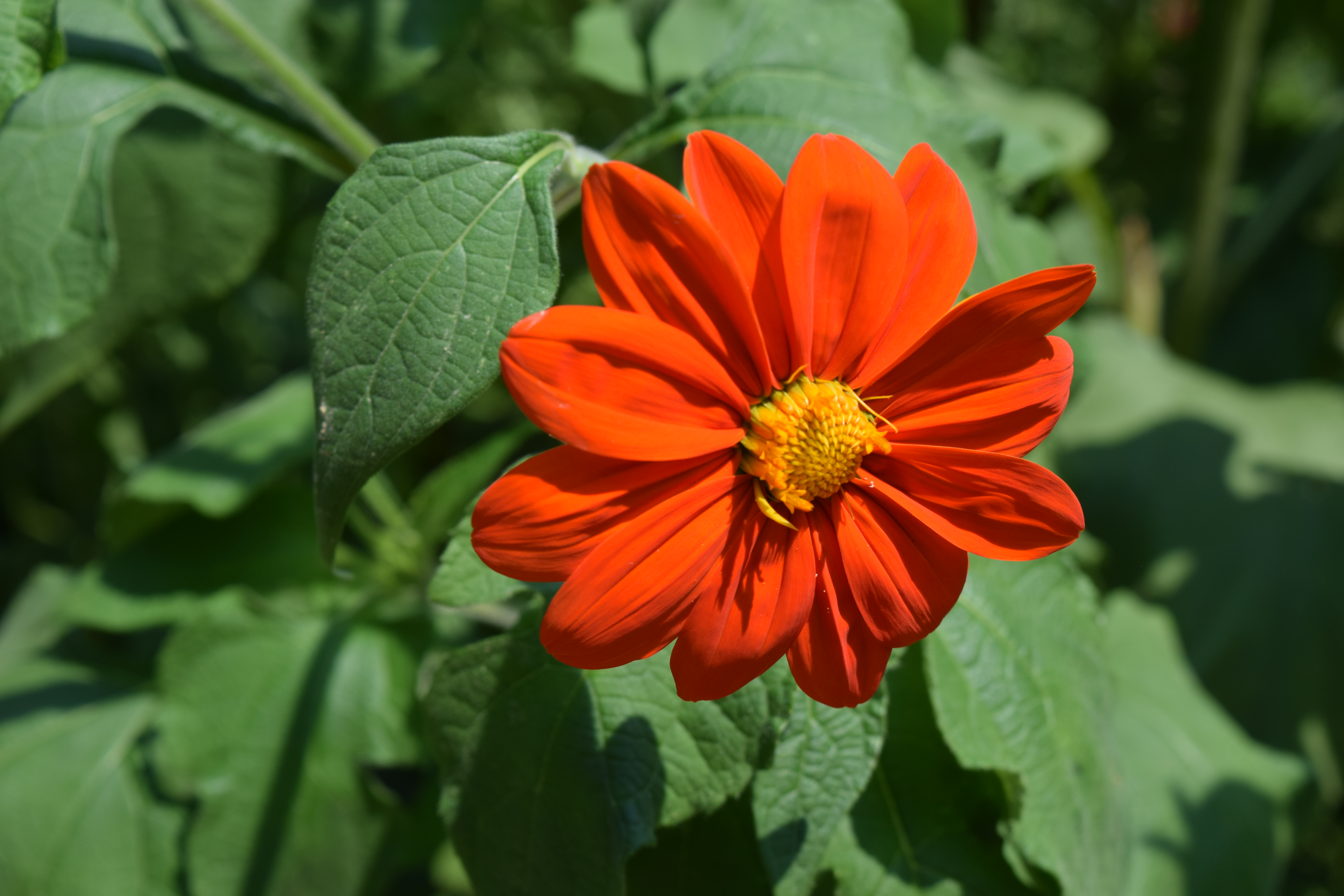
Tithonia
Last year I planted one Mexican sunflower (Tithonia rotundifolia) in the Cuttings and Edibles Bed. I loved it so much that this year I added four to the Driveway Border. I am now crazy for this plant. Mexican sunflower could in the future be the signature summer flower of the Driveway Border.
Next year I think I will plant just two or three Tithonia instead of four. Just one of these plants provides a big presence. I will also avoid placing them east of other tall plants, which forces the Tithonia to grow as tall as 7-8′. Also, I’ll try to place one so that it holds up the ‘Gateway’ joe pye weed (Eupatorium purpureum ssp. maculatum).
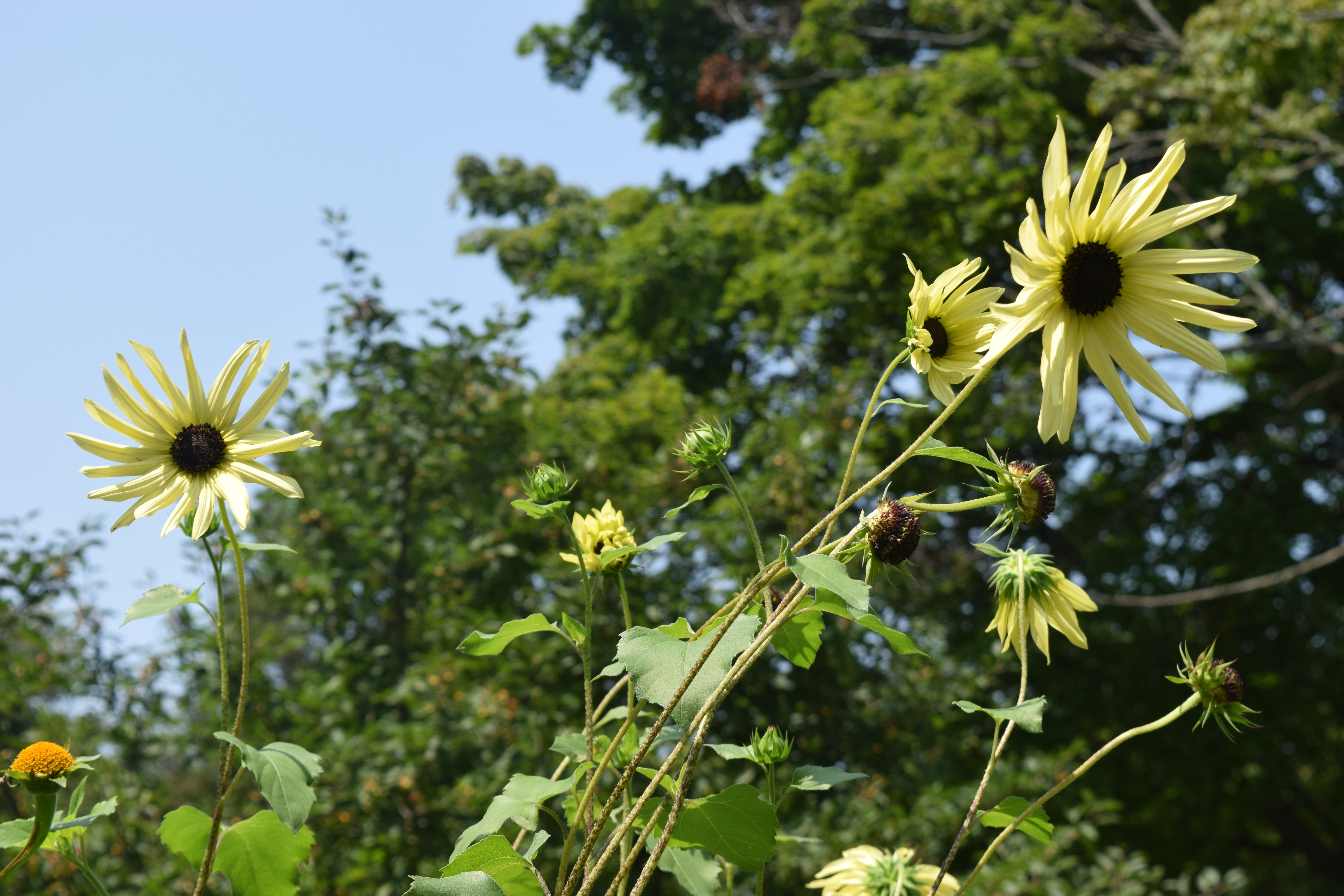
‘Italian White’ sunflower
The annual sunflowers (Helianthus annuus) have also contributed drama and color to this year’s Driveway Border. However, the only one to keep putting out new flowers over a long period is ‘Italian White’, whose copious black-eyed flowers range from sunny to very pale yellow.
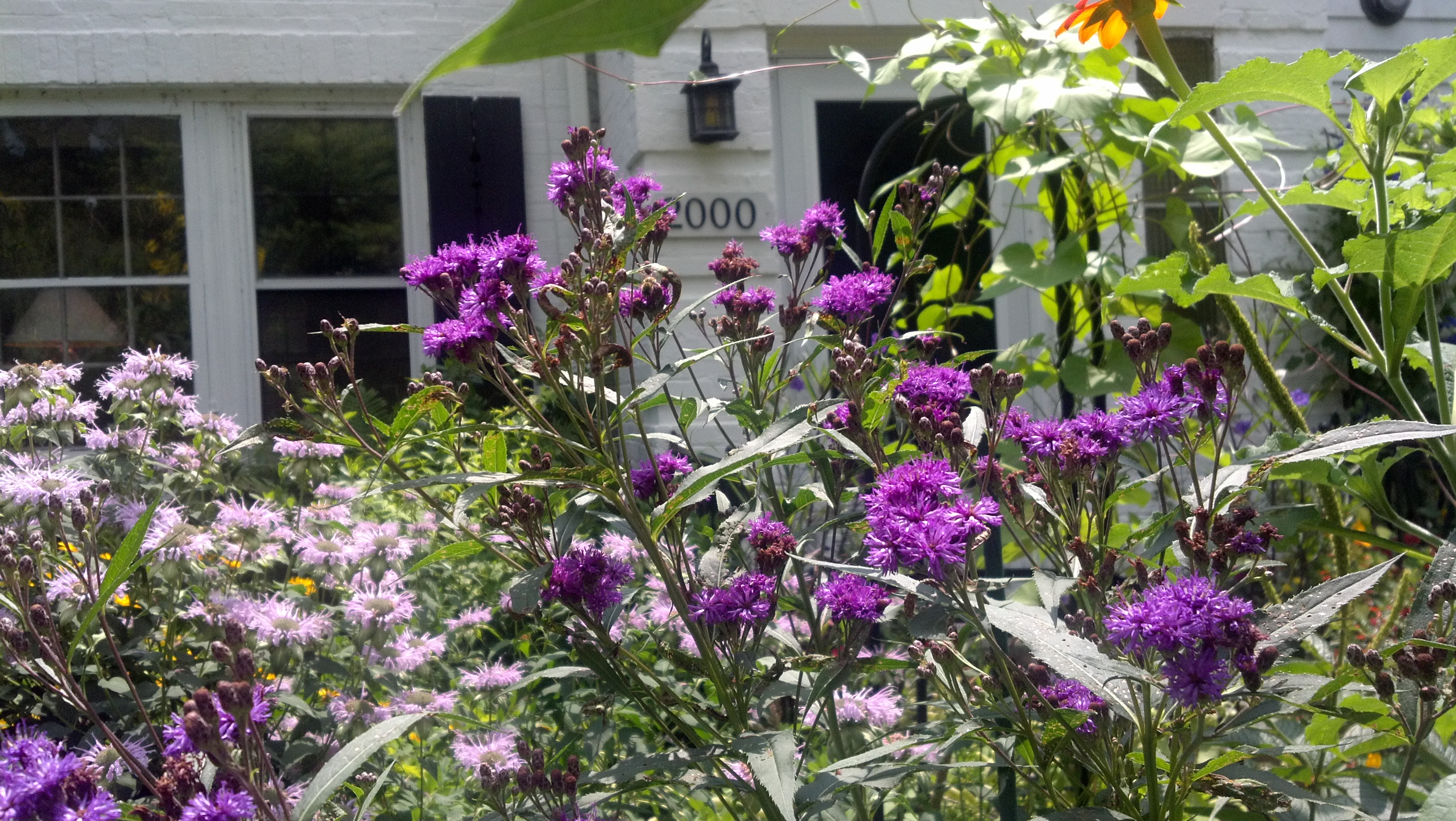
Tall Ironweed. In the background the wild bergamot keeps up its long bloom period.
Tall ironweed (Vernonia altissima) is a member of the cast who has not had as much impact as I had expected. This is partly because it is overshadowed by the Tithonia.
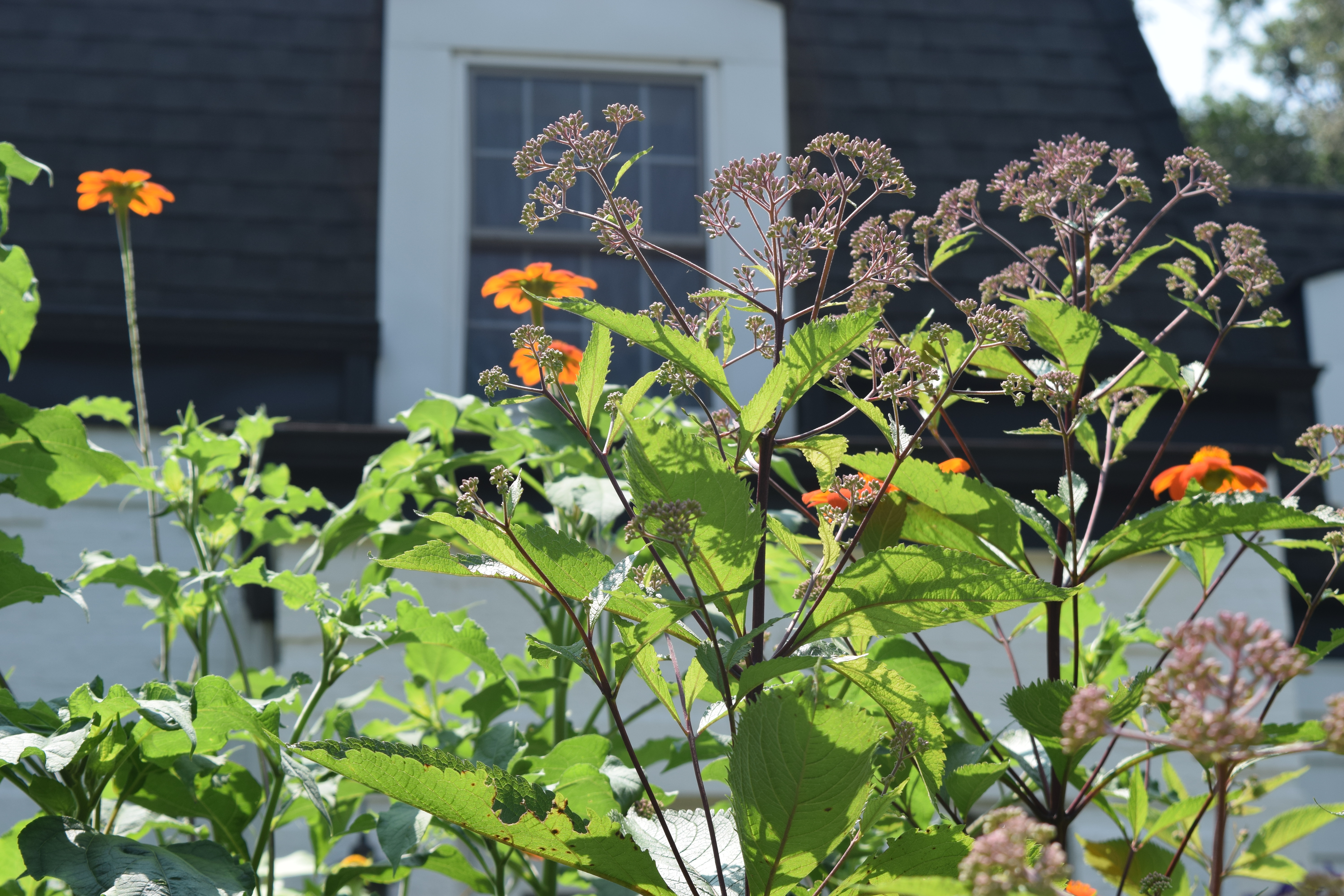
‘Gateway’ joe pye weed with Tithonia. The flower clusters are almost ready to bloom.
The ‘Gateway’ joe pye weed is not really exerting a lot star power just yet either. That may change when it is in full bloom. I am wondering: could there be so many bold, dramatic plants at the same time that some of them are losing their impact? But then I conclude: Nah. I reject the concept of too much of a good thing.
Who are the blooming stars of your beds and borders right now?
There are a lot more bees in our garden this year than last. That does not mean, I realize, that the crisis of bee survival is abating, but it is nice to know that at least our garden provides bees with good foraging. Here’s a little video of the bees on our anise hyssop (Agastache foeniculum).
NOTE: to see the bees, you need to go full screen by clicking the icon at the lower right AFTER you open the video.
They sure do love this plant (though the bumblebees have other favorites). This Agastache is the straight species. It’s too bad that almost all the Agastache sold in garden centers are hybrids. I don’t have anything against the hybrids, which I think are mostly a mix of North American and Asian species. But the straight North American species is hard to beat for flowering, color, and attractiveness to insects. Goldfinches will eat the ripe seeds, and people can make tea from or eat the leaves, which smell strongly of liquorice.
Are there more or fewer bees in your garden this year, and which plant do they love best?
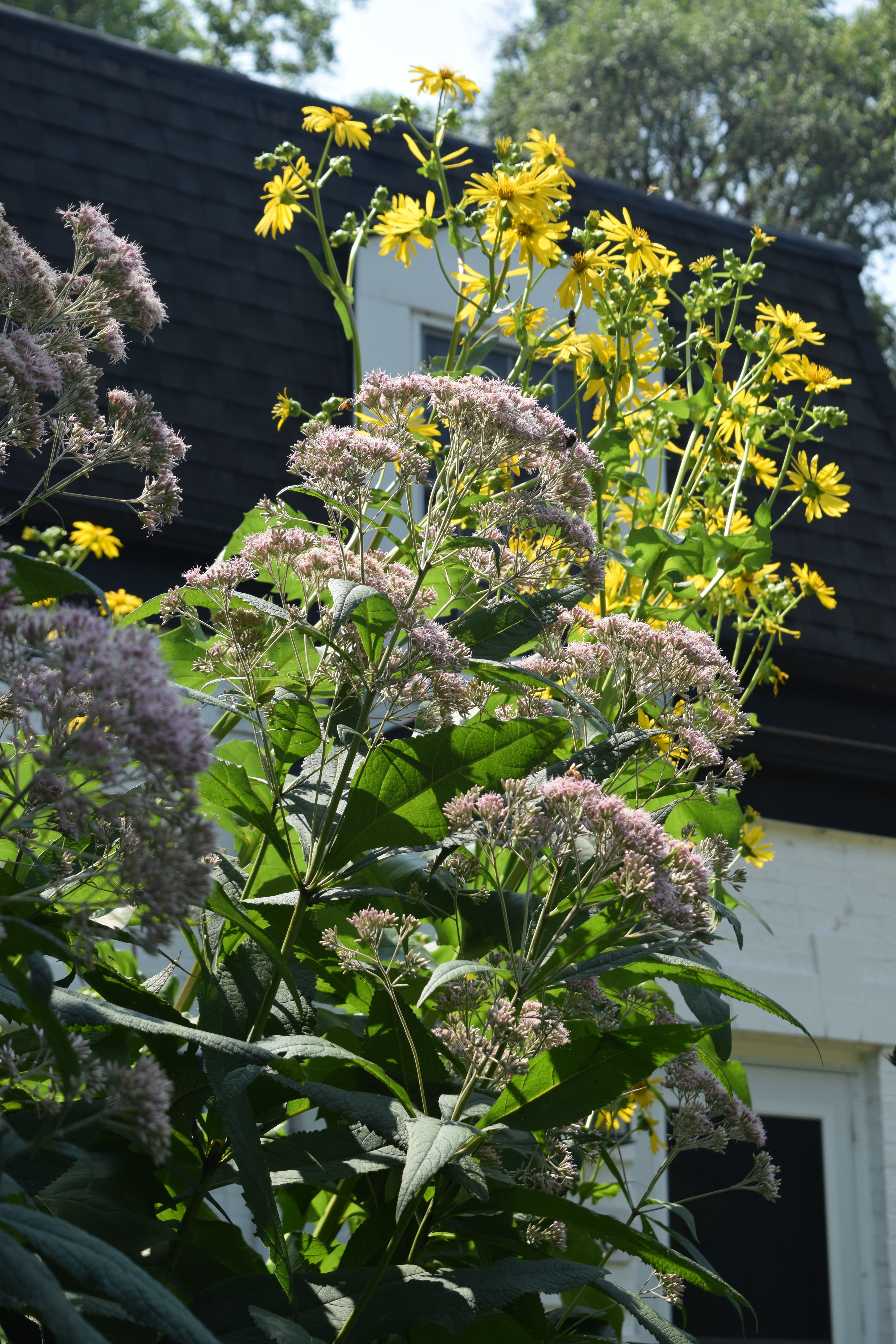
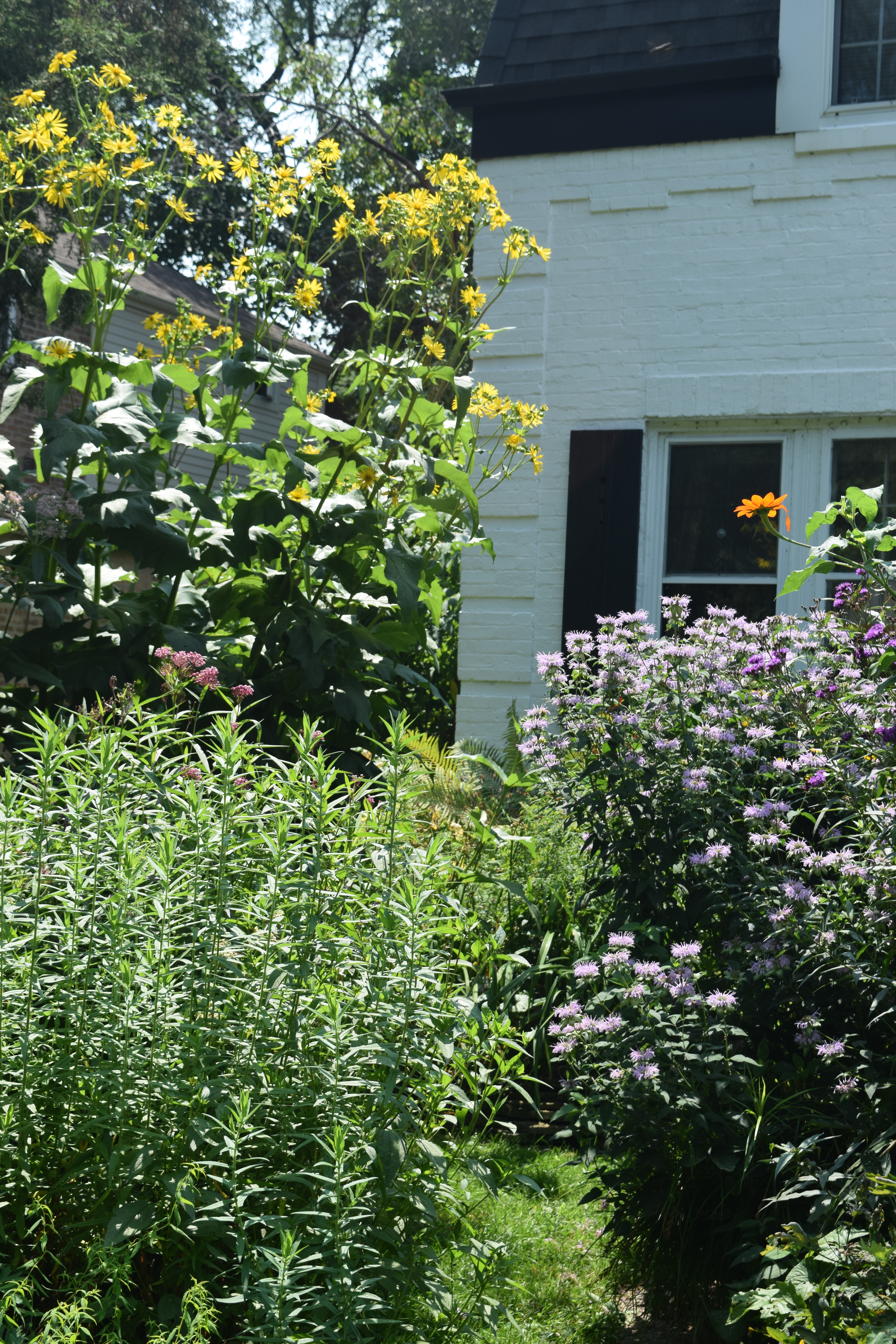
The Island Bed in the front garden really peaks in high summer. That’s when the cupplant (Silphium perfoliatum) and sweet joe pye weed (Eupatorium purpureum) come into bloom. These friendly giants are Midwest natives and great plants for birds and pollinators.
Cupplant and Sweet Joe Pye Weed
In spring the Island Bed is blue – there is squill (Scilla sibirica) in April, and later on Geranium ‘Johnson’s Blue’ and Ohio Spiderwort (Tradescantia ohioensis).
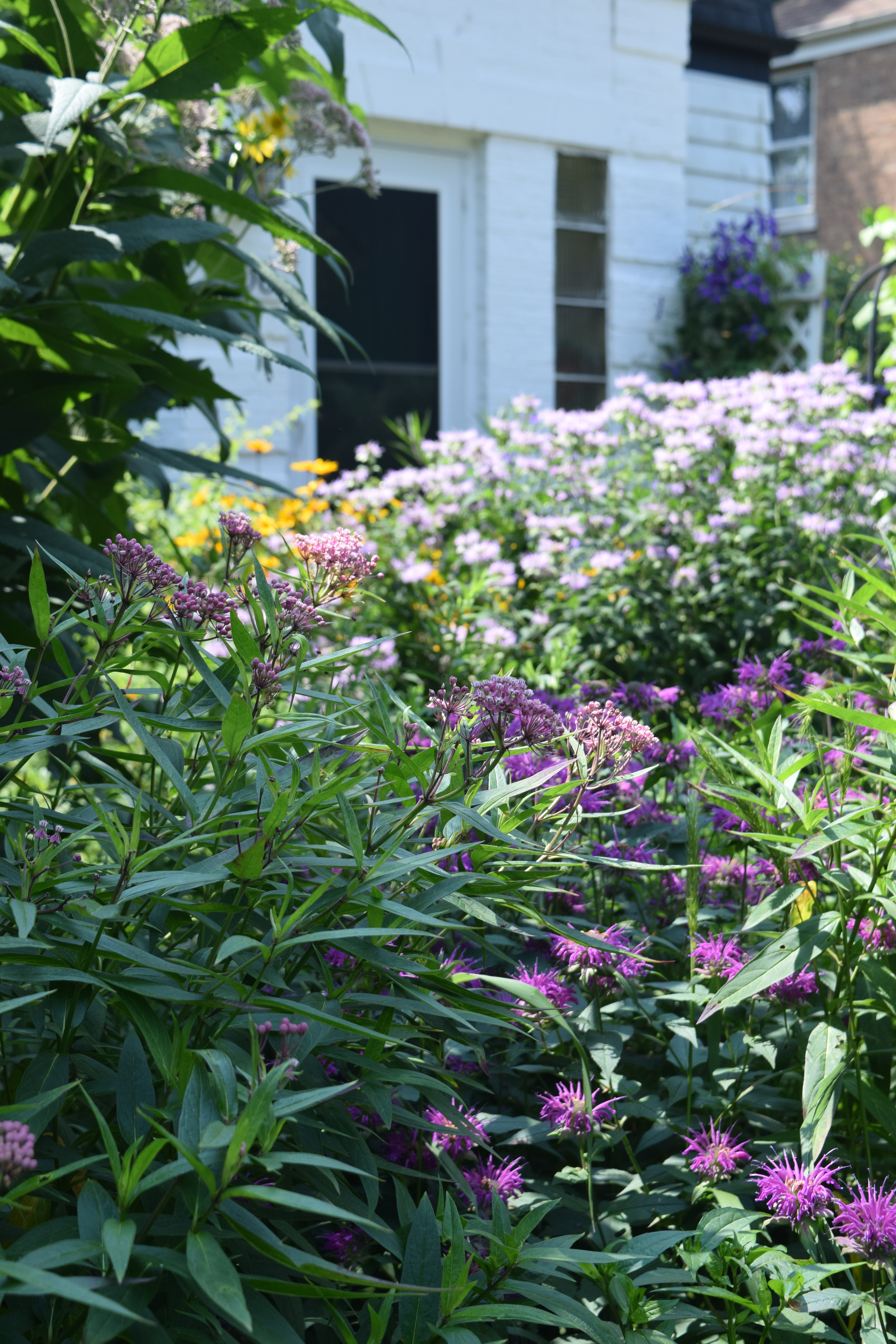
‘Purple Rooster’ bee balm and swamp milkweed, which grow to a mere 3-4′, are in front of the really tall guys.
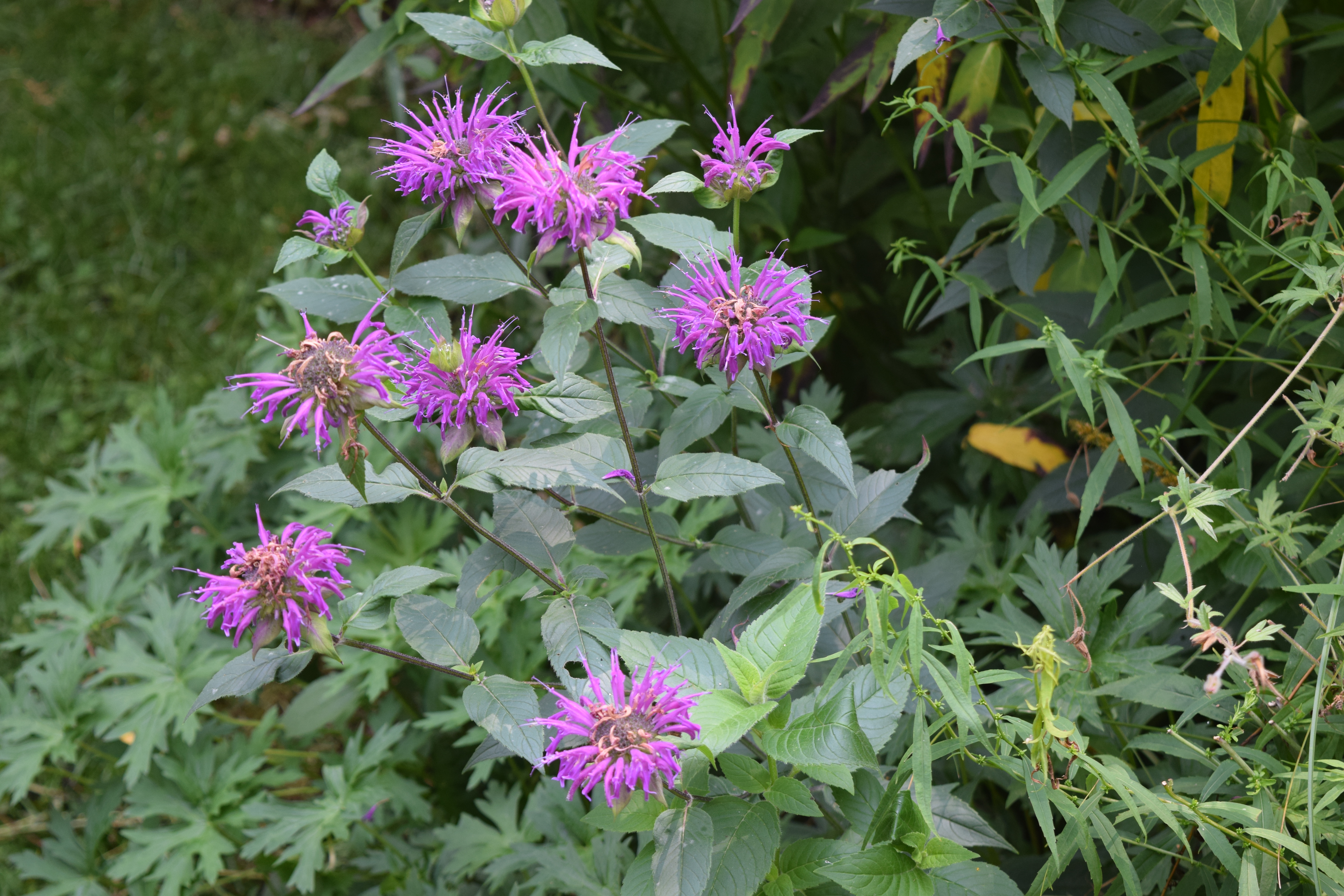
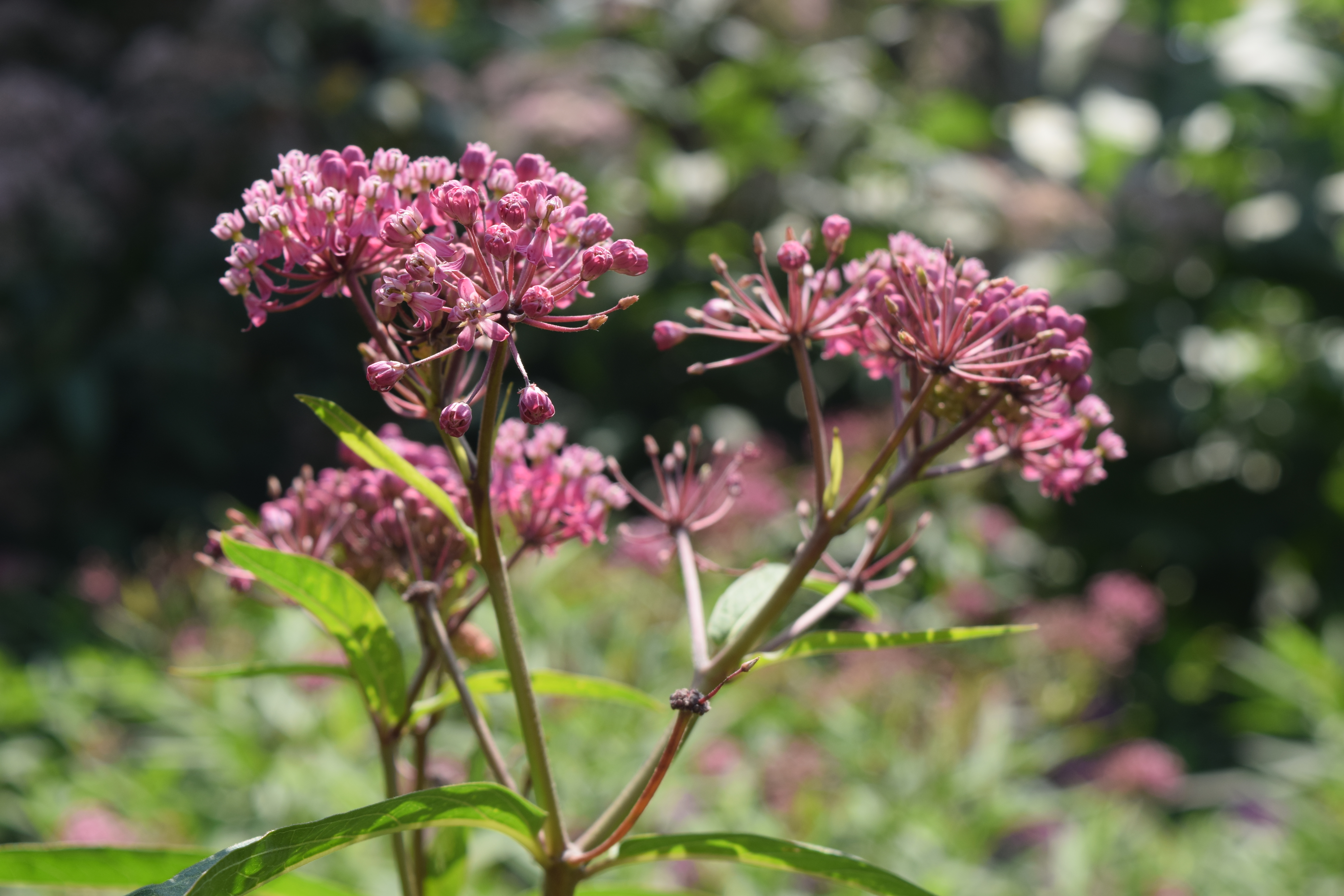
By mid-summer the ‘Purple Rooster’ bee balm (Monarda didyma) is flowering, along with the pink and white blooms of swamp milkweed (Asclepias incarnata).
Another view of the cupplant.
But the cupplant steals the show by the end of July. To an extent that’s because it is impossible to ignore at 8-10′ high in my garden.
Cupplant with wild bergamot from the Driveway Border.
But cup plant is not a malevolent giant. Instead, the bunches of yellow daisies are cheerful and friendly.
‘Purple Rooster’ Bee Balm is maybe just past its peak.
Some people fear cupplant as unmanageable, but I don’t find it to be so. It does self-sow, but the seedlings are not too hard to dig out. I certainly would not cut off the seed heads, which are a favorite of goldfinches.
Ditto the swamp milkweed.
The clumps do get very crowded, and I like to yank out every fourth stalk or so by the end of May. This results in sturdier plants, I think.
Sweet Joe Pye Weed
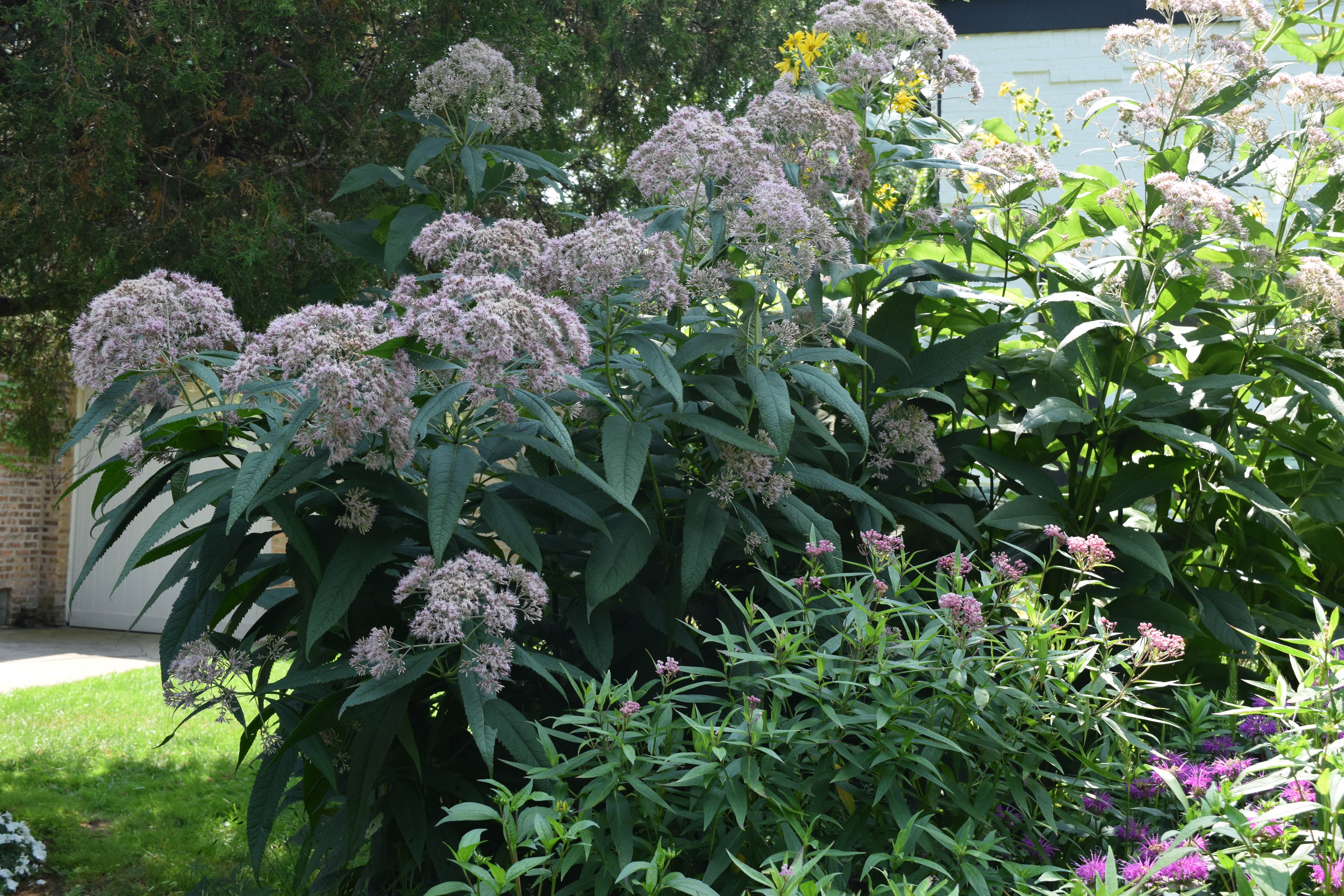
The sweet joe pye weed starts blooming within a few days of the cupplant. Pink and yellow are not supposed to go well together, but these plants seem like natural companions to me. Perhaps that’s because the joe pye weed’s flowers are a very understated, soft pink.
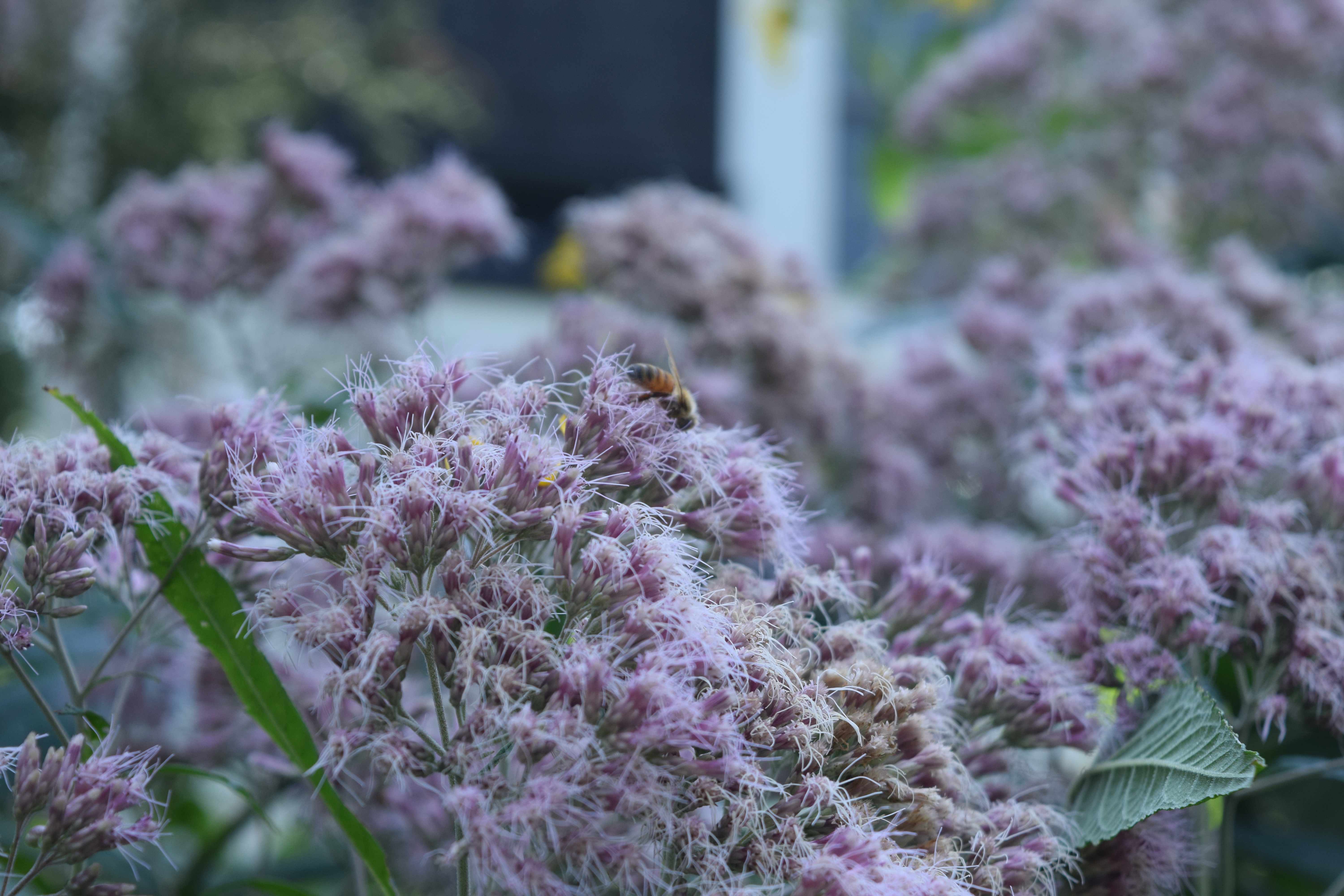
Sweet Joe Pye Weed blooms.
The texture of the flowerheads is soft and fuzzy as well. Sweet joe pye weed does self-sow, but not aggressively. As with the cupplant, I like to thin the stands of this perennial in order to get fewer but stronger stems.
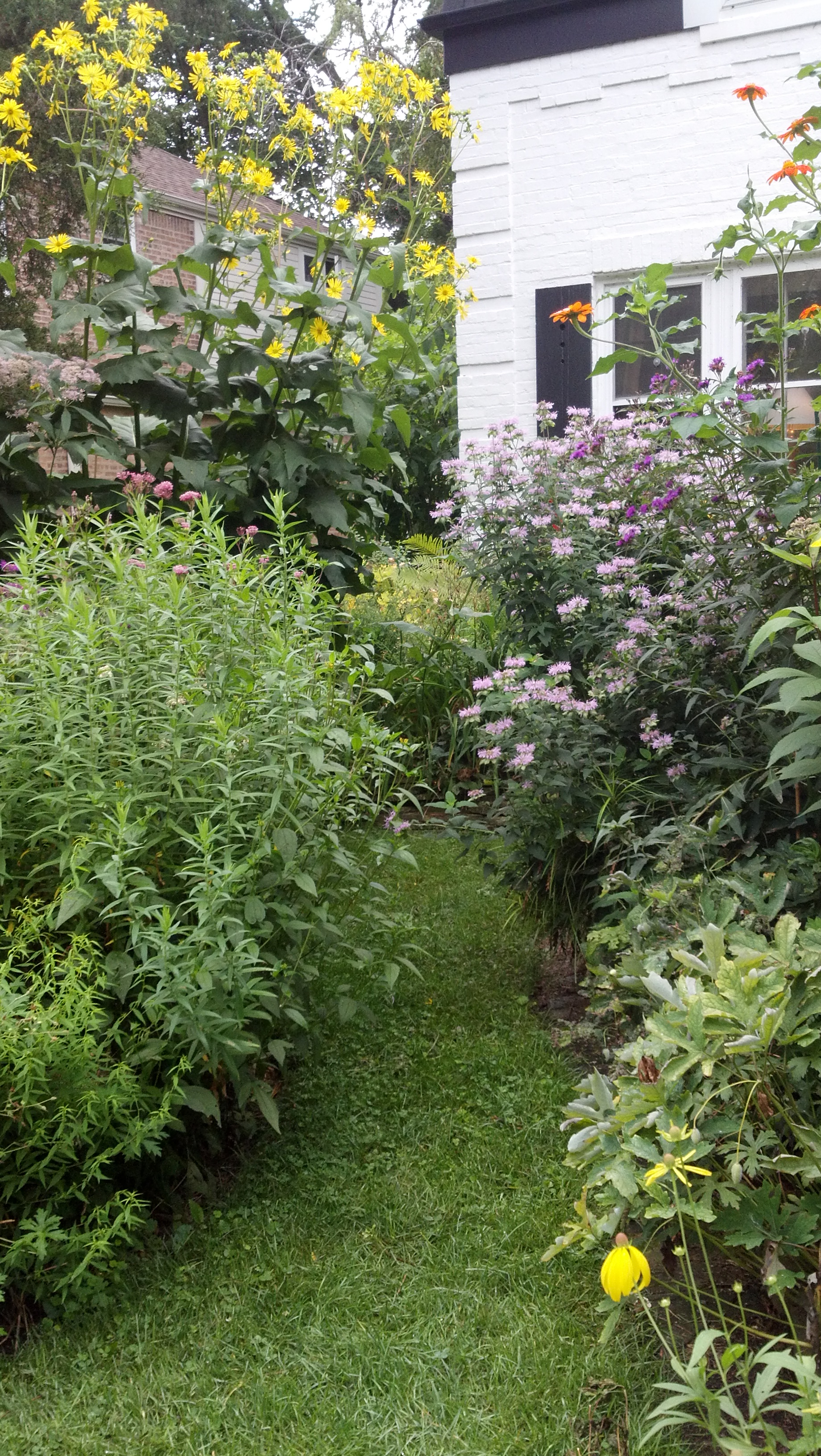
Path between Island Bed and Driveway Border. I took this and the other path picture with my phone. Judy took the other photos.
Oh, and I wanted to show that there are indeed paths between the beds in the front garden. Here is the path between the Island Bed and the Driveway Border.
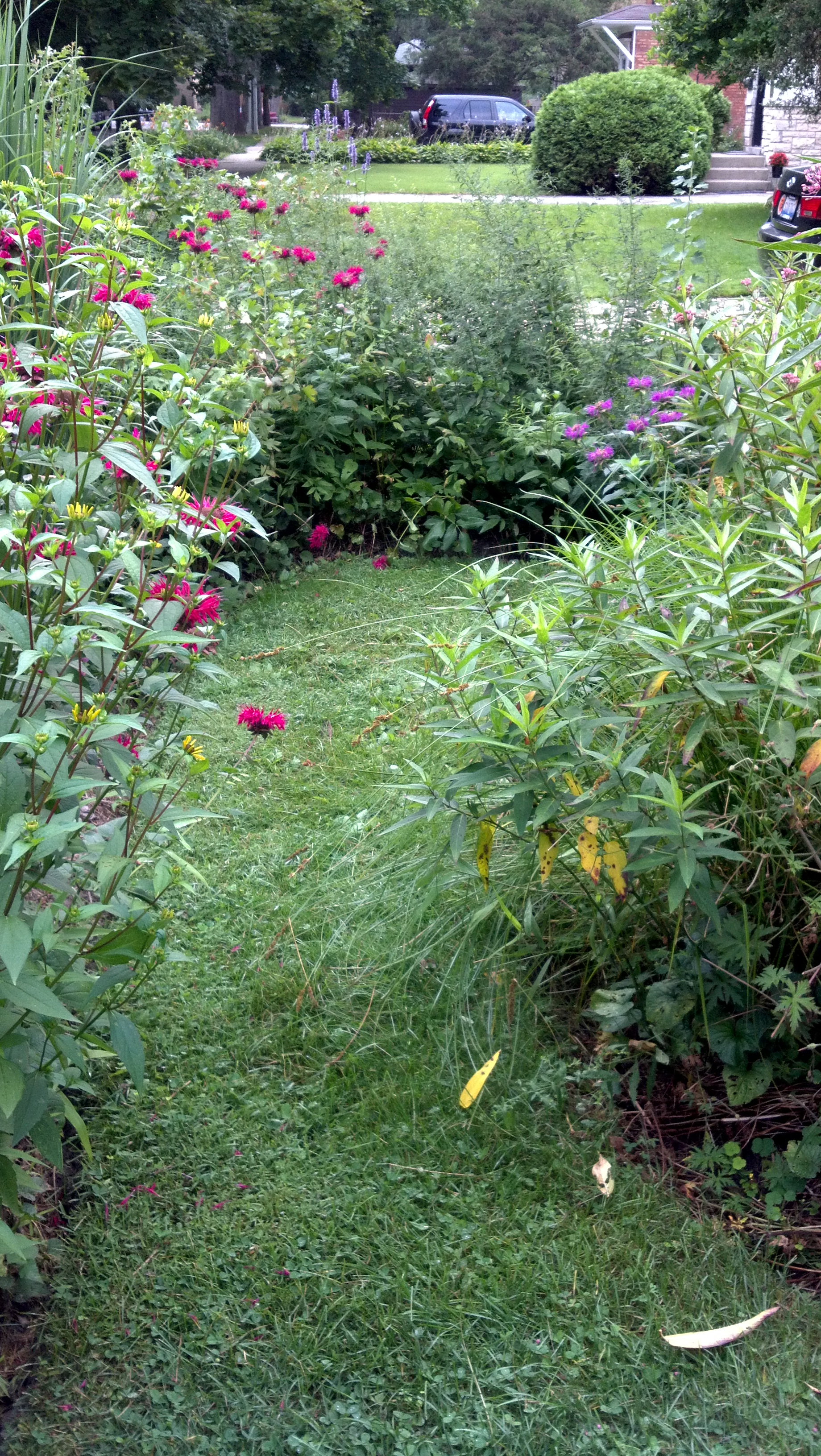
Path between the Island Bed and the Sidewalk Border.
And here is the path between the Island Bed and the Sidewalk Border.
What’s the tallest perennial flower in your garden?
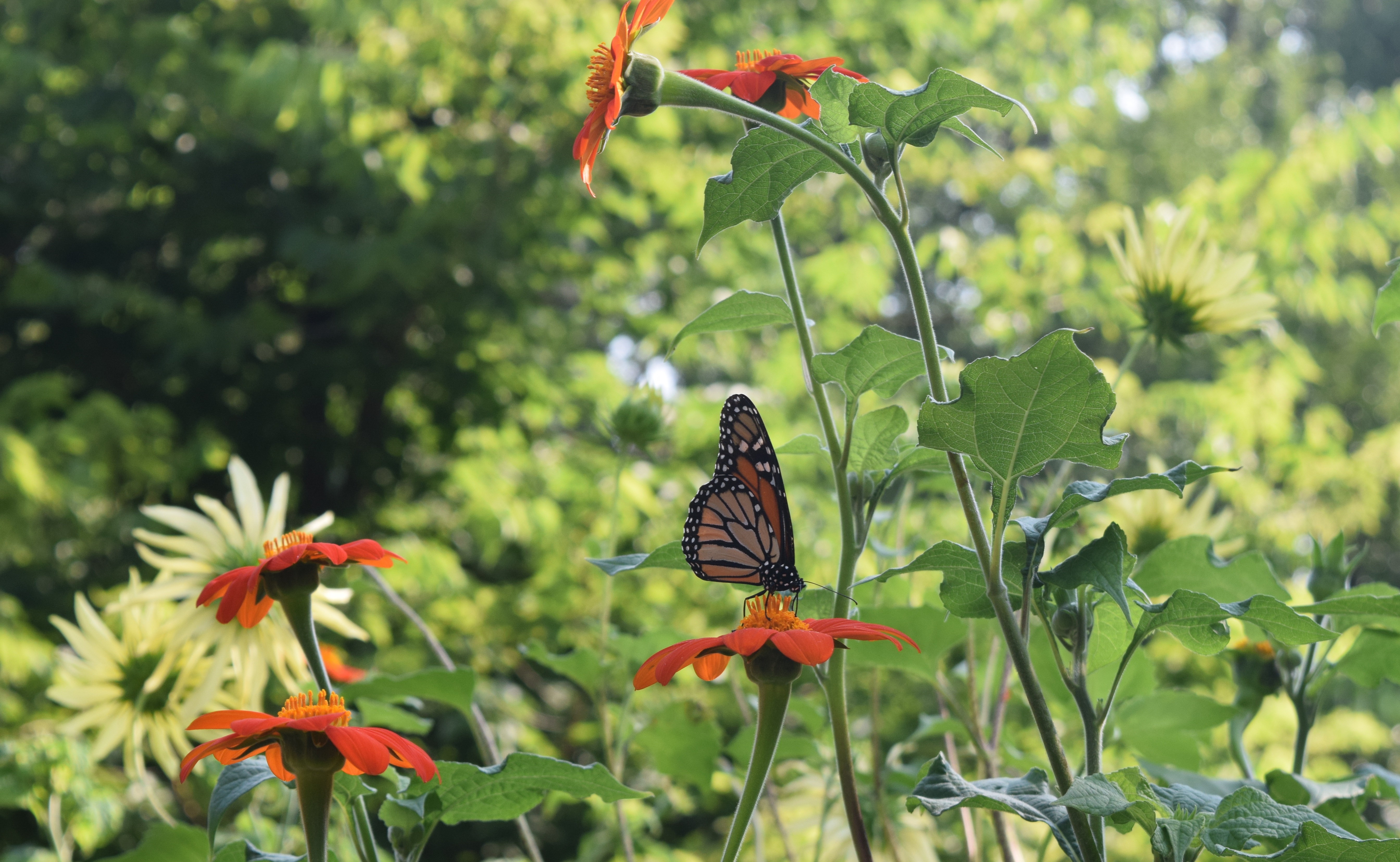
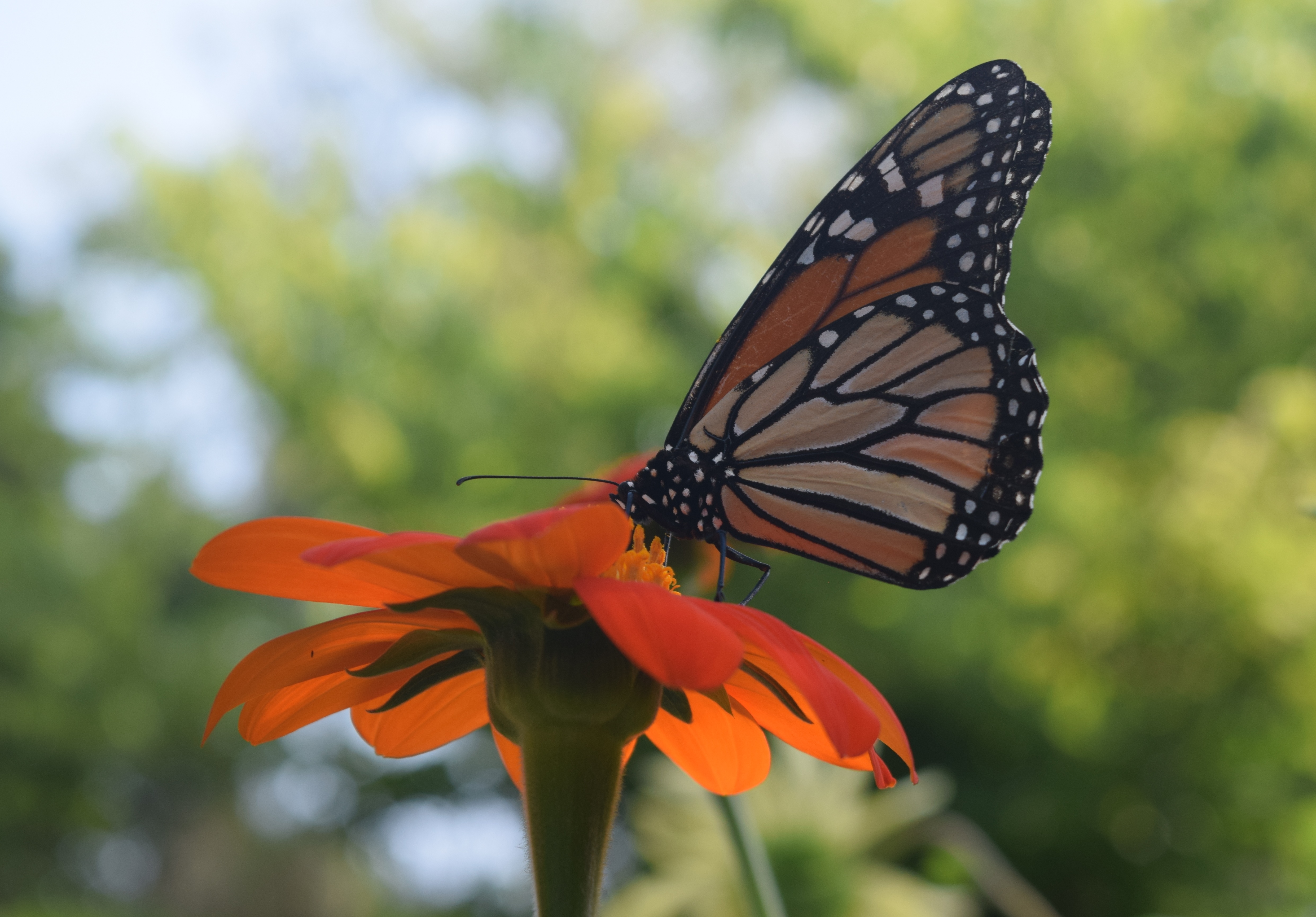
Friday morning there was a Monarch butterfly nectaring on the Mexican sunflower (Tithonia rotundifolia). It seemed so intent on the Tithonia that I was able to get pretty close and took a picture with my phone. Judy then came out, saw the Monarch, then ran back in for her good camera.
Monarch butterfly nectaring on Tithonia.
I posted my cell phone picture on Facebook, but at the risk of being duplicative I wanted to post some of her pictures on the blog.
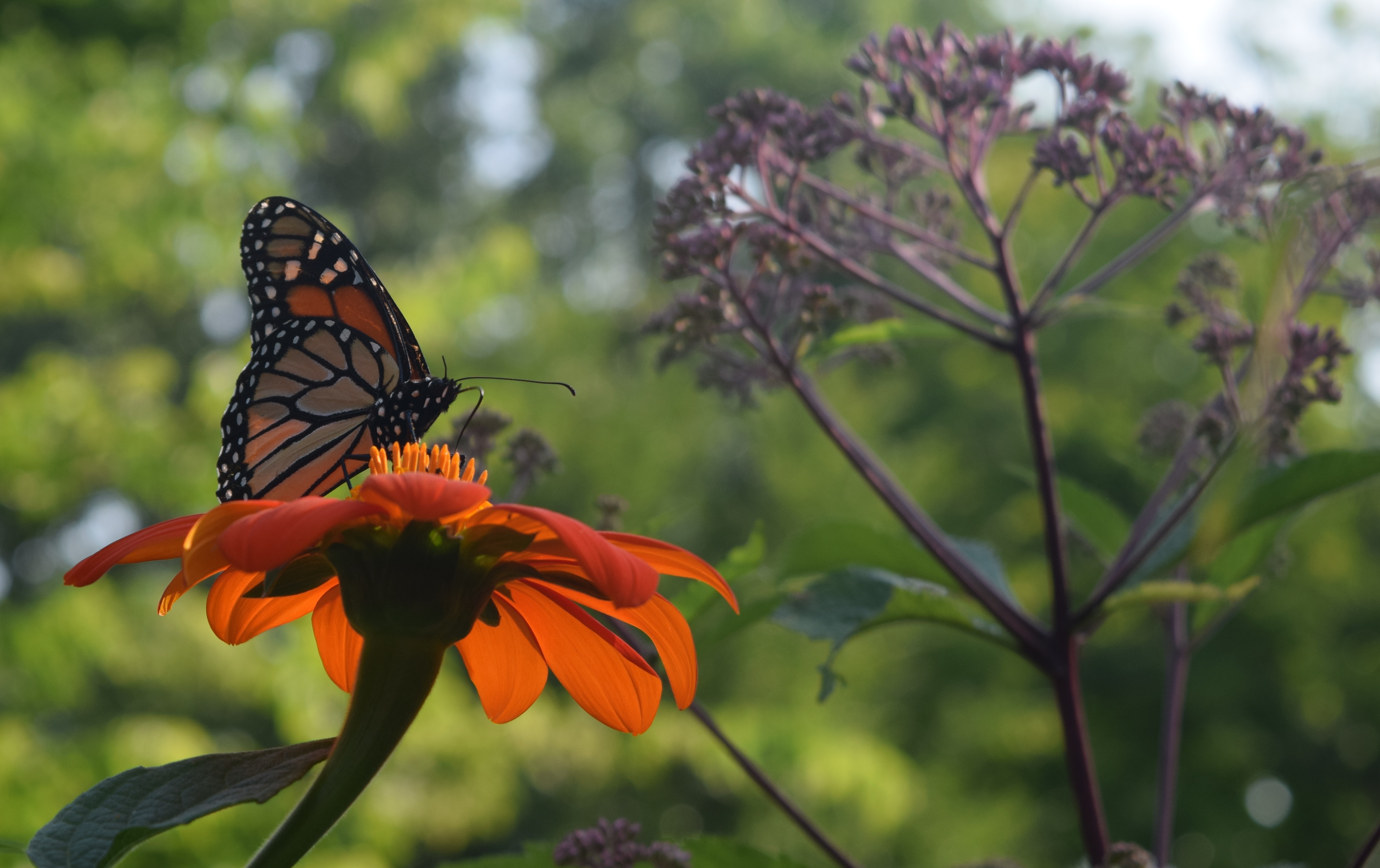
In this picture you get a good view of the butterfly using his proboscis for feeding.
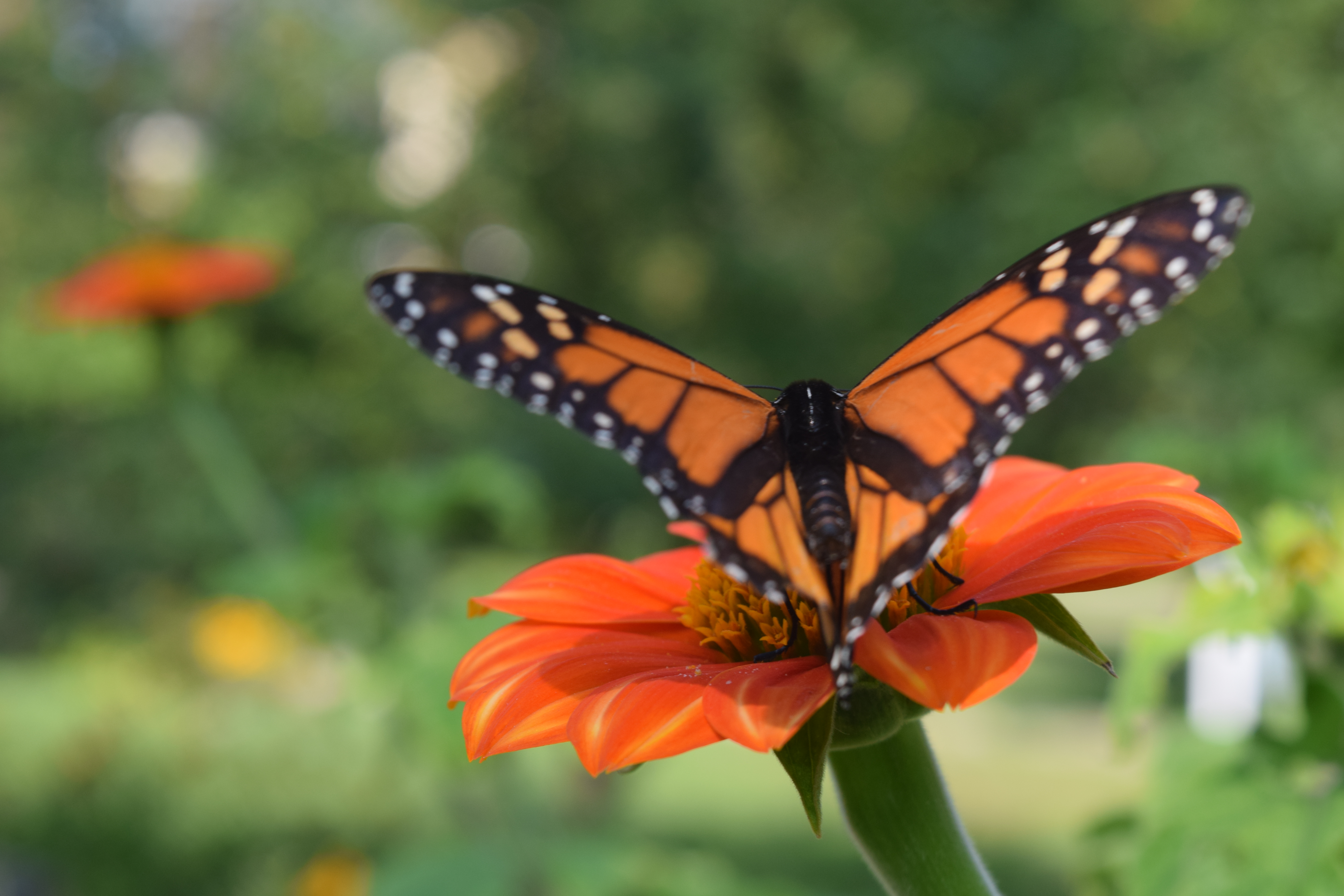
This particular Monarch was remarkably cooperative. He would stay on the same flower for a long time. Even when he flew off, he would land on another Tithonia flower within a few seconds.
They really do love Mexican sunflower.
Monarch spreading his wings to catch a few rays.
At one point he flew to a flower that was so high up Judy had to hold her camera above her head and point down. Despite that, this one came out very nicely, I think.
Were we late for work? Possibly. But seeing a Monarch always makes me feel more optimistic about the day.
Plants with bad posture: can’t stand ’em. Which is a problem in a garden like mine, intended to have an informal, even wild feel to it. Also, I like to grow big plants generally and especially wildflowers accustomed to a lean soil. My soil is fairly rich, the topsoil deep and with lots of organic matter.
Think this will be enough to hold the cup plant?
The result: plants generally grow tall, often much taller than it says in the catalog or reference book.
Some gardeners don’t need stakes, they have planned their gardens so well that the plants support each other. I am not one of those gardeners.
Staking perennial Helianthus with twine at Monet’s garden at Giverny.
I don’t feel too bad about this, though, as I have seen stakes used in some of my favorite public gardens.
Over the years I have acquired a vast arsenal of staking devices. These include green metal hoops, some with grids and some without. There are also an array of stakes, ranging from cheap little 2′ bamboo poles to 10′ lengths of rebar (really). Plus I like to make stakes from the woody stems that are the byproduct of ambitious pruning projects.
It’s easy to get carried away with staking. Then you can end up with a big multi-stem plant that looks squeezed at the waist as if wearing a corset. Or worse, pinched near the top as if prepared for a hanging. This is not a good look.
In order to avoid the corset or the noose, I have learned to tolerate leaning. Plants are going to lean – it’s just a question of how far.
I do try to reduce the need for staking by cutting plants back, by not watering unless absolutely necessary, and by declaring a personal moratorium on the application of compost (except for edibles and a few coddled favorites like clematis and roses).
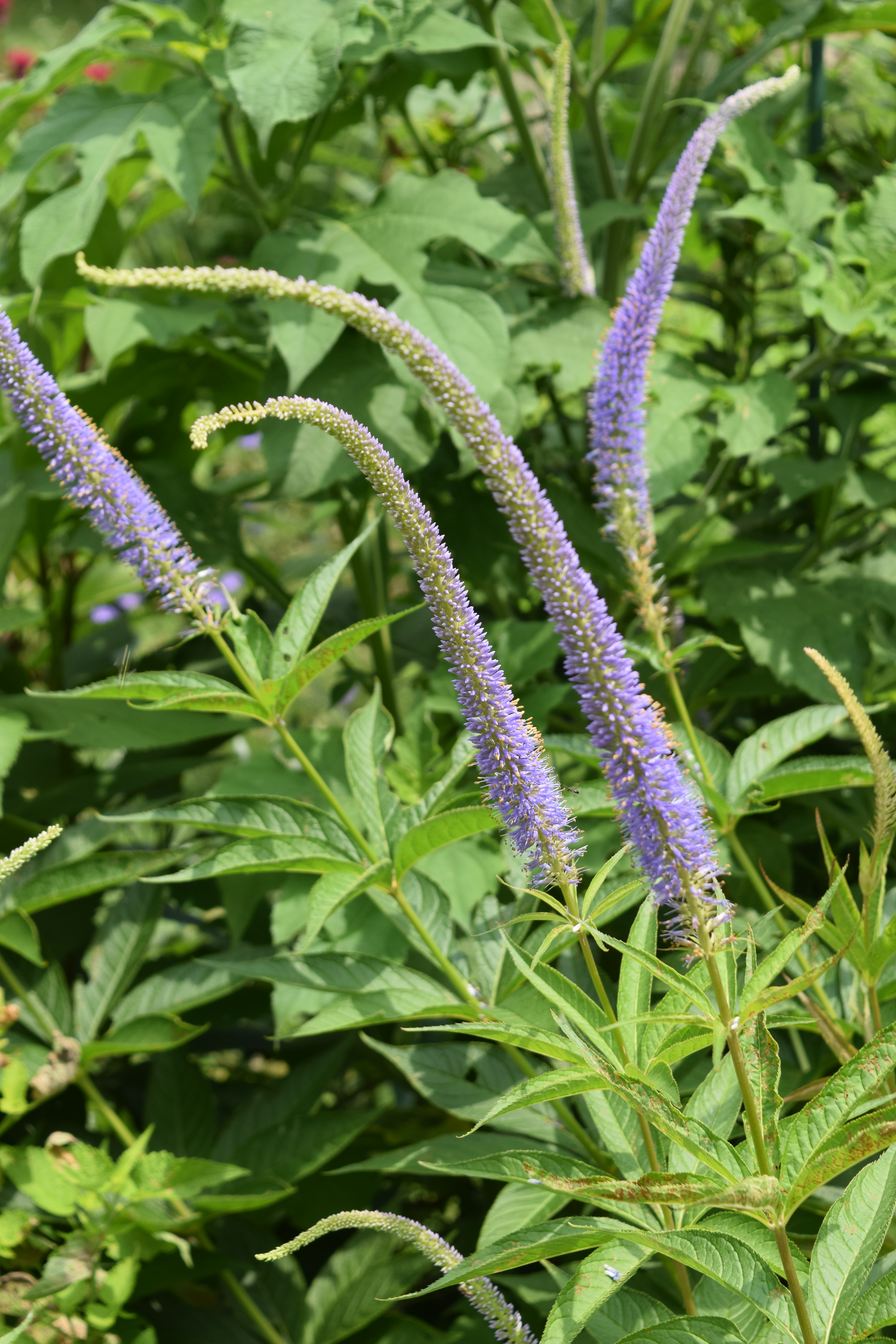
This Culver’s Root is growing through a hoop.
For a few plants, especially tall plants with slender stems (Penstemon, Veronicastrum), I use hoops. The hoops with grids work wonders for my peonies.
You don’t have to buy hoops, though. I get the same results by connecting three or four stakes with green twine, making a triangle or rough circle. If a grid is needed, connect the stakes in an X across the circle with the same twine.
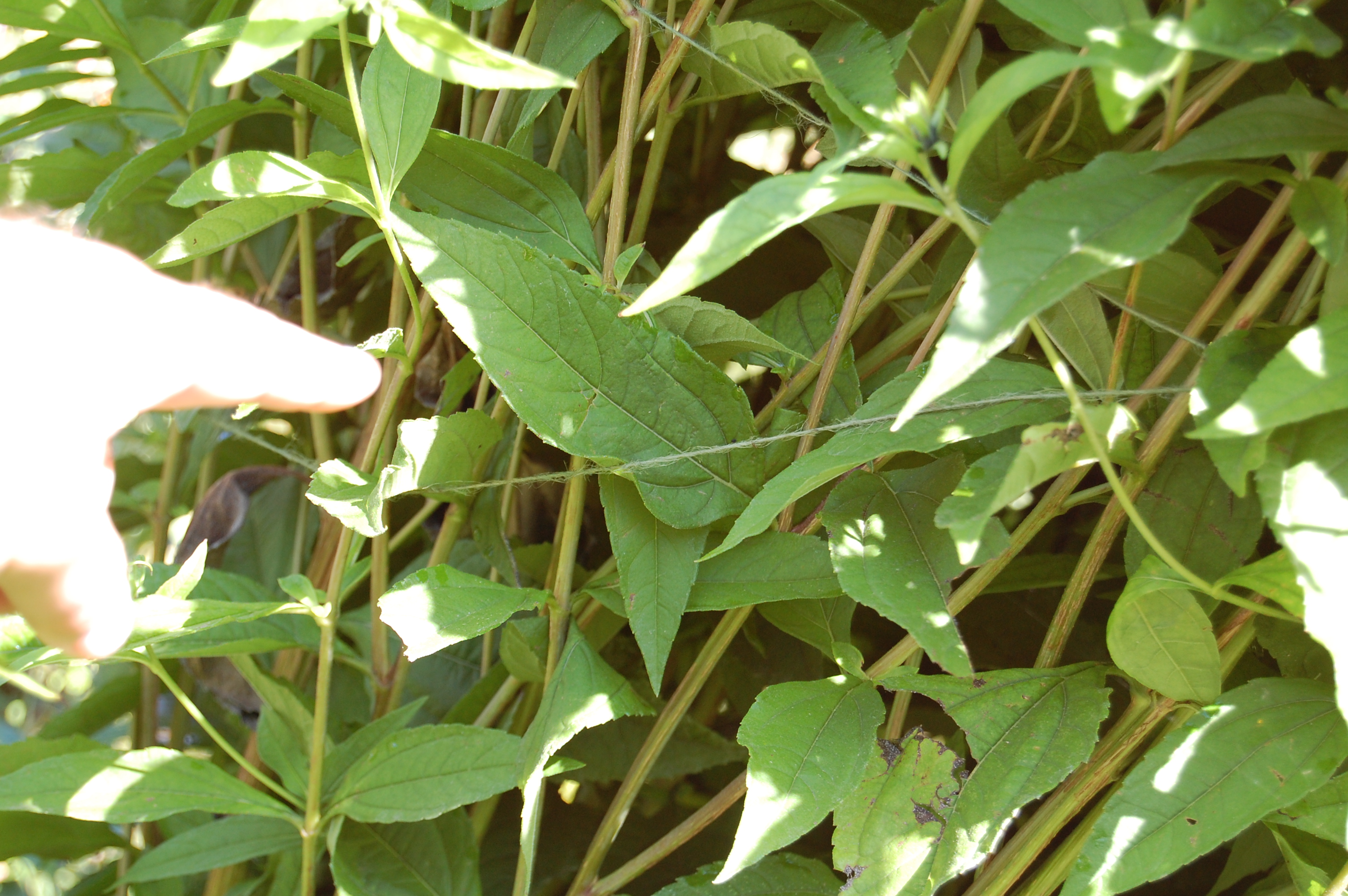
The wild bergamot towards the back is leaning on a length of twine.
If a drift of plants is inclined to lean in only one direction, I run some green twine between stakes at either end of the clump. The plants lean against the twine – not upright, but not sprawling on the ground either. I do this with the wild bergamot (Monarda fistulosa), with results that are satisfactory to me.
This usually works better for me than letting plants lean against two stakes stuck diagonally in the ground to form an X (which is recommended by Traci DiSabato-Aust) – though I do that sometimes as well.
I am gradually figuring out how to let plants lean more on each other. A happy surprise this year is how mixing annual sunflower (Helianthus annuus) and Mexican sunflower (Tithonia rotundifolia) into perennial beds can provide sturdy supports to floppier perennials. But I think I will always do a fair amount of staking.
Staking doesn’t have to be unsightly. I have left hoops in the ground over winter and they are visible early in the season. Before long, though, they are hidden by leaves. Stakes can be placed just inside (or leaning into) a clump of plants so they are unobtrusive, and I generally find twine dyed green ends up almost invisible to most eyes.
Do you have a preferred method of staking, or is your garden a stake-free zone?
So you have to be careful about what you say to Judy. One day I casually mention that people really liked her overview shots of the garden and maybe she should do more of those. Next thing you know, she’s sitting on a windowsill on the second story of our house, both feet dangling over the side. Aside from the risk involved, it was a pretty good idea on her part, as we have never had pictures of the front garden from this perspective.
The view from on high: Sidewalk, Driveway Borders and Island Bed in the Front Garden.
Anyhow, I think these are the first shots of our front garden ever taken from above. Here’s an overview of the whole front on the east side of the driveway.
Far end of the Driveway Border.
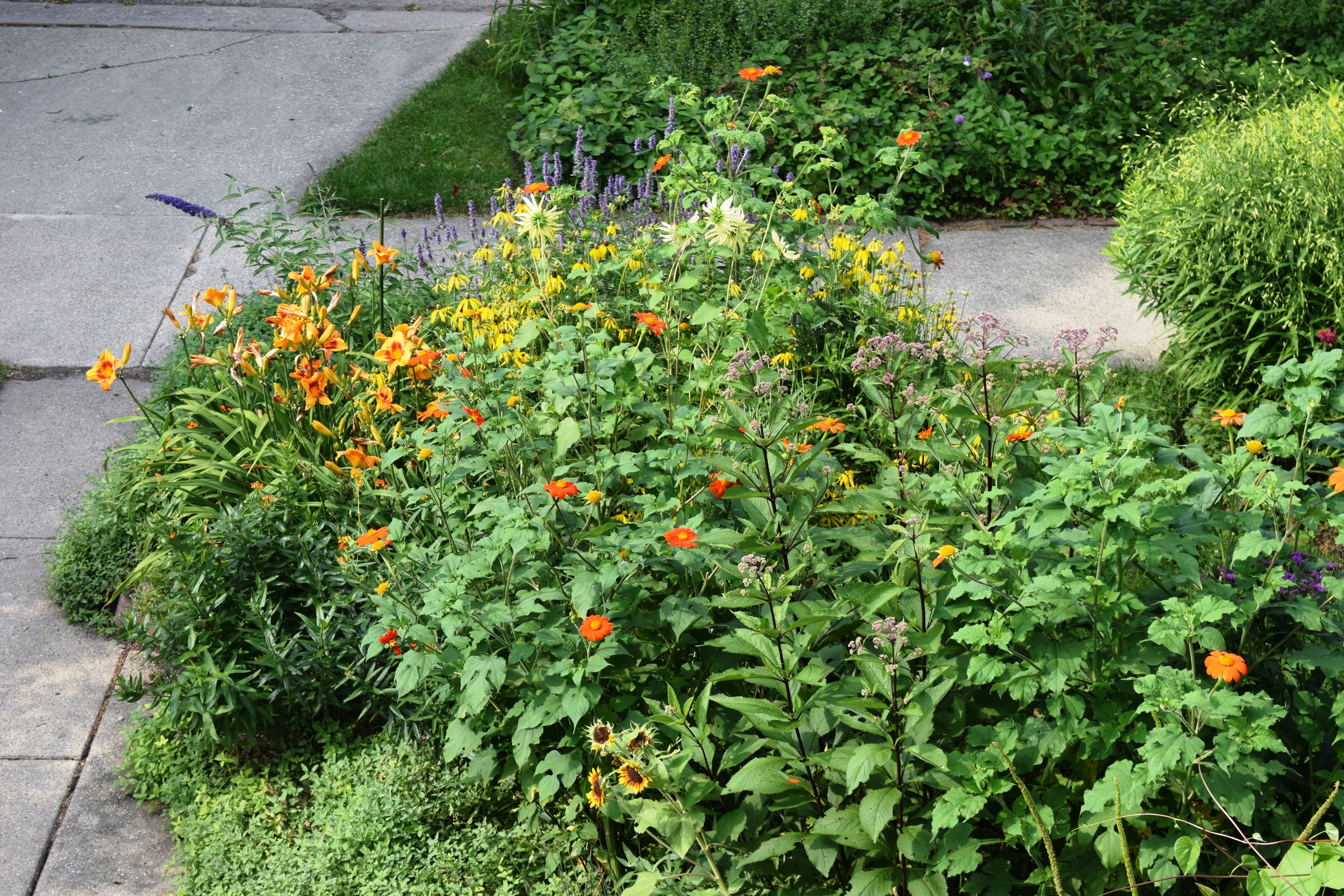
At the far end of the driveway border, we’re all about orange and yellow right now. There’s the orange of the Mexican sunflower (Tithonia rotundifolia) and ‘Eye-yi-yi’ daylilies (Hemerocalis), though I’ve had to cut back the butterflyweed (Asclepias tuberosa) in hopes of another flush of blooms. Then there’s the pale yellow of the ‘Italian White’ sunflowers (Helianthus annuus) and the golden yellow of the yellow coneflower (Ratibida pinnata).
Looking a bit closer.
The ‘Gateway’ Joe Pye weed (Eupatorium purpureum ssp. maculatum) is still forming its flowerheads. At the far end of the far end you can just make out the blue of the anise hyssop (Agastache foeniculum) and the first flower spike of my ‘Adonis Blue’ butterflybush (you can click on the pictures to make them bigger).
Driveway Border, closer to house.
At the other end of the Driveway Border, the biggest drift of color is the lavender of wild bergamot (Monarda fistulosa). The Monarda goes nicely with the yellow early sunflower (Heliopsis helianthoides ‘Prairie Sunrise’). There is also a clump of purple tall ironweed (Vernonia altissima) that’s begun to bloom, but it’s not very visible from this vantage point.
The ‘Heavenly Blue’ morning glory (Ipomoea tricolor) is driving me insane by covering itself in flower buds that seem to have no interest in EVER blooming. I’m wondering if this is some new, more sophisticated variety where you just appreciate the subtle beauty of the flower buds without the distraction of any actual flowers.
Island Bed
The cup plant (Silphium perfoliatum) is now blooming in the Island Bed. So is the sweet Joe Pye weed (Eupatorium purpureum), but from here you can just barely see its dusty pink blooms between the cup plant stalks. Another thing you can’t see is that there really are grass paths between these beds, but they are obscured by all the tall plants.
The purple in front of the cup plant is ‘Purple Rooster’ bee balm (Monarda didyma). You can also make out a few clusters of pink swamp milkweed blooms (Asclepias incarnata). The swamp milkweed blooms later than the butterflyweed.
Island Bed and Sidewalk Border
This gives a pretty good view of both the Island Bed and the Sidewalk Border. You can see that the ‘Northwind’ switchgrass (Panicum virgatum) has bulked up nicely, and that there is still plenty of red from the ‘Raspberry Wine’ bee balm (M. didyma). Orange Zinnias and yellow daylilies bloom on the parkway bed.
The Cutting and Edibles Bed.
On the other side of the driveway, there’s the Cuttings and Edibles Bed. More ‘Italian White’ sunflowers, plus a few ‘Cut and Come Again’ Zinnias (Zinnia elegans). Also lots of parsley (Petroselinum crispum) and fennel (Foeniculum vulgare), plus three tomato plants trained on wooden trellises. Sadly, no caterpillars.
‘Egyptian Spice’ daylilies.
In the Crabapple Bed to the south, Asiatic lilies no longer bloom around the ‘Donald Wyman’. However, there are apricot-colored ‘Egyptian Spice’ daylilies, dark red ‘Chicago Apache’, as well as more ‘Eye-yi-yi’ facing west.
Actually, Judy took these pictures while I was away at a meeting in Urbana. If I had been there I would have 1) taken a picture of her sitting on the window sill, and 2) asked her if she had gone completely insane. But when I got home, all I could do was thank her for the photos, which I really like.
I’m joining in the End of Month View meme, sponsored by Helen at The Patient Gardener. Click on the link to see more long views and overviews of great gardens at the end of July.
You may know from earlier posts that the prairie-style Lurie Garden, in the heart of downtown Chicago, is my favorite American public garden. Jennifer Davit, the Director and Head Horticulturist at the Lurie, was recently nice enough to answer a bunch of questions I sent her.
Jennifer Davit Photo: Chicagoflower.com
Prior to taking her current position, Jennifer was the Director of Conservatory and Special Projects for Miami’s Fairchild Tropical Botanical Garden. She has also worked in gardens in California, Hawaii, and Washington, DC. She has a Masters Degree in Public Garden Management from Cornell University.
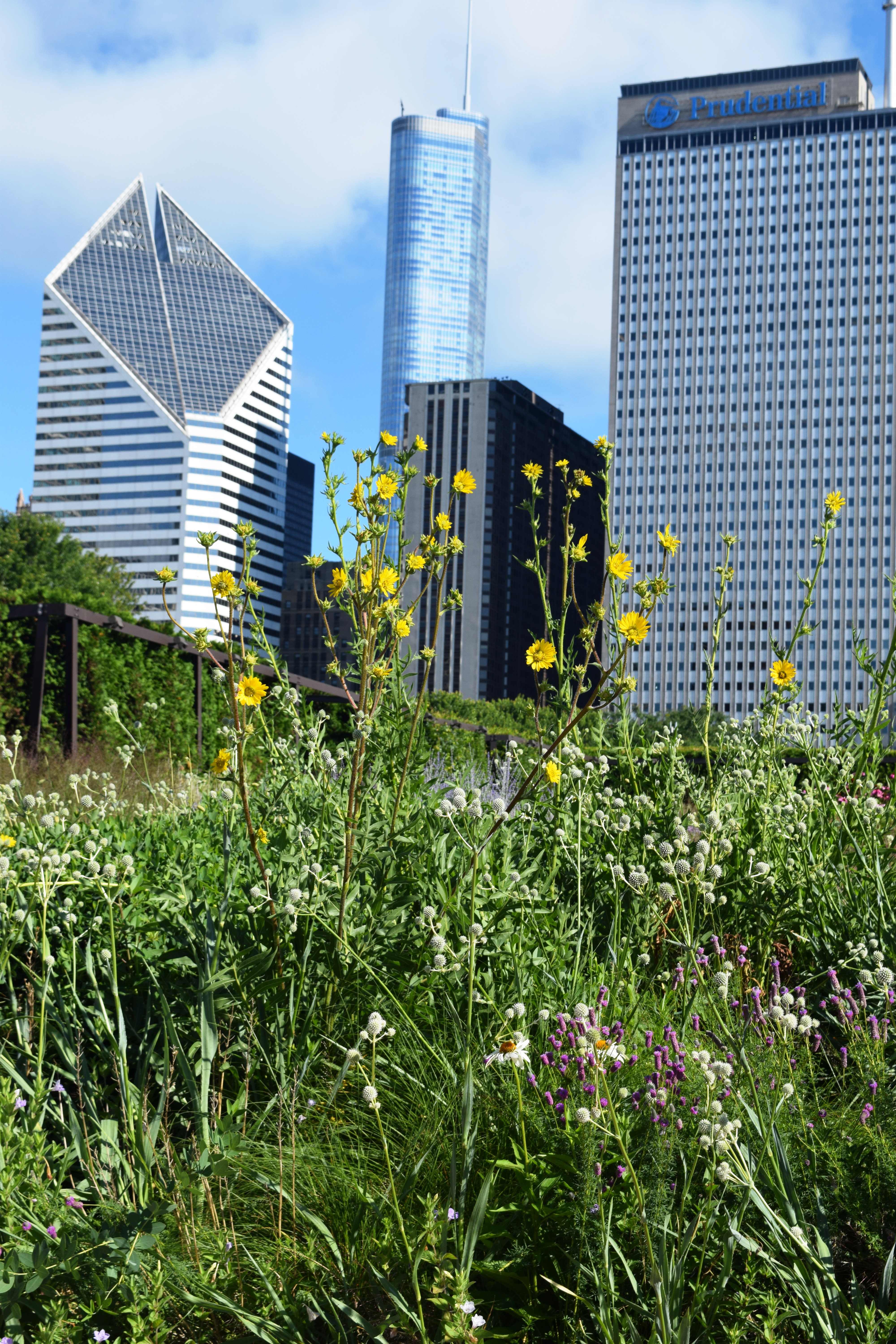
Compass plants (Silphium laciniatum) echo the Chicago skyline, or is it the other way around? Incidentally, the hedge around Lurie is called the Shoulder Hedge, a reference to the Carl Sandburg poem ‘Chicago’.
We have some new pictures of the Lurie in mid-Summer to go along with the interview thanks to Judy, who brought her camera to work one day last week.
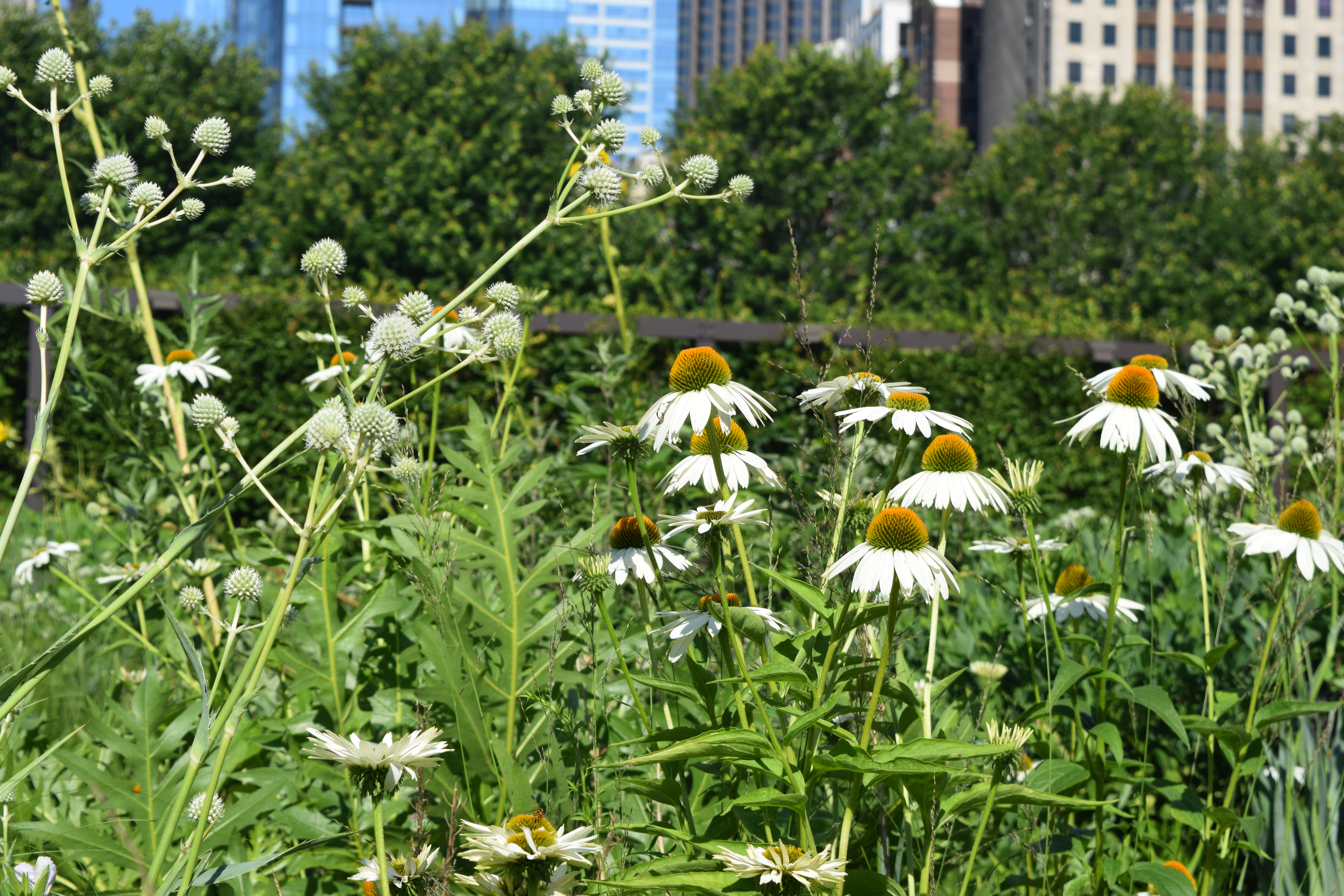
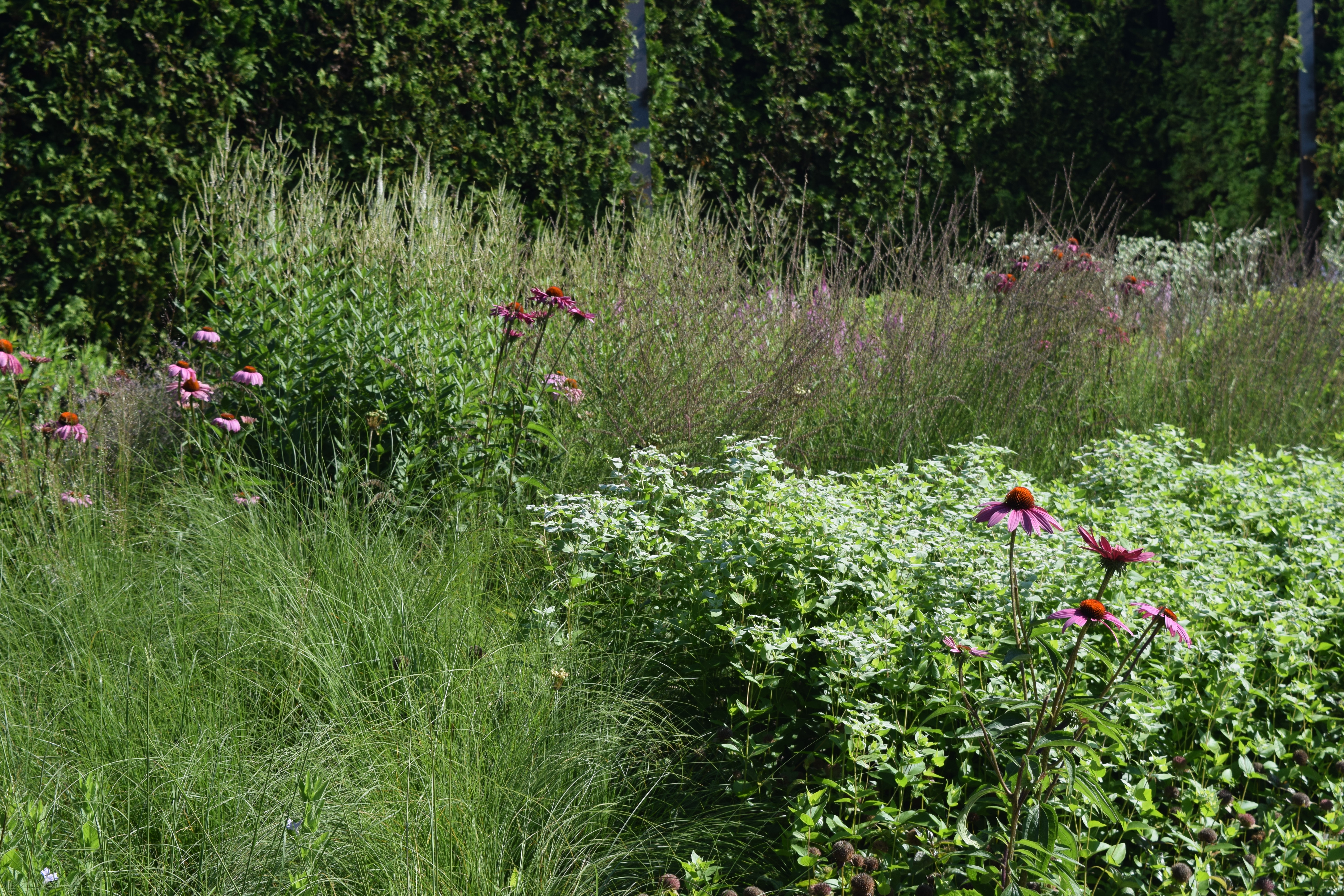
Echinacea and rattlesnake master (Eryngium yuccifolium). Lurie grows eight kinds of Echinacea; I won’t guess which one this is.
Q. You worked in a tropical garden in Miami for years. What made you want to come to Chicago with such a different (and colder!) climate and plant palette?
JD: I loved growing tropical plants, but growing plants in a conservatory requires constant use of fertilizers and pest control. I was looking for a position that embraced sustainability and environmentally conscious gardening in the way the Lurie does. I was also born in Chicago, and though my parents live in Ohio now, we do have a lot of family and friends in the city.
More compass plant against the skyline.
Q. Your title is “Director and Head Horticulturist”. What takes up most of your day during the gardening season?
JD: I don’t spend nearly as much time gardening as I would like. We are lucky to have an excellent horticulturist, Laura Ekasetya, who is out in the garden every day. When I am out gardening, though , most of my time is spent editing – removing in-seeded or migrating perennials. We try to keep the original design intent and part of that is making sure plants do not move too far out of bounds so you can still see the beauty of Piet [Oudolf]’s design.
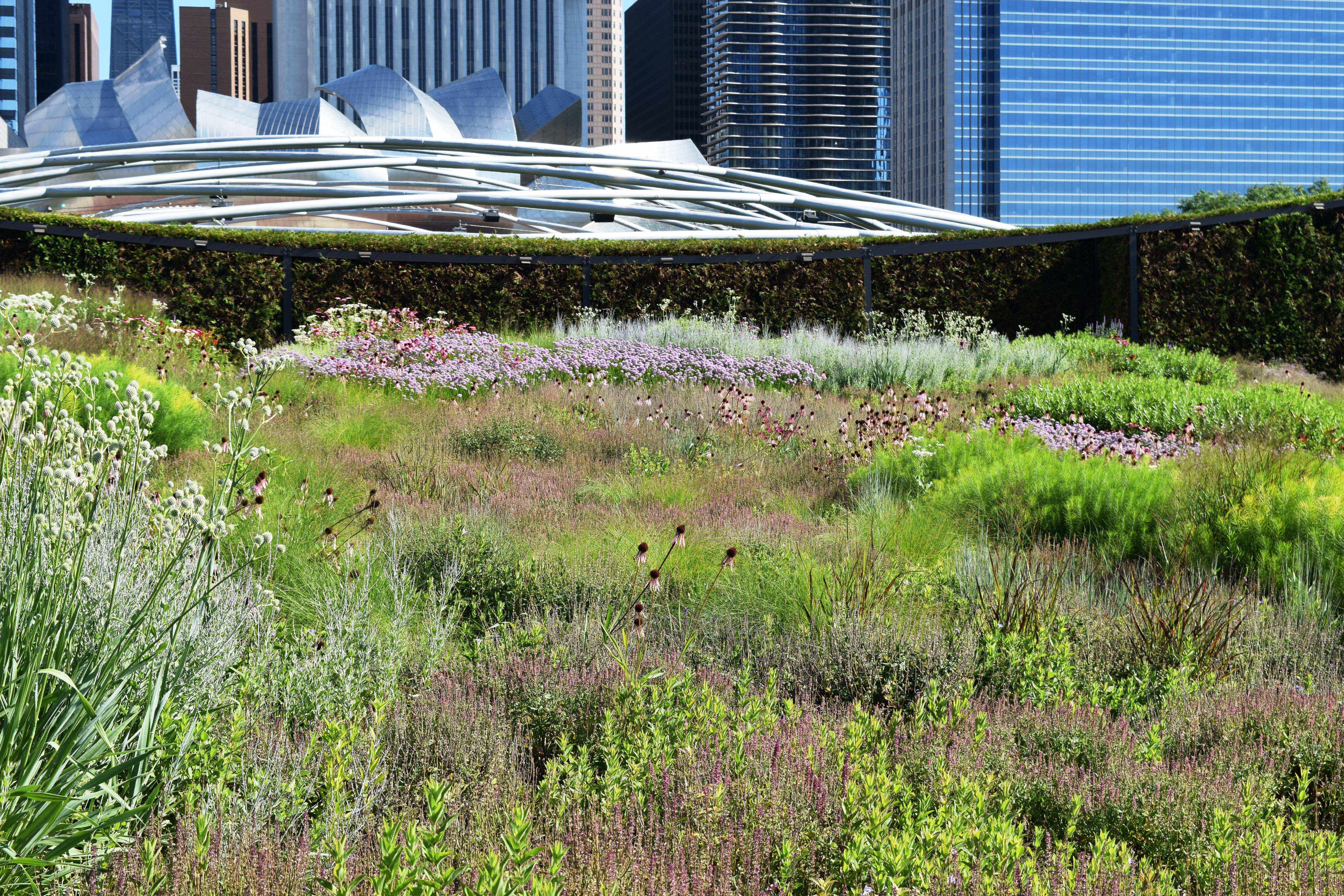
Even without flowers, Lurie offers an enchanting patchwork of colors and textures.
Q. The Lurie Garden covers 5 acres. How many person hours does it take to maintain?
JD: It’s about 90 hours a week of maintenance, of which 24 comes from volunteers. We then hire contractors to maintain the Shoulder Hedge [the hedge that separates Lurie from Millenium Park] and do most of the pruning of the other woodies around the perimeter of the garden.
Lurie Garden volunteer at work.
Q. How much effort is required to prevent invasive species from establishing themselves in the garden?
JD: Some of the plants we grow in the Lurie are prolific seeders. With some plants, like Phlomis, we will remove one half to two-thirds of the seedheads because they will seed everywhere. Then there is enough left over for winter interest, but not so much that the seedlings become unmanageable.
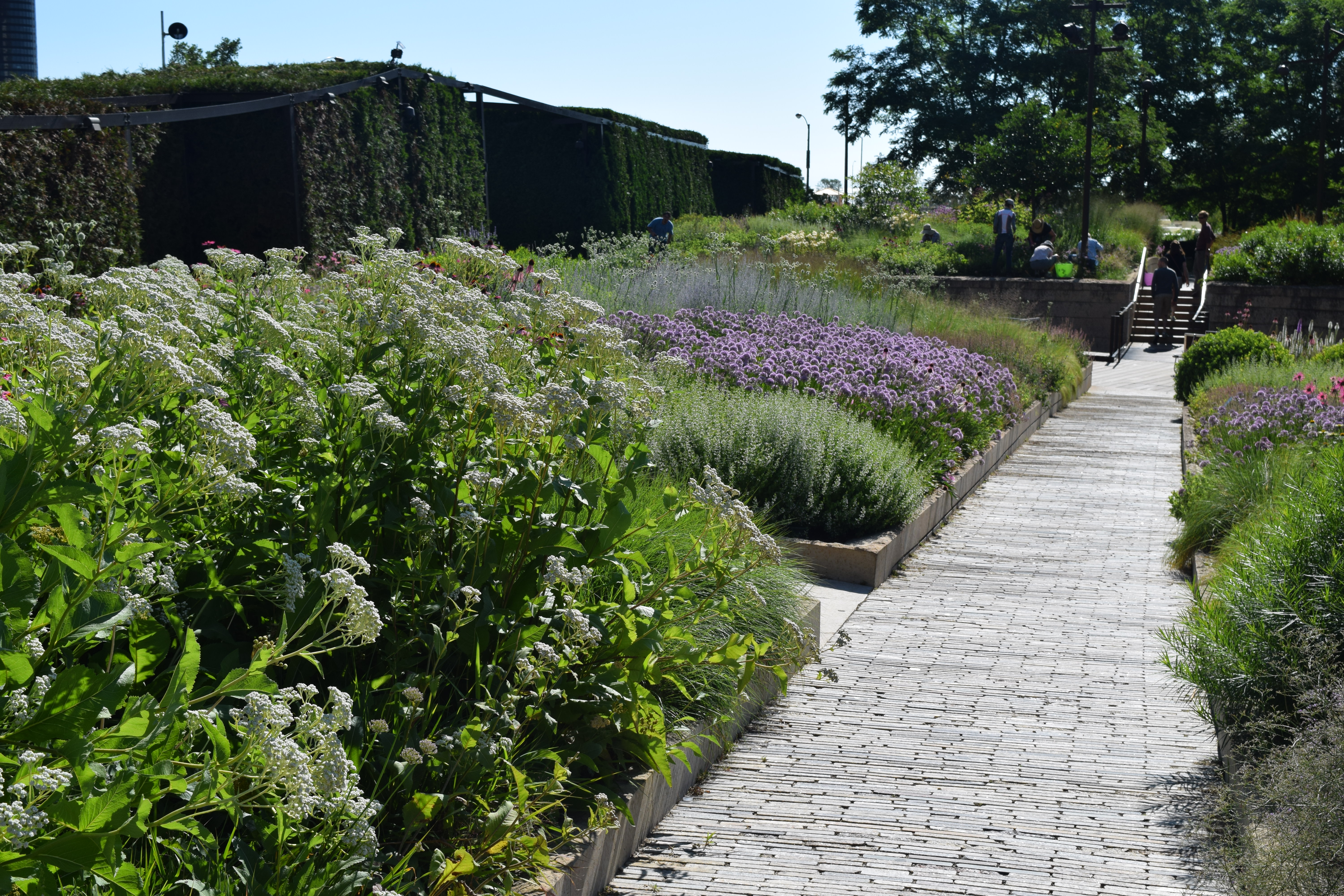
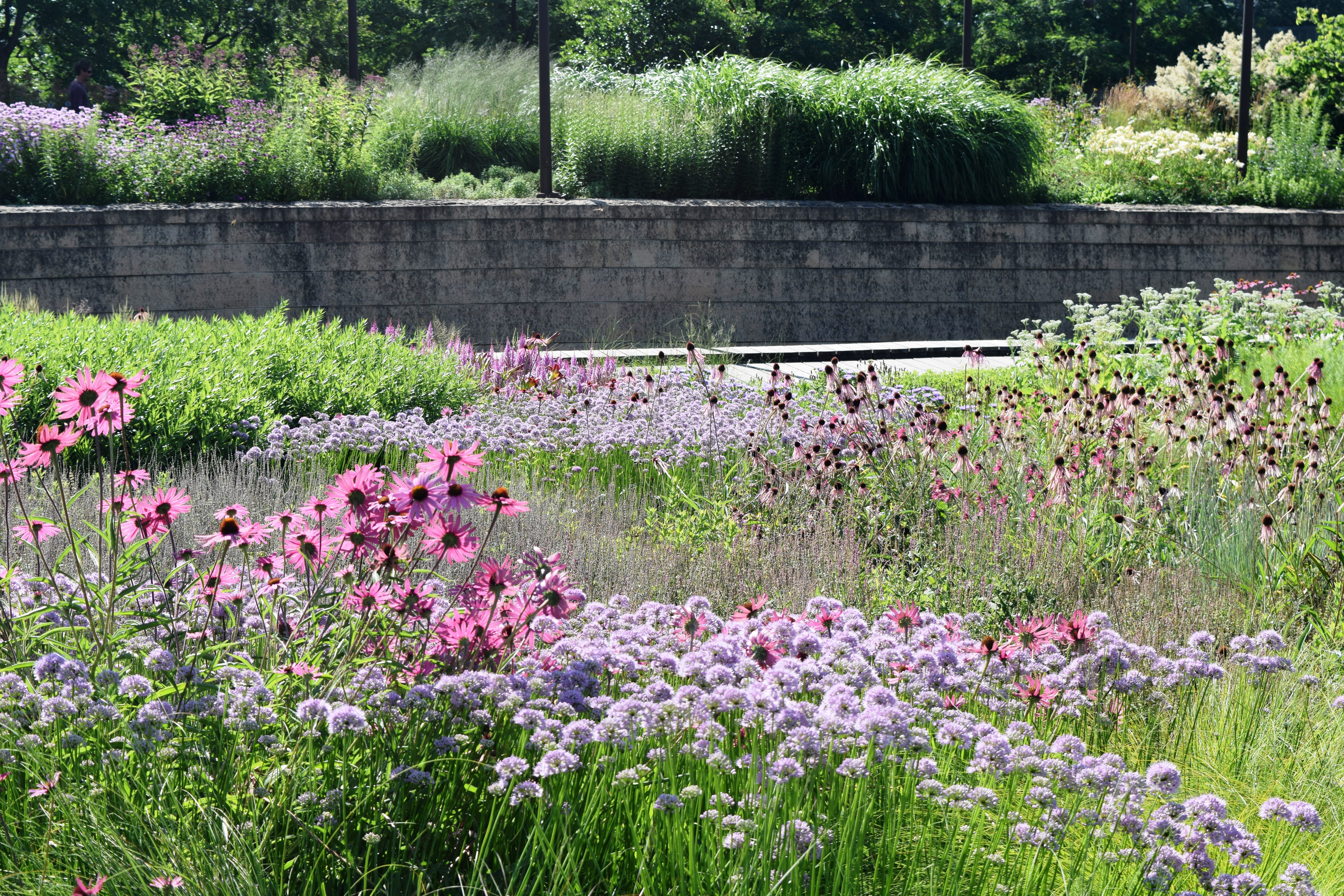
Big drifts of ‘Summer Beauty’ Allium are gorgeous in July.
Q. Are any fertilizers or soil conditioners used at Lurie?
JD: In the perennial planting beds we do not use any fertilizers or soil conditioners. Most of the plants love a lean soil and perform better in prairie-like conditions. On the Shoulder Hedge we do use an OMRI [Organic Materials Review Institute] certified time release fertilizer called Boost.
Q. The perennial plants at Lurie seem to grow without much intervention such as staking, cutting back, and dividing. Is that really the case or do you just make it look that way?
JD: We do avoid staking, but we also pinch back some plants mid-season to keep them from flopping over. With some plants like Geranium ‘Orion’, when we see the new basal foliage growing we go ahead and cut back the older foliage and that promotes a new flush of growth. Because all of our plants are grown without fertilizer in a lean soil, and we do not water too much, the plants perform better in this setting and do not need as much intervention.
Pale purple coneflower (Echinacea pallida) with switchgrass (Panicum virgatum).
Q. Do you have anyone tracking the birds and other wildlife drawn to Lurie?
JD: A friend of the garden, David Johnson, is a birder and works at the AON building across the street. He keeps track of all the birds he sees and shares that information with us. We are also part of e-bird, the citizen science program http://ebird.org/ebird/hotspot/L2132400.
Straight pathways preserve a sense of order.
Q. Piet Oudolf mentioned recently during a lecture in Chicago that some plants included in the original design have been removed from the Lurie garden. Have you been surprised by any particular plants that have or have not worked well at the garden?
JD:Achillea ‘Paprika’ (yarrow) was originally planted in the garden in 2004 and it didn’t perform well at the time and pretty much died out. Then in 2012 we planted Achillea ‘Moonshine’ and it has been an amazing addition. Sometimes cultivar selection can be the key. I also think that when the garden was first planted, everything was watered regularly. When A. ‘Moonshine’ was planted we watered only when needed, which was not as often as other new plantings. It is a really tough plant that likes to be on the dry side, so knowing that and tailoring our watering schedule to suit it was key.
Flowers backlit in the morning sun.
Q. Do you have any guidelines in terms of the ratio of grasses to flowering plants, or native to exotic?
JD: No guidelines – if it looks good and grows well, then it is in the right place!
More ‘Summer Beauty’ with calamint (Calamintha nepeta).
Q. What in particular do you love about your job?
JD: I love the human element of the Lurie Garden. People who would not visit a garden will visit Lurie because it’s downtown. The Lurie Garden serves as a gateway into gardening and developing an appreciation for nature. I love seeing the look of surprise, delight, and wonder on people’s faces when they walk through the hedge and see this amazing garden. It’s priceless and makes this job so rewarding. I also work with an amazing team of people, our horticulturist, program manager, volunteer manager, membership manager, and intern – I love working with them.
Echinacea with Russian Sage ‘Little Spire’ (Perovskia atriplicifolia).
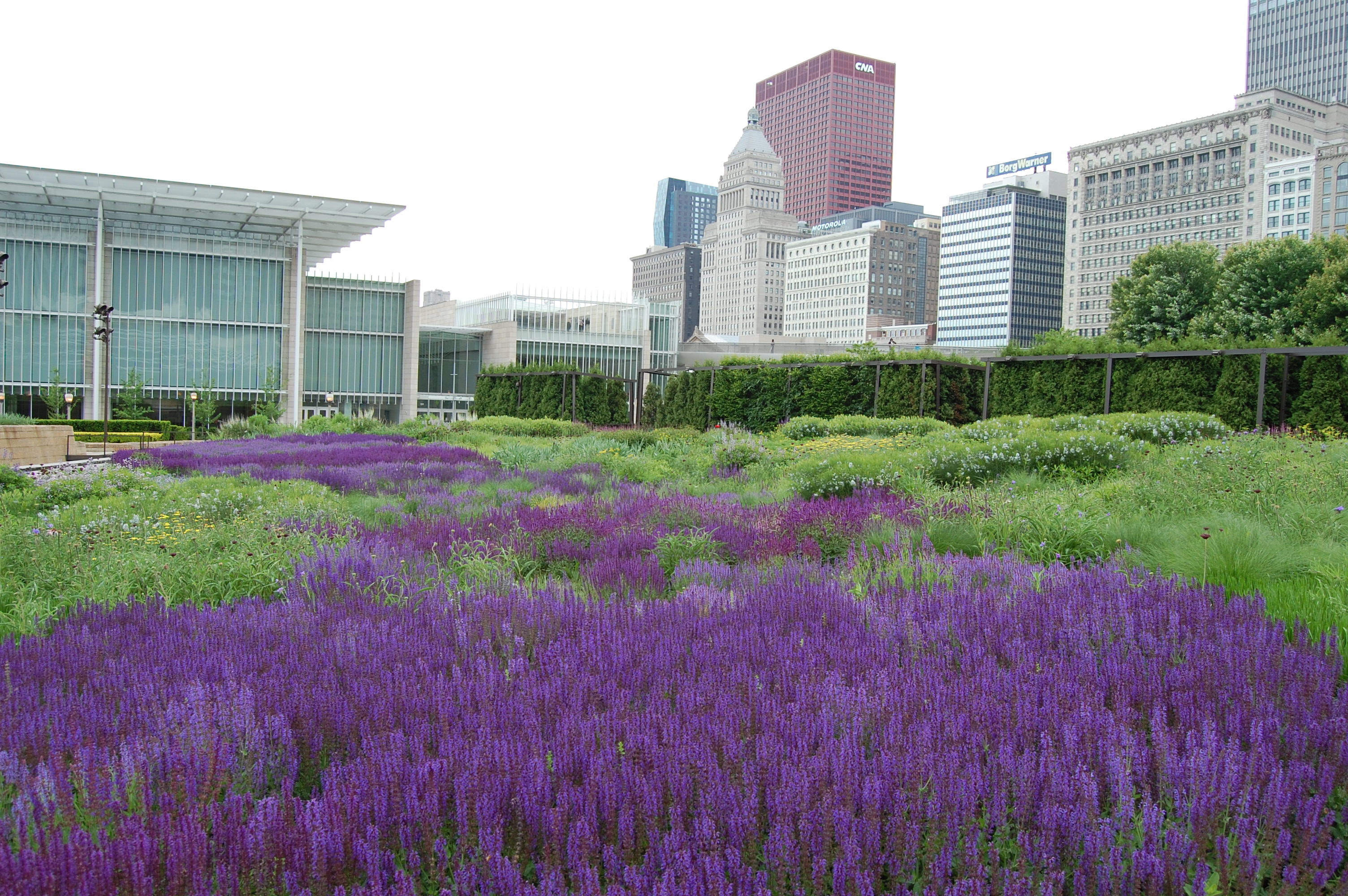
Q. Can you promise me that you will never do away with the River of Salvia?
The River of Salvia. Photo taken June 6, 2014.
JD: It will always be part of the design. It’s now an iconic part of Chicago!
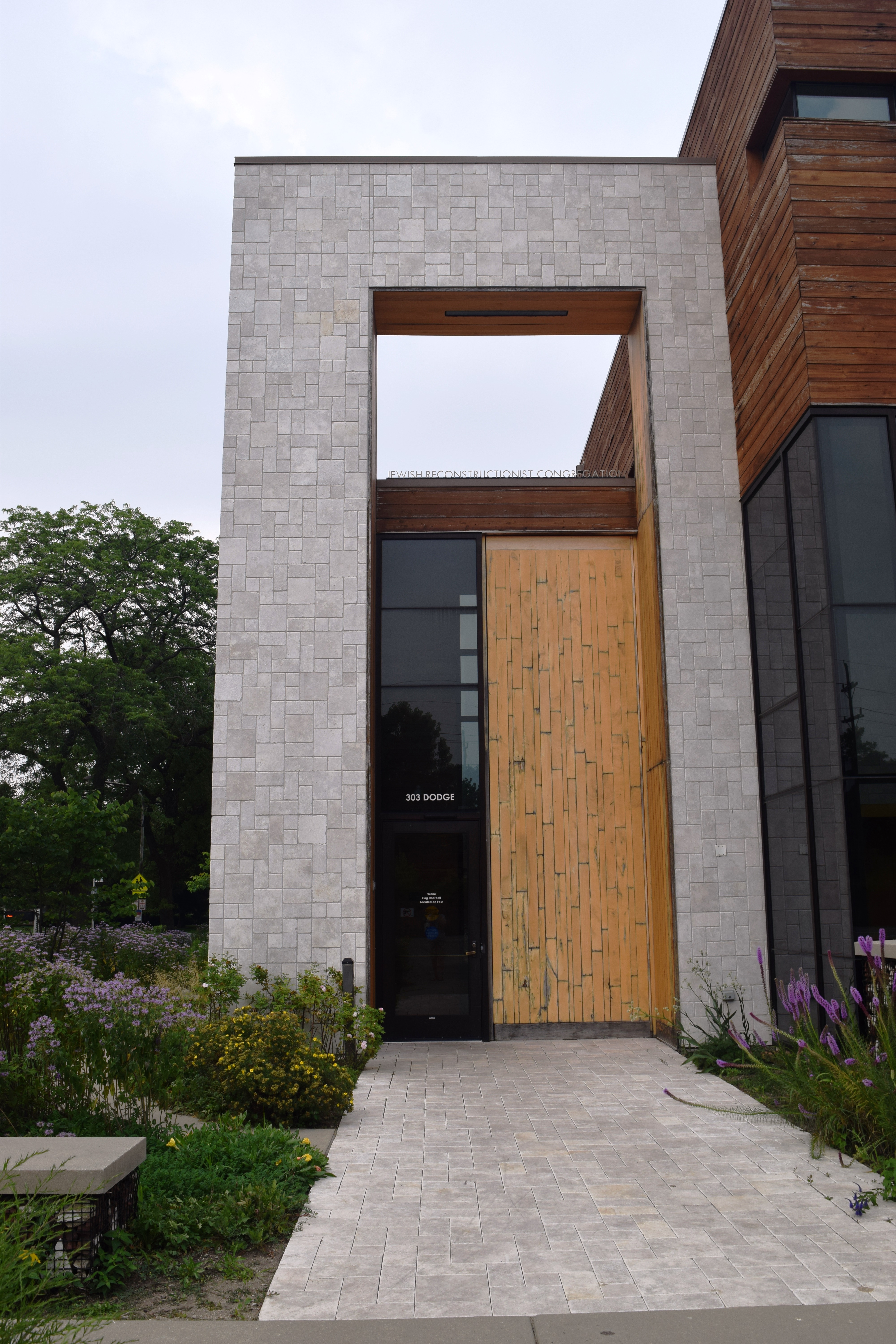
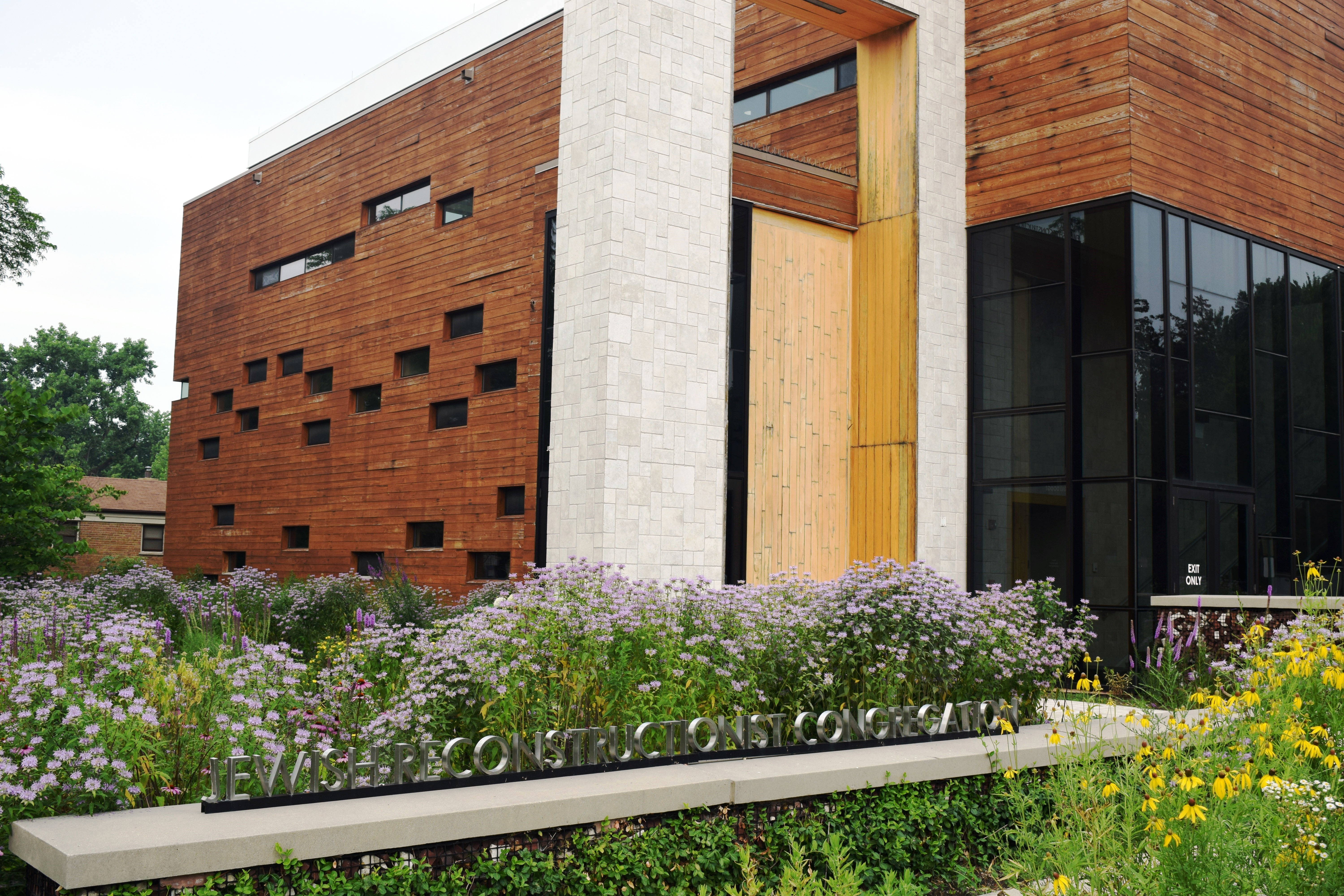
Almost every day Judy and I drive by the garden of the Jewish Reconstructionist Congregation of Evanston. Today we decided to walk the mile from our house to give it a closer look. This garden was created when the congregation rebuilt their old synagogue so as to meet the highest certification standards of the US Green Building Council’s Leadership in Energy and Environmental Design (LEED) program.
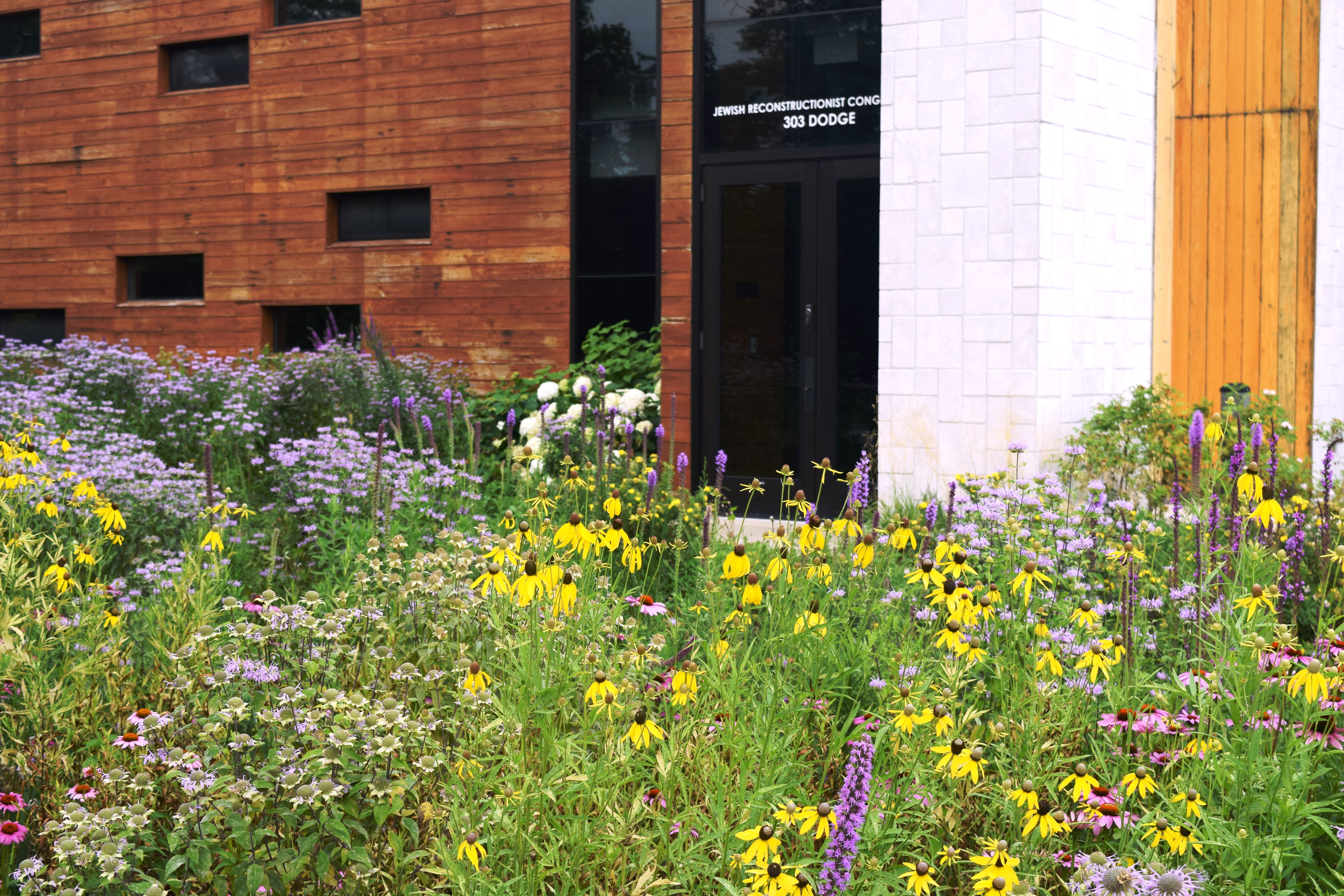
Entrance to the Jewish Reconstructionist Congregation.
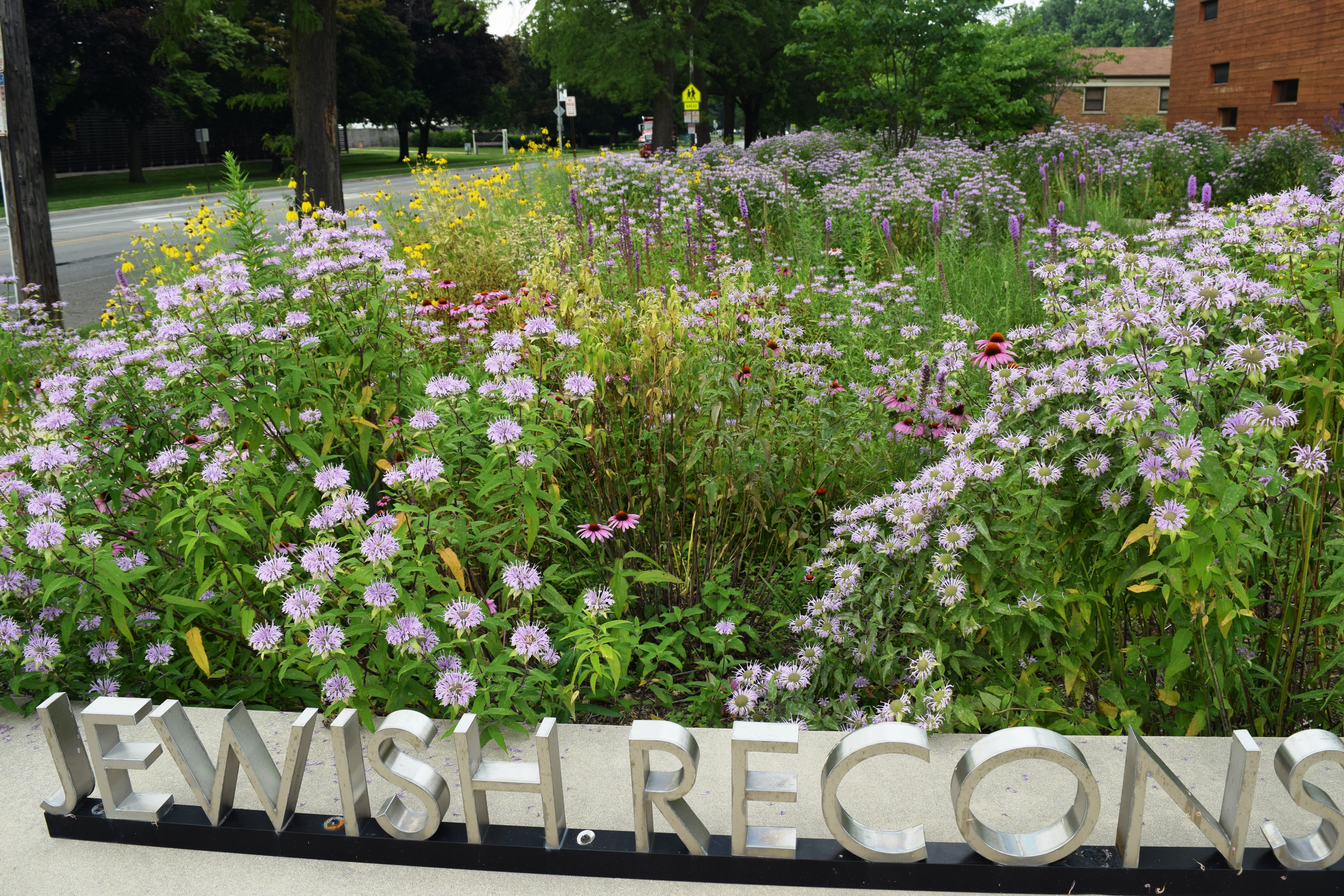
The garden utilizes predominantly native plants and a minimum of inputs. Lying between Dodge Avenue and the west side of the synagogue, it is mostly in full sun, though there are two sizeable redbud trees (Cercis canadensis). (Speaking of sun, the day was quite overcast and less than ideal for taking pictures.)
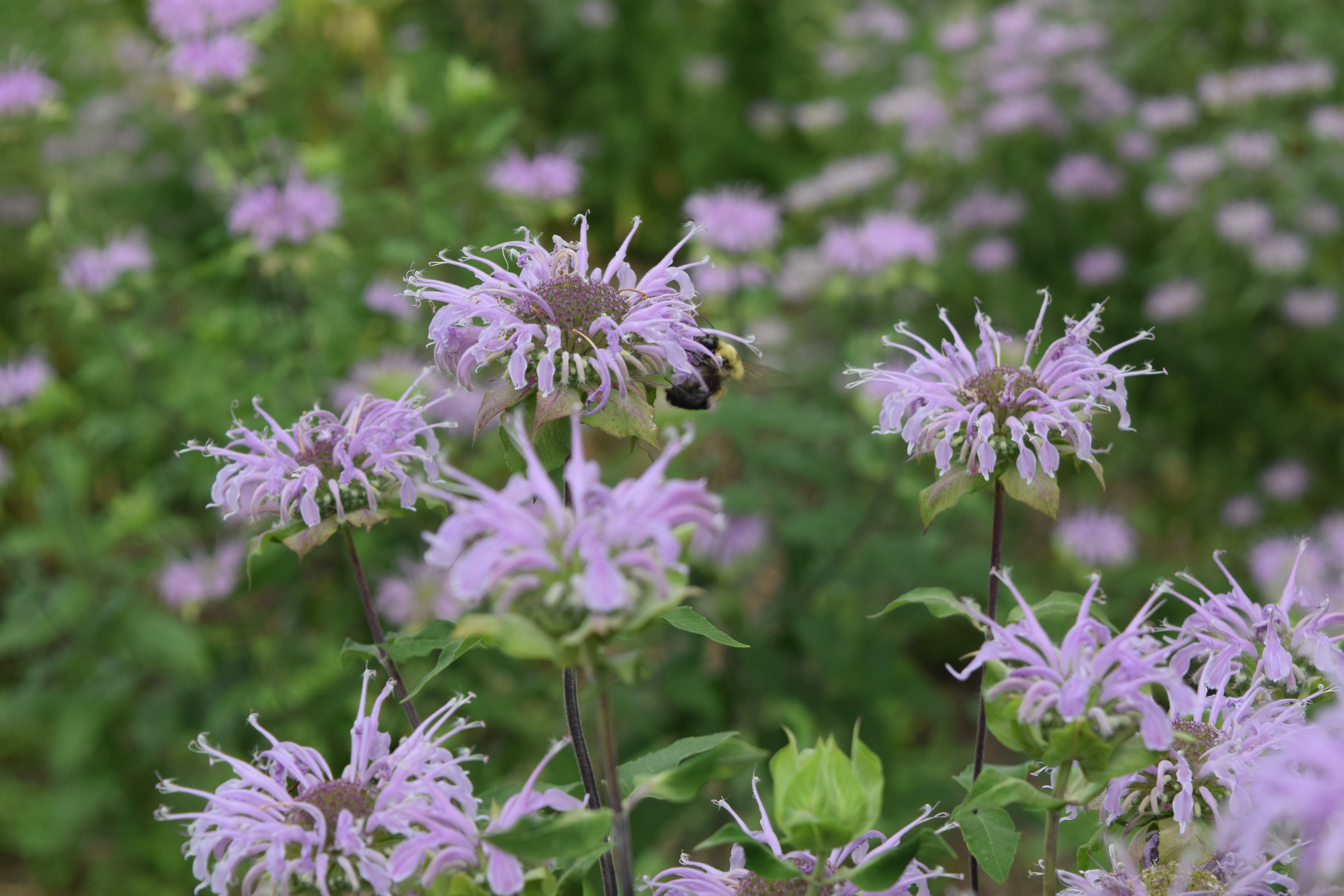
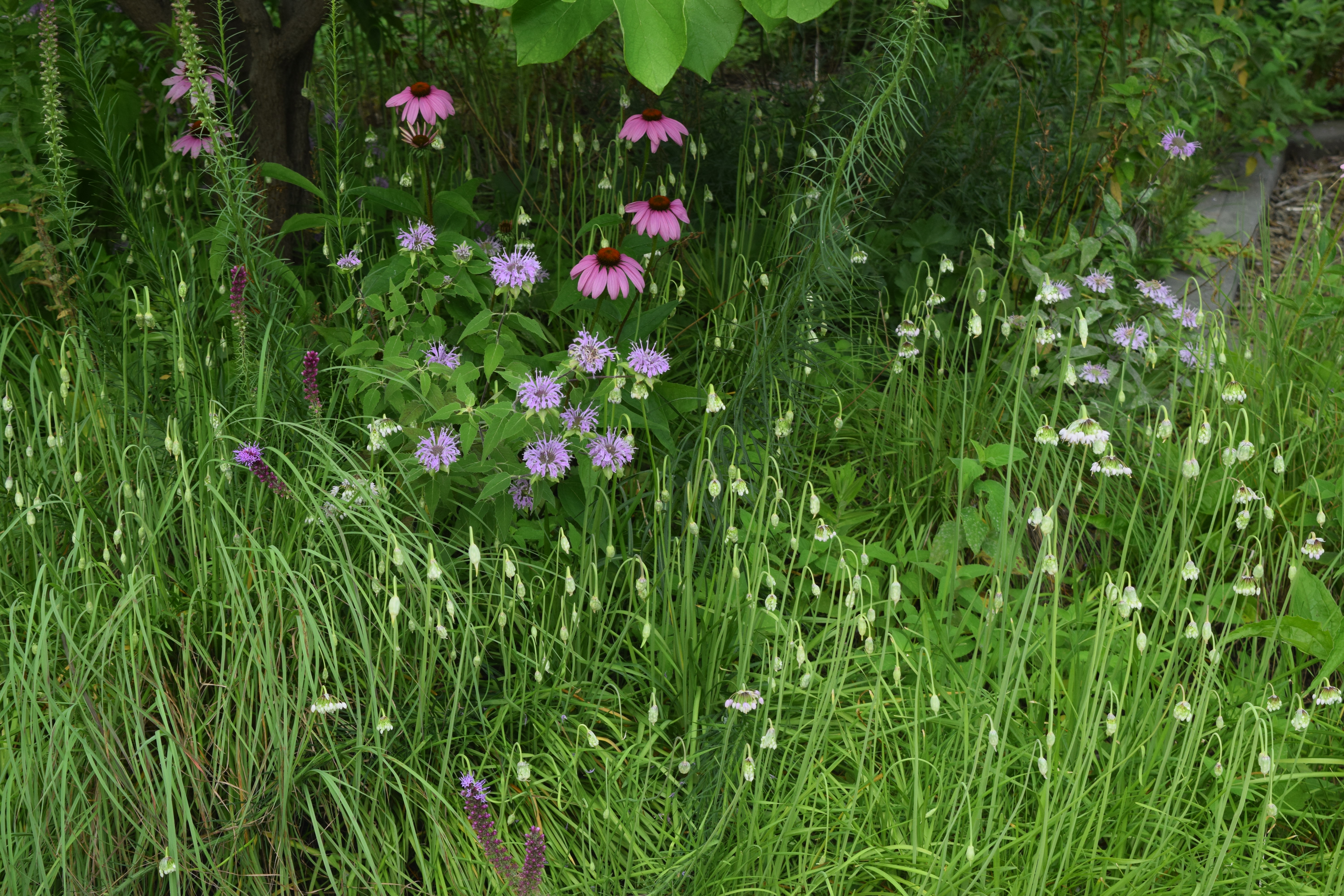
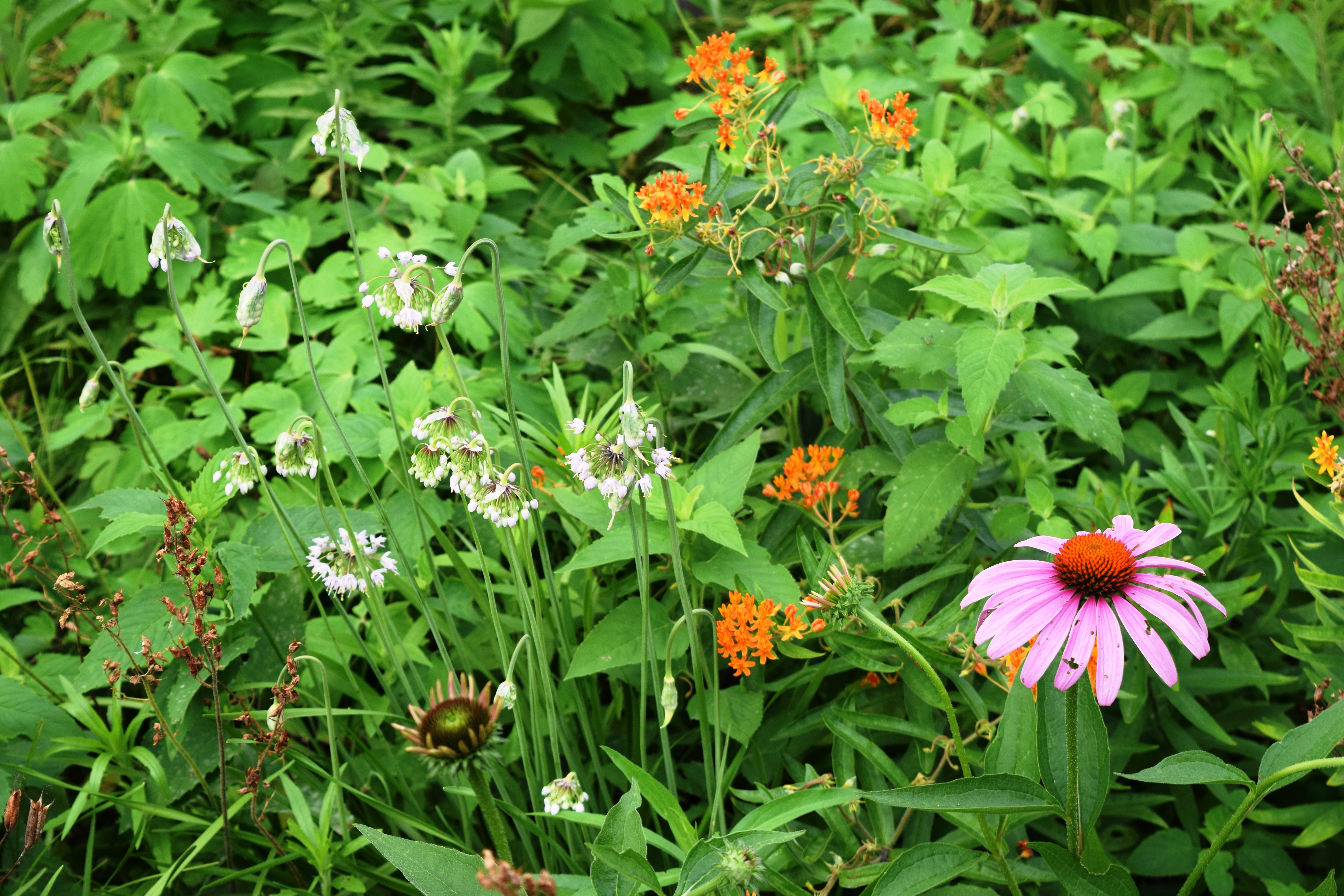
In mid-summer, the garden’s most visually dominant plant is wild bergamot (Monarda fistulosa). Yellow and purple coneflower (Ratibida pinnata and Echinacea purpurea) and nodding onion (Allium cernuum) were also much in evidence. Not 100% sure about the Allium ID, though.
The whole place was buzzing with bees when we were there, and we also saw two Monarch butterflies.
Wild bergamot.
The clumps of wild bergamot seemed remarkably upright, and didn’t seem to be suffering from the dry weather we’ve been having lately.
Nodding onion with purple coneflowers and wild bergamot.
There were swathes of wild onion, though mostly not yet in bloom.
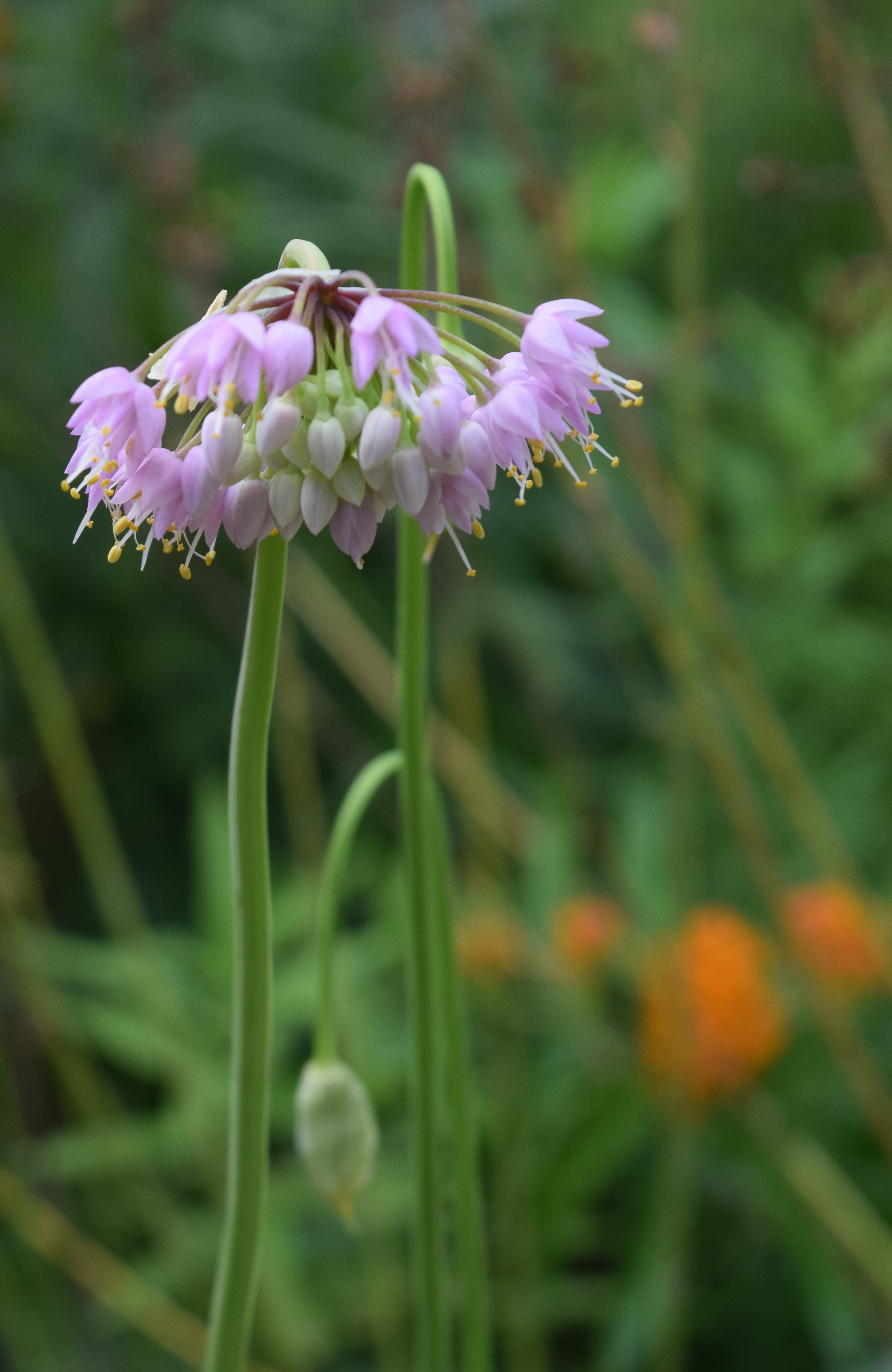
Nodding onion
There were a few exceptions, though. I keep meaning to put some of this Allium into my garden.
Yellow Coneflower
On the other hand, I have lots of wild bergamot and yellow coneflower, so when I see them in a garden it’s like running into old friends.
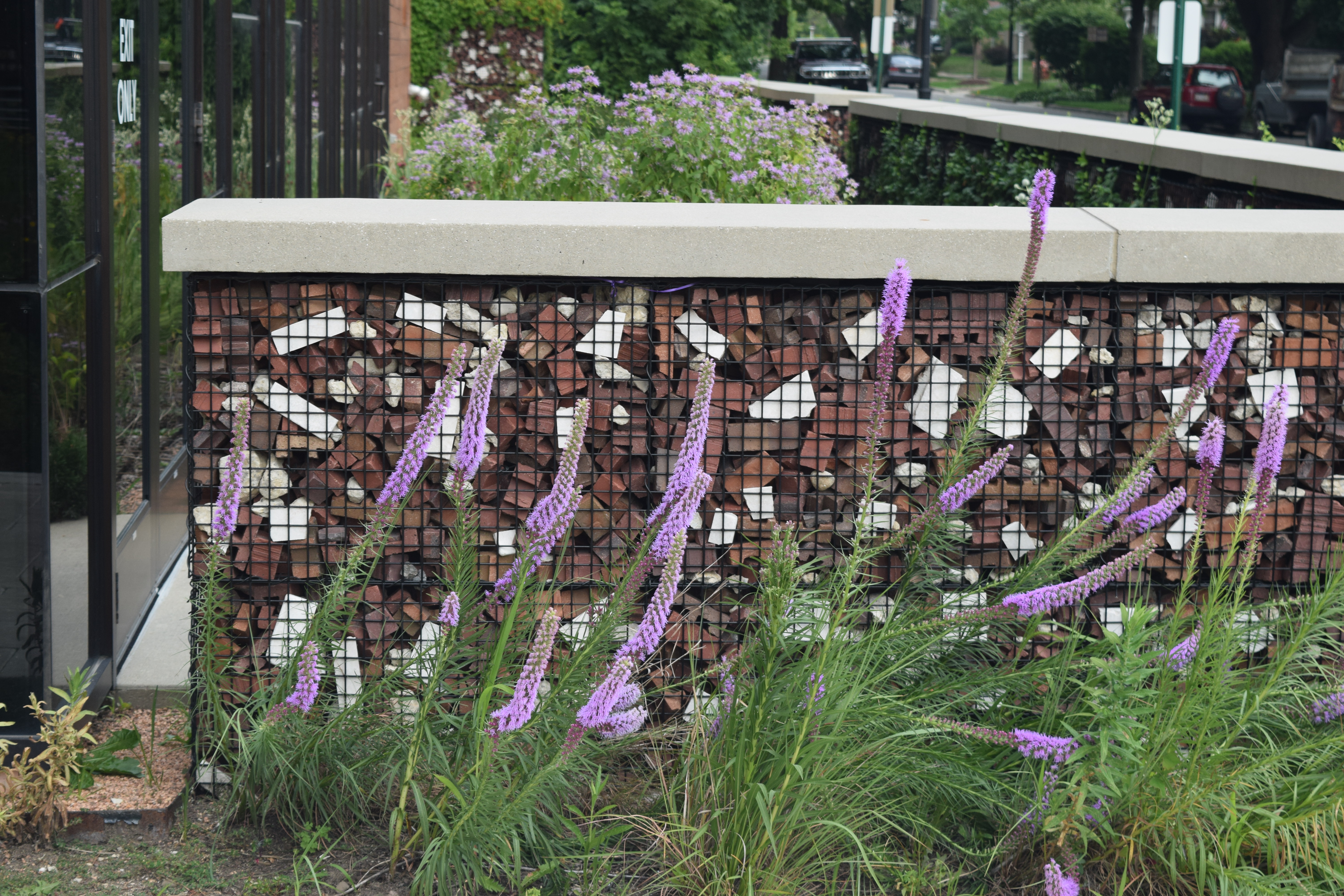
Blazing star in front of a wall built with construction debris.
Extensive use of recycled construction materials is a requirement for the LEED certification.
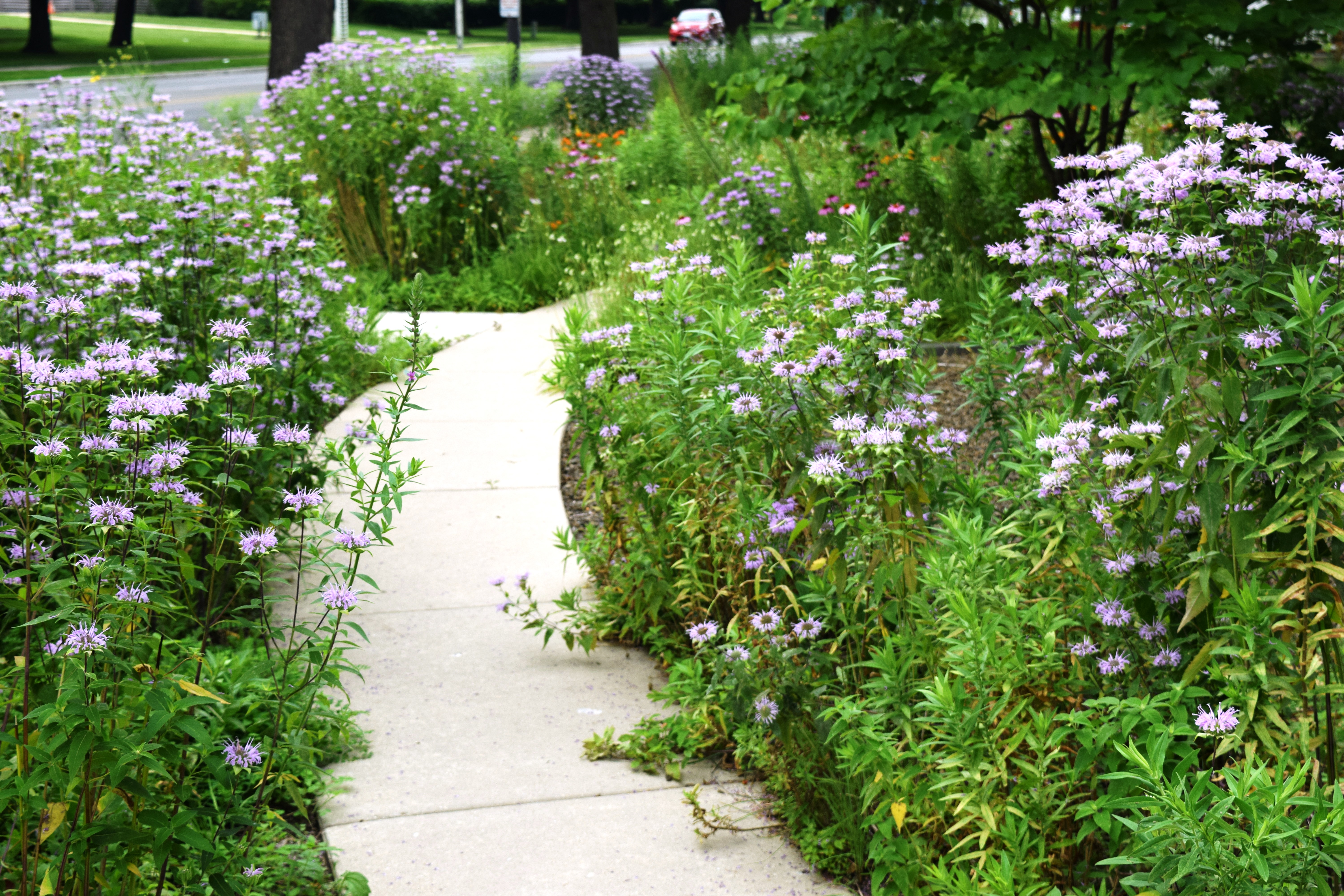
A path wanders through the garden, allowing a closer look.
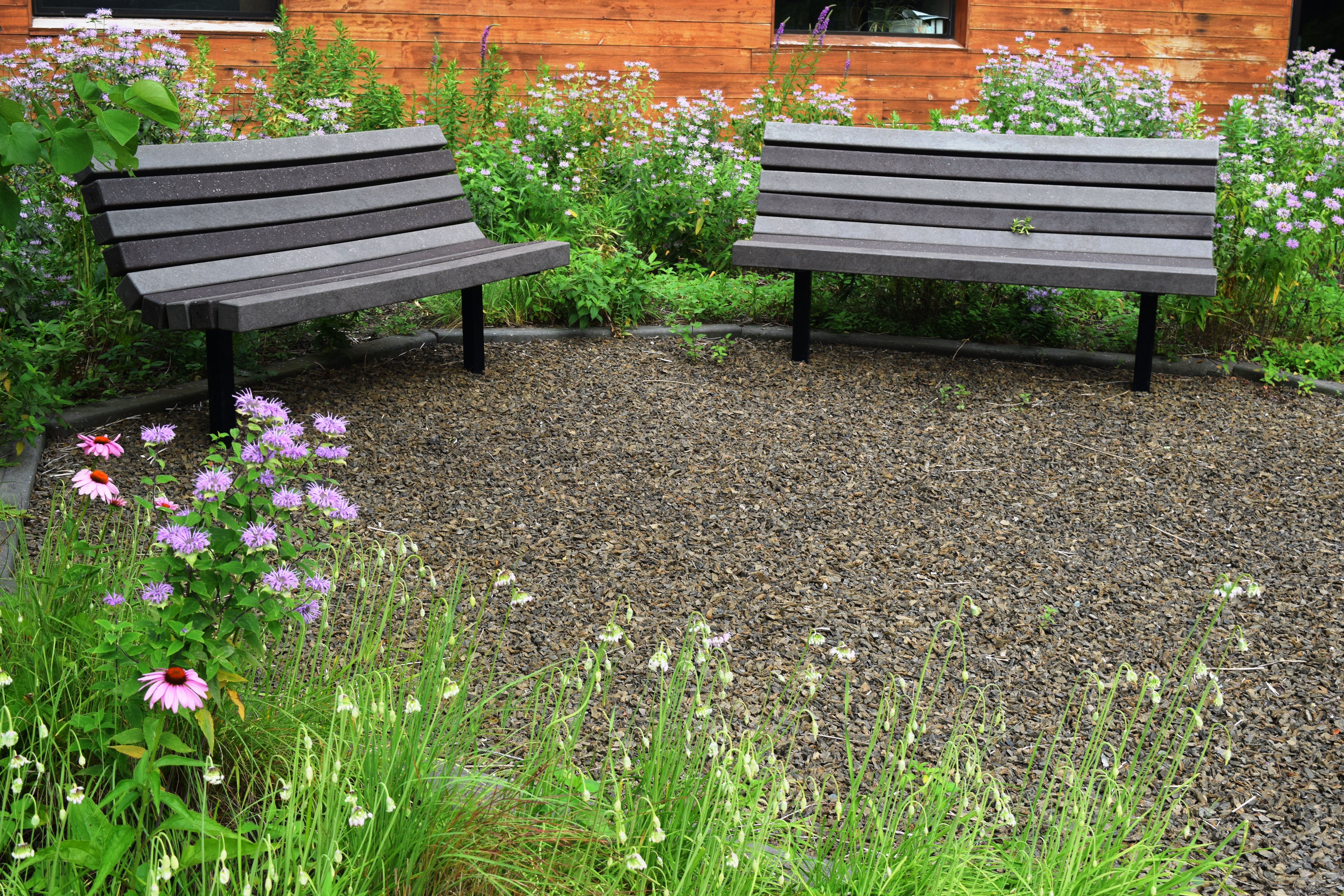
Two benches near the center of the garden.
There are also a couple of benches for kibitzing or contemplation.
There was still some butterflyweed in bloom.
On its website, the congregation notes the religious basis for environmental stewardship, including this quote from Ecclesiastes: “God led Adam around the Garden of Eden and said, ‘Look at My works. See how beautiful they are, how excellent. See to it that you do not spoil or destroy My world – for if you do, there will be no one to repair it after you’.
Neither Judy or I are religious people (my family is Jewish, hers is Lutheran), but I find it encouraging when people of any faith recognize that environmental sanity is a moral and practical imperative. Aside from that, it’s always good to find a congregation with a more exciting and creative approach to landscaping their own small piece of the earth.
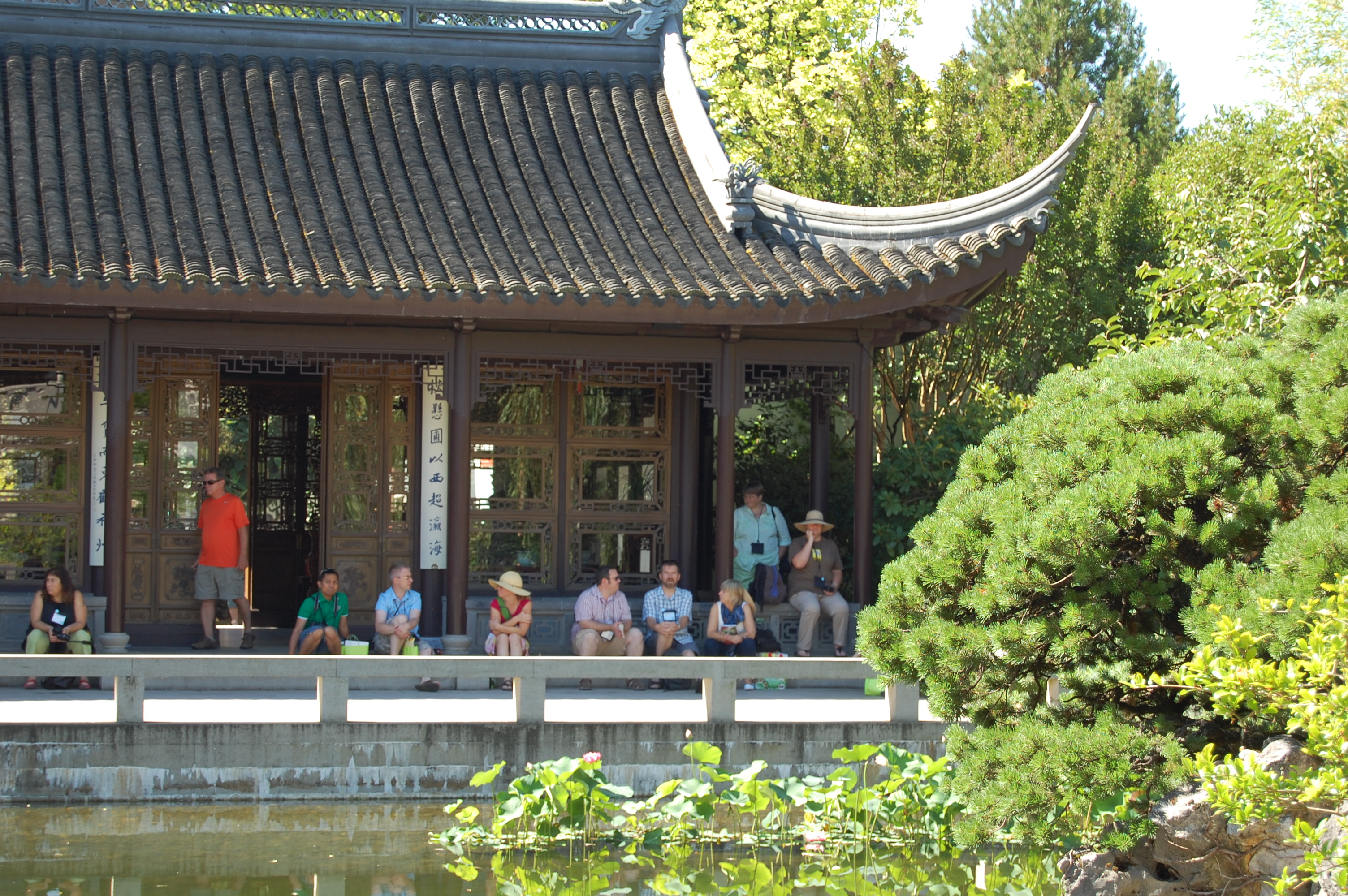
The first garden we visited as part of the 2014 Garden Bloggers’ Fling was Lan Su, located in Portland’s Chinatown. According to its website, Lan Su is the most authentic Chinese garden outside of China. It was created in the style of a Ming Dynasty “Scholar’s Garden” by craftsmen from Portland’s Chinese sister city of Suzhou.
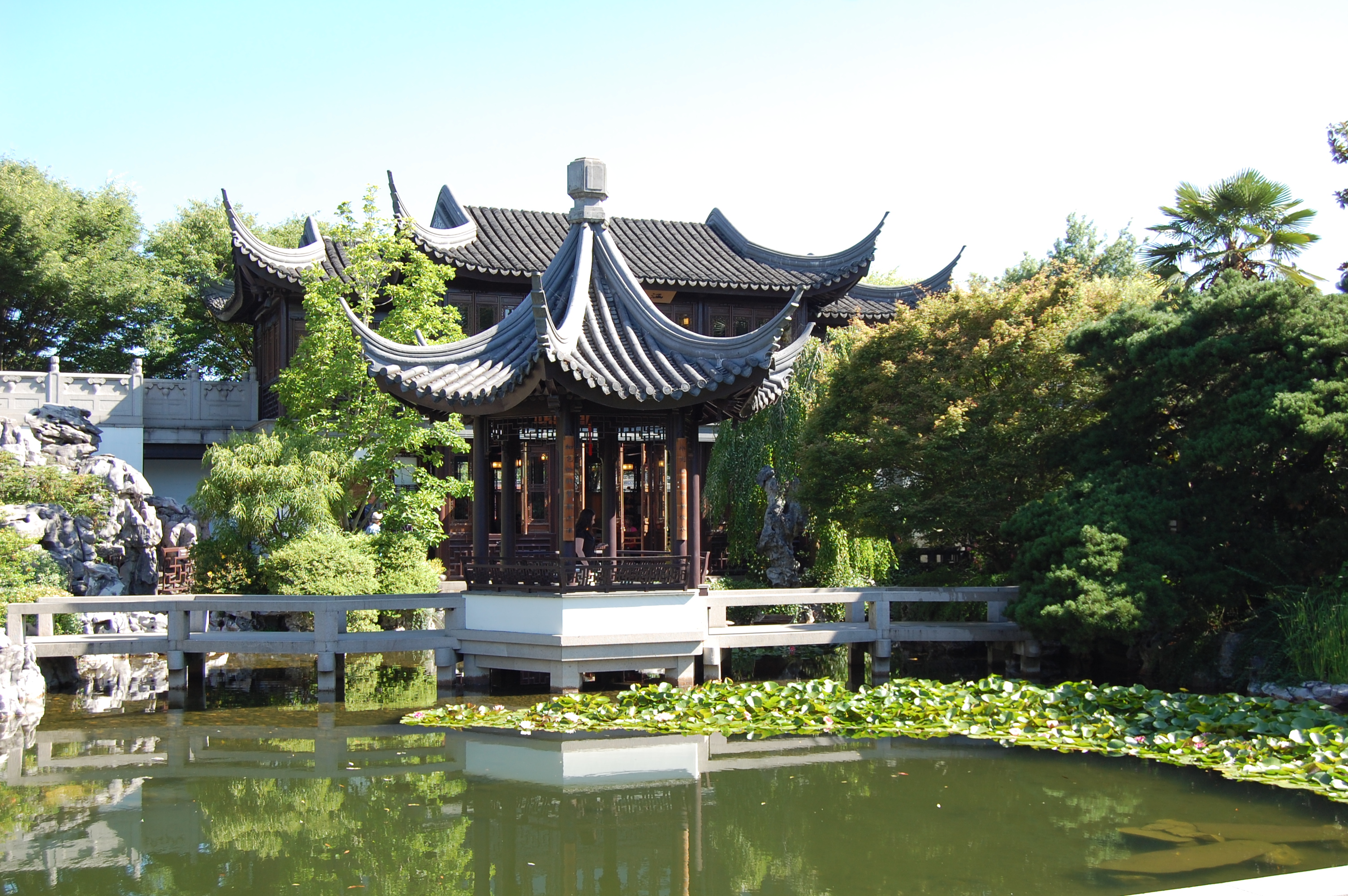
Moon Locking Pavilion, seen from the Terrace
I’m very glad I got to see this garden, but I could not love it. Even so, Lan Su had some wonderful qualities. (A note about the photographs – I took the pictures here because Judy had to miss the first day of the fling, so please excuse any decline in quality.)
I was occasionally startled by glimpses of office buildings, reminding me that I was in downtown Portland.
Behind its walls, this garden makes the visitor feel removed from the intensely urban area that surrounds it. The design creates a sense of space much larger than the single acre it occupies.
Courtyard viewed through archway.
Part of this illusion derives from the framed views that seem to exist in every direction, no matter where in the garden you happen to be. Plus, so many of those views seem to be of distinct but connected spaces. And to visit all the different spaces you can only go by a circuitous route.
All of the plants are native to China, and it was a pleasure to examine the plant palette.
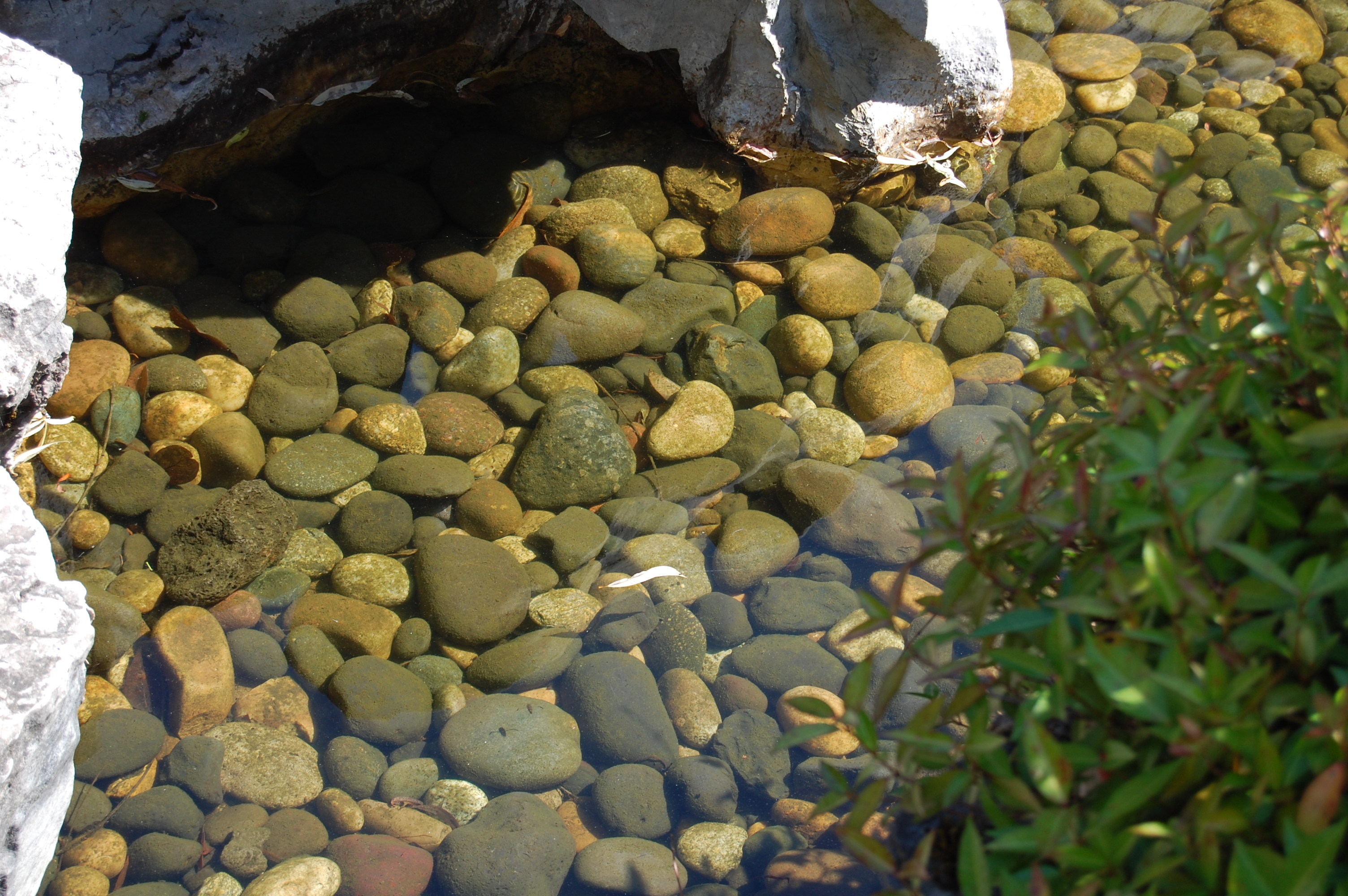
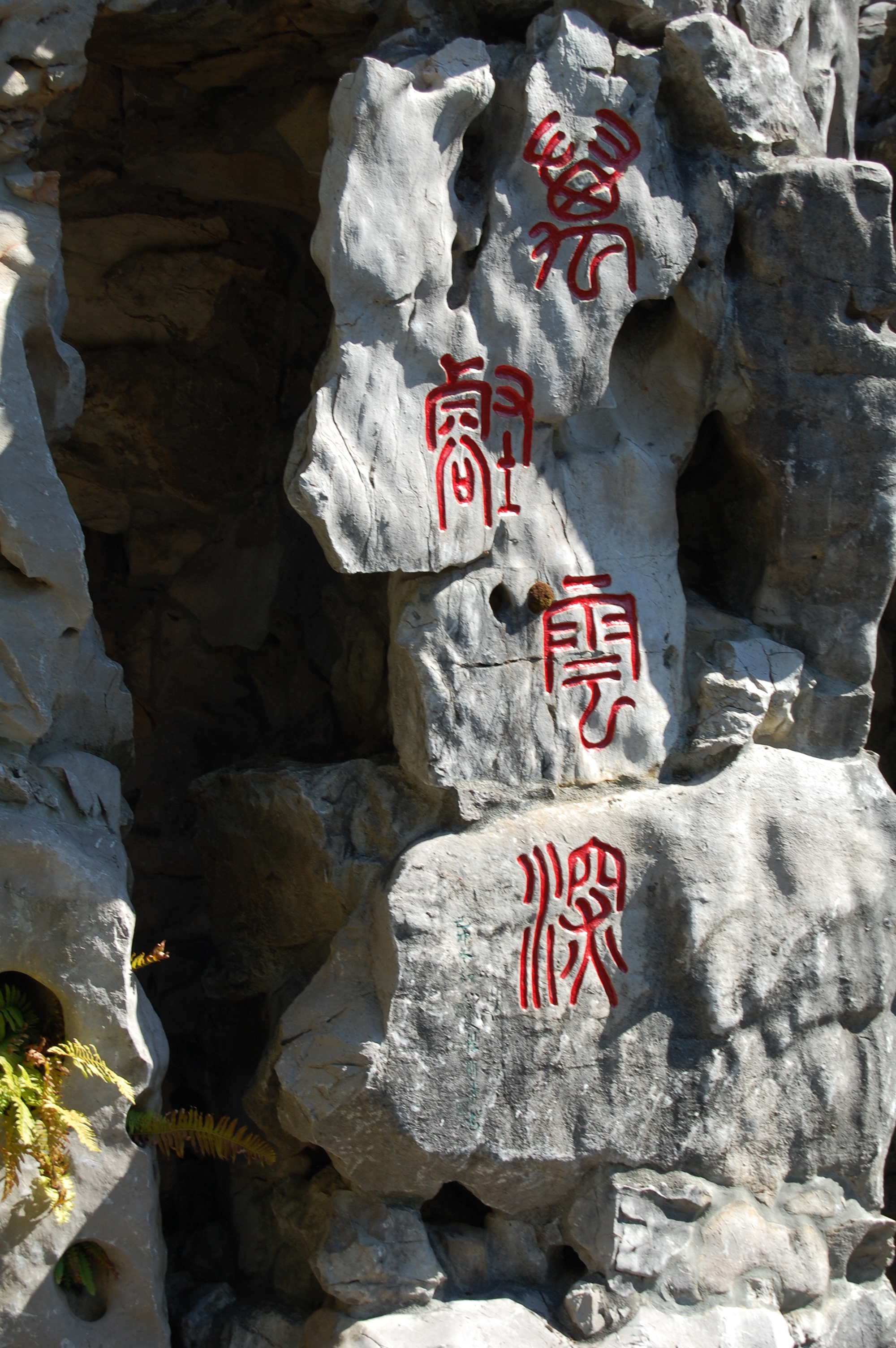
But this garden is really more about water and stone than it is about plants.
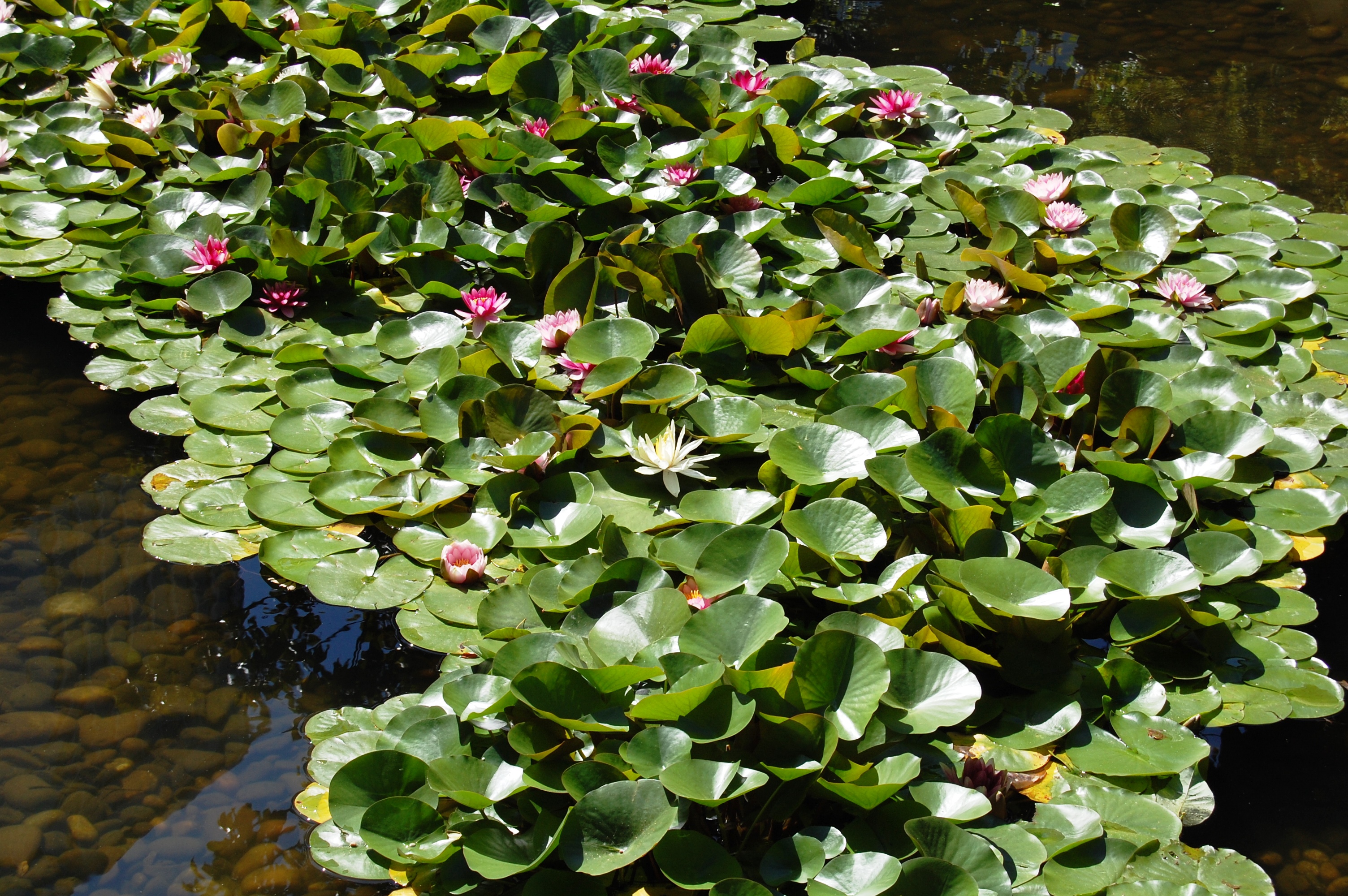
Though I loved all the water lilies.
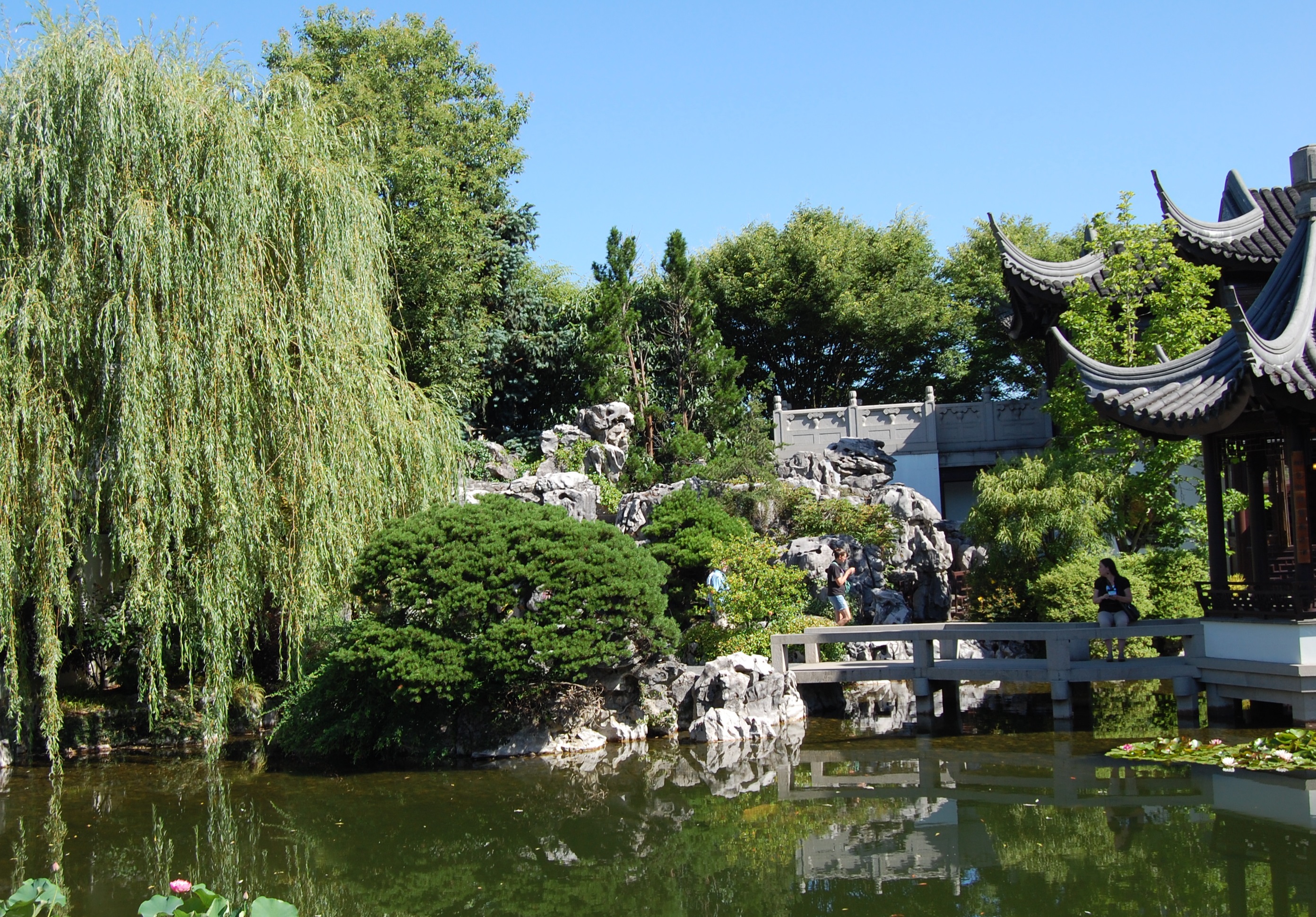
Willow, stone and water.
And Lan Su does showcase in many ways how water and stone can be beautiful.
Window onto the Scholar’s Courtyard (I think).
However, if every garden is a compromise between wild and controlled, soft and hard, quiet and drama – for me personally, Lan Su leans too far toward control, hardness, and quiet. We read in Lan Su’s website that this type of garden was intended to bring nature to the city. While any attempt to emulate nature is artificial to a degree, “nature” in this garden seems a little too stylized.
Though perhaps my reaction has to do with the type of landscape being emulated. The gardens I love are inspired by the prairie, while Lan Su seems to be about mountains.
I respect the fact that this reflects a cultural tradition of which I am not a part. And yet, we can only love what we love.
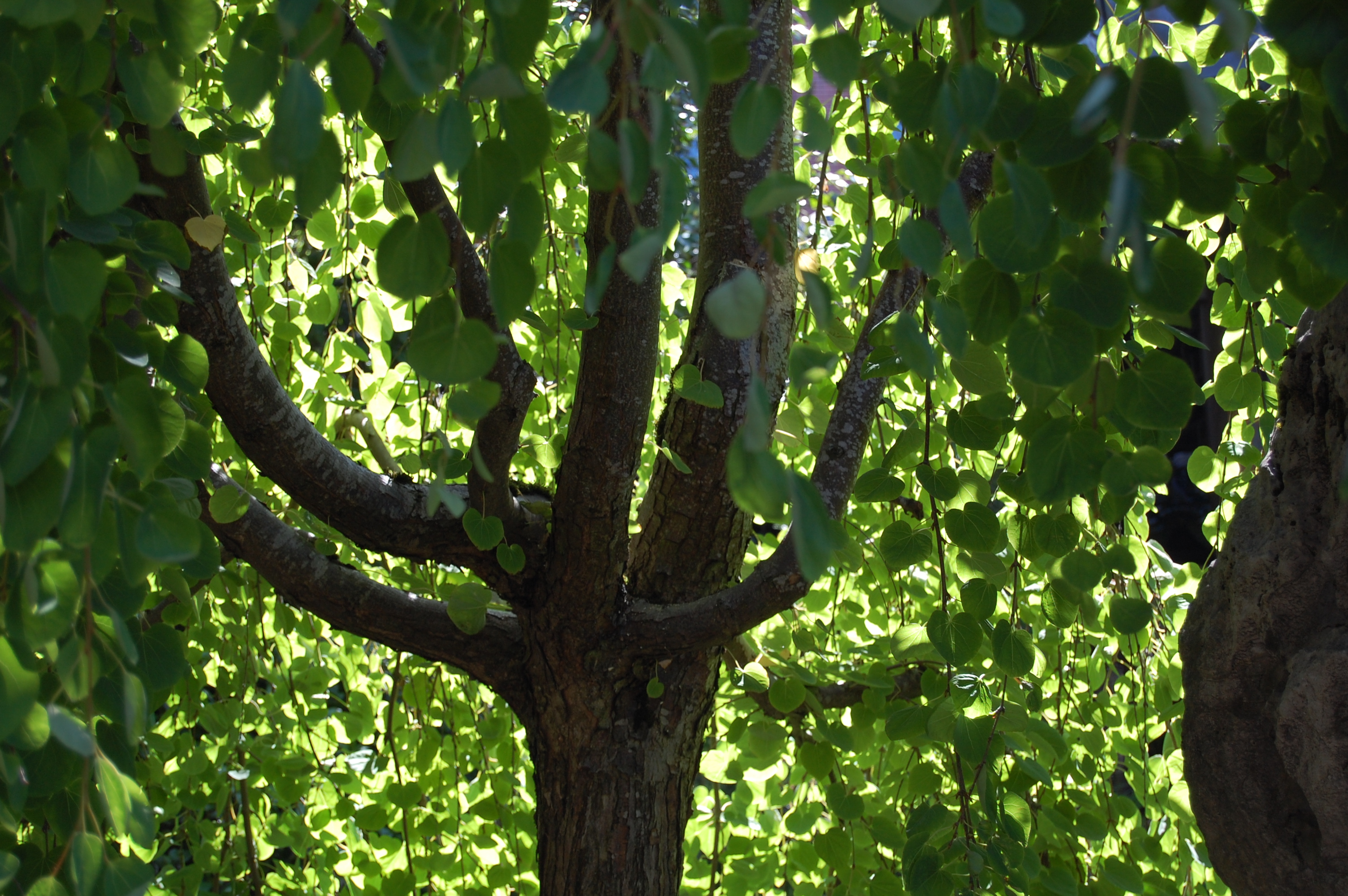
Weeping tree.
In any case, Lan Su is an intricate garden that needs to be experienced slowly, piece by piece.
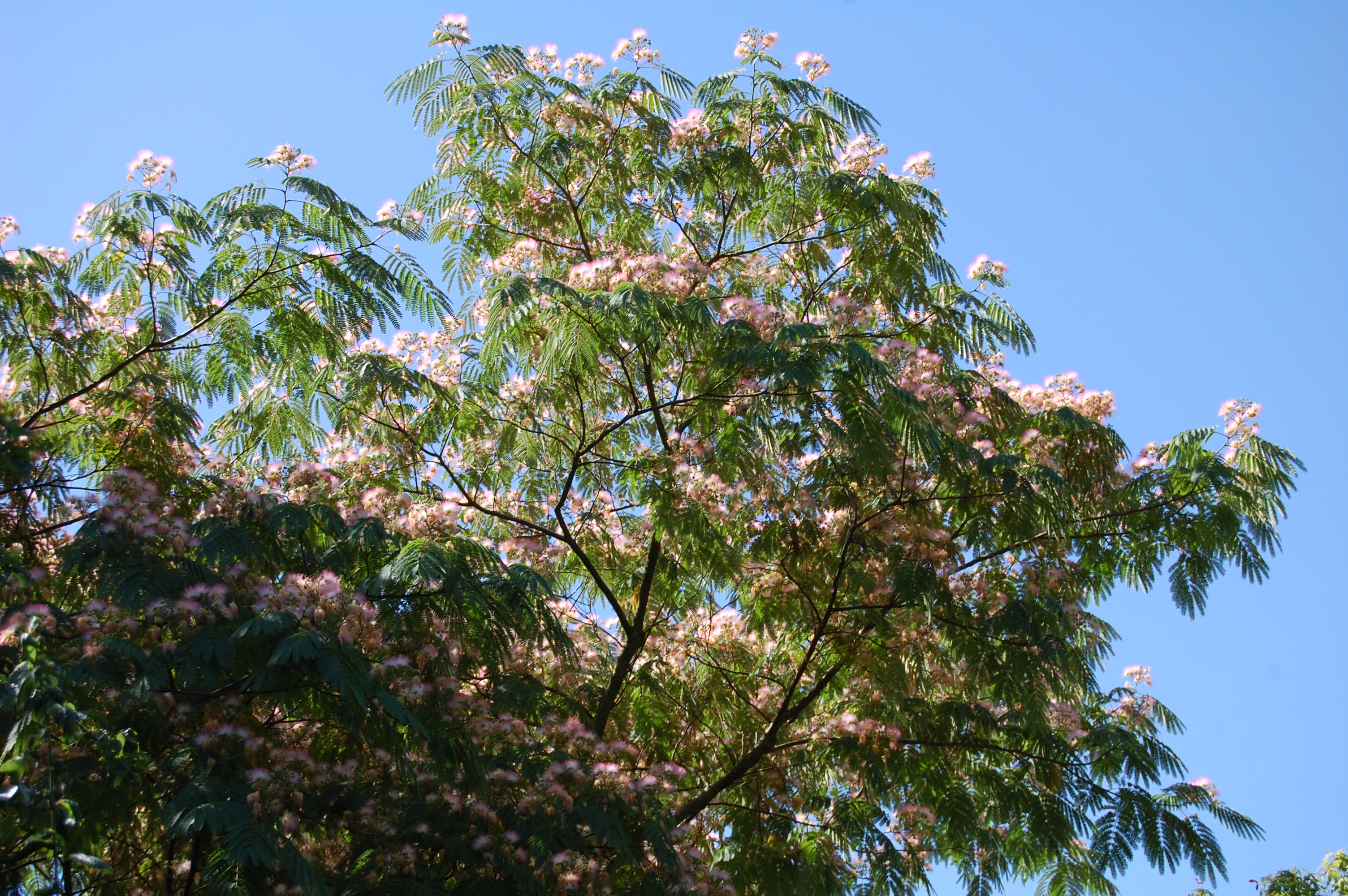
Mimosa
There were horticulturists available to talk about the garden, and I wish I had taken more advantage of this resource, but there was so much to absorb just by looking.
Tired Flingers in front of the Hall of Brocade Clouds.
The day was getting hot, though it was still morning. The Flingers were getting tired and ready to get on the coach for a ride to the next garden.
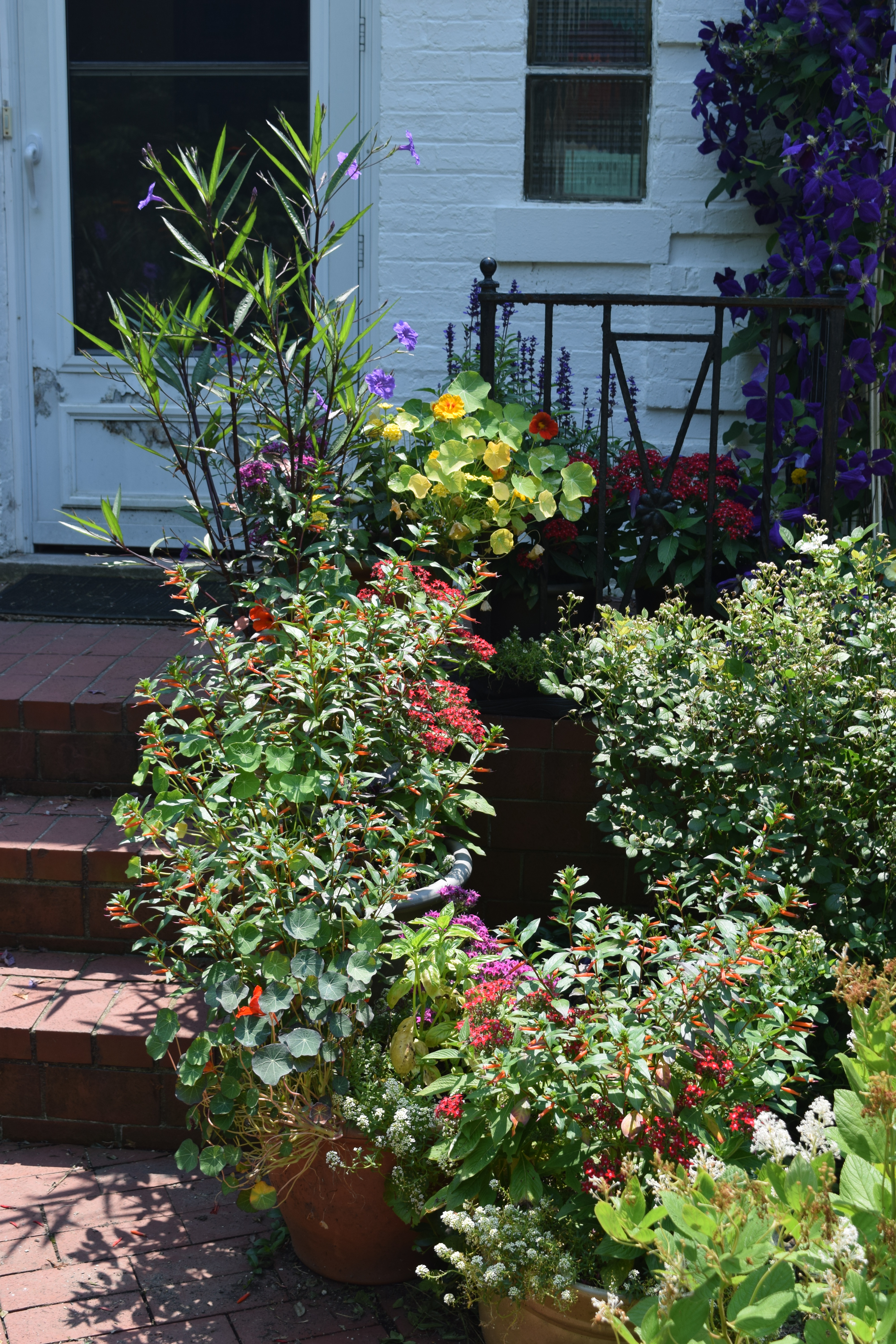
I’m not real thrilled with my containers in sun this year. Each of the individual plants is nice, but they don’t collectively have the impact you would wish for. Back in the spring my containers were filled with tulips or pansies with a bit of stock (Mattheola incana). They had real visual punch.
Containers in sun on the front walk and stoop: not much punch.
Now my containers in sun seem to be delivering only a faint tap.
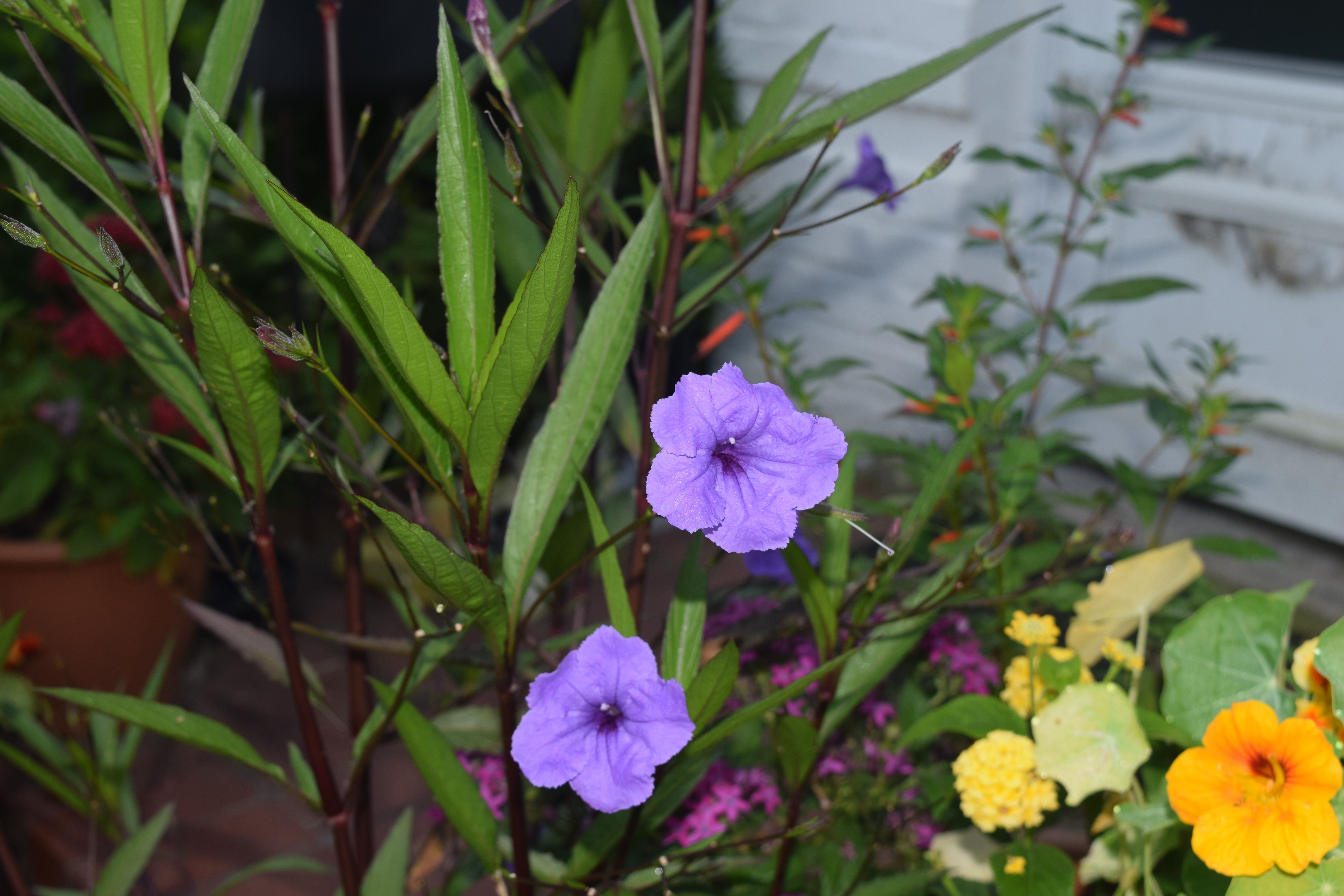
Mexican petunia
Of course, I picked many of this year’s container plants because last year they were attracting hummingbirds in droves (though we never did get a picture). This year: same plants, but no hummingbirds. Which brings their visual appeal to the fore.
Cigar Plant
For tall plants, I’m using Mexican petunia (Ruellia brittoniana) and cigar plant (Cuphea ignea). The Cuphea flowers are profuse but too small, and the Ruellia flowers are nice but too sparse. (Also, I tried some Mexican petunia in the Driveway Border – it did not do well.)
Containers on the front stoop: cigar plant, star flower, Mexican petunia, nasturtium.
The starflower (Pentas lanceolata) does better in this regard. It has clusters of little five pointed flowers – in my garden, mostly red.
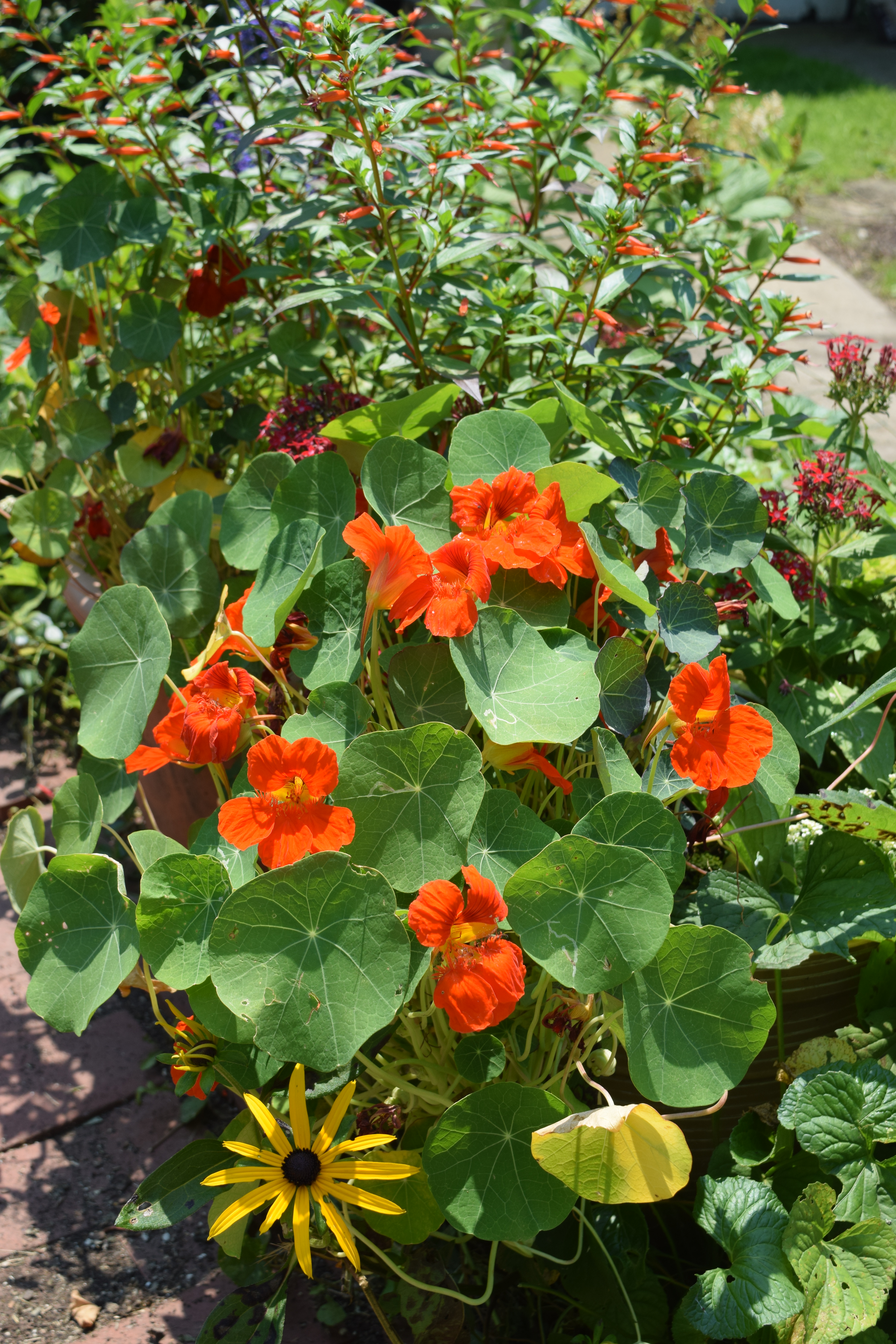
Nasturtium ‘Empress of India’. It’s hard to tell this is a container because it is nestled into a bunch of violets and Rudbeckia.
Also, I am definitely happy that I planted nasturtiums (Tropaeolum majus), both the red/orange ‘Empress of India’ and the ‘Alaska Mix’. Love the color and it trails nicely over the side of the container. Plus the flowers and leaves are edible (tastes like watercress).
Nasturtium ‘Alaska Mix’, red star flower to the right
I had underplanted the tulips with sweet alyssum (Lobularia maritima), and I left them in because the weather has been pretty mild. Usually they fizzle when after a couple of weeks of really hot temperatures. At this point some have fizzled, but a few are still looking good.
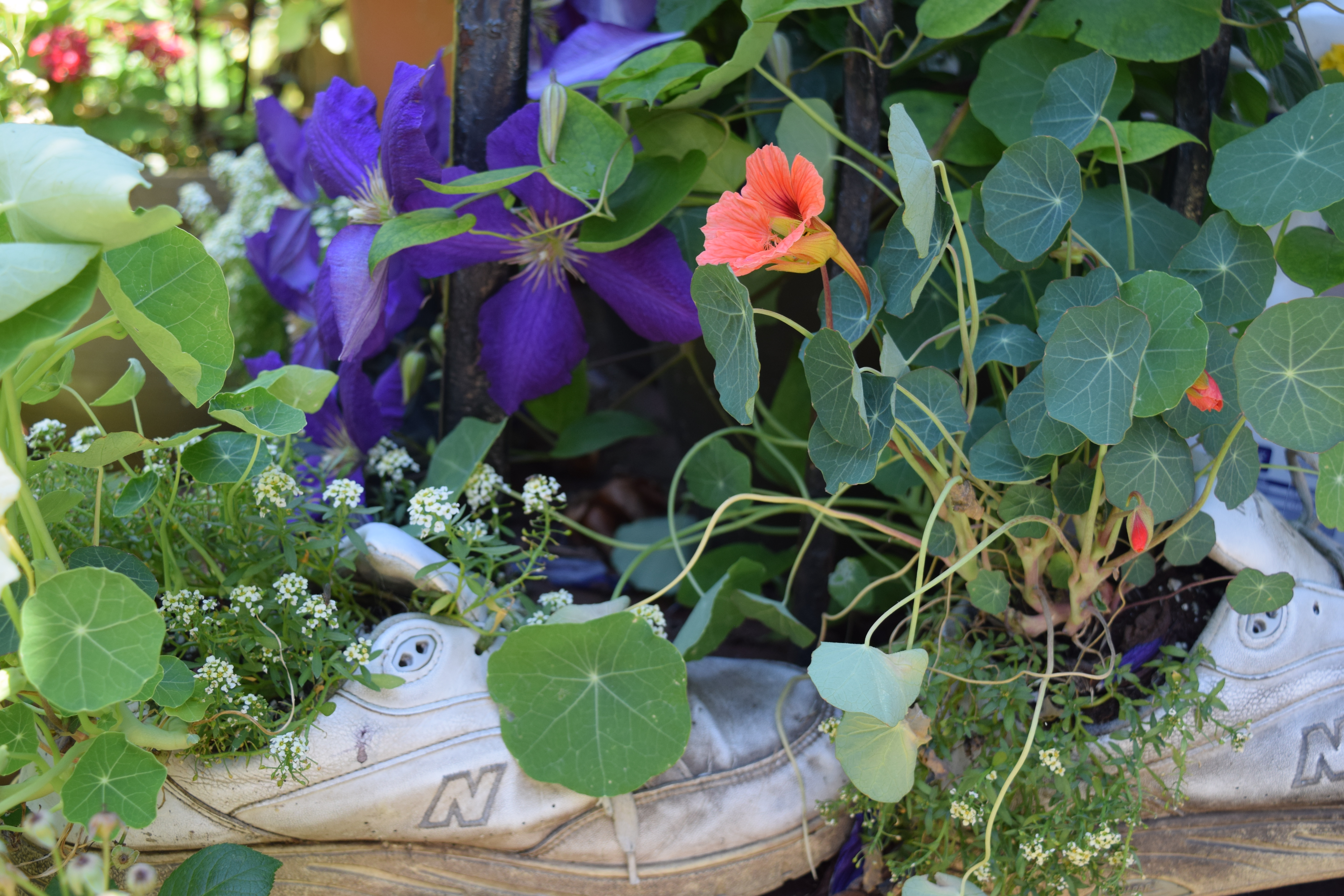
The sweet alyssum is still doing ok cohabiting with nasturtum in my old sneakers, but the clematis wants to butt in.
Though one problem with leaving in the sweet alyssum is that now you can see bare patches in some of the containers.
Anyhow, now I’m thinking maybe next year I will keep the nasturtiums and starflower but just combine them with marigolds and tall Zinnias.
What are your favorite plants for containers in sun?


































 gardeninacity