Westwind Farm Studio is one of the places we saw during the first day of the Portland Garden Bloggers’ Fling. It seemed to me, as a Chicagoan, to be a very Portland sort of place, one where you can record music, take yoga classes, smell the fields of lavender, or commune with nature. It’s a place with a genuinely soothing vibe.
A grass path leads to the gardens.
Westwind contains 40 acres that includes woodland, a naturalistic meadow-style garden, and a more conventional garden around a pool.
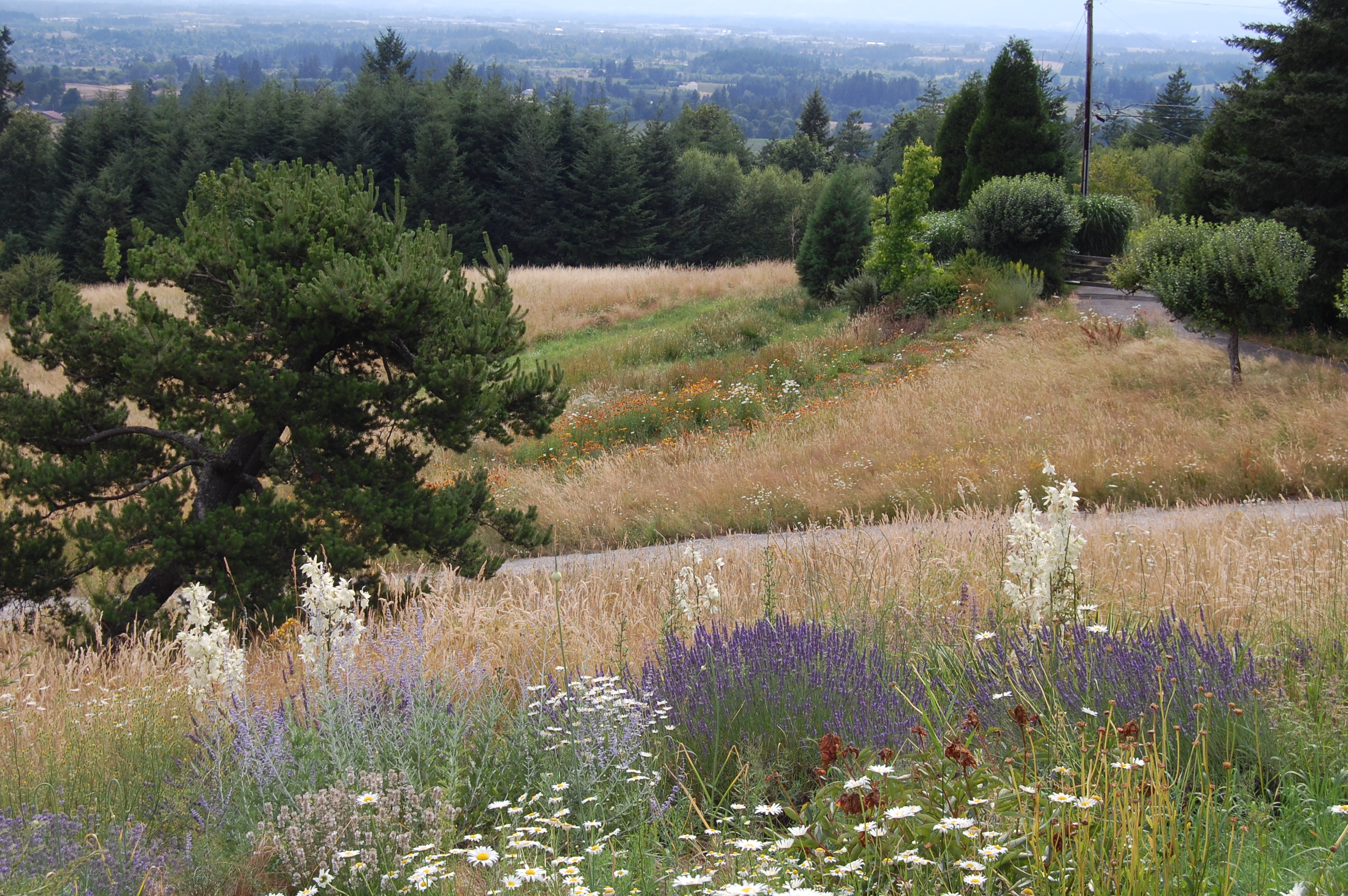
A meadow garden slopes gently downward to deep green woods.
What I loved best was the meadow garden. Grazing land for sheep not so long ago, it slopes downward towards deep green woods, providing a view that made me want to pitch a tent right there and start a new life as a squatter.
Yucca, Agastache, Leucanthemum, Perovskia, Rudbeckia and other flowers bloom among the grasses.
I don’t know what this grass is (I feel like I should), but don’t the deep green conifers provide a fantastic background for it?
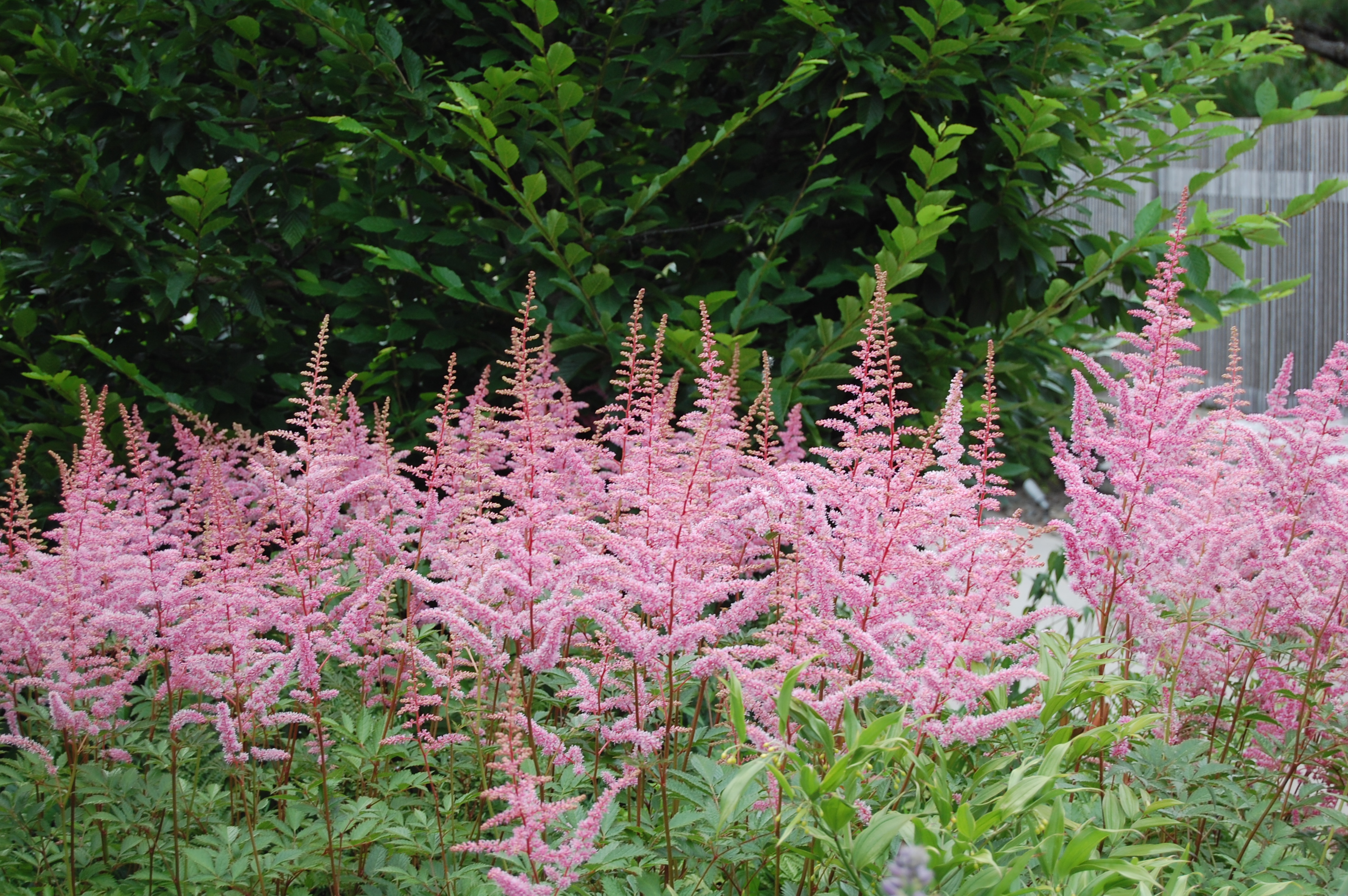
Another deep green background really sets off these Astilbe.
The same contrast really makes the red Monarda go KAPOW (a technical term used by garden designers). There were numerous hummingbirds zipping around but I wasn’t able to get pictures of any.
The gardens here also boast some very satisfying plant combinations, like these Crocosmia and Perovskia.
I was taken aback by these HUGE Epilobium in the more conventional upper garden. I’m used to seeing this plant in overgrown spots at the edge of the woods (its common name is Fireweed). Seeing it here made me appreciate its ornamental qualites, proving once again that a weed is in the eye of the beholder.
Also in the upper garden there were big splashes of bold splashes of yellow, orange and red – contrasting with the sloping meadow, which was dominated by straw-colored grasses.
There was more to see at Westwind, but at this point my camera battery gave out. Because of her job Judy wasn’t able to get to Portland until the first evening of the Fling – so she missed all the gardens we saw on Friday and I had to be photographer for a day. Too bad she didn’t get to see Westwind, it would definitely have helped her decompress from her business trip.
I was going out this morning to pick tomatoes when I saw an unfamiliar butterfly on the Mexican Sunflowrer (Tithonia rotundifolia). Judy grabbed her camera and came outside to get some pictures. However, the humidity was so high that her lens fogged over.
Picture taken through a foggy lens.
So, if you’re wondering what photos look like taken with a fogged over lens, here you go. It took several minutes for the lens to clear.
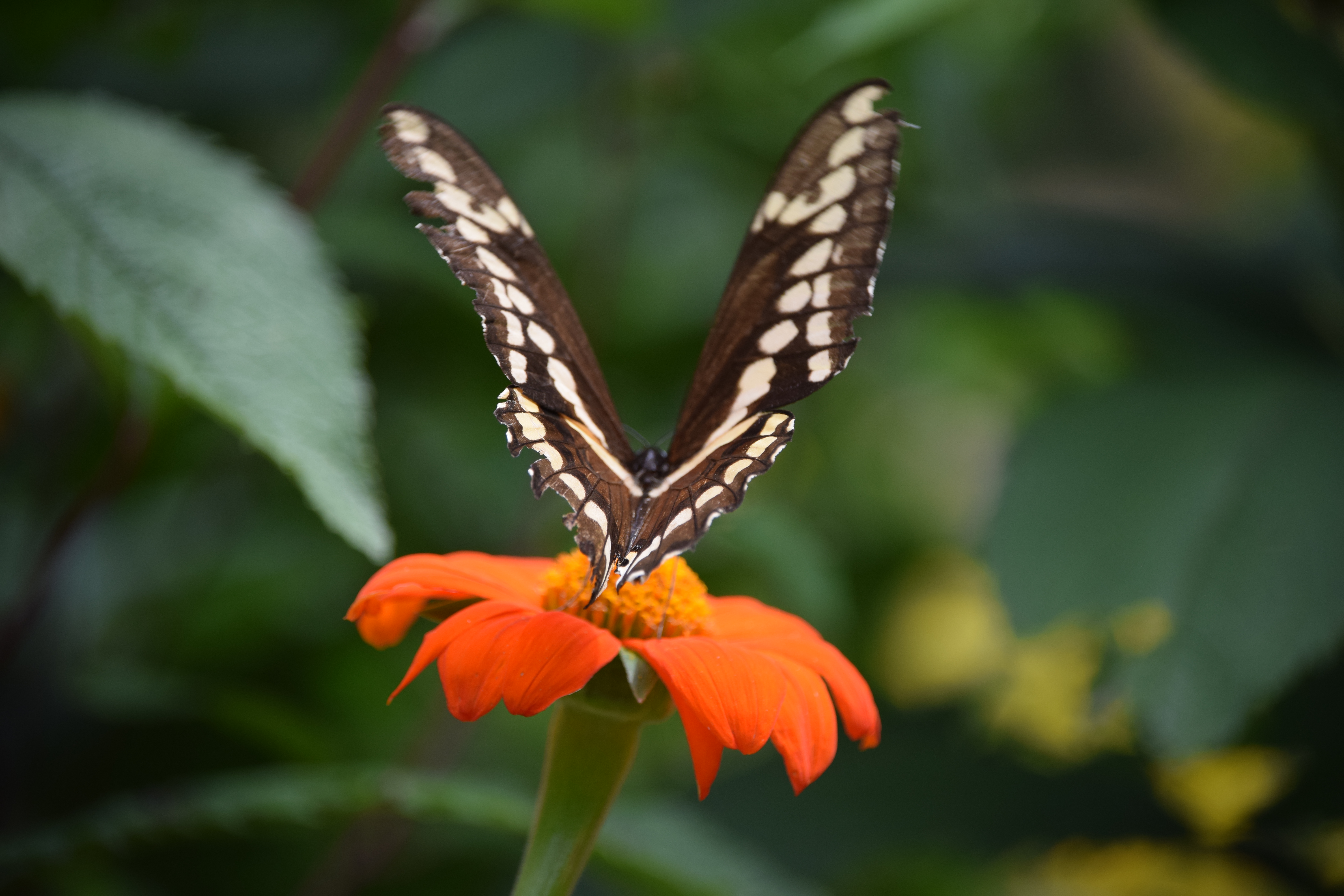
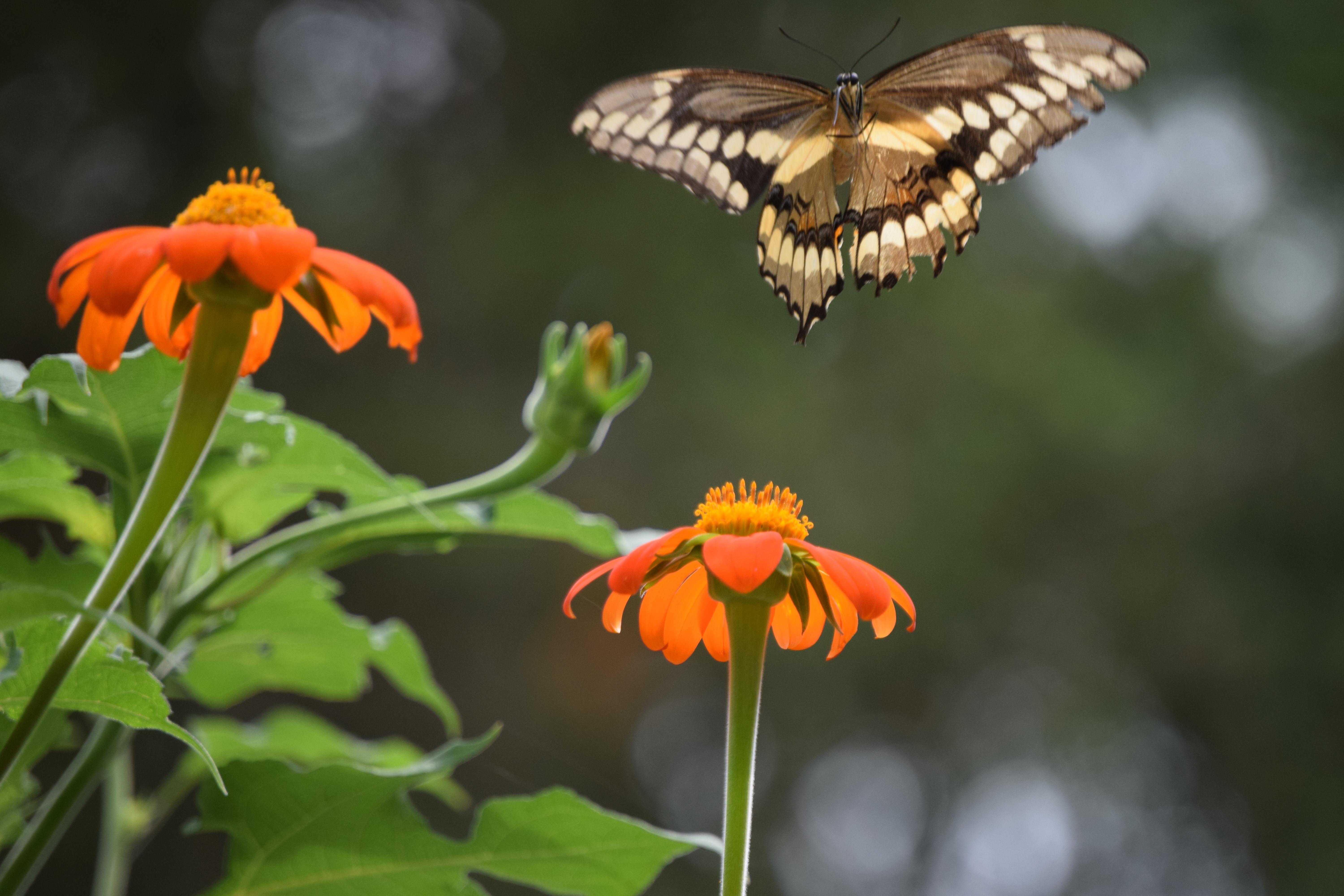
The butterfly turned out to be a Giant Swallowtail. We’d never had one in the garden before to my knowledge.
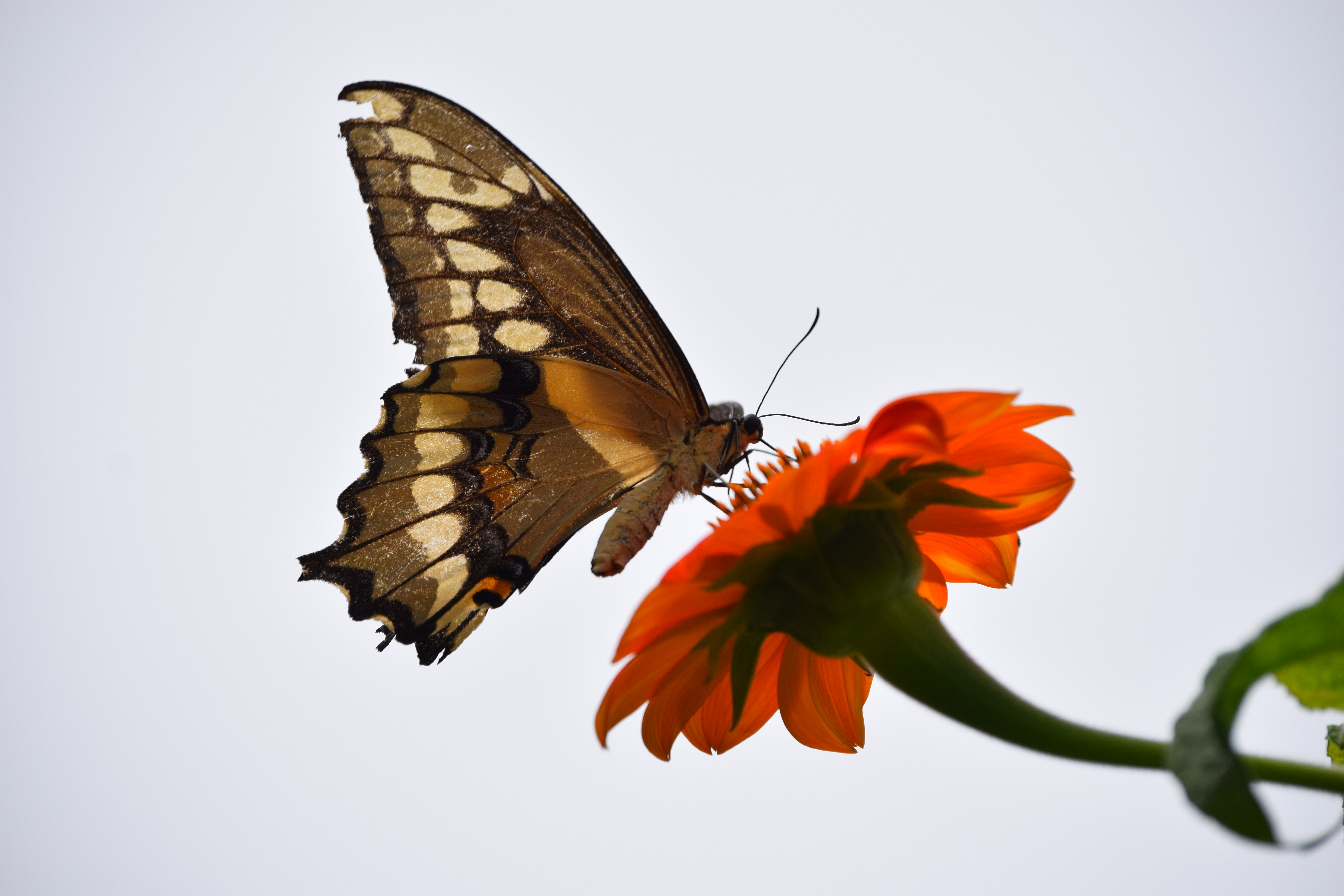
Giant Swallowtail, view from the back.
The Giant Swallowtail was really loving the Tithonia, which has turned out to be golden in terms of attracting butterflies to the garden.
Giant Swallowtail caterpillar. Photo: University of Florida Department of Entomology
Plants in the citrus family are hosts to Giant Swallowtails. In Illinois, that means Prickly Ash (Zanthoxylum americanum) and Hop (Ptelea trifoliate) trees, as well as Common Rue (Ruta graveonlens). I’m tempted to plant some Common Rue myself, though I’m not sure where to get hold of it. Giant Swallowtail caterpillars camouflage themselves by resembling bird poop.
The damaged wings indicate this particular Giant Swallowtail has taken some hard knocks, or bites.
Bumblebee wants the swallowtail to move on, and he does.
The Swallowtail was fluttering from bloom to bloom on the Tithonia. Even while feeding he kept his wings moving, which made getting a good shot challenging for Judy. At one point, she saw a bumblebee chase the swallowtail away from a flower.
Giant Swallowtails aren’t uncommon, but I’m highly gratified every time I find a new butterfly species in the garden.
And now I’m going to force myself to stop obsessing with brightly colored flowers and focus on some calming green stuff. This is something I need to do to keep from getting overstimulated. Fortunately, My Hesperides Garden hosts Garden Bloggers’ Foliage Day to remind me of this essential aspect of the garden.
‘Northwind’ Switchgrass
‘Northwind’ Switchgrass (Panicum virgatum) probably has the most dramatic foliage in my garden at the moment. It has reached its full height and is about to launch it’s airy panicles of tiny flowers. The two clumps of ‘Northwind’ in the Sidewalk Border have reached an impressive size, a mass of tightly packed vertical stems.
Wild Indigo
This year I tried to cut back the wild indigo (Baptisia australis) without also cutting off all the seed heads.
Wild Indigo seed pods
Judy is among the people who think that the Baptisia seed pods are quite ornamental. I could take them or leave them.
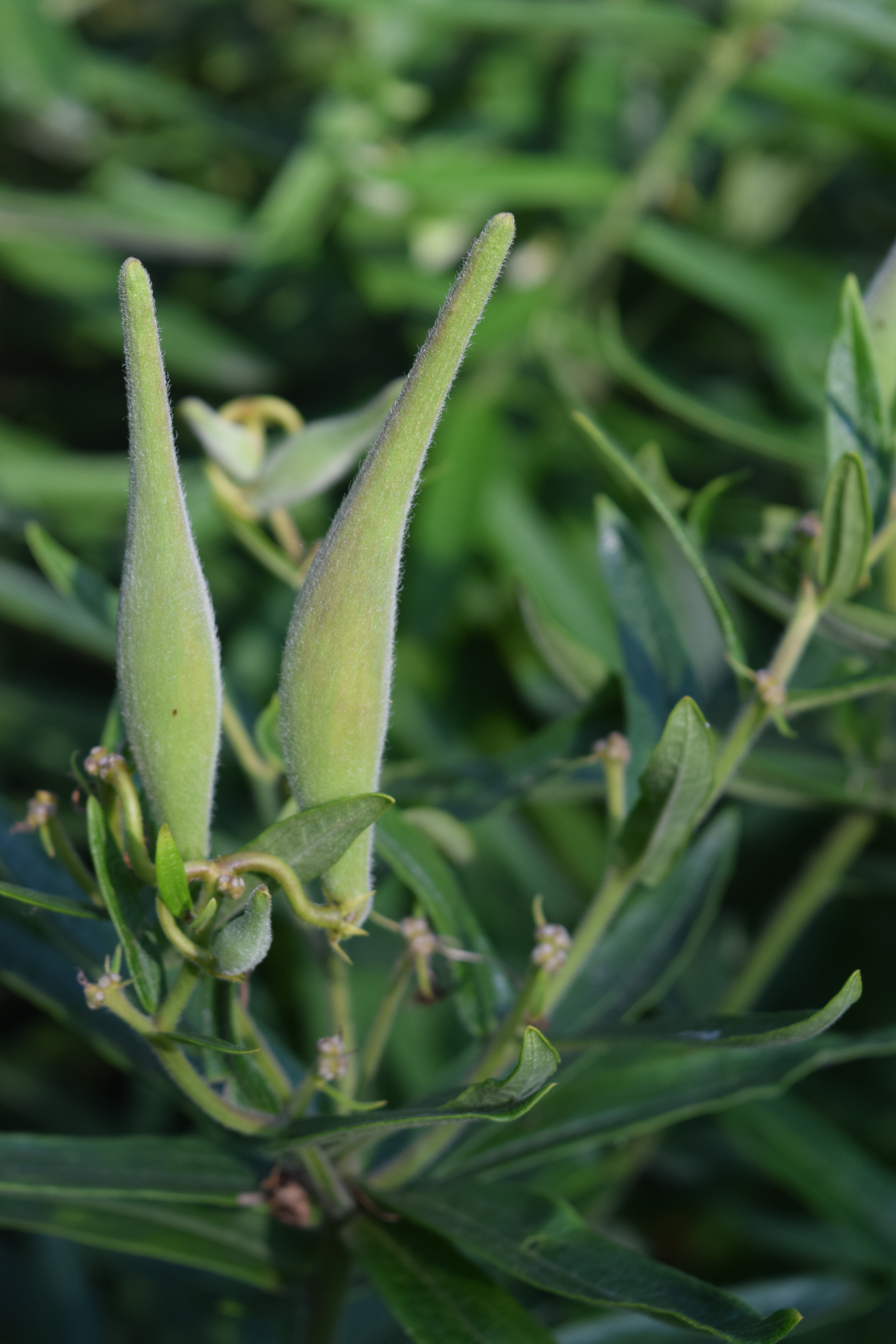
Swamp Milkweed seed pods
On the other hand, I’m very fond of milkweed seed pods, especially when they are fully ripe and begin to open. These Swamp Milkweed (Asclepias incarnata) pods have got a few weeks to go before they reach that stage.
East Side Border
Over on the east side bed, it’s all foliage now: Wild Geranium (Geranium maculatum), Celandine Poppy (Stylophorum diphyllum), Red Elderberry (Sambucus racemosa), among others.
Path to the back garden
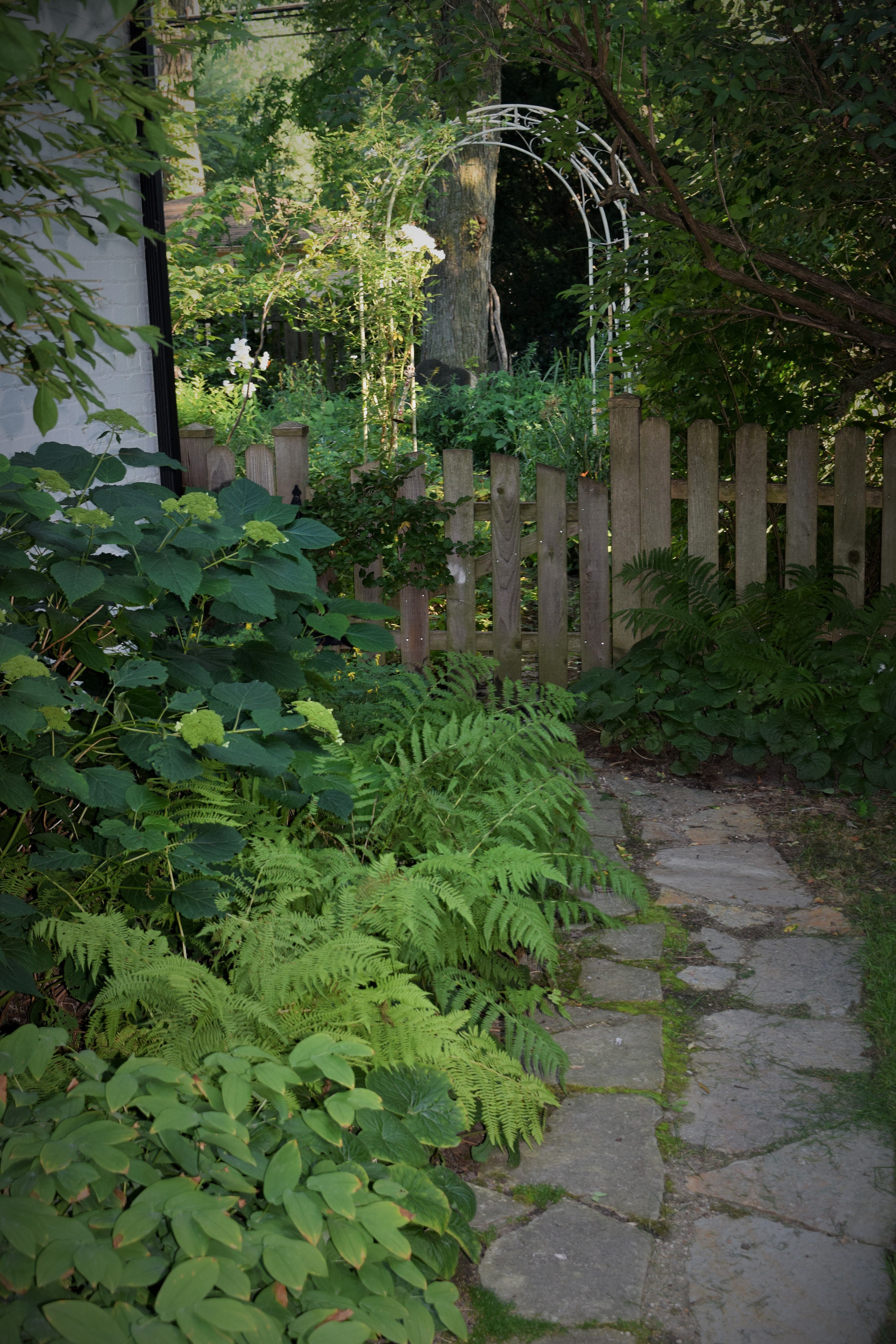
On the west side of the house the Lady Ferns (Athyrium filix-femina) and Wild Ginger (Asarum canadensis) along the path to the back garden has stayed remarkably green. Only the Great Merrybells (Uvularia grandiflora) is starting to get crispy around the edges.
Silky Wild Rye
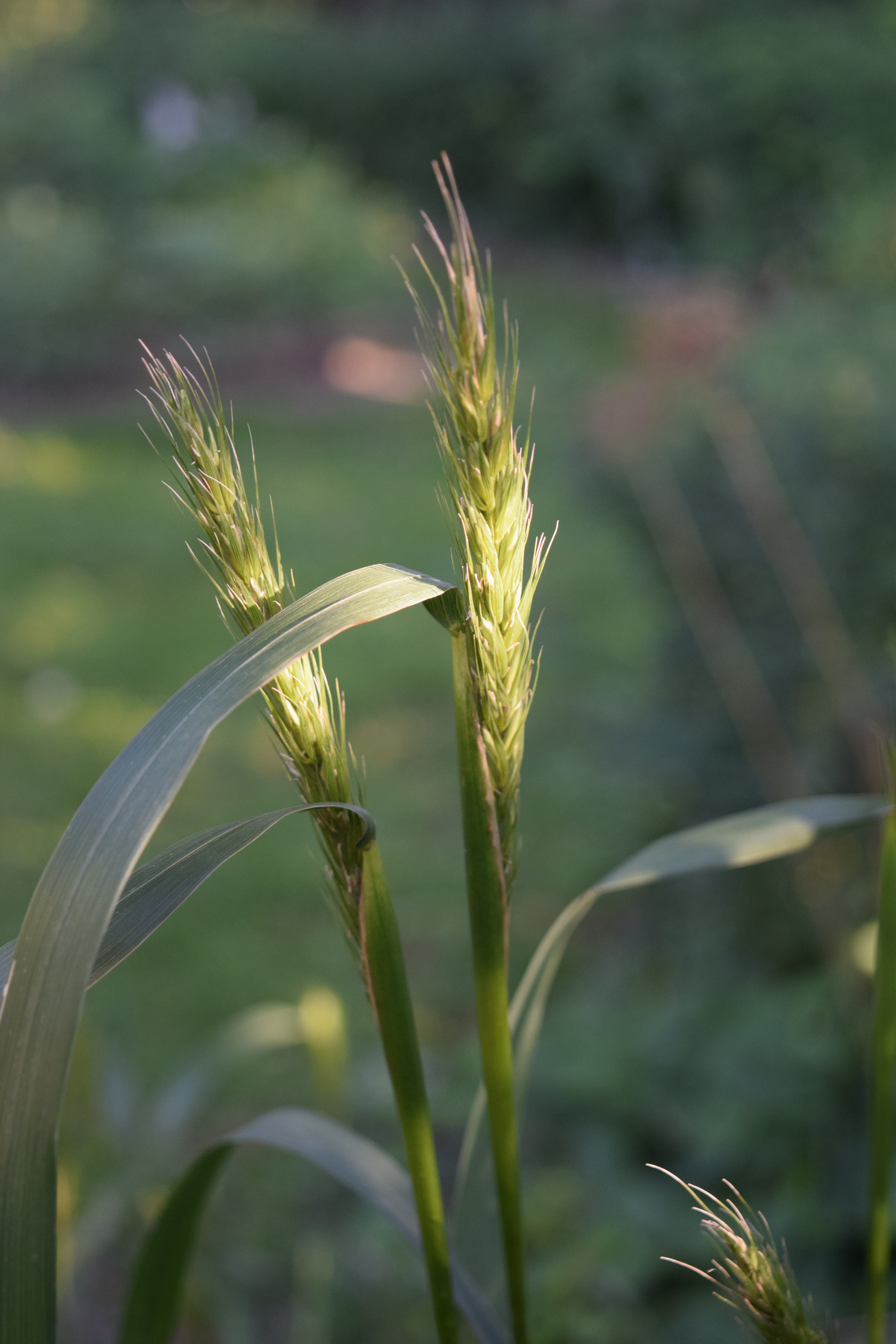
In the back garden, the seed heads of shade tolerant Silky Wild Rye (Elymus vilosus) are just starting to emerge from their sheaths.
Wild Black Raspberry patch
I also like the leaves of wild black raspberry (Rubus occidentalus), which grows in a little patch at the base of the Silver Maple tree (Acer saccharinum).
Calladium in containers with New Guinea Impatiens.
And Calladium is the primary foliage plant in the containers for shade.
The Left Bank is my new name for the sunny garden bed that is west of the driveway, between the crabapple and the sidewalk. I like the name, but at the moment the garden looks like a collection of green lumps.
The Left Bank Garden, a collection of green lumps.
My intent with this garden was to prove that I was capable of planting a bed where the average plant was under five feet tall. I wanted something lower growing and colorful with year-round interest. The plants would also have to tolerate some fairly dry conditions.
The good news is that Judy (who usually resists change) has agreed to a do-over of this bed. Hurrah! Wandering in an abundantly blooming garden makes me happy, but I can be made equally happy rearranging an established bed.
At the moment, here’s what I’m thinking of in terms of which plants will be kept, removed, or added.
You’re Out!
Scabiosa ‘Butterfly Blue’ (in) and Lanceleaf Coreopsis (out),
Coreopsis (Coreopsis lanceolata). These were brought to our garden by a shipping error. I used them to edge the east side of the bed, but they really haven’t worked out. Despite the full sun they tend to grow too tall. If I cut them back, they bloom very sparsely. They are destined for the compost pile.
Prairie Smoke (in) and infiltrating Starry Solomon’s Plume (out)
Starry Solomon’s Plume (Smilacina stellata). This is a good plant, but not right for this spot. Too aggressive. There’s a solid patch of them under the crabapple that I like very much, though. That’s where I’ll move the ones now in the Left Bank.
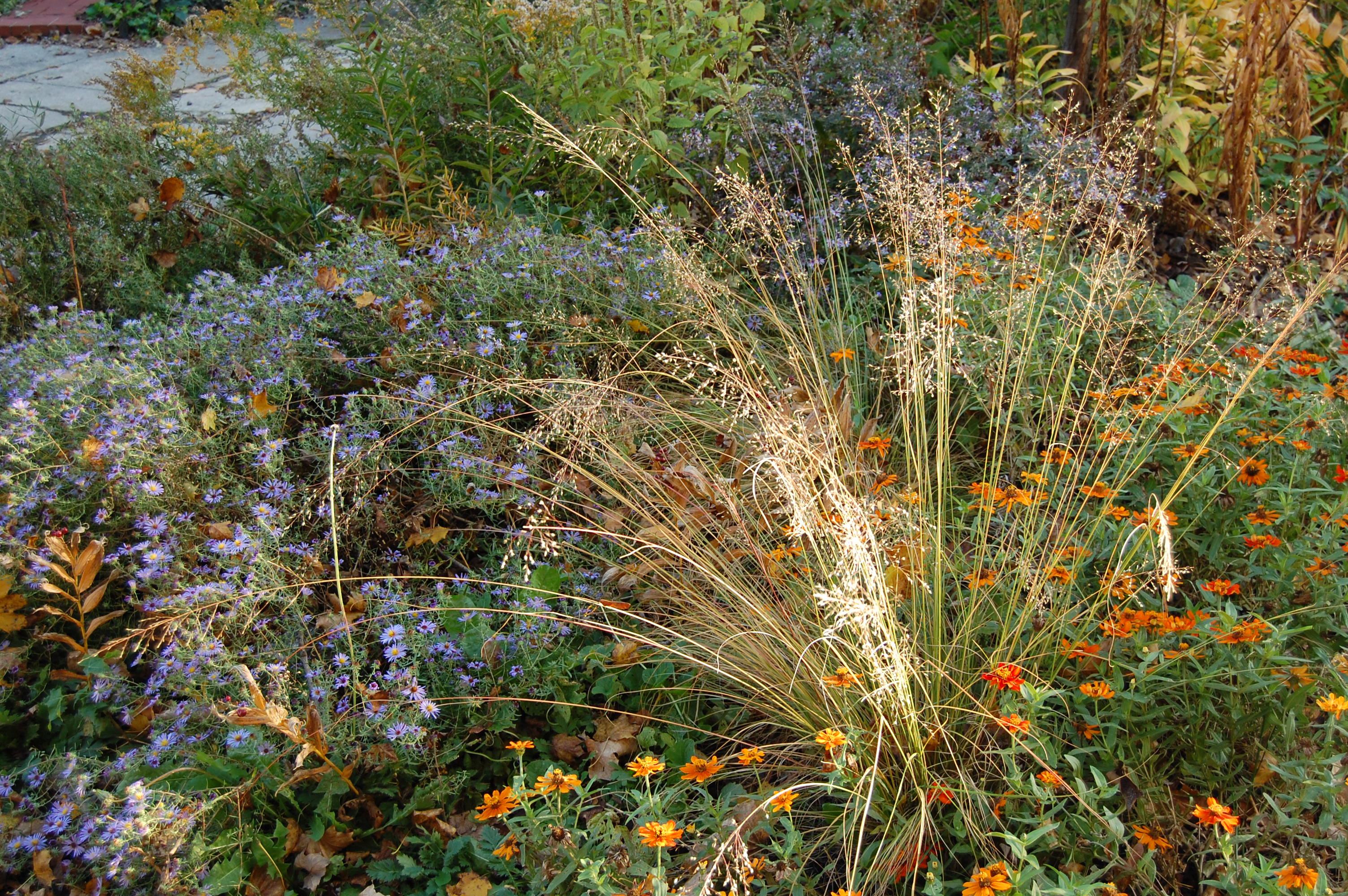
Aromatic Aster (mostly out)
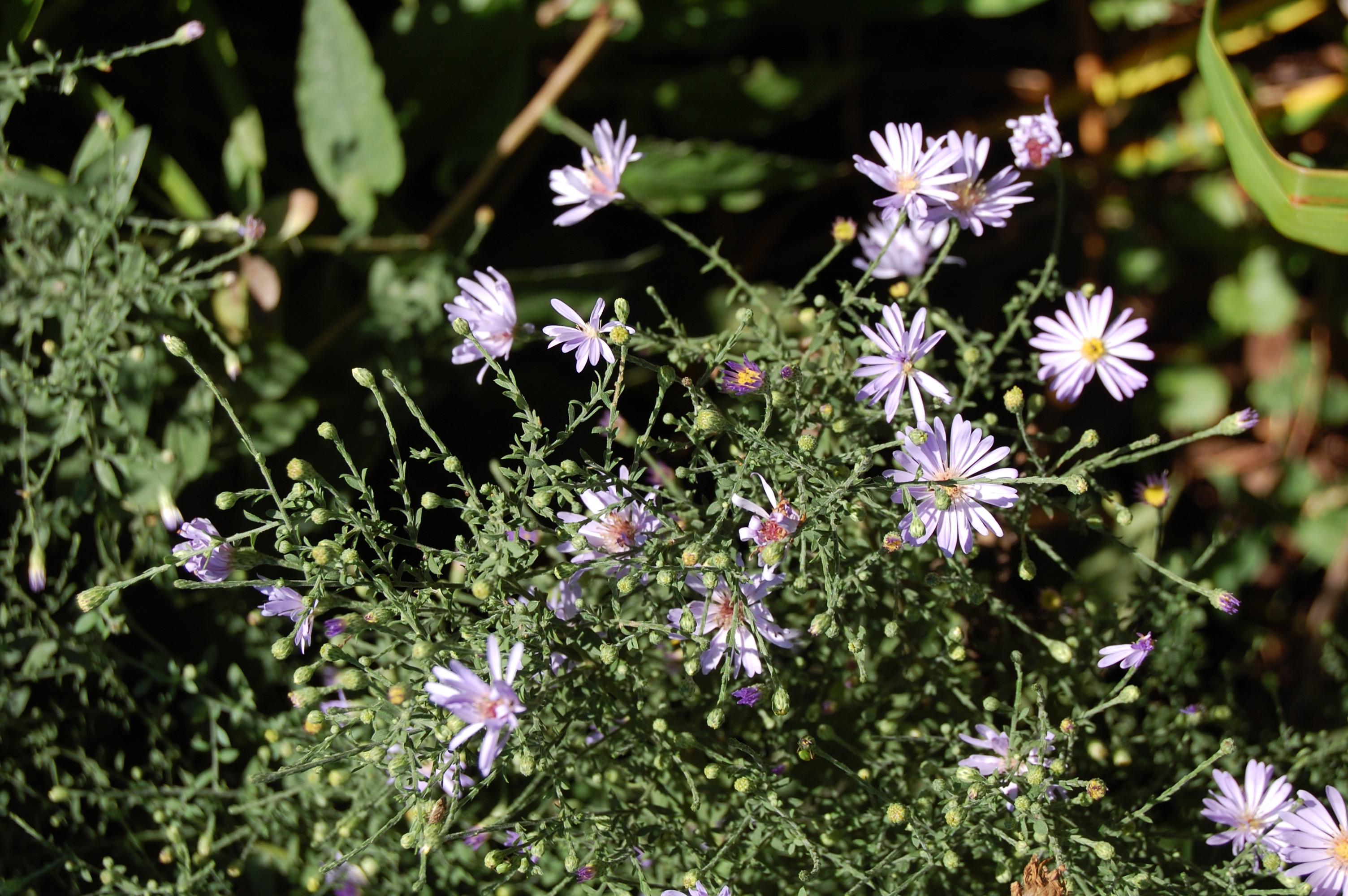
Aromatic Aster (Symphyotrichum oblongifolium). Originally I chose this aster because it’s supposed to be low-growing. I love the abundant blue flowers. But while it is shorter than many asters it still tends to smother its smaller neighbors. I plan to reduce the number of Aromatic Asters from three to one. The other two I’ll transplant or give away.
Various Salvia. This bed is a mess in part because I filled random bare spots with a bunch of Salvia (mostly ‘May Night’ and ‘Blue Hill’) that I bought really cheap at Home Depot. What can I say, I was in my Salvia Period. Anyhow, it wasn’t thought through and looks it. All the Salvia will be transplanted to the Parkway Garden.
You’re In!
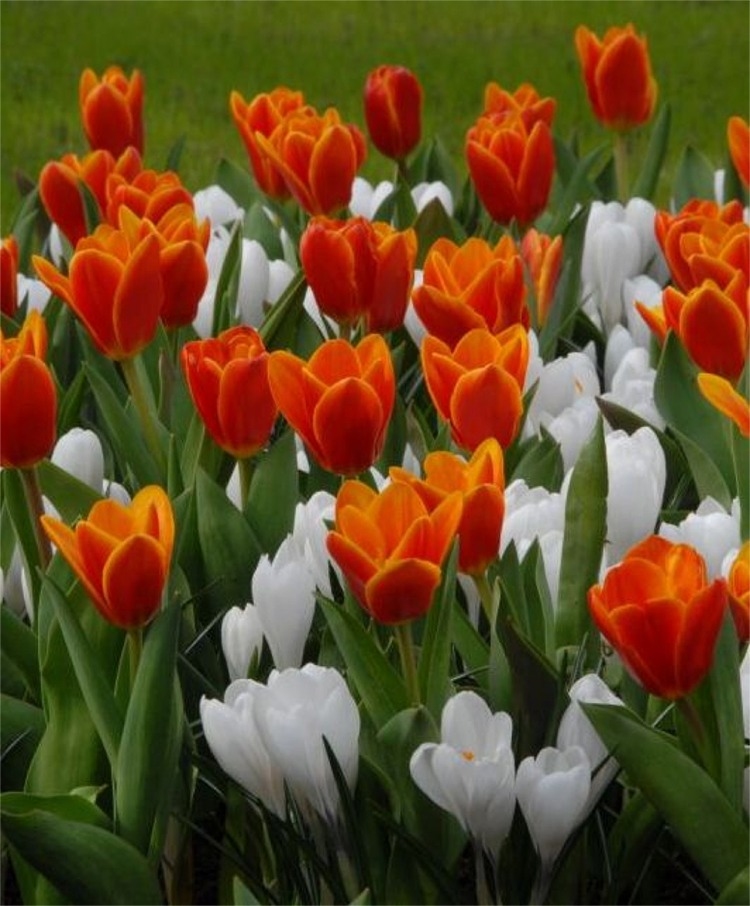
Tulip ‘Early Harvest’ (in) with white crocus. Photograph from johnscheepers.com
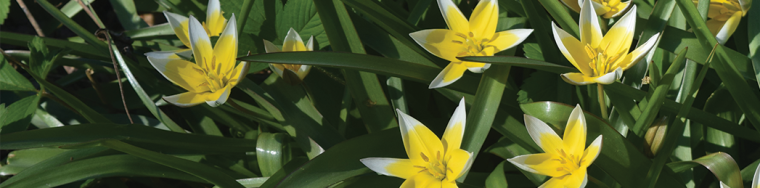
More Tulips. There are already some Species Tulips here, but digging up the bed is a great opportunity to plant more! In addition to more species tulips, I’m going to try the Kaufmanniana Tulip ‘Early Harvest’. Kaufmannianas are good perennializers and very early bloomers.
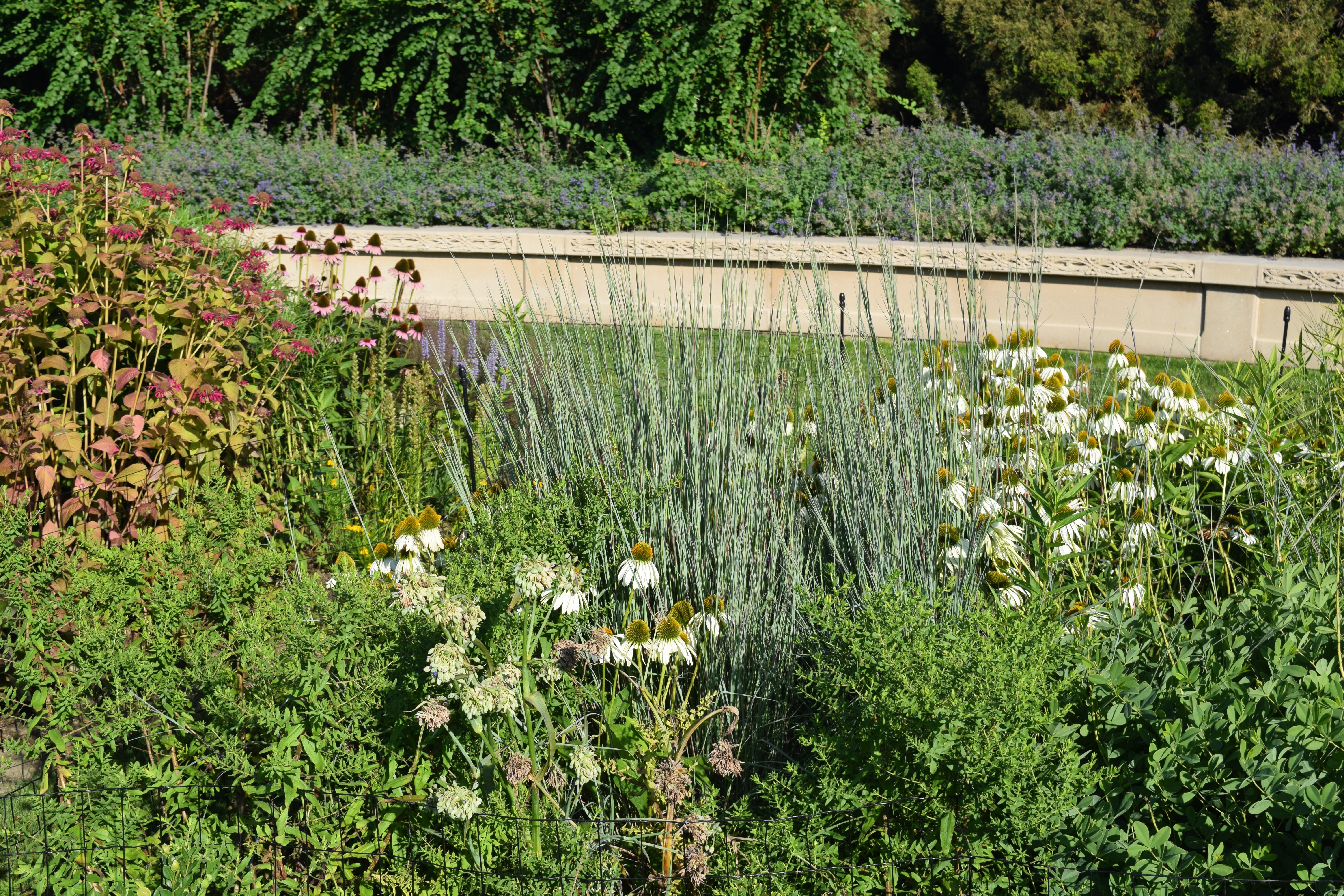
Prairie Dropseed (in)
Prairie Dropseed (Sporobulus heterolepsis). Right now clumps of this shorter prairie grass are scattered around the bed in a way that doesn’t really make sense. I want to move some so that they form a solid border along the west side of the bed.
Prairie Smoke (Geum triflorum). These are currently planted right along the sidewalk. I’ll keep them where they are and add a few more to make a wider drift.
Wild Petunia (in) growing with Wild Strawberry.
Wild Petunia (Ruellia humilis). Petunia-like lavender-blue flowers from June onwards. Low-growing so I’ll plant it behind the Prairie Smoke.
Poppy ‘Pulcinella Bright Solar Yellow’ (in). Photograph from Bluestone Perennials.
Iceland Poppy (Papaver nudicaule ‘Pulicinella Bright Solar Yellow’), To brighten things up I want to interplant the Wild Petunia with this summer-blooming yellow poppy.
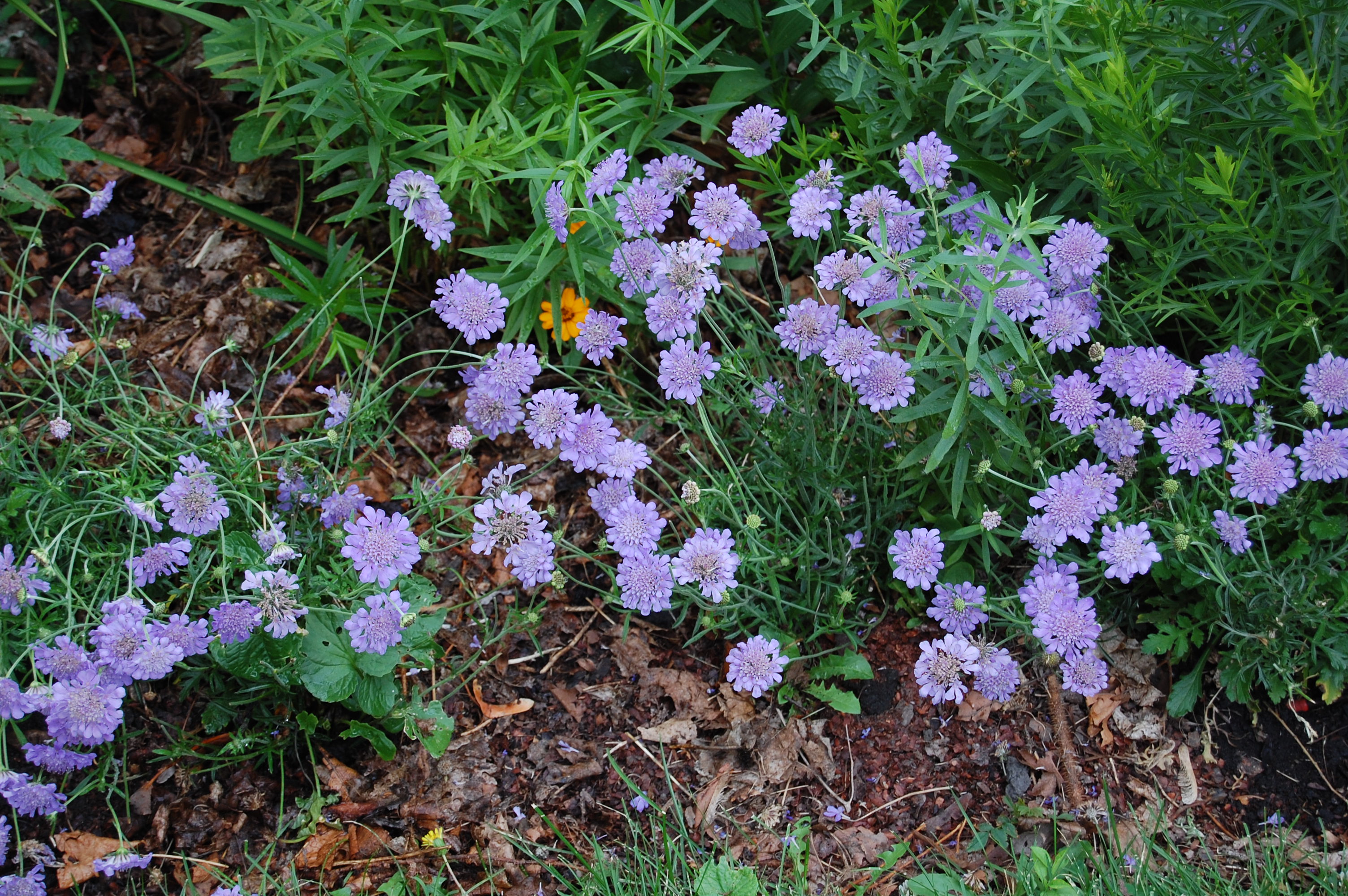
Scabiosa ‘Butterfly Blue’ (in)
Pincushion Flower (Scabiosa columbaria ‘Butterfly Blue’). Very long-blooming, these will replace the coreopsis along the east edge of the bed.
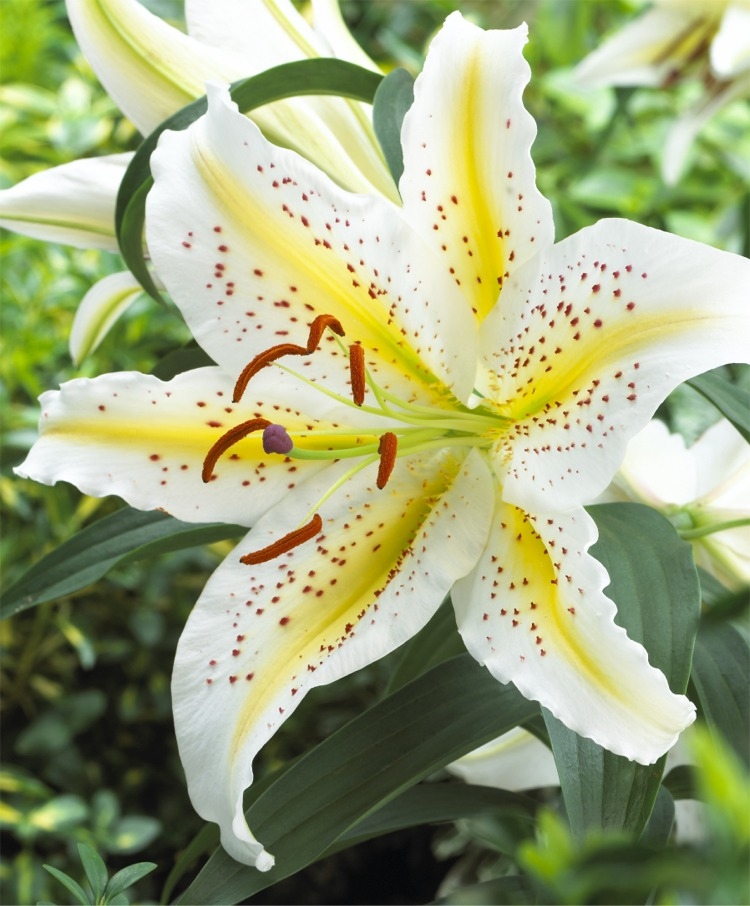
Oriental Lily ‘Gold Band’. Photograph from Bluestoneperennials.com.
Oriental Lily (Lilium auratum ‘Gold Band’). These fragrant yellow and white lilies will bloom in August after the orienpets across the driveway are done.
So that’s the plan, tentatively at least. I intend to do the planting this fall. Any thoughts or suggestions?
Have you had the experience of living practically down the street from a major attraction that you never visit, apparently because it’s just down the street? That’s how it’s been with Judy and I and Chicago’s Baha’i Temple, one of only seven in the world.
View of the Baha’i Temple from Linden Avenue in Wilmette.
Technically, the Temple is in Wilmette, a suburb just north of Evanston, where we live. And we had in fact visited it in February a couple of years ago. Nothing was in bloom, of course, but they say winter is a good time to see a garden’s bones.
Although in this case, we couldn’t pay much attention to the bones because we were trying to stave off hypothermia. But ever since then we have been meaning to visit the Baha’i Temple when the weather was more reasonable. This past weekend, we finally did.
The Baha’i religion was begun in Iran around 1850. Its theology is built on the concepts of “the oneness of God, the oneness of humanity, and the oneness of religions”, according to the Temple website. Baha’i believe in tolerance, universal education, and equal rights for women. Alcohol is prohibited, though, in case you consider that a deal-breaker.
The Temple was begun in 1912 and not completed until 1953, largely because only funds from adherents could be used for its construction.
The nine-sided building reflects the ecumenical spirit of the religion. There seem to be influences both Arabic and Byzantine, Gothic and Renaissance.
Symbols of Hinduism, Judaisim, Christianity, and Islam on a column of the Temple. The religions are ordered chronologically, with the earliest at the bottom.
On columns suggestive of minarets, symbols of Hinduism, Judaism, Christianity, and Islam are carved.
Further up the column there seems to be a carving of a cathedral, complete with rose window.
Outer walk surrounds the gardens.
Each of the nine sides of the Temple has it’s own distinct garden. All of the gardens are surrounded by an outer walk lined with cedar, crabapple, magnolia, and other trees and shrubs.
Each of the gardens was surrounded by tall hedges on three sides.
The gardens here, I’ve been told, are influenced by Persian paradise gardens. Paradise gardens were enclosed, and each of the nine gardens at the Baha’i Temple are kept private from one another (though not from the Temple itself) with hedges of cedar and other woody plants.
One of two rectangular pools at the Baha’i Temple.
In an arid country, one could not imagine paradise without lots of water. Each of the nine gardens at the Baha’i temple has its own fountain, and water also flows through two rectangular pools on either side of the Temple.
Tall yellow snapdragons and red starflower along with low hedges of boxwood or yew.
The gardens here are fairly formal: boxwood hedges, geometric shapes, and a limited palette of massed annuals and perennials. Paradise gardens were meant to be calm and orderly, not wild.
Yellow zinnias and pink canna lilies, with white rugosa roses in the background.
You don’t get swept away with the exuberance of the plantings. On the other hand, they do not seem overly restrained. The simple plant combinations can create blocks of color that are quietly joyful.
Roses, oregano, thyme, and hydrangeas.
Some of the gardens seem planted with a theme in mind. For example, a garden of fragrant roses, thyme, and ornamental oregano.
North American natives at the Baha’i Temple.
There was also a garden of North American natives – coneflowers, anise hyssop, swamp milkweed, bee balm, and little bluestem among others.
You can sit on the walls of the raised beds, but that’s about it.
Apparently these are gardens for strolling, not sitting. There are no benches, though you can sit on the walls of the raised beds.
Gardens are at a lower elevation, the ground separating them is higher.
Each of the gardens are separated by a stretch of lawn set at a higher elevation, so to move from garden to garden (unless you go by the outer walk) you must ascend and then descend a handful of stairs.
There are seven million Baha’i in the world, about 150,000 in the United States. Adherents are still subject to severe persecution in Iran and some other countries.
In the spring the gardens here are full of tulips and flowering crabapple. We intend to come back to see for ourselves.
Water flows over a quite waterfall before recirculating.
I enjoyed the flowers at the Baha’i Temple. However, it is the tranquility and sense of reverence (whatever your religious beliefs) that comes from the combination of enclosure and open space in the shadow of the Temple that makes this a place very much worth seeing.
I am done with morning glories (Ipomoea tricolor). Last year I got only about half a dozen blooms total, and this year seems only marginally better.
Bloomless morning glory on my tuteur.
The cool summers, I suspect, are a big part of the problem. These are tropical vines; they want heat, but they’re not getting it. And so here we are in the middle of August with mostly bloom free morning glory vines.
Plus, I bought the variety ‘Blue Heaven’, which has large blooms of sky blue. The few flowers we’re getting must be of some other variety, as they are a darker blue with white stripes.
Nice, I guess, but not ‘Heavenly Blue’
Anyhow, I’m looking for suggestions for what I can grow instead of morning glories on my tuteur. I’m thinking probably Clematis. Here are the criteria:
Should be in the blue-purple color range.
Should bloom in mid-late summer, after the C. jackmanii are done.
Should grow at least 6′, but not be completely rampant.
Once again it is time for Garden Bloggers’ Bloom Day (GBBD), hosted by May Dreams Gardens. GBBD provides a mid-month opportunity to count up our flowering plants like a latter day pirate counting his treasures. So put on your eyepatch, and let’s go.
The Driveway Border and front garden seen from the end of the driveway.
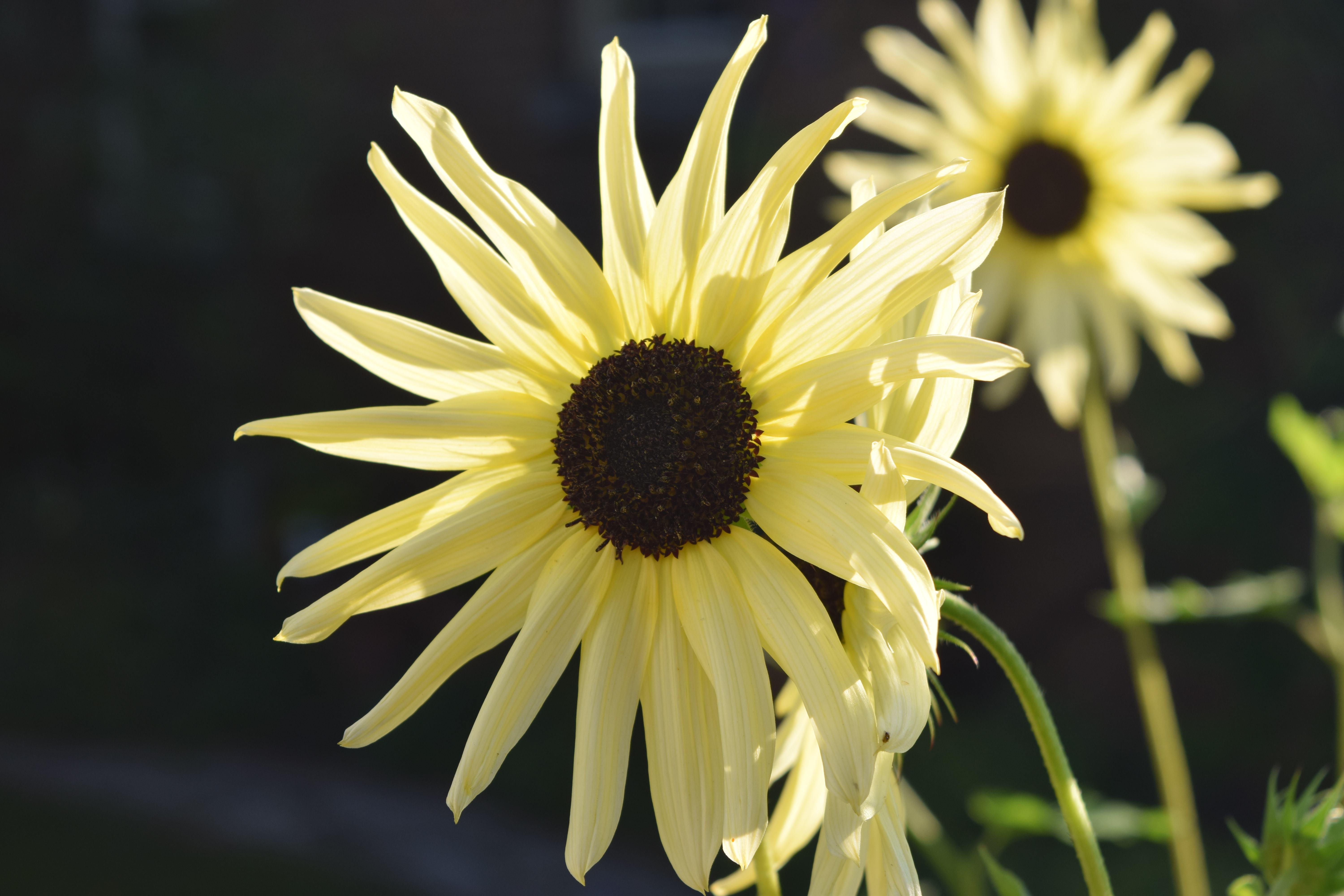
The Driveway Border is the most colorful of all the front garden borders at this time, with blooms of yellow (Ratibida pinnata, Helianthus annuus ‘Italian White’), orange (Tithonia rotundifolia), blue (Agastache foeniculum, Buddleia ‘Adonis Blue), and purple (Eupatorium purpureum ssp. maculatum ‘Gateway’).
Driveway Border seen from the sidewalk.
A closer look.
‘Italian White’ sunflower
As a commenter recently said, ‘Italian White’ is a truly sweet sunflower. At this point in the season it is blooming profusely. For now I am deadheading the flowers, eventually I will leave them to self-sow and feed the goldfinches.
Anise hyssop and Mexican sunflower
Agastache foeniculum and Tithonia rotundifolia make such a cute couple.
‘Gateway’ Joe Pye Weed
‘Gateway’ Joe Pye Weed is not fully in bloom but is colorful anyway.
‘Cassie’ blooming under the watchful gaze of the cupplant.
Last year I deadheaded Rosa ‘Cassie’ but this year I haven’t. Hips are forming, but ‘Cassie’ keeps on blooming regardless.
‘Cassie’
The new flowers look so fresh you can imagine it is springtime.
Cupplant and sweet joe pye weed. Can you see the Monarch butterfly on the joe pye weed?
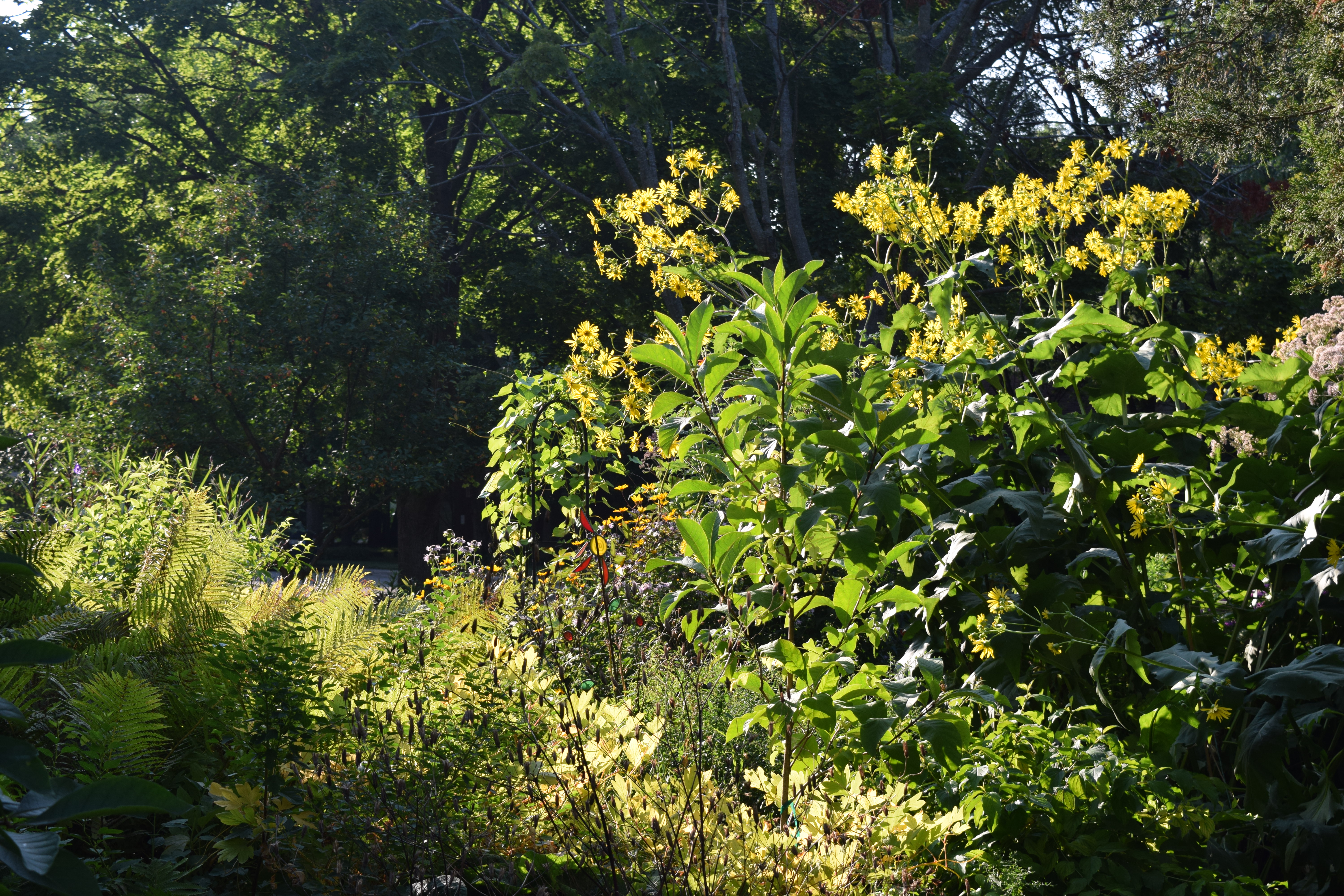
While the Driveway Border puts forth a riot of color, the Island Bed is also hard to ignore. With cupplant (Silphium perfoliatum) and sweet joe pye weed (Eupatorium purpureum), the Island Bed combines stature with daisies of yellow and clouds of soft pink.
Cupplant viewed from the northeast corner fo the house. My young fringe tree is at the center of the picture.
The cupplant really is just stupendously tall.
Sidewalk Border
In the Sidewalk Border, ‘Raspberry Wine’ bee balm (Monarda didyma) is fading, but still has plenty of color. Soon I should do some deadheading, though.
Swamp milkweed with a background of switchgrass.
The swamp milkweed (Asclepias incarnata) is also still blooming.
Oh, and remember sometime back I said there really were paths between these beds and borders? Well, here is the path between the Island Bed and the Driveway Border.
And here’s the path between the Sidewalk Border and the Island Bed.
Calamint in the Parkway Bed.
In the Parkway Bed, calamint (Calamintha nepetoides) has clouds of tiny white flowers. Orange coneflower (Rudbeckia fulgida) and brown eyed susan (Rudbeckia triloba) are just starting to flower.
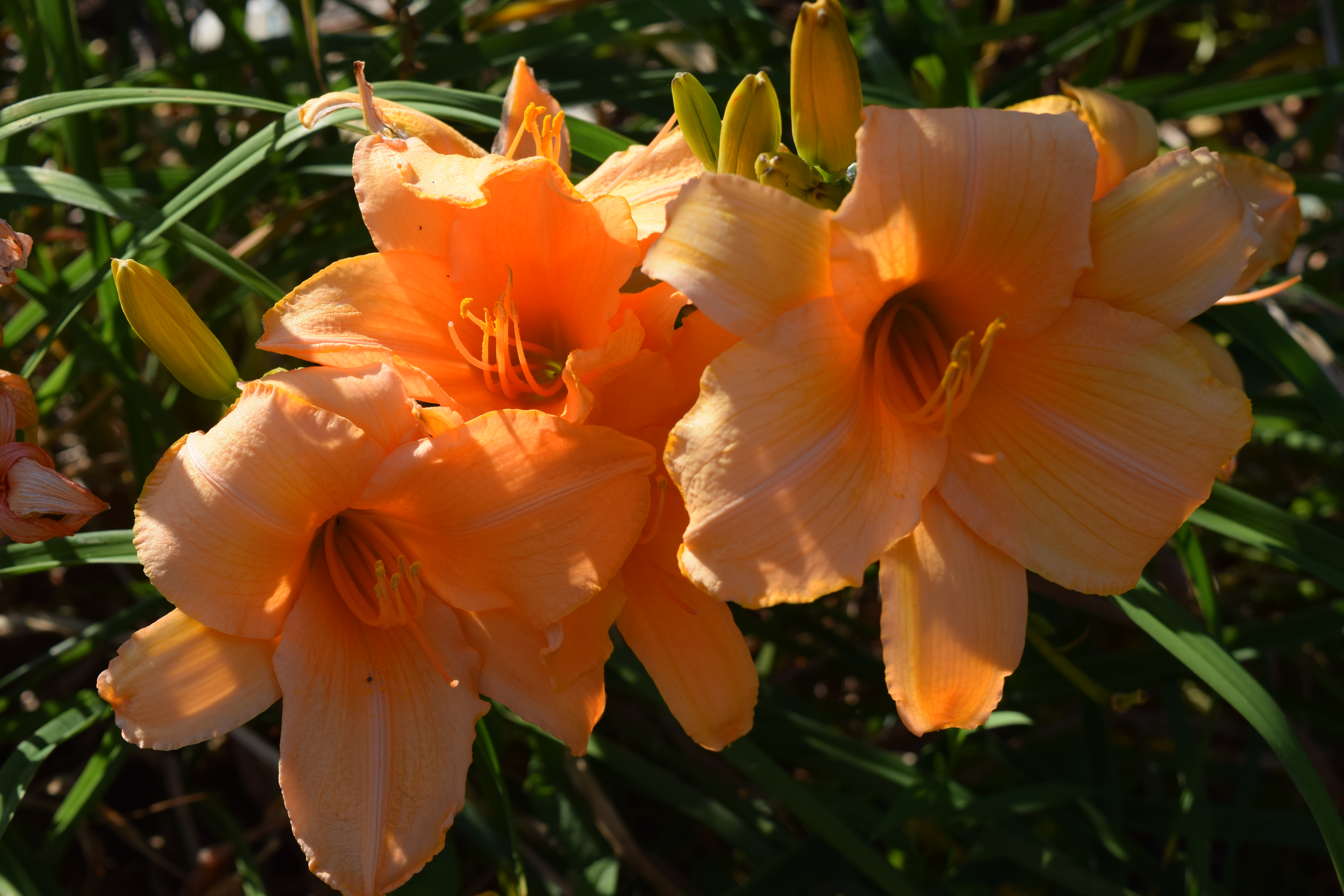
‘Egyptian Spice’ daylily‘Chicago Apache’ daylily
Many of the daylilies are done for the year, but over in the Left Bank Garden (my new name for the other side of the driveway), ‘Egyptian Spice’ and ‘Chicago Apache’ are still pumping out blooms.
View of our house from the street.
Finally, another street view of our house and garden.
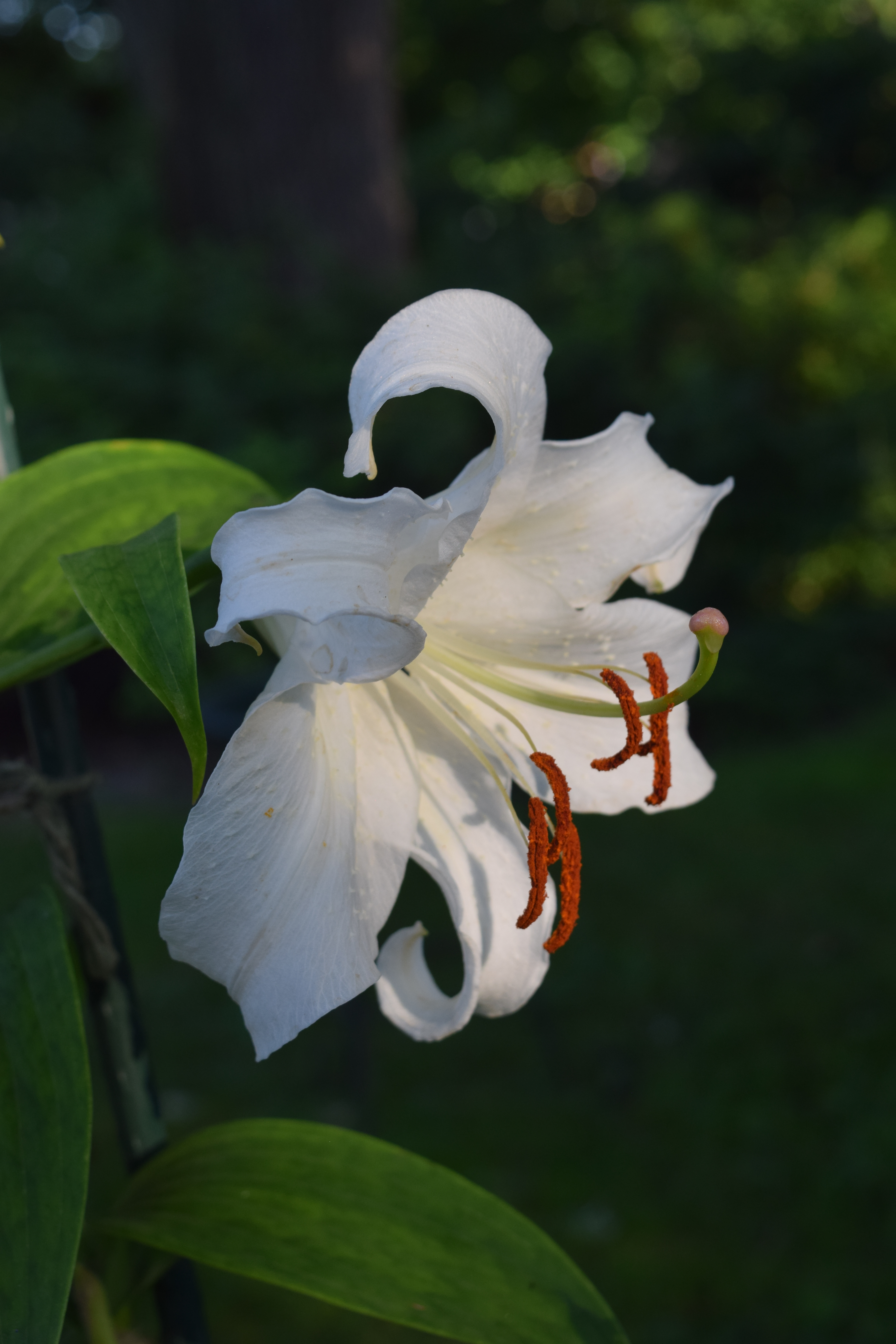
‘Casa Blanca’ oriental lily
Things are a lot quieter in the back garden. The most exciting blooms are the remaining ‘Casa Blanca’ oriental lilies.
‘Darlow’s Enigma’
‘Darlow’s Enigma’ continues to bloom through the summer as it climbs up our arbor.
Summer containers by the back porch.
And there are containers filled with New Guinea impatiens (Impatiens hawkeri).
Blackberry Lily
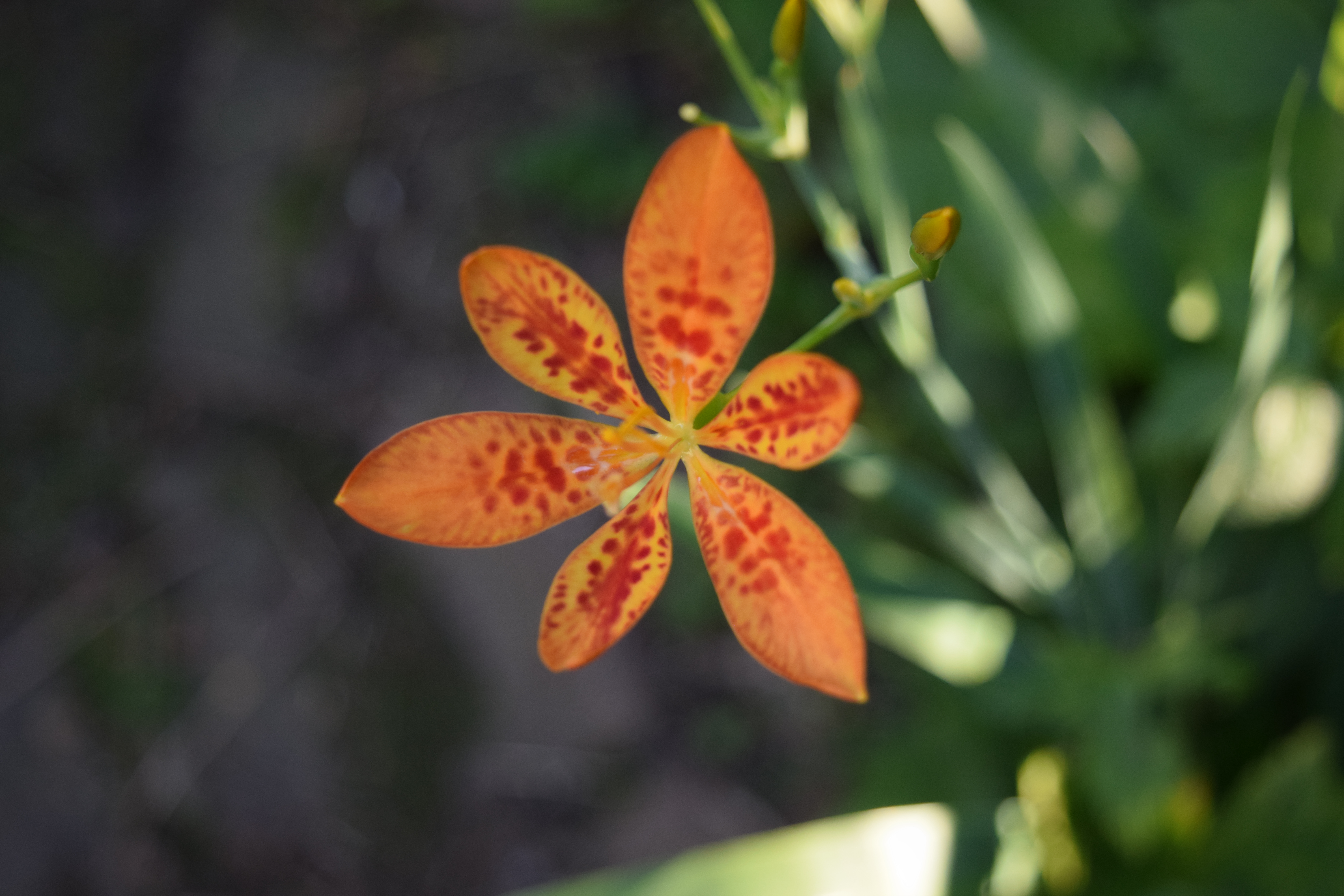
Finally, there is our one blackberry lily (Iris domestica), a gift from the birds. Since it seems intent on sticking around, I think I should get it some companions so it won’t get lonely.
Recently there have been two excellent posts on the nature of gardeners’ personal plant likes and dislikes, one in The Blooming Garden and the second in Angie’s Garden Diaries. These thought-provoking posts reminded me of a very disappointing experience I had involving impatiens (Impatiens walleriana) and The Wall Street Journal.
In March, 2013, I wrote a post about the impatiens blight that got a fair number of views. One of the viewers was Bart Zeigler, a reporter for The Wall Street Journal. He asked if he could interview me on the impatiens’ decline.
Now, I am at best an occasional reader of the WSJ. I don’t like their politics, and it seems that the quality of their reporting has declined since the paper was purchased by Rupert Murdoch. However, I admit I was thrilled to be contacted by the paper. Politics, shmolitics, I thought. My blog is going to be mentioned in The Wall Street Journal! And that means VIEWS!
So I did the interview and waited in an agony of anticipation. When the article appeared, I was dismayed.
Mr. Zeigler’s focus was less on the impatiens blight and more on the “good riddance” attitude held by certain practitioners of haute horticulture. The article had quotes from three people who were glad to see the back of impatiens. The most instructive came from Manhattan-based garden designer Jeffrey Erb:
“I try to give my clients something they are not expecting, and impatiens don’t really fit that bill … I guess what really bothers me about impatiens is that people plant them because they are easy.”
So. Right there are two foundations of plant snobbery: scorning plants because they are common, and because just anyone can grow them.
Now, I like to grow unusual plants. I like it when people point to a plant in my garden and ask, “What IS that?”. But I don’t dislike a plant simply because it is common. I like marigolds. I like Rudbeckia ‘Goldsturm’. I could go on, but you get the point.
I would say that a garden consisting only of the most common plants is likely to be a less interesting garden. However, there is nothing wrong with a garden that combines the old standbys with more unusual offerings.
As for “too easy” – most people would consider that a virtue. And here’s where plant snobbery and class snobbery can overlap. I suspect that many of Mr. Erb’s clients who opted for plants that are not “too easy” are paying Mr. Erb or someone else to take care of those plants.
In addition to ubiquity, people criticized impatiens for having leaves and flowers that are “withery and wimpy” as well as “flat and dull”. This only shows how emotion shapes perception, because otherwise these statements are just silly. Either that, or the impatiens in question are planted in too much sun, or maybe they just need some water.
White impatiens spilling over the back of our wheelbarrow planter.
I was the only person in the article who had anything good to say about impatiens (as opposed to the three impatiens critics). I wish Mr. Zeigler had asked for my reaction to all the disdain heaped on this poor suffering plant, but he didn’t. The takeaway quote from me was this: “They’re a really nice, easy plant.” In other words, my role in the article was to be the unsophisticated dimwit who likes “nice, easy” plants.
I believe in the original draft of the article, it read:
“They’re a really nice, easy plant,” he said, adjusting his polyester stretch pants and wiping the hayseeds from his hair.
And after all that, the article didn’t mention my blog, or even that I wrote a blog, even though that’s how the reporter found me.
However, I’m not bitter. In fact, even though it’s been a long time since the article appeared, I’m considering sending the reporter a thank you gift. Do you think he would like a nice basket of impatiens?
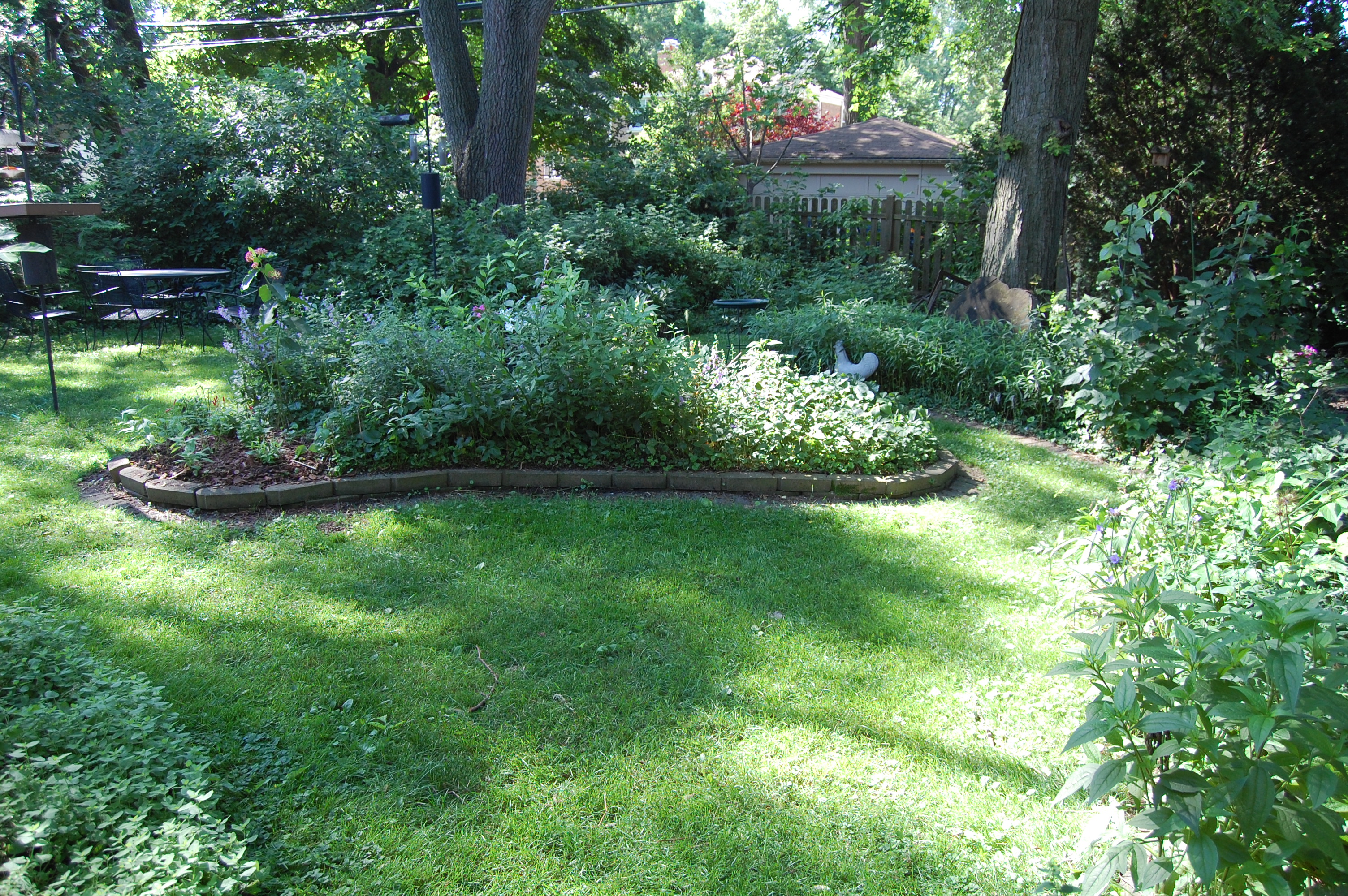
My back garden raised bed has been something of a permanent work in progress. I was in my Raised Bed Period when I created it. Somewhere, I really can’t remember where, I had read about the virtues of raised beds. Over the next couple of years I created four of them in the garden.
Back garden raised bed last July.
Anyway, the conditions in this raised bed must have been more difficult than I realized, because many plants didn’t last more than a season or two. As a result, I have always been trying to get something to fill open spaces here or there.
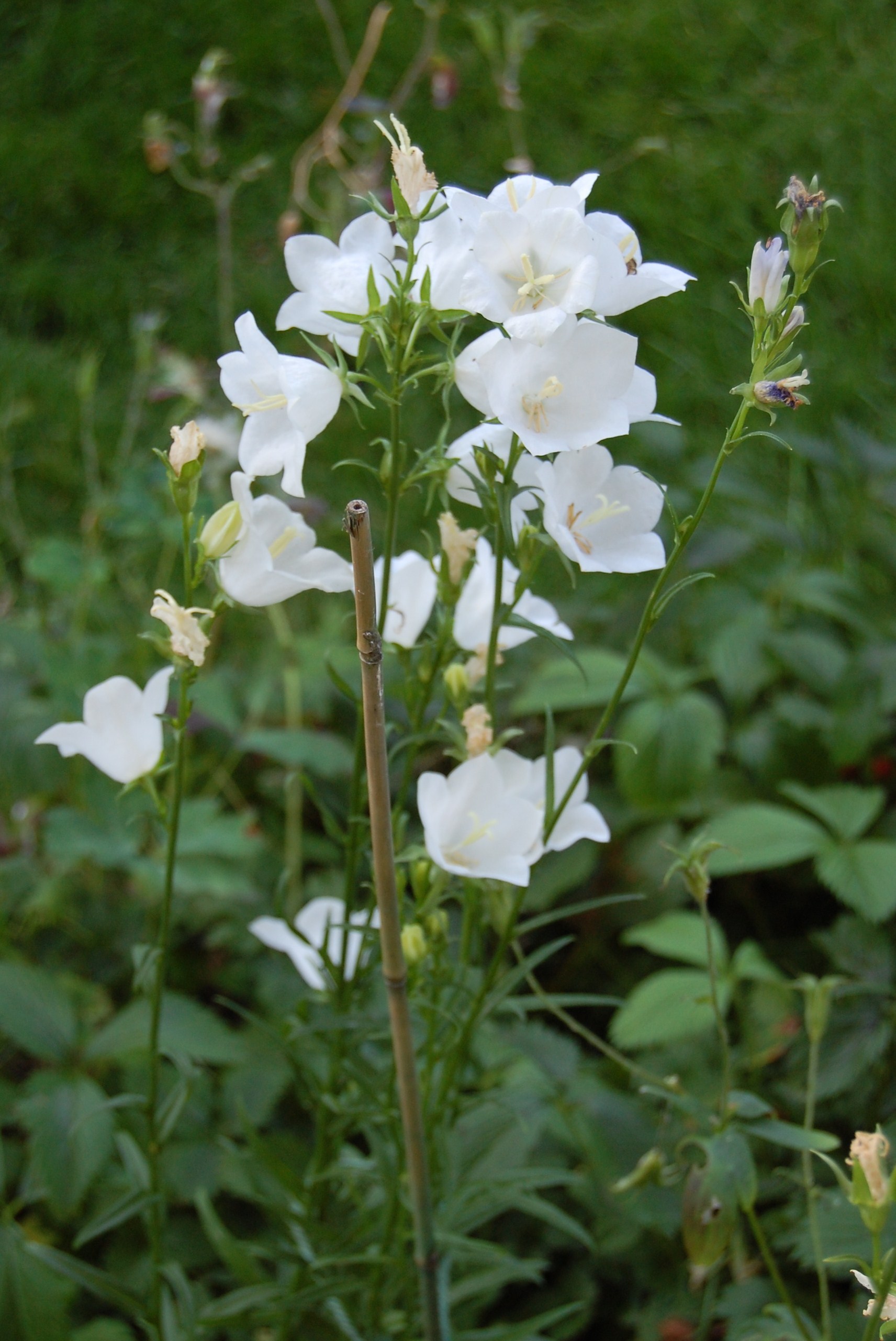
Peach leaf bellflower: didn’t cut it.
The raised bed is in part sun/dappled shade. It’s just a few feet from a silver maple (Acer saccharinum). The silver maple has greedy feeder roots which have not been shy about pushing into the raised bed. At the same time, this bed receives supplemental watering very rarely.
In the hope that you can benefit from my misadventures, I provide below a list of the plants that did not make it in this bed, as well as those that have succeeded and others for whom the jury is still out.
Ladybells. Whatever.
First, the ones that didn’t make it. I can only assume that it was the dryness and root competition that did them in.
Peach leaf bellflower (Campanula persicifolia). Hasn’t lasted more than a season or two.
Snowdrop windflower (Anemone sylvestris). Completely disappeared within three years.
Ladybells (Adenophera lilifolia). I like the flowers, but the plant overall is kind of weedy and had thin stems that would lean all over. It lasted several years, and there are still a few stems, but it is not a major presence in this bed.
Yellow foxglove
Yellow foxglove (Digitalis ambigua). I really thought yellow foxglove would be well-adapted to this site, but most of the plants have been shortlived. There are still a couple hanging on.
Silky wild rye (Elymus villosus). It should be named silky wild rabbit food. Feh. Same thing for Japanese forest grass (Hakonechloa macra).
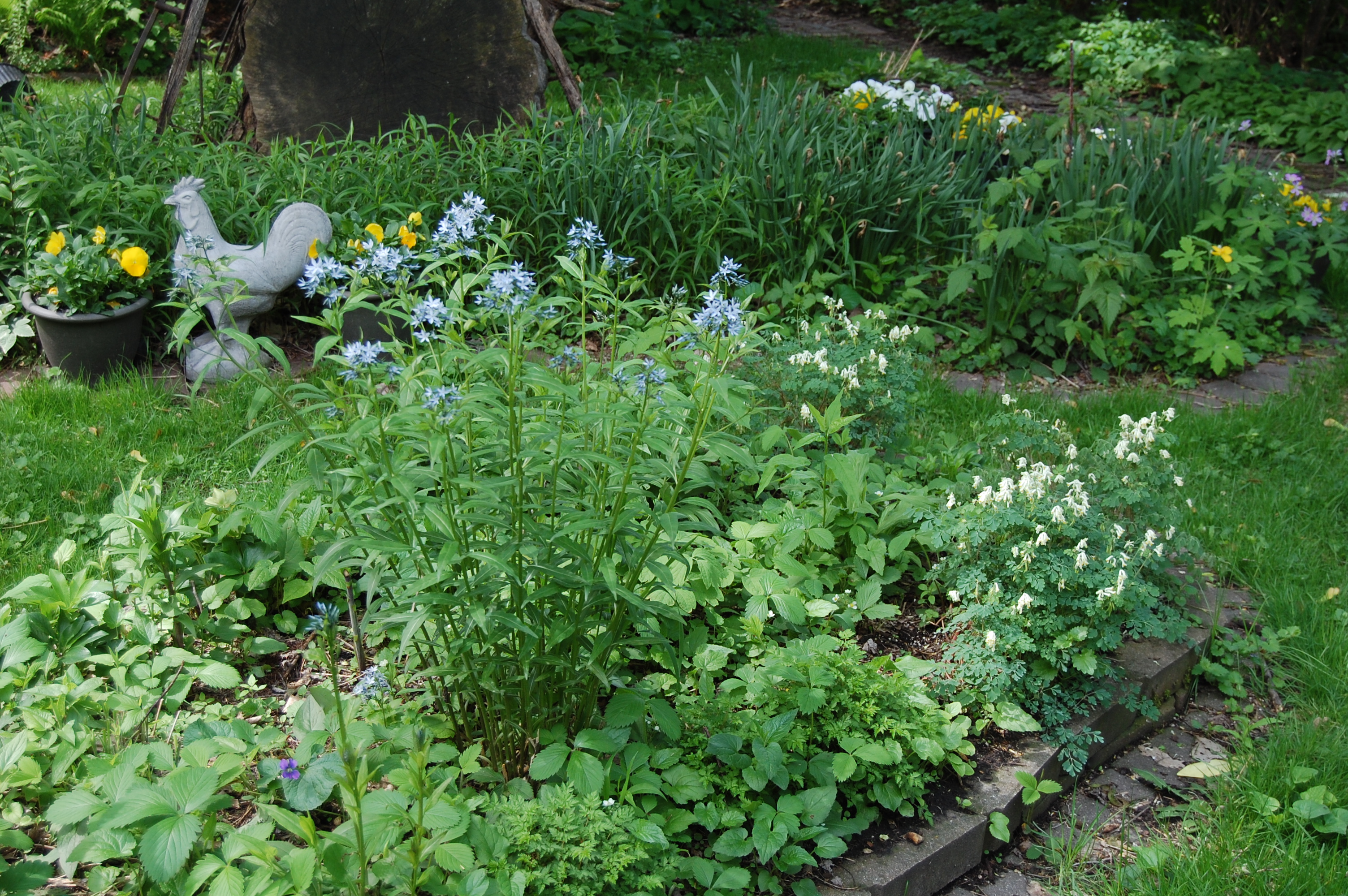
Amsonia ‘Blue Ice’: success story
Now for the success stories.
Amsonia ‘Blue Ice’. ‘Blue Ice’ feels absolutely at home in this raised bed. Every plant has established itself and set about growing into its own large clump. I cut back the foliage when the flowers are done and the new growth comes up yellow.
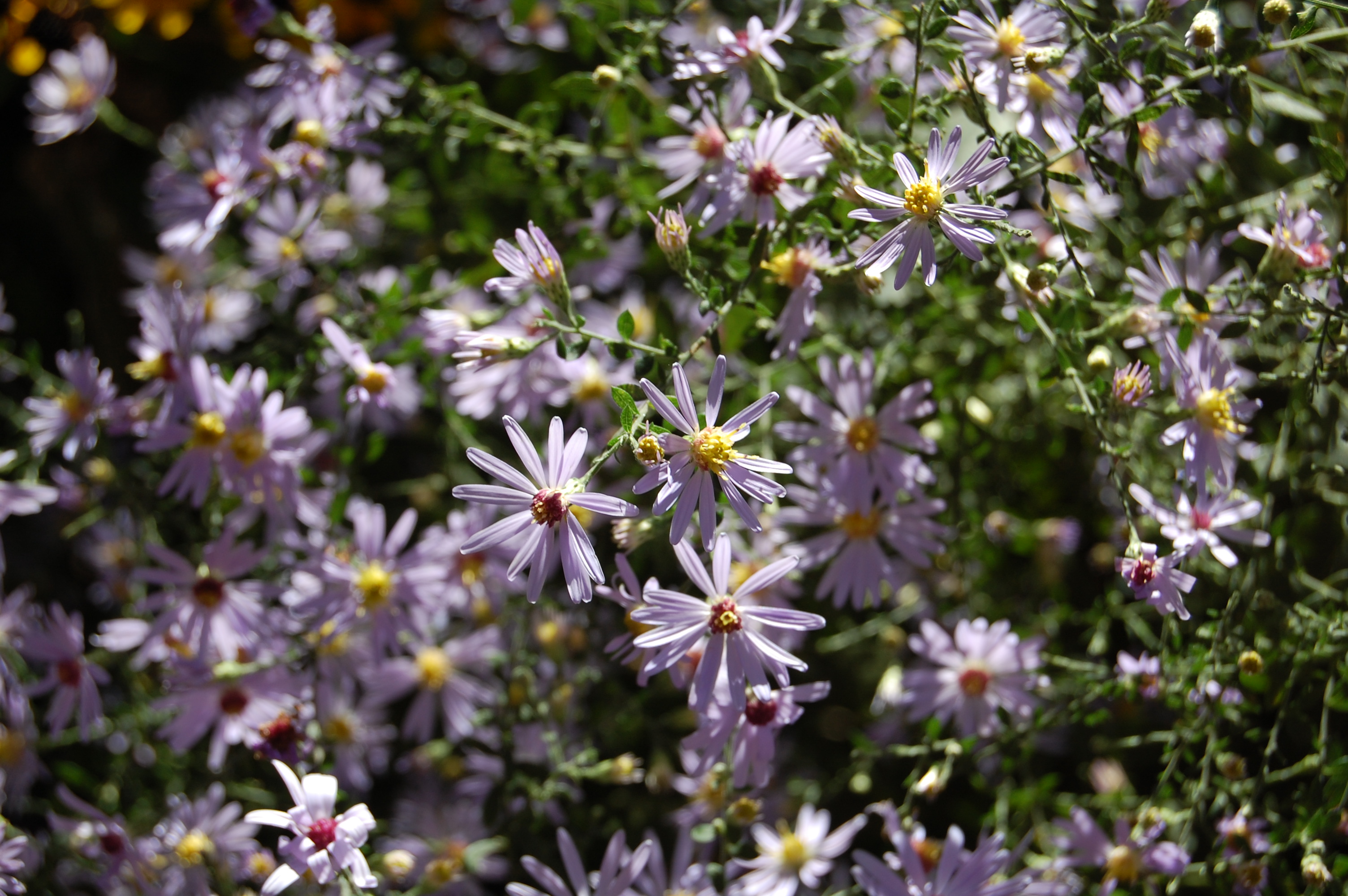
Short’s Aster
Short’s Aster (Symphyotrichum shortii). The rabbits chew, but do not demolish. Clouds of little blue flowers in fall on shrubby plants.
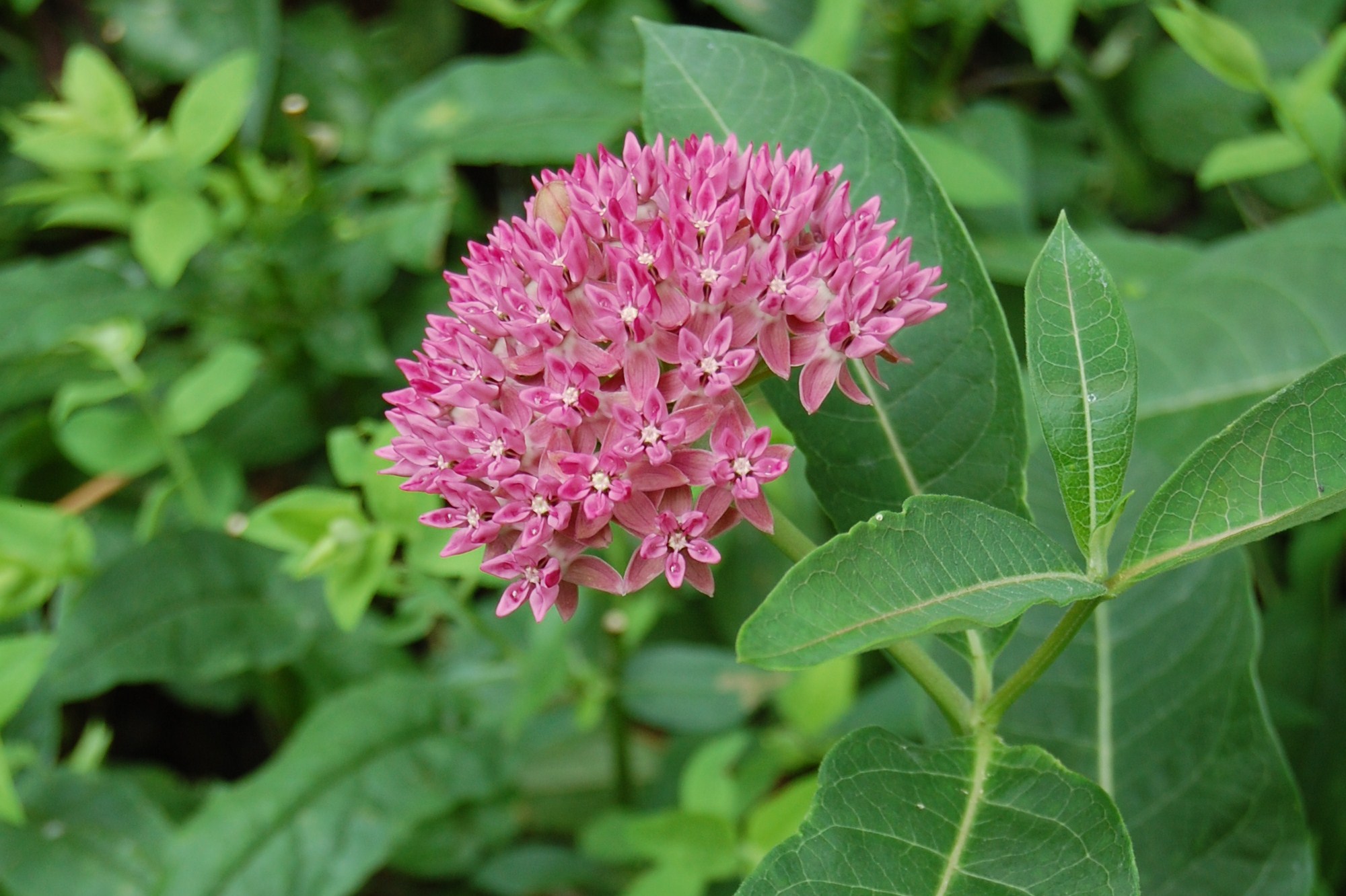
Purple milkweed (Asclepias purpureum). The one Asclepias that tolerates shade. I’ve learned that it doesn’t like to be crowded by other tall plants, so you have to give it some space.
Brown eyed susan (Rudbeckia triloba). A profusion of flowers smaller than most Rudbeckias. Short lived but it self-sows determinedly so it is always popping up somewhere.
Purple Milkweed: don’t crowd it
The jury is out.
Since last year I have been adding plants at every opportunity. Along the west side of the bed I have put dwarf goatsbeard (Dioicus aethusifolius) and yellow corydalis (Corydalis lutea). On the shadier east side I planted Lenten rose (Helleborus x hybridus).
Indian pink, planted at the end of the bed furthest from the silver maple, gets more moisture.
I’ve also got Indian pinks (Spigelia marilandica), and an Arkansas bluestar (Amsonia hubrichtii). Oh, and for drama and height, one spikenard (Arelia racemosa).
Dwarf goatsbeard
Sounds overcrowded, you say? Probably. But some stuff won’t make it, and I can always transplant. Experimenting with different plants under different conditions is half the fun of gardening.
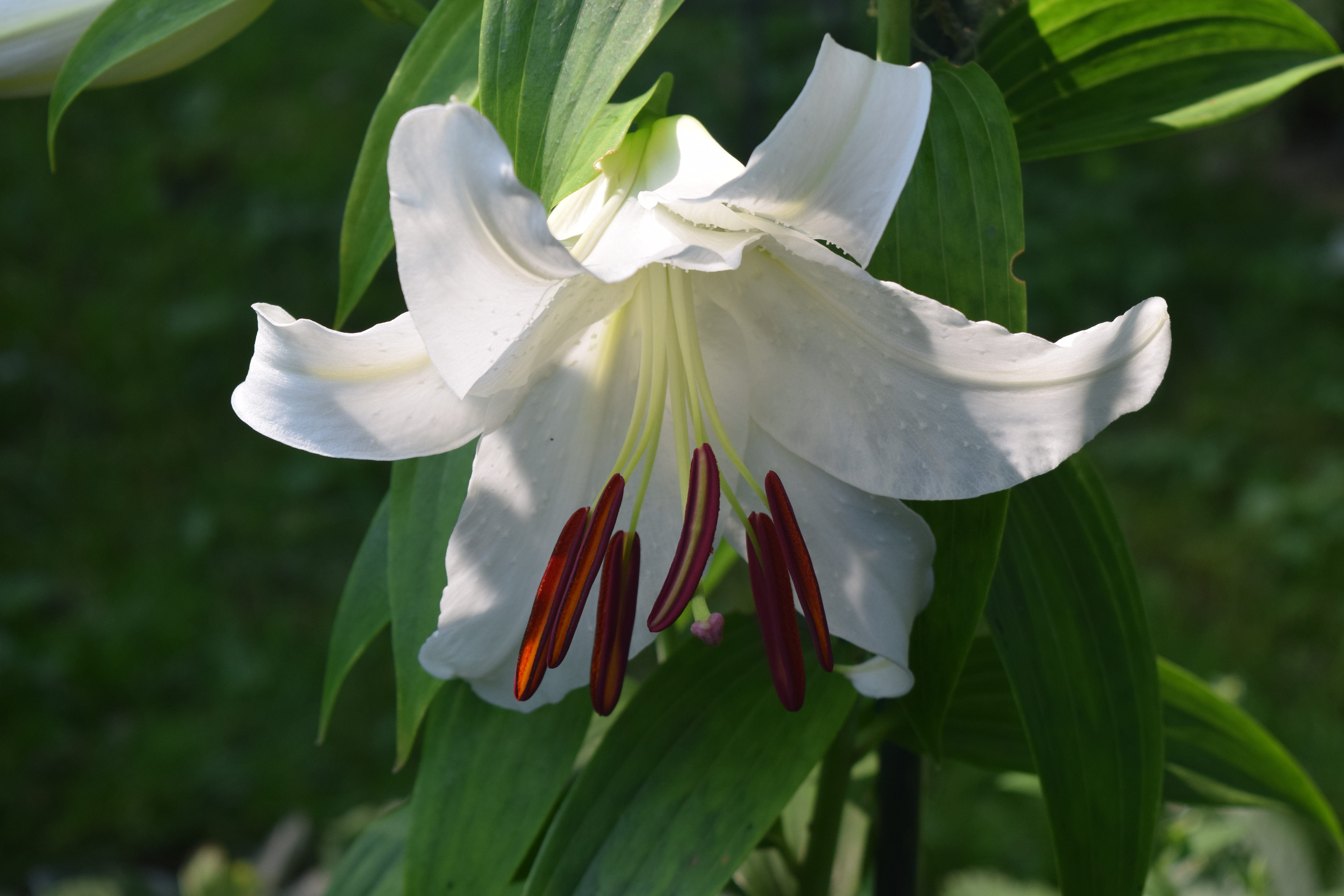
The ‘Casa Blanca’ oriental lilies are blooming in the back garden’s raised bed. I planted them last fall. There used to be ‘Casa Blanca’ in the Driveway Border, but they are no more. Foul play has not been ruled out.
‘Casa Blanca’ oriental lily
Anyhow, these are wonderful lilies. The ivory white petals are rich and luxurious. But it’s the deliciously sweet fragrance, which can be detected ten feet away from the plant, that has me in its thrall. Some people think the scent of oriental lilies is too strong. I, on the other hand, have the same approach to floral fragrance as I do to floral color: you can never have too much. It is probably a good thing I do not wear perfume.
The lily that almost shocked the neighbors.
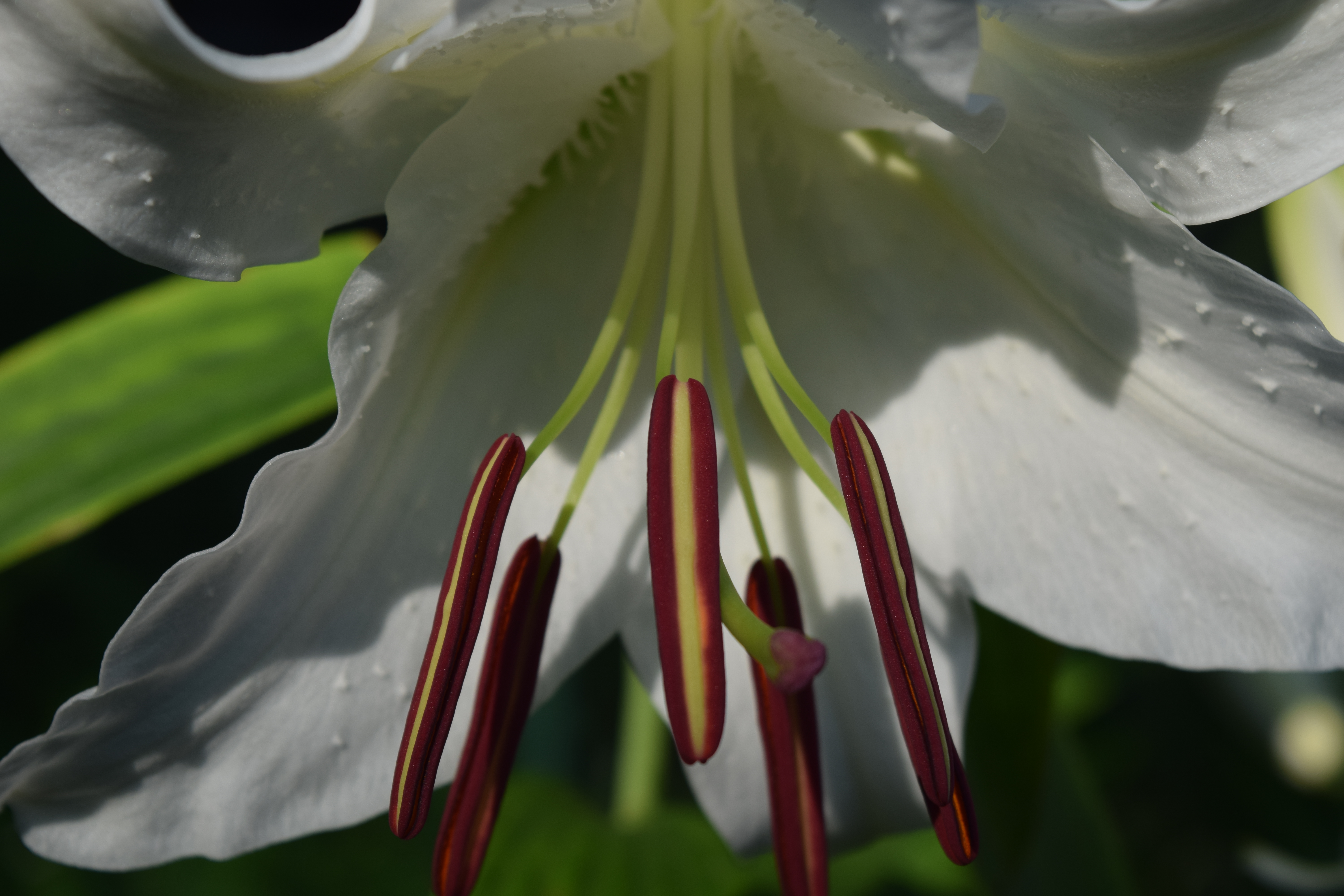
One of the neighbors was admiring the beauty of ‘Casa Blanca’ when she added, ” But those lilies are practically obscene.” It is true, I think, that lilies in general and ‘Casa Blanca’ in particular remind us strongly that flowers are about sexual reproduction. How could they not when the sexual organs, the pistil and stamen, are so prominent?
I did a rather clumsy job of staking because I am not taking any chances. Other ‘Casa Blanca’ lilies in my garden have met tragic accidents.
Which is odd when you consider that white lilies have often been used as symbols of chastity and purity. The late garden writer Cassandra Danz had this to say regarding another white lily, Lilium candidum: “In Renaissance paintings… at the moment when the angel tells Mary that she is going to be a mother, there is always a Madonna lily in the picture… It’s there because it represents fecundity and new life. Only later did it become associated with virginity and death, in that order … What a gorgeous creature this lily is, and virginity has nothing to do with it.”
Asiatic lily
‘Casa Blanca’ is the third and final act in my year of lilies. (Last year it was only a one act play.)
More Asiatic lilies
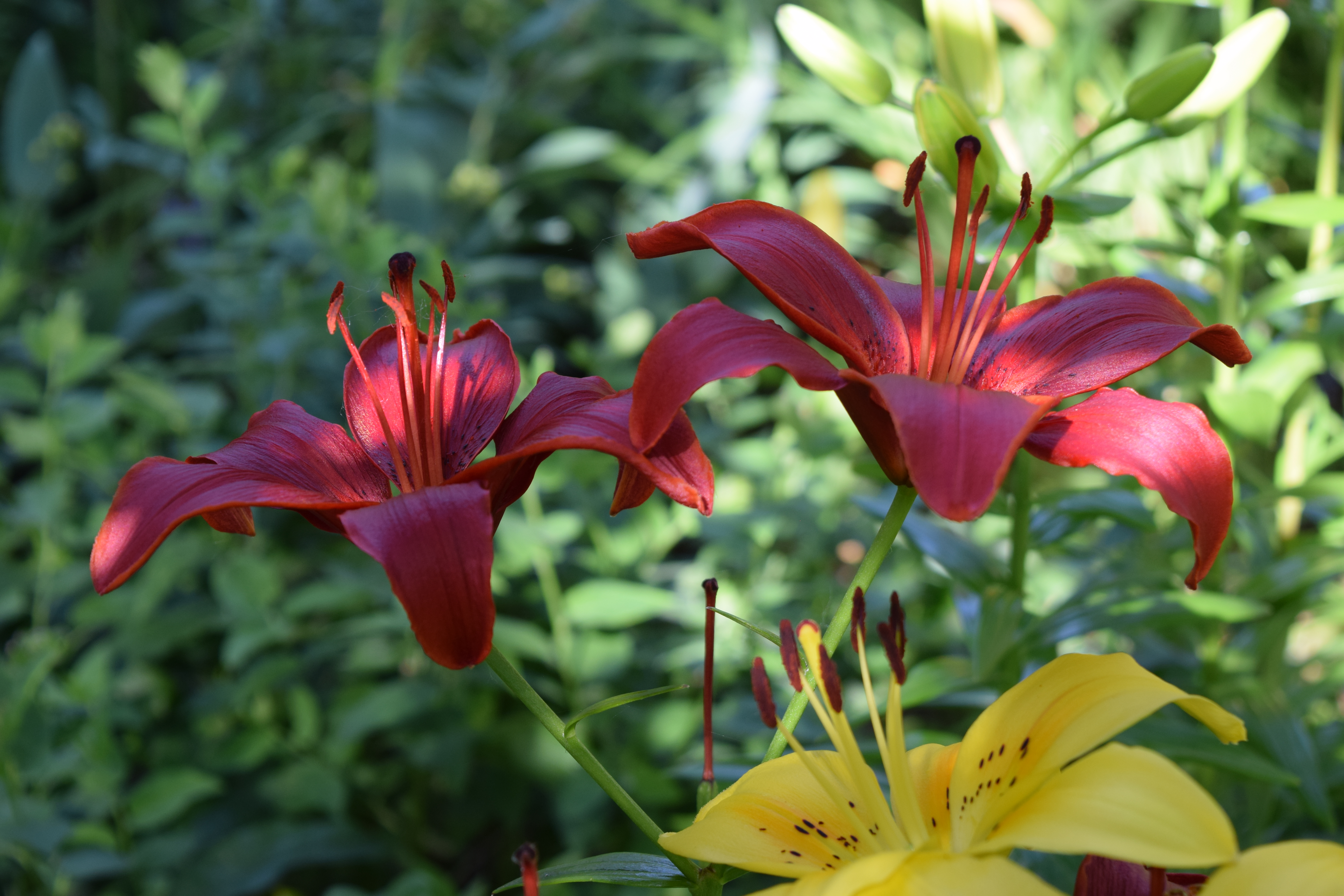
In June the Asiatic lilies burst upon the scene with bright yellow, orange, and red flowers.
All together now.
Very striking, but sadly they have no fragrance.
As the Asiatics are fading in July, the orienpet lily ‘Conca d’Or’ opens its blooms of yellow and ivory in the Driveway Border. Like my current ‘Casa Blanca’, the ‘Conca d’Or’ were planted last fall. They are supposed to grow to around six feet, but apparently it is normal for them to reach just one third of that height in their first year.
‘Conca d’Or’ orienpet lily
Orienpets are fragrant crosses of oriental and trumpet lilies. I’m looking forward to seeing my ‘Conca d’Or’ at maturity.
But here’s the exciting news: I should have a new place to put some new hardy lilies this fall. I’ll talk about why shortly. Now, though, I want to ask what lilies you would recommend. It can be tallish but not a giant, and it must be fragrant. In terms of color, we want to avoid pink or purely white for this location. So – any suggestions?







































 gardeninacity