Book Review: The Well-Designed Mixed Garden, by Tracy DiSabato-Aust
The Well-Designed Mixed Garden, by Traci DiSabato-Aust, Timber Press, 2003.
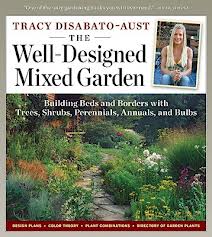
A beautiful garden is in the eye of the gardener, or in the case of garden designers, the eye of the client. That’s what makes the subject of Tracy DiSabato-Aust’s very valuable book, The Well-Designed Mixed Garden, so challenging. She meets the challenge ably, I think. DiSabato-Aust shows us what goes into the making of gardens most people would consider very beautiful, including why certain combinations of structures, colors, and textures tend to be seen as having the quality of beauty.
However, she repeatedly and rightly returns to the point that she can only provide guidelines that a gardener has every right to change or ignore: “Your style should be reflected in your garden. Do whatever makes you happy.” This is a book that gives gardeners the tools to design gardens that are beautiful for them, even if their ideas of beauty diverge from DiSabato-Aust’s at times.
The Well-Designed Mixed Garden is divided into three parts. The first lays out the basics of garden design. The second provides designs of actual gardens, along with explanatory text. And the third includes a number of the author’s favorite plant combinations.
The first part begins with the benefits of a mixed garden, containing both woody and herbaceous plants. Unlike Piet Oudolf (who prefers herbaceous-only beds), DiSabato-Aust believes mixed gardens have many advantages: a more diverse plant palette, more layering and verticality, more winter interest, and a stronger underlying structure. For myself, I would endorse her argument and add that woody plants are generally lower maintenance.
There is a useful discussion of the complexities of color. The author helps us understand that blue is not always “cool” and red “hot”, there can also be warm blues and cool reds depending on the mix, tint, and hue. She explains various color schemes in terms of finding the right balance of harmony and contrast – which ultimately, like so much else, is a matter of personal taste. The importance of plant shapes and textures also gets substantial attention.
I especially appreciated her explanation of the design principles of order, unity, and rhythm. I had heard these phrases before, but in my mind they were quite vague and I suspected that they all meant the same thing. They are in fact all related concepts, but not really the same thing. Order refers to a garden’s underlying structure or organizing principle. Unity is a common theme that pulls the garden together. And rhythm is what gives gardens a sense of movement. The author explains all in some depth, then uses the section on specific garden designs to provide examples.

The section including various garden designs is inspiring, but also a little frustrating for a gardener on a small urban lot. I suspect that big gardens are the author’s true love, because she devotes about twice as much space to them as she does to small and medium-sized gardens. In fact, more than half of this section is devoted to a single massive garden the author designed for a client in Ohio, a garden containing 425 kinds of plants. I have no doubt that this garden is a real accomplishment and a thing of beauty.
However, it has limited value as an example for the small-scale gardener. Further, it’s a little on the overwhelming side for the amateur designer even as an object of study. Similarly, I was surprised by the large number of plants present in the author’s designs as only a single specimen. The author, I infer, is a person who loves plants and places a premium on using many species and varieties.
In addition to the encyclopedia of plant combinations, there are roughly two hundred pages worth of information on plants the author likes to use in her designs. The plants are organized into two charts, one for cultural characteristics and one for design characteristics.
Overall, The Well-Designed Mixed Garden is a book that gardeners should read through once, then keep on hand as a reference they are likely to consult frequently.
Please check out Roses and Other Gardening Joys for more reviews of great books.



 gardeninacity
I ordered this book by mistake, meaning to purchase, The Well-Tended Perennial garden. Now I have both, but seem to refer to the latter more often, which says more about my gardening than her book! This is a first rate review of a first rate book!
Glad you found the review useful. I also have both those books and think they are both good references.
Sounds like a really interesting book, especially the huge garden in Ohio. She must know her stuff. Great review 🙂
Yes, no question she knows her stuff.
I love finding great design books as a resource and will look for this book…thanks!
You’re welcome! Enjoy!
I definitely prefer them as how they’re meant to be. Those double deckers are hilarious! I’ve never managed to grow the purple echinacea? I love it, but simple can not grow it? Very strange??!!
Oops, I managed to somehow post my echinacea comment on here?! You’d never think I was a technologist hey!!
It’s always reassuring to see someone else make a goof, makes me feel like I’m not the only one!
Great review Jason. Her design information is really complex. Listening to her talk about it and then reading your review, I know what you mean. She really brings a lot into each design, thinking about more than I do….but then she is the one who is making money with the book! She does know her plant material.
Thanks, Janet. I guess it’s a reflection of her skill as a designer that us amateurs have can have a little trouble keeping up.
I like this author, but do not have this book. However, it seems to have a lot of valuable information in it, and a book that would become very well-used. This one is definitely going on my wish list! Thanks so much for joining in!
Thanks for starting the meme – I keep it on my calendar for every month.
I like the idea of general design advice with the caveat that the author understands individual expression. Design principles can be very valuable but our gardens are like our own personal artwork.
Definitely, and it’s so important that we feel free to experiment.
This sounds like a must read, what a amazing collection of info. I am going to have to look out for it.
Thanks for the recommendation.
Jen
You’re welcome, Jen. Hope you enjoy.
The book sounds like a useful one for beginning as well as experienced gardeners. Thank you for writing a thorough and helpful review. It would be a book that I could certainly use!
I certainly found it helpful.
Sounds like a good read though I am one of those small scale lots! If you know of any good reads for small garden lots I would so appreciate some suggestions! All the best!
I’m on the lookout for the same kind of book. I’ll do a post when I find it, I’m sure it’s out there.
This sounds like a good garden design reference. I would like to do more reading on the subject of design principals. The author’s take on design principles of order, unity, and rhythm would be particularly interesting to read.
I think it does make a useful design reference, as you say.
I had the pleasure of hearing her speak last year, and as a result asked for, and received The Well Tended Perennial Garden for Christmas. I will have to this book to my list for next year.
Jason, Thanks for this review. I have her earlier book, The Well-Tended Garden, but I’m adding this one to my “must have” list.
Discovered through ancestry.com that Tracy is a relative. My great-grandmother was Teresa DiSabato who was a sibling to Tracy’s relative. I bought her books and hope to meet her someday.