May is a time for fresh green foliage, before heat and drought and little critters give us leaves looking tired and tattered.
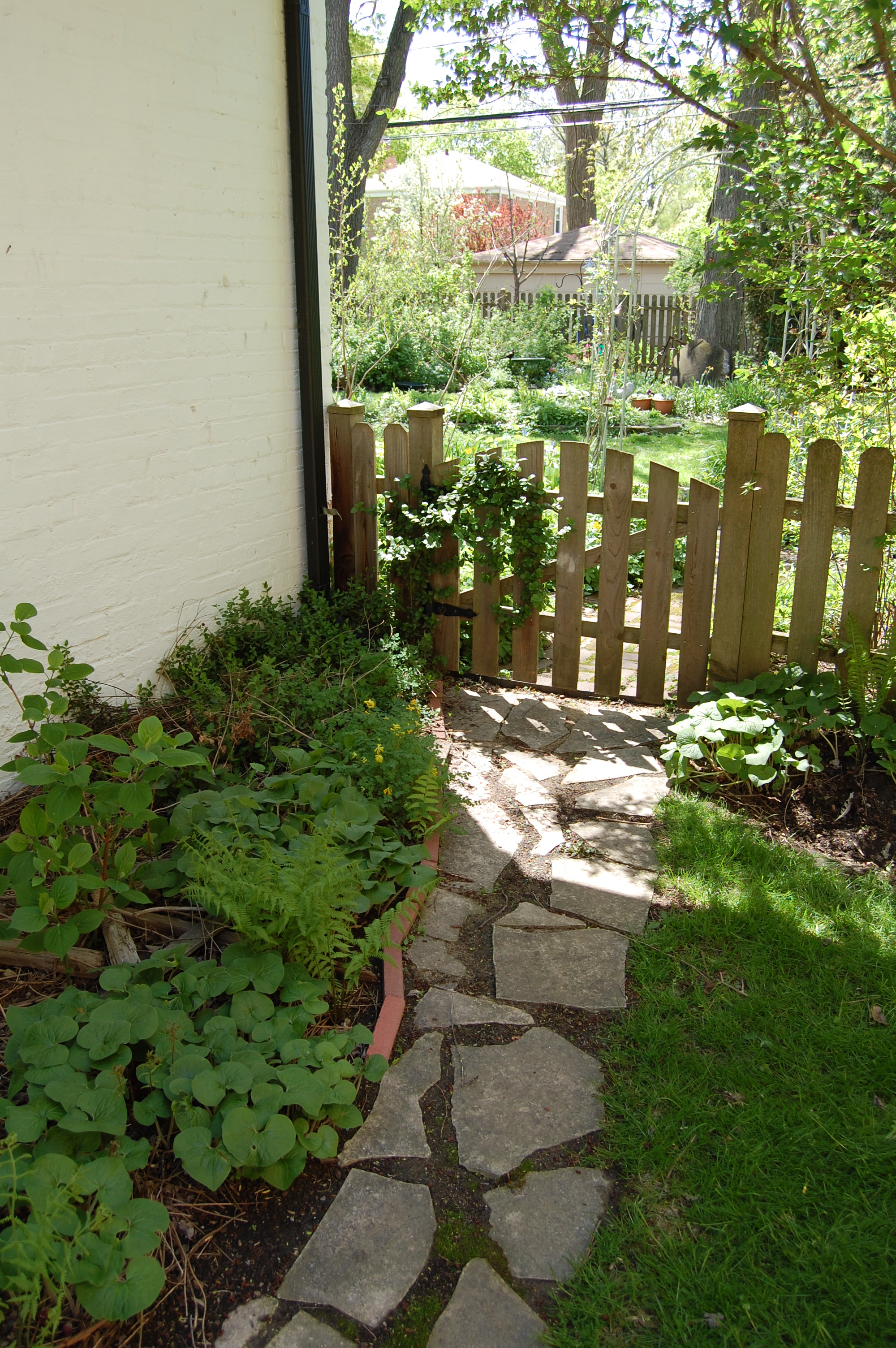
To begin with, there is wild ginger (Asarum canadense). Not really ginger, but the root does have a strong ginger smell. A nice groundcover native to eastern and central North America.
Wild Ginger with Lady Ferns
Then there are the ostrich ferns (Matteucia struthiopteris). They are not yet at their full height, which can be four feet or more. This is their third spring in the garden.
Ostrich Ferns with Bleeding Heart
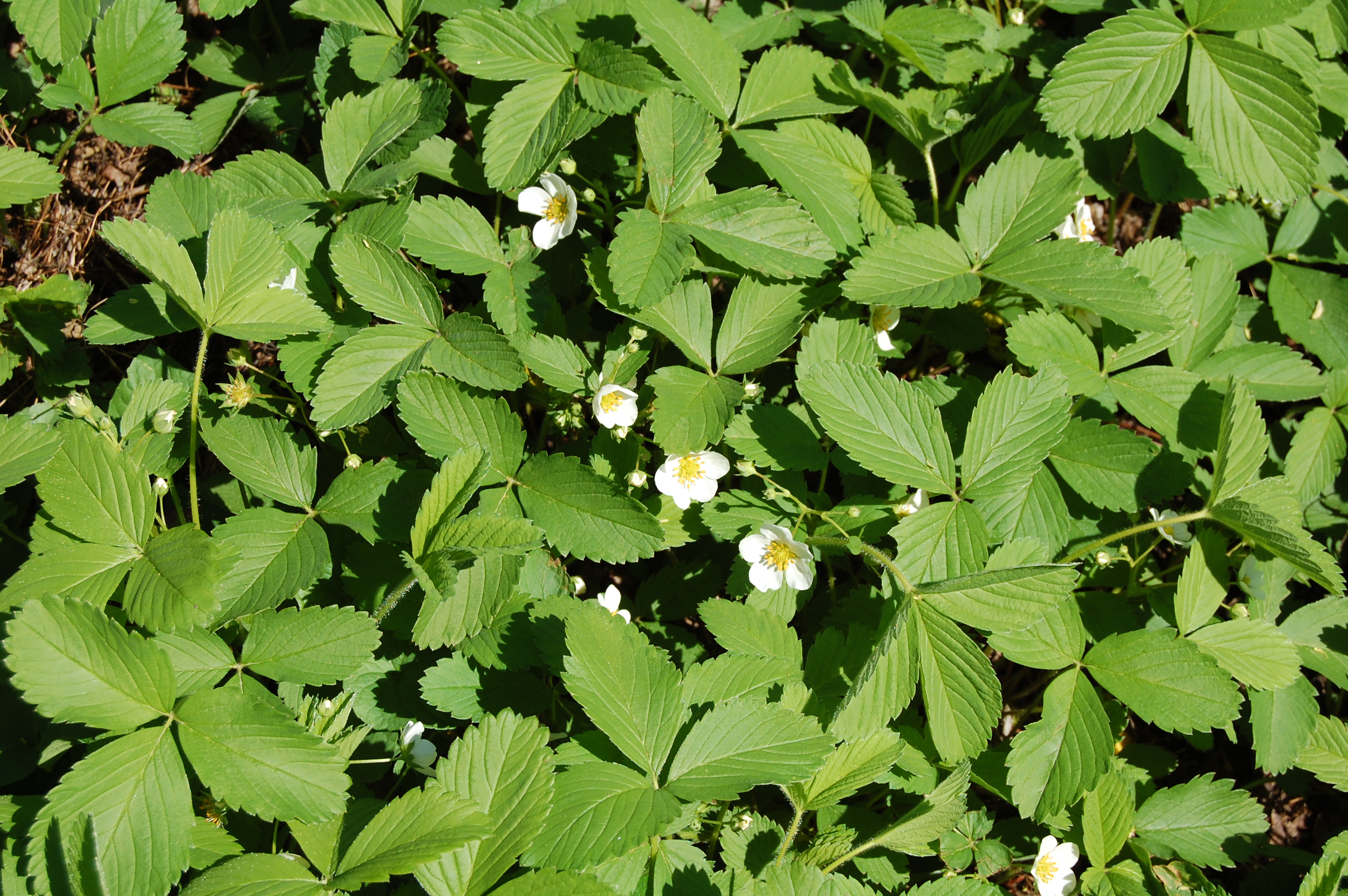
Another native plant that I like to use as a groundcover is wild strawberry (Fragaria virginica). This time of year it also has little white flowers. Later there will be tiny strawberries that are edible but best left to the birds and critters. I use a weed whacker to keep the wandering stolons in bounds.
Wild Strawberry
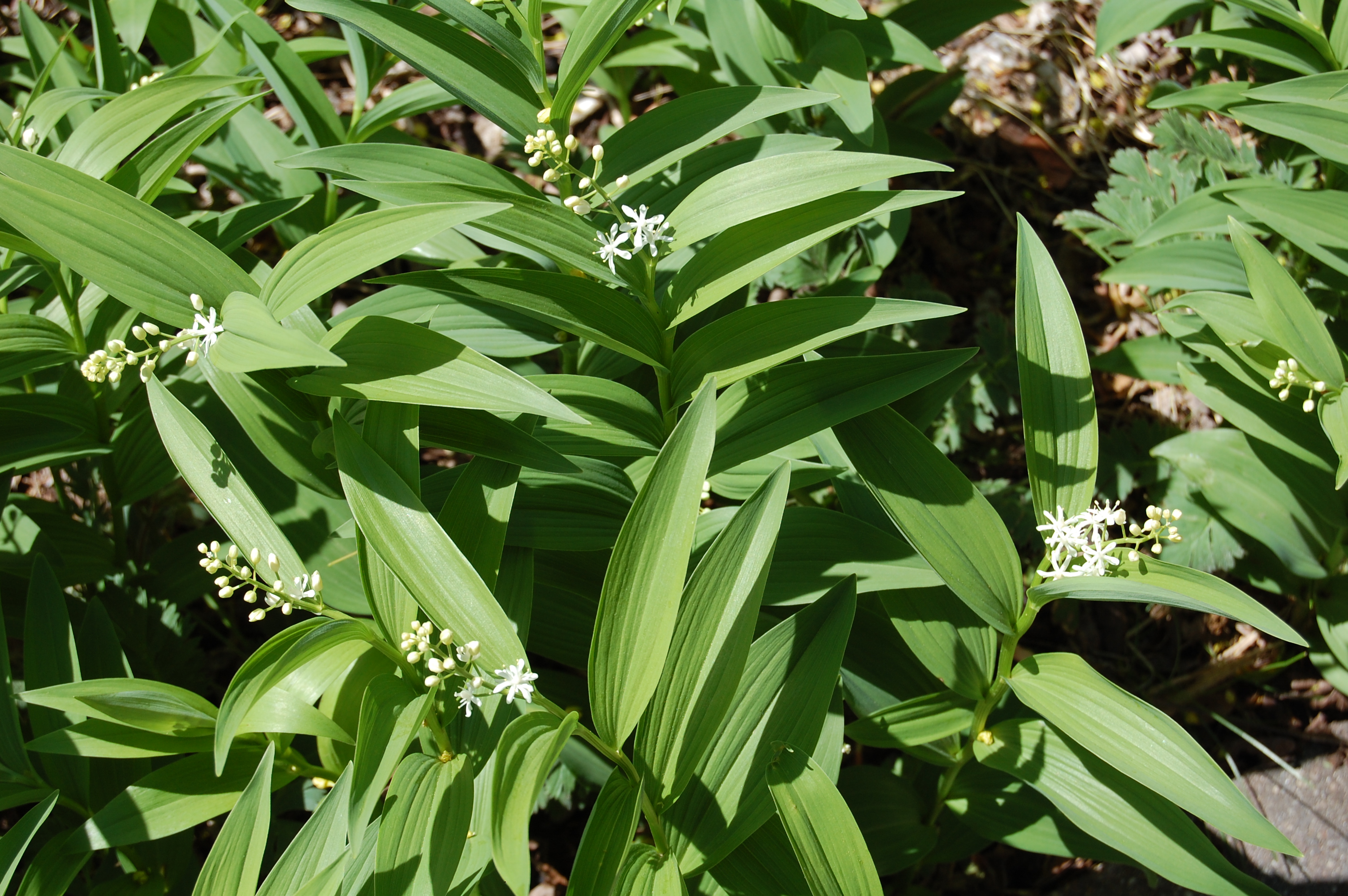
Starry Solomon’s Plume (Smilacina stellata) has inconspicuous flowers in spring. The striped berries that come in late summer are much more interesting. The foliage is nice, also.
Starry Solomon’s Plume
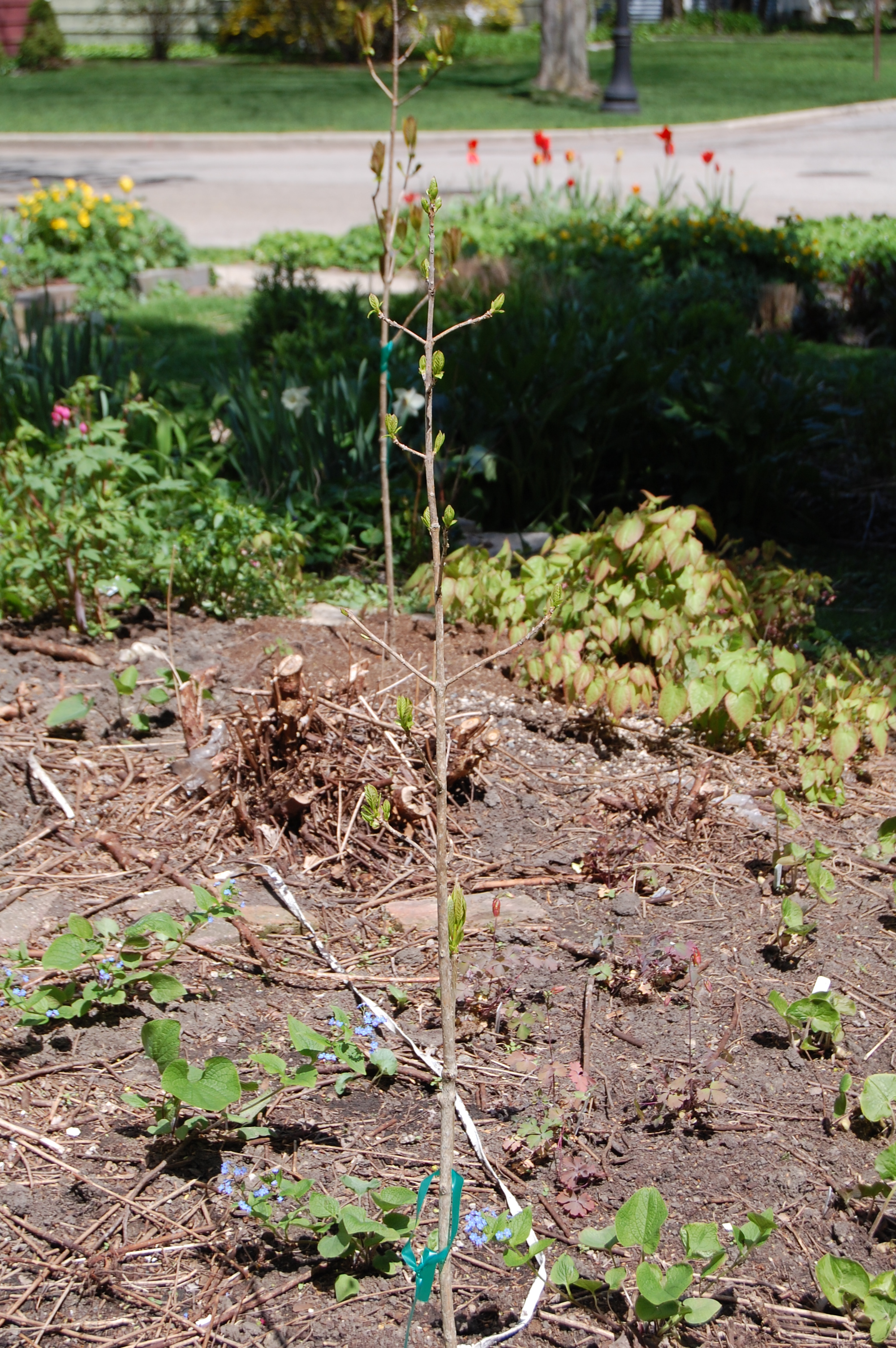
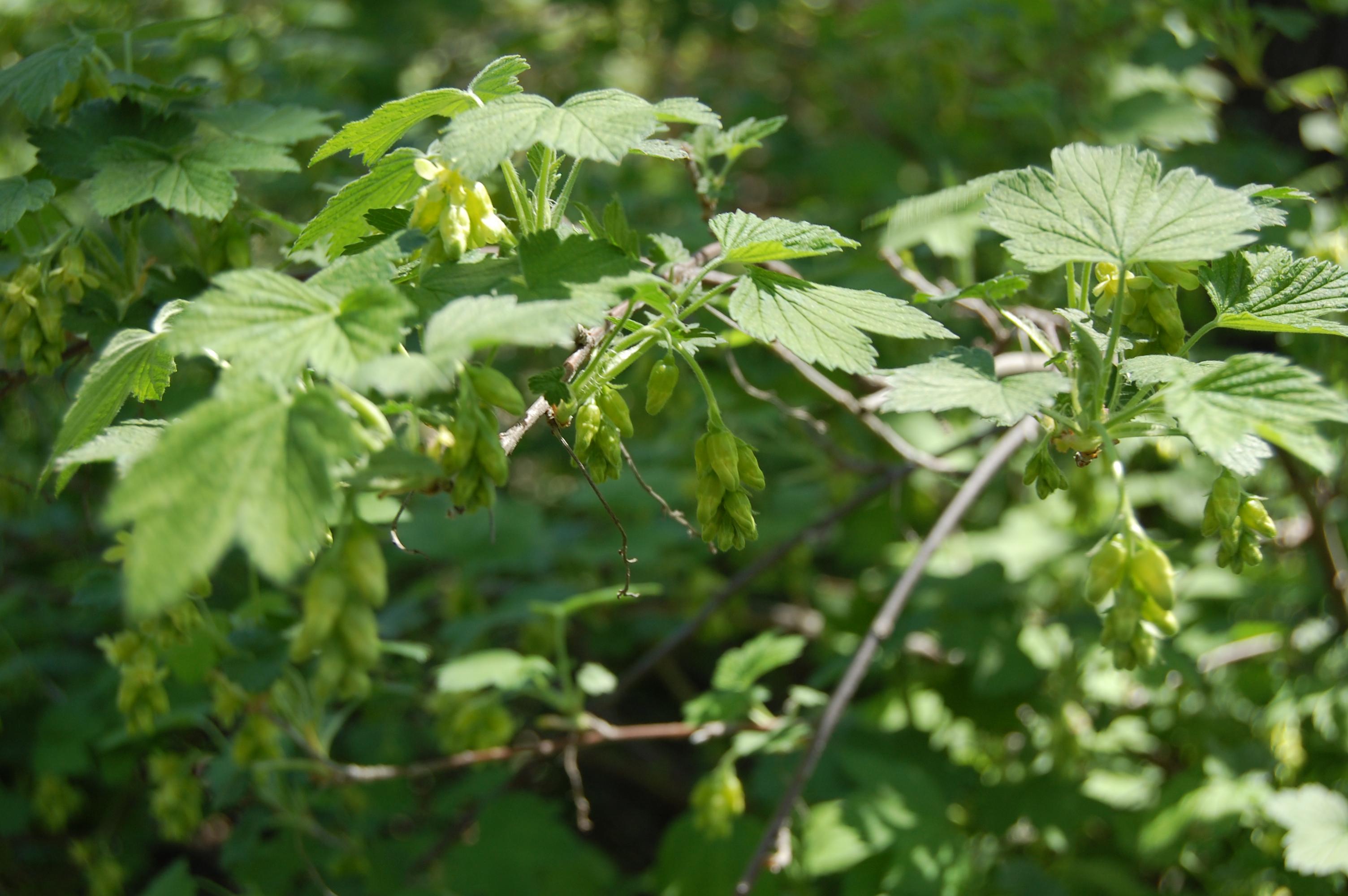
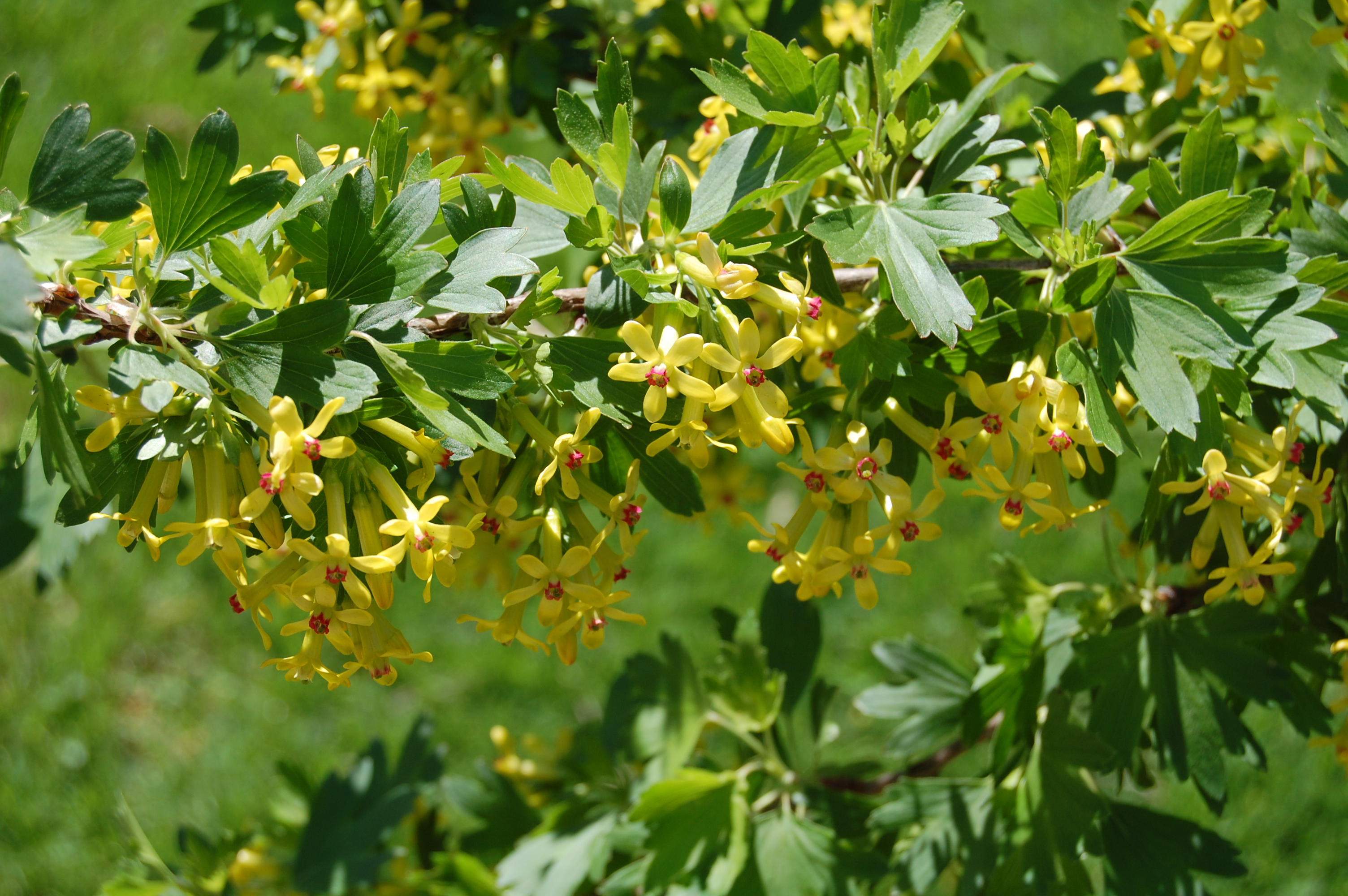
The wild currant (Ribes americanum) has fully leafed out by now. The maple-like leaves have a nice texture. I like the dangling chartreuse flowers as well.
Wild Currant
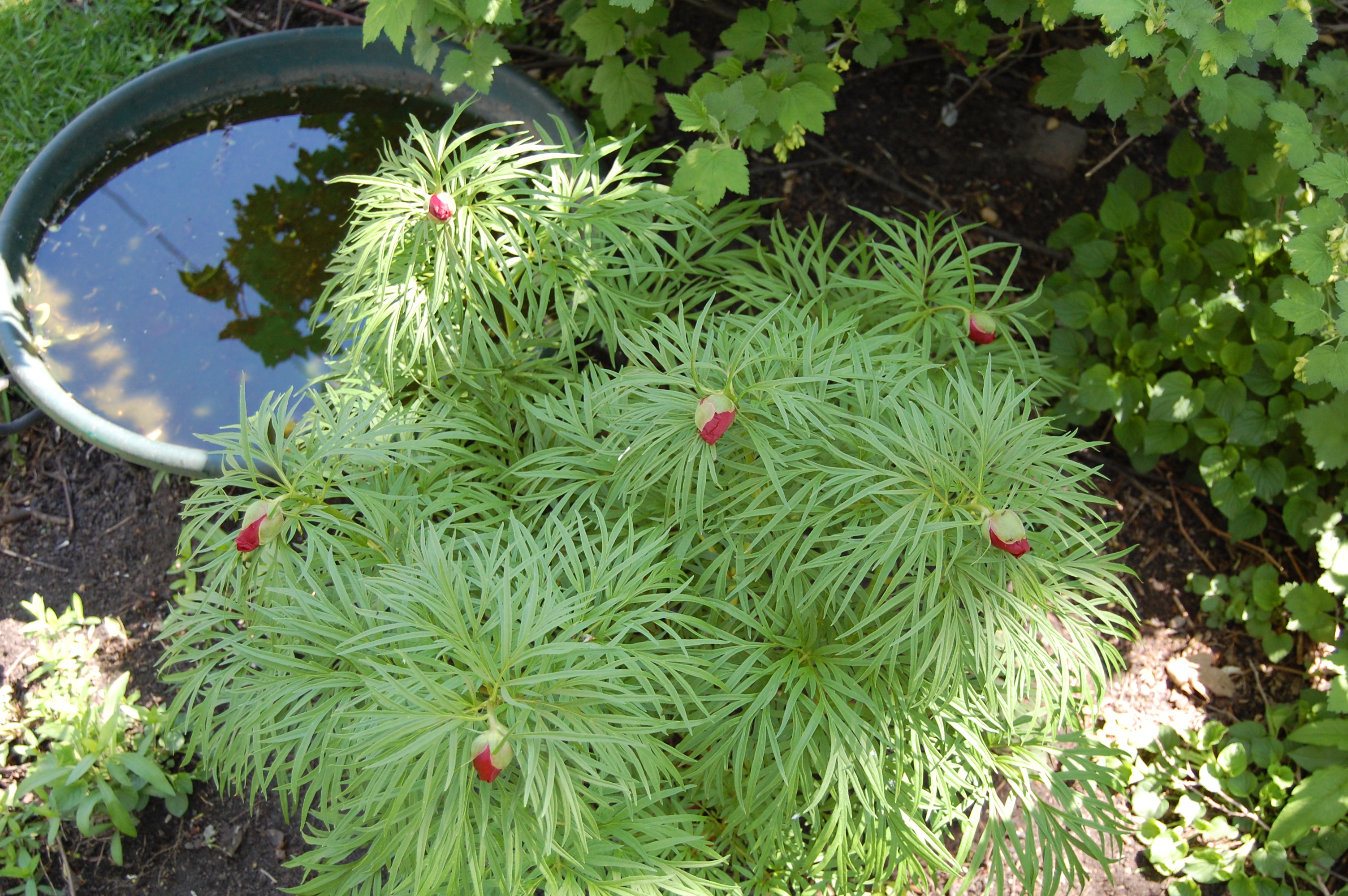
The peony buds are not yet open, but some of them have attractive and unusual foliage.
Peony. Can’t remember the variety.
As I say, this is a time of year when all foliage can delight the eye, just by virtue of being fresh and new.
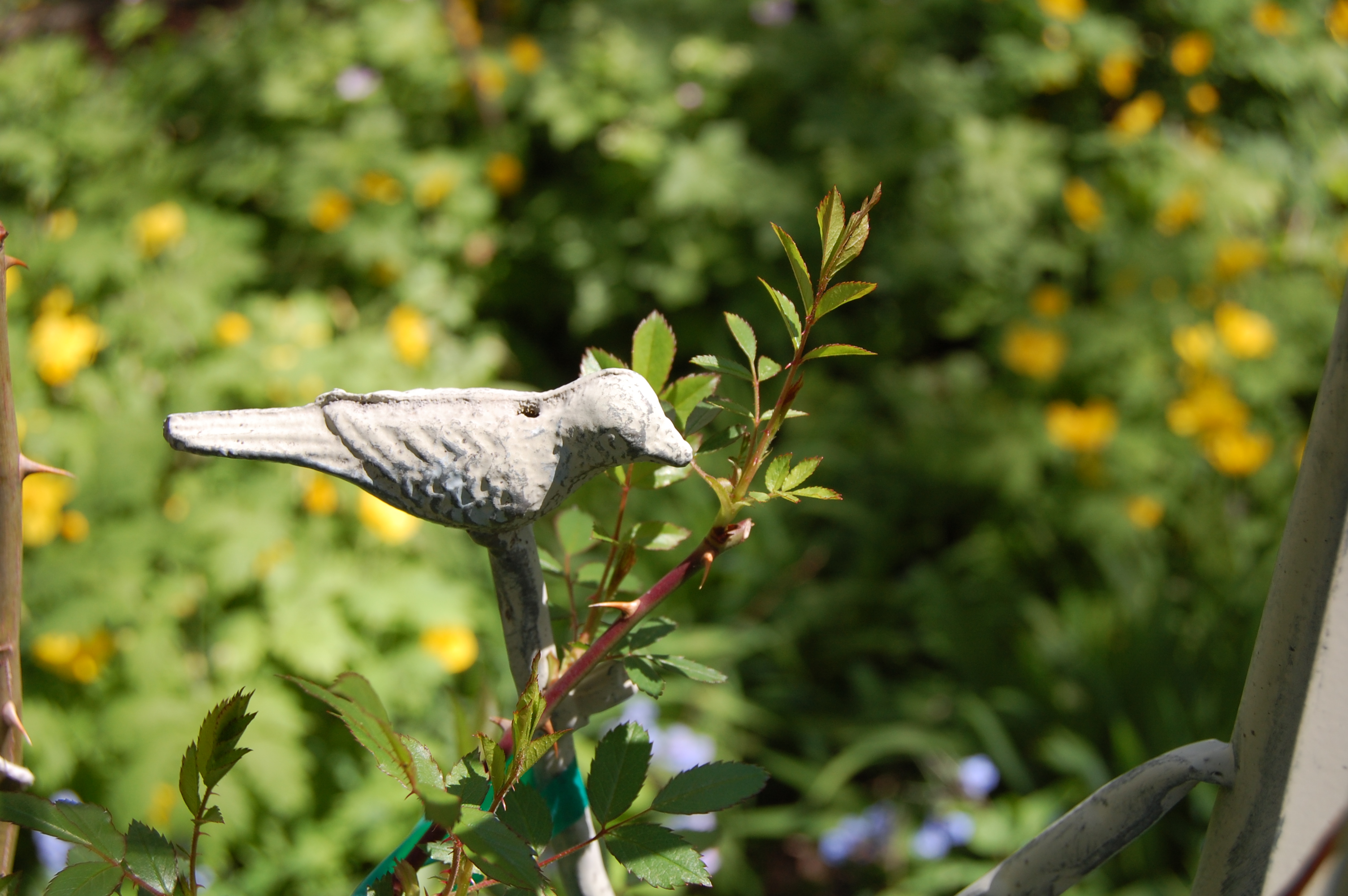
New ‘Darlow’s Enigma’ rose foliage on arbor.
Are the fresh green leaves of spring in your garden making you happy?
Carol of May Dreams Gardens hosts Garden Bloggers Bloom Day on the 15th of every month, giving gardeners around the world an opportunity to show what’s in bloom on their home ground. So let’s get to it! May has been a good month for color in my garden.
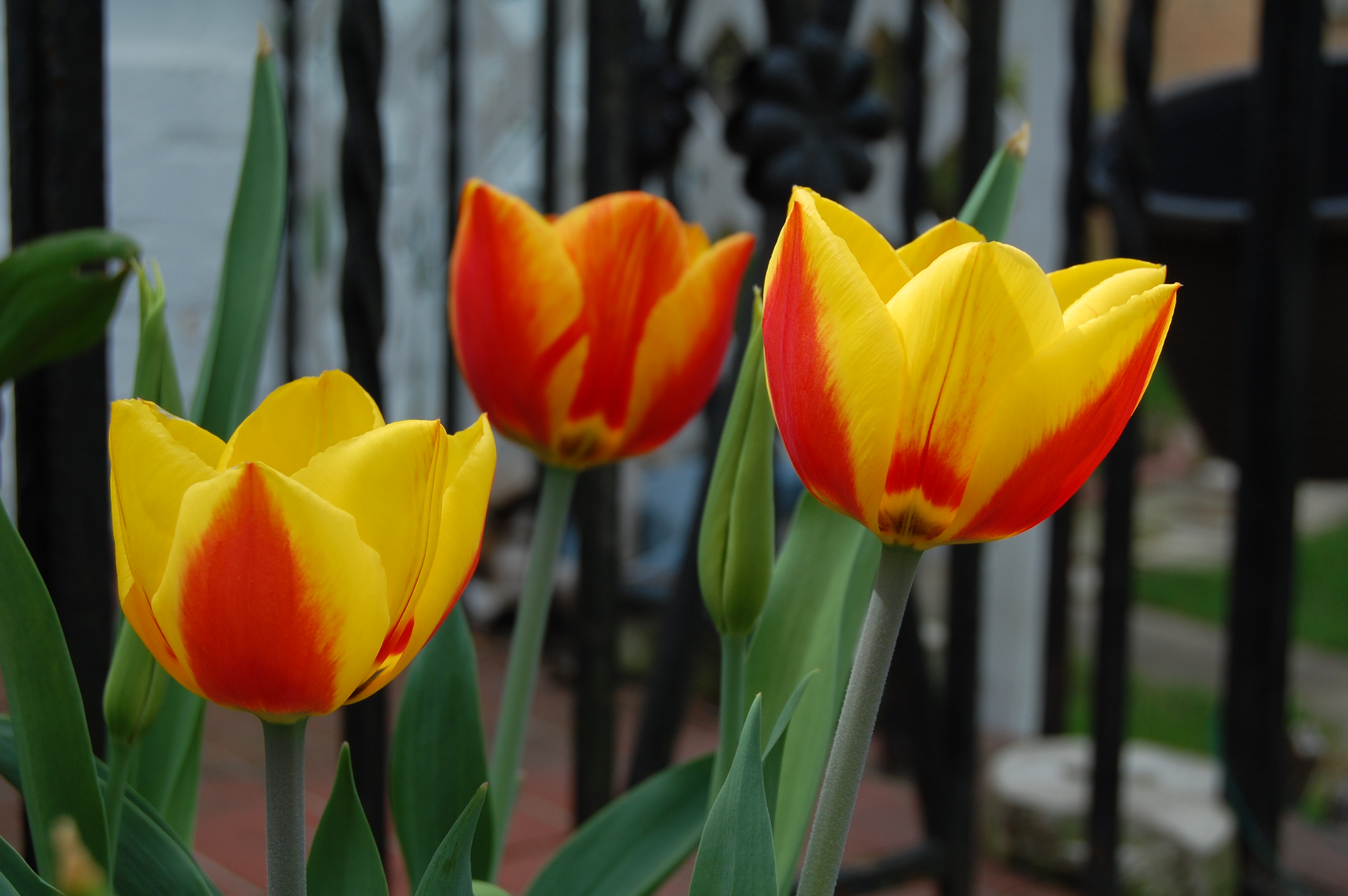
The lily flowering tulip ‘West Point’ is now blooming, adding its cheery yellow and elegant shape to ‘Flair’ and other varieties..
Tulip ‘West Point’ and ‘Flair’
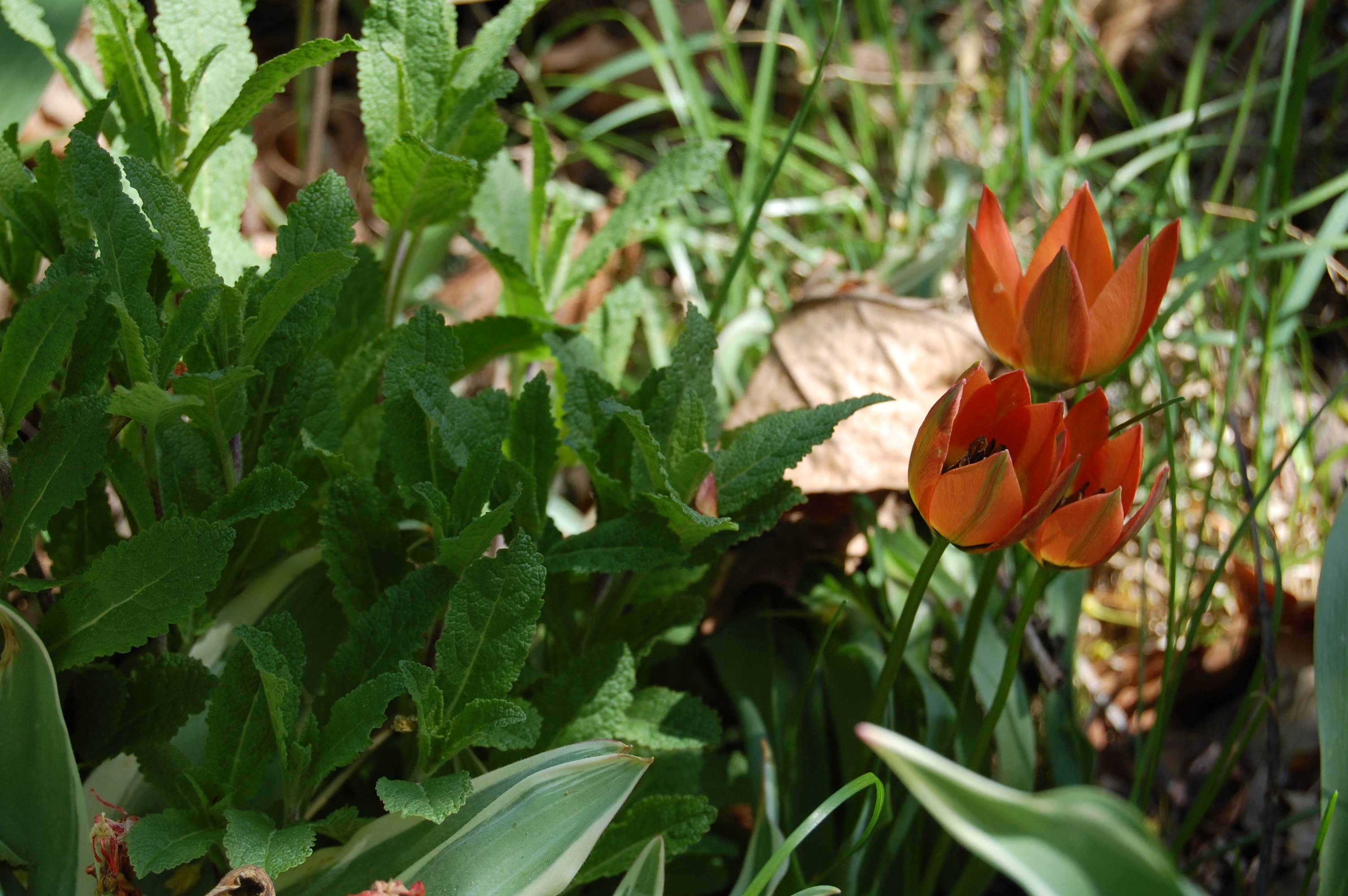
And the late species tulips are showing off. The orange and white ‘Little Princess’ …
Tulip ‘Little Princess’
And the blue and cherry red ‘Little Beauty’ …
Tulip ‘Little Beauty’
And Tulipa clusiana ‘Cynthia’, with petals colored red on the outside and a rich yellow on the inside.
Tulip ‘Cynthia’
Tulipa orphanidea flava is a wonderful tulip, really interesting coloring.
Tulipa orphanidea flava
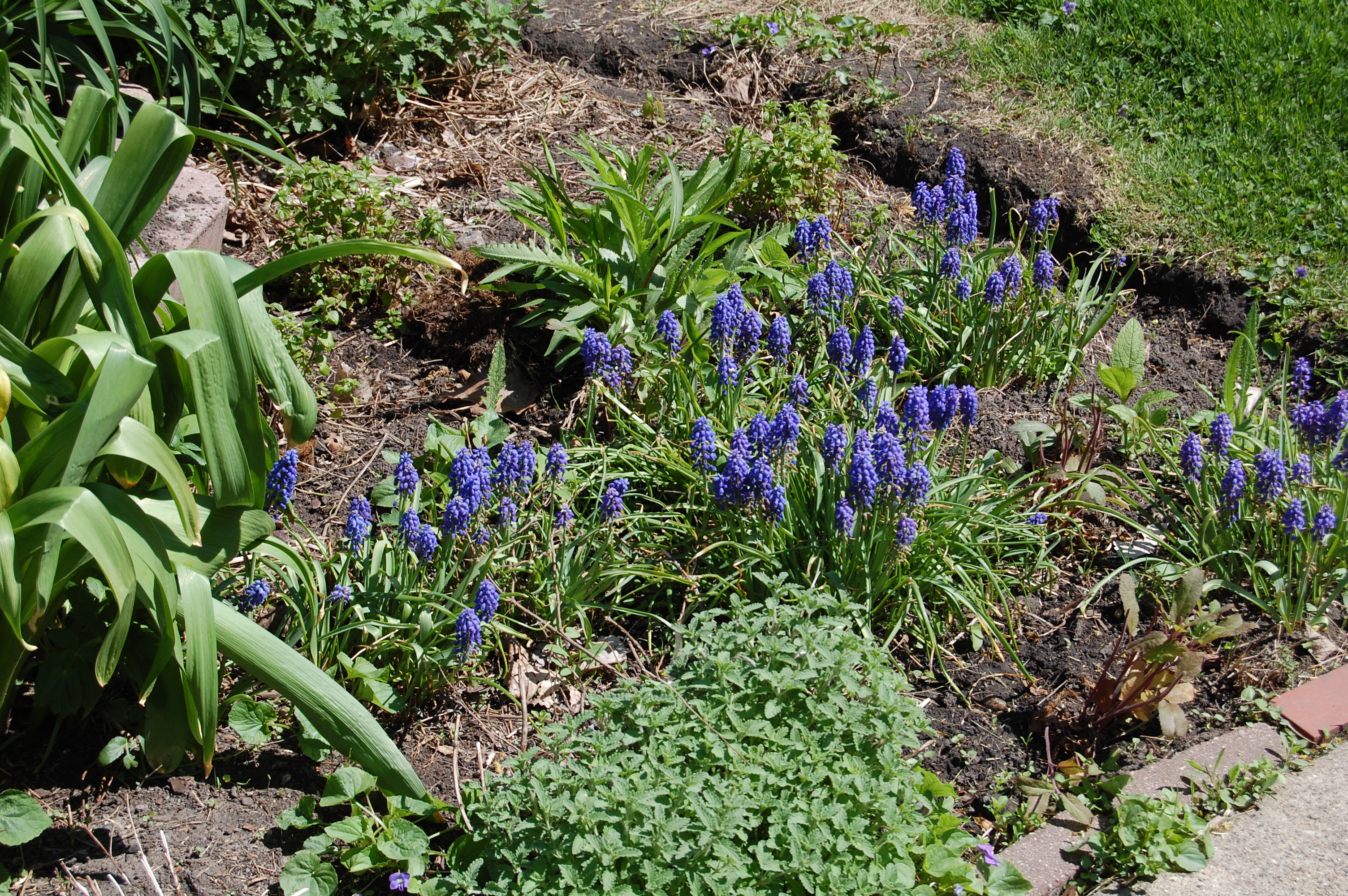
The grape hyacinths (Muscari armeniacum) are also blooming well. I can’t wait for these to spread more to create wider clumps, but the delay is partly my fault as I keep disturbing the beds to change perennials.
Grape Hyacinths
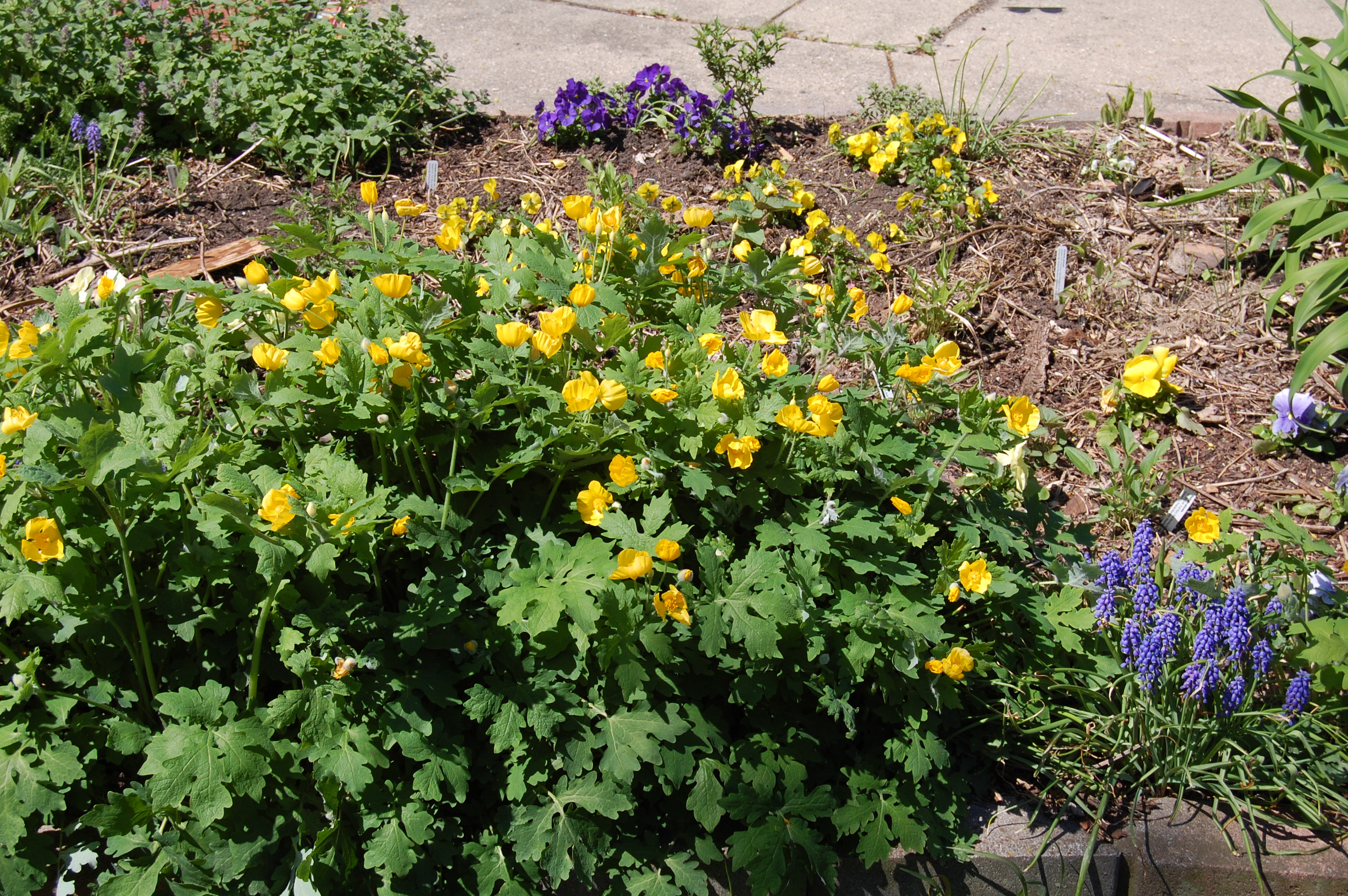
This has been an incredible spring for celandine poppies (Stylophorum diphyllum), the delicate yellow flowers blooming profusely over lush blue-green foliage. They are beginning to show more aggressive tendencies, though, I’m going to have to watch these guys more carefully.
Celandine Poppies
The clove currants (Ribes odoratum) in the sidewalk border are blooming. I planted these because they are supposed to have a strong fragrance. The fragrance is in fact very nice, but you have to put your nose right up to the flowers. This is their third spring, maybe when they are more mature … The much more modest Chartreuse flowers of wild currant (Ribes americanum) have also begun bloom.
Clove Currant
The tiny blue flowers on Nepeta “Kit Kat’ have just started to open. In my garden, the various Nepeta cultivars are essential plants for edging in areas that absorb hot afternoon sun.
Nepeta ‘Kit Kat’ edging the raised front walk/driveway border.
I thought the Virginia bluebells (Mertensia virginica) had reached their peak last weekend, but I was wrong. The cool weather has been kind.
Virginia Bluebells
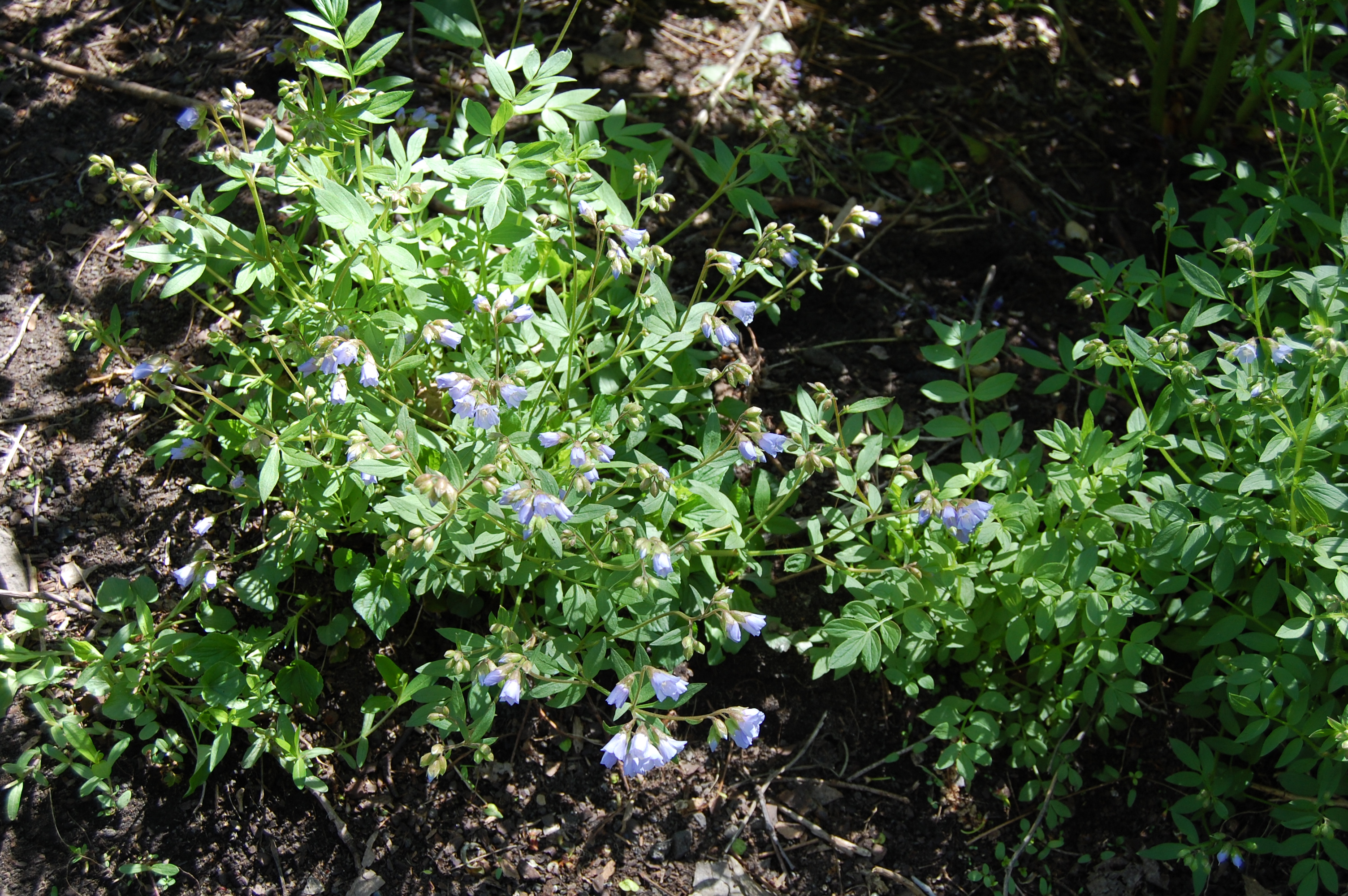
In the shady back garden, Jacob’s ladder (Polemonium reptans) works well as an edging plant. It also has blue flowers.
Jacob’s Ladder
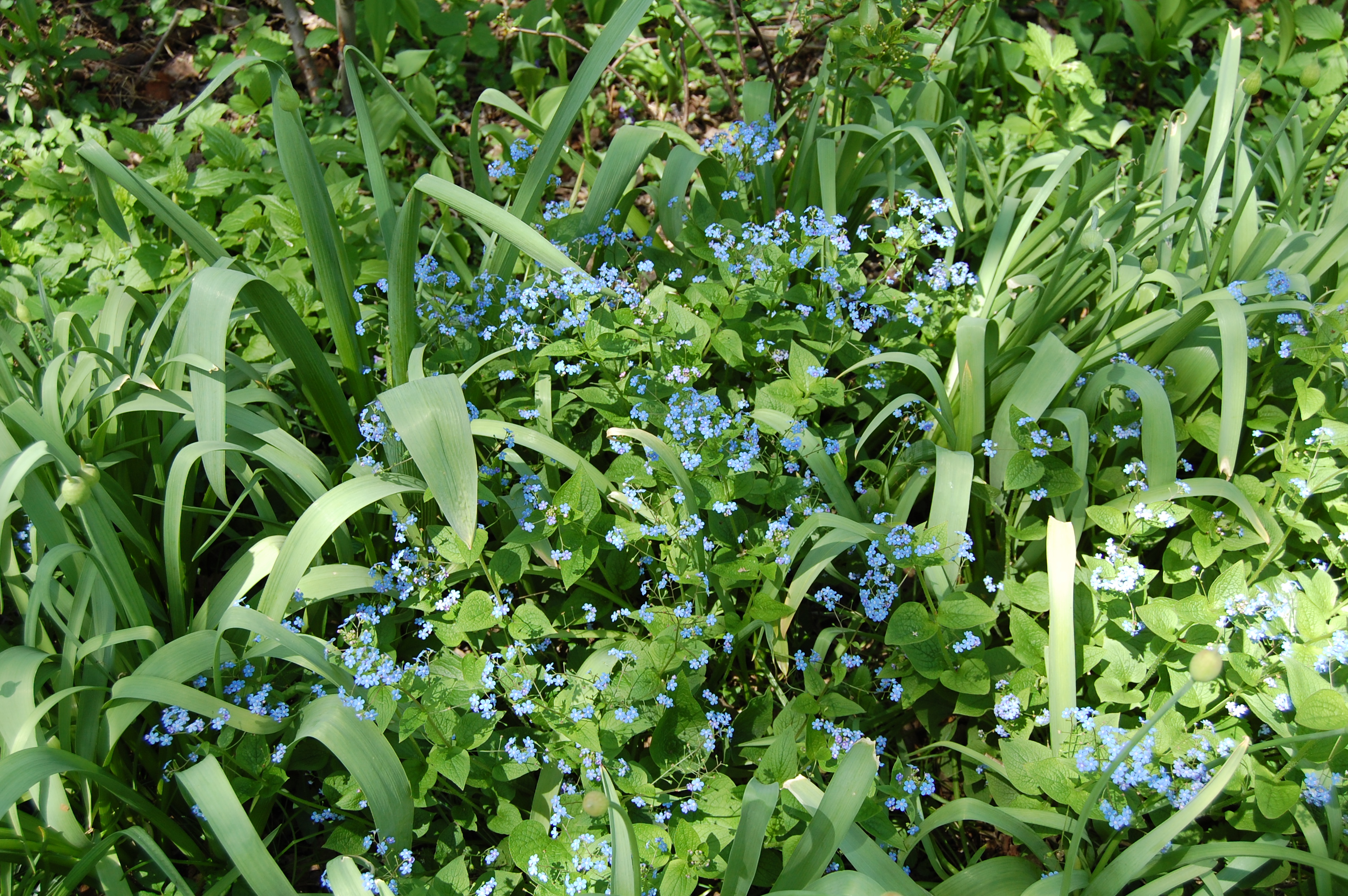
False forget-me-not (Brunnera macrophylla) has tiny sky-blue flowers like real forget-me-nots, but this is a reliable perennial.
Brunnera flowers poking up through Allium foliage.
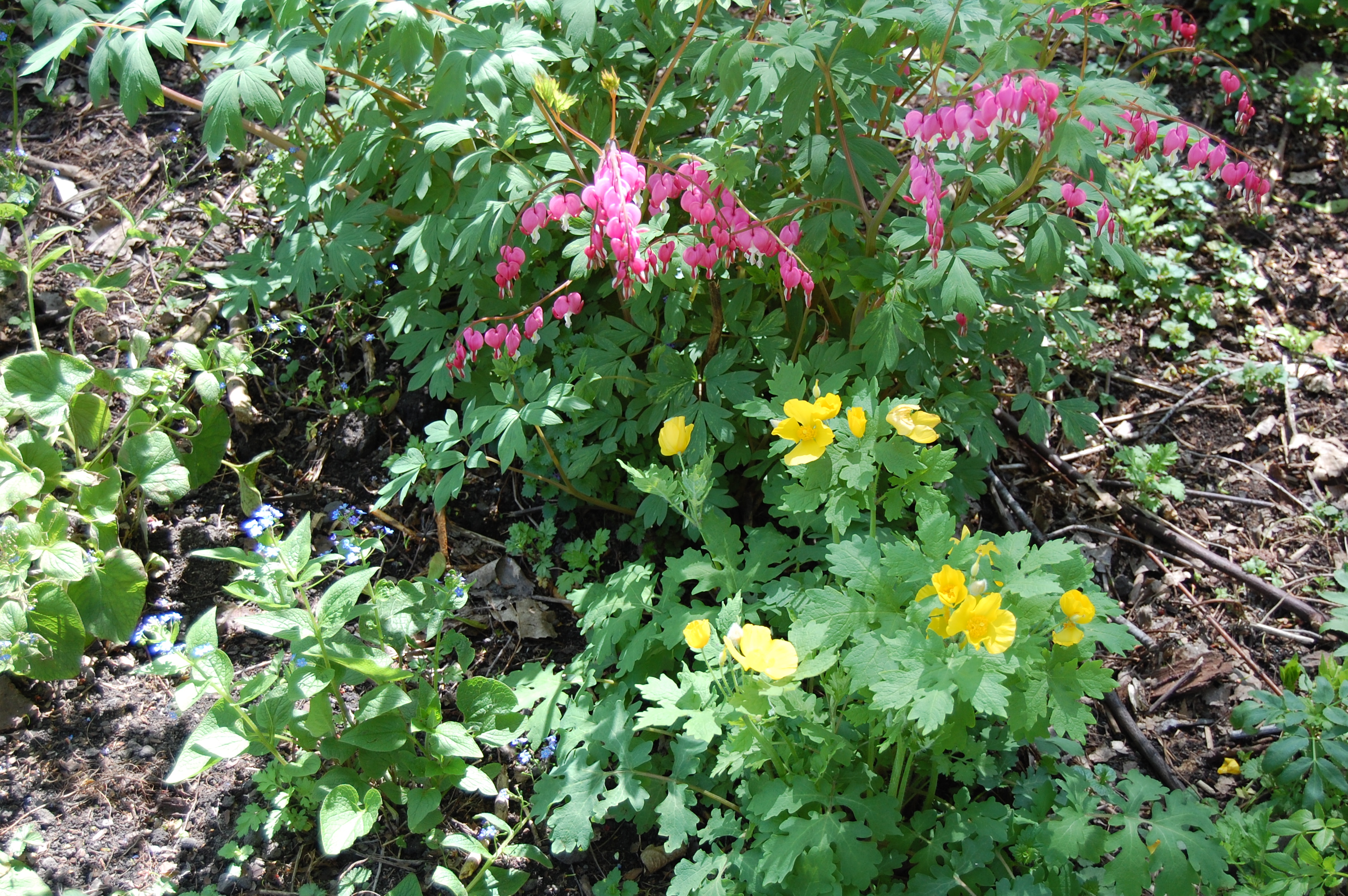
I devoted the last post entirely to old-fashioned bleeding hearts (Lamprocapnos spectabilis). Even so, I have to include one more picture for this post.
Bleeding Heart with Celandine Poppy.
There are quite a few other flowers blooming now: annual stock, violas, and pansies; great merrybells (Uvularia grandiflora), starry solomon’s plume (Smilacina stellata), wild strawberry (Fragaria virginica), and probably a couple of others I can’t think of. Some of these I will include in my foliage follow-up.
In the meantime, happy Garden Blogger Bloom Day to you all!
The old-fashioned bleeding hearts (Lamprocapnos spectabilis) in my garden are looking very happy this year, the moist cool spring must agree with them. They are bushy and robust, with many long stems lined with dangling pink and white flowers.
Old Fashioned Bleeding Heart.
The unique shape of the bleeding heart flower certainly suggests the origin the plant’s name, though it is odd that the drop of “blood” is white. However, this common name makes more sense than some others that have been used. For example: lady in a bath, Dutchman’s breeches, and lyre flower. As to lady in a bath – if the white part is the lady, then the name should be lady in a bath upside down. Now that I think of it, lyre flower is a good fit, though not as evocative as bleeding heart.
Note that the taxonomists have been at their mischief again. The botanical name was Dicentra spectabilis until recently, very suitable and appealing if you ask me. How they came up with Lamprocapnos I don’t know, but it is a very ugly genus name for a lovely flower. Lamprocapnos sounds like one of those parasitic eels that attach themselves to fish and suck out their vital juices.
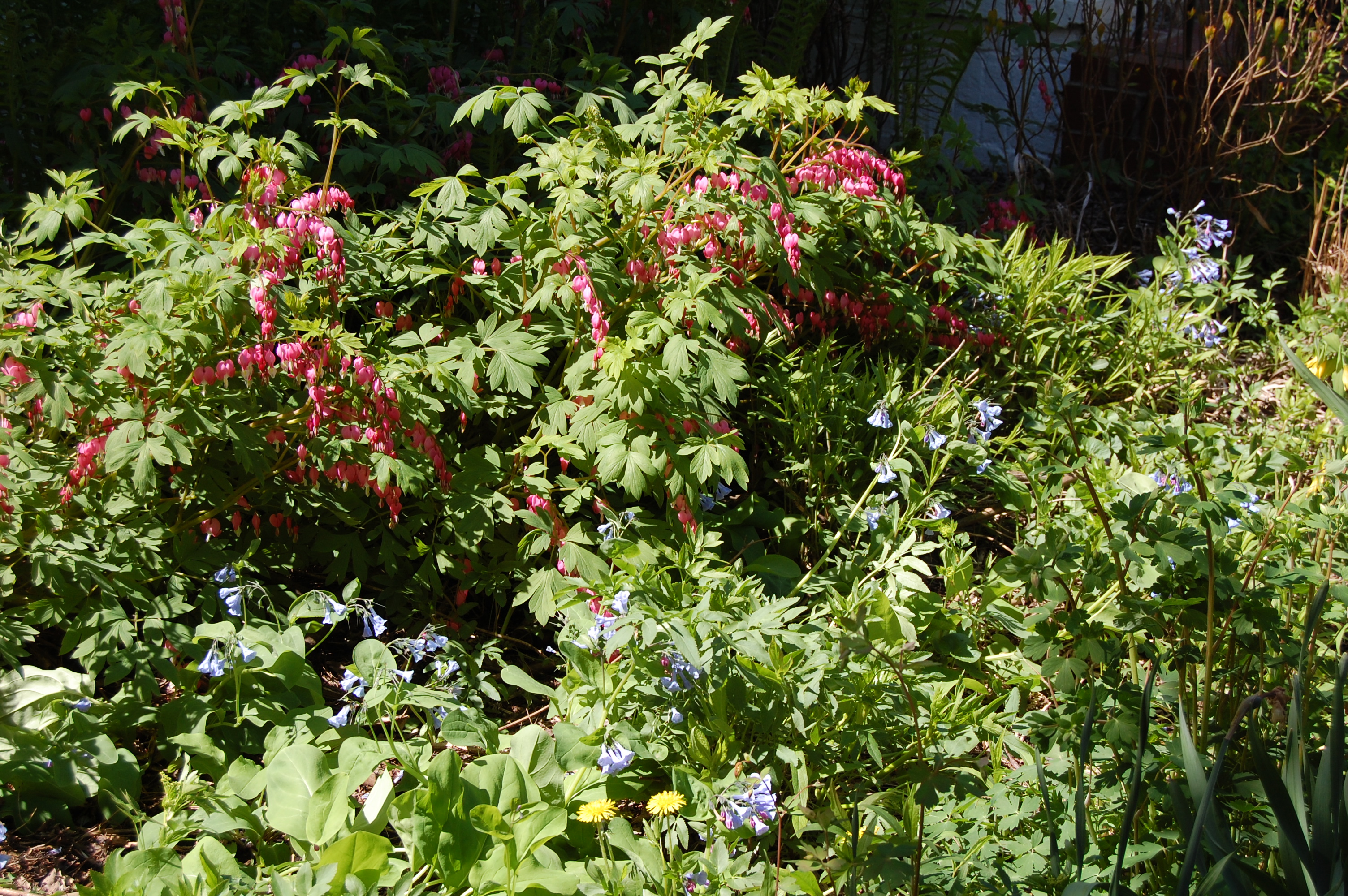
Bleeding Heart with Virginia Bluebells
Another reason my bleeding hearts may be looking especially nice this year is that they are just another year older. This is a plant that spreads gradually by rhizomes, the clumps becoming more and more impressive in size.
Bleeding hearts like shade and moisture. They are considered ephemeral because they die back after blooming. In my experience, though, bleeding hearts in the right sort of spot will keep their foliage looking fresh until July or August.
Bleeding Heart with False Forget-Me-Not
Blue flowers go particularly well with bleeding heart, especially Virginia bluebells (Mertensia virginica) and false forget-me-not (Brunnera macrophyla). A note about false forget-me-not. This is not to be confused with forget-me-not (Myosotis sylvatica). False forget-me-not is a longer-lived perennial with flowers very similar to Myosotis. It also goes under the common name Siberian bugloss. Which would you rather be called? Enough said.
Bleeding Heart with Ostrich Ferns
Ferns are another excellent companion for old-fashioned bleeding heart.
Do you have bleeding heart in your garden? Is it having a good year?
Last Saturday morning, after finishing my class at the Chicago Botanic Garden, I walked outside and realized that it was a perfect day. Perfect days have been few and far between this spring, so I called Judy and asked her to come up and meet me so we could take a walk and enjoy the garden together. Oh, and I asked her to bring the camera.
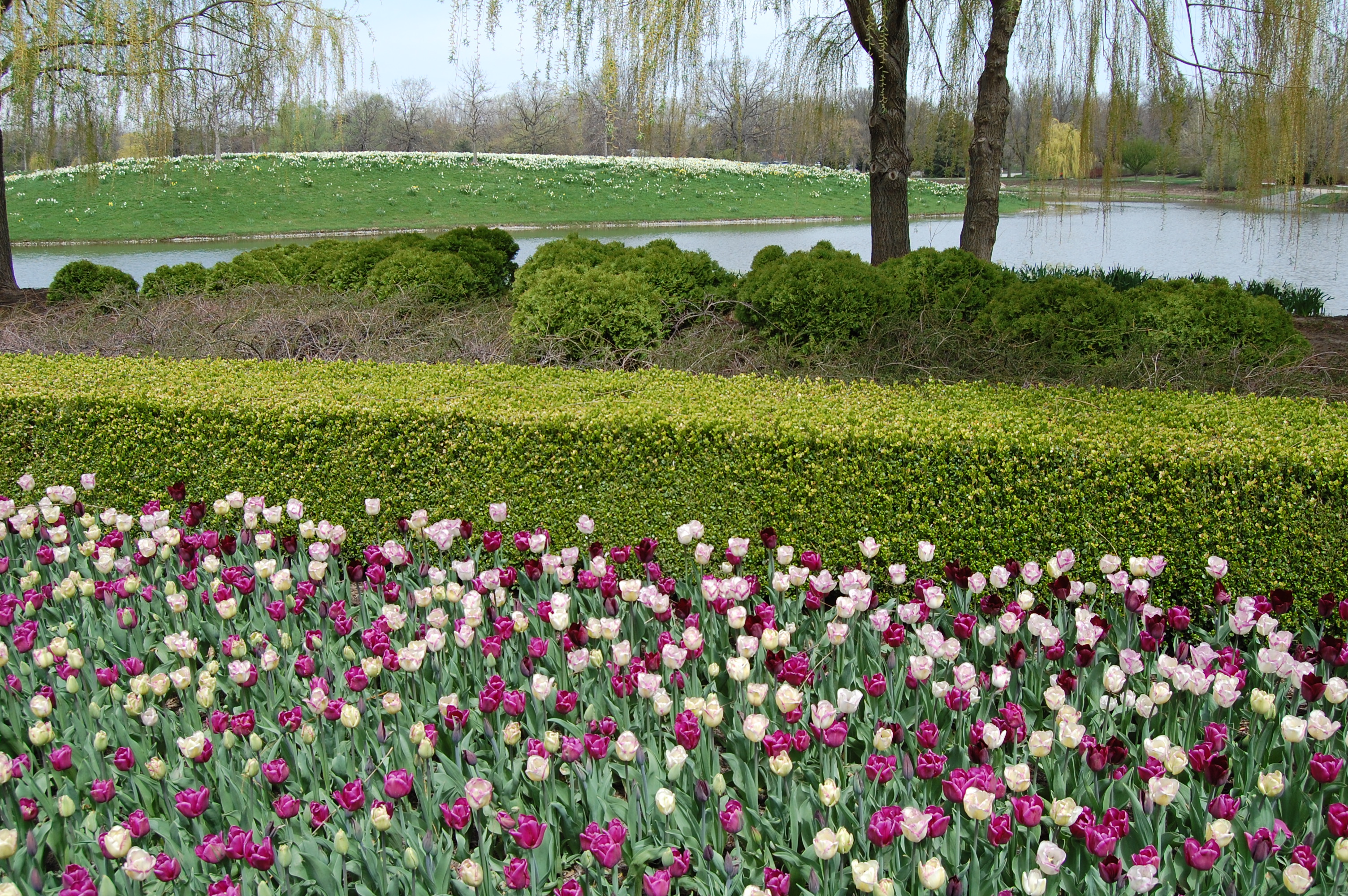
Tulips ‘Passionale’, ‘Shirley’, and ‘Havran’.
The first thing that had us exclaiming was the tulip display in the Esplanade near the entrance. There were a mix of three tulips with a purple color theme. The three were the dark purple ‘Havran’, the medium purple ‘Passionale’, and ‘Shirley’. This last tulip is white with a purple blush. I really like this type of color arrangement with several variations on the theme of a single color.
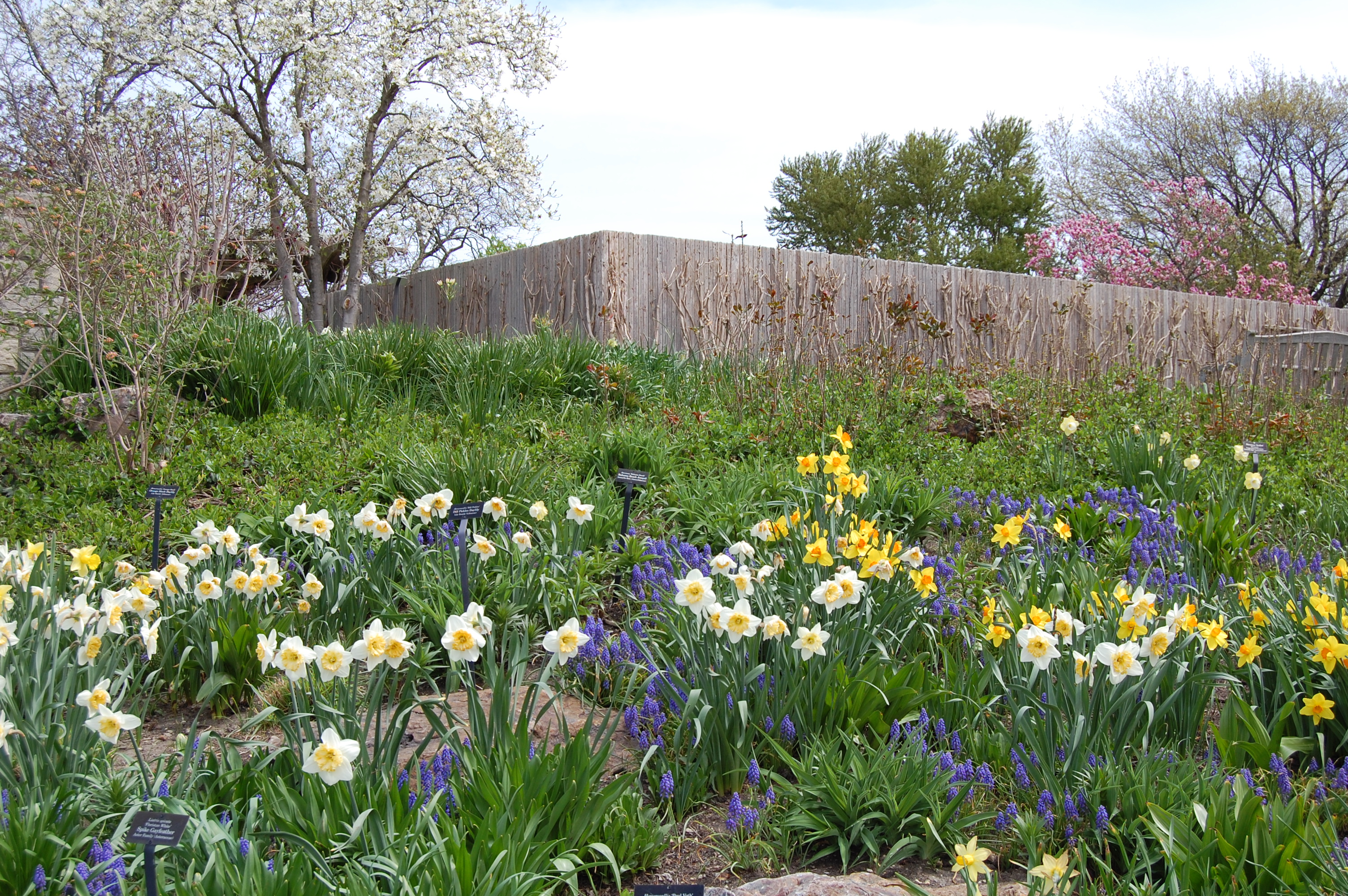
Daffodils at the CBG Bulb Garden.
After the Esplanade we went to the Bulb Garden. Many of the tulips here have not yet opened. Those that have, for some reason, were mostly pink, not my favorite color for tulips. Even so, the bulb garden was lovely, filled with blooming Narcissus, fritilaries, etc.
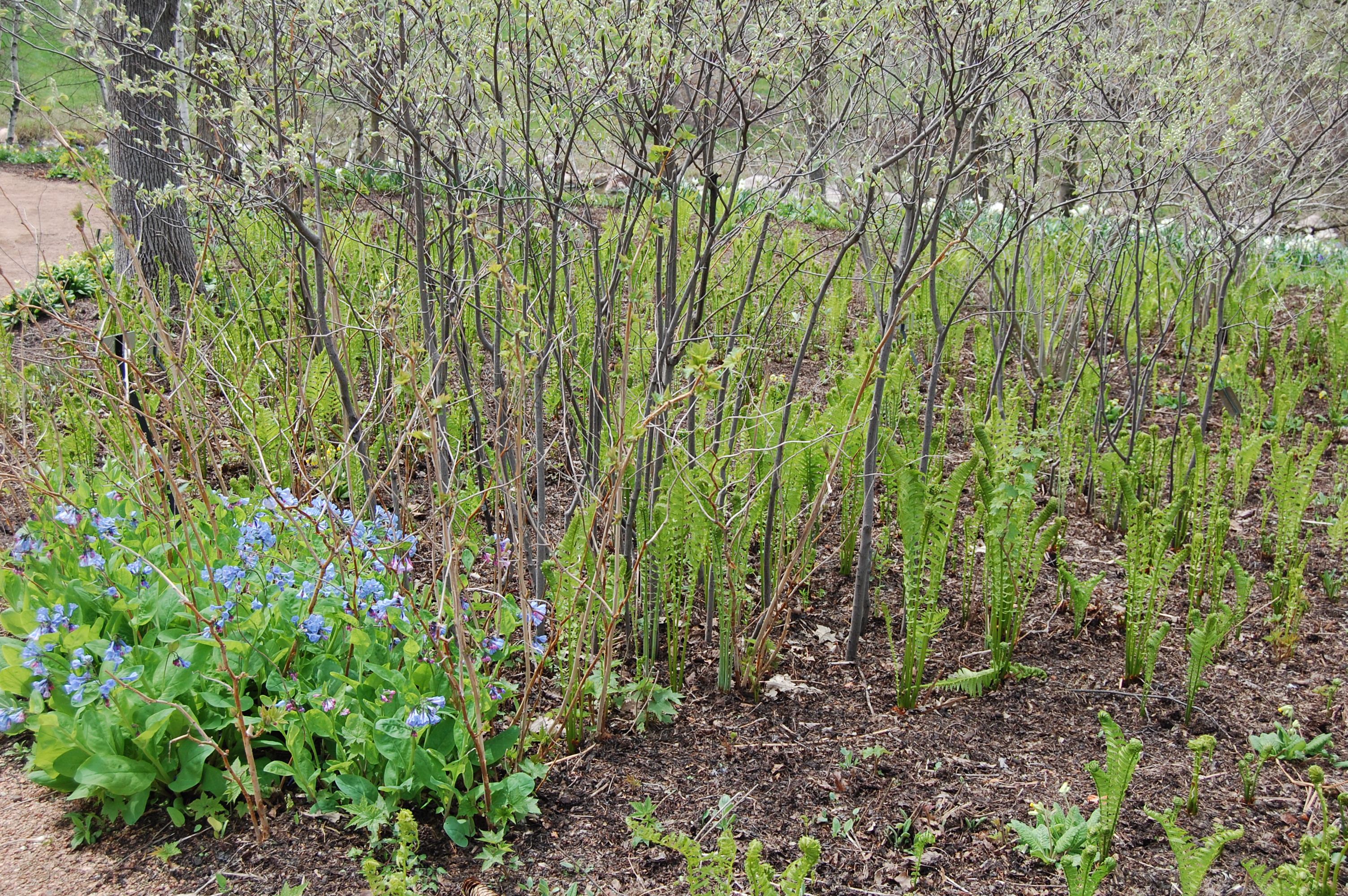
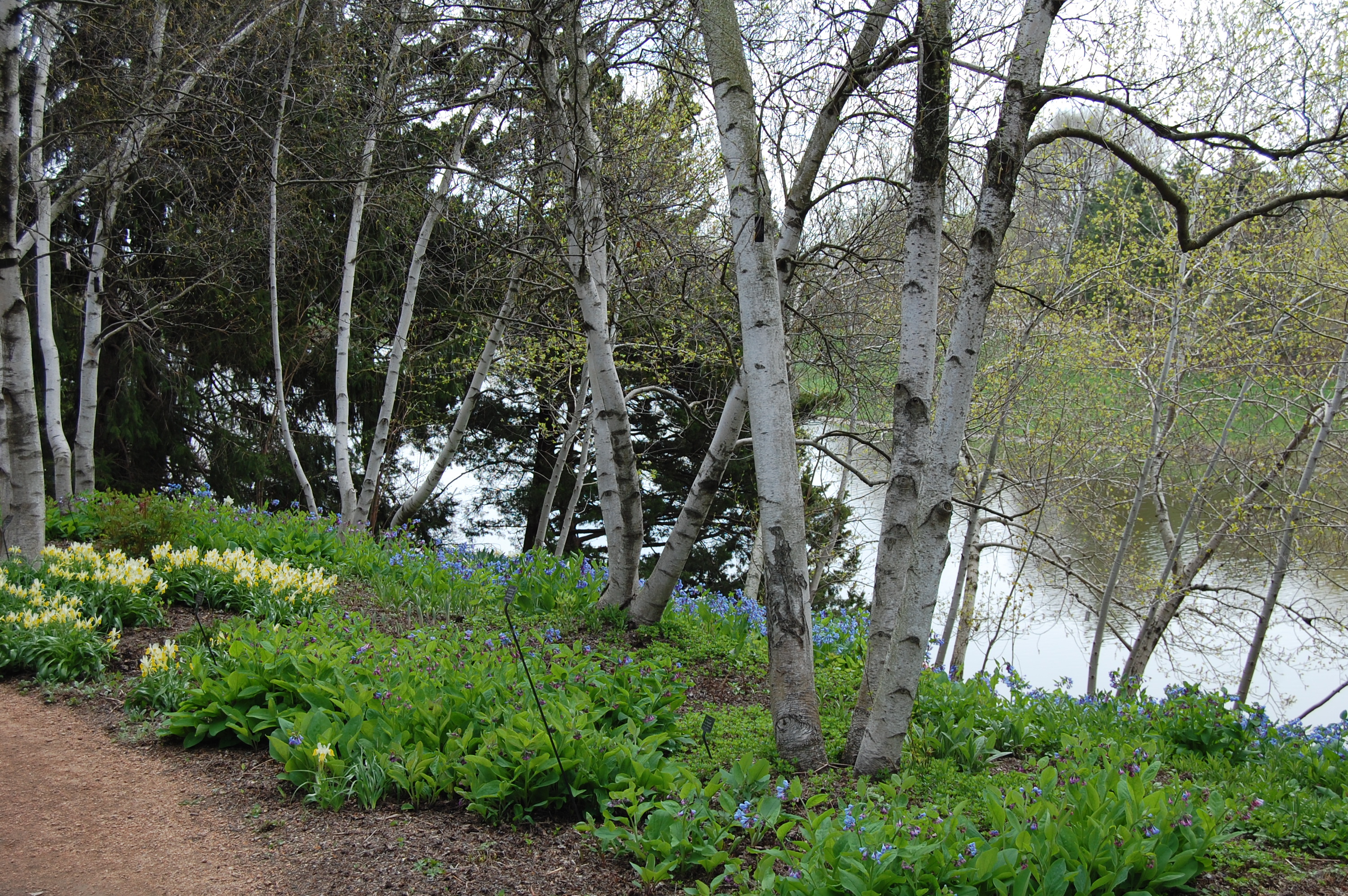
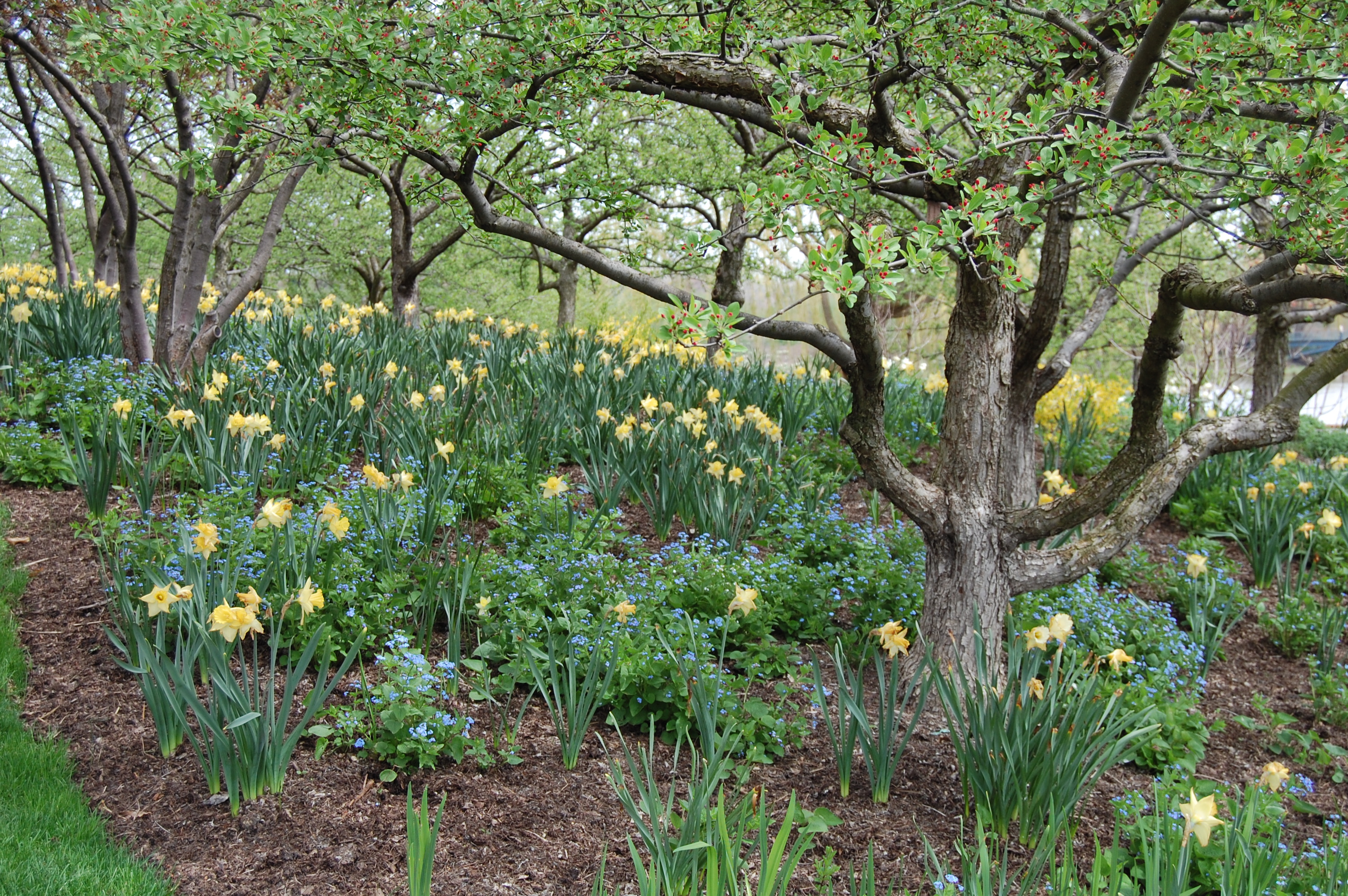
From there we wandered over to a woodland garden which, though unnamed, is actually one of our favorite areas in spring. At this time of year, there are ferns, bluebell false forget me not, and daffodils among the birches and evergreens. When we were there the bleeding hearts were not yet in bloom, but by now they will have added many arching stems of dangling pink flowers to the blue and yellow.
This garden is planted on a steep slope. From the path at the top, you can see down to the lagoon.
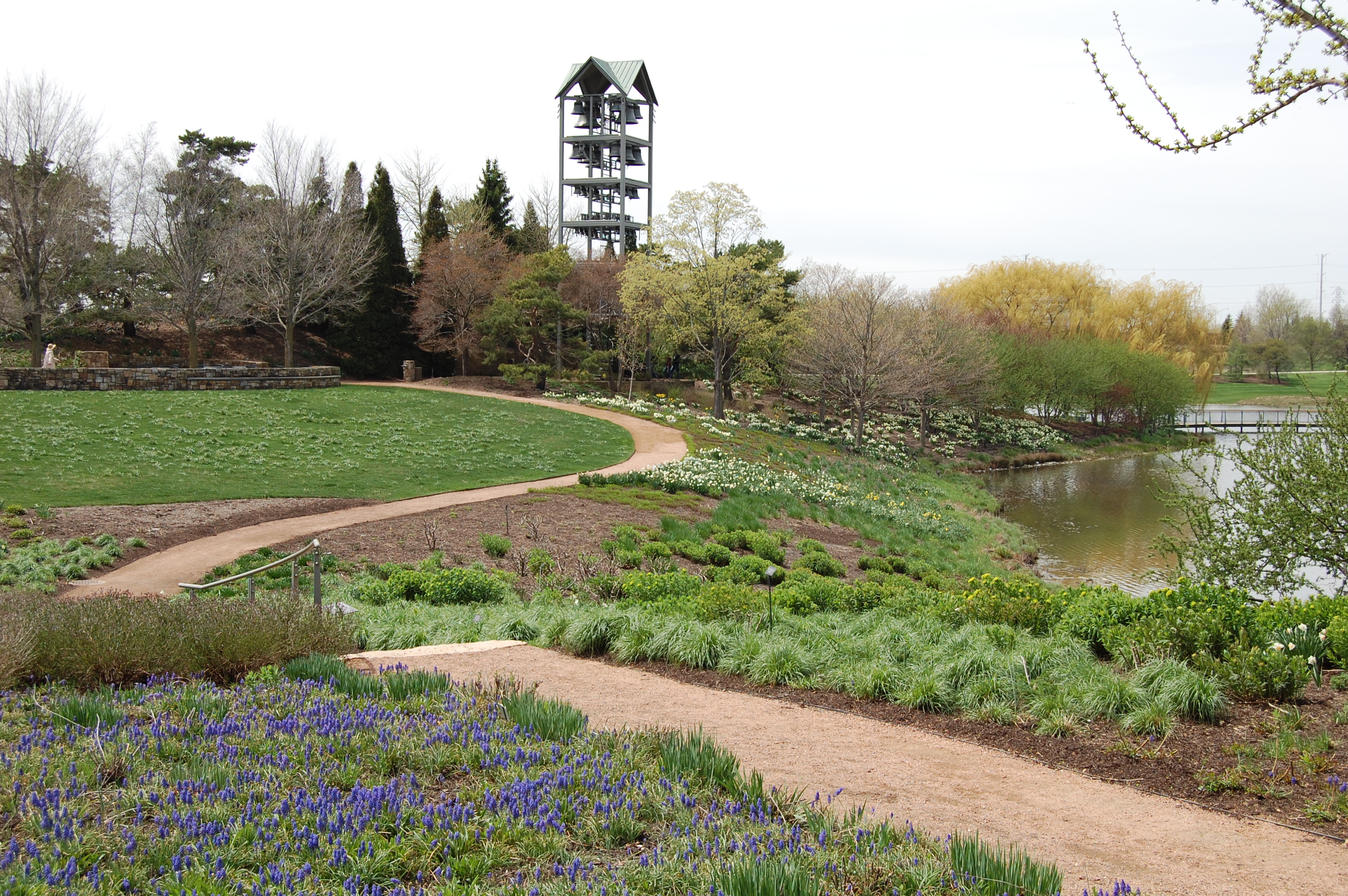
Carillon Tower at Chicago Botanic Garden’s Evening Island.
Onward. We walked across the bridge to Evening Island, which is really a collection of several gardens. At one end there is a small hill topped with a Carillon. Carillon concerts are given on summer evenings, something we have always meant to go to. One piece of advice: do not stand at the base of the Carillon when it starts ringing. I have learned this through personal experience.
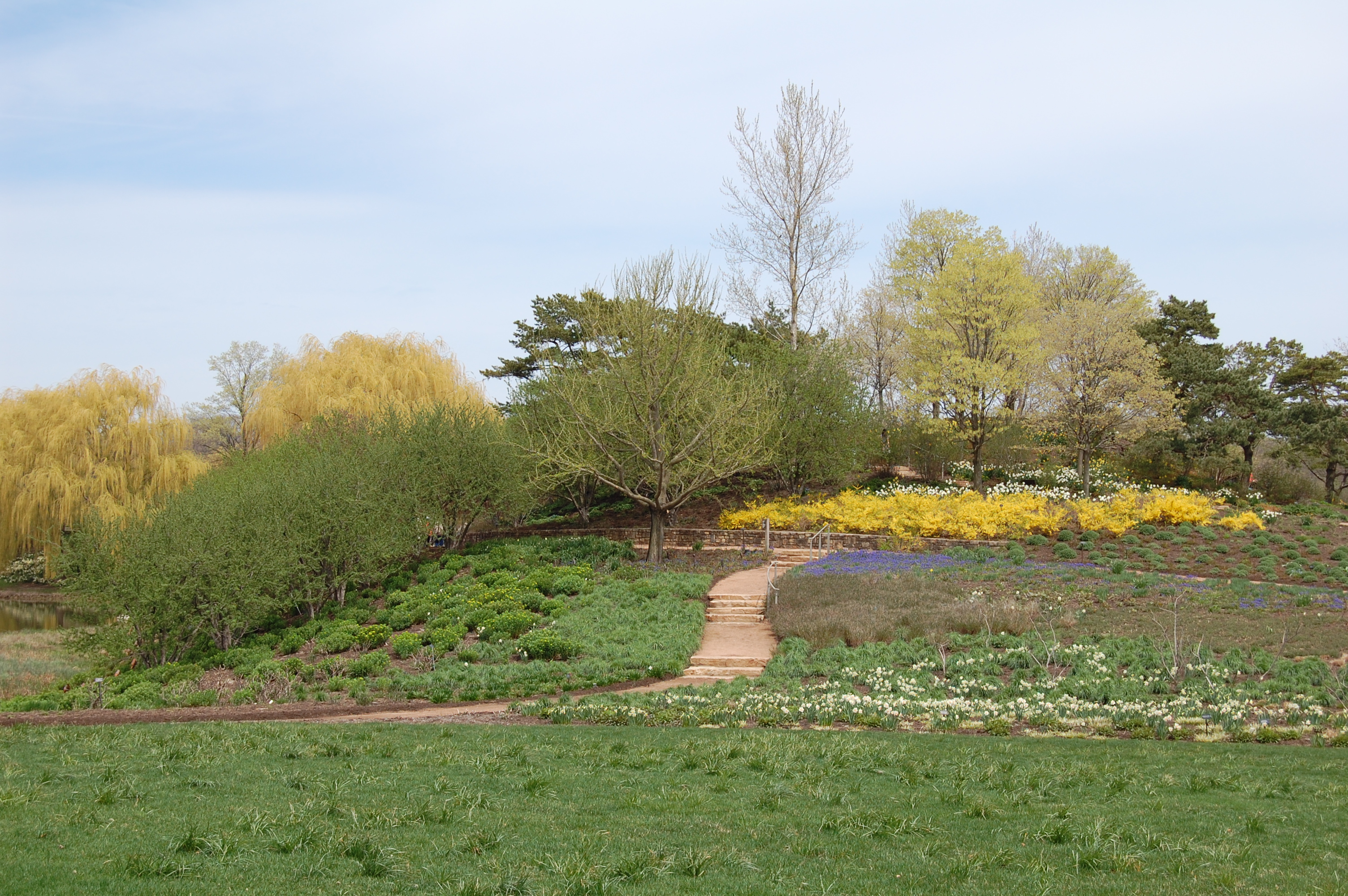
View from Carillon hill.
From the Carillon hill, you can see across sunny fields of flowers to another small hill at the other end of the island. Grape hyacinths make a blue carpet at the feet of a hedge of bright yellow forsythia. Per my earlier post, I admit this is a setting where forsythia looks really good, but I still wouldn’t plnat it in my own garden.
Water-side path on Evening Island
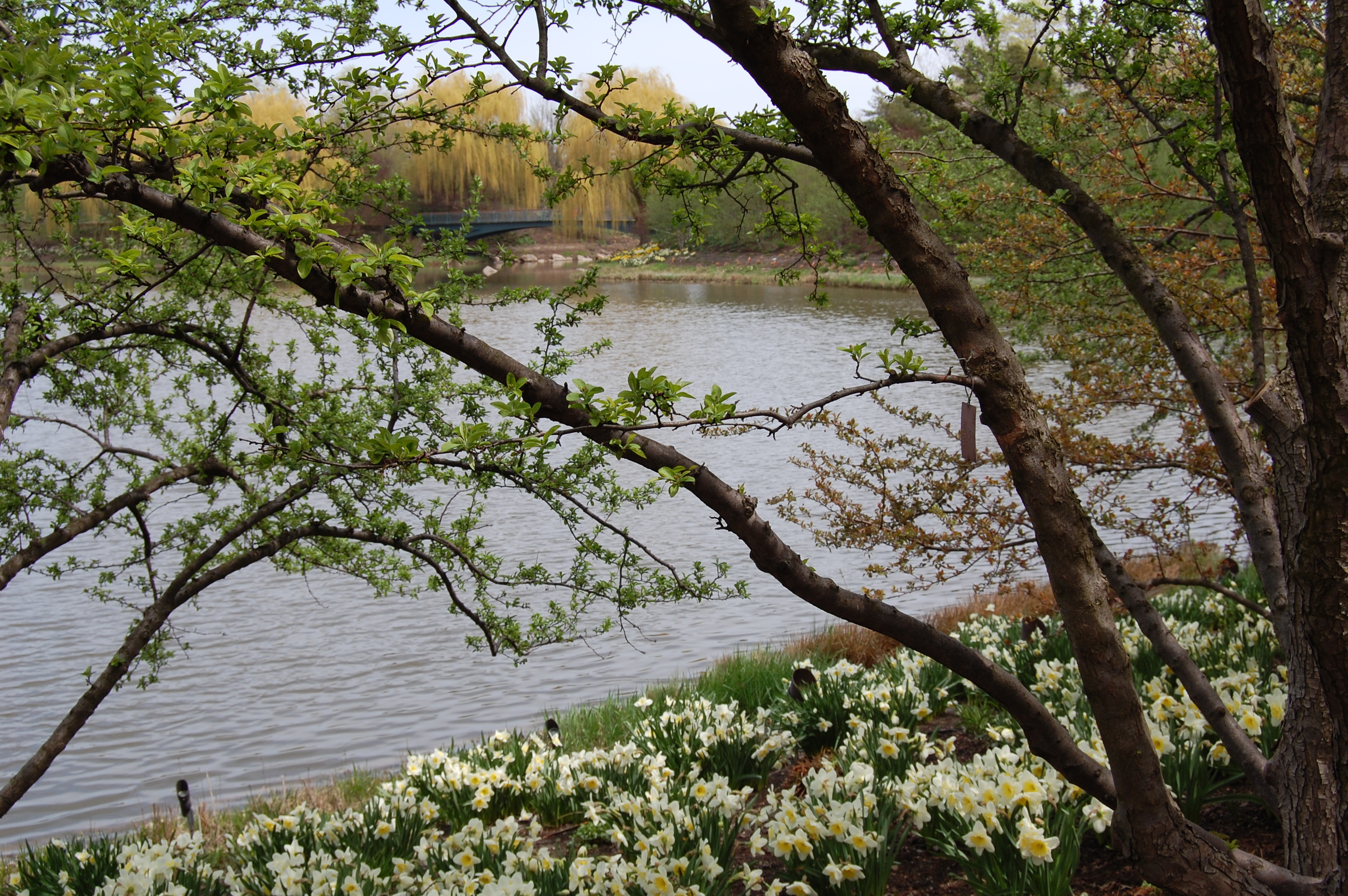
We walked along a path lined with crabapple trees. The crabapples are also planted along the water on the opposite shore. When they bloom it is a glorious sight. I’d think there’s another week or two before that happens.
Leaving Evening Island on the second bridge, there are more crabapples, daffodils, and false forget me not.
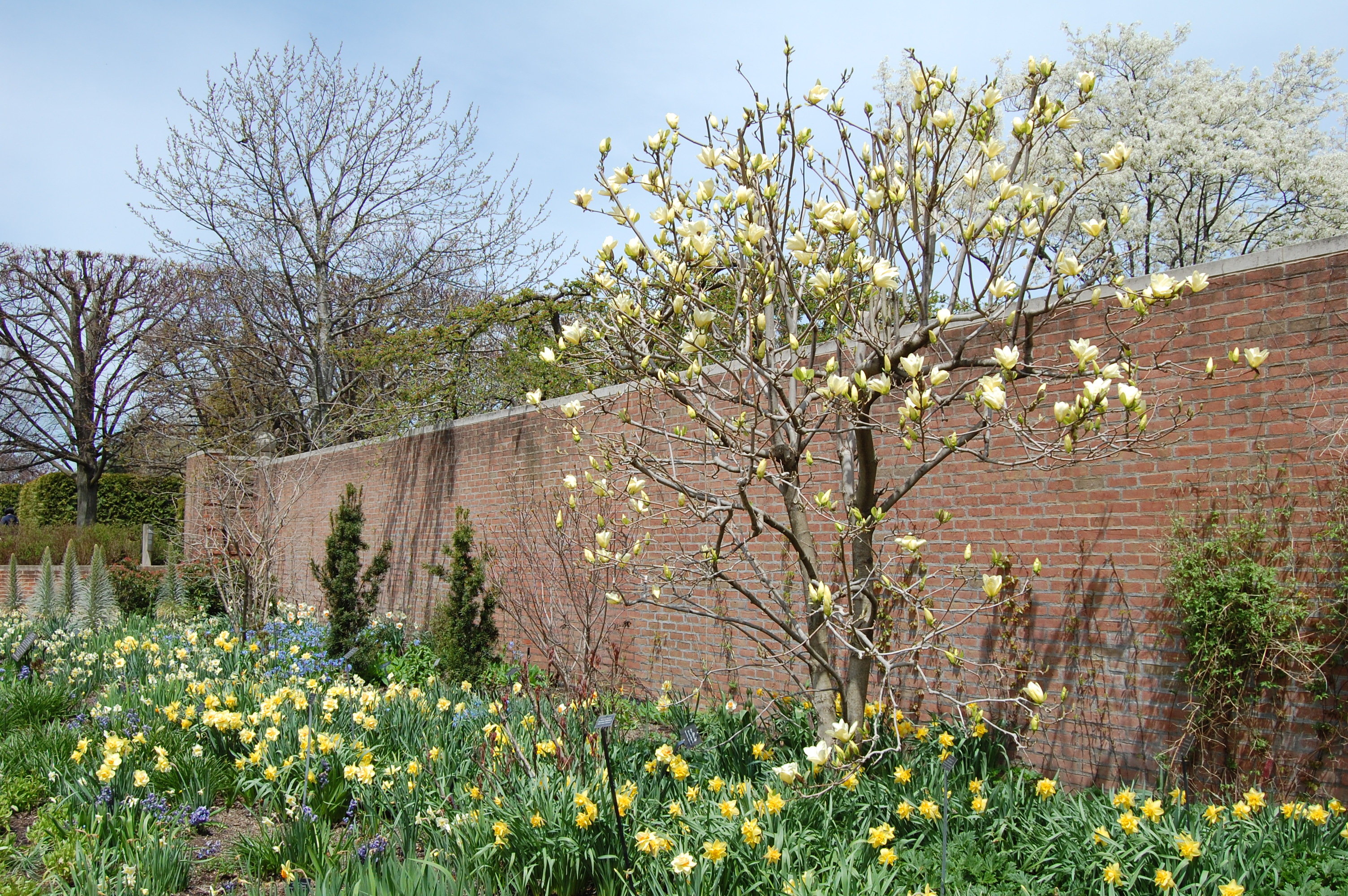
English Walled Garden
Before heading to the parking lot, we walked along the English Walled Garden, admiring the yellow magnolia (Magnolia acuminata).
Finally, we had to head home. After almost three hours, there was still a great deal we had not seen. Even so, we had done enough gawking, and there was serious gardening to be done at home!
Have you taken any great walks so far this spring?
I have more bird feeders than I can actually use at any one time. That’s OK, though, because I like to change feeders and types of food as the seasons progress. For instance, I stop feeding peanuts once the warm weather is established.
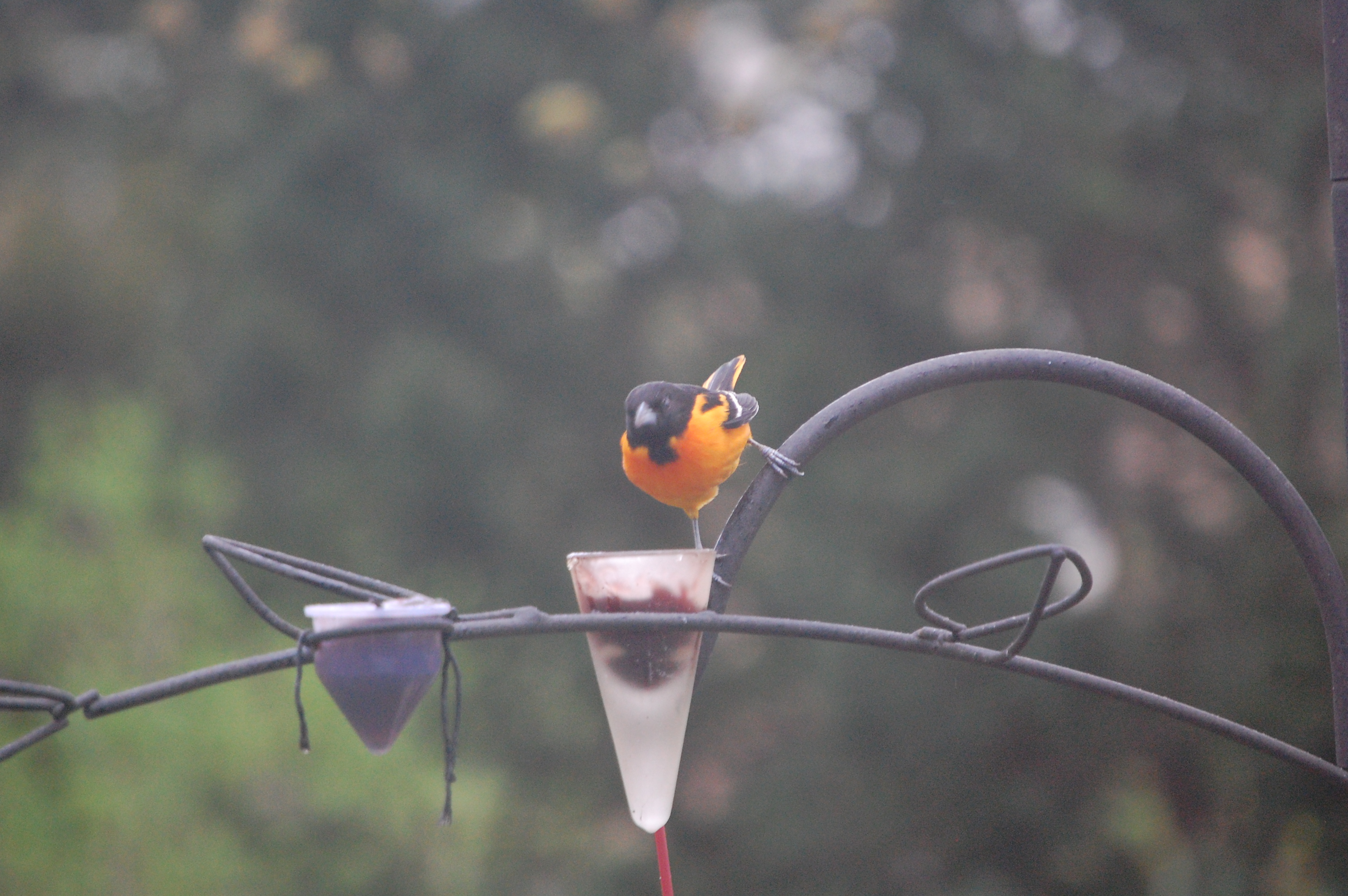
Male Baltimore Oriole at our old feeder. Help yourself to some grape jelly!
These changes keep the birds on their toes (or would if they had toes) – they never know what I’ll do next.
But I want to state something here for the record. It is not true, as certain persons claim, that I buy everything the nice salespeople at the Wild Birds Unlimited store try to sell me.
I admit that the Wild Birds Unlimited store is one of my favorite places. Their prices are not necessarily the cheapest, but the quality and variety of their goods are excellent. More important, the staff are real bird people, so to speak. Meaning they will talk knowledgeably and enthusiastically about birds for as long as you care to pursue a conversation.
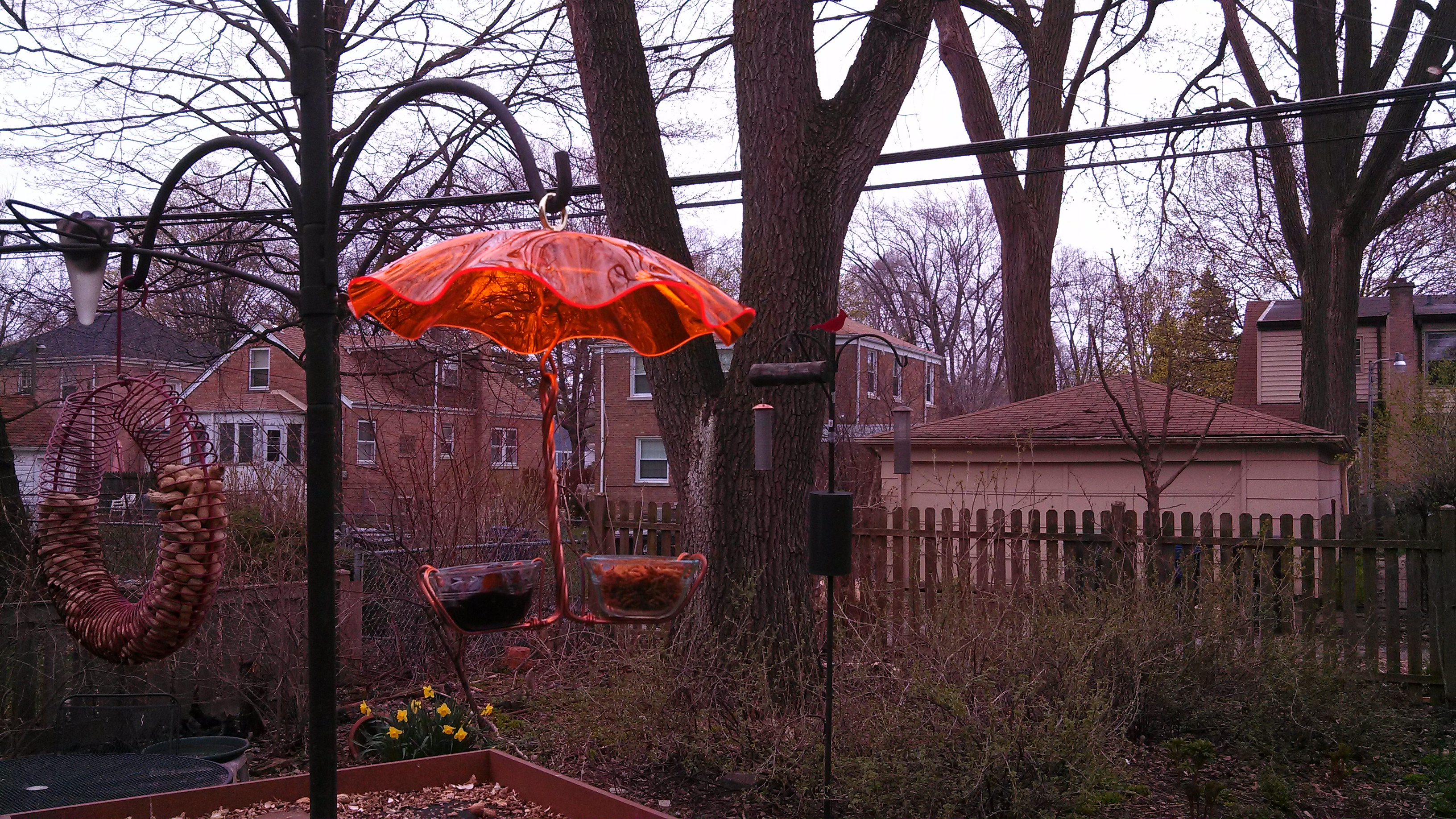
My new Oriole feeder. Took this with my phone when the light was kind of bad.
Now, I added the new feeder because I wanted to make sure I would be able to accommodate all the Baltimore Orioles that might arrive with the spring migration. Yes, I already have one Oriole feeder, but what if some of the Orioles had to go away hungry? The new feeder has two glass bowls that can each hold a larger quantity of grape jelly (the favorite food of Orioles) than my current feeder (or, alternatively, orange halves).
What’s more, the salesperson pointed out the value of the plastic orange roof (sold separately). Not only does this roof prevent watery grape jelly, it also serves as an orange beacon that flying Orioles can see from above. Apparently the color orange makes Orioles think of grape jelly.
But you can put more than just orange halves or grape jelly in this new feeder. It can also hold freeze dried mealworms. The salesperson says that Orioles love freeze dried mealworms, as do warblers and other migrating songbirds.
A bag of freeze dried mealworms.
I did hesitate when I saw the price of the freeze dried mealworms. You would think that demand for such a product would be pretty limited and so the price would be quite modest. This is not the case, however. We live in a strange world.
Anyhow, I threw caution to the winds and bought one bag of mealworms, at least as an experiment for the spring migration. Judy says it’s OK as long as I never take them out in her presence.
The salesperson suggested mixing the mealworms into the jelly for a carb- and protein-rich snack no Oriole can resist. This, however, I refuse to do. There are limits, after all.
In the meantime, Judy is talking to a lawyer about obtaining a restraining order that would keep me at least 100′ from any Wild Birds Unlimited store.
Have you made any purchases for your garden recently that an ill-informed person might regard as not absolutely essential?
When I was growing up in the late Mesozoic era, TV stations used to demonstrate their civic responsibility by running a particular public service announcement. The one I have in mind usually had a still shot of some teenagers on a dark street, obscured by shadows. And there would be an announcer, asking more in sorrow than in anger: “It’s 10 o’clock. Do you know where your children are?”
Culver’s Root ‘Fascination’, a late riser. Asiatic lilies in the background.
As you might suspect, this was at a time of heightened concern about crime. Do they still run that announcement, or some version of it?
I was thinking of that old TV spot recently when I was trying to figure out where in the raised driveway border to plant three ‘Longwood Blue’ bluebeard (Caryopteris xclandonensis). I made the mental connection, such as it was, when I realized that it was spring and I didn’t know where some of my perennials were. And that meant that I was uncertain about where to put my ‘Longwood Blue’.
Joe Pye Weed ‘Gateway’, another slug-a-bed.
Several of the plants in this bed are late to emerge from dormancy, which didn’t help. (Like many teenagers, these plants stay in bed far too long.) Some examples: butterflyweed (Asclepias tuberosa), Joe Pye weed (Eutrochium purpureum), and Culver’s root (Veronicastrum virginicum ‘Fascination’). I didn’t want to place my new bluebeards where they would be cheek by jowl with some inappropriate neighbor, nor did I want to damage an existing perennial while planting a new one.
Also, there were a couple of emerging mystery plants I couldn’t identify. Were they early sunflower (Heliopsis), ironweed (Vernonia)? Friend or foe? Plants in my garden have an annoying habit of disappearing, then reappearing a year or two later more robust than ever before.
Butterflyweed rises late and hates to be disturbed.
Sure, I know I’m supposed to have some system to identify what is growing where, but I’m just not organized that way. So the new bluebeards sat in their pots against the south-facing wall of the house for two weeks, until I could make a more educated guess about what plants were where.
Do you know where your perennials are? Or are you making guesses and hoping for the best?
This is a very stressful period for some garden bloggers (namely, me). On the one hand, we have had another glorious weekend and I am almost overwhelmed by all the wonderful blooms now returning to the garden, not to mention the new plants being installed.
‘Flair’
I want to write posts about all these developments for this blog. But I cannot spend too much time writing, because spring is moving fast and garden tasks are piling up, especially since I am home only two or three days a week. Moreover, everybody else has so many wonderful blooms in THEIR gardens and they are busy writing posts about it for their blogs, and I must read and maybe comment on those posts … Just thinking about it is exhausting.
‘Couleur Cardinal’. This is a Jason picture, please excuse the hubcap.
But enough self-pity. Let’s talk about the new blooms that have emerged just since last week. Well, for starters the container tulips have started to bloom! So far we have ‘Flair’, ‘Bellona’, and ‘Couleur Cardinal’.
The first of my container tulips in bloom. The yellow is ‘Bellona’.
I’m afraid I did lose some of the container tulips, though. This fall I definitely want to plant tulips in containers again. However, I will use only the larger containers and provide them with extra insulation.
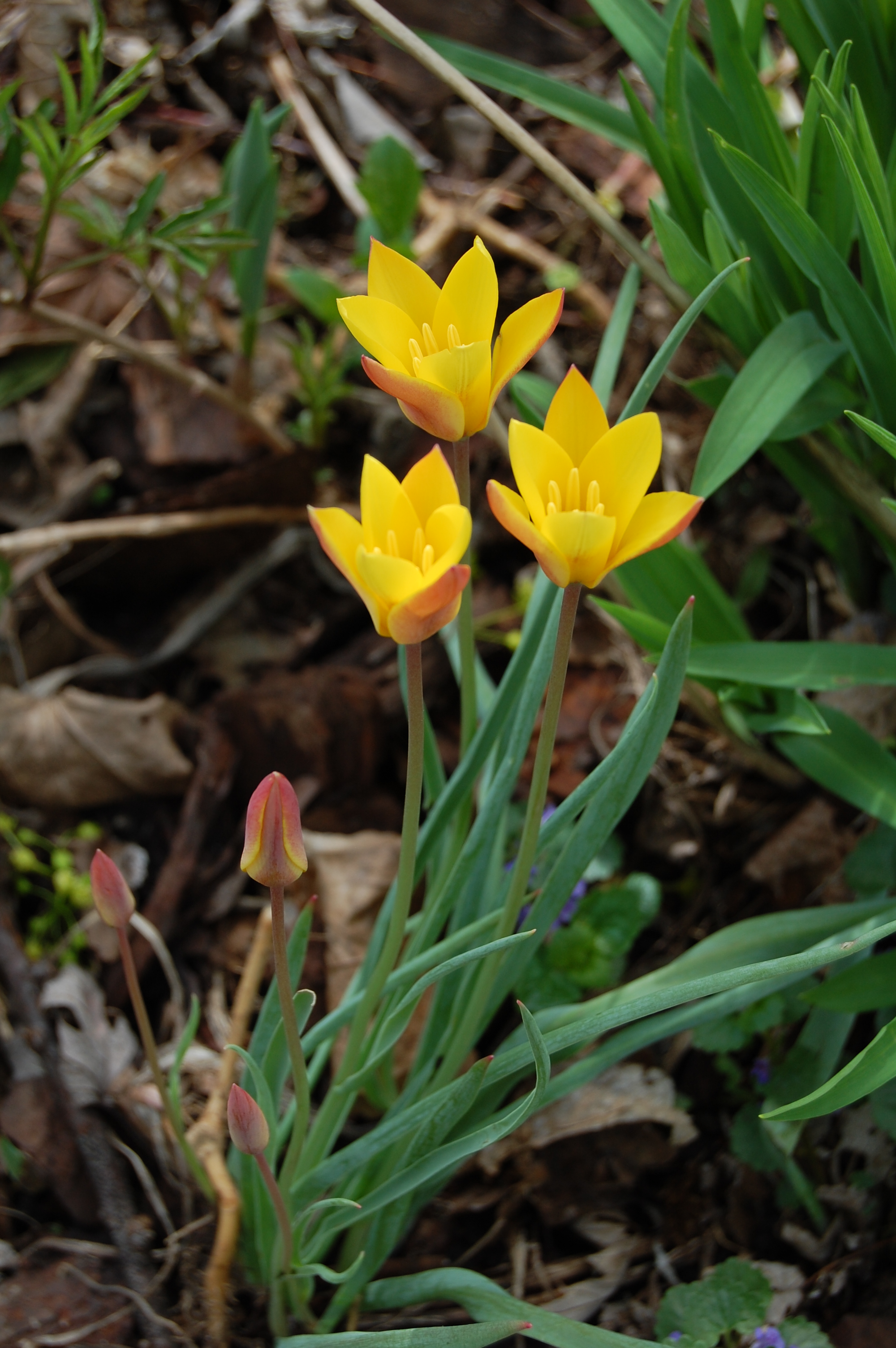
There is also another species tulip, Tulipa clusiana ‘Cynthia’.
Tulipa clusiana ‘Cynthia’
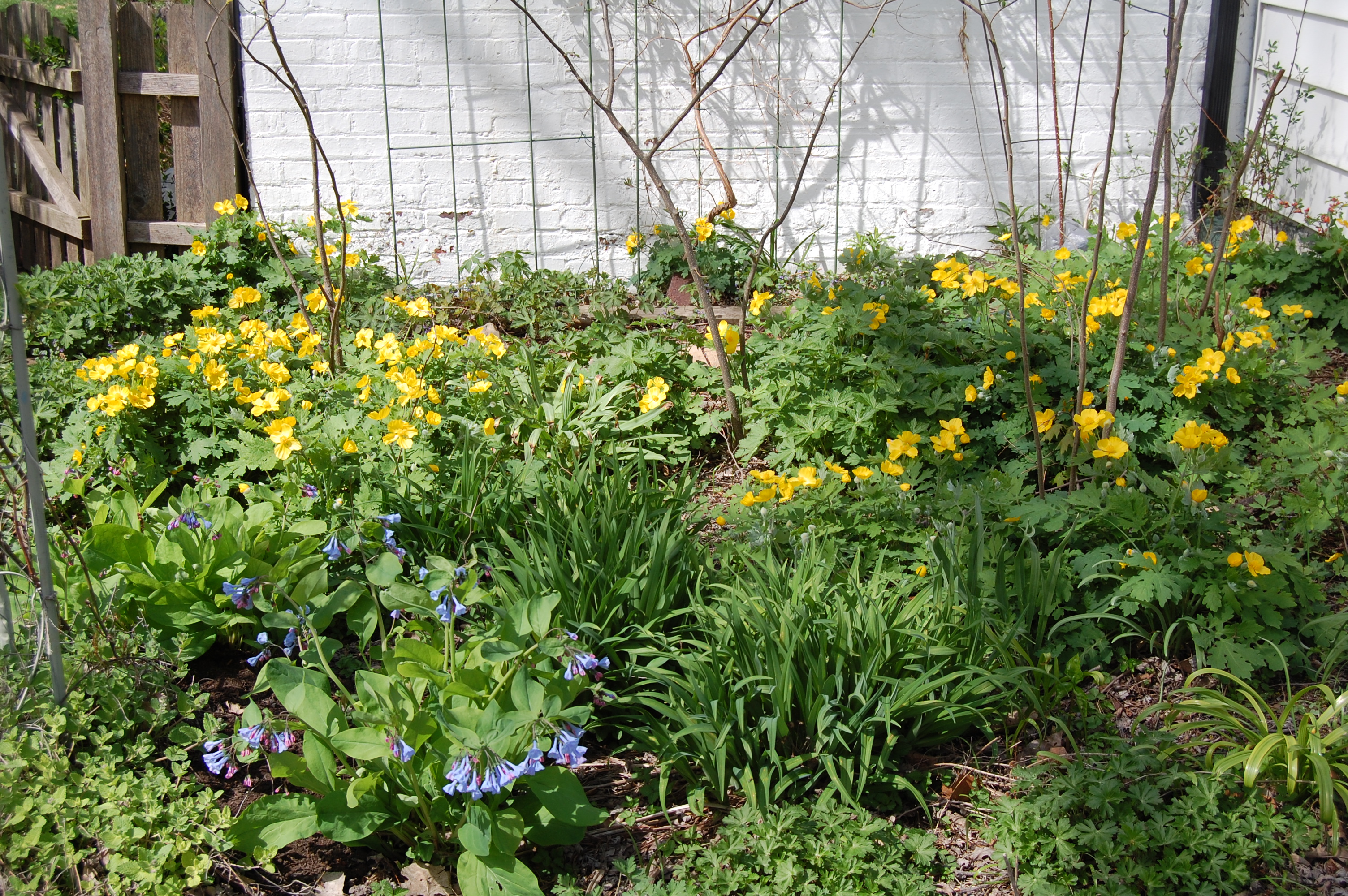
Among the native spring flowers, the celandine poppies (Stylophorum diphyllum) are blooming vigorously.
Celandine poppies with Virginia bluebells at lower left.
And the Virginia Bluebells (Mertensia virginica) are just about reaching their peak.
Virginia Bluebells
The dangling yellow flowers of merrybells (Uvularia grandiflora) are on display. This native wildflower should be used more in shade gardens, I think. It is interesting and beautiful, if a bit understated. In a location with sufficient moisture, it makes a good groundcover after blooming.
Merrybells
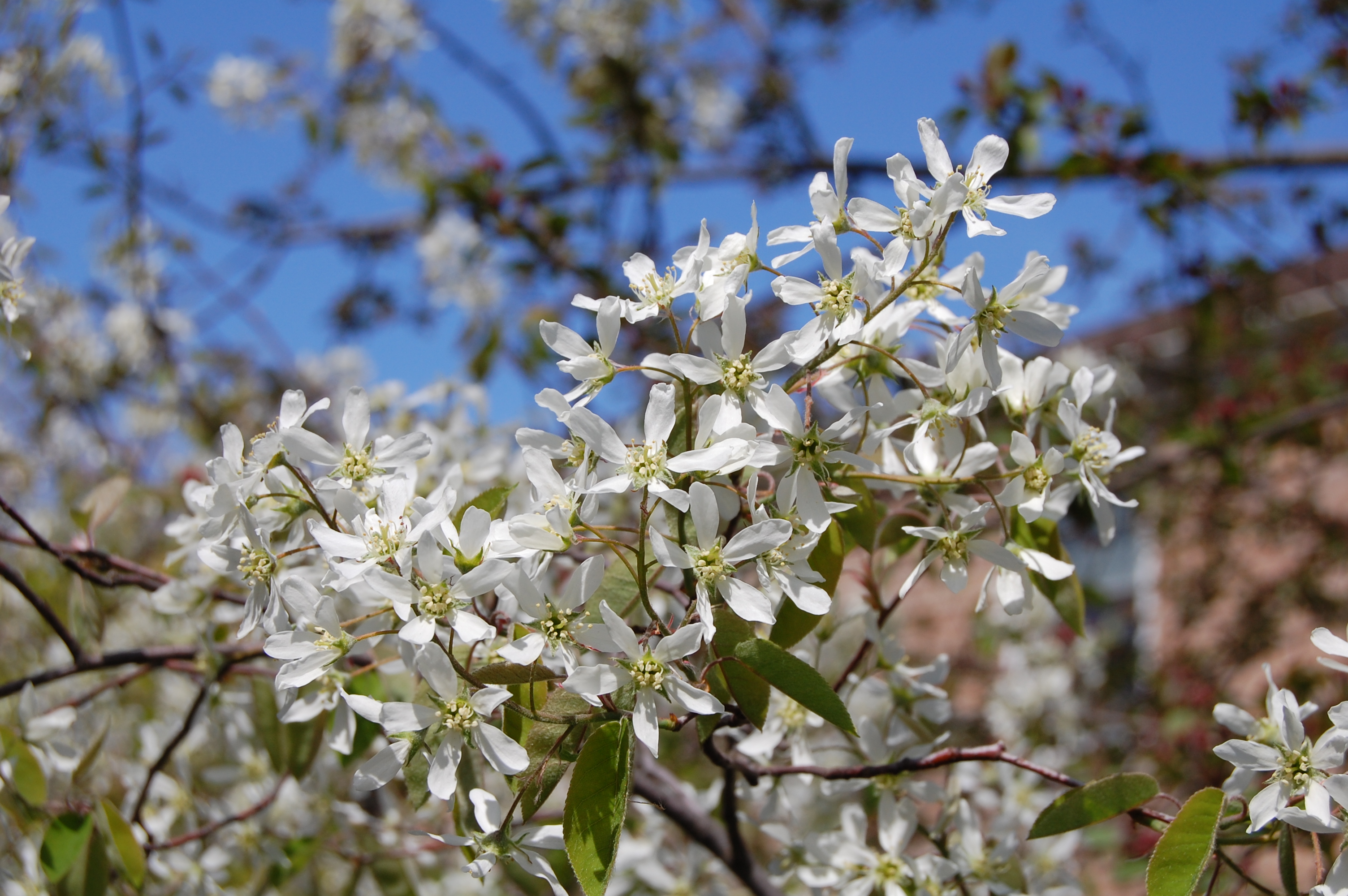
Serviceberry ‘Autumn Brilliance’ is showing off its pure white spring flowers.
Serviceberry ‘Autumn Brilliance’
False forget-me-not (Brunnera macrophylla), a very useful and lovely non-native spring flower, is also blooming.
False Forget-Me-Not
On the foliage front, the fiddleheads of the ostrich ferns (Metteucia struthiopteris) are unfurling.
Ostrich ferns unfurling
And the wild ginger (Asarum canadensis), a nice native groundcover for shade, has emerged.
Wild ginger grows near the gate at the far end of the path. Merrybells grow in the foreground.
Tasks this weekend included:
Planting a new bed in the area where I had taken down some bridalwreath shrubs (Spirea vanhouteii). I also settled some more mail order plants into the raised front walk bed. More on these activities in later posts.
Getting a start on weeding! Featuring dandelions already blooming, creeping charlie, and other delights.
Preparing my little vegetable and herb bed. This entailed setting up the tomato trellises and digging out the rest of the old plant debris. Also, I had to beat back the oregano (Oreganum vulgare), which is bent on turning my entire lot into a oregano plantation. In addition to creating thriving colonies through seeding, the oregano mother ship has a rapidly expanding root mass with the density of 3″ armor plate. I may have bent my shovel trying to slice off pats of it.
Are you having trouble keeping on top of your blog and your garden? And which new blooms are you excited about?
The beginning of May is when many migratory songbirds return to the Chicago area. And so, before leaving home for a business trip, I stocked the bird feeders with some of their favorite foods.
Rose Breasted Grosbeak
Sure enough, when I returned today, there were Baltimore Orioles and Rose Breasted Grosbeaks making themselves at home in the back garden.
Baltimore Orioles spend the winter in Colombia, Central America, and other areas around the Caribbean. They are not considered to be endangered, but are not normally seen because they spend their time up in the tops of trees. Unless, that is, you put out grape jelly and orange halves, but especially grape jelly. And that is exactly what I did before leaving on Tuesday morning. Once they start feeding in your back garden, I have found that they will stick around until fall.
Male Baltimore Oriole
Rose Breasted Grosbeaks are large finches, related to Cardinals. Like the Orioles, they overwinter in regions near the Caribbean. They are ground feeders who appreciate sunflower or safflower seeds. They like to feed on the ground, so I attract them with a platform feeder. Unfortunately, in my garden they show up in May but don’t stick around for more than two or three weeks. They may show up again on their way south in the autumn.
Female Baltimore Oriole
Have you seen any favorite songbirds return lately?
Forsythia bushes bursting with bright yellow flowers is a common springtime sight in this part of the world, a sight that lifts the spirits of many. Yet not everyone loves forsythia. The anti-forsythia camp argues for an indictment of this shrub on the following counts:
Forsythia in the mixed hedge on the west side of the back garden.
An exotic, it is of little wildlife value in North America. No berries for the birds. Not a host plant for butterflies or moths. On the other hand, I have found borers in the stems on a couple of occasions.
Once the yellow flowers are gone, it offers little of interest for the rest of the year. Actually, they sometimes have decent fall color. But even so, this is a plant that fades into the background much of the year.
It creates a thickety mess if you turn your back on it. As they grow, forsythia stems will arch down to the ground, where they put down roots and start a new plant. Ignore them for a season or two and you will have a jungle on your hands, albeit a bright yellow jungle in springtime.
It is just too damn common. I suspect this is the single biggest reason people really don’t like forsythia, and I would agree that it is over-used. On the other hand, some would say that black-eyed susan, also known as orange coneflower (Rudbeckia fulgida), is over-used. This may be true, but I still love black-eyed susan. Simply being common does not always make a plant tiresome. If it does or not seems to be a matter that is entirely personal and subjective.
I suppose I am a member of the anti-forsythia camp, but I try not to be rabid about it. The lack of wildlife value for me is the deciding factor. A few years ago, we had to remove a forsythia hedge on the east side of the house in order to waterproof the basement. I did not mourn its passing.
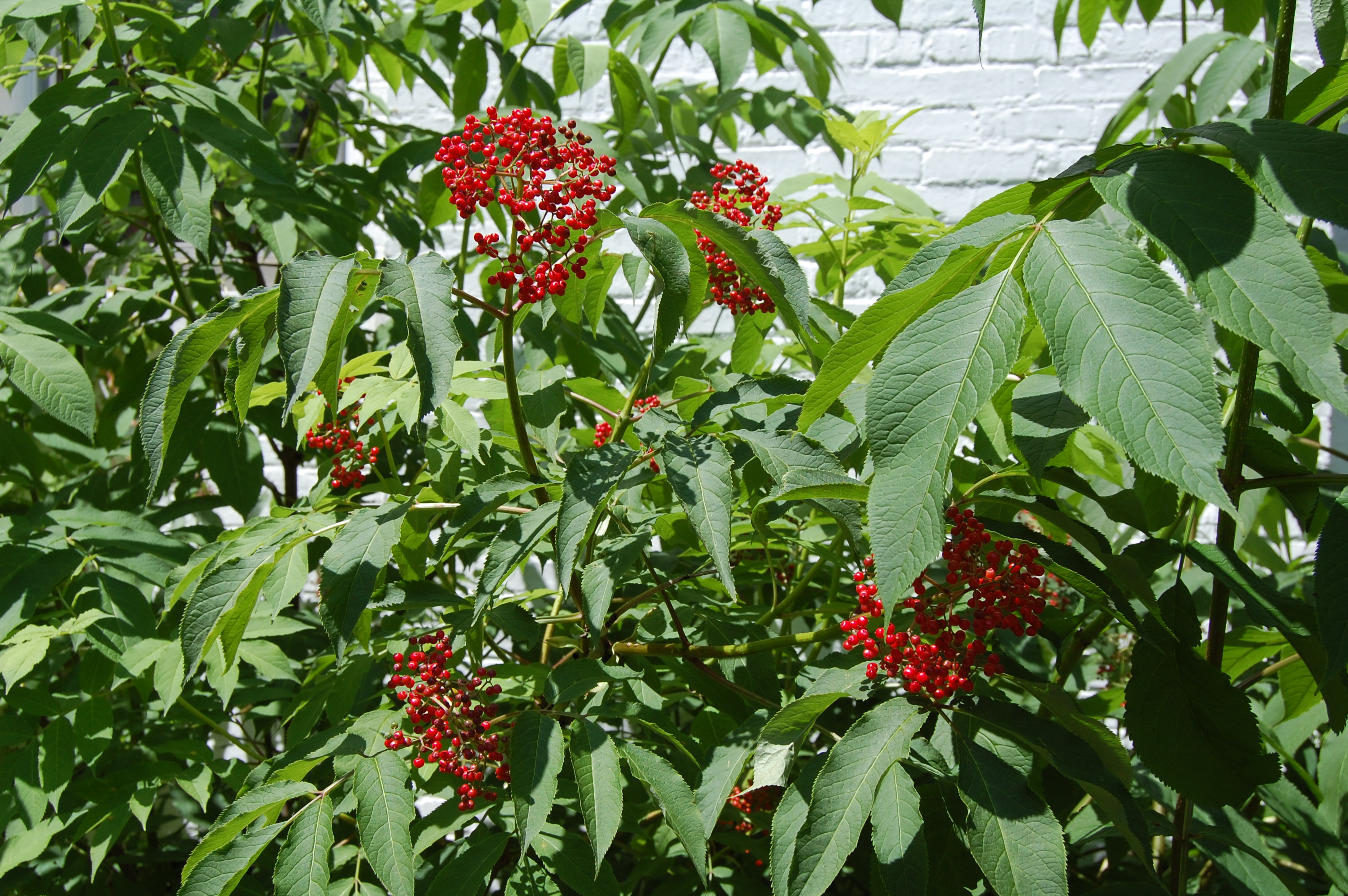
Red elderberry fruit.
Instead, I took the opportunity to replace them with red elderberry (Sambucus racemosa L.), a native shrub with pyramids of small white flowers in spring, followed by bright red berries. It is a favorite of many birds, including cedar waxwings, orioles, and robins. I should confess that this is another shrub that will pursue world domination if not watched closely. Also, though the fruit is edible for birds, it is also toxic for humans.
I still have some forsythia in the mixed hedge along the west side of the back garden. I am trying to train these forsythia so that they will provide a better privacy screen, and also to prevent them from spreading in an unruly manner.
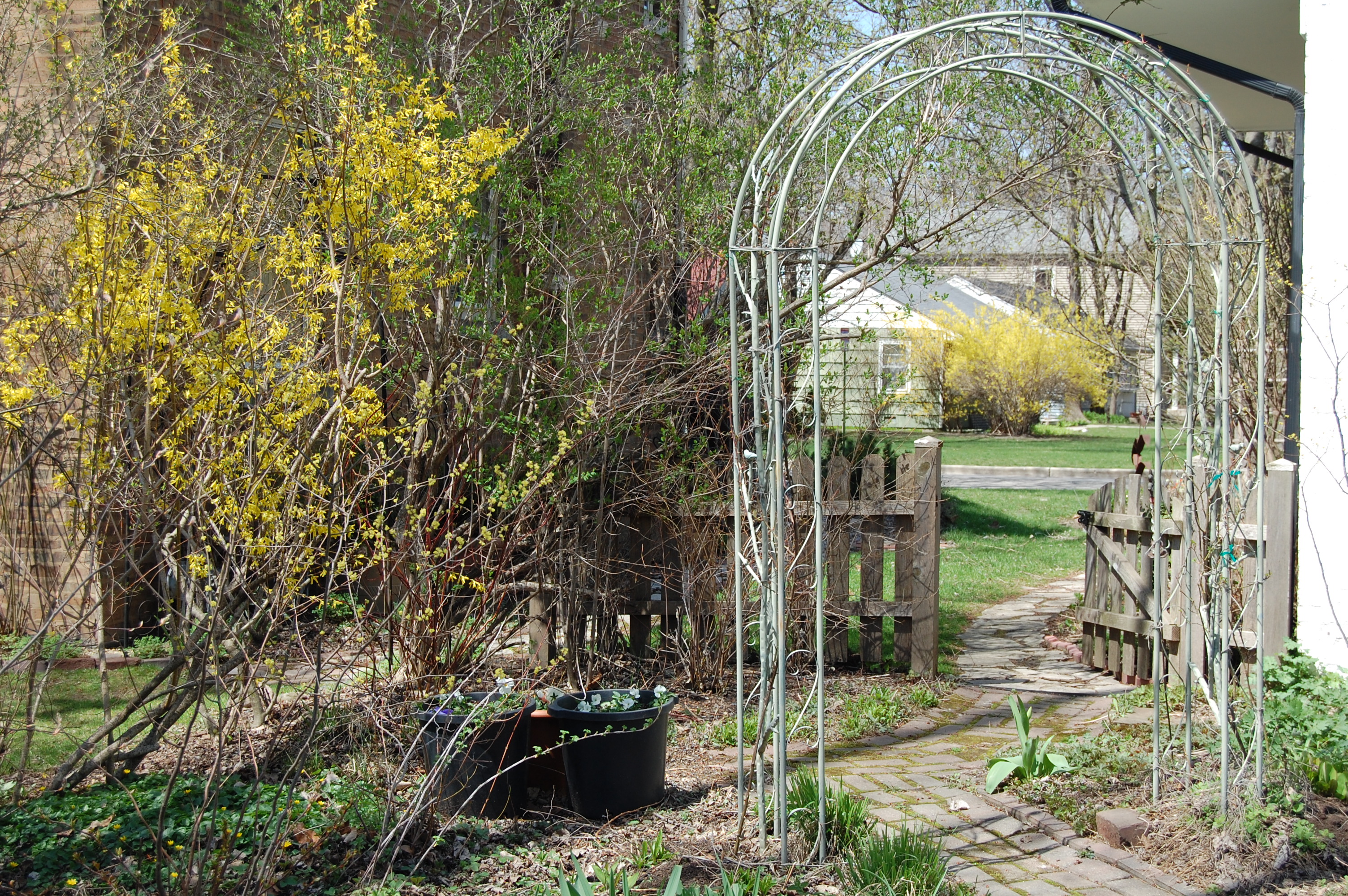
I admit that a well-pruned forsythia bush can be attractive, at least during it’s spring peak. Such a shrub is in front of one of the houses across the street. This forsythia is pruned to create an upright shape topped by arching stems that stop several feet above the ground.
See that forsythia through the gate and across the street? I like that one.
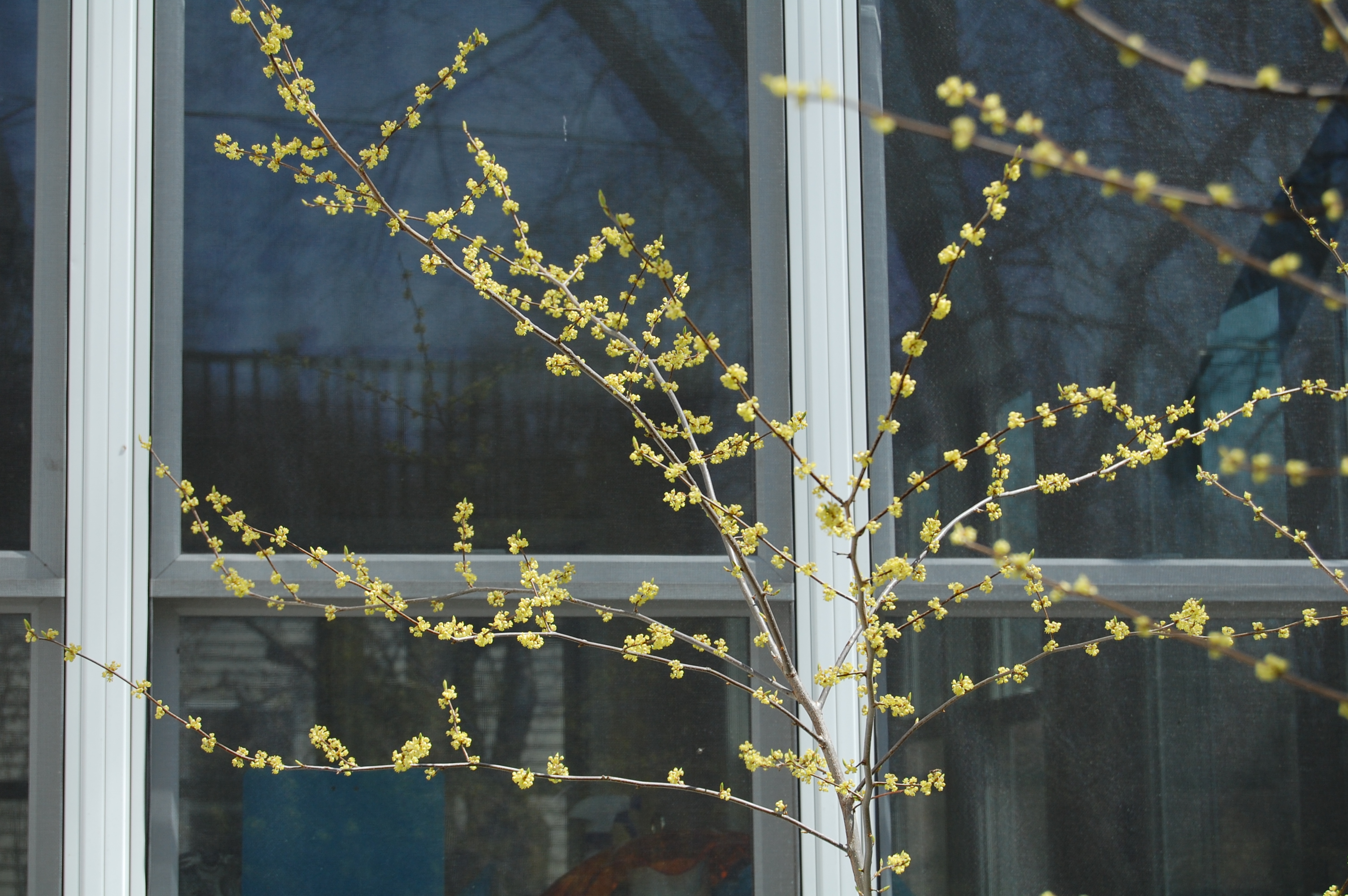
At the risk of being repetitive, I have to mention again that a good native alternative to forsythia is spicebush (Lindera benzoin). This shrub has fragrant foliage, understated yellow flowers in early spring, is a butterfly host plant, and has attractive red berries of high value to birds in fall.
Spicebush in bloom
Which side of the forsythia divide are you on: for or against?
Helen at The Patient Gardener‘s Weblog hosts a meme called End of Month View, which is pretty much what is suggested by the title. This is a very useful exercise because I am often tempted to show close ups of a particular plant or a grouping of plants. Wider views of different sections of the garden tend to appear much less frequently, especially when it is not at its glorious peak. So here’s a picture of the bed that lies along the driveway and front walk.
In this bed there is stock blooming at the far end, plus some daffodils and species tulips. The stock is wonderfully fragrant, we can smell it every time we go in or out. The celandine poppies (Stylophorum diphyllum) are filling in, as are the nepeta and hardy geraniums. Round fuzzy flower buds have appeared on the celandine poppies. There are clumps of grassy Muscari leaves, and the foliage of species tulips not yet ready to bloom. On top of that, I must have planted three flats of pansies of various kinds in order to get a full, colorful look early in the season. Somehow it still looks rather sparse.
Here’s another view of the front garden, looking out towards the street. Y(Sou can see part of the driveway/front walk bed, the parkway bed, the sidewalk bed, and the front island bed. As I mentioned in my last post, the blue squill (Scilla sibirica) is naturalizing in the front island bed. New England Aster and some other perennials are starting to emerge. However, the swamp milkweed (Asclepias incarnata) and some other plants are still dormant.
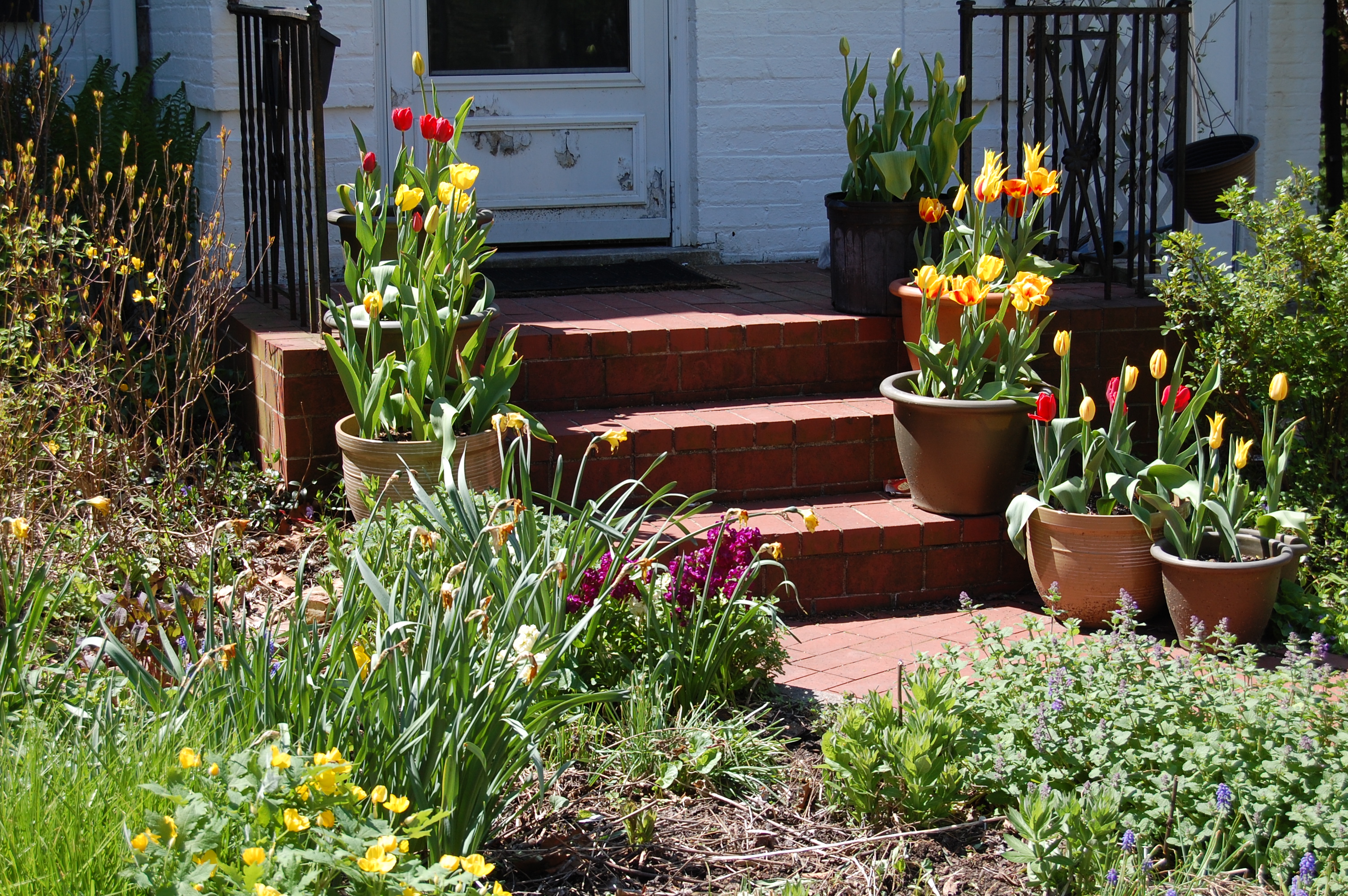
By the way, here’s a picture of the tulips in containers on the front steps. Some already have their flower buds.
Here’s a view into the back garden. Forsythia, spicebush (Lindera benzoin), squill, and daffodils are blooming. Virginia bluebells (Mertensia virginica) should be blooming by next weekend. Hardy geranium, more celandine poppies, allium, jacob’s ladder (Polemonium reptans), and various other bulbs and perennials are pushing up green growth.
This is looking back from inside the back garden toward the side path.
Now that spring has really arrived, it seems to be moving along in a hurry. Are you happy with how your garden is emerging this spring?