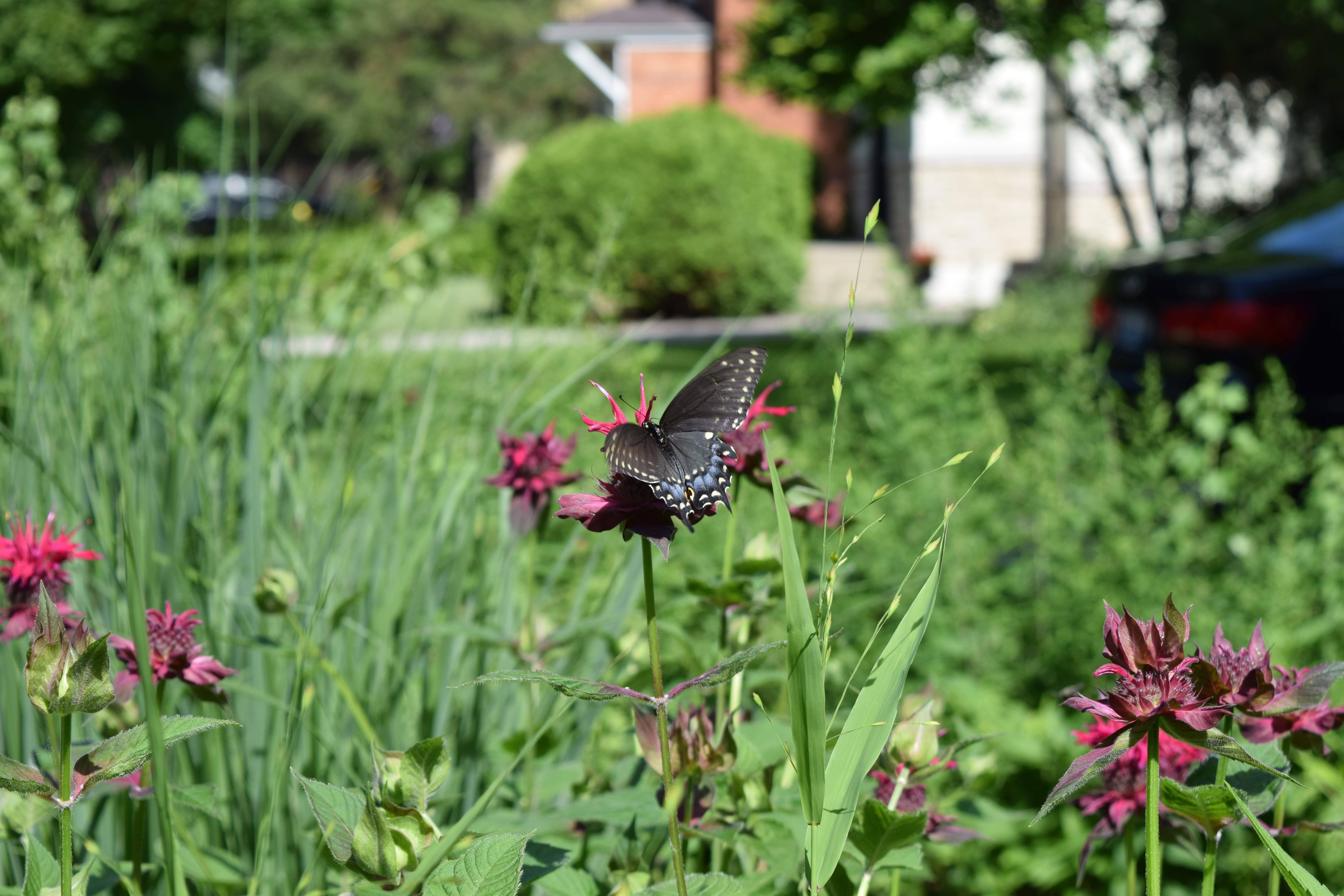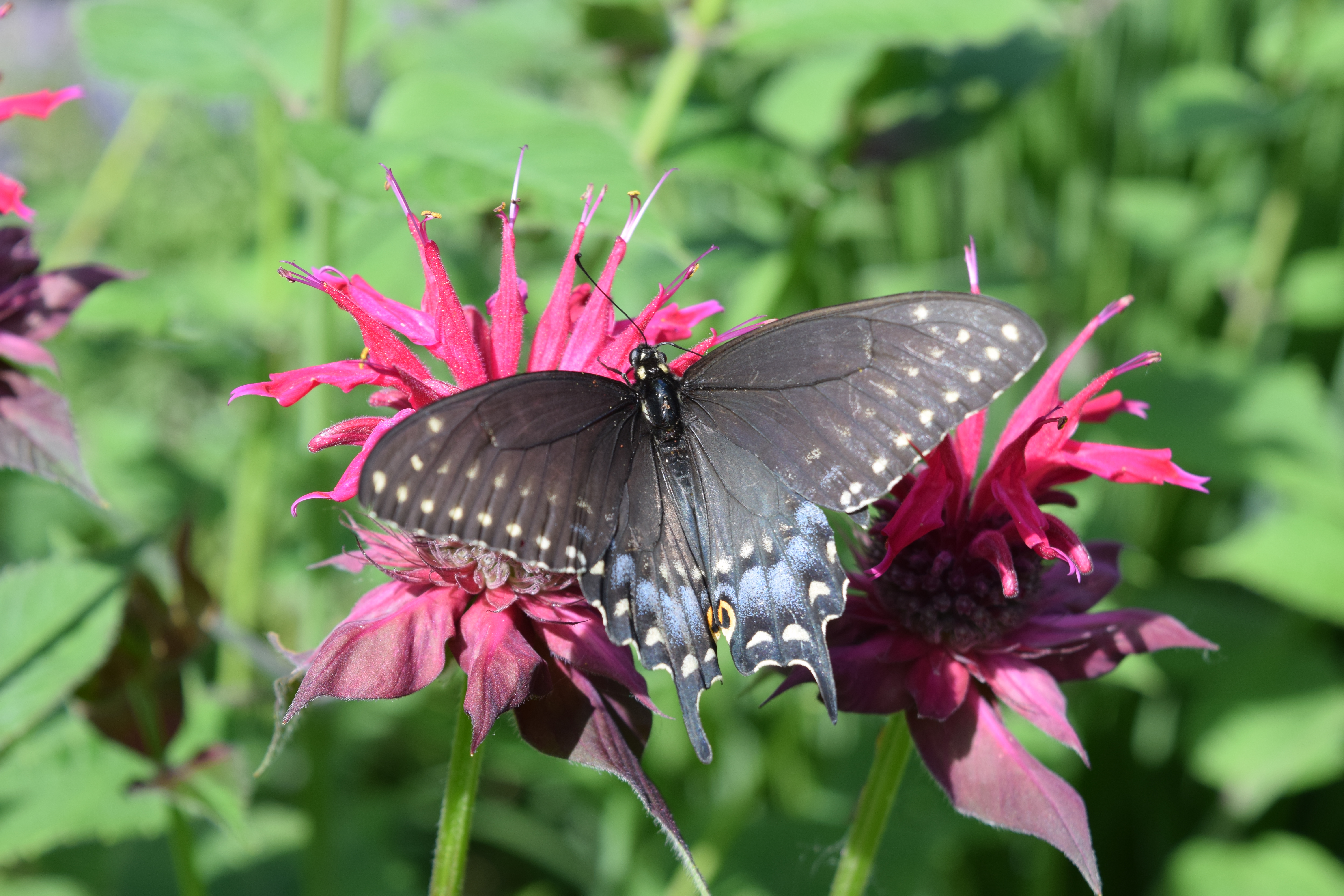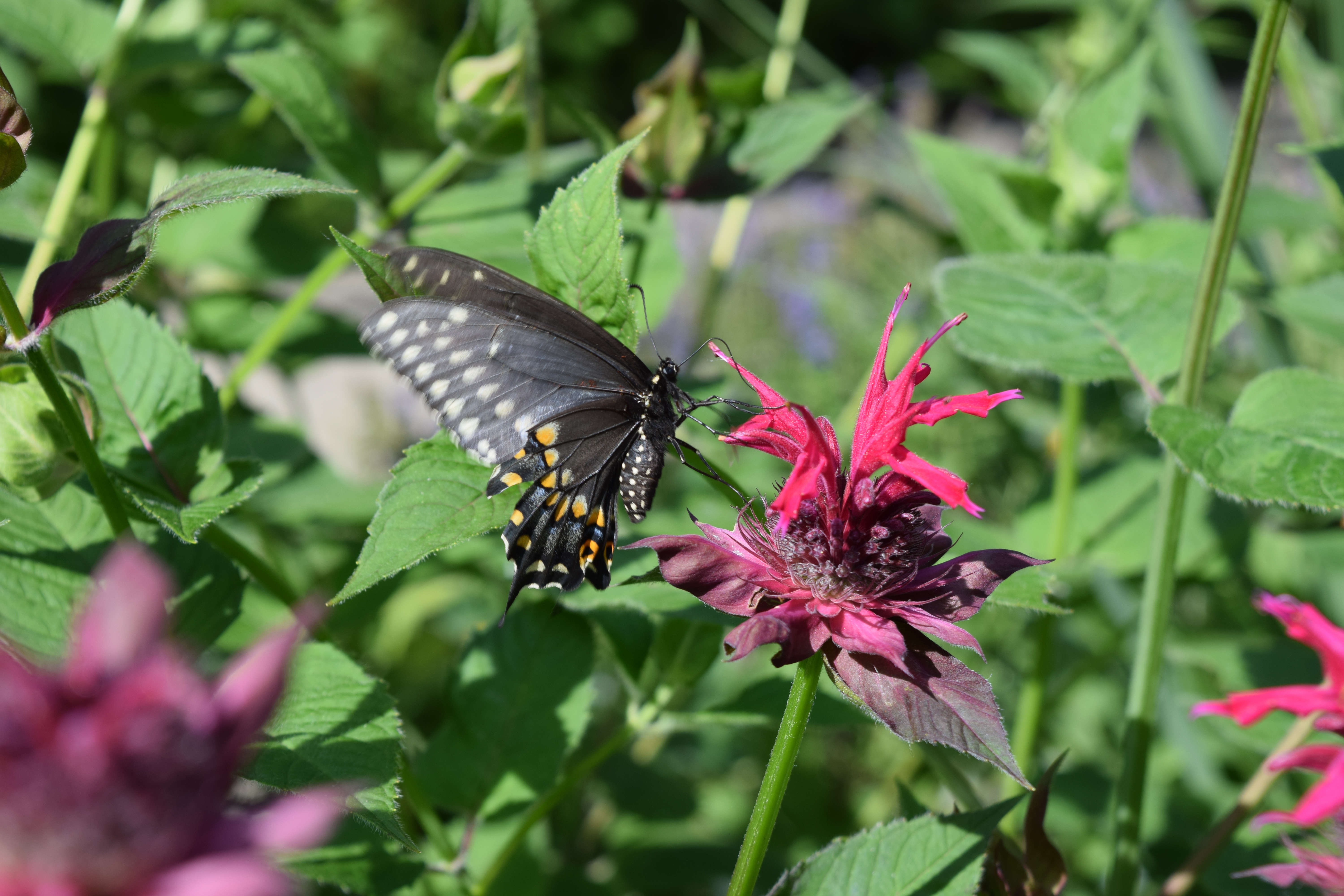
Yesterday Judy and I went out to take pictures in the garden when I spotted a black swallowtail butterfly nectaring on the ‘Raspberry Wine’ Monarda (Monarda didyma).
Look! A butterfly!
The sighting was a notable event, given the scarcity of butterflies in the garden during the last couple of years. So Judy spent some time trying to capture it on film. She was a little hyperactive, so it wasn’t easy. UPDATE: The buttefly, I mean, not Judy. Sorry, Judy.
Upper wings of a black swallowtail. Also notice you can see the pistil and stamen sticking out of the Monarda.
This was a female, which gives me hope there may be swallowtail eggs among the dill, fennel, and parsley plants in the Edibles and Cutting Bed. Black swallowtails use members of the parsley family as host plants for their caterpillars – they also like carrots, celery, and Queen Anne’s lace.
Underwing, plus a good view of the proboscis.
This individual looked a lot more robust than the last swallowtail we saw, in early June, which was nectaring on pansies in the back garden. Although today’s did seem to be missing one antenna.
Sharing nicely with a bumblebee.
Butterflies remain scarce in the garden this year, though there are definitely more than last year. I have also seen single monarchs, sulphurs and red admirals with some frequency, though never more than one at a time. We haven’t gotten any pictures this year, though.
Red Admiral, picture taken in 2012.
There is also a small light blue butterfly, which is often hovering about the New Jersey Tea (Ceanothus americanus). I think this is a spring or summer azure. Again, no pictures yet. Plus there are usually skippers and cabbage whites around.
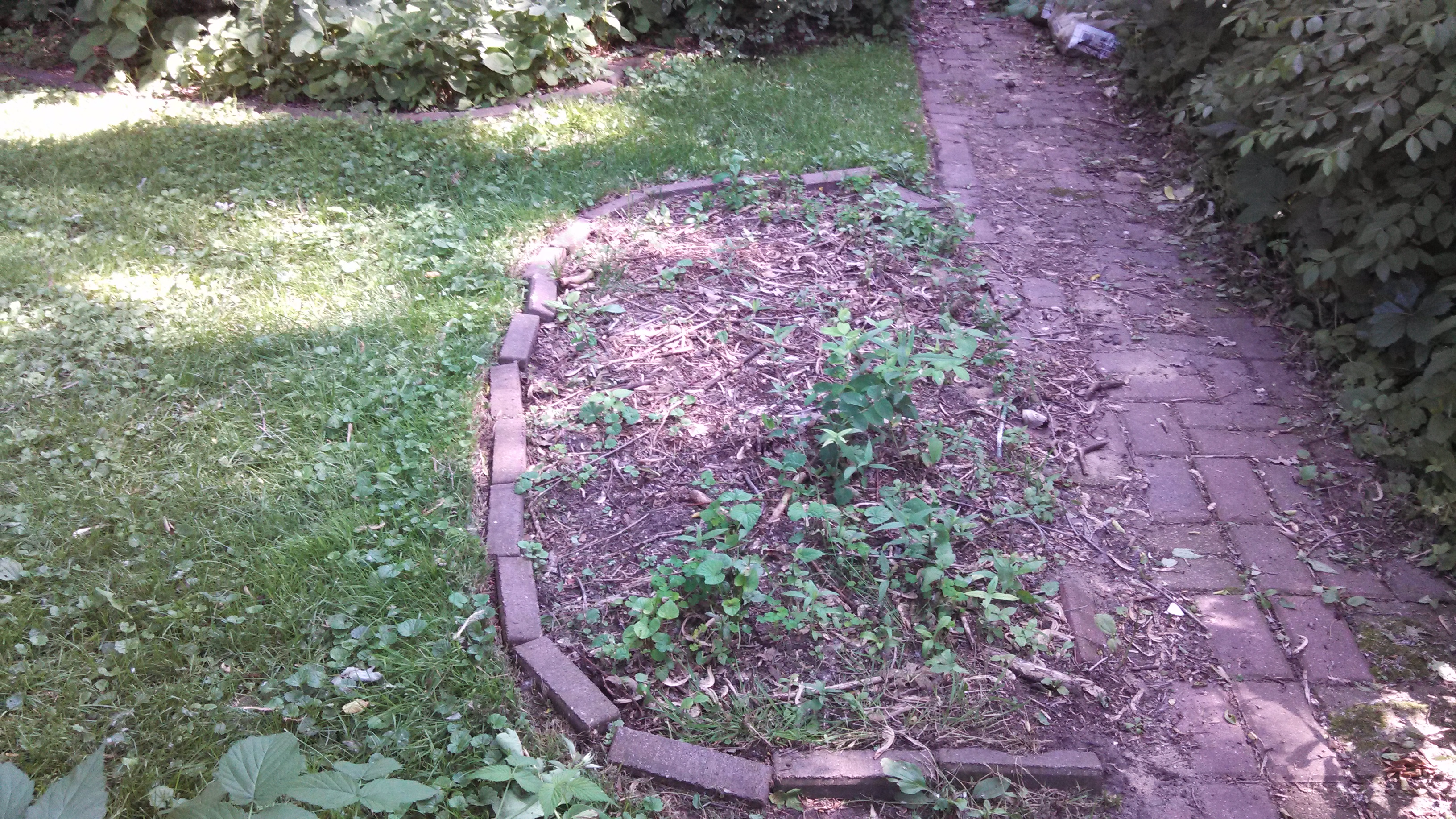
A year ago I wrote about how my woodland sunflowers (Helianthus strumosus) had pooped out on me. They had been the only plant growing in a little back garden bed along the path to the alley. What remained looked like this.
June, 2013: The bed formerly occupied by Woodland Sunflowers.
I was tired of woodland sunflower, so a new plant selection was called for. In addition to being under dappled shade, this bed can get dry in summer and wet in spring, so the replacement plants required careful consideration. Also I wanted this to be a low-growing bed, requiring no staking or pruning.
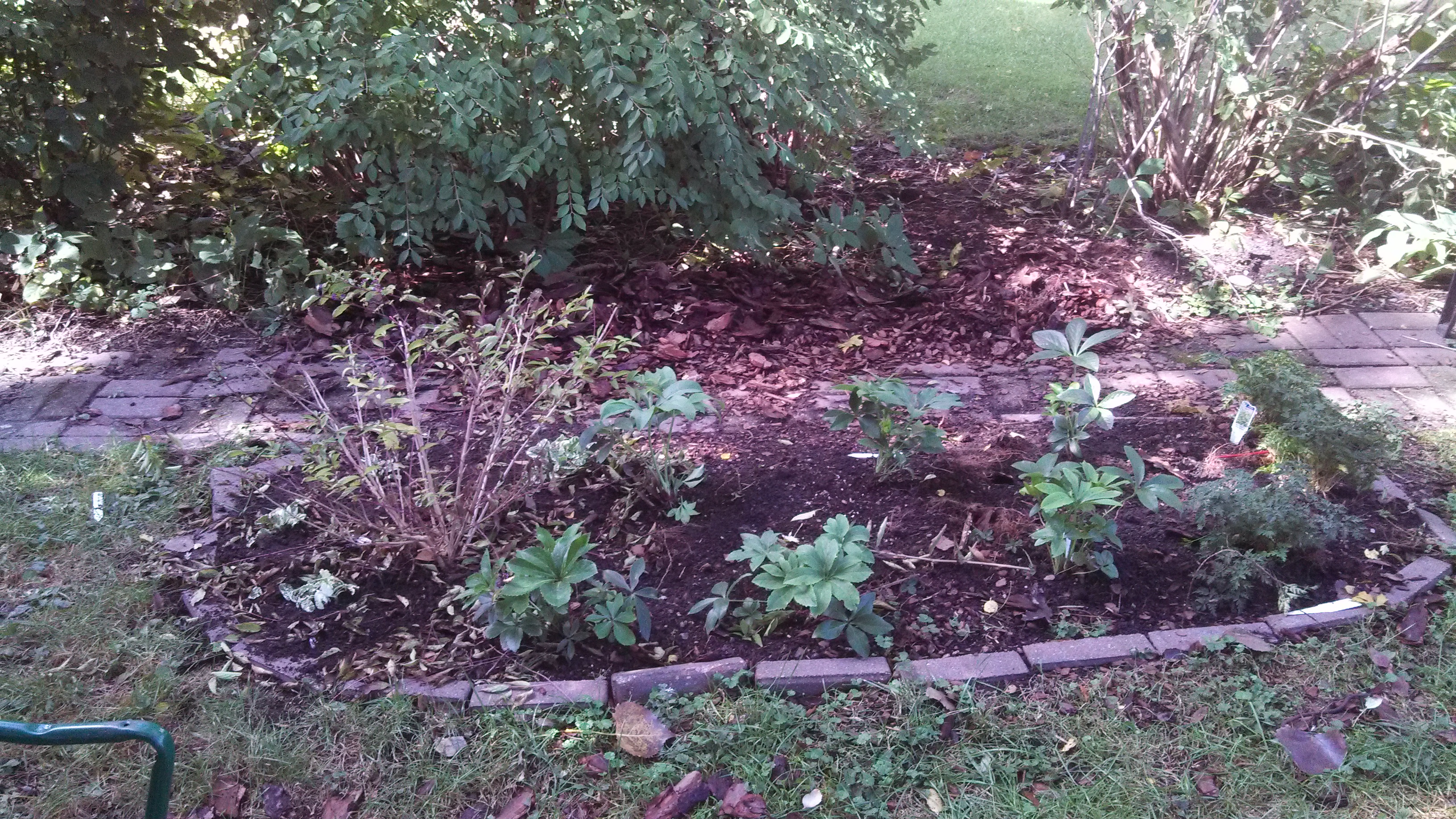
So last fall I ended up planting dwarf goatsbeard (Aruncus aethusifolius), lenten rose (Helleborus orientalis), a variegated bugleweed, and a dwarf beautyberry, Callicarpa dichotoma ‘Isai’. This is how the bed looked last October.
Newly planted bed formerly filled with Woodland Sunflower
Then came winter, a particularly long and hard winter. When we finally thawed out, I found that: 1) the goatsbeard came up looking refreshed and rested; 2) the lenten rose survived mostly, though one plant perished and another looked rather weak; 3) the bugleweed died; and 4) the dwarf beautyberry had been chewed to the ground by rabbits.
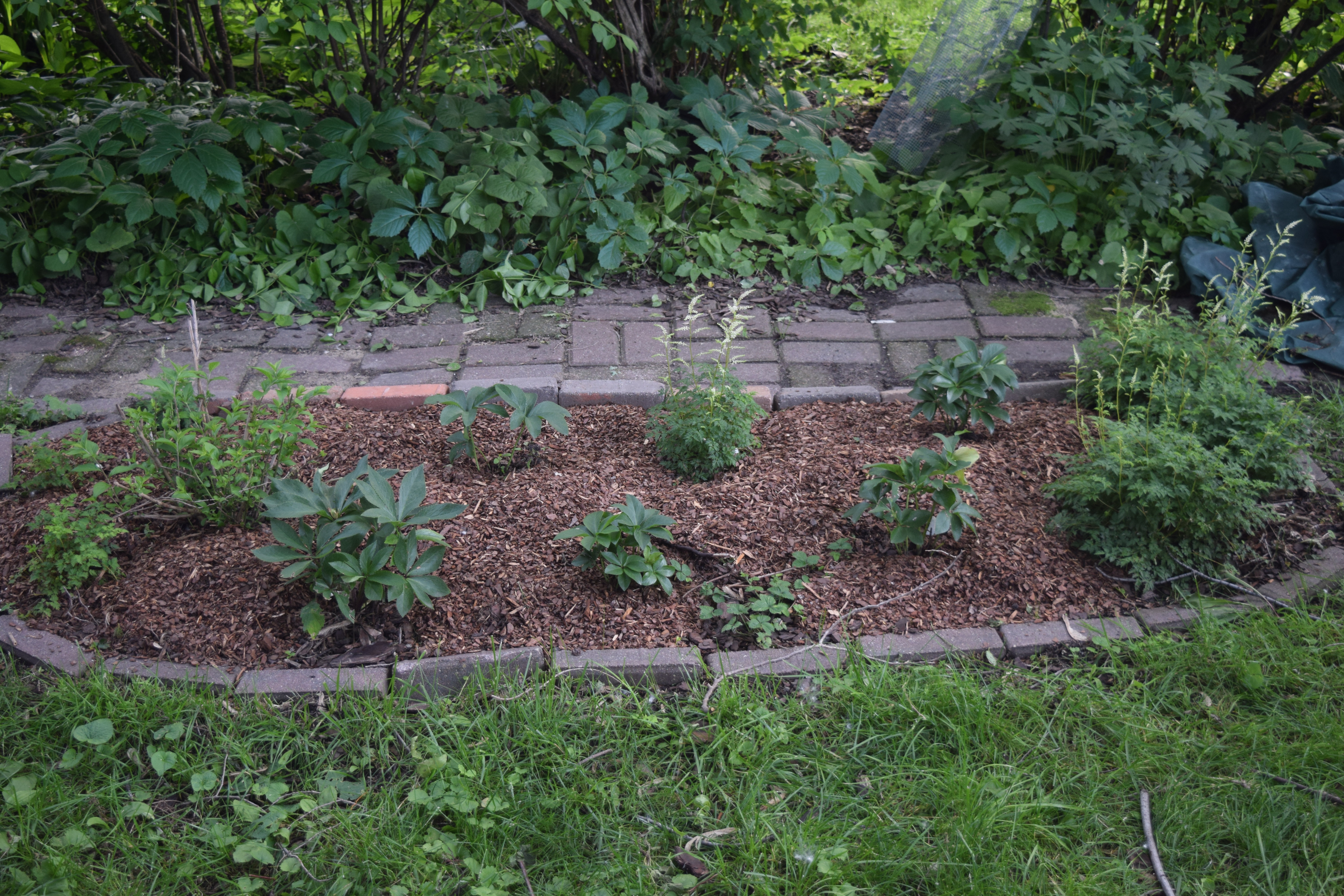
Now the bed looks like this.
Still a lot of filling in to be done. There is a little bit of mock strawberry in there that I decided not to pull out.
Fortunately the dwarf beautyberry has grown back. We’ll see if we get any purple berries this fall, but either way I’ll be sure to give it some winter protection from the evil rabbits. The bugleweed and deceased lenten rose I replaced with more of the dwarf goatsbeard.
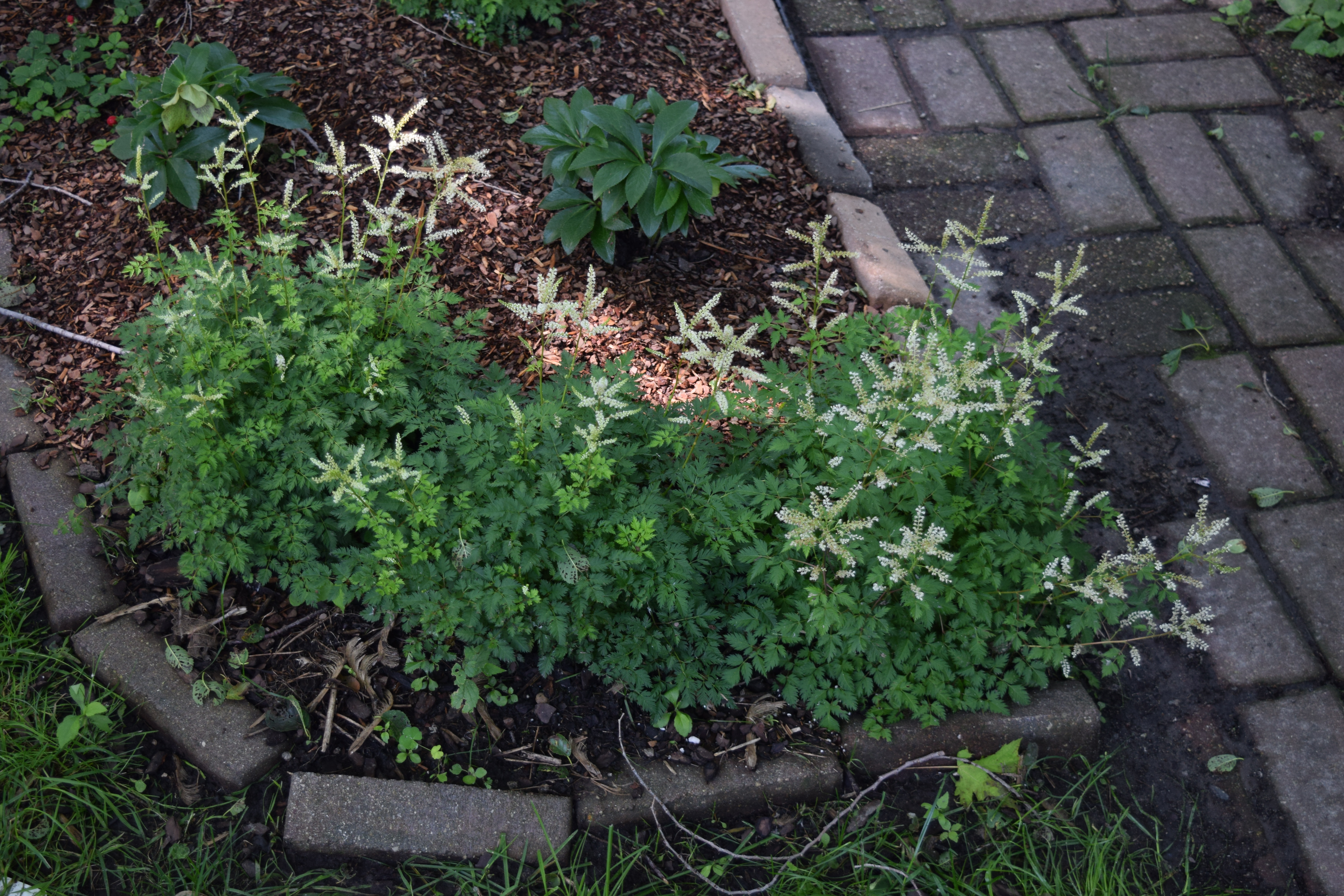
Dwarf Goatsbeard
These were all new plants for me, and overall I am moderately pleased. I do like the goatsbeard. The ones planted last fall have settled in nicely. The flowers are decent if not exciting, and the ferny foliage is very appealing.
I did have a scare when I read that the dwarf beautyberry is considered an invasive plant in some parts of the country. However, it doesn’t appear on the Chicago Botanic Garden list of invasive plants for this region, so I assume it’s OK.
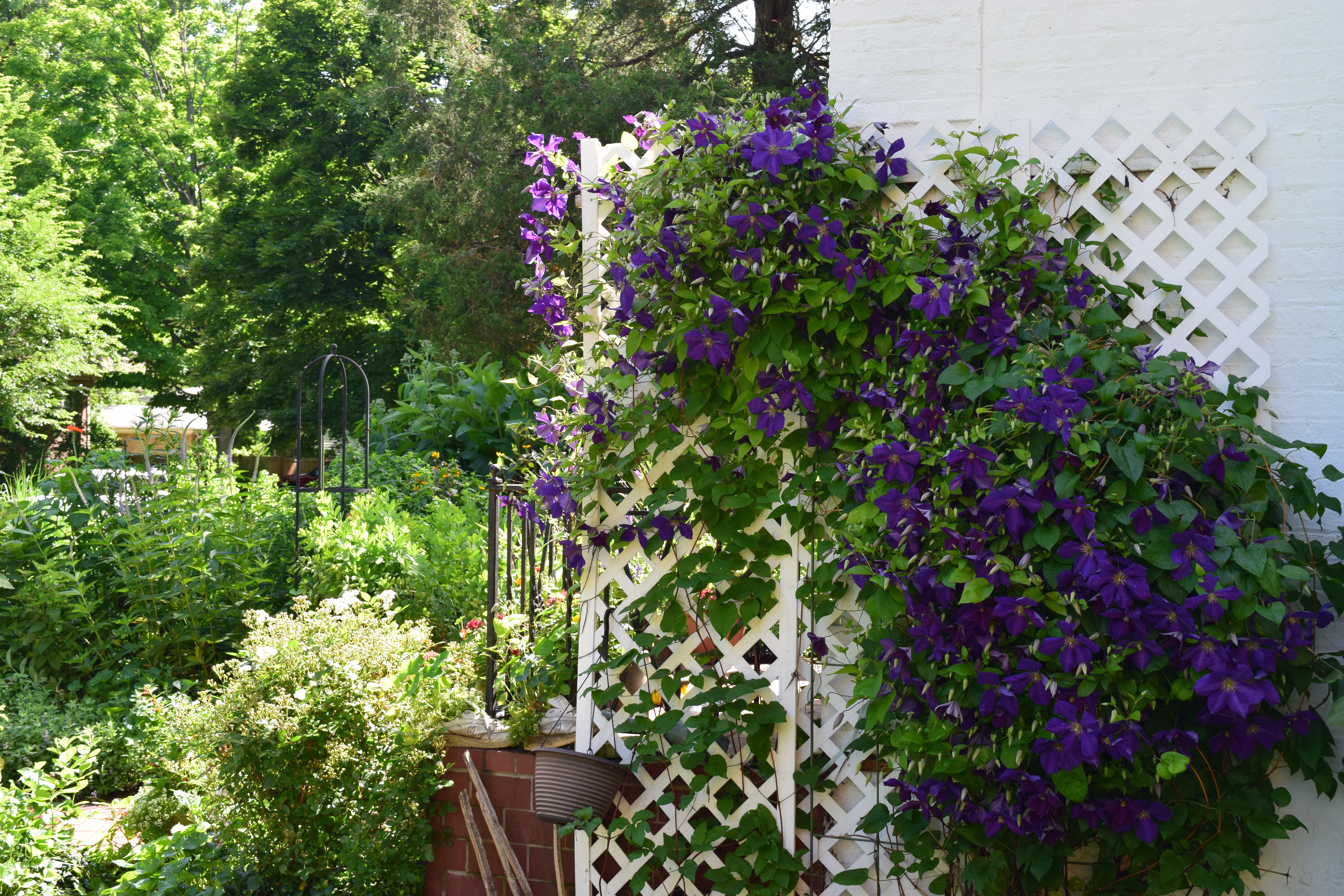
This is completely off topic but all this understated green and white makes me want to show off my Clematis jackmanii, which is doing very nicely this year.
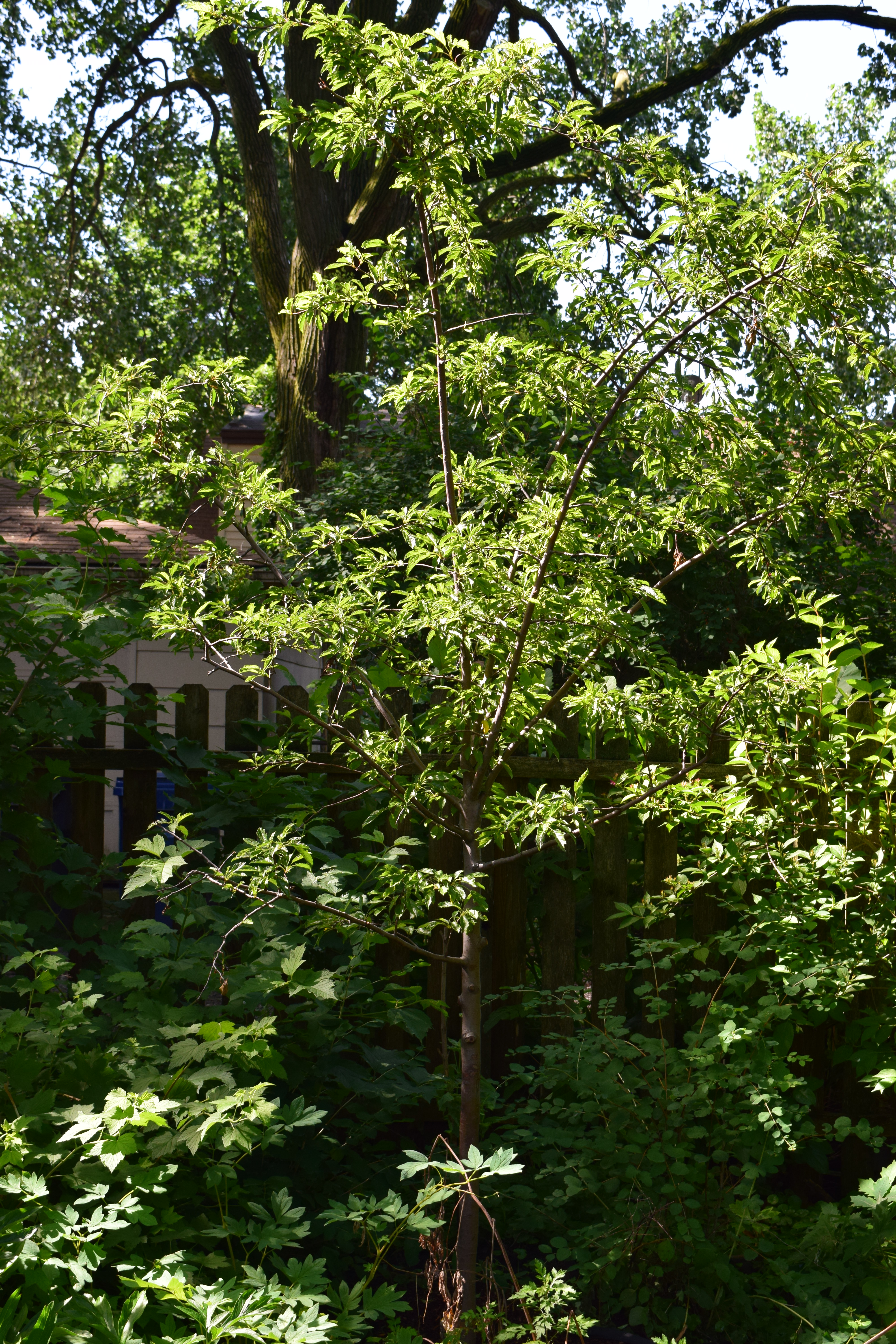
Last week I got a new crabapple tree for the space where the flowering dogwood (Cornus florida) had died. Usually I plant bareroot trees myself, but this time we shelled out for a tree from the nursery that was about 9′ and too heavy for me to plant on my own.
My new ‘Golden Raindrops’ crabapple.
In addition to being highly ornamental, crabapples are great trees for the birds. There’s the fruit, of course, but birds also eat buds and flowers, as well as the insects that are drawn to the flowers and other parts of the tree.
There are native crabs such as Iowa crabapple (Malus ioensis), but native plant advocate Doug Tallamy maintains that most hybrid crabs are so genetically similar to the natives that they are equally attractive to native insects. In his book Bringing Nature Home he found this to be an exception to the rule. (You may think being attractive to insects is a bad thing, but what would insect-eating birds do without insect-attracting trees?)
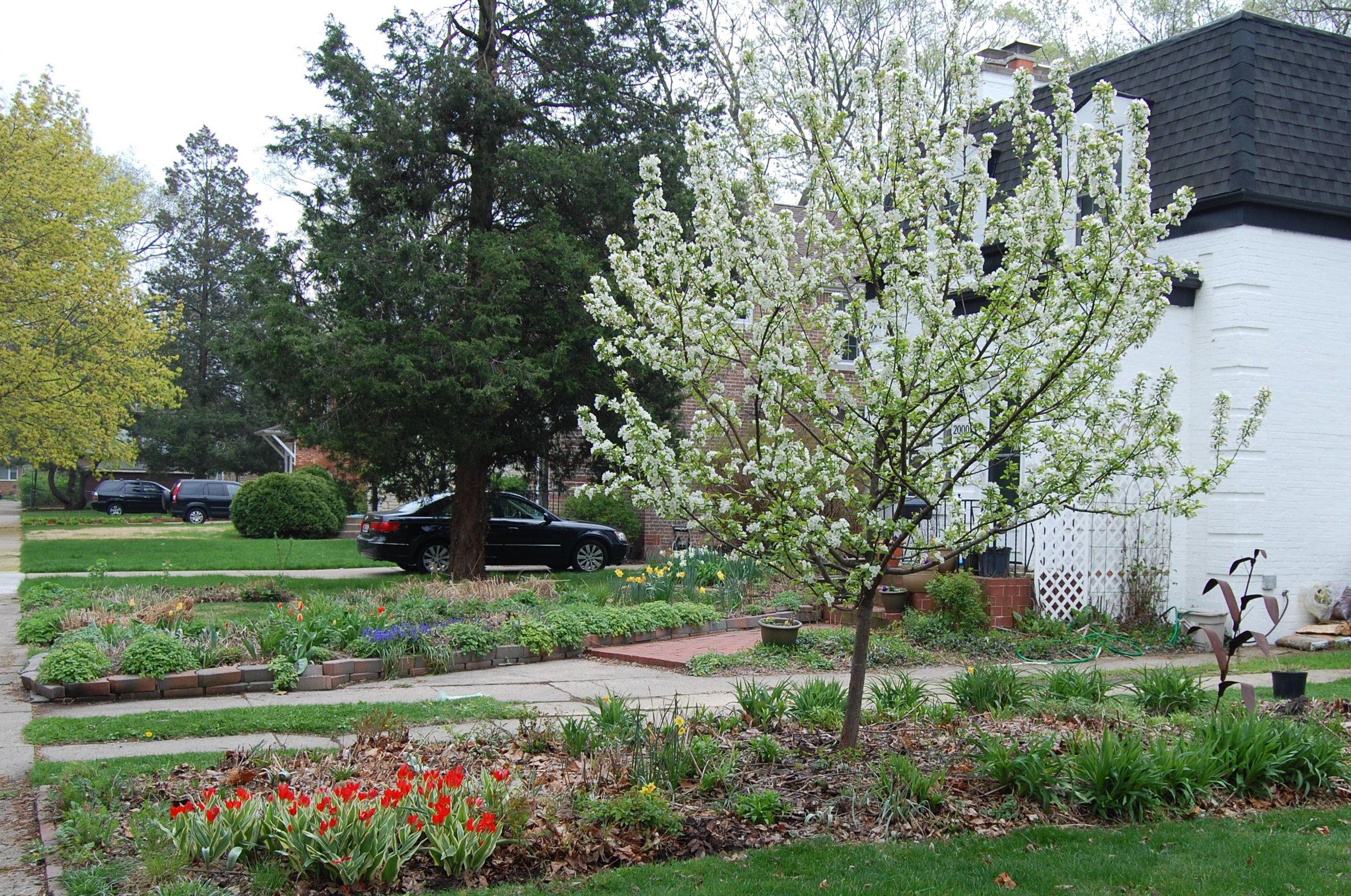
‘Donald Wyman’ crabapple blooming in our front garden.
Crabapples tend to be prone to diseases such as fire blight, scab and various rusts, so it is important to plant varieties that are disease resistant in your area. Trees planted in full sun and moist but well-drained soil will also be less susceptible to disease. Fortunately for Chicago area gardeners, the Chicago Botanic Garden has done extensive testing of crabapple varieties.
The variety I chose is called ‘Golden Raindrops’. This is a more compact, vase-shaped crab with white flowers and small yellow fruits (hence the name). It is disease resistant, pollution-tolerant, and adaptable regarding soil acidity. It is also supposed to be somewhat shade tolerant.
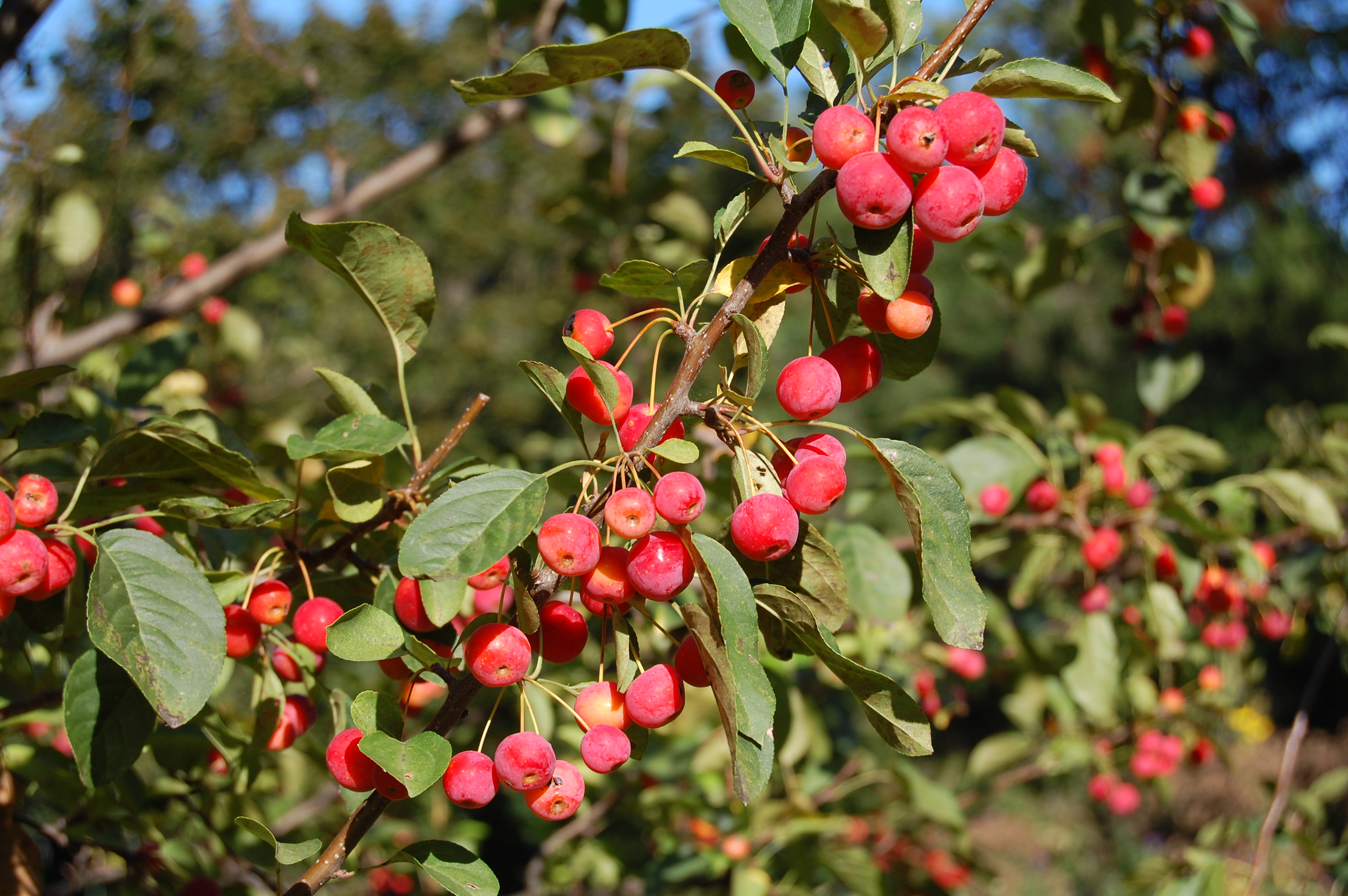
‘Donald Wyman’ fruits. Pretty, but birds like them smaller.
Small fruits tend to be most appealing to birds. I have a ‘Donald Wyman’ crabapple in the front, but I realized too late that the 1/2″ fruits are too large to attract many birds. Some do get eaten in late winter but I think mostly by starlings and larger birds. There is an ornamental plus side, though, as the fruits are persistent. But in general, “persistent fruit” translates to “less attractive to birds”.
Here are some other crabapples that are favored by birds:
Japanese flowering crabapple (Malus floribunda) Fragrant pink flowers.
Zumi crabapple (Malus x zumi ‘Calocarpa’). Large clusters of pink-white flowers.
Sargent crabapple (Malus sargentii). A small, shrubby crab with frangrant white flowers.
‘Red Jade’ Crabapple. A beautiful weeping crab with white flowers and orange-red fruit. Considered disease resistant by the Chicago Botanic Garden.
Of course, it’s not just the fruit that makes crabapples a good wildlife tree, so don’t feel too guilty if you want a crab with larger, persistent fruits.
Do you have a favorite crabapple?
***On an entirely different front, I’m pleased to announce that Nicole of My Garden Diaries has won the copy of David Culp’s The Layered Garden. Nicole, can you email me your mailing address? You can contact me through the “About” page.
For reasons we don’t need to go into here, I find myself in possession of two hard cover copies of David Culp’s The Layered Garden. I figured this was a good reason to do something I have never done before: a giveaway (of the extra book). Details at the end of this post.
The Layered Garden is a fun read. It is best understood as a tour of Culp’s spectacular 2 acre garden at Brandywine Cottage in Pennsylvania, This includes a loving consideration, organized by season, of the many genera that are the object of Culp’s obsessions: snowdrops, hellebores, peonies, alliums, lilies, etc. (Culp is an accomplished breeder of some of these.)
Culp also discusses his guiding garden design principles, but for me that would be a secondary reason for reading this book. Not that those principles are not highly valuable, but they can be found elsewhere. Not so for the vicarious walk through the grounds of Brandywine Cottage.
By “layered garden”, Culp means multi-dimensional in all possible ways: “… to get the most interest from any garden, all the layers need to be considered, from the ground level to the middle level of shrubs and small trees up to the canopy trees.” The seasons also comprise layers of a kind, as do different sections of the garden, so that intensity of interest shifts from bed to bed as the months go by (including the winter months).
Like Christopher Lloyd and other admirable garden writers, Culp disdains rules and believes gardening should be an expression of the gardeners’ passion and a means of having fun. This comes across strongly as Culp shows us around his garden, which given its size and topography provides a mix of opportunities most urban or suburban gardeners could only dream of: steep and flat, shade and sun, moist and dry.
I especially loved the description of his “Ruin Garden”, which is built on the foundation of an old stone barn: “… the most exciting feature of this space … is how the vertical walls are covered with plants. I started planting in existing crevices where the mortar had dislodged … I began deliberately loosening other stones (like a child jiggling a loose tooth) until they fell out.”
He makes ample use of troughs as containers in the Ruin Garden: “I started out with two troughs, but over the years I have learned that one or two of anything looks timid and tentative. I now have twenty-seven …” A gardener after my own heart!
David Culp
So if you would like a copy of The Layered Garden of your very own, just write a comment no later than Monday, June 30th, at 7 PM CST, answering the question: what is your all-time favorite garden book? A winner will be picked at random. If you want to comment but are not interested in receiving the book, just make a note of that in your comment.
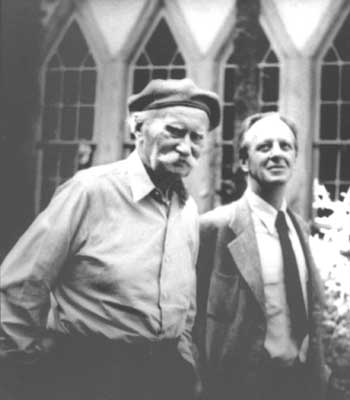
Jens Jensen: the Living Green is a documentary about an unjustly obscure figure who contributed greatly to conservation and garden design, especially in the Chicago area. His legacy includes naturalistic city parks in Chicago and elsewhere, as well as preserved natural lands.
Jens Jensen. Source: Jensjensen.org.
The Danish-born Jensen (1860-1951) arrived in Chicago in 1884, and got a job with the Park District as a street sweeper. Eventually he became Parks Superintendent. He was passionate about the beauty of the American prairie, which was disappearing at the time.
Jensen was one of the first to believe that parks should use native plants and reflect the surrounding natural landscape. He had strong feelings also about parks as means for improving the lives of poor and working class people. He put his ideas into practice in Chicago, creating Douglas, Garfield, and Columbus Parks among others.
Columbus Park waterfall. Source: Jensjensen.org
He was that rare thing, a hard headed idealist. Jensen refused to cooperate with politicians who wanted to use the parks for patronage and for enriching politically connected businessmen. He had to leave public service twice as a result. Despite this, he never gave up an almost mystical belief in a connection between democracy and the prairie landscapes.
In addition to parks, Jensen was a leader in the partly successful effort to save the Indiana Dunes. Though one of the most biodiverse areas of the country, the Indiana legislature designated the Dunes a “wasteland” and turned most of it over to the steel industry. Ultimately a portion was saved as state and federal parks.
Columbus Park “swimming hole”, 1935. Source: Jensjensenthelivinggreen.org
The creation of the Cook County Forest Preserves, the first forest preserve system in the US, also owes a great deal to Jensen. Currently the preserves include 68,000 acres and some of the highest quality natural areas in the state, located in a densely urban county.
Jensen also spent years as a successful private designer, creating gardens for some of the wealthiest Americans including Henry Ford (who he at first rejected as a client).
Jens Jensen and Alfred Caldwell. Source: Jensjensen.org
Jens Jensen: the Living Green is not a masterpiece of documentary film making, but it is most certainly worth seeing. I especially enjoyed film footage of an interview with Alfred Caldwell, a prominent Chicago landscape architect who was a friend and protege of Jensen’s. Click the link for more information, including how to arrange a screening.
You can also find out more about Jensen by visiting the Jens Jensen Legacy Project. There are some books out there as well, but I haven’t read any of them yet.
Jensen’s story is an inspiring one in these cynical days.
Seeds, berries, and foliage sounds like some kind of trail mix, although it would have to be called seeds-berries-n-foliage because apparently the word “and” is bad branding, as you never see it in the names of consumer products. Commas also seem to depress market demand.
But this post is not about consumer products, it is about some of the things you can see in my garden during the relative lull of late June. While there are some blooms right now, many flowering stars of spring and summer are more notable for their leaves, fruits, and seedheads. Foliage plants are also more noticeable.
Bishop’s Weed
For example, there is bishop’s weed (Aegopodium podagraria). Now I know this is considered a terribly invasive pest, but in my garden I have found the variegated form to be quite manageable. I am careful to nip off any flower heads to prevent seed production, and there have been no bishops pillaging adjacent flower beds. I also destroy any non-variegated leaves that emerge. (The common name makes you wonder about the reputation of bishops in olden times.)
In fact, I was worried that the bishop’s weed would overrun the nearby great merrybells (Uvularia grandiflora), but the merrybells seem to be more than holding their own. The bishop’s weed in my garden is inherited – I wouldn’t plant any myself, but I haven’t felt the need to do away with it.
Jacobs Ladder seed capsules.
Jacob’s ladder (Polemonium reptans) foliage persist through the season, and the seed capsules are quite attractive. Though this is a North American native, another common name is Greek valerian, isn’t that odd?
Solomon’s Plume with containers for summer shade.
Solomon’s Plume (Smilacina racemosa) is another native for shady spots. Right now it has tiny green berries that will later turn red. A problem I have had with this plant is that it tends to flop when the berries ripen. Some of these are leaning on containers planted with Caladiums and New Guinea impatiens (Impatiens hawkeri).
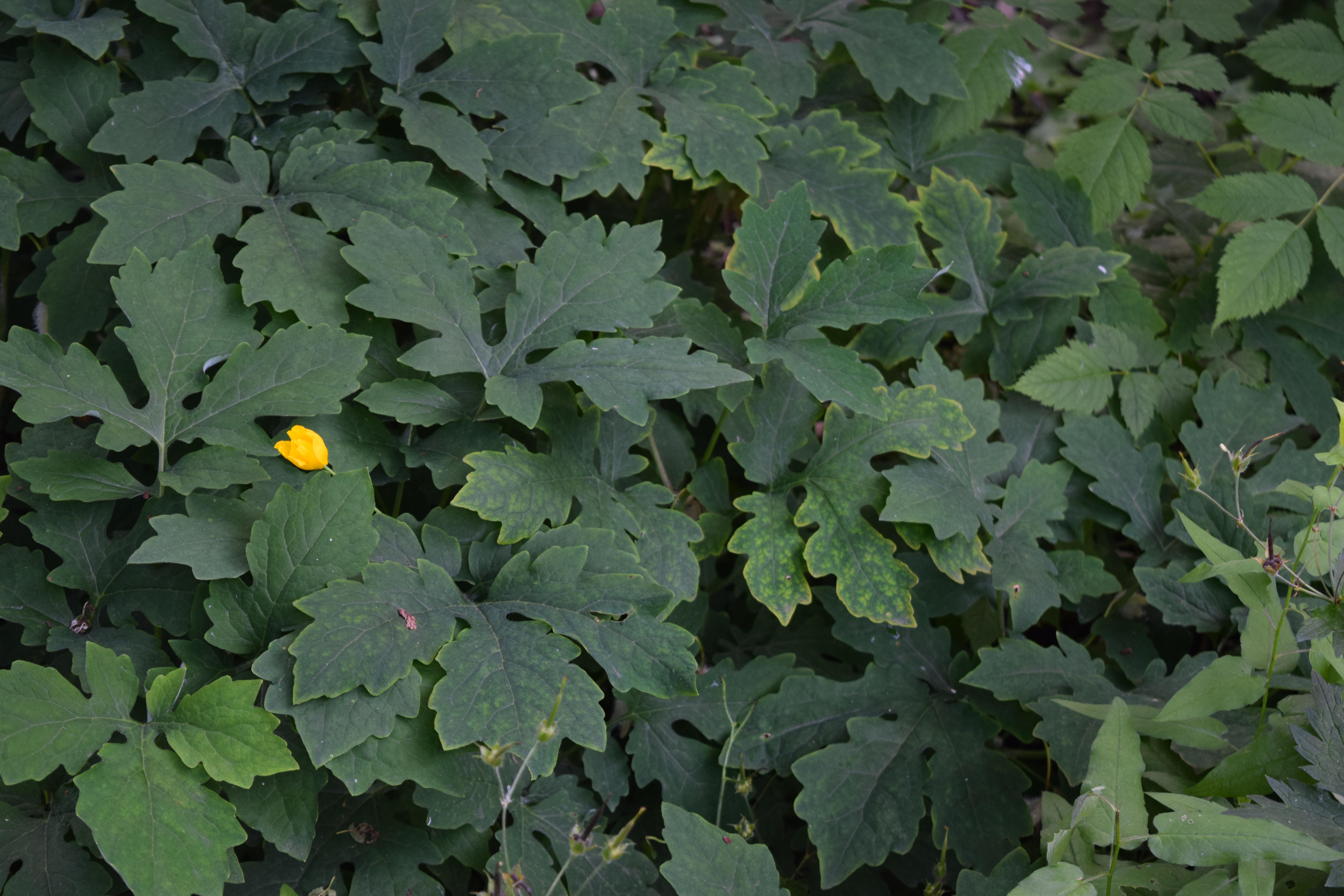
Celandine Poppy
Here and there a lone yellow flower will pop out among the celandine poppies (Stylophorum diphyllum), but really they have been done for a while. The foliage is gradually fading, but still has an appealing look to it.
Allium ‘Purple Sensation’ seed head. Or exploding UGO.
The seed heads of Allium aflatunense ‘Purple Sensation’ remain decorative in an odd way. To me they suggest an Unidentified Green Object (UGO) exploding somewhere in outer space.
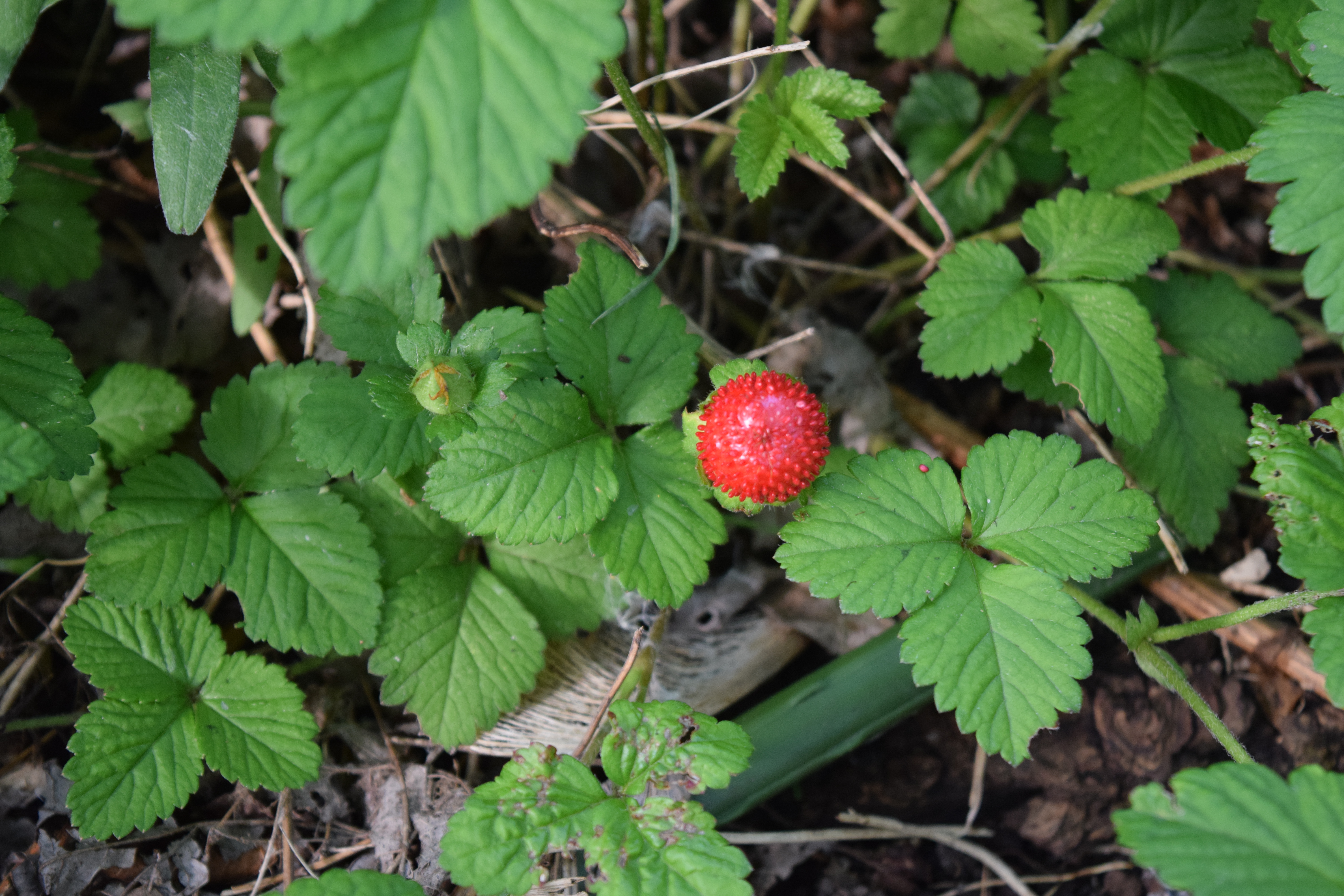
Unknown wild strawberry.
When we moved here there were patches of this wild strawberry, which I decided to treat as a ground cover. This is not the native North American wild strawberry, Fragaria virginiana, which I use extensively, also as a ground cover. I’ve thought that maybe it was barren strawberry (Waldsteinia fragarioides) – the flowers are yellow, but clearly it is not barren. Anybody have an idea?
Starry Solomon’s Seal
Starry Solomon plume’s (Smilacina stellata) berries are my favorite, at least among herbaceous plants. The stripes are so cool! Birds like them, too. The foliage is also appealing.
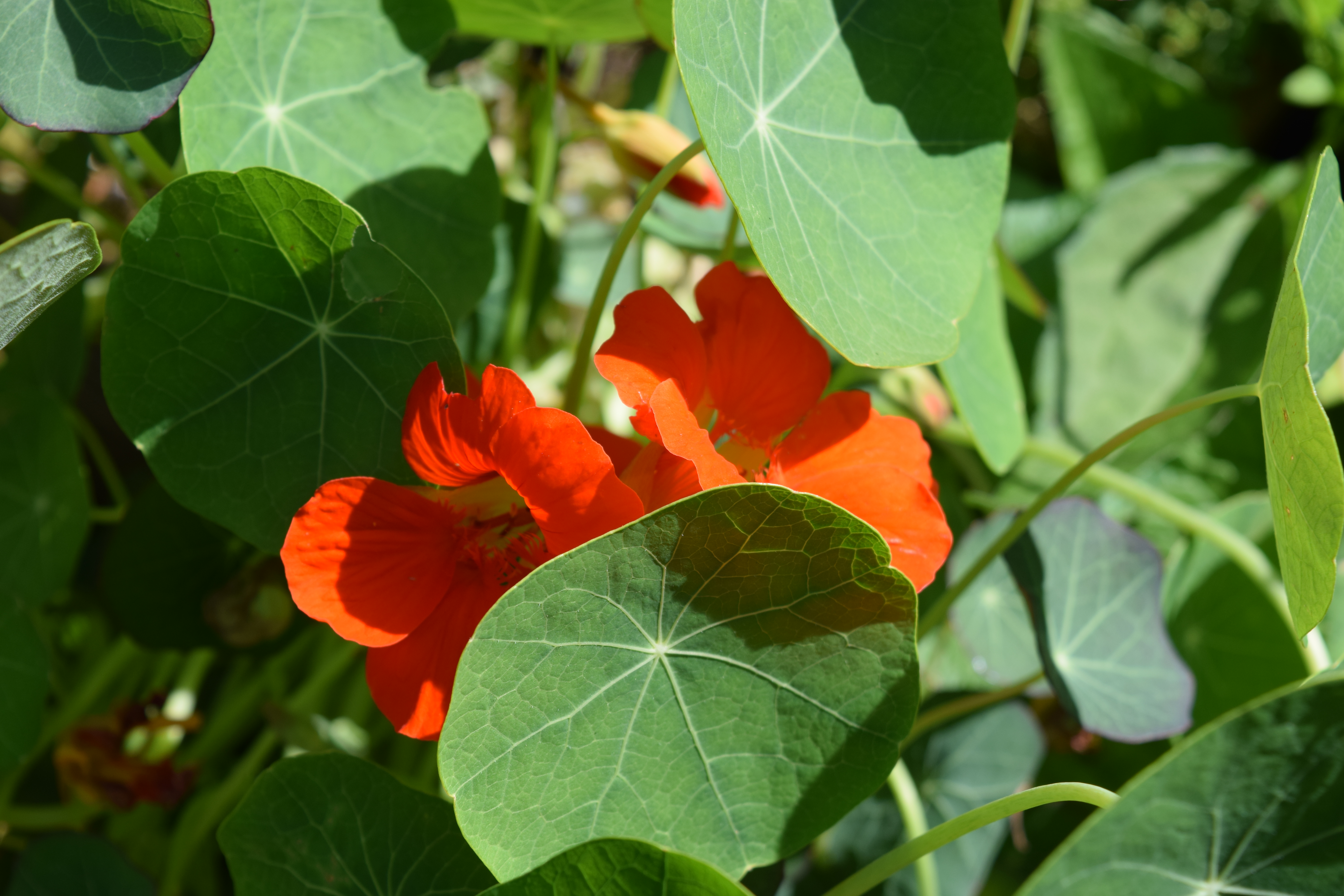
Nasturtium
I’m growing nasturtiums (Tropaeolum majus) in my sunny containers for the first time in a long while. In the past I’ve had trouble getting them to bloom. But even if they don’t bloom, I really like the unique round foliage – and I also like the way they spill over the edge. Here’s our botanical word for today: peltate, which is when a leaf is roundish with the stem attached from beneath, as with nasturtiums. Comes from the Latin word for a small shield.
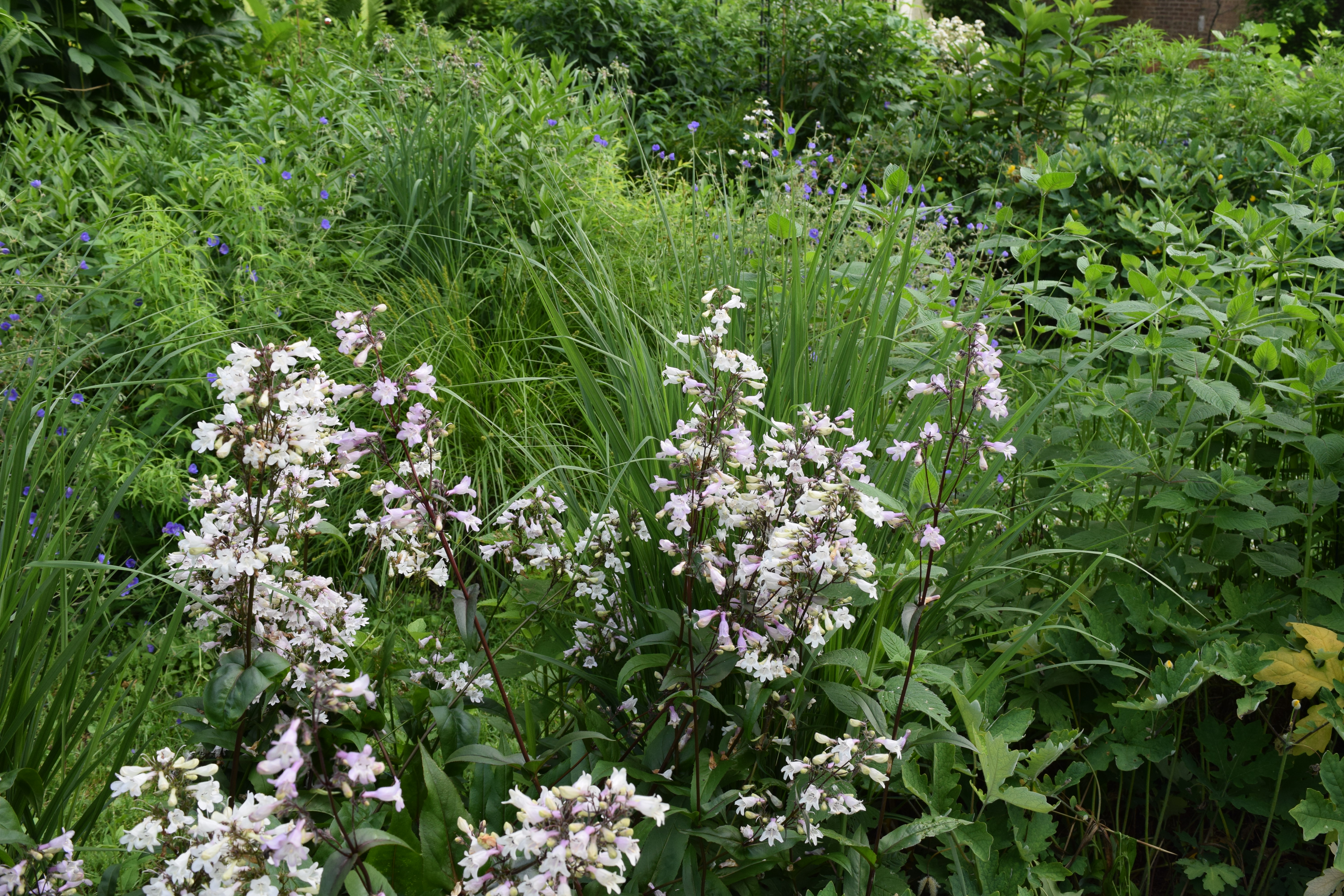
Penstemon ‘Husker Red’, a bit tilted after all the heavy rain we’ve had, in front of Switchgrass ‘Northwind’.
‘Husker Red’ up close.
And finally, this is a little off topic but I just have to say that my Penstemon digitalis ‘Husker Red’ is really peaking right now. Actually, it’s not completely off topic because the red stems and reddish leaves are really nice.
There are more interesting foliage plants to show, but Judy stopped taking pictures because she was tired of serving as a moveable feast for the mosquitos. We’ll get to some of them in future posts.
I am tardily linking this with Christina at My Hesperides Garden, who hosts the meme Garden Bloggers Foliage Day. Check out the link to see more great foliage.
What’s your favorite foliage, fruit, or seedhead at the moment?
This has been a good year for Ohio spiderwort (Tradescantia ohioensis) in my garden. I can’t remember it blooming so profusely before.
Ohio spiderwort in the front island bed.
Ohio spiderwort is not nearly as common in gardens as Virginia spiderwort (Tradescantia virginiana). There are lots of cultivars of Virginia spiderwort, but none that I know of for Ohio spiderwort. I’m guessing there are two reasons: Virginia spiderwort is more compact and can be bred for a more diverse range of colors.
But Ohio spiderwort has many virtues. First is the deep blue color, set off by striking gold anthers. If a flower is a good blue, why would you go messing around trying to come up with other colors?
Ohio spiderwort close up
It’s got a fairly long bloom period in late spring and early summer, and it’s a good plant for bees and butterflies. What’s more, it makes clumps and doesn’t run like Virginia spiderwort. It’s fairly adaptable, taking sun or part shade and preferring moist but tolerating dry soils.
Ohio spiderwort isn’t perfect, of course. Some people think the tall, grassy stems (from 2-4′) can be rather awkward. Actually, I am really pleased this year that most of my spiderwort is standing up without staking. Instead it is leaning a bit on surrounding plants, especially the swamp milkweed (Asclepisa incarnata) and the Monarda didyma ‘Claire Grace’. This is the kind of thing that is supposed to happen in gardens but almost never does in mine.
Ohio spiderwort in the parkway planting. Can you see the bumblebee coming in for a landing near the center of the photo?
Plus, the flowers are only open from morning to early afternoon. It dies back in summer, but if you cut it to the ground you will get new growth and possibly more blooms in fall. I’m not going to do this with most of my spiderwort, though, as it is surrounded by plants that will get quite tall and bloom by mid-summer, obscuring the Tradescantia.
Then there’s that name: spiderwort, which sounds like it has something to do with warts on spiders. But, as I have mentioned before, wort is just a Middle English word for plant. Apparently another common name is widow’s tears, but I don’t think that really helps from a branding point of view.
Ohio spiderwort is a good fit for an informal sort of garden, and one where space isn’t at too much of a premium.
Clematis ‘Ice Blue’
Another blue flower making me happy right now is Clematis ‘Ice Blue’, which is growing on the back arbor where I used to have my ‘Westerland’ rose. These blooms are an unexpected bonus, as I only planted ‘Ice Blue’ last fall. I thought I wouldn’t see any flowers until next year. ‘Ice Blue’ only grew about 3′ this year, and has had exactly three flower buds.
Last night Judy and I went to a lecture given by the noted author, plantsman and garden designer Piet Oudolf. The talk was sponsored by the Lurie Garden, which is appropriate because the Lurie was Oudolf’s first commission in North America.
Piet Oudolf speaking at the Chicago Cultural Center on Thusday night.
The presentation was an overview of his career starting with the creation of his nursery in Hummelo, the Netherlands. It included slides of Lurie, the High Line in NYC, and other public and private gardens he has worked on. I really can’t summarize what was said, but here are a few things I took away from the experience.
Oudolf’s designs are inspired by nature and its outer forms (eg, types and shapes of plants), but do not seek to replicate a particular natural environment as it existed prior to human intervention.
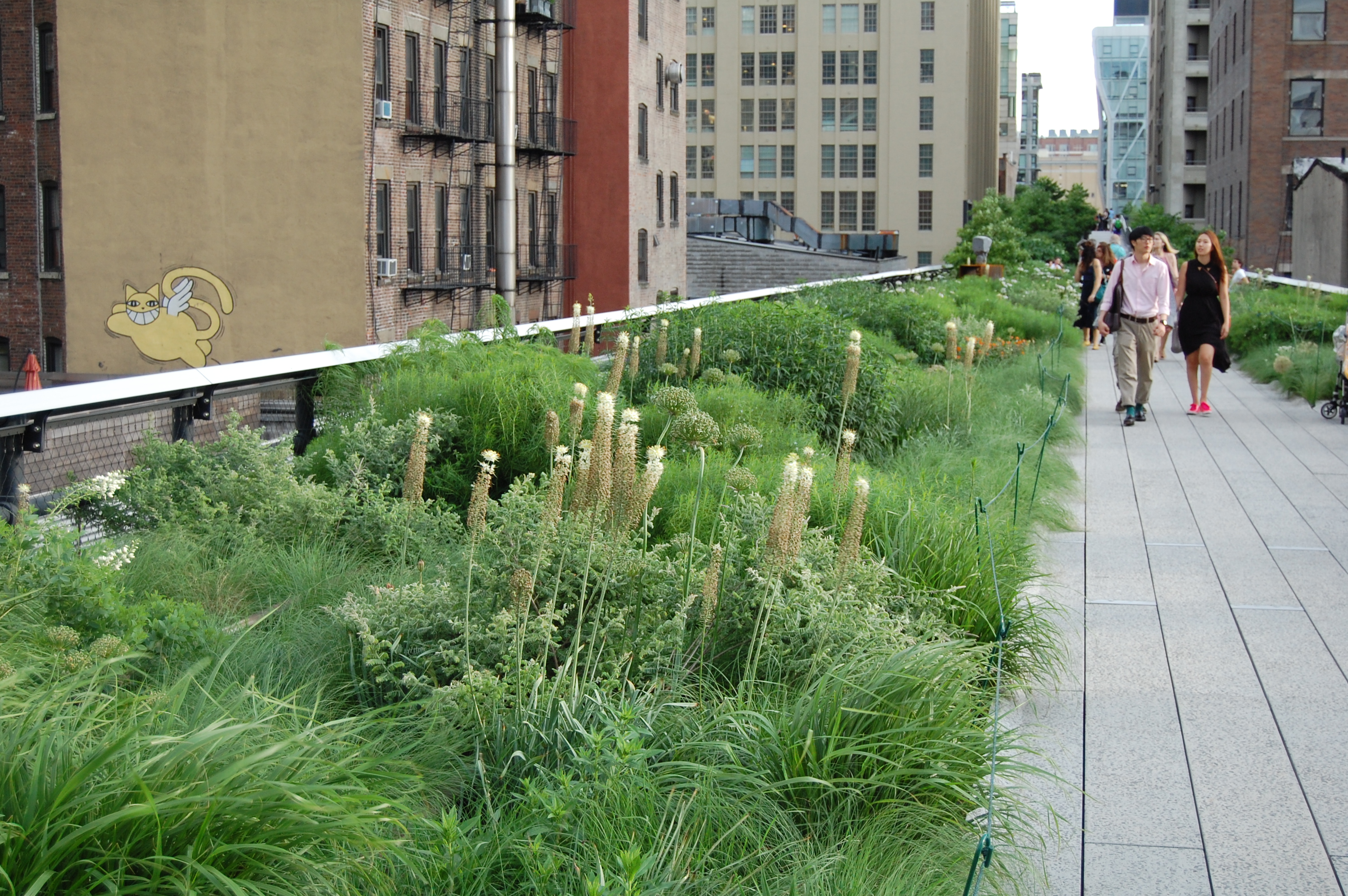
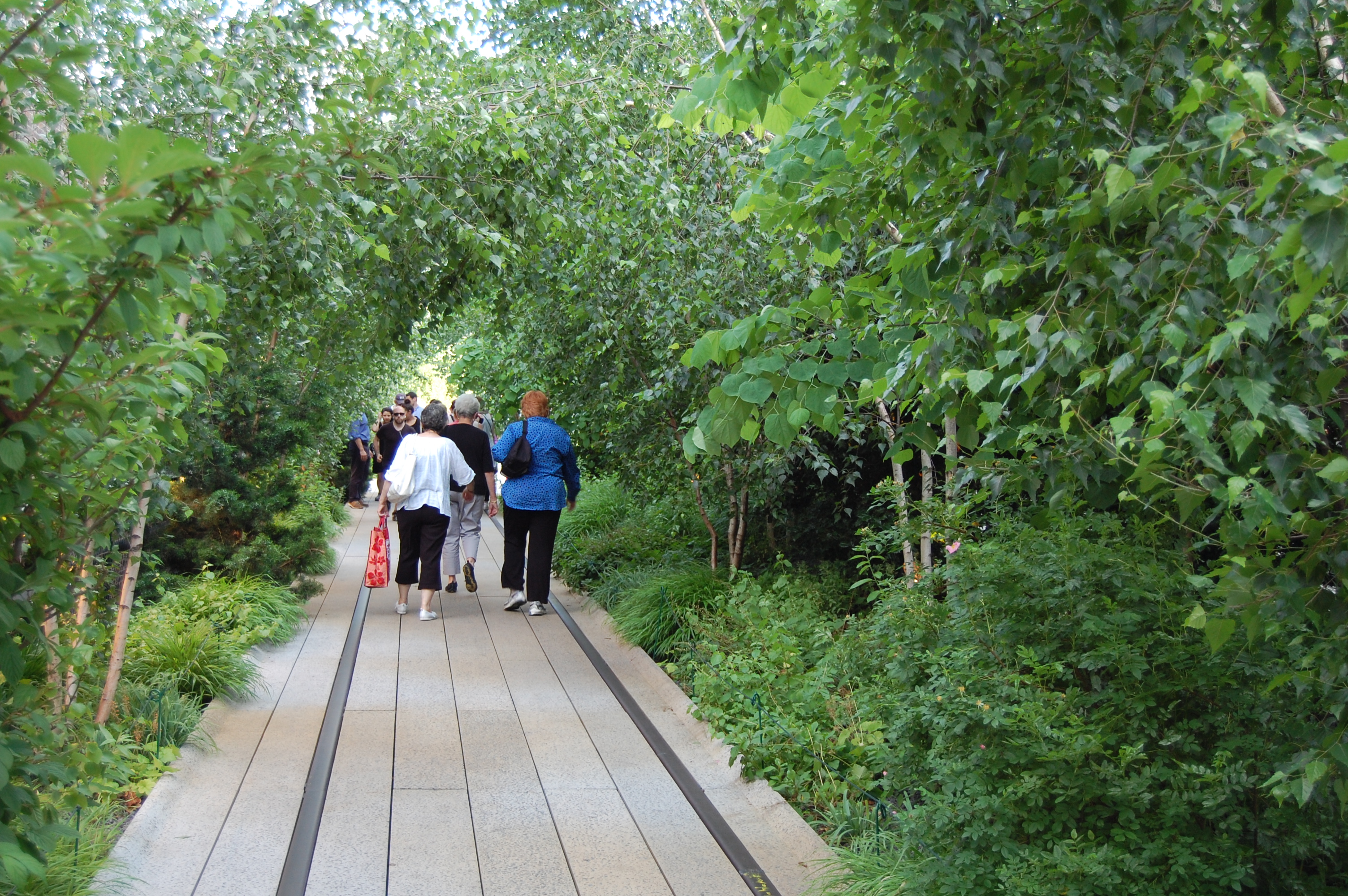
The High Line in New York City is one of the gardens Piet Oudolf helped design.
He believes in “skills, not rules”. In his career, the foremost skill has been the ability to work with plants to create a desired effect. This entails a knowledge of how those plants will behave over time in a variety of environments. This is a highly complex topic requiring years of experience and never fully learned.
Starting early in his career, Oudolf wanted to get beyond the traditional English garden. He had several reasons: a desire for gardens with less control, for giving more attention to garden ecology and less to gardens as “decoration”, etc. Primarily, though, he wanted to do something creative that “came from the inside”, and for him “plants are a medium of self-expression.”
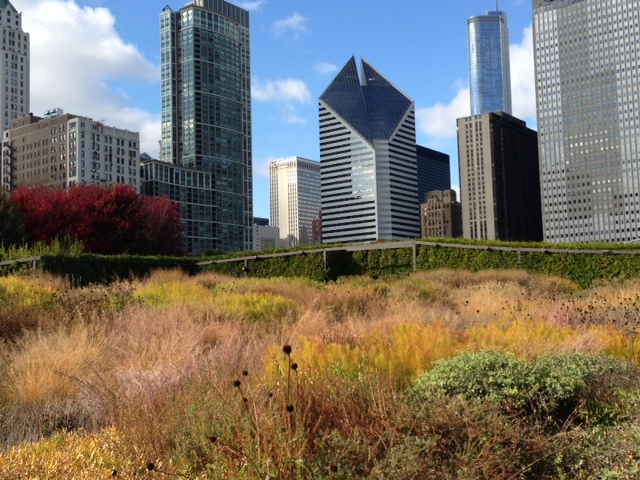
Lurie Garden in late October. Oudolf sees the beauty of plants in all seasons.
Oudolf gave an interesting account of working on the High Line in New York City. As with the Lurie Garden, he was brought in to collaborate with other designers and architects. His role was to develop the plant palette and fit those plants together. The architects provided him with a narrative for each section of the High Line, and that enabled him to choose which plants were right.
Maintenance and properly trained staff are critically important for public gardens. This includes being able to assess the performance of plants and decide which species should be removed or introduced. He mentioned, for example, that Rattlesnake Master (Eryngium yuccifolium) and Compass Plant (Silphium laciniatum) needed to be removed from Lurie because they were just too aggressive, even though they were wonderful plants.
The High Line again. Oudolf relied on a narrative from the architects to pick the plant combinations for each section.
The cost of maintenance reinforces a more informal approach. Instead of staking a leaning plant, we develop an appreciation of the “elegance” of its relaxed lines. This is one point on which I take issue with Oudolf – leaning plants may be elegant in a big setting like Lurie, but in my home garden I believe in staking.
After the lecture we had dinner and went to a premier showing of a new documentary about the landscape designer Jens Jensen, who pioneered prairie-style landscapes in parks and gardens. That, however, will be covered in another post.
When we bought Judy’s last camera, about eight years ago, we were amazed by what it could do. It was a Nikon D40, her first digital SLR camera.
The last pink peony in our garden, and one of the first pictures Judy took with the new camera.
We both tend to believe that any object that represents a major purchase should be kept until it is used up or no longer working (this explains why we had a black and white television until the 1990s). But when we needed to replace the D40’s battery, we found that Nikon no longer made batteries for it. We tried buying a battery on Amazon, but that turned out to be counterfeit.
So we decided it was time for a new camera. We were nudged along in this decision by Judy’s awareness that there had been major advances in digital camera technology. With help from a friend, she researched possible replacements, and settled on the Nikon D5300 (which, I figure, must be 132.5 times better than the D40).
‘Cassie’ – see the cottonwood fluff on the right? This rose, just by our front steps, has been blooming like crazy this year.
We found a camera store at a nearby mall, figuring it would have knowledgeable sales people. Judy asked the salesman, who was not a youth, to explain the differences between the D5300 and the D40.
“It has much more sophisticated focusing and exposure,” he said.
“OK,” said Judy, “in what ways?”
“Well … it takes better pictures.”
He then fled before Judy could ask more questions. Despite the modest expertise of the salesman, we took the plunge and bought the camera.
Judy has been playing with it since then. In our yard she took pictures of our shrub rose ‘Cassie’ and our last pink peony. The focusing and exposure was in fact much improved. This is important because Judy’s schedule means she often has to take her garden pictures when the light isn’t very good. The picture of ‘Cassie’ above has far more detail than the old camera would have captured in similar light. On the right side of the photo you can see fluff from the nearby cottonwood tree.
Compass Plant with Chicago skyline.
On Monday we met at Lurie Garden after work. This was a good place to practice with the new camera, though unfortunately it became overcast shortly after we got there. Judy wants me to mention that she has not yet mastered using this new model.
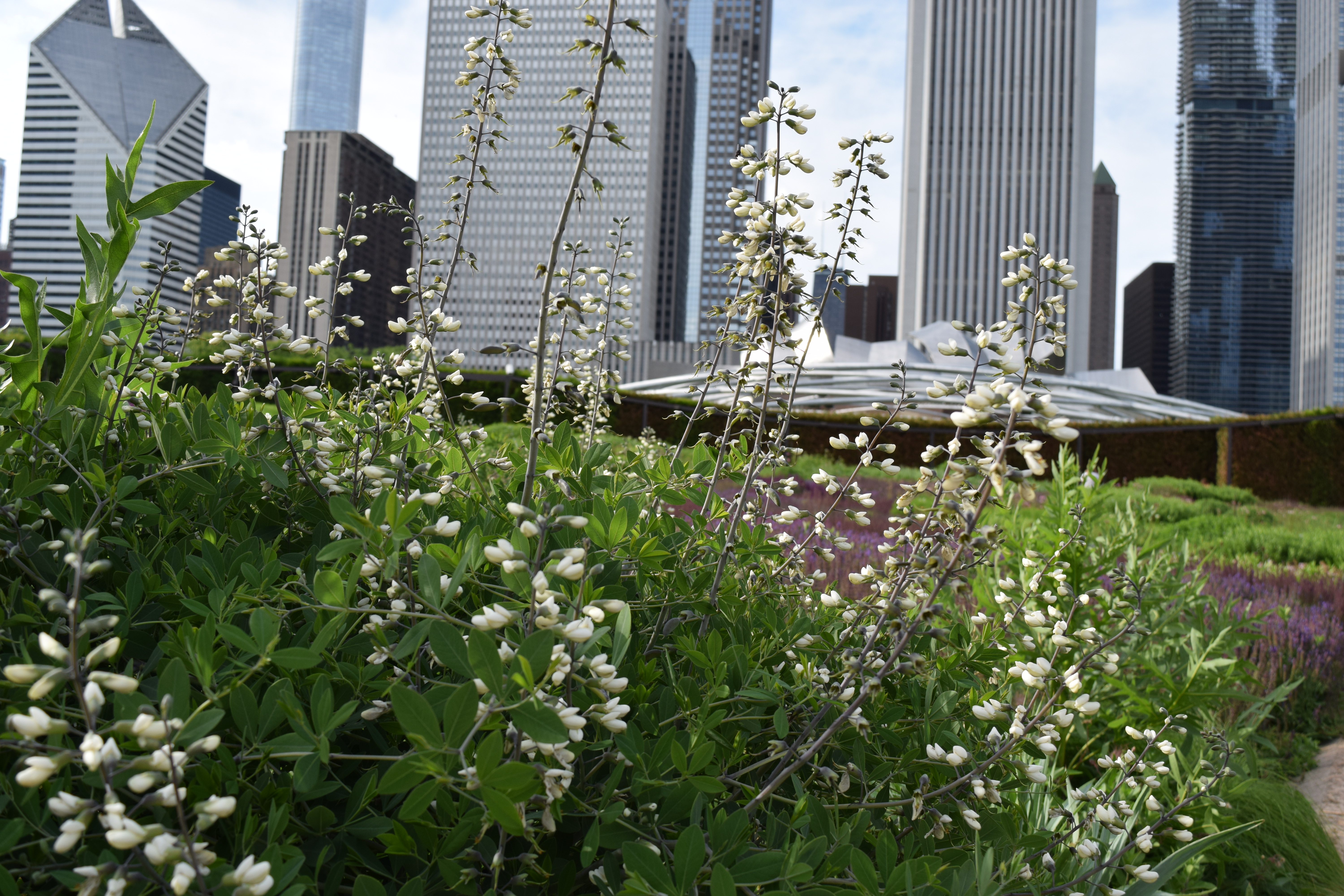
White wild indigo and the Chicago skyline.
The white wild indigo (Baptisia alba) was in full bloom at Lurie. The flowering stalks seemed to imitate the tall office buildings in the background.
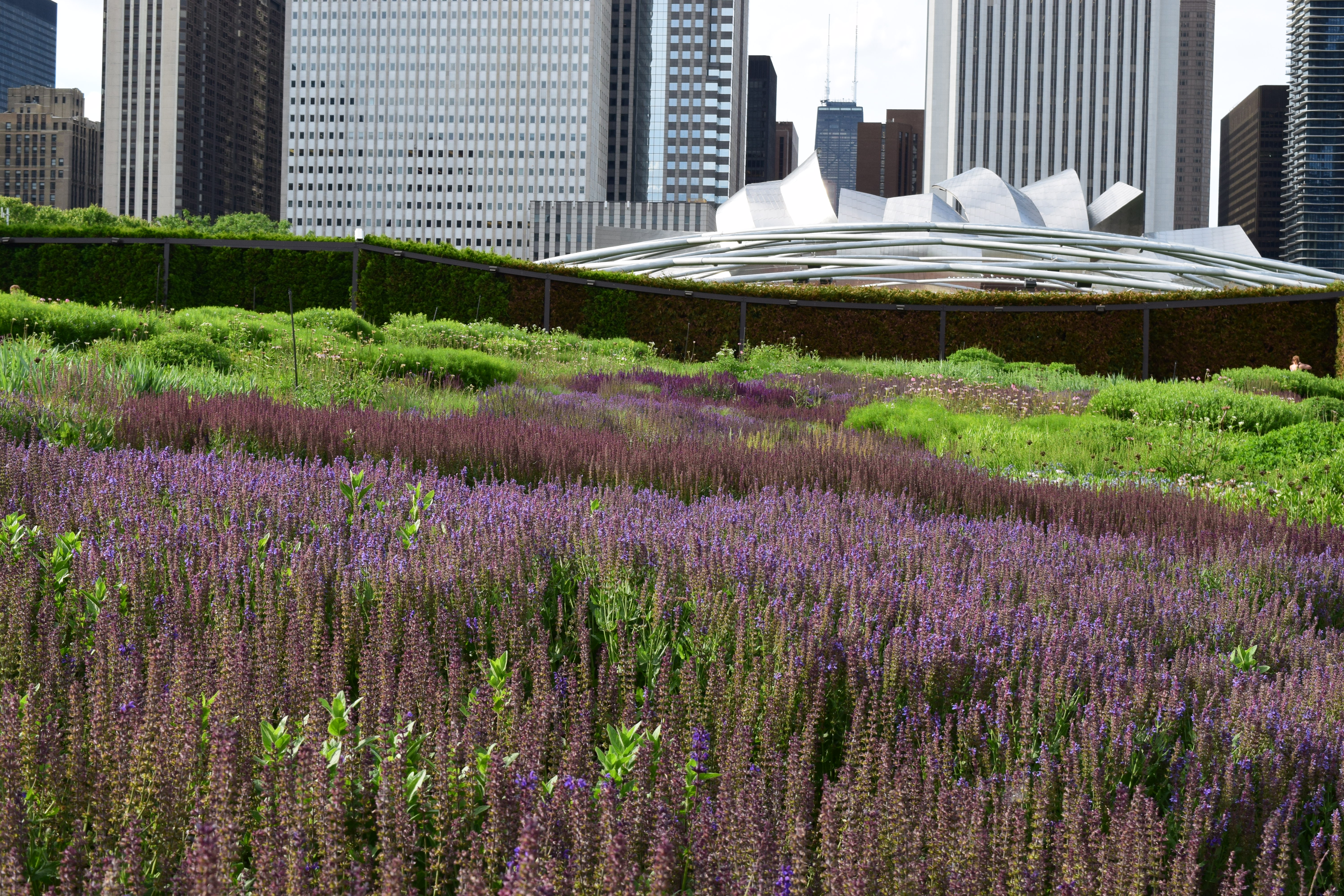
Lurie’s River of Salvia, now starting to turn brown.
I suppose some of you are getting tired of pictures of Lurie Garden’s River of Salvia. Well, too bad. Actually, the River of Salvia is starting to turn brown. Plants at Lurie tend to be a week or so ahead of others in the area, in part because it is on top of a parking garage and the soil warms earlier.
Pale Purple Coneflower
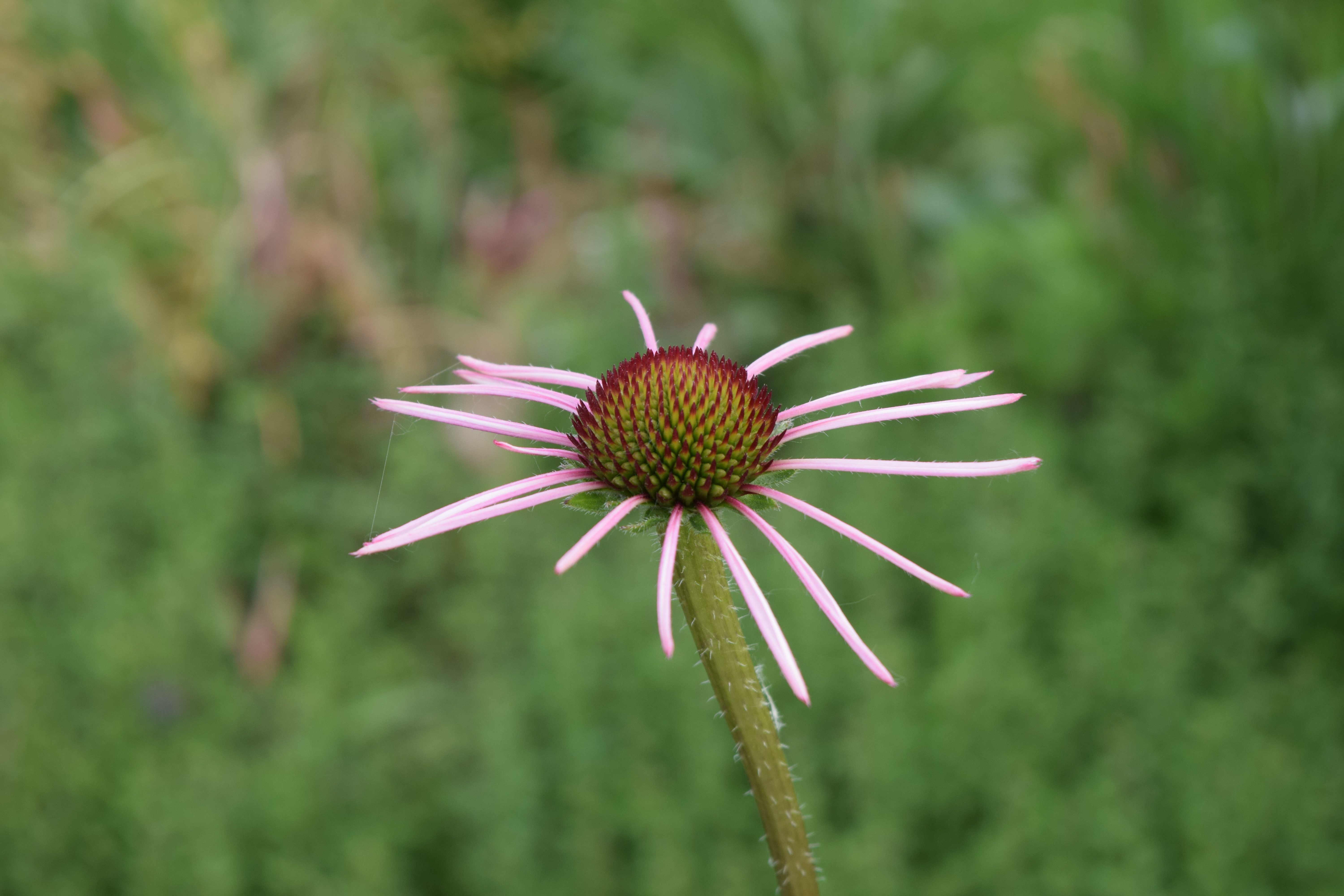
Pale Purple Coneflower opening
The pale purple coneflower (Echinacea palida) was also coming into bloom. I wouldn’t put this plant in my garden, but it’s hard not to like in this setting.
Blue Star still blooming.
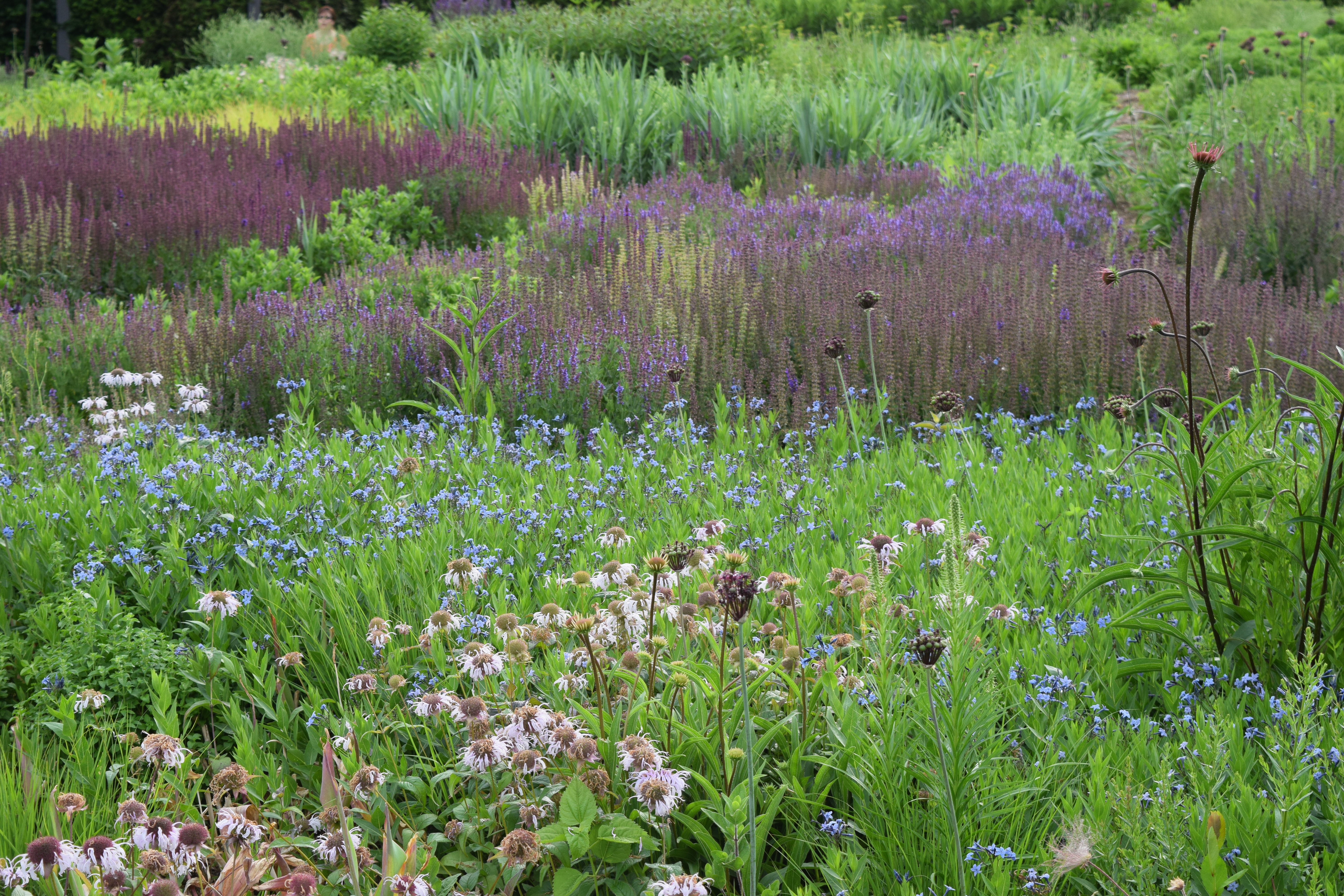
The blue star (Amsonia ‘Blue Ice’) was past its peak, but still had a scattering of flowers among the rising foliage of alliums (I think) and wild petunia (Ruellia humilis).
Prairie Smoke
The prairie smoke (Geum triflorum) hasn’t yet lost that pinkish gauzy effect that is so unusual.
Eastern Bee Balm
What is the usual common name for Monarda bradburiana? I’ve heard it called eastern bee balm, Bradbury’s bee balm, and some other things I can’t recall at the moment.
Visitors cooling their feet.
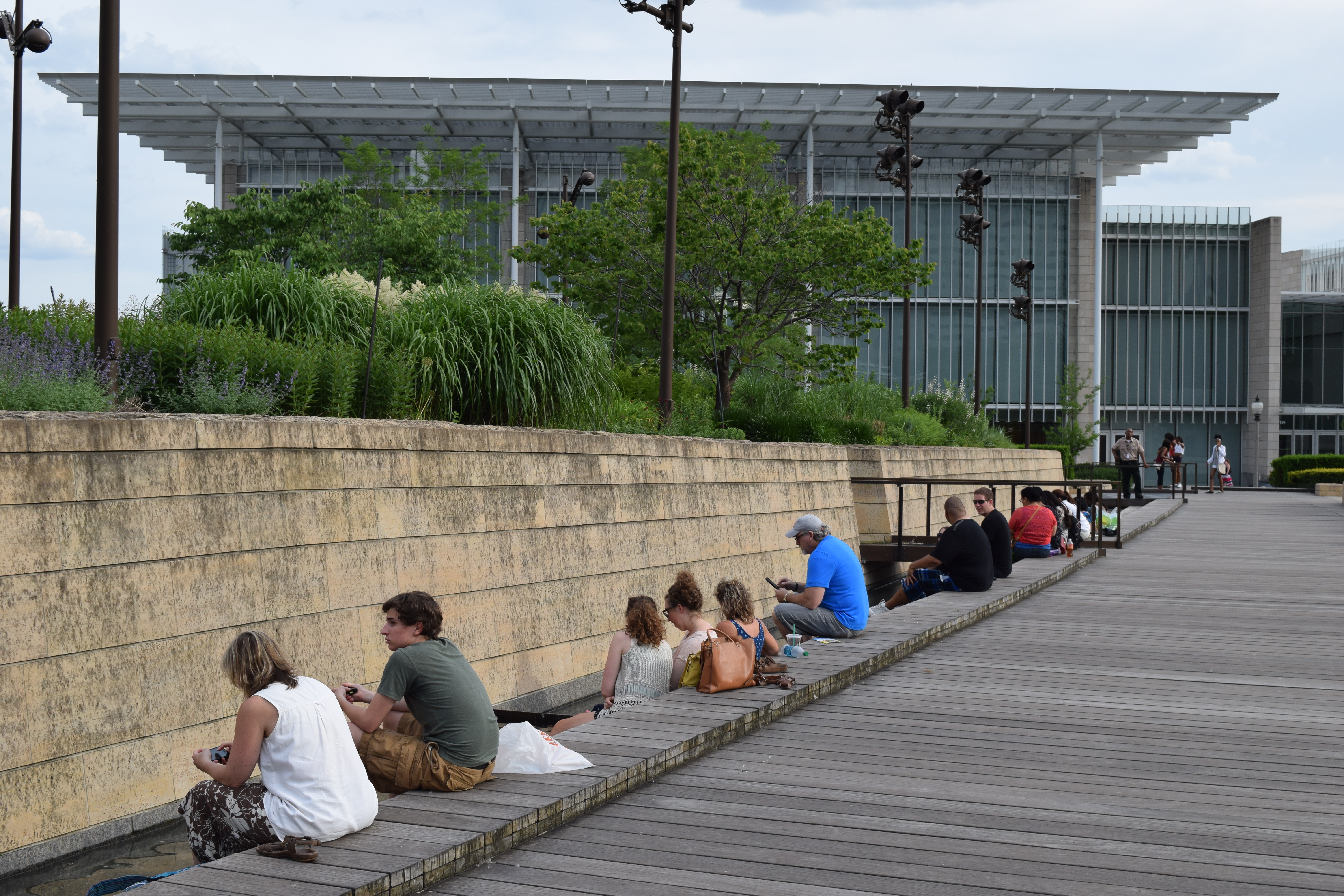
After walking around the Lurie Garden on a warm day it’s nice to take off your shoes and put your feet in the cool water.
Oh, and guess what – the new camera takes video. Judy is trying to get the hang of this feature, and I intend to demand my turn with it also. Here are a couple of her first efforts – one of a Baltimore oriole eating jelly, and one of a house finch and downy woodpecker at the feeders. The woodpecker has a blob of suet stuck on an inconvenient spot on his beak.
Maybe I shouldn’t be so impressed by this, but I am. It’s pretty darn cool, if I say so myself.
This weekend I went to Palmisano Park with Judy and our older son Daniel. Our younger son David is in Minnesota, but he and I had a nice talk on the phone.
Danny and I at Palmisano Park.
Palmisano is an award winning park in the old and very urban neighborhood of Bridgeport (historic home of the Daley clan), south of the Loop. Work on the park began in 2009 on the site of a quarry that for 40 years had been used as a dump for construction debris. Today the park includes prairie and wetland habitats as well as a two acre pond.
We started off with lunch at Pleasant House, about a 10 minute walk from the park, a place that specializes in English-style meat pies. Suitably fortified, we headed out to explore this 27 acre pocket of nature in the city.
Palmisano Park fountain.
You enter from busy Halsted Street, coming to a fountain that recalls the cranes that were used in the old quarry. All the water that falls on Palmisano Park stays in the park, and water circulates from the pond to the fountain and back.
View of the pond.
The walk to the pond is a steady descent. Overall, I thought the restored habitats seemed remarkably lush and full given that they had not been planted until 2011.
Smooth Penstemon
Penstemon, unknown species
Along the way, we got to see some wildflowers. Right now is not when the prairie is at its most colorful, but we got to see both smooth Penstemon (Penstemon digitalis), and a blue variety I didn’t recognize.
Coreopsis with Penstemon.
There was also Coreopsis (I think it was C. lanceolata, but I couldn’t get close enough to tell).
Daisy Fleabane
Daisy fleabane was blooming (Erigeron strigosus).
Purple Prairie Clover, without the tutus.
Also, purple prairie clover (Dalea purpurea) was in evidence, although the flowers didn’t yet have the blooms that remind me of purple tutus.
As we descended, we got to watch shallow waters flowing and trickling downhill, occasionally channeled into little waterfalls. Much of the construction was done with slabs of repurposed concrete.
Blue Flag Iris
As we transitioned into the wetlands, we saw some blue flag iris (Iris versicolor).
Arrowhead
Unknown wetland grass.
There was also common arrowhead (Sagittaria latifolia) and a wetland grass unknown to me but interesting-looking nonetheless.
I enjoyed seeing the sun reflect off the flowing water as we got closer to the pond.
Fishing in the quarry pond.
Palmisano Park was designed with the environment in mind, but it is very people-friendly. There were joggers, walkers, and kite flyers. Once we got down to the pond we found several families on fishing expeditions. I don’t know if they caught anything, but the state Department of Natural Resources keeps the pond stocked with fish.
Playing in the water.
We also saw a father supervising his kids as they played in the shallow water. I’m not sure why, but there is something about moving water that is magical for children, and ideally all should have the opportunity to play in a quiet stream.
Bridgeport Coffee Company
After we were done walking, we retired to Bridgeport Coffee (at 31st and Morgan) where we had a long relaxing talk over some excellent iced coffee. If you find yourself in the Bridgeport neighborhood, this place is definitely worth visiting. Great coffee, pleasant and informal atmosphere, and good service. Oh, and they also have locations in Hyde Park and in the South Loop on Roosevelt Road.OK, full disclosure: the brother of a good friend of mine is a part owner. However, I didn’t learn this until after I had been there, and I had already decided that I really liked it.
I hope to get back to Palmisano Park later in the summer when more of the prairie flowers are in bloom and the grasses have reached their full height. And, of course, visit Pleasant House and the Bridgeport Coffee Company.
Did you do anything special for Father’s Day weekend?